

Unified theory of Alzheimer’s disease (UTAD): implications for prevention and curative therapy
Open accessThe DOI matches its Crossref record; 644 of the 644 references it cites were found in a registry or an index.
Abstract
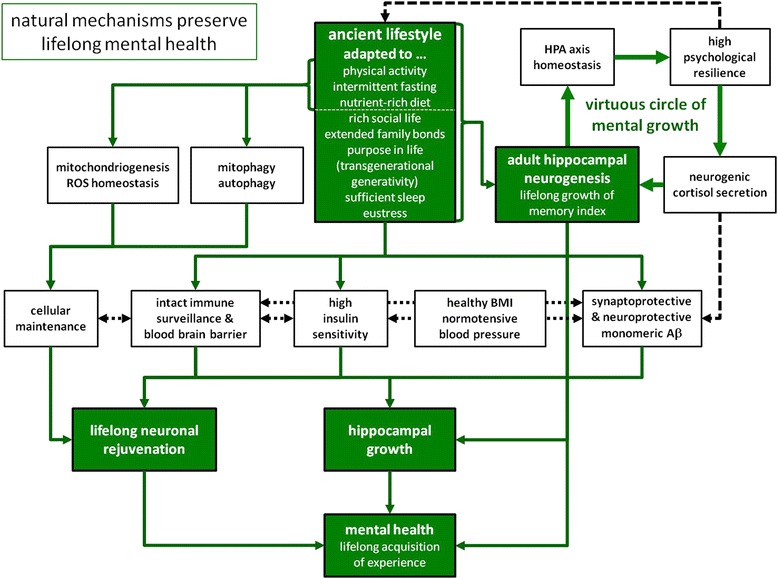
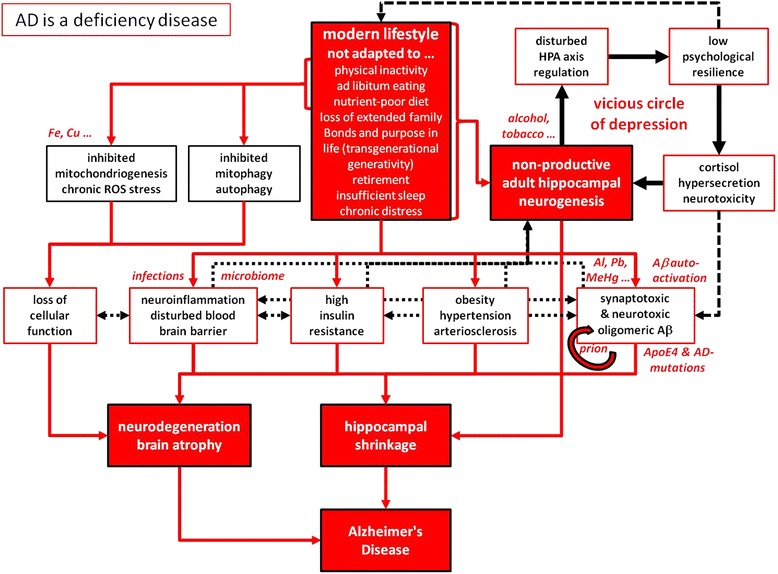
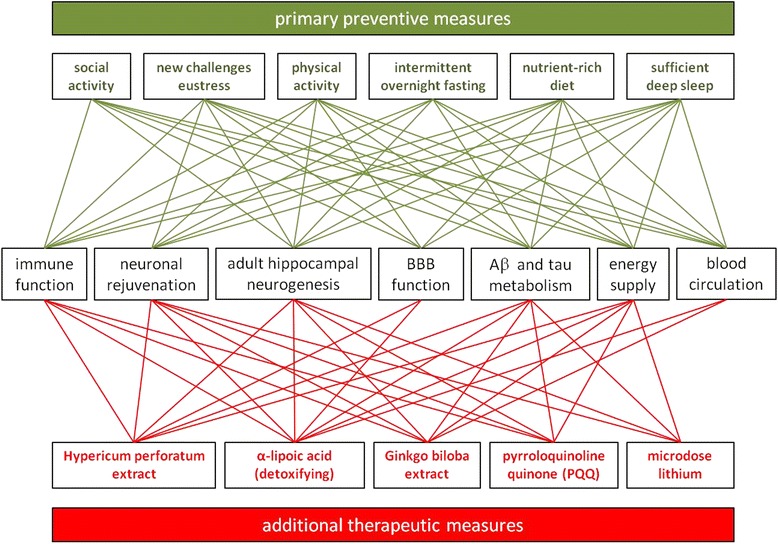
The aim of this review is to propose a Unified Theory of Alzheimer's disease (UTAD) that integrates all key behavioural, genetic and environmental risk factors in a causal chain of etiological and pathogenetic events. It is based on three concepts that emanate from human's evolutionary history: (1) The grandmother-hypothesis (GMH), which explains human longevity due to an evolutionary advantage in reproduction by trans-generational transfer of acquired knowledge. Consequently it is argued that mental health at old-age must be the default pathway of humans' genetic program and not development of AD. (2) Therefore, mechanism like neuronal rejuvenation (NRJ) and adult hippocampal neurogenesis (AHN) that still function efficiently even at old age provide the required lifelong ability to memorize personal experiences important for survival. Cumulative evidence from a multitude of experimental and epidemiological studies indicate that behavioural and environmental risk factors, which impair productive AHN, result in reduced episodic memory performance and in reduced psychological resilience. This leads to avoidance of novelty, dysregulation of the hypothalamic-pituitary-adrenal (HPA)-axis and cortisol hypersecretion, which drives key pathogenic mechanisms of AD like the accumulation and oligomerization of synaptotoxic amyloid beta, chronic neuroinflammation and neuronal insulin resistance. (3) By applying to AHN the law of the minimum (LOM), which defines the basic requirements of biological growth processes, the UTAD explains why and how different lifestyle deficiencies initiate the AD process by impairing AHN and causing dysregulation of the HPA-axis, and how environmental and genetic risk factors such as toxins or ApoE4, respectively, turn into disease accelerators under these unnatural conditions. Consequently, the UTAD provides a rational strategy for the prevention of mental decline and a system-biological approach for the causal treatment of AD, which might even be curative if the systemic intervention is initiated early enough in the disease process. Hence an individualized system-biological treatment of patients with early AD is proposed as a test for the validity of UTAD and outlined in this review.
Overview
The claims and statistics of this paper haven’t been checked yet.
Free: it reads the open-access text and checks the first 5 claims that cite a source we can check. Create a free account to check every claim.
Integrity signals
Registry
Cites
Statistics
Figures
Verification
Claims the paper makes
The claims and statistics of this paper haven’t been checked yet.
Free: it reads the open-access text and checks the first 5 claims that cite a source we can check. Create a free account to check every claim.
Claims other papers make about this one
Each is checked against this paper’s own text: does it say what the citing paper says it does?
The source backs part of the claim, not all of it — or backs it for a different population, condition or comparison.
In the citing paper
“Decades of intensive research on a relatively narrow set of pathogenic processes occurring in the brain and body have produced few effective new drugs or other significant advances in the prevention and treatment of Alzheimer’s disease and related dementias (ADRD).1–3”
From Why the cognitive ‘fountain of youth’ may be upstream: pathways to dementia risk and resilience through social connectedness (2022) · cites this paper as [2]
Experimental — accuracy not yet measuredIn the citing paper
“Neurologists have argued that any successful intervention for ADRD must target multiple pathophysiological processes simultaneously.2”
From Why the cognitive ‘fountain of youth’ may be upstream: pathways to dementia risk and resilience through social connectedness (2022) · cites this paper as [2]
Self-check
Percentages, sums and reported differences re-computed from the paper’s own numbers.
The self-check needs the paper’s full text.
Citations
Cites
4 retracted
Items 601–644 of 644
Effects of Oral Supplementation with Pyrroloquinoline Quinone on Stress, Fatigue, and Sleep
Nakano, M., Yamamoto, T., Okamura, H., Tsuda, A., & Kowatari, Y. (2012) · Functional Foods in Health and Disease · doi:10.31989/ffhd.v2i8.81 · Cited by 33 · cited 1×
“tension-anxiety, depression, anger-hostility and confusion, as well as those for quality of life, appetite, sleep, obsession and pain [617].”
BackgroundUnconventional Neurogenic Niches and Neurogenesis Modulation by Vitamins
Nualart, F. (2014) · Journal of Stem Cell Research & Therapy · doi:10.4172/2157-7633.1000184 · Cited by 33 · cited 1×
“sive review see [320]), D (see below and [321]), and the”
BackgroundLipoic acid and acetyl-carnitine reverse iron-induced oxidative stress in human fibroblasts
Lal, A., Atamna, W., Killilea, D. W., Suh, J. H., & Ames, B. N. (2008) · Redox Report · doi:10.1179/135100008x259150 · Cited by 32
Reconsidering hippocampal neurogenesis in Alzheimer's disease
Martínez-Canabal, A. (2014) · Frontiers in Neuroscience · doi:10.3389/fnins.2014.00147 · Cited by 32 · cited 1×
“Interestingly, some argue that this observed upregulation in ADbrains is evidence against the assumption that diseaserelated loss of AHN might be a key causal contributor to cognitive impairment in AD [622].”
BackgroundEcto-protein kinases and phosphatases: an emerging field for translational medicine
Yalak, G., Ehrlich, Y. H., & Olsen, B. R. (2014) · Journal of Translational Medicine · doi:10.1186/1479-5876-12-165 · Cited by 32 · cited 1×
“Furthermore, extracellular matrix (ECM) ecto-protein kinases and phosphatases [486] were found to enhance the aggregation and toxicity of the Aβ-species [487].”
BackgroundWang, Z., Peng, W., Zhang, C., Sheng, C., Huang, W., Wang, Y., & Fan, R. (2015) · Scientific Reports · doi:10.1038/srep12134 · Cited by 32 · cited 1×
“The optimism generated a flurry of studies in which the effects of stem cell transplantation on cognitive decline in animal models of AD were investigated [634].”
BackgroundMa, Q., Ying, M., Sui, X., Zhang, H., Huang, H., Yang, L., Huang, X., Zhuang, Z., Liu, J., & Yang, X. (2014) · Journal of Alzheimer s Disease · doi:10.3233/jad-140216 · Cited by 31 · cited 1×
“And likewise, excessive intake which leads to free copper contributes to neurotoxicity and impaired spatial memory by specific changes in the expression of synaptic proteins and hippocampal signalling pathways, which causes oxidative stress and neuronal apoptosis [535].”
BackgroundMitochondrial effects of Ginkgo biloba extract
Eckert, A. (2012) · International Psychogeriatrics · doi:10.1017/s1041610212000531 · Cited by 31 · cited 1×
“Particularly flavonoids, bilobalide and some of the ginkgolides (B and J) show a high neuroprotective capacity (for review see [596]).”
BackgroundHippocampal developmental vulnerability to methylmercury extends into prepubescence
Obiorah, M., McCandlish, E. F., Buckley, B., & DiCicco-Bloom, E. M. (2015) · Frontiers in Neuroscience · doi:10.3389/fnins.2015.00150 · Cited by 30 · cited 1×
“Similarly, MeHg intake impairs hippocampal development and AHN [527] and is”
BackgroundPerna, L., Mons, U., Rujescu, D., Kliegel, M., & Brenner, H. (2015) · Dementia and Geriatric Cognitive Disorders · doi:10.1159/000440697 · Cited by 28 · cited 1×
“In one study, hypercholesterolemia was associated with cognitive impairment mainly among ApoE4 carriers [56].”
Background(Radio)active Neurogenesis in the Human Hippocampus
Kheirbek, M. A., & Hen, R. (2013) · Cell · doi:10.1016/j.cell.2013.05.033 · Cited by 28 · cited 1×
“As this mechanism provides for a turnover of almost or 2 % of the cells per year in the DG, AHN has the potential to keep this brain region, critical for acquiring novel experiences, young even at old age [159].”
BackgroundBreakfast: To Skip or Not to Skip?
Zilberter, T., & Zilberter, E. Y. (2014) · Frontiers in Public Health · doi:10.3389/fpubh.2014.00059 · Cited by 28
Xu, A., So, K., Yau, S., & Li, A. (2015) · Neural Regeneration Research · doi:10.4103/1673-5374.150637 · Cited by 28
Yamamoto, H., Watanabe, T., Mizuno, H., Endo, K., Fukushige, J., Hosokawa, T., Kazusaka, A., & Fujita, S. (2001) · Free Radical Research · doi:10.1080/10715760100300071 · Cited by 28 · cited 1×
“patients [3] and (3) treatment with free copperlowering ALA [537], as will be discussed in more”
MethodIs lithium potentially a trace element?
Terao, T. (2015) · World Journal of Psychiatry · doi:10.5498/wjp.v5.i1.1 · Cited by 28 · cited 1×
“Lithium is not yet generally recognized as a trace element but several lines of evidence make it a strong candidate [352].”
BackgroundRaddatz, G., & Bisswanger, H. (1997) · Journal of Biotechnology · doi:10.1016/s0168-1656(97)00135-1 · Cited by 27 · cited 1×
“Only the (R)-(+)-enantiomer exists in nature and is superior in its biological activity [564].”
BackgroundLet Food Be Thy Medicine: Diet, Nutrition, and Biomarkers’ Risk of Alzheimer’s Disease
Mosconi, L., & McHugh, P. F. (2015) · Current Nutrition Reports · doi:10.1007/s13668-014-0111-5 · Cited by 27 · cited 2×
“Therefore, management of potential micronutrients deficiencies can only be one, albeit important, aspect of AD prevention and treatment strategies (for review see [313, 330]).”
BackgroundShi, C., Li, F., Yew, D. T. W., Yao, Z., & Xu, J. (2009) · Platelets · doi:10.3109/09537100903395180 · Cited by 27 · cited 1×
“In diet-induced obese rats, (8) EGbs improve insulin signalling, dyslipidemia, and body adiposity, hence support dysfunctional energy metabolism [597]; (9) EGb-761 protected in ovariectomized rats as models of post-menopause against the decrease of cytochrome c oxidase activity, mitochondrial adenosine-5′-triphosphate…”
BackgroundTocopherols Enhance Neurogenesis in Dentate Gyrus of Adult Rats
Cuppini, R., Ciaroni, S., Cecchini, T., Ambrogini, P., Ferri, P., Cuppini, C., Ninfali, P., & Grande, P. D. (2002) · International Journal for Vitamin and Nutrition Research · doi:10.1024/0300-9831.72.3.170 · Cited by 27 · cited 1×
“E tocopherols [322].”
Martinez-Canabal, A., Wheeler, A. L., Sarkis, D., Lerch, J. P., Lu, W.-Y., Buckwalter, M. S., Wyss-Coray, T., Josselyn, S. A., & Frankland, P. W. (2013) · Hippocampus · doi:10.1002/hipo.22159 · Cited by 26 · cited 1×
“sion [630, 631].”
(2011) · Proceedings of the National Academy of Sciences · doi:10.1073/pnas.1119280109 · Cited by 26
Cissé, M., Duplan, E., Guillot-Sestier, M.-V., Rumigny, J., Bauer, C., Pagès, G., Orzechowski, H.-D., Slack, B. E., Checler, F., & Vincent, B. (2011) · Journal of Biological Chemistry · doi:10.1074/jbc.m110.208249 · Cited by 23
Long and medium chain triglycerides increase plasma concentrations of ketone bodies in suckling rats
Yeh, Y., Klein, L. B., & Zee, P. (1978) · Lipids · doi:10.1007/bf02533597 · Cited by 22 · cited 1×
“therefore directly transported via the portal vein to the liver where they are efficiently transformed into ketone bodies [399].”
BackgroundEffects of Fasting on Ketone Body Concentrations in Healthy Men of Different Ages
London, E. D., Margolin, R. A., Duara, R., Holloway, H. W., Robertson-tchabo, E. A., Cutler, N. R., & Rapoport, S. I. (1986) · Journal of Gerontology · doi:10.1093/geronj/41.5.599 · Cited by 22 · cited 40×
“Interestingly and again in line with the GMH, elderly generate ketone bodies at least as efficient as younger adults during IMF [99] and the metabolic response to a ketogenic diet appears also to be unaffected by aging [100].”
BackgroundInfluentialOsman, N. M. S., Amer, A., & Abdelwahab, S. A. (2015) · Anatomical Science International · doi:10.1007/s12565-015-0297-7 · Cited by 21
Elevated Homocysteine by Levodopa Is Detrimental to Neurogenesis in Parkinsonian Model
Shin, J. Y., Ahn, Y. H., Paik, M., Park, H.-J., Sohn, Y. H., & Lee, P. H. (2012) · PLoS ONE · doi:10.1371/journal.pone.0050496 · Cited by 21 · cited 1×
“Furthermore, elevated homocysteine was shown to be detrimental to AHN [326], where it inhibits the proliferation of neuronal precursors by interfering with several signalling pathways required for cell proliferation [327].”
BackgroundZhou, X., Ma, Z., Geng, T., Wang, Z., Ding, G., Yu-an, B., & Xiao, W. (2014) · Journal of Ethnopharmacology · doi:10.1016/j.jep.2014.10.023 · Cited by 20 · cited 1×
“gene [603].”
Breakfast and cognition: sixteen effects in nine populations, no single recipe
Zilberter, T., & Zilberter, E. Y. (2013) · Frontiers in Human Neuroscience · doi:10.3389/fnhum.2013.00631 · Cited by 20 · cited 1×
“The longer the ketosis on a day to day basis the better for health outcome, which even puts into question the widely held belief that breakfast is the most important meal of the day [394].”
BackgroundOral Health in Alzheimers Disease: A Review
Mancini, M., Mancini, M., Grappasonni, I., Scuri, S., & Amenta, F. (2010) · Current Alzheimer Research · doi:10.2174/1567210200438132050 · Cited by 18
&NA; (1906) · The Journal of Nervous and Mental Disease · doi:10.1097/00005053-190611000-00008 · Cited by 18
Soya, H., Okamoto, M., Matsui, T., Lee, M. C., Inoue, K., Nishikawa, S., Soya, S., Fujikawa, T., Chang, H., Nishijima, T., et al. (2011) · Physical Activity and Nutrition · doi:10.5717/jenb.2011.15.1.1 · Cited by 16
Walton, J., Aubrecht, T. G., Weil, Z., Leuner, B., & Nelson, R. (2014) · European Journal of Neuroscience · doi:10.1111/ejn.12626 · Cited by 16 · cited 1×
“This type of research has been extended to mammals, in which it was shown that the hippocampal size for example in kangaroo rats (Dipodomys) tightly depends on their natural space-use pattern [203], or that photoperiodic organisms like white-footed mice (Peromyscus leucopus) monitor environmental day length to engage…”
BackgroundDo Cultural Differences Affect Alzheimer Disease?
Martin, G. M., & Kukull, W. A. (1996) · JAMA · doi:10.1001/jama.1996.03540120071037 · Cited by 15 · cited 1×
“Hence, not ethnical origin, but rather the adopted modern lifestyle has an impact on AD risk [34].”
BackgroundConsumption of fish and Alzheimer's Disease
Hunt, W., & McManus, A. (2011) · The journal of nutrition health & aging · doi:10.1007/s12603-011-0065-x · Cited by 13 · cited 1×
“While a lack of essential n-3 PUFA is causing neuroinflammation and a disturbed AHN (wherefore supplements containing EPA and DHA were shown to have a positive effect on primary depression [306]), there is also substantial convergence of research findings to date indicating that seafood consumption reduces the risk of…”
ResultInfluence of age on androgen deprivation therapy-associated Alzheimer’s disease
Nead, K. T., Gaskin, G., Chester, C., Swisher-McClure, S. D., Dudley, J. T., Leeper, N. J., & Shah, N. H. (2016) · Scientific Reports · doi:10.1038/srep35695 · Cited by 13
Paz, M. A., Flückiger, R., Torrelio, B. M., & Gallop, P. M. (1989) · Connective Tissue Research · doi:10.3109/03008208909023895 · Cited by 12 · cited 1×
“Due to its nutritional importance, its inherent free-radical scavenging and redox modulator properties, and its coenzyme function in mammalian tissue [609], PQQ was proposed as a potential new B-vitamin [610].”
BackgroundSuter, A., Niemer, W., & Klopp, R. C. (2011) · Advances in Therapy · doi:10.1007/s12325-011-0083-4 · Cited by 11 · cited 1×
“improve the radical scavenging capacity even in elderly patients is of great therapeutic utility in AD [589].”
BackgroundShichiri, M., Adkins, Y. C., Ishida, N., Umeno, A., Shigeri, Y., Yoshida, Y., Fedor, D. M., Mackey, B. E., & Kelley, D. S. (2014) · Journal of Clinical Biochemistry and Nutrition · doi:10.3164/jcbn.14-22 · Cited by 10 · cited 1×
“This development is unfortunate, since high concentrations of DHA would inhibit lipid peroxidation [291], and, together with EPA, would reduce brain inflammation and cognitive impairment [292].”
BackgroundSt. John’s Wort Has Metabolically Favorable Effects on Adipocytes In Vivo
Fuller, S. E., Richard, A. J., Ribnicky, D., Beyl, R. A., Mynatt, R. L., & Stephens, J. M. (2014) · Evidence-based Complementary and Alternative Medicine · doi:10.1155/2014/862575 · Cited by 10 · cited 1×
“[561].”
Memory and hippocampal architecture following short-term midazolam in western diet-treated rats
Rosenberger, D. S., Falangola, M. F., Ledreux, A., Nie, X., Suhre, W. M., Boger, H. A., & Granholm, A. (2016) · Neuroscience Letters · doi:10.1016/j.neulet.2016.04.021 · Cited by 7 · cited 1×
“A recent study provided evidence that memory and hippocampal architecture of WeDi-treated rats was particularly vulnerable to short-term treatment with the benzodiazepine midazolam [542].”
BackgroundCan Alzheimer's disease be prevented?
Murray (2013) · Intractable & Rare Diseases Research · doi:10.5582/irdr.2013.v2.4.136 · Cited by 3 · cited 1×
“Meanwhile, more and more experts in the field demand pleiotropic interventions to prevent or even cure AD [636, 637].”
BackgroundSoya, H., Okamoto, M., Matsui, T., Lee, M. C., Inoue, K., Nishikawa, S., Soya, S., Fujikawa, T., Rakwal, R., Chang, H. K., et al. (2011) · Cited by 2
Morley (2010) · doi:10.3233/jad-2009-1230 · cited 1×
“synapses, where Aβ plays an important role in learning memory formation [111].”
BackgroundLaffel (1999) · doi:10.1002/(sici)1520-7560(199911/12)15:6<412::aid-dmrr72>3.0.co;2-8 · cited 1×
“These two respiratory fuels can endogenously be produced by the liver in large quantities (up to 150 g/day) from mobilized fatty acids in a variety of physiological [92] or pathological conditions [93].”
Background
Research works printed but not linked: 5
- Boyd W A textbook of pathology: an introduction to medicine, Lea and febiger 1938
- Sprengel PC Von der Substanz der Ackerkrume und des Untergrundes 1828 Leipzig Journal für Technische und Ökonomische Chemie
- Jørgensen JR Fjord-Larsen L Wahlberg LU Andrade NGM Johansen TE Therapeutic use of a growth factor METRNL. US-patent 2012 8334264 B2
- Miklossy J.J. Neuroinflammation. Alzheimer’s disease - a neurospirochetosis. Analysis of the evidence following Koch’s and Hill’s criteria. 2011;8:90. doi: 10.1186/1742-2094-8-90. PMC3171359 21816039 · DOI · Paper page
- Nakano M Effect of pyrroloquinoline quinone (PQQ) on mental status of middle-aged and elderly persons Food Style 2009 13 50 53
Cited by
Alzheimer’s Disease: An Updated Overview of Its Genetics
Andrade-Guerrero, J., Santiago-Balmaseda, A., Jeronimo-Aguilar, P., Vargas-Rodríguez, I., Cadena-Suárez, A. R., Sánchez-Garibay, C., Pozo-Molina, G., Méndez-Catalá, C. F., Cardenas-Aguayo, M.-D.-C., Diaz-Cintra, S., et al. (2023) · International Journal of Molecular Sciences · doi:10.3390/ijms24043754 · Cited by 336
Advancements in nanotherapeutics for Alzheimer’s disease: current perspectives
Harilal, S., Jose, J., Parambi, D. G. T., Kumar, R., Mathew, G. E., Uddin, M. S., Kim, H., & Mathew, B. (2019) · Journal of Pharmacy and Pharmacology · doi:10.1111/jphp.13132 · Cited by 154
Neuroinflammation—A Crucial Factor in the Pathophysiology of Depression—A Comprehensive Review
Sălcudean, A., Bodo, C.-R., Popovici, R. A., Lica, M. M., Păcurar, M., Crăciun, R.-E., Crișan, A., ENĂTESCU, V. R., Marinescu, I. P., Cîmpian, D. M., et al. (2025) · Biomolecules · doi:10.3390/biom15040502 · Cited by 202
“Elevated cortisol levels have been linked to increased neuroin fl ammation in conditions such as Alzheimer’s disease, in which in fl ammation is considered a feature of the disease process [312].”
The Immunopathogenesis of Alzheimer’s Disease Is Related to the Composition of Gut Microbiota
Leblhuber, F., Ehrlich, D., Steiner, K., Geisler, S., Fuchs, D., Lanser, L., & Kurz, K. (2021) · Nutrients · doi:10.3390/nu13020361 · Cited by 159
Nanomedicine: A Promising Way to Manage Alzheimer’s Disease
Khan, N. H., Mir, M., Ngowi, E. E., Zafar, U., Khakwani, M. M. A. K., Khattak, S., Zhai, Y., Jiang, E., Zheng, M., Duan, S., et al. (2021) · Frontiers in Bioengineering and Biotechnology · doi:10.3389/fbioe.2021.630055 · Cited by 88
“Although the mechanisms of this association are complex, it is considered that hypertension can influence AD through the association of cerebrovascular pathology (Diaz-Ruiz et al., 2009; Nehls, 2016).”
Background
Metadata
- Authors
- Nehls, M.
- Corresponding author
- Nehls, Michael
- ORCID
- Nehls, Michael
- Venue
- Journal of Molecular Psychiatry
- Published
- 2016-07-15
- Volume
- 4
- Issue
- 1
- Pages
- 3-3
- ISSN
- 2049-9256 (ISSN-L)
- PMC
- PMC4947325
- OpenAlex
- W2463416598
- Cited by
- 41
- References
- 644
- Citations by year
- 2025: 3 · 2024: 4 · 2023: 3 · 2022: 4 · 2021: 8 · 2020: 5 · 2019: 4 · 2018: 4 · 2017: 4 · 2016: 1
- FWCI
- 0.51
- Type
- journal article
- Language
- en
- Open access
- hybrid
- doi.org
- Licence
- cc-by
- Locations
- Journal of Molecular Psychiatry (publishedVersion, cc-by)
- Europe PMC (PubMed Central) (publishedVersion, cc-by)
- PubMed Central (publishedVersion, cc-by)
- PubMed (publishedVersion)
- Funders
- Not applicable (Not applicable, independent researcher)
- Topics
- Life Sciences › Neuroscience › Cellular and Molecular Neuroscience › Alzheimer's disease research and treatments
- Health Sciences › Medicine › Psychiatry and Mental health › Dementia and Cognitive Impairment Research
- Life Sciences › Neuroscience › Developmental Neuroscience › Neurogenesis and neuroplasticity mechanisms
- Keywords
- Alzheimer's disease, grandmother hypothesis, adult hippocampal neurogenesis, HPA axis dysregulation, cortisol hypersecretion, amyloid-beta oligomerization, neuroinflammation, insulin resistance, APOE ε4, law of the minimum, behavioral risk factors, environmental risk factors, episodic memory, psychological resilience, early intervention, curative treatment
About these checks
Registry, retraction, Cites and statistics results are computed, not judged, with one exception: a printed reference that no index lists is read once by a model before it counts as a citation error. Claims are extracted by a model and kept only when their quote appears verbatim in the text; each cited source is then checked, with a model’s help, for whether it says what the claim relies on. Those verdicts can be wrong — read the claim’s quote and the cited source before relying on one.
Statistics and arithmetic are recomputed, not judged.
Confidence bands are shown only for fields calibrated on our annotated test set. None is calibrated yet, so no band is shown.
What counts as a claim ›How we measure confidence ›How we check this ›
Are you an author, or do you see a problem with this page? Request a review
Data sources
Bibliographic data: Semantic Scholar, OpenAlex, Crossref.
Contains information from the Semantic Scholar Academic Graph Datasets, made available under the ODC Attribution License (ODC-BY 1.0).
Semantic Scholar’s data is described in: Kinney, R., et al. (2023). The Semantic Scholar Open Data Platform. arXiv:2301.10140.
