

Developmental trajectories of eating disorder symptoms: A longitudinal study from early adolescence to young adulthood
Open accessThe DOI matches its Crossref record; 50 of the 50 references it cites were found in a registry or an index.
Abstract
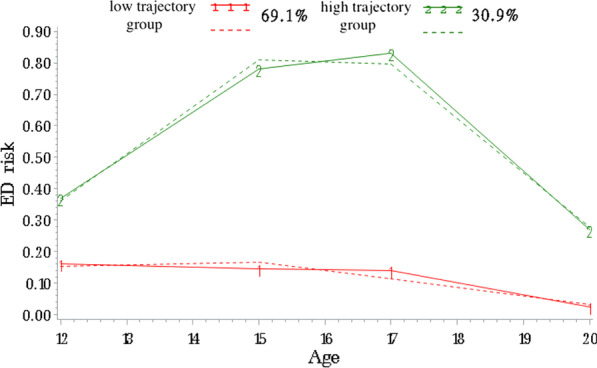
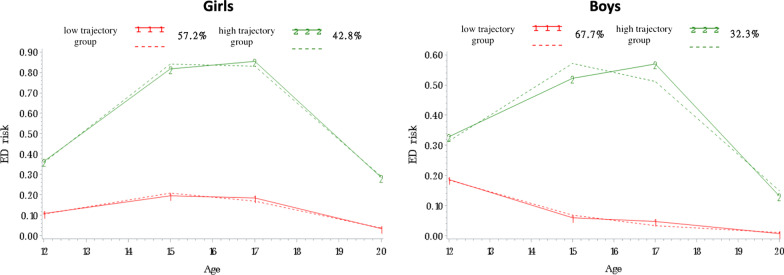
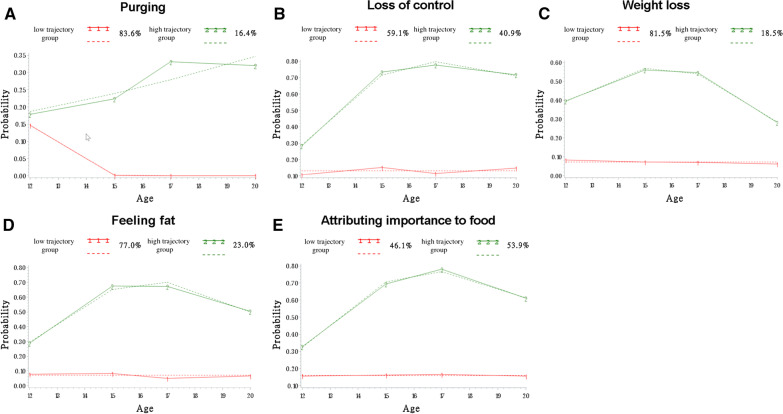
Background: Adolescence is a critical period for the development of eating disorders, but data is lacking on the heterogeneity of their evolution during that time-period. Group-based trajectories can be used to understand how eating disorders emerge and evolve over time. The aim of this study was to identify groups of individuals with distinct levels of eating disorder symptoms between 12 and 20 years and the onset of different types of symptoms. We also studied sex differences in the evolution and course of eating disorder symptoms from early adolescence to adulthood. Methods: Using archival data from the QLSCD cohort, trajectories of eating disorder symptomatology were estimated from ages 12 to 20 years using semiparametric models. These trajectories included overall eating disorder symptomatology as measured by the SCOFF (Sick, Control, One Stone, Fat, Food), sex, and symptom-specific trajectories. Results: Two groups of adolescents following distinct trajectories of eating disorder symptoms were identified. The first trajectory group included 30.9% of youth with sharply rising levels between 12 and 15 years, followed by high levels of symptoms between 15 and 20 years. The second trajectory group included 69.1% of youth with low and stable levels of symptoms between 12 and 20 years. Sex-specific models indicated that the proportion of girls in the high trajectory group was 1.3 times higher than the proportion of boys (42.8% girls vs. 32.3% boys). Trajectories of SCOFF items were similar for loss-of-control eating, feeling overweight, and attributing importance to food. The weight loss item had a different developmental pattern, increasing between 12 and 15 years and then decreasing between 17 and 20 years. Conclusions: The largest increase in eating disorder symptoms in adolescence is between the ages of 12 and 15 . Yet, most prevention programs start after 15 years of age. Our findings suggest that, unlike common practices, eating disorder prevention programs should aim to start before puberty.
Overview
The claims and statistics of this paper haven’t been checked yet.
Free: it reads the open-access text and checks the first 5 claims that cite a source we can check. Create a free account to check every claim.
Integrity signals
Registry
Cites
Statistics
Figures
Verification
Claims the paper makes
The claims and statistics of this paper haven’t been checked yet.
Free: it reads the open-access text and checks the first 5 claims that cite a source we can check. Create a free account to check every claim.
Claims other papers make about this one
Each is checked against this paper’s own text: does it say what the citing paper says it does?
The cited source says what the claim attributes to it.
In the citing paper
“We used group-based trajectories previously calculated (Breton et al., 2022).”
From Pathways of association between disordered eating in adolescence and mental health outcomes in young adulthood during the COVID-19 pandemic (2023) · cites this paper as Breton et al., 2022
The cited source says what the claim attributes to it.
In the citing paper
“Note that the average number of disordered eating symptoms was higher among females than among males (Breton et al., 2022).”
From Pathways of association between disordered eating in adolescence and mental health outcomes in young adulthood during the COVID-19 pandemic (2023) · cites this paper as Breton et al., 2022
Self-check
Percentages, sums and reported differences re-computed from the paper’s own numbers.
The self-check needs the paper’s full text.
Citations
Cites
Diagnostic and Statistical Manual of Mental Disorders
American Psychiatric Association (2013) · doi:10.1176/appi.books.9780890425596 · Cited by 116,369
Group-Based Trajectory Modeling in Clinical Research
Nagin, D. S., & Odgers, C. L. (2010) · Annual Review of Clinical Psychology · doi:10.1146/annurev.clinpsy.121208.131413 · Cited by 2,708
Analyzing developmental trajectories: A semiparametric, group-based approach.
Nagin, D. S. (1999) · Psychological Methods · doi:10.1037/1082-989x.4.2.139 · Cited by 2,346 · cited 3×
“Proc Traj provides an estimate of the proportions of individuals in the study population following each trajectory group, as well as the probabilities that each individual has to belong to the different trajectory groups [30].”
BackgroundMethodInfluentialSwanson, S. A., Crow, S. J., Le Grange, D., Swendsen, J., & Merikangas, K. R. (2011) · Archives of General Psychiatry · doi:10.1001/archgenpsychiatry.2011.22 · Cited by 1,611
Analyzing developmental trajectories of distinct but related behaviors: A group-based method.
Nagin, D. S., & Tremblay, R. E. (2001) · Psychological Methods · doi:10.1037//1082-989x.6.1.18 · Cited by 1,280
Self-citationTreasure, J., Duarte, T. A., & Schmidt, U. (2020) · The Lancet · doi:10.1016/s0140-6736(20)30059-3 · Cited by 1,026
Udo, T., & Grilo, C. M. (2018) · Biological Psychiatry · doi:10.1016/j.biopsych.2018.03.014 · Cited by 799 · cited 1×
“Additionally, some studies have shown that bingeing and purging-type symptoms (such as those present in BED and BN) appear later than restrictive symptoms (such as those present in AN) [17, 18].”
BackgroundThe GRoLTS-Checklist: Guidelines for Reporting on Latent Trajectory Studies
van de Schoot, R., Sijbrandij, M., Winter, S. D., Depaoli, S., & Vermunt, J. K. (2017) · Structural Equation Modeling: A Multidisciplinary Journal · doi:10.1080/10705511.2016.1247646 · Cited by 721
The enigma of male eating disorders: A critical review and synthesis
Murray, S. B., Nagata, J. M., Griffiths, S., Calzo, J. P., Brown, T. A., Mitchison, D., Blashill, A. J., & Mond, J. M. (2017) · Clinical Psychology Review · doi:10.1016/j.cpr.2017.08.001 · Cited by 702 · cited 1×
“On the other hand, in community samples, women are approximately four times more likely to have Anorexia Nervosa (AN) and Bulimia Nervosa (BN) than men, with this number increasing to ten times more likely in clinical settings [11].”
BackgroundNguena Nguefack, H. L., Pagé, M. G., Katz, J., Choinière, M., Vanasse, A., Dorais, M., Samb, O. M., & Lacasse, A. (2020) · Clinical Epidemiology · doi:10.2147/clep.s265287 · Cited by 527
Cited by
López-Gil, J. F., García-Hermoso, A., Smith, L., Firth, J., Trott, M., Mesas, A. E., Jiménez-López, E., Gutiérrez-Espinoza, H., Tárraga-López, P. J., & Victoria-Montesinos, D. (2023) · JAMA Pediatrics · doi:10.1001/jamapediatrics.2022.5848 · Cited by 276
Ghazzawi, H. A., Nimer, L. S., Haddad, A. J., Alhaj, O. A., Amawi, A. T., Pandi-Perumal, S. R., Trabelsi, K., Seeman, M. V., & Jahrami, H. (2024) · Journal of Eating Disorders · doi:10.1186/s40337-024-00982-5 · Cited by 64
The healthy eating movement on social media and its psychological effects on body image
Zaharia, A., & Gonța, I. (2024) · Frontiers in Nutrition · doi:10.3389/fnut.2024.1474729 · Cited by 46
Ghazzawi, H., Nimer, L. S., Sweidan, D. H., Alhaj, O. A., Lawi, D. A., Amawi, A. T., Levine, M. P., & Jahrami, H. (2023) · Journal of Eating Disorders · doi:10.1186/s40337-023-00849-1 · Cited by 43
“However, another possibility with important implications for prevention emerges from a recent longitudinal study conducted in Canada [89], which identified a distinct trajectory, present in slightly less than one third of youth, defined by a sharp increase in disordered eating between ages 12 and…”
BackgroundShifting age of child eating disorder hospitalizations during the Covid‐19 pandemic
Auger, N., Steiger, H., Luu, T. M., Chadi, N., Low, N. C. P., Bilodeau‐Bertrand, M., Healy‐Profitós, J., Ayoub, A., Brousseau, É., & Israël, M. (2023) · Journal of Child Psychology and Psychiatry · doi:10.1111/jcpp.13800 · Cited by 26
The bidirectional associations between self‐esteem and problematic eating behaviors in adolescents
Beckers, D., Burk, W. J., Larsen, J. K., & Cillessen, A. H. N. (2023) · International Journal of Eating Disorders · doi:10.1002/eat.24083 · Cited by 21
Ryan, L., Quigley, F., Birney, S., Crotty, M., Conlan, O., & Walsh, J. C. (2024) · Health Expectations · doi:10.1111/hex.14098 · Cited by 31
“Like obesity, development of eating disorders has a complex aetiology but onset in late childhood/early adolescence is not uncommon [43, 44].”
BackgroundCyberbullying and eating disorder symptoms in US early adolescents
Cheng, C. M., Chu, J., Ganson, K. T., Trompeter, N., Testa, A. M., Jackson, D. B., He, J., Glidden, D. V., Baker, F. C., & Nagata, J. M. (2023) · International Journal of Eating Disorders · doi:10.1002/eat.24034 · Cited by 23
“Yet, previous research has shown that the largest increase in eating disorder symptoms starts in early adolescence (Breton et al., 2022).”
Paraskeva, N., Haywood, S., Hasan, F., Nicholls, D., Toledano, M. B., & Diedrichs, P. C. (2024) · Body Image · doi:10.1016/j.bodyim.2024.101753 · Cited by 27
Krug, I., Dang, A. B., Portingale, J., Li, Y., & Won, Y. Q. (2025) · Nutrients · doi:10.3390/nu17233735 · Cited by 23
“At the same time, adolescence is also the peak risk period for EDs, disordered eating, and body image problems [123].”
Muscle dysmorphia in adolescents and young adults
Nagata, J. M., Hur, J. O., Murakami, K., Ganson, K. T., He, J., Murray, S. B., & Lavender, J. M. (2025) · The Lancet Child & Adolescent Health · doi:10.1016/s2352-4642(25)00283-4 · Cited by 20
Zhang, Z., Robinson, L., Whelan, R., Jollans, L., Wang, Z., Nees, F., Chu, C., Bobou, M., Du, D., Cristea, I., et al. (2024) · Journal of Affective Disorders · doi:10.1016/j.jad.2024.12.053 · Cited by 22
“This calls for early, pre-pubertal interventions in high-risk groups, such as girls with higher BMI, to prevent disease onset (Breton et al., 2022).”
Associations of adverse childhood events with disordered eating behaviors among US adolescents
Ghaffari, A., Graves, K. Y., Hogans-Mathews, S., Flowers, K., & Harman, J. S. (2024) · Eating Behaviors · doi:10.1016/j.eatbeh.2024.101929 · Cited by 16
Basch, M. C., Lupini, F., Ho, S., Dagnachew, M., Gutierrez‐Colina, A. M., Kelly, K. P., Shomaker, L. B., Streisand, R. M., Vagadori, J., & Mackey, E. R. (2024) · Journal of Pediatric Psychology · doi:10.1093/jpepsy/jsae071 · Cited by 18
Weng, H., Barnhart, W. R., Zickgraf, H. F., Dixit, U., Cheng, Y., Chen, G., & He, J. (2024) · Appetite · doi:10.1016/j.appet.2024.107728 · Cited by 14
Kenđel Jovanović, G., & Čulina, T. (2024) · Frontiers in Nutrition · doi:10.3389/fnut.2024.1398464 · Cited by 8
Meshkova, T. A., Mitina, O. V., & Aleksandrova, R. V. (2023) · Consortium Psychiatricum · doi:10.17816/cp6132 · Cited by 9
“What we know about the trajectory of ED symptomatology development from early adolescence to adulthood allows us to conclude that ED prevention should start before puberty [27].”
Breton, É., Côté, S. M., Dubois, L., Vitaro, F., Boivin, M., Tremblay, R. E., & Booij, L. (2023) · Journal of Youth and Adolescence · doi:10.1007/s10964-023-01796-5 · Cited by 9
“Modelling trajectories for boys only again identified two eating-disorder trajectory groups associated with low (1) and high (2) symptom levels throughout adolescence, to which 67.7 and 32.3% of boys were assigned, respectively (Breton et al., 2022).”
BackgroundMethodInfluentialSelf-citationChen, J., Liu, K., Zhang, J., Liu, S., Wang, Y., Cao, R., Peng, X., Han, M., Han, H., Yao, R., et al. (2023) · Psychology Research and Behavior Management · doi:10.2147/prbm.s418535 · Cited by 7
“A longitudinal study showed that the symptoms of EDs were most common between the ages of 12 and 15 years.(2) The excessive expectation of weight loss, unhealthy weight control behaviors, and body image dissatisfaction are major risk factors for EDs.”
BackgroundLoose, T., Geoffroy, M. C., Orri, M., Chadi, N., Scardera, S., Booij, L., Breton, E., Tremblay, R., Boivin, M., & Coté, S. (2023) · Canadian Journal of Public Health · doi:10.17269/s41997-022-00715-8 · Cited by 7
“Note that the average number of disordered eating symptoms was higher among females than among males (Breton et al., 2022).”
BackgroundSelf-citationBao, J., Gan, P., Feng, J., Wang, Y., Luo, Y., & Zang, Y. (2025) · BMC Medicine · doi:10.1186/s12916-025-04319-0 · Cited by 11
“Additionally, some ED behaviors may be transient, particularly during adolescence, as suggested by evidence of spontaneous recovery [41].”
Tendencies of eating disordered behaviours in male content creators: a social media analysis
Schmitt, A., Frenser, M., & Fischer, T. W. (2025) · Journal of Eating Disorders · doi:10.1186/s40337-025-01395-8 · Cited by 7
“The context of this matter is that eating disorders commonly develop during early adolescence [50, 51].”
Dufour, R., Breton, É., Morin, A. J. S., Côté, S. M., Dubois, L., Vitaro, F., Boivin, M., Tremblay, R. E., & Booij, L. (2023) · Journal of Eating Disorders · doi:10.1186/s40337-023-00902-z · Cited by 10
“1 Given the documented sex differences in the prevalence of ED symptoms and hyperactivity [2, 4, 5, 42–44], supplementary analyses of measurement invariance and equivalence (e.g., [45, 46]) were considered and reported in Additional file 2.”
BackgroundResultInfluentialSelf-citationMohapatra, D., Pemde, H. K., & Kataria, D. K. (2024) · Indian Journal of Psychiatry · doi:10.4103/indianjpsychiatry.indianjpsychiatry_717_23 · Cited by 5
“[6] Studies evaluating the global trends have interestingly shown that while the prevalence of these disorders is still the maximum in high-income countries, the most significant rise in prevalence occurred in East Asia and South Asia over the last three decades.”
Soidla, K., Reintam, K., & Akkermann, K. (2025) · Eating Disorders · doi:10.1080/10640266.2025.2540293 · Cited by 6
Pham, A., Webster, Z., Jackson, M.-I., Bean, M. K., Thomson, M. D., Mazzeo, S. E., & Ahrens, K. R. (2024) · PLoS ONE · doi:10.1371/journal.pone.0313908 · Cited by 4
Makowski, C., Westwater, M. L., Rhee, K. E., Zou, J., Bischoff‐Grethe, A., & Wierenga, C. E. (2023) · medRxiv · doi:10.1101/2023.12.18.23300155 · Cited by 6
“Parent-reported ED symptoms generally increased from baseline to two-year [38], with low concordance on symptom endorsement between youth and parents/caregivers in early adolescence, consistent with previous reports [19,21].”
Pennisi, F., Pinto, A., Nucci, D., Stacchini, L., Garzitto, M., Veronese, N., Maggi, S., Signorelli, C., Baldo, V., Colizzi, M., et al. (2026) · Nutrients · doi:10.3390/nu18101588 · Cited by 3
“ED patterns were also more prevalent among younger students compared to older ones, confirming the heightened vulnerability to mental health problems [43,44].”
Albassam, R. S., Alahmadi, A. K., & Alfawaz, W. (2024) · Healthcare · doi:10.3390/healthcare12232439 · Cited by 4
Li, S., Fu, W., Liu, W., & Zhong, N. (2025) · International Journal of Mental Health Promotion · doi:10.32604/ijmhp.2025.059866 · Cited by 8
“In a longitudinal study, researchers found that FNE was a determinant of subsequent symptoms of body dissatisfaction and eating disorders [17].”
Vankerckhoven, L., Claes, L., Piran, N., Raemen, L., Vanderhaegen, J., & Luyckx, K. (2025) · Body Image · doi:10.1016/j.bodyim.2025.101889 · Cited by 6
Myszko, O., Torga, A. P., Lawrence, D., & Rosenthal, L. (2023) · Bulletin of the Menninger Clinic · doi:10.1521/bumc.2023.87.2.135 · Cited by 4
Marshall, T. E., Thomas, K. S., Weinstein, N., & Vanderwert, R. E. (2022) · Journal of Child and Adolescent Mental Health · doi:10.2989/17280583.2023.2277763 · Cited by 4
Disordered Eating Profiles in Adolescence to Early Adulthood and Future Cardiometabolic Health
Pereira, R., Araújo, J., Severo, M., Ramos, E., & Oliveira, A. (2024) · PEDIATRICS · doi:10.1542/peds.2024-066076 · Cited by 4
Beckers, D., Burk, W., Larsen, J., & Cillessen, A. (2025) · Journal of Research on Adolescence · doi:10.1111/jora.70005 · Cited by 2
“Adolescence represents a risk period for the development of LOC eating and other disordered eating behaviors (Breton et al., 2022).”
Moro, I., Bertani, J. P. B., Cé, P. F., Jantsch, M., do Prado, K. G., Wegner, D. P., & Adami, F. S. (2025) · Revista Multidisciplinar do Nordeste Mineiro · doi:10.61164/rmnm.v11i1.4108 · Cited by 2
Lu, Z. (2025) · International Journal of Eating Disorders · doi:10.1002/eat.24555 · Cited by 2
“These shifts heighten body awareness and self-evaluation, contributing to increased DEB risk (Breton et al. 2022).”
Freeman, J. L. (2025) · International Journal of Adolescence and Youth · doi:10.1080/02673843.2025.2590907 · Cited by 4
“…is supported by studies of adolescents which suggest that self-tracking tools have been associated with an increase in maladaptive health behaviors in this age group, including disordered eating and compulsive exercise (e.g. Bratland-Sanda et al., 2022; Breton et al., 2022; Reynolds et al., 2024).”
Zhang, X., Chen, S., Mao, E., Luo, J., Fan, X.-C., Liu, J., Liu, S., Guo, J., Xu, R.-L., Li, G., et al. (2025) · Frontiers in Neurology · doi:10.3389/fneur.2025.1695706 · Cited by 2
Obeid, N., Porter, J., LaMarre, A., Silva‐Roy, P., Coelho, J. S., Dimitropoulos, G., Maharaj, A., Feder, S., Norris, M. L., Spettigue, W. J., et al. (2026) · Translational Behavioral Medicine · doi:10.1093/tbm/ibaf092 · Cited by 2
Tang, H., Ahern, A. L., Spreckley, M., & Smith, A. D. (2026) · Journal of Medical Internet Research · doi:10.2196/89344 · Cited by 3
“These limitations are particularly relevant during young adulthood, a formative period characterized by growing dietary autonomy, health awareness, and identity development [24-26].”
Reynolds, K. A., Haycraft, E., & Plateau, C. R. (2024) · International Journal of Adolescence and Youth · doi:10.1080/02673843.2024.2371397 · Cited by 2
“…reach the recommended levels of physical activity (81%; World Health Organization [WHO], 2023), with a particular decline in physical activity between 12 and 15 years (e.g. Marques et al., 2020), and concurrent increase in maladaptive health behaviours (e.g. disordered eating, Breton et al., 2022).”
Eating disorder risk among Australian youth starting a diet in the community
Pehlivan, M., Okada, M., Miskovic‐Wheatley, J., Barakat, S., Touyz, S. W., Simpson, S. J., Griffiths, K. R., Holmes, A. J., & Maguire, S. (2024) · Appetite · doi:10.1016/j.appet.2024.107685 · Cited by 4
“…disordered eating, over-evaluation of weight/shape) typically start in early adolescence (12 – 15 years) and rise over time, peaking in older adolescence/early adulthood [15 – 20 years (Breton et al., 2022)], when EDs most commonly emerge (average age of onset is 18 years; Volpe et al., 2016).”
Dufour, R., Breton, É., Côté, S. M., Dubois, L., Vitaro, F., Boivin, M., Tremblay, R. E., & Booij, L. (2025) · BMC Pediatrics · doi:10.1186/s12887-025-06001-z · Cited by 3
“Eating behavior trajectories Modeling of different trajectories for childhood eating behaviors was done with the Proc Traj program of SAS (version 9.4) [38].”
InfluentialSelf-citationLongitudinal Associations between Adolescent Electronic Cigarette Use and Eating Behaviors
Sarwar, S., Mason, W. A., Nelson, J. M., Espy, K. A., & Nelson, T. D. (2025) · Substance Use & Misuse · doi:10.1080/10826084.2025.2534491 · Cited by 1
“Adolescents are also at heightened risk for engaging in problematic eating behaviors (Breton et al., 2022) such as binge-eating (Bohon, 2019) and restrictive dieting (Klump, 2013), with one study finding that nearly one-third of U.S. adolescents report engaging in emotional eating (Kidwell et al.,…”
Eating Disorders: Manifestation of Dysphagia and Role of the Speech-Language Pathologist
Raina, S. (2025) · Perspectives of the ASHA Special Interest Groups · doi:10.1044/2025_persp-25-00010 · Cited by 2
Gillard, A., Labossière, S., Vaillancourt‐Morel, M., & Parent, S. (2025) · International Journal of Sport and Exercise Psychology · doi:10.1080/1612197x.2025.2547359 · Cited by 2
“As adolescence is a sensitive period for developing DE (Breton et al., 2022; Martinsen & Sundgot-Borgen, 2013; Walter et al., 2022), a better understanding of the role of SV in its development is crucial.”
Jiang, G., Peng, S., Zhong, J., Guo, Y., Liu, Q., Zhou, Y., & Guo, L. (2025) · Journal of Eating Disorders · doi:10.1186/s40337-025-01478-6 · Cited by 3
“Adolescence is a critical developmental period during which early manifestations of EDs, collectively referred to as ED symptoms, often emerge [3].”
Norris, M. L., Power, K. A., Spettigue, W. J., Lavallée, N., Gertler, M. J., Livingston, D. B. H., Rodrigue, A. F., Porter, J., Pope, L., Harrison, M. E., et al. (2025) · Journal of Eating Disorders · doi:10.1186/s40337-025-01490-w · Cited by 2
“Not surprisingly, dropout rates vary considerably across ED studies, with many citing high overall rates of drop-out [4, 18] but others noting high completion rates [7].”
Katsiferis, A., Joensen, A., Petersen, L. V., Ekstrøm, C. T., Olsen, E. M., Bhatt, S., Nguyen, T., & Strandberg‐Larsen, K. (2025) · npj Mental Health Research · doi:10.1038/s44184-025-00179-x · Cited by 2
Feminine Gender Norms Among Women with Eating Disorders: Findings from an Exploratory Pilot Study
Gras, R. M. L., Patiño-Ortega, M., López-Hernández, P., & Galvez-Sánchez, C. M. (2026) · Women · doi:10.3390/women6010015 · Cited by 1
“Developmental stage, diagnostic category, and illness course are likely to influence both the internalization of gender norms and the expression of eating disorder symptomatology [47,48].”
Martin, S. L., Parsons, L. M., Ogle, C. M., Shiels, J., & Schwimmer, J. B. (2026) · JAACAP Open · doi:10.1016/j.jaacop.2026.03.005 · Cited by 2
Development and validation of a short form of the Yale Food Addiction Scale 2.0 in adolescents
Anselmi, P., Colledani, D., Pérez, L. J. G., Monacis, L., Genetti, B., Andreotti, A., Fassinato, D., Robusto, E., Minutillo, A., Mastrobattista, L., et al. (2026) · Journal of Eating Disorders · doi:10.1186/s40337-026-01609-7 · Cited by 2
“Longitudinal research has shown a marked increase in eating-disorder symptoms throughout adolescence, particularly between 12 and 15 years of age [15].”
Why Eating Disorder Treatment Outcomes Have Not Improved in over Two Decades
Levinson, C. A., Hynes, Z., Hooper, S. C., Buseman, S. I., & Farrell, N. R. (2026) · Advances in Psychiatry and Behavioral Health · doi:10.1016/j.ypsc.2026.04.006 · Cited by 1
Hochgraf, A. K., Berge, J. M., & Lanza, S. T. (2024) · Preventive Medicine · doi:10.1016/j.ypmed.2024.107946 · Cited by 2
Croci, M. S., Brañas, M. J. A. A., Javaras, K. N., Dechant, E., Jurist, J., Steigerwald, G., & Choi-Kain, L. W. (2024) · American Journal of Psychotherapy · doi:10.1176/appi.psychotherapy.20230045 · Cited by 3
Polskaya, N. A., Yakubovskaya, D. K., Razvaliaeva, A. Y., & Vlasova, N. V. (2024) · Counseling Psychology and Psychotherapy · doi:10.17759/cpp.2024320304 · Cited by 2
Meier, K., van Hoeken, D., Kager, C., van Eeden, A. E., Oldehinkel, A. J., & Hoek, H. W. (2025) · International Journal of Eating Disorders · doi:10.1002/eat.24431 · Cited by 3
PRETA: A Gamified Platform for Eating Disorders Prevention
Nacimiento-García, E., Cotino-Arbelo, A. E., González, C. S. G., Robayna, B. P., & Ramallo‐Fariña, Y. (2025) · Lecture notes in educational technology · doi:10.1007/978-981-96-5658-5_9 · Cited by 1
Development and Validation of a Short Form of the Yale Food Addiction Scale 2.0Preprint
Anselmi, P., Colledani, D., Pérez, L. J. G., Monacis, L., Genetti, B., Andreotti, A., Fassinato, D., Robusto, E., Minutillo, A., Mastrobattista, L., et al. (2025) · SSRN Electronic Journal · doi:10.2139/ssrn.5193787 · Cited by 1
Chen, J., Liu, K., Zhang, J., Liu, S., Wang, Y. Y., Cao, R., Peng, X., Han, M., Han, H., Yao, R., et al. (2022) · Research Square · doi:10.21203/rs.3.rs-2262148/v1
Chen, J., Liu, K., Zhang, J., Liu, S., Wang, Y., Cao, R., Peng, X., Han, M., Han, H., Yao, R., et al. (2023) · Research Square · doi:10.21203/rs.3.rs-2687357/v1
Turki, M., ali, A. H., Chaari, I., Abid, W., Aribi, L., Halouani, N., Ellouze, S., & Aloulou, J. (2024) · Research Square · doi:10.21203/rs.3.rs-3980026/v1 · Cited by 1
Eating Disorders in Boys and Men
Cooper, M., Lavender, J. M., & Fernández‐Aranda, F. (2024) · Springer eBooks · doi:10.1007/978-3-030-97416-9_35-1
Eating Disorders in Boys and Men
Cooper, M., Lavender, J. M., & Fernández‐Aranda, F. (2024) · Springer eBooks · doi:10.1007/978-3-031-46096-8_35
Eating Disorders and Related Behavior: Impact of the COVID-19 Pandemic
Thompson, K. A., Costello, K., & Watson, H. J. (2024) · Springer eBooks · doi:10.1007/978-3-031-32046-0_81-1
Eating Disorders and Related Behavior: Impact of the COVID-19 Pandemic
Thompson, K. A., Costello, K., & Watson, H. J. (2025) · Springer eBooks · doi:10.1007/978-3-031-73363-5_81 · Cited by 2
Dufour, R., Breton, É., Morin, A. J. S., Côté, S. M., Dubois, L., Vitaro, F., Boivin, M., Tremblay, R. E., & Booij, L. (2024) · Figshare · doi:10.6084/m9.figshare.24310024
Self-citationDufour, R., Breton, É., Morin, A. J. S., Côté, S. M., Dubois, L., Vitaro, F., Boivin, M., Tremblay, R. E., & Booij, L. (2023) · Figshare · doi:10.6084/m9.figshare.24309961
Self-citationTamm, A., Parm, Ü., Sokk, J., Läänelaid, S., Orav, A., Liiv, K., Jaansoo, E., Salus, M., Vaher, I., Köster, K., et al. (2026) · Medicina · doi:10.3390/medicina62010127
Turner, A., Hickie, I. B., Maguire, S., Tonini, E., LaMonica, H. M., Varidel, M., Nichles, A., Zmicerevska, N., Scott, J. L., Pantelis, C., et al. (2026) · European Child & Adolescent Psychiatry · doi:10.1007/s00787-026-02978-9
Argyrides, M., Horovitz, O., Reppa, G. P., & Kouppa, K. (2026) · Nutrients · doi:10.3390/nu18060978
“Identifying such early markers of vulnerability is essential for proactive intervention efforts aimed at preventing the progression to more severe psychopathology [28].”
Hahn, S. L., Barajas, G. R., Rubinovich, U., Rose, K. L., Davis, H. A., & Martin‐Wagar, C. A. (2026) · Journal of Eating Disorders · doi:10.1186/s40337-026-01629-3
“Adolescence is an optimal target for eating disorder prevention given the biological and social changes that increase incidence of eating disorders during this period [6].”
Kranes, M., Münchenberg, P. S., Thomas, C., Schulz, R. S., Campione, A., & Kreutzberg, A. (2026) · Journal of Eating Disorders · doi:10.1186/s40337-026-01660-4
“Individuals may have initially experienced an accelerated deterioration of ED pathology, followed by sustained high symptomology over time [166].”
Sun, M., Dai, J., Li, Y., Zhu, S., Wu, C., & Wang, D. (2026) · Journal of Eating Disorders · doi:10.1186/s40337-026-01678-8
“EDS typically emerge during adolescence, and their prevalence increases from early to late adolescence [2, 3] under the intensifying social pressure that compels individuals to conform to cultural ideals [4, 5].”
Wang, J., Li, Y., Wu, C., & Wang, D. (2026) · Journal of Eating Disorders · doi:10.1186/s40337-026-01686-8
“EDs typically emerge during adolescence, with prevalence peaking in late adolescence and early adulthood [2, 3], making college years a critical high-risk period [4–6].”
de Matos, D. C. M., Marques, E. S., Vaz, J. D. S., Buffarini, R., & Vilela, A. A. F. (2026) · Appetite Disordered Eating · doi:10.1016/j.appde.2026.100002
Social and Emotional Wellbeing for Females With Autism at School: A Qualitative Analysis
Jarman, B., & Beswick, K. (2026) · Australasian Journal of Special and Inclusive Education · doi:10.1017/jsi.2026.10014
“Breton et al. (2022) emphasised that eating disorder prevention programs should start before puberty, which is consistent with our finding that children as young as 7 may be at risk of developing disordered eating.”
Increasing social media use trajectories are linked to greater eating disorder symptoms
Nagata, J. M., Wong, J. H., Nayak, S., Li, E. J., Bisom-Rapp, E., Ganson, K. T., Testa, A. M., Baker, F. C., & Lavender, J. M. (2026) · Annals of Epidemiology · doi:10.1016/j.annepidem.2026.110195
Fantozzi, P., Fossati, B., Apicella, F., Belmonti, V., Ditaranto, F., Tancredi, R., Muratori, P., Levantini, V., & Calderoni, S. (2026) · Journal of Clinical Medicine · doi:10.3390/jcm15145644
“Anorexia nervosa (AN) is a severe and often chronic eating disorder, with an incidence peak in adolescence [1,2].”
Stock, M., Murphy, R., & Adams, J. (2026) · Journal of Eating Disorders · doi:10.1186/s40337-026-01712-9
“For CYP, schools are considered appropriate settings for prevention programs [3], thus clinicians and policymakers worldwide advocate for schools to incorporate universal interventions to promote good mental and physical health [12,21, 78, 86].”
Torales, J. C., Vera-Orrego, C., García, Ó., O’Higgins, M. G., Caycho‐Rodríguez, T., Ventriglio, A., Castaldelli-Maia, J. M., & Barrios, I. (2026) · Memorias del Instituto de Investigaciones en Ciencias de la Salud · doi:10.18004/mem.iics/1812-9528/2026.e24122608
“Los estudios sobre el desarrollo temprano de la anorexia nerviosa y las trayectorias de síntomas alimentarios muestran la importancia de examinar su aparición y evolución durante la adolescencia (8,9) .”
Metadata
- Authors
- Breton, É., Dufour, R., Côté, S. M., Dubois, L., Vitaro, F., Boivin, M., Tremblay, R. E., & Booij, L.
- Affiliations
- Centre Hospitalier Universitaire Sainte-Justine (CA)
- University of Ottawa (CA)
- Université Laval (CA)
- Corresponding author
- Booij, Linda
- ORCID
- Venue
- Journal of Eating Disorders
- Published
- 2022-06-20
- Volume
- 10
- Issue
- 1
- Pages
- 84-84
- ISSN
- 2050-2974 (ISSN-L)
- PMC
- PMC9210773
- OpenAlex
- W4283167587
- Semantic Scholar
- 270c843ad75316a95a18fe9036d2100f99b0b2ce
- Cited by
- 82
- References
- 50
- Citations by year
- 2026: 20 · 2025: 23 · 2024: 23 · 2023: 13 · 2022: 3
- FWCI
- 14.16
- Type
- journal article
- Language
- en
- Open access
- gold
- doi.org
- Licence
- cc-by
- creativecommons.org/licenses/by/4.0 (tdm)
- creativecommons.org/licenses/by/4.0 (vor)
- Locations
- Journal of Eating Disorders (publishedVersion, cc-by)
- PubMed Central (publishedVersion, cc-by)
- PubMed (publishedVersion)
- uO Research (University of Ottawa) (submittedVersion, public-domain)
- DOAJ (DOAJ: Directory of Open Access Journals) (submittedVersion)
- Funders
- Fonds de Recherche du Québec - Santé
- Centre hospitalier universitaire Sainte-Justine
- Topics
- Social Sciences › Psychology › Clinical Psychology › Eating Disorders and Behaviors
- Health Sciences › Nursing › Nutrition and Dietetics › Nutrition, Health and Food Behavior
- Health Sciences › Medicine › Psychiatry and Mental health › Child Nutrition and Feeding Issues
- Keywords
- eating disorder symptoms, developmental trajectories, adolescence, early adulthood, sex differences, SCOFF questionnaire, loss of control eating, food preoccupation, weight loss, eating disorder prevention, puberty
About these checks
Registry, retraction, Cites and statistics results are computed, not judged, with one exception: a printed reference that no index lists is read once by a model before it counts as a citation error. Claims are extracted by a model and kept only when their quote appears verbatim in the text; each cited source is then checked, with a model’s help, for whether it says what the claim relies on. Those verdicts can be wrong — read the claim’s quote and the cited source before relying on one.
Statistics and arithmetic are recomputed, not judged.
Confidence bands are shown only for fields calibrated on our annotated test set. None is calibrated yet, so no band is shown.
What counts as a claim ›How we measure confidence ›How we check this ›
Are you an author, or do you see a problem with this page? Request a review
Data sources
Bibliographic data: Semantic Scholar, OpenAlex, Crossref.
Contains information from the Semantic Scholar Academic Graph Datasets, made available under the ODC Attribution License (ODC-BY 1.0).
Semantic Scholar’s data is described in: Kinney, R., et al. (2023). The Semantic Scholar Open Data Platform. arXiv:2301.10140.
