

Developmental trajectories of eating disorder symptoms: A longitudinal study from early adolescence to young adulthood
Open accessThe DOI matches its Crossref record; 50 of the 50 references it cites were found in a registry or an index.
Abstract
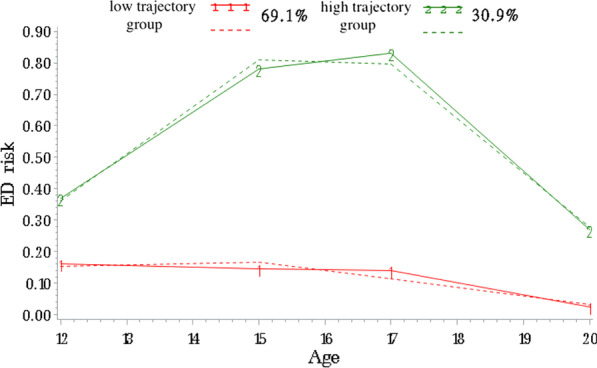
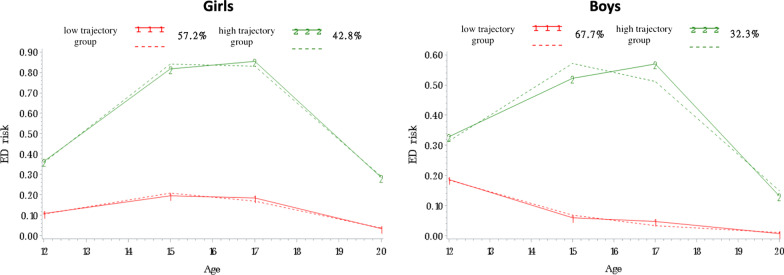
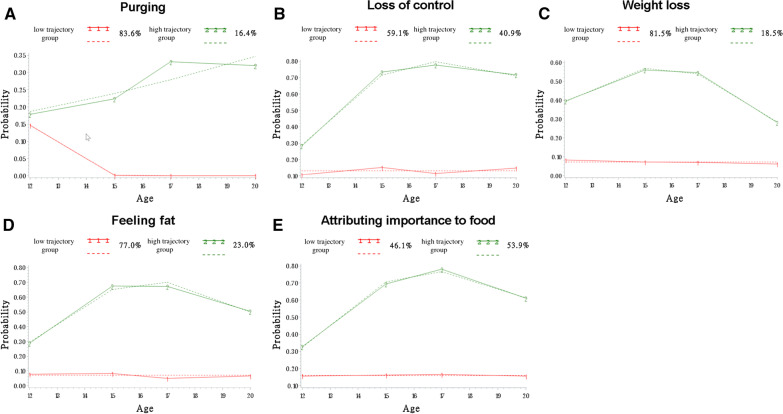
Background: Adolescence is a critical period for the development of eating disorders, but data is lacking on the heterogeneity of their evolution during that time-period. Group-based trajectories can be used to understand how eating disorders emerge and evolve over time. The aim of this study was to identify groups of individuals with distinct levels of eating disorder symptoms between 12 and 20 years and the onset of different types of symptoms. We also studied sex differences in the evolution and course of eating disorder symptoms from early adolescence to adulthood. Methods: Using archival data from the QLSCD cohort, trajectories of eating disorder symptomatology were estimated from ages 12 to 20 years using semiparametric models. These trajectories included overall eating disorder symptomatology as measured by the SCOFF (Sick, Control, One Stone, Fat, Food), sex, and symptom-specific trajectories. Results: Two groups of adolescents following distinct trajectories of eating disorder symptoms were identified. The first trajectory group included 30.9% of youth with sharply rising levels between 12 and 15 years, followed by high levels of symptoms between 15 and 20 years. The second trajectory group included 69.1% of youth with low and stable levels of symptoms between 12 and 20 years. Sex-specific models indicated that the proportion of girls in the high trajectory group was 1.3 times higher than the proportion of boys (42.8% girls vs. 32.3% boys). Trajectories of SCOFF items were similar for loss-of-control eating, feeling overweight, and attributing importance to food. The weight loss item had a different developmental pattern, increasing between 12 and 15 years and then decreasing between 17 and 20 years. Conclusions: The largest increase in eating disorder symptoms in adolescence is between the ages of 12 and 15 . Yet, most prevention programs start after 15 years of age. Our findings suggest that, unlike common practices, eating disorder prevention programs should aim to start before puberty.
Overview
The claims and statistics of this paper haven’t been checked yet.
Free: it reads the open-access text and checks the first 5 claims that cite a source we can check. Create a free account to check every claim.
Integrity signals
Registry
Cites
Statistics
Figures
Verification
Claims the paper makes
The claims and statistics of this paper haven’t been checked yet.
Free: it reads the open-access text and checks the first 5 claims that cite a source we can check. Create a free account to check every claim.
Claims other papers make about this one
Each is checked against this paper’s own text: does it say what the citing paper says it does?
The cited source says what the claim attributes to it.
In the citing paper
“We used group-based trajectories previously calculated (Breton et al., 2022).”
From Pathways of association between disordered eating in adolescence and mental health outcomes in young adulthood during the COVID-19 pandemic (2023) · cites this paper as Breton et al., 2022
The cited source says what the claim attributes to it.
In the citing paper
“Note that the average number of disordered eating symptoms was higher among females than among males (Breton et al., 2022).”
From Pathways of association between disordered eating in adolescence and mental health outcomes in young adulthood during the COVID-19 pandemic (2023) · cites this paper as Breton et al., 2022
Self-check
Percentages, sums and reported differences re-computed from the paper’s own numbers.
The self-check needs the paper’s full text.
Citations
Cites
Diagnostic and Statistical Manual of Mental Disorders
American Psychiatric Association (2013) · doi:10.1176/appi.books.9780890425596 · Cited by 116,369
Group-Based Trajectory Modeling in Clinical Research
Nagin, D. S., & Odgers, C. L. (2010) · Annual Review of Clinical Psychology · doi:10.1146/annurev.clinpsy.121208.131413 · Cited by 2,708
Analyzing developmental trajectories: A semiparametric, group-based approach.
Nagin, D. S. (1999) · Psychological Methods · doi:10.1037/1082-989x.4.2.139 · Cited by 2,346 · cited 3×
“Proc Traj provides an estimate of the proportions of individuals in the study population following each trajectory group, as well as the probabilities that each individual has to belong to the different trajectory groups [30].”
BackgroundMethodInfluentialSwanson, S. A., Crow, S. J., Le Grange, D., Swendsen, J., & Merikangas, K. R. (2011) · Archives of General Psychiatry · doi:10.1001/archgenpsychiatry.2011.22 · Cited by 1,611
Analyzing developmental trajectories of distinct but related behaviors: A group-based method.
Nagin, D. S., & Tremblay, R. E. (2001) · Psychological Methods · doi:10.1037//1082-989x.6.1.18 · Cited by 1,280
Self-citationTreasure, J., Duarte, T. A., & Schmidt, U. (2020) · The Lancet · doi:10.1016/s0140-6736(20)30059-3 · Cited by 1,026
Udo, T., & Grilo, C. M. (2018) · Biological Psychiatry · doi:10.1016/j.biopsych.2018.03.014 · Cited by 799 · cited 1×
“Additionally, some studies have shown that bingeing and purging-type symptoms (such as those present in BED and BN) appear later than restrictive symptoms (such as those present in AN) [17, 18].”
BackgroundThe GRoLTS-Checklist: Guidelines for Reporting on Latent Trajectory Studies
van de Schoot, R., Sijbrandij, M., Winter, S. D., Depaoli, S., & Vermunt, J. K. (2017) · Structural Equation Modeling: A Multidisciplinary Journal · doi:10.1080/10705511.2016.1247646 · Cited by 721
The enigma of male eating disorders: A critical review and synthesis
Murray, S. B., Nagata, J. M., Griffiths, S., Calzo, J. P., Brown, T. A., Mitchison, D., Blashill, A. J., & Mond, J. M. (2017) · Clinical Psychology Review · doi:10.1016/j.cpr.2017.08.001 · Cited by 702 · cited 1×
“On the other hand, in community samples, women are approximately four times more likely to have Anorexia Nervosa (AN) and Bulimia Nervosa (BN) than men, with this number increasing to ten times more likely in clinical settings [11].”
BackgroundNguena Nguefack, H. L., Pagé, M. G., Katz, J., Choinière, M., Vanasse, A., Dorais, M., Samb, O. M., & Lacasse, A. (2020) · Clinical Epidemiology · doi:10.2147/clep.s265287 · Cited by 527
Cited by
López-Gil, J. F., García-Hermoso, A., Smith, L., Firth, J., Trott, M., Mesas, A. E., Jiménez-López, E., Gutiérrez-Espinoza, H., Tárraga-López, P. J., & Victoria-Montesinos, D. (2023) · JAMA Pediatrics · doi:10.1001/jamapediatrics.2022.5848 · Cited by 276
Ghazzawi, H. A., Nimer, L. S., Haddad, A. J., Alhaj, O. A., Amawi, A. T., Pandi-Perumal, S. R., Trabelsi, K., Seeman, M. V., & Jahrami, H. (2024) · Journal of Eating Disorders · doi:10.1186/s40337-024-00982-5 · Cited by 64
The healthy eating movement on social media and its psychological effects on body image
Zaharia, A., & Gonța, I. (2024) · Frontiers in Nutrition · doi:10.3389/fnut.2024.1474729 · Cited by 46
Ghazzawi, H., Nimer, L. S., Sweidan, D. H., Alhaj, O. A., Lawi, D. A., Amawi, A. T., Levine, M. P., & Jahrami, H. (2023) · Journal of Eating Disorders · doi:10.1186/s40337-023-00849-1 · Cited by 43
“However, another possibility with important implications for prevention emerges from a recent longitudinal study conducted in Canada [89], which identified a distinct trajectory, present in slightly less than one third of youth, defined by a sharp increase in disordered eating between ages 12 and…”
BackgroundShifting age of child eating disorder hospitalizations during the Covid‐19 pandemic
Auger, N., Steiger, H., Luu, T. M., Chadi, N., Low, N. C. P., Bilodeau‐Bertrand, M., Healy‐Profitós, J., Ayoub, A., Brousseau, É., & Israël, M. (2023) · Journal of Child Psychology and Psychiatry · doi:10.1111/jcpp.13800 · Cited by 26
Metadata
- Authors
- Breton, É., Dufour, R., Côté, S. M., Dubois, L., Vitaro, F., Boivin, M., Tremblay, R. E., & Booij, L.
- Affiliations
- Centre Hospitalier Universitaire Sainte-Justine (CA)
- University of Ottawa (CA)
- Université Laval (CA)
- Corresponding author
- Booij, Linda
- ORCID
- Venue
- Journal of Eating Disorders
- Published
- 2022-06-20
- Volume
- 10
- Issue
- 1
- Pages
- 84-84
- ISSN
- 2050-2974 (ISSN-L)
- PMC
- PMC9210773
- OpenAlex
- W4283167587
- Cited by
- 82
- References
- 50
- Citations by year
- 2026: 20 · 2025: 23 · 2024: 23 · 2023: 13 · 2022: 3
- FWCI
- 14.16
- Type
- journal article
- Language
- en
- Open access
- gold
- doi.org
- Licence
- cc-by
- creativecommons.org/licenses/by/4.0 (tdm)
- creativecommons.org/licenses/by/4.0 (vor)
- Locations
- Journal of Eating Disorders (publishedVersion, cc-by)
- PubMed Central (publishedVersion, cc-by)
- PubMed (publishedVersion)
- uO Research (University of Ottawa) (submittedVersion, public-domain)
- DOAJ (DOAJ: Directory of Open Access Journals) (submittedVersion)
- Funders
- Fonds de Recherche du Québec - Santé
- Centre hospitalier universitaire Sainte-Justine
- Topics
- Social Sciences › Psychology › Clinical Psychology › Eating Disorders and Behaviors
- Health Sciences › Nursing › Nutrition and Dietetics › Nutrition, Health and Food Behavior
- Health Sciences › Medicine › Psychiatry and Mental health › Child Nutrition and Feeding Issues
- Keywords
- eating disorder symptoms, developmental trajectories, adolescence, early adulthood, sex differences, SCOFF questionnaire, loss of control eating, food preoccupation, weight loss, eating disorder prevention, puberty
About these checks
Registry, retraction, Cites and statistics results are computed, not judged, with one exception: a printed reference that no index lists is read once by a model before it counts as a citation error. Claims are extracted by a model and kept only when their quote appears verbatim in the text; each cited source is then checked, with a model’s help, for whether it says what the claim relies on. Those verdicts can be wrong — read the claim’s quote and the cited source before relying on one.
Statistics and arithmetic are recomputed, not judged.
Confidence bands are shown only for fields calibrated on our annotated test set. None is calibrated yet, so no band is shown.
What counts as a claim ›How we measure confidence ›How we check this ›
Are you an author, or do you see a problem with this page? Request a review
Data sources
Bibliographic data: Semantic Scholar, OpenAlex, Crossref.
Contains information from the Semantic Scholar Academic Graph Datasets, made available under the ODC Attribution License (ODC-BY 1.0).
Semantic Scholar’s data is described in: Kinney, R., et al. (2023). The Semantic Scholar Open Data Platform. arXiv:2301.10140.
