

Developmental trajectories of eating disorder symptoms: A longitudinal study from early adolescence to young adulthood
Open accessThe DOI matches its Crossref record; 50 of the 50 references it cites were found in a registry or an index.
Abstract
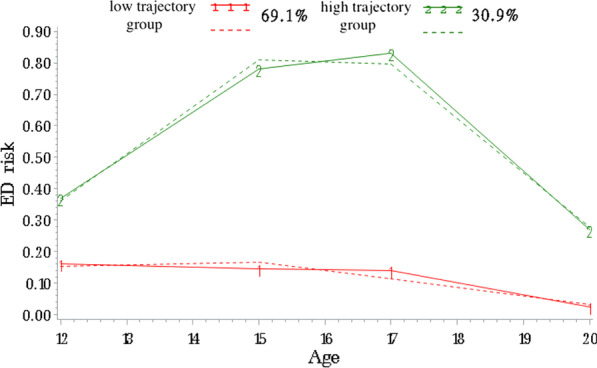
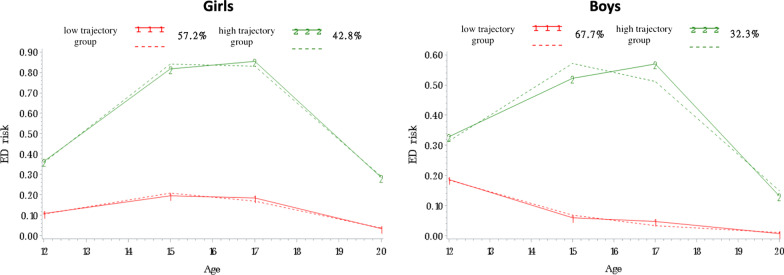
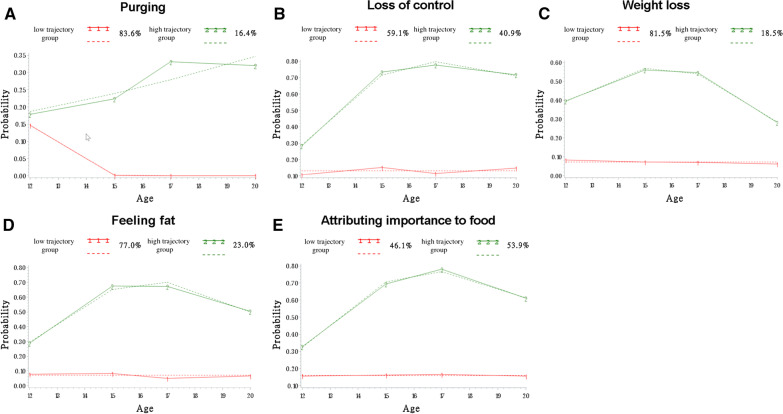
Background: Adolescence is a critical period for the development of eating disorders, but data is lacking on the heterogeneity of their evolution during that time-period. Group-based trajectories can be used to understand how eating disorders emerge and evolve over time. The aim of this study was to identify groups of individuals with distinct levels of eating disorder symptoms between 12 and 20 years and the onset of different types of symptoms. We also studied sex differences in the evolution and course of eating disorder symptoms from early adolescence to adulthood. Methods: Using archival data from the QLSCD cohort, trajectories of eating disorder symptomatology were estimated from ages 12 to 20 years using semiparametric models. These trajectories included overall eating disorder symptomatology as measured by the SCOFF (Sick, Control, One Stone, Fat, Food), sex, and symptom-specific trajectories. Results: Two groups of adolescents following distinct trajectories of eating disorder symptoms were identified. The first trajectory group included 30.9% of youth with sharply rising levels between 12 and 15 years, followed by high levels of symptoms between 15 and 20 years. The second trajectory group included 69.1% of youth with low and stable levels of symptoms between 12 and 20 years. Sex-specific models indicated that the proportion of girls in the high trajectory group was 1.3 times higher than the proportion of boys (42.8% girls vs. 32.3% boys). Trajectories of SCOFF items were similar for loss-of-control eating, feeling overweight, and attributing importance to food. The weight loss item had a different developmental pattern, increasing between 12 and 15 years and then decreasing between 17 and 20 years. Conclusions: The largest increase in eating disorder symptoms in adolescence is between the ages of 12 and 15 . Yet, most prevention programs start after 15 years of age. Our findings suggest that, unlike common practices, eating disorder prevention programs should aim to start before puberty.
Overview
The claims and statistics of this paper haven’t been checked yet.
Free: it reads the open-access text and checks the first 5 claims that cite a source we can check. Create a free account to check every claim.
Integrity signals
Registry
Cites
Statistics
Figures
Verification
Claims the paper makes
The claims and statistics of this paper haven’t been checked yet.
Free: it reads the open-access text and checks the first 5 claims that cite a source we can check. Create a free account to check every claim.
Claims other papers make about this one
Each is checked against this paper’s own text: does it say what the citing paper says it does?
The cited source says what the claim attributes to it.
In the citing paper
“We used group-based trajectories previously calculated (Breton et al., 2022).”
From Pathways of association between disordered eating in adolescence and mental health outcomes in young adulthood during the COVID-19 pandemic (2023) · cites this paper as Breton et al., 2022
The cited source says what the claim attributes to it.
In the citing paper
“Note that the average number of disordered eating symptoms was higher among females than among males (Breton et al., 2022).”
From Pathways of association between disordered eating in adolescence and mental health outcomes in young adulthood during the COVID-19 pandemic (2023) · cites this paper as Breton et al., 2022
Self-check
Percentages, sums and reported differences re-computed from the paper’s own numbers.
The self-check needs the paper’s full text.
Citations
Cites
Diagnostic and Statistical Manual of Mental Disorders
American Psychiatric Association (2013) · doi:10.1176/appi.books.9780890425596 · Cited by 116,369
Group-Based Trajectory Modeling in Clinical Research
Nagin, D. S., & Odgers, C. L. (2010) · Annual Review of Clinical Psychology · doi:10.1146/annurev.clinpsy.121208.131413 · Cited by 2,708
Analyzing developmental trajectories: A semiparametric, group-based approach.
Nagin, D. S. (1999) · Psychological Methods · doi:10.1037/1082-989x.4.2.139 · Cited by 2,346 · cited 3×
“Proc Traj provides an estimate of the proportions of individuals in the study population following each trajectory group, as well as the probabilities that each individual has to belong to the different trajectory groups [30].”
BackgroundMethodInfluentialSwanson, S. A., Crow, S. J., Le Grange, D., Swendsen, J., & Merikangas, K. R. (2011) · Archives of General Psychiatry · doi:10.1001/archgenpsychiatry.2011.22 · Cited by 1,611
Analyzing developmental trajectories of distinct but related behaviors: A group-based method.
Nagin, D. S., & Tremblay, R. E. (2001) · Psychological Methods · doi:10.1037//1082-989x.6.1.18 · Cited by 1,280
Self-citationTreasure, J., Duarte, T. A., & Schmidt, U. (2020) · The Lancet · doi:10.1016/s0140-6736(20)30059-3 · Cited by 1,026
Udo, T., & Grilo, C. M. (2018) · Biological Psychiatry · doi:10.1016/j.biopsych.2018.03.014 · Cited by 799 · cited 1×
“Additionally, some studies have shown that bingeing and purging-type symptoms (such as those present in BED and BN) appear later than restrictive symptoms (such as those present in AN) [17, 18].”
BackgroundThe GRoLTS-Checklist: Guidelines for Reporting on Latent Trajectory Studies
van de Schoot, R., Sijbrandij, M., Winter, S. D., Depaoli, S., & Vermunt, J. K. (2017) · Structural Equation Modeling: A Multidisciplinary Journal · doi:10.1080/10705511.2016.1247646 · Cited by 721
The enigma of male eating disorders: A critical review and synthesis
Murray, S. B., Nagata, J. M., Griffiths, S., Calzo, J. P., Brown, T. A., Mitchison, D., Blashill, A. J., & Mond, J. M. (2017) · Clinical Psychology Review · doi:10.1016/j.cpr.2017.08.001 · Cited by 702 · cited 1×
“On the other hand, in community samples, women are approximately four times more likely to have Anorexia Nervosa (AN) and Bulimia Nervosa (BN) than men, with this number increasing to ten times more likely in clinical settings [11].”
BackgroundNguena Nguefack, H. L., Pagé, M. G., Katz, J., Choinière, M., Vanasse, A., Dorais, M., Samb, O. M., & Lacasse, A. (2020) · Clinical Epidemiology · doi:10.2147/clep.s265287 · Cited by 527
Longitudinal relationships between childhood, adolescent, and adult eating disorders
KOTLER, L. A., COHEN, P., DAVIES, M., PINE, D. S., & WALSH, B. T. (2001) · Journal of the American Academy of Child & Adolescent Psychiatry · doi:10.1097/00004583-200112000-00014 · Cited by 419
Pfeifer, J. H., & Allen, N. B. (2021) · Biological Psychiatry · doi:10.1016/j.biopsych.2020.09.002 · Cited by 411 · cited 1×
“The rise in ED symptoms between ages 12 and 15 aligns with the beginning of puberty, which has been associated with physical, hormonal, and social changes [34, 35].”
BackgroundHerpertz-Dahlmann, B. (2015) · Child and Adolescent Psychiatric Clinics of North America · doi:10.1016/j.chc.2014.08.003 · Cited by 407 · cited 1×
“This decision was made since the weight loss item refers to significant weight loss in a short period of time, a symptom characteristic of AN which has a lower prevalence than other EDs [32, 33].”
BackgroundPsychosocial risk factors for eating disorders
Keel, P. K., & Forney, K. J. (2013) · International Journal of Eating Disorders · doi:10.1002/eat.22094 · Cited by 390 · cited 1×
“Supporting this hypothesis, previous studies have highlighted the role of peers and social environment in the development of purging behaviors during adolescence [41].”
ResultPubertal timing and the development of psychopathology in adolescence and beyond
Graber, J. A. (2013) · Hormones and Behavior · doi:10.1016/j.yhbeh.2013.04.003 · Cited by 350 · cited 1×
“The rise in ED symptoms between ages 12 and 15 aligns with the beginning of puberty, which has been associated with physical, hormonal, and social changes [34, 35].”
BackgroundSCOFF, the development of an eating disorder screening questionnaire
Hill, L. S., Reid, F., Morgan, J. F., & Lacey, J. H. (2010) · International Journal of Eating Disorders · doi:10.1002/eat.20679 · Cited by 285 · cited 7×
“, weight loss), Fat, Food (SCOFF) questionnaire was administered to assess ED symptoms [28, 29].”
BackgroundMethodInfluentialGroup-Based Trajectory Modeling (Nearly) Two Decades Later
Nagin, D. S., & Odgers, C. L. (2010) · Journal of Quantitative Criminology · doi:10.1007/s10940-010-9113-7 · Cited by 258
Nagl, M., Jacobi, C., Paul, M., Beesdo-Baum, K., Höfler, M., Lieb, R., & Wittchen, H.-U. (2016) · European Child & Adolescent Psychiatry · doi:10.1007/s00787-015-0808-z · Cited by 253 · cited 1×
“Additionally, some studies have shown that bingeing and purging-type symptoms (such as those present in BED and BN) appear later than restrictive symptoms (such as those present in AN) [17, 18].”
BackgroundEating disorder prevention: Current evidence‐base and future directions
Stice, E., Becker, C. B., & Yokum, S. (2013) · International Journal of Eating Disorders · doi:10.1002/eat.22105 · Cited by 219 · cited 2×
“As these interventions typically result in modest reductions of symptoms, clarifying aspects of ED development would have important implications on preventive interventions [23, 24].”
BackgroundO’Dea, J., & Abraham, S. F. (1999) · PubMed · Cited by 202
Herle, M., Stavola, B. D., Hübel, C., Abdulkadir, M., Ferreira, D. S., Loos, R. J. F., Bryant-Waugh, R., Bulik, C. M., & Micali, N. (2020) · The British Journal of Psychiatry · doi:10.1192/bjp.2019.174 · Cited by 161
Risk and maintenance factors for young women’s DSM-5 eating disorders
Dakanalis, A., Clerici, M., Bartoli, F., Caslini, M., Crocamo, C., Riva, G., & Carrà, G. (2017) · Archives of Women s Mental Health · doi:10.1007/s00737-017-0761-6 · Cited by 136 · cited 1×
“Both feeling overweight and attributing importance to food can be considered maintenance factors for binge-purging behaviors, while loss-of-control eating is a component of binge eating [4, 46, 47].”
BackgroundCohort Profile: Quebec Longitudinal Study of Child Development (QLSCD)
Orri, M., Boivin, M., Chen, C., Ahun, M. N., Geoffroy, M.-C., Ouellet-Morin, I., Tremblay, R. E., & Côté, S. M. (2021) · Social Psychiatry and Psychiatric Epidemiology · doi:10.1007/s00127-020-01972-z · Cited by 130 · cited 3×
“[26] for more details about the characteristics of the cohort.”
BackgroundMethodSelf-citationCiao, A. C., Loth, K., & Neumark-Sztainer, D. (2014) · Current Psychiatry Reports · doi:10.1007/s11920-014-0453-0 · Cited by 125 · cited 4×
“reviewed the literature on ED preventive programs, and a closer look at the included studies suggests that only one third of the programs targeted youth during middle school or early high school [24].”
BackgroundInfluentialMicali, N., De Stavola, B., Ploubidis, G., Simonoff, E., Treasure, J., & Field, A. E. (2015) · British Journal of Psychiatry · doi:10.1192/bjp.bp.114.152371 · Cited by 123 · cited 5×
“For example, a longitudinal study found that childhood body dissatisfaction predicted weight and shape concerns in girls, while it only predicted weight and shape concerns in boys when interacting with BMI [8].”
BackgroundInfluentialPeer and family influence in eating disorders: A meta-analysis
Quiles Marcos, Y., Quiles Sebastián, M. J., Pamies Aubalat, L., Botella Ausina, J., & Treasure, J. (2013) · European Psychiatry · doi:10.1016/j.eurpsy.2012.03.005 · Cited by 117 · cited 1×
“Moreover, there may be an increase in environmental stressors such as peer pressure around 12 to 15 years, which has been shown to influence the development of psychopathology including EDs, as young adolescents begin high school [36].”
BackgroundDifferent Facets of Body Image Disturbance in Binge Eating Disorder: A Review
Lewer, M., Bauer, A., Hartmann, A., & Vocks, S. (2017) · Nutrients · doi:10.3390/nu9121294 · Cited by 113
Slane, J. D., Klump, K. L., McGue, M., & Iacono, W. G. (2014) · International Journal of Eating Disorders · doi:10.1002/eat.22329 · Cited by 104
Towards understanding gender differences in disordered eating among adolescents
Hautala, L. A., Junnila, J., Helenius, H., Väänänen, A., Liuksila, P., Räihä, H., Välimäki, M., & Saarijärvi, S. (2008) · Journal of Clinical Nursing · doi:10.1111/j.1365-2702.2007.02143.x · Cited by 97 · cited 1×
“However, findings are mixed when it comes to other ED risk factors during adolescence; all sexes are affected by weight/ appearance anxiety, use of tobacco, and poor communication with parents, among other factors [9, 10].”
BackgroundGarcia, F. D., Grigioni, S., Allais, E., Houy-Durand, E., Thibaut, F., & Déchelotte, P. (2011) · Clinical Nutrition · doi:10.1016/j.clnu.2010.09.007 · Cited by 91 · cited 7×
“, weight loss), Fat, Food (SCOFF) questionnaire was administered to assess ED symptoms [28, 29].”
BackgroundMethodInfluentialGlazer, K. B., Sonneville, K. R., Micali, N., Swanson, S. A., Crosby, R., Horton, N. J., Eddy, K. T., & Field, A. E. (2019) · Journal of Adolescent Health · doi:10.1016/j.jadohealth.2018.09.023 · Cited by 85
Zeiler, M., Waldherr, K., Philipp, J., Nitsch, M., Dür, W., Karwautz, A., & Wagner, G. (2016) · European Eating Disorders Review · doi:10.1002/erv.2368 · Cited by 84 · cited 1×
“Moreover, EDs are debilitating psychiatric disorders associated with several negative outcomes, and their typical symptoms include preoccupation with eating, compensatory behaviors, and body image disturbances [1, 2].”
BackgroundSerra, R., Kiekens, G., Vanderlinden, J., Vrieze, E., Auerbach, R. P., Benjet, C. L., Claes, L., Cuijpers, P. J., Demyttenaere, K., Ebert, D. D., et al. (2019) · International Journal of Eating Disorders · doi:10.1002/eat.23211 · Cited by 83
Risk factors for eating disorder symptoms at 12 years of age: A 6-year longitudinal cohort study
Evans, E. H., Adamson, A. J., Basterfield, L., Le Couteur, A., Reilly, J. K., Reilly, J. J., & Parkinson, K. N. (2017) · Appetite · doi:10.1016/j.appet.2016.09.005 · Cited by 75
Yoon, C., Mason, S. M., Hooper, L., Eisenberg, M. E., & Neumark-Sztainer, D. (2020) · Journal of Adolescent Health · doi:10.1016/j.jadohealth.2019.08.012 · Cited by 70 · cited 3×
“Developmental trajectories have been used to study the evolution of BMI and weight status in youth [19, 20].”
BackgroundMethodResultCôté, S. M., Orri, M., Brendgen, M., Vitaro, F., Boivin, M., Japel, C., Séguin, J. R., Geoffroy, M., Rouquette, A., Falissard, B., et al. (2017) · International Journal of Methods in Psychiatric Research · doi:10.1002/mpr.1566 · Cited by 66 · cited 1×
“The time points of interest in the present study were at ages 12, 15, 17, and 20, where a questionnaire that evaluated mental health [27], including ED symptoms, was completed by the participants.”
BackgroundSelf-citationA risk model for preadolescent disordered eating
Combs, J. L., Pearson, C. M., & Smith, G. T. (2011) · International Journal of Eating Disorders · doi:10.1002/eat.20851 · Cited by 64
Timmermans, M., van Lier, P. A. C., & Koot, H. M. (2010) · Psychological Medicine · doi:10.1017/s0033291709992091 · Cited by 64 · cited 1×
“Also, the important environmental changes happening at the end of adolescence can represent stressful events for at-risk adolescents and might contribute to the peak of purging behaviors observed later in adolescence [42].”
BackgroundSex-specific issues in eating disorders: a clinical and psychopathological investigation
Valente, S., di Girolamo, G., Forlani, M., Biondini, A., Scudellari, P., Ronchi, D. D., & Atti, A. R. (2017) · Eating and Weight Disorders - Studies on Anorexia Bulimia and Obesity · doi:10.1007/s40519-017-0432-7 · Cited by 64
Risk and Protective Factors of Disordered Eating in Adolescents Based on Gender and Body Mass Index
Argyrides, M., Anastasiades, E., & Alexiou, E. (2020) · International Journal of Environmental Research and Public Health · doi:10.3390/ijerph17249238 · Cited by 59 · cited 1×
“However, findings are mixed when it comes to other ED risk factors during adolescence; all sexes are affected by weight/ appearance anxiety, use of tobacco, and poor communication with parents, among other factors [9, 10].”
BackgroundPryor, L., Brendgen, M. R., Boivin, M., Dubois, L., Japel, C., Falissard, B., Tremblay, R. E., & Côté, S. M. (2016) · Journal of Affective Disorders · doi:10.1016/j.jad.2016.05.022 · Cited by 53 · cited 1×
“Developmental trajectories have been used to study the evolution of BMI and weight status in youth [19, 20].”
MethodSelf-citationGrilo, C. M., Crosby, R. D., & Machado, P. P. P. (2019) · International Journal of Eating Disorders · doi:10.1002/eat.23161 · Cited by 52
Allen, K. L., Crosby, R. D., Oddy, W. H., & Byrne, S. M. (2013) · Journal of Eating Disorders · doi:10.1186/2050-2974-1-32 · Cited by 49
Rozzell, K., Moon, D. Y., Klimek, P., Brown, T., & Blashill, A. J. (2019) · JAMA Pediatrics · doi:10.1001/jamapediatrics.2018.3678 · Cited by 47 · cited 1×
“This decision was made since the weight loss item refers to significant weight loss in a short period of time, a symptom characteristic of AN which has a lower prevalence than other EDs [32, 33].”
Backgroundvan Eeden, A. E., Oldehinkel, A. J., van Hoeken, D., & Hoek, H. W. (2021) · International Journal of Eating Disorders · doi:10.1002/eat.23496 · Cited by 43
Munkholm, A., Olsen, E. M., Rask, C. U., Clemmensen, L., Rimvall, M. K., Jeppesen, P., Micali, N., & Skovgaard, A. M. (2016) · Appetite · doi:10.1016/j.appet.2016.02.020 · Cited by 36
Characterizing and predicting trajectories of disordered eating over adolescence.
Fairweather‐Schmidt, A. K., & Wade, T. D. (2016) · Journal of Abnormal Psychology · doi:10.1037/abn0000146 · Cited by 31 · cited 2×
“Another study focusing on ED risk from 12 to 19 years identified three trajectory groups, interpreted as low risk, early onset, and late-onset ED risk trajectories [22].”
BackgroundResultYiu, A., Murray, S. M., Arlt, J. M., Eneva, K. T., & Chen, E. Y. (2017) · Body Image · doi:10.1016/j.bodyim.2017.04.005 · Cited by 28
Verschueren, M., Claes, L., Palmeroni, N., Bogaerts, A., Gandhi, A., Moons, P., & Luyckx, K. (2020) · Journal of Youth and Adolescence · doi:10.1007/s10964-019-01174-0 · Cited by 26 · cited 1×
“Studies on trajectories of ED symptoms suggest that symptomatology increases during adolescence, which is consistent with the typical onset of the first symptoms of AN and BN [7, 21].”
Result‘Feeling fat,’ eating pathology, and eating pathology-related impairment in young men and women
Mehak, A., & Racine, S. E. (2019) · Eating Disorders · doi:10.1080/10640266.2019.1695451 · Cited by 25 · cited 1×
“Both feeling overweight and attributing importance to food can be considered maintenance factors for binge-purging behaviors, while loss-of-control eating is a component of binge eating [4, 46, 47].”
Background
Cited by
López-Gil, J. F., García-Hermoso, A., Smith, L., Firth, J., Trott, M., Mesas, A. E., Jiménez-López, E., Gutiérrez-Espinoza, H., Tárraga-López, P. J., & Victoria-Montesinos, D. (2023) · JAMA Pediatrics · doi:10.1001/jamapediatrics.2022.5848 · Cited by 276
Ghazzawi, H. A., Nimer, L. S., Haddad, A. J., Alhaj, O. A., Amawi, A. T., Pandi-Perumal, S. R., Trabelsi, K., Seeman, M. V., & Jahrami, H. (2024) · Journal of Eating Disorders · doi:10.1186/s40337-024-00982-5 · Cited by 64
The healthy eating movement on social media and its psychological effects on body image
Zaharia, A., & Gonța, I. (2024) · Frontiers in Nutrition · doi:10.3389/fnut.2024.1474729 · Cited by 46
Ghazzawi, H., Nimer, L. S., Sweidan, D. H., Alhaj, O. A., Lawi, D. A., Amawi, A. T., Levine, M. P., & Jahrami, H. (2023) · Journal of Eating Disorders · doi:10.1186/s40337-023-00849-1 · Cited by 43
“However, another possibility with important implications for prevention emerges from a recent longitudinal study conducted in Canada [89], which identified a distinct trajectory, present in slightly less than one third of youth, defined by a sharp increase in disordered eating between ages 12 and…”
BackgroundShifting age of child eating disorder hospitalizations during the Covid‐19 pandemic
Auger, N., Steiger, H., Luu, T. M., Chadi, N., Low, N. C. P., Bilodeau‐Bertrand, M., Healy‐Profitós, J., Ayoub, A., Brousseau, É., & Israël, M. (2023) · Journal of Child Psychology and Psychiatry · doi:10.1111/jcpp.13800 · Cited by 26
Metadata
- Authors
- Breton, É., Dufour, R., Côté, S. M., Dubois, L., Vitaro, F., Boivin, M., Tremblay, R. E., & Booij, L.
- Affiliations
- Centre Hospitalier Universitaire Sainte-Justine (CA)
- University of Ottawa (CA)
- Université Laval (CA)
- Corresponding author
- Booij, Linda
- ORCID
- Venue
- Journal of Eating Disorders
- Published
- 2022-06-20
- Volume
- 10
- Issue
- 1
- Pages
- 84-84
- ISSN
- 2050-2974 (ISSN-L)
- PMC
- PMC9210773
- OpenAlex
- W4283167587
- Cited by
- 82
- References
- 50
- Citations by year
- 2026: 20 · 2025: 23 · 2024: 23 · 2023: 13 · 2022: 3
- FWCI
- 14.16
- Type
- journal article
- Language
- en
- Open access
- gold
- doi.org
- Licence
- cc-by
- creativecommons.org/licenses/by/4.0 (tdm)
- creativecommons.org/licenses/by/4.0 (vor)
- Locations
- Journal of Eating Disorders (publishedVersion, cc-by)
- PubMed Central (publishedVersion, cc-by)
- PubMed (publishedVersion)
- uO Research (University of Ottawa) (submittedVersion, public-domain)
- DOAJ (DOAJ: Directory of Open Access Journals) (submittedVersion)
- Funders
- Fonds de Recherche du Québec - Santé
- Centre hospitalier universitaire Sainte-Justine
- Topics
- Social Sciences › Psychology › Clinical Psychology › Eating Disorders and Behaviors
- Health Sciences › Nursing › Nutrition and Dietetics › Nutrition, Health and Food Behavior
- Health Sciences › Medicine › Psychiatry and Mental health › Child Nutrition and Feeding Issues
- Keywords
- eating disorder symptoms, developmental trajectories, adolescence, early adulthood, sex differences, SCOFF questionnaire, loss of control eating, food preoccupation, weight loss, eating disorder prevention, puberty
About these checks
Registry, retraction, Cites and statistics results are computed, not judged, with one exception: a printed reference that no index lists is read once by a model before it counts as a citation error. Claims are extracted by a model and kept only when their quote appears verbatim in the text; each cited source is then checked, with a model’s help, for whether it says what the claim relies on. Those verdicts can be wrong — read the claim’s quote and the cited source before relying on one.
Statistics and arithmetic are recomputed, not judged.
Confidence bands are shown only for fields calibrated on our annotated test set. None is calibrated yet, so no band is shown.
What counts as a claim ›How we measure confidence ›How we check this ›
Are you an author, or do you see a problem with this page? Request a review
Data sources
Bibliographic data: Semantic Scholar, OpenAlex, Crossref.
Contains information from the Semantic Scholar Academic Graph Datasets, made available under the ODC Attribution License (ODC-BY 1.0).
Semantic Scholar’s data is described in: Kinney, R., et al. (2023). The Semantic Scholar Open Data Platform. arXiv:2301.10140.
