

High and low mutational burden tumors versus immunologically hot and cold tumors and response to immune checkpoint inhibitors
Open accessThe DOI matches its Crossref record; 26 of the 26 references it cites were found in a registry or an index.
Abstract
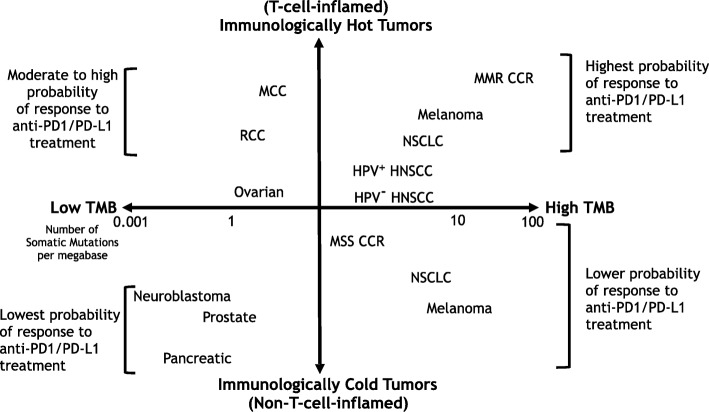
Tumors responding to immune checkpoint inhibitors (ICIs) have a higher level of immune infiltrates and/or an Interferon (IFN) signature indicative of a T-cell-inflamed phenotype. Melanoma and lung cancer demonstrate high response rates to ICIs and are commonly referred to as "hot tumors". These are in sharp contrast to tumors with low immune infiltrates called "cold tumors" or non-T-cell-inflamed cancers, such as those from the prostate and pancreas. Classification of tumors based on their immune phenotype can partially explain clinical response to ICIs. However, this model alone cannot fully explain the lack of response among many patients treated with ICIs.Dichotomizing tumors based on their mutation profile into high tumor mutation burden (TMB) or low TMB, such as many childhood malignancies, can also, to some extent, explain the clinical response to immunotherapy. This model mainly focuses on a tumor's genotype rather than its immune phenotype. High TMB tumors often have higher levels of neoantigens that can be recognized by the immune system. In the current era of immunotherapy, with the lack of definitive biomarkers, we need to evaluate tumors based on both their immune phenotype and genomic mutation profile to determine which patients have a higher likelihood of responding to treatment with ICIs.
Overview
The claims and statistics of this paper haven’t been checked yet.
Free: it reads the open-access text and checks the first 5 claims that cite a source we can check. Create a free account to check every claim.
Integrity signals
Registry
Cites
Statistics
Figures
Verification
Claims the paper makes
The claims and statistics of this paper haven’t been checked yet.
Free: it reads the open-access text and checks the first 5 claims that cite a source we can check. Create a free account to check every claim.
Claims other papers make about this one
Each is checked against this paper’s own text: does it say what the citing paper says it does?
In the citing paper
“Given this contribution of mutational burden to ICI efficacy, tumors with low mutational burdens, such as prostate and pancreatic cancers, might be expected to respond poorly to ICIs, and this is indeed the case (88).”
From Immune Checkpoint Inhibitors for the Treatment of Cancer: Clinical Impact and Mechanisms of Response and Resistance (2021) · cites this paper as [88]
Self-check
Percentages, sums and reported differences re-computed from the paper’s own numbers.
The self-check needs the paper’s full text.
Citations
Cites
Signatures of mutational processes in human cancer
Initiative, A. P. C. G., Alexandrov, L. B., ICGC Breast Cancer Consortium, ICGC MMML-Seq Consortium, PedBrain, I., Nik-Zainal, S., Wedge, D. C., Aparicio, S. A. J. R., Behjati, S., Biankin, A. V., et al. (2013) · Nature · doi:10.1038/nature12477 · Cited by 9,660 · cited 2×
“For example, ovarian cancer has a modest somatic mutation burden and is somewhat infiltrated by T-cells; however, it displays a low response rate to various ICIs [2 – 4].”
TGFβ attenuates tumour response to PD-L1 blockade by contributing to exclusion of T cells
Mariathasan, S., Turley, S. J., Nickles, D., Castiglioni, A., Yuen, K., Wang, Y., Kadel III, E. E., Koeppen, H., Astarita, J. L., Cubas, R., et al. (2018) · Nature · doi:10.1038/nature25501 · Cited by 5,400 · cited 1×
“This could be partially explained by the recent report that TGF β plays a crucial role in excluding T-cells from the tumor microenvironment [22].”
Elements of cancer immunity and the cancer–immune set point
Chen, D. S., & Mellman, I. (2017) · Nature · doi:10.1038/nature21349 · Cited by 5,352
Clonal neoantigens elicit T cell immunoreactivity and sensitivity to immune checkpoint blockade
McGranahan, N., Furness, A. J. S., Rosenthal, R., Ramskov, S., Lyngaa, R., Saini, S. K., Jamal-Hanjani, M., Wilson, G. A., Birkbak, N. J., Hiley, C. T., et al. (2016) · Science · doi:10.1126/science.aaf1490 · Cited by 3,065
Melanoma-intrinsic β-catenin signalling prevents anti-tumour immunity
Spranger, S., Bao, R., & Gajewski, T. F. (2015) · Nature · doi:10.1038/nature14404 · Cited by 2,830
Tumor Mutational Burden as an Independent Predictor of Response to Immunotherapy in Diverse Cancers
Goodman, A. M., Kato, S., Bazhenova, L., Patel, S. P., Frampton, G. M., Miller, V., Stephens, P. J., Daniels, G. A., & Kurzrock, R. (2017) · Molecular Cancer Therapeutics · doi:10.1158/1535-7163.mct-17-0386 · Cited by 2,264 · cited 1×
“Recently, TMB has been proposed as a biomarker of response to ICIs [10].”
Schadendorf, D., Hodi, F. S., Robert, C., Weber, J. S., Margolin, K., Hamid, O., Patt, D., Chen, T.-T., Berman, D. M., & Wolchok, J. D. (2015) · Journal of Clinical Oncology · doi:10.1200/jco.2014.56.2736 · Cited by 2,141 · cited 1×
“As one example, among advanced melanoma patients treated with ipili-mumab (an anti-CTLA-4 antibody), some remain alive ten years after treatment with this drug [1].”
Oncolytic virotherapy promotes intratumoral T cell infiltration and improves anti-PD-1 immunotherapy
Ribas, A., Dummer, R., Puzanov, I., VanderWalde, A., Andtbacka, R. H. I., Michielin, O., Olszanski, A. J., Malvehy, J., Cebon, J., Fernandez, E., et al. (2017) · Cell · doi:10.1016/j.cell.2017.08.027 · Cited by 1,520 · cited 1×
“…a cancer such as metastatic melanoma, which has high TMB, but is non-T-cell-inflamed (genomically high levels of mutations but phenotypically an immunologically cold tumor), can be rendered responsive to ICIs by treatment with a combination of oncolytic virus therapy and anti-PD-1 therapy [23].”
Targeting neoantigens to augment antitumour immunity
Yarchoan, M., Johnson, B. A., Lutz, E. R., Laheru, D. A., & Jaffee, E. M. (2017) · Nature Reviews Cancer · doi:10.1038/nrc.2016.154 · Cited by 997 · cited 1×
“However, the MCPyV positive-MCC tumors with low TMB have equivalent or higher response rates to ICIs than the MCPyV-negative MCC tumors [15].”
Turajlic, S., Litchfield, K., Xu, H., Rosenthal, R., McGranahan, N., Reading, J. L., Wong, Y. N. S., Rowan, A., Kanu, N., Al Bakir, M., et al. (2017) · The Lancet Oncology · doi:10.1016/s1470-2045(17)30516-8 · Cited by 911 · cited 1×
“Although a high prevalence of insertions and deletions (indels) can result in the formation of some neoantigens, RCC still has a significantly lower burden of somatic mutations than melanoma and NSCLC (true high TMB tumors) [13].”
Cited by
Bagchi, S., Yuan, R., & Engleman, E. G. (2021) · Annual Review of Pathology: Mechanisms of Disease · doi:10.1146/annurev-pathol-042020-042741 · Cited by 2,189
Saxena, M., van der Burg, S. H., Melief, C. J. M., & Bhardwaj, N. (2021) · Nature reviews. Cancer · doi:10.1038/s41568-021-00346-0 · Cited by 1,581
Cancer Immune Evasion Through Loss of MHC Class I Antigen Presentation
Dhatchinamoorthy, K., Colbert, J. D., & Rock, K. L. (2021) · Frontiers in Immunology · doi:10.3389/fimmu.2021.636568 · Cited by 1,077
Hu, J., Yu, A., Othmane, B., Qiu, D., Li, H., Li, C., Liu, P., Ren, W., Chen, M., Gong, G., et al. (2021) · Theranostics · doi:10.7150/thno.53649 · Cited by 387
“ICB inhibits tumor growth by re-invigorating tumor-cytotoxic T cells in TME, but does not induce their formation [10].”
Cancer DNA vaccines: current preclinical and clinical developments and future perspectives
Lopes, A., Vandermeulen, G., & Préat, V. (2019) · Journal of Experimental & Clinical Cancer Research · doi:10.1186/s13046-019-1154-7 · Cited by 385
PD-1 Blockade in Anaplastic Thyroid Carcinoma
Capdevila, J., Wirth, L. J., Ernst, T., Ponce Aix, S., Lin, C.-C., Ramlau, R., Butler, M. O., Delord, J.-P., Gelderblom, H., Ascierto, P. A., et al. (2020) · Journal of Clinical Oncology · doi:10.1200/jco.19.02727 · Cited by 353
CD8 T-cell subsets: heterogeneity, functions, and therapeutic potential
Koh, C.-H., Lee, S., Kwak, M., Kim, B.-S., & Chung, Y. (2023) · Experimental & Molecular Medicine · doi:10.1038/s12276-023-01105-x · Cited by 329
“These “ hot ” tumors exhibit a more favorable response to immunotherapies than “ cold ” tumors, which lack Tc1 cell in fi ltration 28,29 .”
BackgroundHo, D. W.-H., Tsui, Y.-M., Chan, L.-K., Sze, K. M.-F., Zhang, X., Cheu, J. W.-S., Chiu, Y.-T., Lee, J. M.-F., Chan, A. C.-Y., Cheung, E. T.-Y., et al. (2021) · Nature Communications · doi:10.1038/s41467-021-24010-1 · Cited by 324
DNA Sensing in Mismatch Repair-Deficient Tumor Cells Is Essential for Anti-tumor Immunity
Lu, C., Guan, J., Lu, S., Jin, Q., Rousseau, B., Lu, T., Stephens, D., Zhang, H., Zhu, J., Yang, M., et al. (2021) · Cancer Cell · doi:10.1016/j.ccell.2020.11.006 · Cited by 285
Tumor promoting roles of IL-10, TGF-β, IL-4, and IL-35: Its implications in cancer immunotherapy
Mirlekar, B. (2022) · SAGE Open Medicine · doi:10.1177/20503121211069012 · Cited by 258
Patel, R. B., Hernandez, R., Carlson, P., Grudzinski, J., Bates, A. M., Jagodinsky, J. C., Erbe, A., Marsh, I. R., Arthur, I., Aluicio-Sarduy, E., et al. (2021) · Science Translational Medicine · doi:10.1126/scitranslmed.abb3631 · Cited by 232
Revisiting Immunotherapy: A Focus on Prostate Cancer
Cha, H.-R., Lee, J. H., & Ponnazhagan, S. (2020) · Cancer Research · doi:10.1158/0008-5472.can-19-2948 · Cited by 223
“Types of cancer with higher response rate to anti–PD-1/PD-L1 immunotherapy aremelanoma and non–small cell lung carcinoma, which are known to have higher tumor mutation burden (93).”
BackgroundOvercoming Immune Evasion in Melanoma
Eddy, K., & Chen, S. (2020) · International Journal of Molecular Sciences · doi:10.3390/ijms21238984 · Cited by 222
Integrative Approaches to Cancer Immunotherapy
Szeto, G. L., & Finley, S. D. (2019) · Trends in Cancer · doi:10.1016/j.trecan.2019.05.010 · Cited by 206
“An important, related construct for evaluating immunotherapy’s potential is the paradigm of immunologically ‘hot’ or ‘cold’ tumors, defined as the extent of T cell infiltration in a tumor, and tumor cell-intrinsic features, such as tumor mutational burden (TMB), which together dictate whether an immune response can be…”
BackgroundHan, X., Wei, Q., Lv, Y., Weng, L., Huang, H., Wei, Q., Li, M., Mao, Y., Hua, D., Cai, X., et al. (2022) · Molecular Therapy · doi:10.1016/j.ymthe.2021.08.028 · Cited by 170
Cancer-induced nerve injury promotes resistance to anti-PD-1 therapy
Baruch, E. N., Gleber‐Netto, F. O., Nagarajan, P., Rao, X., Akhter, S., Eichwald, T., Xie, T., Balood, M., Adewale, A., Na’ara, S., et al. (2025) · Nature · doi:10.1038/s41586-025-09370-8 · Cited by 156
Yang, Y., Zhang, J., Chen, Y., Xu, R., Zhao, Q., & Guo, W. (2020) · Clinical and Translational Medicine · doi:10.1002/ctm2.155 · Cited by 141
The role of CXCR3 and its ligands in cancer
Wang, X., Zhang, Y., Wang, S., Ni, H., Zhao, P., Chen, G., Xu, B., & Yuan, L. (2022) · Frontiers in Oncology · doi:10.3389/fonc.2022.1022688 · Cited by 137
“All three ligands are effective against activated Th1, CTL, and NK cells (143).”
BackgroundInsights Into Lung Cancer Immune-Based Biology, Prevention, and Treatment
Saab, S., Zalzale, H., Rahal, Z., Khalifeh, Y., Sinjab, A. F., & Kadara, H. N. (2020) · Frontiers in Immunology · doi:10.3389/fimmu.2020.00159 · Cited by 131
The roles of PD-1/PD-L1 in the prognosis and immunotherapy of prostate cancer
Xu, Y., Song, G., Xie, S., Jiang, W., Chen, X., Chu, M., Hu, X., & Wang, Z. P. (2021) · Molecular Therapy · doi:10.1016/j.ymthe.2021.04.029 · Cited by 131
Turning tumors from cold to inflamed to improve immunotherapy response
Gerard, C. L., Delyon, J., Wicky, A. M., Homicskó, K., Cuendet, M. A., & Michielin, O. A. (2021) · Cancer Treatment Reviews · doi:10.1016/j.ctrv.2021.102227 · Cited by 130
Loupakis, F., Depetris, I., Biason, P., Intini, R., Prete, A. A., Leone, F., Lombardi, P., Filippi, R., Spallanzani, A., Cascinu, S., et al. (2020) · The Oncologist · doi:10.1634/theoncologist.2019-0611 · Cited by 111
“MSI-H colorectal cancers (CRCs) are globally considered “hot” tumors and display high TMB [13]; initial data on TMB and ICI activity in this specific subset were recently reported on a small cohort of 22 patients [14].”
BackgroundPast, Current, and Future of Immunotherapies for Prostate Cancer
Boettcher, A. N., Usman, A., Morgans, A., VanderWeele, D. J., Sosman, J. A., & Wu, J. D. (2019) · Frontiers in Oncology · doi:10.3389/fonc.2019.00884 · Cited by 121
“Low mutational tumor burden may contribute to the de novo resistance of prostate cancer to immunotherapy (101), although this view is controversial as stratified genomic analyses revealed higher mutational burden than found in renal cancer (102).”
BackgroundSantagata, S., Ieranò, C., Trotta, A. M., Capiluongo, A., Auletta, F., Guardascione, G., & Scala, S. (2021) · Frontiers in Oncology · doi:10.3389/fonc.2021.591386 · Cited by 117
“The lack of immune effector cells, the presence of immune suppressive cells and the polarization of immune cells in the TME play a fundamental role in shifting the balance from an immune active ‘hot’ or ‘T-cell-inflamed TME’ to ‘cold’ TME or ‘non-T-cell-inflamed TME’, such as those from the prostate and pancreas (131,…”
BackgroundCCR4 as a Therapeutic Target for Cancer Immunotherapy
Yoshie, O. (2021) · Cancers · doi:10.3390/cancers13215542 · Cited by 116
Immunotherapy in Ovarian Cancer: Thinking Beyond PD-1/PD-L1
Chardin, L., & Leary, A. F. (2021) · Frontiers in Oncology · doi:10.3389/fonc.2021.795547 · Cited by 110
The diversity of CD8+ T cell dysfunction in cancer and viral infection
Galluzzi, L., Smith, K. N., Liston, A., & Garg, A. D. (2025) · Nature reviews. Immunology · doi:10.1038/s41577-025-01161-6 · Cited by 106
“ICIs that target PD1 (and less so CTLA4) have demonstrated considerable clinical activity in patients with various solid tumours, including melanoma, NSCLC and renal cell carcinoma 12,237,238 .”
CD200 promotes immunosuppression in the pancreatic tumor microenvironment
Choueiry, F., Torok, M. A., Shakya, R., Agrawal, K., Deems, A., Benner, B. N., Hinton, A. M., Shaffer, J. L., Blaser, B. W., Noonan, A. M., et al. (2020) · Journal for ImmunoTherapy of Cancer · doi:10.1136/jitc-2019-000189 · Cited by 104
Immune-Checkpoint Blockade Enhances225Ac-PSMA617 Efficacy in a Mouse Model of Prostate Cancer
Czernin, J., Current, K., Mona, C. E., Nyiranshuti, L., Hikmat, F., Radu, C. G., & Lückerath, K. (2021) · Journal of Nuclear Medicine · doi:10.2967/jnumed.120.246041 · Cited by 93
Chen, P., Wang, Y., Li, J., Bo, X., Wang, J., Nan, L., Wang, C., Ba, Q., Liu, H., & Wang, H. (2021) · Clinical and Translational Medicine · doi:10.1002/ctm2.462 · Cited by 100
Advancing CAR T-Cell Therapy for Solid Tumors: Lessons Learned from Lymphoma Treatment
Titov, A., Valiullina, A., Zmievskaya, E., Zaikova, E. K., Petukhov, A., Рифкатовна, М. Р., Bulatov, E., & Rizvanov, A. A. (2020) · Cancers · doi:10.3390/cancers12010125 · Cited by 98
The Tumor Microenvironment and Immunotherapy in Prostate and Bladder Cancer
Nair, S. S., Weil, R., Dovey, Z. S., Davis, A., & Tewari, A. K. (2020) · Urologic Clinics of North America · doi:10.1016/j.ucl.2020.10.005 · Cited by 98
Molecular Pathology of Lung Cancer
Saller, J. J., & Boyle, T. A. (2021) · Cold Spring Harbor Perspectives in Medicine · doi:10.1101/cshperspect.a037812 · Cited by 98
Pancreatic tropism of metastatic renal cell carcinoma
Singla, N., Xie, Z., Zhang, Z., Gao, M., Yousuf, Q., Onabolu, O., McKenzie, T., Tcheuyap, V. T., Ma, Y., Choi, J. S., et al. (2020) · JCI Insight · doi:10.1172/jci.insight.134564 · Cited by 96
Du, M., Gu, D., Xin, J., Peters, U., Song, M., Cai, G., Li, S., Ben, S., Meng, Y., Chu, H., et al. (2023) · Cell Reports Medicine · doi:10.1016/j.xcrm.2023.100974 · Cited by 95
Tumor immune microenvironment modulation-based drug delivery strategies for cancer immunotherapy
Han, S., Huang, K., Gu, Z., & Wu, J. (2020) · Nanoscale · doi:10.1039/c9nr08086d · Cited by 93
Designing neoantigen cancer vaccines, trials, and outcomes
Biswas, N., Chakrabarti, S., Padul, V. G., Jones, L. D., & Ashili, S. (2023) · Frontiers in Immunology · doi:10.3389/fimmu.2023.1105420 · Cited by 90
“Tumors with a high mutational burden are more likely to have more number of neoantigenic peptides, which may lead to more neoepitope choices and better outcomes (77).”
BackgroundHelm, A., Tinganelli, W., Simoniello, P., Kurosawa, F., Fournier, C., Shimokawa, T., & Durante, M. (2020) · International Journal of Radiation Oncology*Biology*Physics · doi:10.1016/j.ijrobp.2020.09.041 · Cited by 87
Review of immune checkpoint inhibitors in immuno-oncology
Jacob, J. B., Jacob, M. K., & Parajuli, P. (2021) · Advances in pharmacology · doi:10.1016/bs.apha.2021.01.002 · Cited by 86
Cai, Z., Chen, J., Yu, Z.-Z., Li, H., Liu, Z., Deng, D., Liu, J., Chen, C., Zhang, C., Ou, Z., et al. (2023) · Advanced Science · doi:10.1002/advs.202207155 · Cited by 86
Immunotherapy and Immunotherapy Combinations in Metastatic Castration-Resistant Prostate Cancer
Bansal, D., Reimers, M. A., Knoche, E. M., & Pachynski, R. K. (2021) · Cancers · doi:10.3390/cancers13020334 · Cited by 85
Computational immunogenomic approaches to predict response to cancer immunotherapies
Addala, V., Newell, F., Pearson, J. V., Redwood, A., Robinson, B. W. S., Creaney, J., & Waddell, N. (2023) · Nature Reviews Clinical Oncology · doi:10.1038/s41571-023-00830-6 · Cited by 86
“…(scRNA-seq) data for five major melanoma-infiltrating immune cell types 155 . xCell 177 is a webtool that makes a linear comparison between cell types using a curve-fitting method that uses RNA-seq data from 1,822 samples annotated to 64 cell types as a reference matrix and provides diverse,…”
Penetrable Nanoplatform for “Cold” Tumor Immune Microenvironment Reeducation
Chen, Q., He, Y., Wang, Y., Li, C., Zhang, Y., Guo, Q., Zhang, Y., Chu, Y., Liu, P., Chen, H., et al. (2020) · Advanced Science · doi:10.1002/advs.202000411 · Cited by 83
Li, X., Zhang, Q., Chen, G., & Luo, D. (2021) · Frontiers in Immunology · doi:10.3389/fimmu.2021.694801 · Cited by 81
““Hot tumors” which had higher T-cell immune infiltration was reported to have higher response rates to immune checkpoint inhibitors (ICIs) immunotherapies compared with “cold tumors,” which had lower T-cell immune infiltration (23).”
BackgroundAran, A., Garrigós, L., Curigliano, G., Cortés, J., & Martí, M. (2022) · Cancers · doi:10.3390/cancers14071771 · Cited by 81
The evolutionary legacy of immune checkpoint inhibitors
Kaushik, I., Ramachandran, S., Zabel, C., Gaikwad, S., & Srivastava, S. K. (2022) · Seminars in Cancer Biology · doi:10.1016/j.semcancer.2022.03.020 · Cited by 79
Opportunities and challenges of targeting cGAS–STING in cancer
Lu, C., Wang, W., & Fu, Y. (2026) · Nature reviews. Cancer · doi:10.1038/s41568-025-00894-9 · Cited by 79
Voeller, J., Erbe, A. K., Slowinski, J., Rasmussen, K., Carlson, P. M., Hoefges, A., VandenHeuvel, S. N., Stuckwisch, A. M., Wang, X., Gillies, S. D., et al. (2019) · Journal for ImmunoTherapy of Cancer · doi:10.1186/s40425-019-0823-6 · Cited by 79
Schirrmacher, V. (2020) · Biomedicines · doi:10.3390/biomedicines8030061 · Cited by 79
“Combining immunotherapies has been proposed as a concept to convert “cold” into “hot” tumors [99].”
BackgroundNassar, A. H., Mouw, K. W., Jegede, O. A., Shinagare, A. B., Kim, J., Liu, C., Pomerantz, M. M., Harshman, L. C., Allen, E. M. V., Wei, X. X., et al. (2019) · British Journal of Cancer · doi:10.1038/s41416-019-0686-0 · Cited by 78
Stenström, J., Hedenfalk, I. A., & Hagerling, C. (2021) · Breast Cancer Research · doi:10.1186/s13058-021-01403-0 · Cited by 77
“This can illustrate the important principal of what is referred to as “hot” and “cold” tumors, meaning that some tumors have a higher inflammatory activity than others and are more immunogenic [47].”
BackgroundRupp, T., Genest, L., Babin, D., Legrand, C., Hunault, M., Froget, G., & Castagné, V. (2022) · Translational Oncology · doi:10.1016/j.tranon.2022.101405 · Cited by 77
“Classification of tumors based on their immune phenotype can partially explain clinical response to immunotherapies, with in general a higher T cell infiltration in the ‘hot ’ phenotype which is associated with better clinical response [40,63].”
Krishnamoorthy, M., Lenehan, J. G., & Vareki, S. M. (2021) · JNCI Journal of the National Cancer Institute · doi:10.1093/jnci/djaa216 · Cited by 76
“terferon (IFN) gene signature, and the presence of immunestimulatory chemokines and antigen-presenting cells (30,34).”
BackgroundInfluentialAmodio, V., Mauri, G., Reilly, N. M., Bianchi, A. S., Siena, S., Bardelli, A., & Germano, G. (2021) · Cancers · doi:10.3390/cancers13112638 · Cited by 74
Emerging biomaterial-based strategies for personalized therapeutic in situ cancer vaccines
Viswanath, D. I., Liu, H., Huston, D. P., Chua, C. Y. X., & Grattoni, A. (2021) · Biomaterials · doi:10.1016/j.biomaterials.2021.121297 · Cited by 74
Kim, T. J., & Koo, K. C. (2020) · International Journal of Molecular Sciences · doi:10.3390/ijms21155484 · Cited by 73
Quintanilha, J. C. F., Storandt, M. H., Graf, R. P., Li, G., Keller, R. B., Lin, D. I., Ross, J. S., Huang, R. S. P., Schrock, A. B., Oxnard, G. R., et al. (2023) · JCO Precision Oncology · doi:10.1200/po.23.00092 · Cited by 70
Precision Oncology Beyond Genomics: The Future Is Here—It Is Just Not Evenly Distributed
Pfohl, U., Pflaume, A., Regenbrecht, M., Finkler, S., Adelmann, Q. G., Reinhard, C., Regenbrecht, C. R. A., & Wedeken, L. (2021) · Cells · doi:10.3390/cells10040928 · Cited by 68
Knol, J. C., Lyu, M., Böttger, F., Monteiro, M. N., Pham, T. V., Rolfs, F., Vallés‐Martí, A., Schelfhorst, T., Haas, R. R. D. G., Bijnsdorp, I. V., et al. (2025) · Cancer Cell · doi:10.1016/j.ccell.2025.05.003 · Cited by 68
Cancer neoantigens as potential targets for immunotherapy
Ma, W., Pham, B., & Li, T. (2021) · Clinical & Experimental Metastasis · doi:10.1007/s10585-021-10091-1 · Cited by 68
Immunotherapy in hepatocellular carcinoma
Buonaguro, L., Mauriello, A., Cavalluzzo, B., Petrizzo, A., & Tagliamonte, M. (2019) · Annals of Hepatology · doi:10.1016/j.aohep.2019.04.003 · Cited by 66
Siltari, A., Syvälä, H., Lou, Y., Gao, Y., & Murtola, T. J. (2022) · Cancers · doi:10.3390/cancers14174293 · Cited by 66
Pagadala, M. S., Sears, T. J., Wu, V. H., Pérez‐Guijarro, E., Kim, H., Castro, A., Talwar, J. V., González-Colín, C., Cao, S., Schmiedel, B. J., et al. (2023) · Nature Communications · doi:10.1038/s41467-023-38271-5 · Cited by 66
“In contrast, prostate cancer tends to have a more suppressed immune microenvironment 67,68 .”
Doshi, A. S., Cantin, S., Prickett, L. B., Mele, D. A., & Amiji, M. M. (2022) · Journal of Controlled Release · doi:10.1016/j.jconrel.2022.03.054 · Cited by 65
Oncolytic Viruses and Immune Checkpoint Inhibitors: The “Hot” New Power Couple
Lovatt, C., & Parker, A. L. (2023) · Cancers · doi:10.3390/cancers15164178 · Cited by 65
Chen, Y., Tang, L., Huang, W., Zhang, Y., Abisola, F. H., & Li, L. (2022) · Frontiers in Endocrinology · doi:10.3389/fendo.2022.963220 · Cited by 64
“Cold tumors, on the other hand, have less T cell infiltration and proinflammatory cytokine production and may respond less well to ICB therapy (32, 33).”
BackgroundImmune checkpoint inhibitors: a narrative review of considerations for the anaesthesiologist
Lewis, A., Chaft, J. E., Girotra, M., & Fischer, G. W. (2020) · British Journal of Anaesthesia · doi:10.1016/j.bja.2019.11.034 · Cited by 64
Barton, K. N., Siddiqui, F., Pompa, R., Freytag, S. O., Khan, G. N., Dobrosotskaya, I. Y., Ajlouni, M., Zhang, Y., Cheng, J., Movsas, B., et al. (2020) · Molecular Therapy — Oncolytics · doi:10.1016/j.omto.2020.11.006 · Cited by 64
“Others have argued that low mutational burden is of equal importance as lack of immune cells in the definition of “immunologically cold” tumors.(29) Mutation burden is the property of the tumor genome that results in novel DNA sequences leading to novel polypeptide sequences presented on tumor cells.”
BackgroundBaretti, M., Danilova, L., Durham, J. N., Betts, C. B., Cope, L., Sidiropoulos, D. N., Tandurella, J. A., Charmsaz, S., Groß, N., Hernandez, A., et al. (2024) · Nature Communications · doi:10.1038/s41467-024-52528-7 · Cited by 63
Impact of PET/CT for Assessing Response to Immunotherapy—A Clinical Perspective
Lang, D., Wahl, G., Poier-Fabian, N., Graf, S., Kiesl, D., Lamprecht, B., & Gabriel, M. (2020) · Journal of Clinical Medicine · doi:10.3390/jcm9113483 · Cited by 62
Immune checkpoint inhibitors in cancer therapy: what lies beyond monoclonal antibodies?
Zamani, M. R., & Šácha, P. (2025) · Medical Oncology · doi:10.1007/s12032-025-02822-1 · Cited by 61
Weed, D. T., Zilio, S., dos Reis, I. M., Sargi, Z., Abouyared, M., Gomez-Fernandez, C. R., Civantos, F., Rodriguez, C. P., & Serafini, P. (2019) · Frontiers in Immunology · doi:10.3389/fimmu.2019.01206 · Cited by 61
“Immune exclusion (also known as the absence of effector T cells inside the neoplastic lesion) is emerging as one of the main reasons that may explain the lack of response in patients undergoing immunotherapies such as checkpoint inhibition therapy (12, 13).”
BackgroundThe potential of CAR T cell therapy for prostate cancer
Wolf, P., Alzubi, J., Gratzke, C., & Cathomen, T. (2021) · Nature Reviews Urology · doi:10.1038/s41585-021-00488-8 · Cited by 60
Li, C., Qiu, Q., Gao, X., Yan, X., Fan, C., Luo, X., Liu, X., Wang, S., Lai, X., Song, Y., et al. (2021) · Journal of Controlled Release · doi:10.1016/j.jconrel.2021.06.027 · Cited by 60
Vitiello, G. A. F., Ferreira, W. A. S., de Lima, V. C. C., & Medina, T. D. S. (2021) · Frontiers in Immunology · doi:10.3389/fimmu.2021.782852 · Cited by 59
“Conversely, current immunotherapies fail to elicit efficient antitumor immune responses in patients harboring “cold” tumors, including breast and prostate cancers (4, 5).”
BackgroundFabian, K. P., Padget, M. R., Fujii, R., Schlom, J., & Hodge, J. W. (2021) · Journal for ImmunoTherapy of Cancer · doi:10.1136/jitc-2020-001691 · Cited by 59
T-Cell Receptor Therapy in the Treatment of Ovarian Cancer: A Mini Review
Wu, J., Dand, S., Doig, L., Papenfuss, A. T., Scott, C. L., Ho, G., & Ooi, J. D. (2021) · Frontiers in Immunology · doi:10.3389/fimmu.2021.672502 · Cited by 57
“Alternative Immunotherapy Option for Immunologically “Cold” OCs Cell-based therapy strategy includes the adoptive transfer of autologous antigen-specific T-cells, which have undergone ex vivo modification and expansion, with the aim of achieving a targeted immune response (41).”
BackgroundInfluentialDas, S., Camphausen, K. A., & Shankavaram, U. T. (2020) · Cancers · doi:10.3390/cancers12092476 · Cited by 57
Novel Combination Therapies for the Treatment of Bladder Cancer
Peng, M., Xiao, D., Bu, Y., Long, J., Yang, X. F., Lv, S., & Yang, X. (2021) · Frontiers in Oncology · doi:10.3389/fonc.2020.539527 · Cited by 56
“More importantly, marked advances to understand the molecular interplay within the immune environment have been generated in the past decades (63, 64).”
BackgroundFeng, B., Shen, Y., Hostench, X. P., Bieg, M., Plath, M., Ishaque, N., Eils, R., Freier, K., Weichert, W., Zaoui, K., et al. (2020) · Clinical Cancer Research · doi:10.1158/1078-0432.ccr-19-3997 · Cited by 55
“High interferon g (IFNg) levels accompanied by accelerated lymphocyte infiltration may be the key to identify tumors with a cytotoxic immune phenotype, which are more likely to respond to anti–PD-1 therapy (8).”
BackgroundImmune Escape Mechanisms and Their Clinical Relevance in Head and Neck Squamous Cell Carcinoma
Seliger, B., Massa, C., Yang, B., Bethmann, D., Kappler, M., Eckert, A. W., & Wickenhauser, C. (2020) · International Journal of Molecular Sciences · doi:10.3390/ijms21197032 · Cited by 55
Hong, M. M. Y., & Vareki, S. M. (2022) · Cancers · doi:10.3390/cancers14061580 · Cited by 54
“The field of immunometabolism is a new and growing area in immuno-oncology research as ICIs can alter the metabolic profile of T-cells, thereby affecting their function.”
BackgroundInfluentialEstablishing standardized immune phenotyping of metastatic melanoma by digital pathology
Sobottka, B., Nowak, M., Frei, A. L., Haberecker, M., Merki, S., Levesque, M. P., Dummer, R., Moch, H., Koelzer, V. H., Aebersold, R. H., et al. (2021) · Laboratory Investigation · doi:10.1038/s41374-021-00653-y · Cited by 53
Kaviarasan, V., Das, A., Deka, D., Saha, B., Banerjee, A., Sharma, N. R., Duttaroy, A. K., & Pathak, S. (2024) · International Journal of Colorectal Disease · doi:10.1007/s00384-024-04790-w · Cited by 53
Wu, Y., Lu, D., Jiang, Y., Jin, J., Liu, S., Chen, L., Zhang, H., Zhou, Y., Chen, H., Nagle, D. G., et al. (2021) · Journal of Medicinal Chemistry · doi:10.1021/acs.jmedchem.0c02237 · Cited by 53
Neuroblastoma Formation Requires Unconventional CD4 T Cells and Arginase-1–Dependent Myeloid Cells
de Velde, L.-A. V., Allen, E. K., Crawford, J. C., Wilson, T. L., Guy, C. S., Russier, M., Zeitler, L., Bahrami, A., Finkelstein, D., Pelletier, S. W., et al. (2021) · Cancer Research · doi:10.1158/0008-5472.can-21-0691 · Cited by 53
Martori, C., Sánchez-Moral, L., Paul, T., Pardo, J. C., Pous, A. F., de Porras, V. R., & Sarrias, M. (2022) · Cancers · doi:10.3390/cancers14020440 · Cited by 53
Melo, C. M., Vidotto, T., Chaves, L. P., Lautert-Dutra, W., dos Reis, R. B., & Squire, J. A. (2021) · International Journal of Molecular Sciences · doi:10.3390/ijms22179550 · Cited by 52
“Immunologically hot tumors, such as melanomas, are the most responsive to checkpoint blockade [17], and have a variety of infiltrating T cells in the TME and tumor [22].”
BackgroundEmerging Immunotherapies in the Treatment of Brain Metastases
Nieblas‐Bedolla, E., Nayyar, N., Singh, M., Sullivan, R. J., & Brastianos, P. K. (2020) · The Oncologist · doi:10.1002/onco.13575 · Cited by 52
Huo, J., Wu, L., & Zang, Y. (2020) · Frontiers in Molecular Biosciences · doi:10.3389/fmolb.2020.581354 · Cited by 52
“Frontiers in Molecular Biosciences | www.frontiersin.org 12 November 2020 | Volume 7 | Article 581354 (Ramalingam et al., 2018; Szustakowski et al., 2018; Vareki, 2018).”
BackgroundPrognostic Value of Neoantigen Load in Immune Checkpoint Inhibitor Therapy for Cancer
Zou, X.-L., Li, X., Ke, H., Zhang, G., Tang, Q., Yuan, J., Zhou, C.-J., Zhang, J.-L., Zhang, R., & Chen, W.-Y. (2021) · Frontiers in Immunology · doi:10.3389/fimmu.2021.689076 · Cited by 52
“The primary explanation is that high TMB increases the formation and presentation of immune neoantigens, thereby inducing effective anti-tumor immune responses (33).”
BackgroundHwang, H. S., Kim, D., & Choi, J. (2021) · Journal for ImmunoTherapy of Cancer · doi:10.1136/jitc-2021-002797 · Cited by 51
Romero-Cordoba, S. L., Meneghini, E., Sant, M., Iorio, M. V., Sfondrini, L., Paolini, B., Agresti, R., Tagliabue, E., & Bianchi, F. (2019) · Cancers · doi:10.3390/cancers11070911 · Cited by 50
Mechanisms of Immunosuppressive Tumor Evasion: Focus on Acute Lymphoblastic Leukemia
Jiménez‐Morales, S., Aranda-Uribe, I. S., Pérez-Amado, C. J., Ramírez‐Bello, J., & Hidalgo‐Miranda, A. (2021) · Frontiers in Immunology · doi:10.3389/fimmu.2021.737340 · Cited by 50
Lang, D., Horner, A., Brehm, E., Akbari, K., Hergan, B., Langer, K., Asel, C., Scala, M., Kaiser, B., & Lamprecht, B. (2019) · Lung Cancer · doi:10.1016/j.lungcan.2019.05.033 · Cited by 49
Flesner, B. K., Wood, G. W., Gayheart-Walsten, P. A., Sonderegger, F. L., Henry, C. J., Tate, D. J., Axiak‐Bechtel, S. M., Donnelly, L. L., Johnson, G. C., Kim, D. Y., et al. (2020) · Journal of Veterinary Internal Medicine · doi:10.1111/jvim.15852 · Cited by 49
Photothermal therapies to improve immune checkpoint blockade for cancer
Balakrishnan, P. B., Sweeney, E. E., Ramanujam, A. S., & Fernandes, R. (2020) · International Journal of Hyperthermia · doi:10.1080/02656736.2020.1797190 · Cited by 49
“Neuroblastoma is an aggressive pediatric cancer that is considered to be immuno-logically ‘ cold ’ ; that is, they express lower amounts of cancer-specific antigens and have lower tumor-infiltrating immune cells making then less responsive to ICB alone [98,99].”
Pimentel, V. O., Marcus, D., van der Wiel, A. M.-M. A., Lieuwes, N. G., Biemans, R., Lieverse, R. I. Y., Neri, D., Theys, J., Yaromina, A., Dubois, L. J., et al. (2021) · Journal for ImmunoTherapy of Cancer · doi:10.1136/jitc-2020-001764 · Cited by 49
Nano-drug delivery systems for T cell-based immunotherapy
Li, R. P., Chen, Z., Li, J., Dai, Z., & Yu, Y. (2022) · Nano Today · doi:10.1016/j.nantod.2022.101621 · Cited by 49
Rationally designed approaches to augment CAR-T therapy for solid tumor treatment
Zhu, C., Wu, Q., Sheng, T., Shi, J., Shen, X., Yu, J., Du, Y., Sun, J., Liang, T., He, K., et al. (2023) · Bioactive Materials · doi:10.1016/j.bioactmat.2023.11.002 · Cited by 48
“For low mutational tumors that are with low immunogenicity, the oncolytic virus can transfect tumor cells with neoantigens to overcome tumor antigen escape [144].”
Background
Metadata
- Authors
- Maleki Vareki, S.
- Venue
- Journal for ImmunoTherapy of Cancer
- Publisher
- BMJ
- Published
- 2018-12
- Volume
- 6
- Issue
- 1
- Pages
- 157-157
- ISSN
- 2051-1426 (ISSN-L)
- PMC
- PMC6307306
- OpenAlex
- W2905817704
- Cited by
- 569
- References
- 26
- Citations by year
- 2026: 34 · 2025: 68 · 2024: 73 · 2023: 82 · 2022: 102 · 2021: 96 · 2020: 88 · 2019: 26
- FWCI
- 19.69
- Type
- journal article
- Language
- en
- Open access
- gold
- doi.org
- Licence
- cc-by
- creativecommons.org/licenses/by/4.0/ (tdm)
- Locations
- Journal for ImmunoTherapy of Cancer (publishedVersion, cc-by)
- Europe PMC (PubMed Central) (publishedVersion, cc-by)
- PubMed Central (publishedVersion, cc-by)
- PubMed (publishedVersion)
- DOAJ (DOAJ: Directory of Open Access Journals) (submittedVersion)
- Funders
- Institute of Cancer Research (MOP#389137)
- Topics
- Health Sciences › Medicine › Oncology › Cancer Immunotherapy and Biomarkers
- Life Sciences › Immunology and Microbiology › Immunology › Immunotherapy and Immune Responses
- Life Sciences › Biochemistry, Genetics and Molecular Biology › Cancer Research › Cancer Genomics and Diagnostics
- Keywords
- tumor mutational burden, immune checkpoint inhibitors, tumor immune phenotype, interferon signature, T cell infiltration, neoantigens, immunotherapy response prediction, biomarkers, melanoma, lung cancer, pediatric malignancies
- MeSH terms
- Antineoplastic Agents, Immunological, Genotype, Humans, Mutation, Neoplasms, Phenotype, T-Lymphocytes, Biomarkers
About these checks
Registry, retraction, Cites and statistics results are computed, not judged, with one exception: a printed reference that no index lists is read once by a model before it counts as a citation error. Claims are extracted by a model and kept only when their quote appears verbatim in the text; each cited source is then checked, with a model’s help, for whether it says what the claim relies on. Those verdicts can be wrong — read the claim’s quote and the cited source before relying on one.
Statistics and arithmetic are recomputed, not judged.
Confidence bands are shown only for fields calibrated on our annotated test set. None is calibrated yet, so no band is shown.
What counts as a claim ›How we measure confidence ›How we check this ›
Are you an author, or do you see a problem with this page? Request a review
Data sources
Bibliographic data: Semantic Scholar, OpenAlex, Crossref.
Contains information from the Semantic Scholar Academic Graph Datasets, made available under the ODC Attribution License (ODC-BY 1.0).
Semantic Scholar’s data is described in: Kinney, R., et al. (2023). The Semantic Scholar Open Data Platform. arXiv:2301.10140.
