

High and low mutational burden tumors versus immunologically hot and cold tumors and response to immune checkpoint inhibitors
Open accessThe DOI matches its Crossref record; 26 of the 26 references it cites were found in a registry or an index.
Abstract
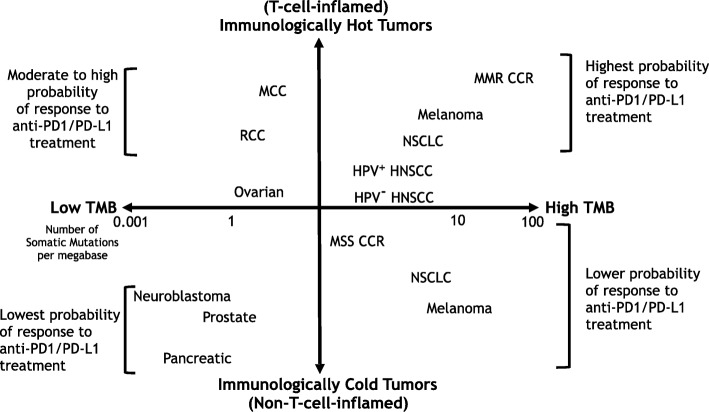
Tumors responding to immune checkpoint inhibitors (ICIs) have a higher level of immune infiltrates and/or an Interferon (IFN) signature indicative of a T-cell-inflamed phenotype. Melanoma and lung cancer demonstrate high response rates to ICIs and are commonly referred to as "hot tumors". These are in sharp contrast to tumors with low immune infiltrates called "cold tumors" or non-T-cell-inflamed cancers, such as those from the prostate and pancreas. Classification of tumors based on their immune phenotype can partially explain clinical response to ICIs. However, this model alone cannot fully explain the lack of response among many patients treated with ICIs.Dichotomizing tumors based on their mutation profile into high tumor mutation burden (TMB) or low TMB, such as many childhood malignancies, can also, to some extent, explain the clinical response to immunotherapy. This model mainly focuses on a tumor's genotype rather than its immune phenotype. High TMB tumors often have higher levels of neoantigens that can be recognized by the immune system. In the current era of immunotherapy, with the lack of definitive biomarkers, we need to evaluate tumors based on both their immune phenotype and genomic mutation profile to determine which patients have a higher likelihood of responding to treatment with ICIs.
Overview
The claims and statistics of this paper haven’t been checked yet.
Free: it reads the open-access text and checks the first 5 claims that cite a source we can check. Create a free account to check every claim.
Integrity signals
Registry
Cites
Statistics
Figures
Verification
Claims the paper makes
The claims and statistics of this paper haven’t been checked yet.
Free: it reads the open-access text and checks the first 5 claims that cite a source we can check. Create a free account to check every claim.
Claims other papers make about this one
Each is checked against this paper’s own text: does it say what the citing paper says it does?
In the citing paper
“Given this contribution of mutational burden to ICI efficacy, tumors with low mutational burdens, such as prostate and pancreatic cancers, might be expected to respond poorly to ICIs, and this is indeed the case (88).”
From Immune Checkpoint Inhibitors for the Treatment of Cancer: Clinical Impact and Mechanisms of Response and Resistance (2021) · cites this paper as [88]
Self-check
Percentages, sums and reported differences re-computed from the paper’s own numbers.
The self-check needs the paper’s full text.
Citations
Cites
Signatures of mutational processes in human cancer
Initiative, A. P. C. G., Alexandrov, L. B., ICGC Breast Cancer Consortium, ICGC MMML-Seq Consortium, PedBrain, I., Nik-Zainal, S., Wedge, D. C., Aparicio, S. A. J. R., Behjati, S., Biankin, A. V., et al. (2013) · Nature · doi:10.1038/nature12477 · Cited by 9,660 · cited 2×
“For example, ovarian cancer has a modest somatic mutation burden and is somewhat infiltrated by T-cells; however, it displays a low response rate to various ICIs [2 – 4].”
TGFβ attenuates tumour response to PD-L1 blockade by contributing to exclusion of T cells
Mariathasan, S., Turley, S. J., Nickles, D., Castiglioni, A., Yuen, K., Wang, Y., Kadel III, E. E., Koeppen, H., Astarita, J. L., Cubas, R., et al. (2018) · Nature · doi:10.1038/nature25501 · Cited by 5,400 · cited 1×
“This could be partially explained by the recent report that TGF β plays a crucial role in excluding T-cells from the tumor microenvironment [22].”
Elements of cancer immunity and the cancer–immune set point
Chen, D. S., & Mellman, I. (2017) · Nature · doi:10.1038/nature21349 · Cited by 5,352
Clonal neoantigens elicit T cell immunoreactivity and sensitivity to immune checkpoint blockade
McGranahan, N., Furness, A. J. S., Rosenthal, R., Ramskov, S., Lyngaa, R., Saini, S. K., Jamal-Hanjani, M., Wilson, G. A., Birkbak, N. J., Hiley, C. T., et al. (2016) · Science · doi:10.1126/science.aaf1490 · Cited by 3,065
Melanoma-intrinsic β-catenin signalling prevents anti-tumour immunity
Spranger, S., Bao, R., & Gajewski, T. F. (2015) · Nature · doi:10.1038/nature14404 · Cited by 2,830
Tumor Mutational Burden as an Independent Predictor of Response to Immunotherapy in Diverse Cancers
Goodman, A. M., Kato, S., Bazhenova, L., Patel, S. P., Frampton, G. M., Miller, V., Stephens, P. J., Daniels, G. A., & Kurzrock, R. (2017) · Molecular Cancer Therapeutics · doi:10.1158/1535-7163.mct-17-0386 · Cited by 2,264 · cited 1×
“Recently, TMB has been proposed as a biomarker of response to ICIs [10].”
Schadendorf, D., Hodi, F. S., Robert, C., Weber, J. S., Margolin, K., Hamid, O., Patt, D., Chen, T.-T., Berman, D. M., & Wolchok, J. D. (2015) · Journal of Clinical Oncology · doi:10.1200/jco.2014.56.2736 · Cited by 2,141 · cited 1×
“As one example, among advanced melanoma patients treated with ipili-mumab (an anti-CTLA-4 antibody), some remain alive ten years after treatment with this drug [1].”
Oncolytic virotherapy promotes intratumoral T cell infiltration and improves anti-PD-1 immunotherapy
Ribas, A., Dummer, R., Puzanov, I., VanderWalde, A., Andtbacka, R. H. I., Michielin, O., Olszanski, A. J., Malvehy, J., Cebon, J., Fernandez, E., et al. (2017) · Cell · doi:10.1016/j.cell.2017.08.027 · Cited by 1,520 · cited 1×
“…a cancer such as metastatic melanoma, which has high TMB, but is non-T-cell-inflamed (genomically high levels of mutations but phenotypically an immunologically cold tumor), can be rendered responsive to ICIs by treatment with a combination of oncolytic virus therapy and anti-PD-1 therapy [23].”
Targeting neoantigens to augment antitumour immunity
Yarchoan, M., Johnson, B. A., Lutz, E. R., Laheru, D. A., & Jaffee, E. M. (2017) · Nature Reviews Cancer · doi:10.1038/nrc.2016.154 · Cited by 997 · cited 1×
“However, the MCPyV positive-MCC tumors with low TMB have equivalent or higher response rates to ICIs than the MCPyV-negative MCC tumors [15].”
Turajlic, S., Litchfield, K., Xu, H., Rosenthal, R., McGranahan, N., Reading, J. L., Wong, Y. N. S., Rowan, A., Kanu, N., Al Bakir, M., et al. (2017) · The Lancet Oncology · doi:10.1016/s1470-2045(17)30516-8 · Cited by 911 · cited 1×
“Although a high prevalence of insertions and deletions (indels) can result in the formation of some neoantigens, RCC still has a significantly lower burden of somatic mutations than melanoma and NSCLC (true high TMB tumors) [13].”
Cited by
Items 101–200 of 626
Zhao, L., Li, D., Zhang, Y., Huang, Q., Zhang, Z., Chen, C., Xu, C., Chu, X., Zhang, Y., & Yang, X. (2022) · ACS Nano · doi:10.1021/acsnano.2c01885 · Cited by 48
Zuniga, L. A., Leßmann, T., Uppal, K., Bisek, N., Hong, E., Rasmussen, C. E., Karlsson, J.-J., Zettler, J., Holten-Andersen, L., Bang, K., et al. (2022) · Cancer Cell International · doi:10.1186/s12935-022-02708-6 · Cited by 48
Mismatch repair deficiency is rare in bone and soft tissue tumors
Lam, S. W., Kostine, M., de Miranda, N. F. C. C., Schöffski, P., Lee, C., Morreau, H. M., & Bovée, J. V. M. G. (2021) · Histopathology · doi:10.1111/his.14377 · Cited by 47
“Also, PDL1 expression alone was not a predictive biomarker.47,48,57 Clearly, there is an urgent need for predictive biomarkers, and it remains to be answered if the MMR status contributes to the selection of patients who will respond to ICI.”
BackgroundInfluentialSun, J., Wan, Z., Xu, J., Luo, Z., Ren, P., Zhang, B., Diao, D., Huang, Y., & Li, S. (2020) · Biomaterials · doi:10.1016/j.biomaterials.2020.120629 · Cited by 46
Evolving Status of Clinical Immunotherapy with Oncolytic Adenovirus
Farrera-Sal, M., Moya-Borrego, L., Bazán‐Peregrino, M., & Alemany, R. (2021) · Clinical Cancer Research · doi:10.1158/1078-0432.ccr-20-1565 · Cited by 47
“(3) Adenoviruses could infect cells through CAR/integrins mechanism.”
BackgroundHansen, S. B., Unal, B., Kuzu, O. F., & Saatcioglu, F. (2024) · Theranostics · doi:10.7150/thno.100555 · Cited by 45
“Melanomas, non-small cell lung cancer (NSCLC), and liver cancer, are considered immunologically hot tumors, whereas cancers such as PCa, breast cancer, and pancreatic cancer are recognized as immunologically cold [17-19].”
BackgroundTackling hepatocellular carcinoma with individual or combinatorial immunotherapy approaches
Tagliamonte, M., Mauriello, A., Cavalluzzo, B., Ragone, C., Manolio, C., Petrizzo, A., & Buonaguro, L. (2019) · Cancer Letters · doi:10.1016/j.canlet.2019.12.029 · Cited by 45
Choi, J., Lee, H. J., Yoon, S., Ryu, H.-M., Lee, E., Jo, Y., Seo, S., Kim, D., Lee, C. H., Kim, W., et al. (2020) · PubMed · Cited by 45
Epigenomics and immunotherapeutic advances in pediatric brain tumors
Abedalthagafi, M., Mobark, N. A., Alrashed, M. M., & Alharbi, M. (2021) · npj Precision Oncology · doi:10.1038/s41698-021-00173-4 · Cited by 45
Chaurasiya, S., Yang, A., Kang, S., Lü, J., Kim, S., Park, A. K., Sivanandam, V., Zhang, Z., Woo, Y., Warner, S. G., et al. (2020) · OncoImmunology · doi:10.1080/2162402x.2020.1729300 · Cited by 44
He, M., Henderson, M., Muth, S. T., Murphy, A. G., & Zheng, L. (2020) · Annals of Pancreatic Cancer · doi:10.21037/apc.2020.03.03 · Cited by 44
“Such property of human PDAC partially explains the negative outcome of immune checkpoint inhibitors in clinical settings (56).”
BackgroundPollini, T., Adsay, V., Capurso, G., Molin, M. D., Esposito, I., Hruban, R. H., Luchini, C., Maggino, L., Matthaei, H., Marchegiani, G., et al. (2022) · The Lancet. Gastroenterology & hepatology · doi:10.1016/s2468-1253(22)00235-7 · Cited by 44
Fabian, K. P., Kowalczyk, J. T., Reynolds, S. T., & Hodge, J. W. (2022) · Cells · doi:10.3390/cells11233826 · Cited by 44
Guo, X., Yang, Z., Guo, Z., Lai, H., Meng, H., Meng, M., Li, T., Li, Z., Chen, J., Feng, Y., et al. (2025) · Advanced Materials · doi:10.1002/adma.202410998 · Cited by 42
Caisová, V., Li, L., Gupta, G., Jochmanová, I., Jha, A., Uher, O., Huynh, T., Miettinen, M., Pang, Y. K., Abunimer, L., et al. (2019) · Cancers · doi:10.3390/cancers11050654 · Cited by 42
Zheng, B., Ma, J., Tian, L., Dong, L., Song, G., Pan, J., Liu, Y., Yang, S., Wang, X., Zhang, X., et al. (2020) · Clinical and Translational Medicine · doi:10.1002/ctm2.11 · Cited by 42
Gui, J., Guo, Z., & Wu, D. (2022) · Journal of Translational Medicine · doi:10.1186/s12967-022-03532-2 · Cited by 41
“Furthermore, CM has high levels of tumor mutational burden (TMB).”
BackgroundInfluentialThe dark side of immunotherapy: pancreatic cancer
Mucciolo, G., Roux, C., Scagliotti, A., Brugiapaglia, S., Novelli, F., & Cappello, P. (2020) · Cancer Drug Resistance · doi:10.20517/cdr.2020.13 · Cited by 41
“antigenic and immunogenic and thus potentially more sensitive to immunotherapy([221]).”
BackgroundFlickinger, J. C., Singh, J., Carlson, R. D., Leong, E., Baybutt, T. R., Barton, J. R., Caparosa, E. M., Pattison, A. M., Rappaport, J. A., Roh, J. W., et al. (2020) · Journal for ImmunoTherapy of Cancer · doi:10.1136/jitc-2020-001046 · Cited by 40
Benoit, A., Vogin, G., Duhem, C., Berchem, G., & Janji, B. (2023) · Cells · doi:10.3390/cells12131787 · Cited by 39
Zhou, Y., Zhu, G., Lu, X., Zheng, K. I., Wang, Q.-W., Chen, J.-N., Zhang, Q., Yan, F., & Li, X. (2020) · Cancer Immunology Immunotherapy · doi:10.1007/s00262-020-02525-8 · Cited by 39
miRNA-Based Signature Associated With Tumor Mutational Burden in Colon Adenocarcinoma
Xue, W., Wang, Y., Gong, Z., Yang, C., Xie, Y., Guan, C., Wei, C., 牛兆健, & Zhu, C. (2021) · Frontiers in Oncology · doi:10.3389/fonc.2021.634841 · Cited by 39
“This protein is recognized by the immune system as “non-self” and this activates a specific antitumor immune response as a new tumor-specific antigen, increasing the probability of these tumor cells being killed (15).”
BackgroundEnhancing Tumor Immunotherapy by Multivalent Anti‐PD‐L1 Nanobody Assembled via Ferritin Nanocage
Liu, M., Jin, D., Yu, W., Yu, J., Cao, K., Cheng, J., Zheng, X., Wang, A. Z., & Liu, Y. (2024) · Advanced Science · doi:10.1002/advs.202308248 · Cited by 39
A Pan-Cancer Approach to Predict Responsiveness to Immune Checkpoint Inhibitors by Machine Learning
Polano, M., Chierici, M., Bo, M. D., Gentilini, D., Cintio, F. D., Baboçi, L., Gibbs, D. L., Furlanello, C., & Toffoli, G. (2019) · Cancers · doi:10.3390/cancers11101562 · Cited by 39
Newton, H. S., Gawali, V. S., Chimote, A. A., Lehn, M. A., Palackdharry, S. M., Hinrichs, B. H., Jandarov, R., Hildeman, D. A., Janssen, E. M., Wise-Draper, T. M., et al. (2020) · Journal for ImmunoTherapy of Cancer · doi:10.1136/jitc-2020-000844 · Cited by 39
Sheth, S. H., Gao, C., Mueller, N. K., Angra, N., Gupta, A. K., Germa, C., Martínez, P., & Soria, J. (2020) · Journal for ImmunoTherapy of Cancer · doi:10.1136/jitc-2020-000650 · Cited by 39
Loupakis, F., Maddalena, G., Depetris, I., Murgioni, S., Bergamo, F., Tos, A. P. D., Rugge, M., Munari, G., Nguyen, A., Szeto, C. W., et al. (2019) · Journal for ImmunoTherapy of Cancer · doi:10.1186/s40425-019-0788-5 · Cited by 38
“In mCRC, TMB is correlated with MSI status [24] and recent data suggest a role as an independent biomarker of ICI efficacy [25].”
BackgroundSmazynski, J., Hamilton, P. T., Thornton, S., Milne, K., Wouters, M. C. A., Webb, J. R., & Nelson, B. H. (2020) · Gynecologic Oncology · doi:10.1016/j.ygyno.2020.04.689 · Cited by 38
Therapy-Induced Tumor Cell Death: Friend or Foe of Immunotherapy?
van Schaik, T., Chen, K., & Shah, K. (2021) · Frontiers in Oncology · doi:10.3389/fonc.2021.678562 · Cited by 38
Overcoming Immune Resistance in Prostate Cancer: Challenges and Advances
Movassaghi, M., Chung, R., Anderson, C. B., Stein, M. N., Saenger, Y. M., & Faiena, I. (2021) · Cancers · doi:10.3390/cancers13194757 · Cited by 38
Advances and prospects of mRNA vaccines in cancer immunotherapy
Liu, Y., Yan, Q., Zeng, Z., Fan, C., & Xiong, W. (2024) · Biochimica et Biophysica Acta (BBA) - Reviews on Cancer · doi:10.1016/j.bbcan.2023.189068 · Cited by 37
Vicier, C. E., Ravi, P. K., Kwak, L., Werner, L. L., Huang, Y., Evan, C. P., Loda, M. F., Hamid, A., & Sweeney, C. J. (2020) · The Prostate · doi:10.1002/pros.24079 · Cited by 37
Immune characterization of pre-clinical murine models of neuroblastoma
Webb, E. R., Lanati, S., Wareham, C., Easton, A., Dunn, S. N., Inzhelevskaya, T., Sadler, F. M., James, S., Ashton‐Key, M., Cragg, M. S., et al. (2020) · Scientific Reports · doi:10.1038/s41598-020-73695-9 · Cited by 37
Ion Channels Orchestrate Pancreatic Ductal Adenocarcinoma Progression and Therapy
Hofschröer, V., Najder, K., Rugi, M., Bouazzi, R., Cozzolino, M., Arcangeli, A., Panyi, G., & Schwab, A. (2021) · Frontiers in Pharmacology · doi:10.3389/fphar.2020.586599 · Cited by 37
Strategies to Overcome Failures in T-Cell Immunotherapies by Targeting PI3K-δ and –γ
Chandrasekaran, S., Funk, C. R., Kleber, T. J., Paulos, C. M., Shanmugam, M., & Waller, E. K. (2021) · Frontiers in Immunology · doi:10.3389/fimmu.2021.718621 · Cited by 38
Strategies for Heating Up Cold Tumors to Boost Immunotherapies
Zabransky, D. J., Yarchoan, M. M., & Jaffee, E. M. (2023) · Annual Review of Cancer Biology · doi:10.1146/annurev-cancerbio-061421-040258 · Cited by 38
Immunological Network in Head and Neck Squamous Cell Carcinoma—A Prognostic Tool Beyond HPV Status
Fialová, A., Koucký, V., Hajdůšková, M., Hladíková, K., & Špíšek, R. (2020) · Frontiers in Oncology · doi:10.3389/fonc.2020.01701 · Cited by 38
“In general, tumors with high TMB express higher levels of neoantigens that can be recognized by the immune system (12).”
BackgroundThe Role of Chemokine Receptor CXCR3 and Its Ligands in Renal Cell Carcinoma
Gudowska-Sawczuk, M., Kudelski, J., & Mroczko, B. (2020) · International Journal of Molecular Sciences · doi:10.3390/ijms21228582 · Cited by 36
Santiago-Sánchez, G. S., Fabian, K. P., & Hodge, J. W. (2024) · Cancer Biology & Therapy · doi:10.1080/15384047.2024.2308097 · Cited by 36
“91,95 Whereas high ORR and OS are associated with tumors with TMB-H, cancers categorized as low TMB (TMB-L), defined as ≤5 mutations per Mb, 38,91 such as pancreatic cancer and triple-negative breast cancer (TNBC), have a low probability of response to ICIs and manifest as primary or acquired resistance.”
BackgroundInfluentialJiang, X., Luo, T., Yang, K., Lee, M. J., Liu, J., Tillman, L., Zhen, W., Weichselbaum, R. R., & Lin, W. (2024) · Science Advances · doi:10.1126/sciadv.ado0082 · Cited by 36
“Thus, OX/GA exhibited potent antitumor effects in the immunologically cold orthotopic pancreatic tumor model ( 41 ).”
Jiang, J., Ding, Y., Wu, M., Chen, Y., Lyu, X., Lü, J., Wang, H., & Teng, L. (2020) · Cancer Medicine · doi:10.1002/cam4.3481 · Cited by 36
Immune Checkpoint Blockade in Gynecologic Cancers: State of Affairs
Drakes, M. L., Czerlanis, C. M., & Stiff, P. J. (2020) · Cancers · doi:10.3390/cancers12113301 · Cited by 36
Guerrisi, A., Russillo, M., Loi, E., Ganeshan, B., Ungania, S., Desiderio, F., Bruzzaniti, V., Falcone, I., Renna, D., Ferraresi, V., et al. (2021) · Frontiers in Oncology · doi:10.3389/fonc.2021.704607 · Cited by 36
Neoantigen-directed therapeutics in the clinic: where are we?
Lybaert, L., Thielemans, K., Feldman, S. A., van der Burg, S. H., Bogaert, C., & Ott, P. A. (2023) · Trends in cancer · doi:10.1016/j.trecan.2023.02.004 · Cited by 36
Backman, M., Fleur, L. L., Kurppa, P., Djureinovic, D., Elfving, H., Brunnström, H., Mattsson, J. S. M., Lindberg, A., Pontén, V., Eltahir, M., et al. (2021) · The Journal of Pathology · doi:10.1002/path.5772 · Cited by 35
Müller, M. D., Holst, P. J., & Nielsen, K. N. (2022) · International Journal of Molecular Sciences · doi:10.3390/ijms23031330 · Cited by 35
Immunotherapy for Metastatic Non-Small Cell Lung Cancer: Therapeutic Advances and Biomarkers
Russano, M., Cava, G. L., Cortellini, A., Citarella, F., Galletti, A., Fazio, G. R. D., Santo, V., Brunetti, L., Vendittelli, A., Fioroni, I., et al. (2023) · Current Oncology · doi:10.3390/curroncol30020181 · Cited by 36
Novel Mouse Models for Cancer Immunology
Connolly, K. A., Fitzgerald, B., Damo, M., & Joshi, N. S. (2022) · Annual Review of Cancer Biology · doi:10.1146/annurev-cancerbio-070620-105523 · Cited by 34
Hu, P., Li, Y., Zhang, L., Lan, X., Ren, X., Liang, W., Wang, S., Wang, Y., Zhao, Y., Zhang, Y., et al. (2023) · Materials & Design · doi:10.1016/j.matdes.2023.112568 · Cited by 34
Gartrell, R. D., Chen, A., Rizk, E. M., Marks, D. K., Bogardus, M. H., Hart, T. D., Silverman, A. M., Bayan, C.-A. Y., Finkel, G. G., Barker, L. W., et al. (2020) · Cancer Research · doi:10.1158/0008-5472.can-19-2039 · Cited by 33
Feng, B., & Heß, J. (2021) · Cancers · doi:10.3390/cancers13051162 · Cited by 33
Distinct T helper cell-mediated antitumor immunity: T helper 2 cells in focus
Silva, R. C. M. C., Lopes, M. F., & Travassos, L. H. (2022) · Cancer Pathogenesis and Therapy · doi:10.1016/j.cpt.2022.11.001 · Cited by 33
Ellingsen, E. B., O'Day, S. J., Mezheyeuski, A., Gromadka, A., Clancy, T., Kristedja, T. S., Milhem, M. M., & Zakharia, Y. (2023) · Clinical Cancer Research · doi:10.1158/1078-0432.ccr-23-0416 · Cited by 33
“The lack of response in some highTMB patients underscores the multifactorial nature of immunotherapy response, where an immunosuppressive tumor microenvironment or a disruption in HLA-antigen presentation may have contributed to progression (31, 32).”
BackgroundWalter, K. R., Balko, J. M., & Hagan, C. R. (2020) · OncoImmunology · doi:10.1080/2162402x.2020.1758547 · Cited by 33
The pros and cons of interferons for oncolytic virotherapy
Geoffroy, K., & Bourgeois‐Daigneault, M. (2020) · Cytokine & Growth Factor Reviews · doi:10.1016/j.cytogfr.2020.07.002 · Cited by 32
Zhang, S., Gong, C., Ruiz-Martínez, Á., Wang, H., Davis-Marcisak, E. F., Deshpande, A. M., Popel, A. S., & Fertig, E. J. (2021) · ImmunoInformatics · doi:10.1016/j.immuno.2021.100002 · Cited by 34
“However, other studies have shown high TMB cannot guarantee patients’ responses to immunotherapy due to either the insufficient immune cell infiltration or therapeutic resistance resulting from tumor cell heterogeneity [12,13].”
BackgroundAdvances in immunotyping of colorectal cancer
Wu, Y., Jing, Z., Qu, Z., Yang, X., & Han, S. (2023) · Frontiers in Immunology · doi:10.3389/fimmu.2023.1259461 · Cited by 32
Tumor mutational burden and immune signatures interplay in renal cell carcinoma
Yakirevich, E., & Patel, N. R. (2020) · Annals of Translational Medicine · doi:10.21037/atm.2020.02.81 · Cited by 32
“The latter are referred to as “hot tumors” (15).”
BackgroundExercise to transform tumours from cold to hot and improve immunotherapy responsiveness
Hapuarachi, B. S., Danson, S. J., Wadsley, J., & Muthana, M. (2023) · Frontiers in Immunology · doi:10.3389/fimmu.2023.1335256 · Cited by 31
The Future of Personalized Cancer Vaccines
Martini, D. J., & Wu, C. J. (2025) · Cancer Discovery · doi:10.1158/2159-8290.cd-25-0300 · Cited by 31
Immunotherapy in prostate cancer: new horizon of hurdles and hopes
Tsaur, I., Brandt, M. P., Juengel, E., Manceau, C., & Ploussard, G. (2020) · World Journal of Urology · doi:10.1007/s00345-020-03497-1 · Cited by 31
“Due to a low TMB and T-cell-mediated inflammation, the probability that PCa responses to antiPD1/PD-L1 treatment is weak [30].”
BackgroundAddressing Resistance to Immune Checkpoint Inhibitor Therapy: An Urgent Unmet Need
Hu‐Lieskovan, S., Malouf, G. G., Jacobs, I. A., Chou, J., Liu, L., & Johnson, M. L. (2021) · Future Oncology · doi:10.2217/fon-2020-0967 · Cited by 32
Guidry, K., Vasudevaraja, V., Labbe, K. E., Mohamed, H., Serrano, J., Guidry, B. W., DeLorenzo, M., Zhang, H., Deng, J., Sahu, S., et al. (2022) · Clinical Cancer Research · doi:10.1158/1078-0432.ccr-22-0391 · Cited by 31
Colciago, R. R., Fischetti, I., Giandini, C., Rocca, E. L., Tiziana Rancati, T., Mateo, A. R., Colombo, M. P., Lozza, L., Chiodoni, C., Jachetti, E., et al. (2023) · Expert Review of Anticancer Therapy · doi:10.1080/14737140.2023.2173175 · Cited by 31
Lipid-based phagocytosis nanoenhancer for macrophage immunotherapy
Ramesh, A., Kumar, S., Nguyen, A. H., Brouillard, A., & Kulkarni, A. A. (2019) · Nanoscale · doi:10.1039/c9nr08670f · Cited by 31
Breaking the shield of solid tumors: a combined approach for enhanced efficacy of CAR-T cells
Khaliulin, M., Valiullina, A., Petukhov, A., Yuan, Y., Spada, S., & Bulatov, E. (2024) · Cancer Immunology Immunotherapy · doi:10.1007/s00262-024-03817-z · Cited by 30
Osteoimmuno-Oncology: Therapeutic Opportunities for Targeting Immune Cells in Bone Metastasis
Kähkönen, T. E., Halleen, J. M., & Bernoulli, J. (2021) · Cells · doi:10.3390/cells10061529 · Cited by 30
Sandström, N., Carannante, V., Olofsson, K., Sandoz, P. A., Moussaud-Lamodière, E. L., Seashore-Ludlow, B. A., van Ooijen, H., Verron, Q., Frisk, T. W., Takai, M., et al. (2022) · Cell Reports Methods · doi:10.1016/j.crmeth.2022.100256 · Cited by 30
“One area where it has proven challenging to predict patient responses using biomarkers is immunotherapy (Ameratunga et al., 2018; Chyuan et al., 2021; Fujii et al., 2018; Maleki Vareki, 2018; Maleki Vareki et al., 2017), where most treatments show significant percentages of non-responders across multiple cancer types…”
BackgroundVoutsadakis, I. A. (2019) · Targeted Oncology · doi:10.1007/s11523-019-00689-7 · Cited by 29
Guo, Y., Yang, J., Ren, K., Tian, X., Gao, H., Tian, X., Zhang, X., & Kan, Q. (2022) · Frontiers in Immunology · doi:10.3389/fimmu.2022.861525 · Cited by 31
Sato, S., Matsushita, H., Shintani, D., Kobayashi, Y., Fujieda, N., Yabuno, A., Nishikawa, T., Fujiwara, K., Kakimi, K., & Hasegawa, K. (2022) · BMC Cancer · doi:10.1186/s12885-022-09534-z · Cited by 28
Li, R., Zhan, Y., Ding, X., Cui, J., Han, Y., Zhang, J., Zhang, J., Li, W., Wang, L., & Jiang, J. (2023) · International Journal of Biological Sciences · doi:10.7150/ijbs.83599 · Cited by 28
Kane, S. R., Engelhart, A.-B. A., Guadagno, J., Jones, A.-B. A., Usoro, I., & Brutcher, A.-B. E. (2020) · Journal of the Advanced Practitioner in Oncology · doi:10.6004/jadpro.2020.11.7.4 · Cited by 27
“In contrast, PDAC is a “cold tumor” with low TMB and is consequently not responsive to immune checkpoint inhibitors, a situation that creates a challenge for the successful application of immunotherapy in these cancers (Vareki, 2018).”
BackgroundAppleton, K. M., Elrod, A. K., Lassahn, K. A., Shuford, S., Holmes, L. M., & DesRochers, T. M. (2021) · Cancer Immunology Immunotherapy · doi:10.1007/s00262-021-02849-z · Cited by 27
“Yet if the OC TIME is immunologically “hot” or T cell inflammed, there is a moderate to high probability of response to anti-PD-1/PD-L1 treatment [40].”
BackgroundPalermo, B., Bottero, M., Panetta, M., Faiella, A., Sperduti, I., Masi, S., Frisullo, G., Foddai, M. L., Cordone, I., Nisticò, P., et al. (2023) · OncoImmunology · doi:10.1080/2162402x.2023.2174721 · Cited by 27
Sun, J., Yao, H., Ren, X., Cui, L., Liu, L., Wang, G., & Tang, Z. (2024) · Nano Letters · doi:10.1021/acs.nanolett.4c00114 · Cited by 27
Biology of NSCLC: Interplay between Cancer Cells, Radiation and Tumor Immune Microenvironment
Tubin, S., Khan, M. K., Gupta, S., & Jeremic, B. M. (2021) · Cancers · doi:10.3390/cancers13040775 · Cited by 27
Resistance mechanisms to checkpoint inhibitors
Weiss, S. A., & Sznol, M. (2021) · Current Opinion in Immunology · doi:10.1016/j.coi.2021.02.001 · Cited by 27
Confronting Melanoma Radioresistance: Mechanisms and Therapeutic Strategies
Gorodetska, I., Schulz, A., Behre, G., & Dubrovska, A. (2025) · Cancers · doi:10.3390/cancers17162648 · Cited by 26
Intratumoral heterogeneity and immunotherapy resistance: clinical implications
Keenan, B. P., Yadav, M., Ansstas, G., Fabrizio, D. A., Murugesan, K., Montesion, M., Niyogi, D. G., Mellman, I., & Melero, I. (2025) · Annals of Oncology · doi:10.1016/j.annonc.2025.10.1239 · Cited by 26
Edwards, J. J., Ferguson, P. M., Lo, S., da Silva, I. P., Colebatch, A. J., Lee, H., Saw, R. P. M., Thompson, J. F., Menzies, A. M., Long, G. V., et al. (2020) · Cancer Immunology Research · doi:10.1158/2326-6066.cir-19-0835 · Cited by 26
“This theory is based on (i) the observation that tumor types displaying a high TMB are generally more immunogenic (able to generate an immune response and have greater TILs) than low TMB tumor types (7), (ii) tumors with higher TMB are generally more responsive to anti–PD-1 checkpoint inhibitor immunotherapy (5, 8, 9)…”
BackgroundMethodHolbrook, M. C., Goad, D. W., & Grdzelishvili, V. Z. (2021) · Cancers · doi:10.3390/cancers13051171 · Cited by 26
Cuppens, K., Baas, P., Geerdens, E., Cruys, B., Froyen, G., Decoster, L., Thomeer, M., & Maes, B. (2022) · Lung Cancer · doi:10.1016/j.lungcan.2022.05.019 · Cited by 27
Understanding and Overcoming Immunosuppression Shaped by Cancer Stem Cells
Li, L., & Jensen, R. A. (2023) · Cancer Research · doi:10.1158/0008-5472.can-23-0230 · Cited by 26
Dual anti-PD-(L)1/TGF-β inhibitors in cancer immunotherapy – Updated
Karami, Z., Mortezaee, K., & Majidpoor, J. (2023) · International Immunopharmacology · doi:10.1016/j.intimp.2023.110648 · Cited by 26
Understanding and overcoming resistance to immunotherapy in genitourinary cancers
Evans, S. T., Jani, Y. C., Jansen, C. S., Yıldırım, A., Kalemoglu, E., & Bilen, M. A. (2024) · Cancer Biology & Therapy · doi:10.1080/15384047.2024.2342599 · Cited by 27
“46 In cases like metastatic renal cell carcinoma and polyomavirus-positive Merkel cell carcinoma, patients have still responded positively to ICIs despite their low TMB. 47 Thus, although a high TMB is generally associated with better response to ICIs, the interplay between mutational burden and…”
BackgroundDNA vaccines as promising immuno-therapeutics against cancer: a new insight
Shariati, A., Khezrpour, A., Shariati, F. S., Afkhami, H., Yarahmadi, A., Alavimanesh, S., Kamrani, S., Modarressi, M. H., & Khani, P. (2025) · Frontiers in Immunology · doi:10.3389/fimmu.2024.1498431 · Cited by 26
Changing the History of Prostate Cancer with New Targeted Therapies
Polo, S. H., Muñoz, D. M., Rosero, A., Ruiz, J. S., Rodriguez, D. I. R., & Couñago, F. (2021) · Biomedicines · doi:10.3390/biomedicines9040392 · Cited by 28
MCAM/MUC18/CD146 as a Multifaceted Warning Marker of Melanoma Progression in Liquid Biopsy
Rapanotti, M. C., Cugini, E., Nuccetelli, M., Terrinoni, A., Raimondo, C. D., Lombardo, P., Costanza, G., Cosio, T., Rossi, P., Orlandi, A., et al. (2021) · International Journal of Molecular Sciences · doi:10.3390/ijms222212416 · Cited by 26
Jahromi, A. H., Barkauskas, D. A., Zabel, M. K., Goodman, A. M., Frampton, G. M., Nikanjam, M., Hoh, C. K., & Kurzrock, R. (2020) · EJNMMI Research · doi:10.1186/s13550-020-00732-z · Cited by 25
Immunotherapy in Advanced Prostate Cancer: Current Knowledge and Future Directions
López‐Campos, F., Gajate, P., Romero-Laorden, N., Zafra, J., Juan, M., Polo, S. H., Conde-Moreno, A. J., & Couñago, F. (2022) · Biomedicines · doi:10.3390/biomedicines10030537 · Cited by 25
Chen, X., Liu, Y., Tao, B.-Y., Xue, X., Zhang, X., Wang, L., Zhong, H., Zhang, J., Yang, S., & Jiang, Q. (2022) · Frontiers in Immunology · doi:10.3389/fimmu.2022.975847 · Cited by 25
“NAL and TMB are promising biomarkers for predicting the efficacy of ICIs (79, 80).”
BackgroundNguyen, C. M., Vu, T. T., Nguyen, M. N., Tran-Nguyen, T.-S., Huynh, C. T., Ha, Q. T., Nguyen, H., & Tran, L. S. (2025) · Cancer Immunology Immunotherapy · doi:10.1007/s00262-025-03992-7 · Cited by 24
Knowledge mapping and current trends of immunotherapy for prostate cancer: A bibliometric study
Zhong, W., Shen, Z., Wu, Y., Mao, X., Kong, J., & Wu, W. (2022) · Frontiers in Immunology · doi:10.3389/fimmu.2022.1014981 · Cited by 24
Miyake, M., Hori, S., Owari, T., Oda, Y., Tatsumi, Y., Nakai, Y., Fujii, T., & Fujimoto, K. (2020) · Cancers · doi:10.3390/cancers12113153 · Cited by 24
de Porras, V. R., Pardo, J. C., Notario, L., Etxániz, O., & Pous, A. F. (2021) · International Journal of Molecular Sciences · doi:10.3390/ijms22094712 · Cited by 24
“3% of advanced PC tumors have a high TMB, which represents a significant obstacle for immunotherapy efficacy in these patients [54,55].”
BackgroundLundgren, S., Micke, P., Elebro, J., Heby, M., Hrynchyk, I., Nodin, B., Leandersson, K., Mezheyeuski, A., & Jirström, K. (2020) · Frontiers in Immunology · doi:10.3389/fimmu.2020.558169 · Cited by 24
“There is, however, increasing evidence that a high mutational burden does not always correspond to an immunologically “hot” tumor and, hence, an effective anti-tumoral immune response (8).”
BackgroundCheng, H., Zhao, L., & Cai, J. (2025) · Materials Today Bio · doi:10.1016/j.mtbio.2025.101894 · Cited by 23
“Immunotherapeutic strategies, such as PD-1/PD-L1 immune check-point inhibition, have demonstrated potential; however, they frequently falter when confronted with malignancies marked by sparse immune cell infiltration, exemplified by cold tumors like prostate cancer [60,61].”
Zhang, W., Xu, H., Qiao, R., Zhong, B., Zhang, X., Gu, J., Zhang, X., Wei, L., & Wang, X. (2021) · Briefings in Bioinformatics · doi:10.1093/bib/bbab362 · Cited by 23
Intron-Retention Neoantigen Load Predicts Favorable Prognosis in Pancreatic Cancer
Dong, C., Reiter, J. L., Dong, E., Wang, Y., Lee, K. P., Lu, X., & Liu, Y. (2022) · JCO Clinical Cancer Informatics · doi:10.1200/cci.21.00124 · Cited by 23
“One explanation for why PDAC responds poorly to ICB therapy is a low TMB.(11) However, recent studies have shown that some PDAC tumors do express neoantigens and exhibit T-cell infiltration.”
BackgroundInfluential
Metadata
- Authors
- Maleki Vareki, S.
- Venue
- Journal for ImmunoTherapy of Cancer
- Publisher
- BMJ
- Published
- 2018-12
- Volume
- 6
- Issue
- 1
- Pages
- 157-157
- ISSN
- 2051-1426 (ISSN-L)
- PMC
- PMC6307306
- OpenAlex
- W2905817704
- Cited by
- 569
- References
- 26
- Citations by year
- 2026: 34 · 2025: 68 · 2024: 73 · 2023: 82 · 2022: 102 · 2021: 96 · 2020: 88 · 2019: 26
- FWCI
- 19.69
- Type
- journal article
- Language
- en
- Open access
- gold
- doi.org
- Licence
- cc-by
- creativecommons.org/licenses/by/4.0/ (tdm)
- Locations
- Journal for ImmunoTherapy of Cancer (publishedVersion, cc-by)
- Europe PMC (PubMed Central) (publishedVersion, cc-by)
- PubMed Central (publishedVersion, cc-by)
- PubMed (publishedVersion)
- DOAJ (DOAJ: Directory of Open Access Journals) (submittedVersion)
- Funders
- Institute of Cancer Research (MOP#389137)
- Topics
- Health Sciences › Medicine › Oncology › Cancer Immunotherapy and Biomarkers
- Life Sciences › Immunology and Microbiology › Immunology › Immunotherapy and Immune Responses
- Life Sciences › Biochemistry, Genetics and Molecular Biology › Cancer Research › Cancer Genomics and Diagnostics
- Keywords
- tumor mutational burden, immune checkpoint inhibitors, tumor immune phenotype, interferon signature, T cell infiltration, neoantigens, immunotherapy response prediction, biomarkers, melanoma, lung cancer, pediatric malignancies
- MeSH terms
- Antineoplastic Agents, Immunological, Genotype, Humans, Mutation, Neoplasms, Phenotype, T-Lymphocytes, Biomarkers
About these checks
Registry, retraction, Cites and statistics results are computed, not judged, with one exception: a printed reference that no index lists is read once by a model before it counts as a citation error. Claims are extracted by a model and kept only when their quote appears verbatim in the text; each cited source is then checked, with a model’s help, for whether it says what the claim relies on. Those verdicts can be wrong — read the claim’s quote and the cited source before relying on one.
Statistics and arithmetic are recomputed, not judged.
Confidence bands are shown only for fields calibrated on our annotated test set. None is calibrated yet, so no band is shown.
What counts as a claim ›How we measure confidence ›How we check this ›
Are you an author, or do you see a problem with this page? Request a review
Data sources
Bibliographic data: Semantic Scholar, OpenAlex, Crossref.
Contains information from the Semantic Scholar Academic Graph Datasets, made available under the ODC Attribution License (ODC-BY 1.0).
Semantic Scholar’s data is described in: Kinney, R., et al. (2023). The Semantic Scholar Open Data Platform. arXiv:2301.10140.
