

High and low mutational burden tumors versus immunologically hot and cold tumors and response to immune checkpoint inhibitors
Open accessThe DOI matches its Crossref record; 26 of the 26 references it cites were found in a registry or an index.
Abstract
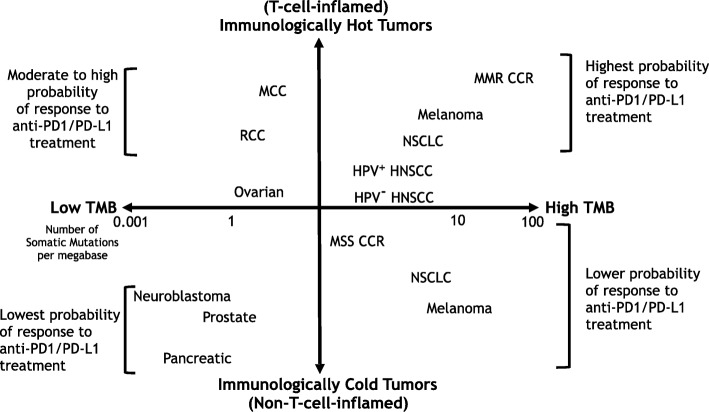
Tumors responding to immune checkpoint inhibitors (ICIs) have a higher level of immune infiltrates and/or an Interferon (IFN) signature indicative of a T-cell-inflamed phenotype. Melanoma and lung cancer demonstrate high response rates to ICIs and are commonly referred to as "hot tumors". These are in sharp contrast to tumors with low immune infiltrates called "cold tumors" or non-T-cell-inflamed cancers, such as those from the prostate and pancreas. Classification of tumors based on their immune phenotype can partially explain clinical response to ICIs. However, this model alone cannot fully explain the lack of response among many patients treated with ICIs.Dichotomizing tumors based on their mutation profile into high tumor mutation burden (TMB) or low TMB, such as many childhood malignancies, can also, to some extent, explain the clinical response to immunotherapy. This model mainly focuses on a tumor's genotype rather than its immune phenotype. High TMB tumors often have higher levels of neoantigens that can be recognized by the immune system. In the current era of immunotherapy, with the lack of definitive biomarkers, we need to evaluate tumors based on both their immune phenotype and genomic mutation profile to determine which patients have a higher likelihood of responding to treatment with ICIs.
Overview
The claims and statistics of this paper haven’t been checked yet.
Free: it reads the open-access text and checks the first 5 claims that cite a source we can check. Create a free account to check every claim.
Integrity signals
Registry
Cites
Statistics
Figures
Verification
Claims the paper makes
The claims and statistics of this paper haven’t been checked yet.
Free: it reads the open-access text and checks the first 5 claims that cite a source we can check. Create a free account to check every claim.
Claims other papers make about this one
Each is checked against this paper’s own text: does it say what the citing paper says it does?
In the citing paper
“Given this contribution of mutational burden to ICI efficacy, tumors with low mutational burdens, such as prostate and pancreatic cancers, might be expected to respond poorly to ICIs, and this is indeed the case (88).”
From Immune Checkpoint Inhibitors for the Treatment of Cancer: Clinical Impact and Mechanisms of Response and Resistance (2021) · cites this paper as [88]
Self-check
Percentages, sums and reported differences re-computed from the paper’s own numbers.
The self-check needs the paper’s full text.
Citations
Cites
Signatures of mutational processes in human cancer
Initiative, A. P. C. G., Alexandrov, L. B., ICGC Breast Cancer Consortium, ICGC MMML-Seq Consortium, PedBrain, I., Nik-Zainal, S., Wedge, D. C., Aparicio, S. A. J. R., Behjati, S., Biankin, A. V., et al. (2013) · Nature · doi:10.1038/nature12477 · Cited by 9,660 · cited 2×
“For example, ovarian cancer has a modest somatic mutation burden and is somewhat infiltrated by T-cells; however, it displays a low response rate to various ICIs [2 – 4].”
TGFβ attenuates tumour response to PD-L1 blockade by contributing to exclusion of T cells
Mariathasan, S., Turley, S. J., Nickles, D., Castiglioni, A., Yuen, K., Wang, Y., Kadel III, E. E., Koeppen, H., Astarita, J. L., Cubas, R., et al. (2018) · Nature · doi:10.1038/nature25501 · Cited by 5,400 · cited 1×
“This could be partially explained by the recent report that TGF β plays a crucial role in excluding T-cells from the tumor microenvironment [22].”
Elements of cancer immunity and the cancer–immune set point
Chen, D. S., & Mellman, I. (2017) · Nature · doi:10.1038/nature21349 · Cited by 5,352
Clonal neoantigens elicit T cell immunoreactivity and sensitivity to immune checkpoint blockade
McGranahan, N., Furness, A. J. S., Rosenthal, R., Ramskov, S., Lyngaa, R., Saini, S. K., Jamal-Hanjani, M., Wilson, G. A., Birkbak, N. J., Hiley, C. T., et al. (2016) · Science · doi:10.1126/science.aaf1490 · Cited by 3,065
Melanoma-intrinsic β-catenin signalling prevents anti-tumour immunity
Spranger, S., Bao, R., & Gajewski, T. F. (2015) · Nature · doi:10.1038/nature14404 · Cited by 2,830
Tumor Mutational Burden as an Independent Predictor of Response to Immunotherapy in Diverse Cancers
Goodman, A. M., Kato, S., Bazhenova, L., Patel, S. P., Frampton, G. M., Miller, V., Stephens, P. J., Daniels, G. A., & Kurzrock, R. (2017) · Molecular Cancer Therapeutics · doi:10.1158/1535-7163.mct-17-0386 · Cited by 2,264 · cited 1×
“Recently, TMB has been proposed as a biomarker of response to ICIs [10].”
Schadendorf, D., Hodi, F. S., Robert, C., Weber, J. S., Margolin, K., Hamid, O., Patt, D., Chen, T.-T., Berman, D. M., & Wolchok, J. D. (2015) · Journal of Clinical Oncology · doi:10.1200/jco.2014.56.2736 · Cited by 2,141 · cited 1×
“As one example, among advanced melanoma patients treated with ipili-mumab (an anti-CTLA-4 antibody), some remain alive ten years after treatment with this drug [1].”
Oncolytic virotherapy promotes intratumoral T cell infiltration and improves anti-PD-1 immunotherapy
Ribas, A., Dummer, R., Puzanov, I., VanderWalde, A., Andtbacka, R. H. I., Michielin, O., Olszanski, A. J., Malvehy, J., Cebon, J., Fernandez, E., et al. (2017) · Cell · doi:10.1016/j.cell.2017.08.027 · Cited by 1,520 · cited 1×
“…a cancer such as metastatic melanoma, which has high TMB, but is non-T-cell-inflamed (genomically high levels of mutations but phenotypically an immunologically cold tumor), can be rendered responsive to ICIs by treatment with a combination of oncolytic virus therapy and anti-PD-1 therapy [23].”
Targeting neoantigens to augment antitumour immunity
Yarchoan, M., Johnson, B. A., Lutz, E. R., Laheru, D. A., & Jaffee, E. M. (2017) · Nature Reviews Cancer · doi:10.1038/nrc.2016.154 · Cited by 997 · cited 1×
“However, the MCPyV positive-MCC tumors with low TMB have equivalent or higher response rates to ICIs than the MCPyV-negative MCC tumors [15].”
Turajlic, S., Litchfield, K., Xu, H., Rosenthal, R., McGranahan, N., Reading, J. L., Wong, Y. N. S., Rowan, A., Kanu, N., Al Bakir, M., et al. (2017) · The Lancet Oncology · doi:10.1016/s1470-2045(17)30516-8 · Cited by 911 · cited 1×
“Although a high prevalence of insertions and deletions (indels) can result in the formation of some neoantigens, RCC still has a significantly lower burden of somatic mutations than melanoma and NSCLC (true high TMB tumors) [13].”
Cited by
Items 501–600 of 626
Aghajani, M. J., Yang, T., Schmitz, U., James, A. C., McCafferty, C. E., SOUZA, P. D., Niles, N., & Roberts, T. L. (2020) · Research Square · doi:10.21203/rs.3.rs-34509/v1
Li, P., Chen, Z., Wang, D., Zheng, Z. J., & Ji, Z. (2021) · Research Square · doi:10.21203/rs.3.rs-63592/v3
Bases biologiques de l’immunothérapie anti-cancéreuse
Soumelis, V., Medvedovic, J., & Hoffmann, C. (2022) · Revue des Maladies Respiratoires Actualités · doi:10.1016/s1877-1203(22)00097-0
朱, 谦. (2023) · Advances in Clinical Medicine · doi:10.12677/acm.2023.131143
Roles of Tumor Immune Microenvironment in Non-small Cell Lung Cancer
Esfandiyari, M. T., Balibegloo, M., & Rezaei, N. (2023) · Interdisciplinary cancer research · doi:10.1007/16833_2023_150
li, Z., Li, B., Meng, Y., Zhai, K., & Li, X. (2023) · bioRxiv (Cold Spring Harbor Laboratory) · doi:10.1101/2023.03.09.531978
“infiltration may be key to identifying tumors with cytotoxic immunophenotypes that are more likely to respond to PD-1 therapy (20).”
BackgroundFabian, K. P., Malamas, A. S., Padget, M. R., Solocinski, K., Wolfson, B., Fujii, R., Sater, H. A., Schlom, J., & Hodge, J. W. (2023) · doi:10.1158/2326-6066.c.6550240
Fabian, K. P., Malamas, A. S., Padget, M. R., Solocinski, K., Wolfson, B., Fujii, R., Sater, H. A., Schlom, J., & Hodge, J. W. (2023) · doi:10.1158/2326-6066.c.6550240.v1
Berzofsky, J. A., Olkhanud, P. B., & Maeng, H. M. (2023) · Elsevier eBooks · doi:10.1016/b978-0-323-79058-1.00014-1
Losada, J., Lasarte, A. S., Irizar, E., Maestro, B., Urizar, E. T., & Losada, I. (2023) · Clinics of Surgery · doi:10.47829/cos.2023.9604
Chaves, L. P. (2023) · Digital Library of Theses and Dissertations (Universidade de São Paulo) · doi:10.11606/d.17.2023.tde-08082023-145937
Pham, T. M. Q., Nguyễn, T. N., Nguyen, B. Q. T., Tran, T. P. D., Pham, N. M. D., Nguyen, H. T. P., Ho, T. K. C., Nguyen, D. V. L., Nguyen, H. T., Tran, D. H., et al. (2024) · eLife · doi:10.7554/elife.94658.3
Targeting transcriptional addiction in cutaneous melanoma
Cigrang, M. (2023) · theses.fr (ABES) · doi:10.70675/32a61798z3cd7z4cd8za2acza750367acaf5
Impact of EGFR pathway inhibition on immunogenicity of head and neck squamous cell carcinoma
Azevedo, J. D. (2022) · theses.fr (ABES) · doi:10.70675/b58b07d9z4d86z4d70zabf8z7a9954a8ec90
Immunotherapy of Solid Tumors Based on Neoantigen Vaccines
Aleebrahim‐Dehkordi, E., Jolfayi, A. G., & Rezaei, N. (2024) · Springer eBooks · doi:10.1007/978-3-030-80962-1_399-1
Zeng, C., Zhang, L., Luo, C., Yang, C. G., Huang, X., Fan, L., Li, J., Chen, F., & Luo, Z. (2022) · Figshare · doi:10.6084/m9.figshare.20003709
Yang, J., Hsu, T.-H., Chen, C., Yu, J.-H., Lin, K., & Chen, Y. (2024) · Molecular & Cellular Proteomics · doi:10.1016/j.mcpro.2024.100792
Learning from incomplete biomedical data : guiding the partition toward prognostic information
Faucheux, L. (2021) · theses.fr (ABES) · doi:10.70675/4f886ba4z7a20z4a7dz8585z934ab4013d1b
Decker, K. D. (2024) · University of Groningen research database (University of Groningen / Centre for Information Technology) · doi:10.33612/diss.1081510083
Bases biologiques de l’immunothérapie anti-cancéreuse
Mascaux, C., Pabst, L., Soumelis, V., Medvedovic, J., & Hoffmann, C. (2024) · Revue des Maladies Respiratoires Actualités · doi:10.1016/s1877-1203(24)00071-5
Immunotherapy with Checkpoint Inhibitors
Vickers, E. (2024) · Wiley eBooks · doi:10.1002/9781119834090.ch5
Advances in Prostate Cancer Immunotherapy: Current Options and Emerging Novel Approaches
Alanazi, N. S., & Alrafiah, M. H. (2024) · annals of urologic oncology · doi:10.32948/auo.2024.10.20
Pham, T. M. Q., Nguyễn, T. N., Nguyen, B. Q. T., Tran, T. P. T., Pham, N. M. D., Nguyen, H. T., Ho, T. K. C., Nguyen, D. V., Nguyen, H. T., Tran, D. H., et al. (2024) · eLife · doi:10.7554/elife.94658.3.sa2
Critères d’évaluation de la TEP au 18F-FDG au cours de l’immunothérapie
Hamdan, D., Anjorand, E., Bousquet, G., & Soussan, M. (2024) · Médecine Nucléaire · doi:10.1016/j.mednuc.2024.10.005
Current Strategies for the Development of a Therapeutic Cancer Vaccine – A Review
Bhaliya, K., Anwer, M., & Wei, M. Q. (2024) · Eastern Journal of Medical Sciences · doi:10.32677/ejms.v9i3.4659
“High numbers of tumor mutational burden usually develop higher immune checkpoint inhibition (ICI) [51,52].”
Dziubek, K., Faktor, J., Lokhande, K. B., Shrivastava, A., Papak, I., Chruściel, E., Pilch, M., Hupp, T., Marek-Trzonkowska, N. M., Singh, A., et al. (2024) · Cell Communication and Signaling · doi:10.1186/s12964-024-01935-w
“ICIs exhibit the most favorable outcomes in malignancies considered hot tumors characterized by high mutational burden and immune infiltrate, for example melanoma or non-small cell lung cancer (NSCLC) [27–30].”
New Insights in Veterinary Cancer Immunology
(2025) · Frontiers research topics · doi:10.3389/978-2-8325-5923-9
Lin, Z., Xu, H., Zhang, L., & Tian, G. (2025) · Serican Journal of Medicine · doi:10.17161/sjm.v2i2.23130
“The so-called immune phenotypes, which were classified based on TME, have attracted wide attention for their association with treatment response to ICIs [33, 34].”
Koruga, D. L., Kuhn, D., Matija, L., Stanković, I., & Dinić, A. (2025) · Preprints.org · doi:10.20944/preprints202503.1142.v1
From CMV to cancer : the immunological power of adaptive NK cells
Almazán, N. M. (2025) · doi:10.69622/28458692
Pietrzak, J., & Knopik-Skrocka, A. (2025) · Tutoring Gedanensis · doi:10.26881/tutg.2025.1.02
Li, M., Wu, S., Zeng, Y., & Xu, C. (2025) · ONCOLOGIE · doi:10.1515/oncologie-2025-0072
“Combination therapies with pembrolizumab demonstrate improved outcomes [13].”
Wang, J., Liu, T., Li, H., Hou, B., Zhao, Y., Kai, F., Tian, H., Li, Y., & Liu, B. (2025) · Computer Methods in Biomechanics & Biomedical Engineering · doi:10.1080/10255842.2025.2559045
Novik, A. V. N., Капуста, К. Ю., Нехаева, Т. Л., Danilova, A. B., Orekhov, A. V., Vasilev, E. V., Латипова, Д. Х., Semenova, A. I. S., Baboshkina, L. S., Teletaeva, G. M. T., et al. (2025) · Voprosy Onkologii · doi:10.37469/0507-3758-2025-71-4-of-2448
Immunotherapy of Solid Tumors Based on Neoantigen Vaccines
Aleebrahim‐Dehkordi, E., Jolfayi, A. G., & Rezaei, N. (2025) · Springer eBooks · doi:10.1007/978-3-032-00767-4_399
Ojwang’, A. M. E., Zahid, M. U., Aiurova, A., Nguyen, T., Alam, M. B. E., Harris, T., Dorta-Estremera, S. M., Sastry, K. J., Napravnik, T. C., Colbert, L. E., et al. (2025) · Journal for ImmunoTherapy of Cancer · doi:10.1136/jitc-2025-sitc2025.0110
Inoue, S., Koizumi, S., Yamazaki, N., Ichigozaki, Y., Kitagawa, H., Kiniwa, Y., Sato, S., Takai, T., Doi, R., Ito, T., et al. (2025) · International Journal of Clinical Oncology · doi:10.1007/s10147-025-02936-6
Horii, T., Orikawa, Y., Ohira, Y., Eta, R., Kobayashi, N., Sato, T., Watanabe, T., & Tanaka, T. (2023) · Figshare · doi:10.6084/m9.figshare.22616339
Zuniga, L. A., Leßmann, T., Uppal, K., Bisek, N., Hong, E., Rasmussen, C. E., Karlsson, J.-J., Zettler, J., Holten-Andersen, L., Bang, K., et al. (2022) · Figshare · doi:10.6084/m9.figshare.21171499
Zuniga, L. A., Leßmann, T., Uppal, K., Bisek, N., Hong, E., Rasmussen, C. E., Karlsson, J.-J., Zettler, J., Holten-Andersen, L., Bang, K., et al. (2022) · Figshare · doi:10.6084/m9.figshare.21171496
Zuniga, L. A., Leßmann, T., Uppal, K., Bisek, N., Hong, E., Rasmussen, C. E., Karlsson, J.-J., Zettler, J., Holten-Andersen, L., Bang, K., et al. (2022) · Figshare · doi:10.6084/m9.figshare.21171502
Liu, Q., Li, R., Wu, H., & Liang, Z. (2023) · Figshare · doi:10.6084/m9.figshare.22619240
Bündgen, G. (2022) · Gutenberg Open Science · doi:10.25358/openscience-7826
Stenström, J., Hedenfalk, I. A., & Hagerling, C. (2021) · Figshare · doi:10.6084/m9.figshare.14059770
Sato, S., Matsushita, H., Shintani, D., Kobayashi, Y., Fujieda, N., Yabuno, A., Nishikawa, T., Fujiwara, K., Kakimi, K., & Hasegawa, K. (2022) · Figshare · doi:10.6084/m9.figshare.19633822
Sato, S., Matsushita, H., Shintani, D., Kobayashi, Y., Fujieda, N., Yabuno, A., Nishikawa, T., Fujiwara, K., Kakimi, K., & Hasegawa, K. (2022) · Figshare · doi:10.6084/m9.figshare.19633819
Wu, Q., Tao, X., Luo, Y., Zheng, S., Lin, N., & Xie, X. (2024) · Figshare · doi:10.6084/m9.figshare.26611376
Lepper, A. (2025) · heiDOK (Heidelberg University) · doi:10.11588/heidok.00036613
Hasibuzzaman, M. M. (2024) · Iowa Research Online (The University of Iowa) · doi:10.25820/etd.007681
Stenström, J., Hedenfalk, I. A., & Hagerling, C. (2021) · Figshare · doi:10.6084/m9.figshare.14059758
Stenström, J., Hedenfalk, I. A., & Hagerling, C. (2021) · Figshare · doi:10.6084/m9.figshare.14059761
Stenström, J., Hedenfalk, I. A., & Hagerling, C. (2021) · Figshare · doi:10.6084/m9.figshare.14059773
Stenström, J., Hedenfalk, I. A., & Hagerling, C. (2021) · Figshare · doi:10.6084/m9.figshare.14059755
Wu, Q., Tao, X., Luo, Y., Zheng, S., Lin, N., & Xie, X. (2024) · Figshare · doi:10.6084/m9.figshare.26611397
Wu, Q., Tao, X., Luo, Y., Zheng, S., Lin, N., & Xie, X. (2024) · Figshare · doi:10.6084/m9.figshare.26611388
Wu, Q., Tao, X., Luo, Y., Zheng, S., Lin, N., & Xie, X. (2024) · Figshare · doi:10.6084/m9.figshare.26611385
Stenström, J., Hedenfalk, I. A., & Hagerling, C. (2021) · Figshare · doi:10.6084/m9.figshare.14059764
Zuniga, L. A., Leßmann, T., Uppal, K., Bisek, N., Hong, E., Rasmussen, C. E., Karlsson, J.-J., Zettler, J., Holten-Andersen, L., Bang, K., et al. (2022) · Figshare · doi:10.6084/m9.figshare.21171508
Wu, Q., Tao, X., Luo, Y., Zheng, S., Lin, N., & Xie, X. (2024) · Figshare · doi:10.6084/m9.figshare.26611394
Stenström, J., Hedenfalk, I. A., & Hagerling, C. (2021) · Figshare · doi:10.6084/m9.figshare.14059776
Zeng, C., Zhang, L., Luo, C., Yang, C., Huang, X., Fan, L., Li, J., Chen, F., & Luo, Z. (2022) · Figshare · doi:10.6084/m9.figshare.20003712
Fan, Y.-C., Fong, Y.-C., Kuo, C.-T., Li, C.-W., Chen, W.-Y., Lin, J.-D., Bürtin, F., Linnebacher, M., Bui, Q. T., Lee, K.-D., et al. (2023) · Figshare · doi:10.6084/m9.figshare.23930443
Wu, Q., Tao, X., Luo, Y., Zheng, S., Lin, N., & Xie, X. (2024) · Figshare · doi:10.6084/m9.figshare.26611382
Targeting MDSC-mediated immunosuppression in melanoma
Özbay Kurt, F. G. (2023) · heiDOK (Heidelberg University) · doi:10.11588/heidok.00033880
Targeting the Glucocorticoid Pathway Improves the Outcome of Immunotherapy in a Renal Cancer Model
Poinot, H. (2023) · Archive ouverte UNIGE (University of Geneva) · doi:10.13097/archive-ouverte/unige:172584
Sato, S., Matsushita, H., Shintani, D., Kobayashi, Y., Fujieda, N., Yabuno, A., Nishikawa, T., Fujiwara, K., Kakimi, K., & Hasegawa, K. (2022) · Figshare · doi:10.6084/m9.figshare.19633825
Horii, T., Orikawa, Y., Ohira, Y., Eta, R., Kobayashi, N., Sato, T., Watanabe, T., & Tanaka, T. (2023) · Figshare · doi:10.6084/m9.figshare.22616336
Wu, Q., Tao, X., Luo, Y., Zheng, S., Lin, N., & Xie, X. (2024) · Figshare · doi:10.6084/m9.figshare.26611379
Wu, Q., Tao, X., Luo, Y., Zheng, S., Lin, N., & Xie, X. (2024) · Figshare · doi:10.6084/m9.figshare.26611391
Sato, S., Matsushita, H., Shintani, D., Kobayashi, Y., Fujieda, N., Yabuno, A., Nishikawa, T., Fujiwara, K., Kakimi, K., & Hasegawa, K. (2022) · Figshare · doi:10.6084/m9.figshare.19633816
Wu, Q., Tao, X., Luo, Y., Zheng, S., Lin, N., & Xie, X. (2024) · Figshare · doi:10.6084/m9.figshare.26611400
García Sánchez, J. (2024) · Repository of Digital Objects for Teaching Research and Culture (University of Valencia)
Estudio de marcadores genéticos e inmunitarios relacionados con inmunoterapia en cáncer gástrico
Martín-Delgado, I. J. (2021) · Docta Complutense (Universidad Complutense de Madrid)
Bastos, N. (2024) · Portuguese National Funding Agency for Science, Research and Technology (RCAAP Project by FCT) · doi:10.34626/jwbw-ny56
Nanomedicine Approaches to Overcome Immune Escape in Cold Tumors: Mechanisms and Future Directions
Zheng, J. (2025) · Highlights in Science Engineering and Technology · doi:10.54097/16fwha40
“…which activate T cells through major histocompatibility complex class I molecules (MHC-I molecules), and pro-inflammatory factors (interferon-γ (IFN-γ), tumor necrosis factor-α (TNF-α)) drive the inflammatory microenvironment, resulting in a PD-1 inhibitor response rate of more than 30% [17].”
INIBIDORES DE PONTOS DE VERIFICAÇÃO IMUNE UTILIZADOS NO TRATAMENTO DO CÂNCER
Errante, P. R. (2023) · LA Referencia (Red Federada de Repositorios Institucionales de Publicaciones Científicas)
Towards the tumor microenvironment scoring methods for immune checkpoint inhibitor response
Zhou, Q., Kirshtein, A., & Shahriyari, L. (2026) · npj Precision Oncology · doi:10.1038/s41698-025-01221-z
“These tumor types are usually associated with “ hot ” immunophenotypes and higher response rates to ICI 78,79 , aligning with our enrichment analysis for the TIP Hot signature.”
Xudong, Z. H. U., Hao, S., CHENG, Z., & Fang, W. J. (2026) · Journal of Zhejiang University (Medical Sciences) · doi:10.3724/zdxbyxb-2025-0205
Su, S., Wu, B., Li, Y., Wang, X., Lou, F., Mei, Z., & Guo, L. (2026) · Clinical & Translational Oncology · doi:10.1007/s12094-026-04257-0
Martola, L. (2024) · Tampere University Institutional Repository (Tampere University)
Chen, J. H. K. (2022) · TSpace (University of Toronto)
Stephens, H. R., Elkins, E., Li, J., Swalley, Z. N., Ogbonna, H. N., Muri, P., Roberts, Z. J., Dempsey, F., Ali, M. A., Siam, M. H. B., et al. (2026) · The Journal of Immunology · doi:10.1093/jimmun/vkag013
Exercise to boost the immune system and optimise immunotherapy responsiveness
Hapuarachchi, S. B. (2025) · White Rose eTheses Online (University of Leeds, The University of Sheffield, University of York)
Ponzo, M. (2020) · theses.fr (ABES) · doi:10.70675/05815fd1z5314z4734z8240zd1a40c5a9bdf
Systems analysis of intercellular communication in the tumor microenvironment
Massenet-Regad, L. (2023) · theses.fr (ABES) · doi:10.70675/909b8153z00efz42f7za922z6b476829dbf2
Optimiser les bénéfices de l'immuno-oncologie dans les cancers de l'ovaire
Chardin, L. (2024) · theses.fr (ABES) · doi:10.70675/0937dcebzbfd6z45cfzaf35z6dbc578d9b29
Teng, Q., Cheng, S., Chen, J., Zhu, H., Hu, K., Sun, L., Zhao, J. S., Yuan, Z., Wang, W., Zhang, L., et al. (2026) · Frontiers in Oncology · doi:10.3389/fonc.2026.1714939
“Furthermore, insuf fi cient CD8 cell in fi ltration and a non-in fl ammatory tumor microenvironment (TME) can contribute to the failure of immunotherapy (14, 15).”
Barcan, I.-D., Stoia-Djeska, T.-S., Rakitovan, M., Zară, F., Cloşca, R. M., Cîndrea, A. C., Banța, A.-M., Militaru, A. G., Urechescu, H. C., & Horhat, D. I. (2026) · Diagnostics · doi:10.3390/diagnostics16091283
Song, J., Li, L., Ding, L., Yang, F., Mao, H., Wang, K., & Li, Q. (2026) · Frontiers in Immunology · doi:10.3389/fimmu.2026.1796402
Lu, X., Cui, X., Chen, H., Zhang, J., Zhao, S., Yang, B., Yang, Y., Du, N., Ma, W., An, J., et al. (2026) · Frontiers in Immunology · doi:10.3389/fimmu.2026.1795481
“These patients may require longer exposure to immunochemotherapy or immune checkpoint inhibitors to fully prime the immune system and recruit effector cells (36, 40 – 43).”
Clinical application of cytokine-induced killer cells in cancer immunotherapy
Ghorbani, F., Abbaszadeh, H., Yahyavi, Y., Talebi, M., & Shamsasenjan, K. (2026) · Cancer Cell International · doi:10.1186/s12935-026-04318-y
“This contrasts markedly with “hot” tumors such as melanoma and lung cancer, which demonstrate substantial immune infiltration [58].”
Metadata
- Authors
- Maleki Vareki, S.
- Venue
- Journal for ImmunoTherapy of Cancer
- Publisher
- BMJ
- Published
- 2018-12
- Volume
- 6
- Issue
- 1
- Pages
- 157-157
- ISSN
- 2051-1426 (ISSN-L)
- PMC
- PMC6307306
- OpenAlex
- W2905817704
- Cited by
- 569
- References
- 26
- Citations by year
- 2026: 34 · 2025: 68 · 2024: 73 · 2023: 82 · 2022: 102 · 2021: 96 · 2020: 88 · 2019: 26
- FWCI
- 19.69
- Type
- journal article
- Language
- en
- Open access
- gold
- doi.org
- Licence
- cc-by
- creativecommons.org/licenses/by/4.0/ (tdm)
- Locations
- Journal for ImmunoTherapy of Cancer (publishedVersion, cc-by)
- Europe PMC (PubMed Central) (publishedVersion, cc-by)
- PubMed Central (publishedVersion, cc-by)
- PubMed (publishedVersion)
- DOAJ (DOAJ: Directory of Open Access Journals) (submittedVersion)
- Funders
- Institute of Cancer Research (MOP#389137)
- Topics
- Health Sciences › Medicine › Oncology › Cancer Immunotherapy and Biomarkers
- Life Sciences › Immunology and Microbiology › Immunology › Immunotherapy and Immune Responses
- Life Sciences › Biochemistry, Genetics and Molecular Biology › Cancer Research › Cancer Genomics and Diagnostics
- Keywords
- tumor mutational burden, immune checkpoint inhibitors, tumor immune phenotype, interferon signature, T cell infiltration, neoantigens, immunotherapy response prediction, biomarkers, melanoma, lung cancer, pediatric malignancies
- MeSH terms
- Antineoplastic Agents, Immunological, Genotype, Humans, Mutation, Neoplasms, Phenotype, T-Lymphocytes, Biomarkers
About these checks
Registry, retraction, Cites and statistics results are computed, not judged, with one exception: a printed reference that no index lists is read once by a model before it counts as a citation error. Claims are extracted by a model and kept only when their quote appears verbatim in the text; each cited source is then checked, with a model’s help, for whether it says what the claim relies on. Those verdicts can be wrong — read the claim’s quote and the cited source before relying on one.
Statistics and arithmetic are recomputed, not judged.
Confidence bands are shown only for fields calibrated on our annotated test set. None is calibrated yet, so no band is shown.
What counts as a claim ›How we measure confidence ›How we check this ›
Are you an author, or do you see a problem with this page? Request a review
Data sources
Bibliographic data: Semantic Scholar, OpenAlex, Crossref.
Contains information from the Semantic Scholar Academic Graph Datasets, made available under the ODC Attribution License (ODC-BY 1.0).
Semantic Scholar’s data is described in: Kinney, R., et al. (2023). The Semantic Scholar Open Data Platform. arXiv:2301.10140.
