

High and low mutational burden tumors versus immunologically hot and cold tumors and response to immune checkpoint inhibitors
Open accessThe DOI matches its Crossref record; 26 of the 26 references it cites were found in a registry or an index.
Abstract
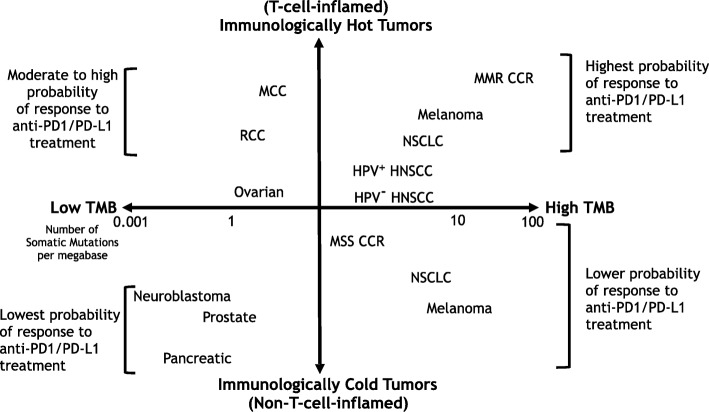
Tumors responding to immune checkpoint inhibitors (ICIs) have a higher level of immune infiltrates and/or an Interferon (IFN) signature indicative of a T-cell-inflamed phenotype. Melanoma and lung cancer demonstrate high response rates to ICIs and are commonly referred to as "hot tumors". These are in sharp contrast to tumors with low immune infiltrates called "cold tumors" or non-T-cell-inflamed cancers, such as those from the prostate and pancreas. Classification of tumors based on their immune phenotype can partially explain clinical response to ICIs. However, this model alone cannot fully explain the lack of response among many patients treated with ICIs.Dichotomizing tumors based on their mutation profile into high tumor mutation burden (TMB) or low TMB, such as many childhood malignancies, can also, to some extent, explain the clinical response to immunotherapy. This model mainly focuses on a tumor's genotype rather than its immune phenotype. High TMB tumors often have higher levels of neoantigens that can be recognized by the immune system. In the current era of immunotherapy, with the lack of definitive biomarkers, we need to evaluate tumors based on both their immune phenotype and genomic mutation profile to determine which patients have a higher likelihood of responding to treatment with ICIs.
Overview
The claims and statistics of this paper haven’t been checked yet.
Free: it reads the open-access text and checks the first 5 claims that cite a source we can check. Create a free account to check every claim.
Integrity signals
Registry
Cites
Statistics
Figures
Verification
Claims the paper makes
The claims and statistics of this paper haven’t been checked yet.
Free: it reads the open-access text and checks the first 5 claims that cite a source we can check. Create a free account to check every claim.
Claims other papers make about this one
Each is checked against this paper’s own text: does it say what the citing paper says it does?
In the citing paper
“Given this contribution of mutational burden to ICI efficacy, tumors with low mutational burdens, such as prostate and pancreatic cancers, might be expected to respond poorly to ICIs, and this is indeed the case (88).”
From Immune Checkpoint Inhibitors for the Treatment of Cancer: Clinical Impact and Mechanisms of Response and Resistance (2021) · cites this paper as [88]
Self-check
Percentages, sums and reported differences re-computed from the paper’s own numbers.
The self-check needs the paper’s full text.
Citations
Cites
Signatures of mutational processes in human cancer
Initiative, A. P. C. G., Alexandrov, L. B., ICGC Breast Cancer Consortium, ICGC MMML-Seq Consortium, PedBrain, I., Nik-Zainal, S., Wedge, D. C., Aparicio, S. A. J. R., Behjati, S., Biankin, A. V., et al. (2013) · Nature · doi:10.1038/nature12477 · Cited by 9,660 · cited 2×
“For example, ovarian cancer has a modest somatic mutation burden and is somewhat infiltrated by T-cells; however, it displays a low response rate to various ICIs [2 – 4].”
TGFβ attenuates tumour response to PD-L1 blockade by contributing to exclusion of T cells
Mariathasan, S., Turley, S. J., Nickles, D., Castiglioni, A., Yuen, K., Wang, Y., Kadel III, E. E., Koeppen, H., Astarita, J. L., Cubas, R., et al. (2018) · Nature · doi:10.1038/nature25501 · Cited by 5,400 · cited 1×
“This could be partially explained by the recent report that TGF β plays a crucial role in excluding T-cells from the tumor microenvironment [22].”
Elements of cancer immunity and the cancer–immune set point
Chen, D. S., & Mellman, I. (2017) · Nature · doi:10.1038/nature21349 · Cited by 5,352
Clonal neoantigens elicit T cell immunoreactivity and sensitivity to immune checkpoint blockade
McGranahan, N., Furness, A. J. S., Rosenthal, R., Ramskov, S., Lyngaa, R., Saini, S. K., Jamal-Hanjani, M., Wilson, G. A., Birkbak, N. J., Hiley, C. T., et al. (2016) · Science · doi:10.1126/science.aaf1490 · Cited by 3,065
Melanoma-intrinsic β-catenin signalling prevents anti-tumour immunity
Spranger, S., Bao, R., & Gajewski, T. F. (2015) · Nature · doi:10.1038/nature14404 · Cited by 2,830
Tumor Mutational Burden as an Independent Predictor of Response to Immunotherapy in Diverse Cancers
Goodman, A. M., Kato, S., Bazhenova, L., Patel, S. P., Frampton, G. M., Miller, V., Stephens, P. J., Daniels, G. A., & Kurzrock, R. (2017) · Molecular Cancer Therapeutics · doi:10.1158/1535-7163.mct-17-0386 · Cited by 2,264 · cited 1×
“Recently, TMB has been proposed as a biomarker of response to ICIs [10].”
Schadendorf, D., Hodi, F. S., Robert, C., Weber, J. S., Margolin, K., Hamid, O., Patt, D., Chen, T.-T., Berman, D. M., & Wolchok, J. D. (2015) · Journal of Clinical Oncology · doi:10.1200/jco.2014.56.2736 · Cited by 2,141 · cited 1×
“As one example, among advanced melanoma patients treated with ipili-mumab (an anti-CTLA-4 antibody), some remain alive ten years after treatment with this drug [1].”
Oncolytic virotherapy promotes intratumoral T cell infiltration and improves anti-PD-1 immunotherapy
Ribas, A., Dummer, R., Puzanov, I., VanderWalde, A., Andtbacka, R. H. I., Michielin, O., Olszanski, A. J., Malvehy, J., Cebon, J., Fernandez, E., et al. (2017) · Cell · doi:10.1016/j.cell.2017.08.027 · Cited by 1,520 · cited 1×
“…a cancer such as metastatic melanoma, which has high TMB, but is non-T-cell-inflamed (genomically high levels of mutations but phenotypically an immunologically cold tumor), can be rendered responsive to ICIs by treatment with a combination of oncolytic virus therapy and anti-PD-1 therapy [23].”
Targeting neoantigens to augment antitumour immunity
Yarchoan, M., Johnson, B. A., Lutz, E. R., Laheru, D. A., & Jaffee, E. M. (2017) · Nature Reviews Cancer · doi:10.1038/nrc.2016.154 · Cited by 997 · cited 1×
“However, the MCPyV positive-MCC tumors with low TMB have equivalent or higher response rates to ICIs than the MCPyV-negative MCC tumors [15].”
Turajlic, S., Litchfield, K., Xu, H., Rosenthal, R., McGranahan, N., Reading, J. L., Wong, Y. N. S., Rowan, A., Kanu, N., Al Bakir, M., et al. (2017) · The Lancet Oncology · doi:10.1016/s1470-2045(17)30516-8 · Cited by 911 · cited 1×
“Although a high prevalence of insertions and deletions (indels) can result in the formation of some neoantigens, RCC still has a significantly lower burden of somatic mutations than melanoma and NSCLC (true high TMB tumors) [13].”
Cited by
Items 401–500 of 626
Sánchez, J., Nicolini, V., Fahrni, L., Waldhauer, I., Walz, A., Jamois, C., Fowler, S. C., Simon, S., Klein, C., Umaña, P., et al. (2022) · The AAPS Journal · doi:10.1208/s12248-022-00755-5 · Cited by 4
“(2) kGROW resistant = kGROW resistant MAX × Cavtwo cycles”
BackgroundInfluentialRosellini, M., Marchetti, A., Tassinari, E., Nuvola, G., Rizzo, A., Santoni, M., Mollica, V., & Massari, F. (2022) · Expert Review of Precision Medicine and Drug Development · doi:10.1080/23808993.2022.2156786 · Cited by 4
“The improved response to immunotherapy of TMB cancers may be a consequence of their increased production of neoantigens, which enhances the host immune response against the tumor itself [106].”
BackgroundImproving T-cell mediated immunogenic epitope identification via machine learning: the neoIM modelPreprint
Pfitzer, L., Lybaert, L., Bogaert, C., & Fant, B. (2022) · bioRxiv (Cold Spring Harbor Laboratory) · doi:10.1101/2022.06.03.494687 · Cited by 4
“Next to PD-L1 expression, one of the most common clinical biomarkers for response to checkpoint inhibition therapy is tumor mutational burden (TMB) 43,44 .”
BackgroundExperimental models for developing oncolytic virotherapy for metastatic prostate cancer
Chen, Y.-C., & Figueiredo, M. L. (2025) · Frontiers in Immunology · doi:10.3389/fimmu.2025.1626432 · Cited by 3
Azimi, M. (2025) · Journal of Cancer · doi:10.7150/jca.115037 · Cited by 3
CARG-2020 targets IL-12, IL-17, and PD-L1 pathways to effectively treat melanoma and breast cancer
Ahmadi, E., Chiari, C. C., Madina, B. R., Yarovinsky, T. O., Krady, M. M., Chen, J., Almassian, B., Nakaar, V., & Wang, K. (2025) · Scientific Reports · doi:10.1038/s41598-025-14750-1 · Cited by 3
“Immune checkpoint blockade treatment is less efficient in immunologically ‘cold’ tumors 40,41 .”
Emerging evidence for sequencing and combining PSMA-based therapies in prostate cancer
Adeleke, S. M., Galante, J. R., Wang, Y., Azad, G. A. A., Wan, S., Haroon, A., Bianchini, D., Bomanji, J. B., Hofman, M. S., Young, T. S., et al. (2025) · Nature Reviews Urology · doi:10.1038/s41585-025-01107-6 · Cited by 3
Unveiling oncogene-induced senescence: a new frontier in prostate cancer prognosis and therapy
Peng, Y., Qiu, X., Cai, J., Li, Y., & Wei, X. (2025) · Discover Oncology · doi:10.1007/s12672-025-03893-2 · Cited by 3
Tumor Mutational Burden Shapes Success and Resistance in Cancer Immunotherapy
Aguadé‐Gorgorió, G. (2026) · Journal of Theoretical Biology · doi:10.1016/j.jtbi.2026.112421 · Cited by 3
Zhang, X., Wang, J., Abudurexiti, M., Du, L., Zhang, W., Ni, X., Xu, M., Zhang, X., Zhang, M., Yao, Z., et al. (2026) · Journal for ImmunoTherapy of Cancer · doi:10.1136/jitc-2025-014276 · Cited by 3
Xu, F., Meng, Q., Wu, F., Wang, Y., Yang, W., Tong, Y., Liu, L., & Chen, X. (2022) · Oxidative Medicine and Cellular Longevity · doi:10.1155/2022/3472179 · Cited by 3
“Targeted activation of specific kinases can promote the content of immune cells to form an inflammatory tumor environment and then convert “cold tumors” to “hot tumors,” thereby enhancing the efficacy of immune checkpoint inhibitors [47].”
Sng, C. C. T., Kallor, A. A., Simpson, B. S. S., Bedran, G., Alfaro, J. A., & Litchfield, K. (2024) · Frontiers in Immunology · doi:10.3389/fimmu.2024.1347542 · Cited by 3
Luo, L., Deng, J., & Tang, Q. (2024) · Cancer Reports · doi:10.1002/cnr2.70000 · Cited by 3
Bruneau, A., & Hammerich, L. (2024) · Translational Cancer Research · doi:10.21037/tcr-24-876 · Cited by 3
“However, objective response rates of 15% to 25% (depending on the therapy) mean that the majority of patients are still non-responders and illustrate the need for strategies to increase response rates and overcome tumor resistance to immunotherapy (18).”
A novel mismatch repair deficient lung adenocarcinoma model for immunotherapy research
Zadra, I., Abad, E., Krasko, A., Porqueras, V. C., Subirana-Granés, M., Reyes-Garau, D., Borredat, P., Pasquali, L., Aramburu, J. F., López‐Rodríguez, C., et al. (2025) · Cancer Letters · doi:10.1016/j.canlet.2025.217882 · Cited by 3
Sokołowski, M., Sokołowska, A., Chrząszcz, M., & Butrym, A. K. (2025) · International Journal of Molecular Sciences · doi:10.3390/ijms26157194 · Cited by 3
“…environment for tumor-infiltrating immune cells with anti-tumor activities, especially a smaller number of tumor-infiltrating CD8+ T cells and increased numbers of immunosuppressive cells, including tumor-associated macrophages, regulatory T cells and myeloid-delivered suppressor cells [95].”
Cancer Resistance to Immunotherapy
Khoury, R., Shayya, A., Orm, C. B., Deen, O. Z., & Ghanem, H. (2025) · Immuno · doi:10.3390/immuno5030032 · Cited by 3
Wang, J., Zhang, S., Wei, Y., Li, C., Wang, Z., Qu, H., Li, Z., Liu, M., & Guan, B. (2026) · The American Journal of Chinese Medicine · doi:10.1142/s0192415x26500059 · Cited by 3
Zheng, M. (2025) · Seminars in Oncology · doi:10.1016/j.seminoncol.2025.152414 · Cited by 3
Dhir, A., Li, R., Li, G., Dean, J., Robin, N. H., & Alva, E. D. (2019) · Pediatric Blood & Cancer · doi:10.1002/pbc.28116 · Cited by 3
An Immune-Related Prognostic Signature Predicts Overall Survival in Stomach Adenocarcinomas
Zhou, K., Hu, N., Hong, Y., Wu, X., Zhang, J., Lai, H., Zhang, Y., & Wu, F. (2022) · Frontiers in Genetics · doi:10.3389/fgene.2022.903393 · Cited by 3
“It has been demonstrated that the “hot” tumor phenotype has high response rates to immune checkpoint inhibitors, in which the immune cell infiltration in the tumor microenvironment are mainly characterized, while tumor with low immune infiltrations is regarded as “cold” tumor (Maleki Vareki, 2018).”
BackgroundDrug-induced altered self-presentation increases tumor immunogenicity
Susukida, T., Sasaki, S., Shirayanagi, T., Aoki, S., Ito, K., & Hayakawa, Y. (2023) · Biomedicine & Pharmacotherapy · doi:10.1016/j.biopha.2023.115241 · Cited by 3
Czarnecka, A. M., Ostaszewski, K., Błoński, P. J., Szumera‐Ciećkiewicz, A., Kozak, K., Placzke, J., Borkowska, A. M., Terlecka, A. M., Rogala, P., Świtaj, T., et al. (2024) · European Journal of Surgical Oncology · doi:10.1016/j.ejso.2024.108382 · Cited by 3
A case study of a long-term glioblastoma survivor with unmethylated MGMT and hypermutated genotype
Jue, T. R., Olafson, L. R., Siddell, A. H., Rapkins, R. W., Ng, B., Yin, J. X. M., Lu, V. M., Chung, S. A., Whittaker, S. P., Davies, M., et al. (2019) · Molecular Case Studies · doi:10.1101/mcs.a003251 · Cited by 3
“Hypermutated tumors often have higher levels of neoantigens that can be recognized by the immune system (Maleki Vareki 2018).”
BackgroundGingrich, A. A., & Kirane, A. (2020) · Surgical Oncology Clinics of North America · doi:10.1016/j.soc.2020.02.012 · Cited by 3
Pezzicoli, G., Triggiano, G., Sergi, M. C., Mannavola, F., Porta, C., & Tucci, M. (2021) · Europe PMC (PubMed Central) · Cited by 3
Antonova, L., Paramanthan, P., Falls, T. J., Wedge, M.-È., Mayer, J., Sekhon, H. S., McPherson, J. P., Denroche, R. E., Gallinger, S., Bell, J. C., et al. (2024) · Cancers · doi:10.3390/cancers16152721 · Cited by 2
Lee, K., Kim, S., Zhao, J., & Neo, S. (2025) · Frontiers in Immunology · doi:10.3389/fimmu.2025.1631258 · Cited by 2
Chakraborty, S., Basak, U., Mukherjee, S., Dutta, A., Mukherjee, S., Sa, G., Dastidar, S. G., & Das, T. (2025) · In Silico Research in Biomedicine · doi:10.1016/j.insi.2025.100071 · Cited by 2
RNA-based cancer vaccines: mechanisms, clinical progress, and translational challenges
Al‐Kabariti, A. Y., Kadhim, M. A., Mousa, H. M., Jyothi, S. R., Nayak, P. P., Janney, J. B., Singh, G., & Chauhan, A. S. (2025) · Immunologic Research · doi:10.1007/s12026-025-09725-3 · Cited by 2
Giner, I. S., Resende, J. S. D. S., Muzzi, J. C. D., Barbuto, J. A. M., Lalli, E., Castro, M. A. A., & de Figueiredo, B. C. (2026) · Cancers · doi:10.3390/cancers18020229 · Cited by 2
Xiao, J., Lv, Z., Zhang, Z., Wei, H., Jiang, X., & Tian, J. (2026) · Translational Andrology and Urology · doi:10.21037/tau-2025-aw-871 · Cited by 2
“We extracted core data (authors, year, sample size, design, oncological/functional outcomes, complications) and categorized results by IRE’s PCa-stage application, TIME-remodeling mechanisms, and combination efficacy.”
InfluentialChen, L., Chen, M., Yuan, S., Wang, Y., Wang, H., Zhu, L., Wijaya, C. S., Xu, J., Shen, J., Chen, D., et al. (2026) · Cell Death and Differentiation · doi:10.1038/s41418-026-01710-z · Cited by 2
Zheng, M. (2025) · Seminars in Oncology · doi:10.1053/j.seminoncol.2025.01.003 · Cited by 2
Liu, P., Wu, R., Zhang, J., Zhang, Y., Zhang, C., Chen, L., Yu, S., & Yang, X. (2021) · International Journal of General Medicine · doi:10.2147/ijgm.s335399 · Cited by 2
“associated with higher levels of neoantigens that can be recognized by the immune system.(18) Therefore, “hot-”
BackgroundHorii, T., Orikawa, Y., Ohira, Y., Eta, R., Kobayashi, N., Sato, T., Watanabe, T., & Tanaka, T. (2022) · Cancer Cell International · doi:10.1186/s12935-022-02821-6 · Cited by 2
“In general, squamous cell carcinoma is known as a hot tumor-like cancer, while melanoma is known as a cold tumor-like cancer [32].”
BackgroundGuo, X., Chen, J., Fang, A., Ji, Q., Chen, F., Zhou, X., Li, X., & Li, W. (2022) · Biomolecules · doi:10.3390/biom12121847 · Cited by 2
Comprehensive overview of biomarkers to predict response to immune checkpoint therapy in lung cancer
Jain, K. M., Mehra, D., Ganguly, N. K., Rana, R., Ganguly, S., & Aggarwal, S. (2023) · Current Medicine Research and Practice · doi:10.4103/cmrp.cmrp_78_23 · Cited by 2
The Evolving Landscape of Biomarkers for Immune Checkpoint Blockade in Genitourinary Cancers
Mustafa, S., Jansen, C. S., Jani, Y. C., Evans, S., Zhuang, T., Brown, J. T., Nazha, B., Master, V. A., & Bilen, M. A. (2024) · Biomarker Insights · doi:10.1177/11772719241254179 · Cited by 2
Gao, H., Qu, L., Li, M., Guan, X., Zhang, S., Deng, X., Wang, J., & Xing, F. (2025) · International Journal of Biological Macromolecules · doi:10.1016/j.ijbiomac.2025.139829 · Cited by 2
Suzuki, S., Negoro, H., Kubota, M., Sumiyoshi, T., Saito, R., Okuno, T., Segawa, T., Fukuzawa, S., Onishi, H., Hattahara, K., et al. (2025) · Scientific Reports · doi:10.1038/s41598-025-86521-x · Cited by 2
“On the other hand, PCa is also known to be an immunologically cold tumor that is resistant to immune checkpoint inhibitors 8 .”
Abscopal effect in head and neck cancer: a unicorn summoned once every eon?
Kamperis, E., Kodona, C., Markou, K., & Giannouzakos, V. (2019) · Journal of Cancer Prevention & Current Research · doi:10.15406/jcpcr.2019.10.00402 · Cited by 2
Translational Development and Testing of Theranostics in Combination with Immunotherapies
Carlson, P. M., & Morris, Z. S. (2021) · Springer eBooks · doi:10.1007/978-3-030-81261-4_12 · Cited by 2
Trannscriptomics and Immune Response in Human Cancer
Chaves, L. P., Melo, C. M., Lautert-Dutra, W., Caliari, A. L., & Squire, J. A. (2022) · Springer eBooks · doi:10.1007/978-3-030-87821-4_13 · Cited by 2
Xu, Z., Zhang, L., Wang, M., Huang, Y., Zhang, M., Li, S., Wang, L., Li, K., & Hou, Y. (2022) · Epigenomics · doi:10.2217/epi-2022-0206 · Cited by 2
Modur, V., Muhammad, B. A., Yang, J.-Q., Zheng, Y., Komurov, K., & Guo, F. (2023) · Cell Reports · doi:10.1016/j.celrep.2023.112364 · Cited by 2
Ranade, M., Shah, A., Yadav, S. C., Menon, S. G., & Gupta, S. (2022) · Indian Journal of Medical and Paediatric Oncology · doi:10.1055/s-0042-1742319 · Cited by 1
Аношкин, К. И., Zosen, D., Karandasheva, K., Untesco, M., Volodin, I. V., Alekseeva, E., Parfenenkova, A., Snegova, E., Kim, A., Dorofeeva, M. Y., et al. (2022) · Heliyon · doi:10.1016/j.heliyon.2022.e10291 · Cited by 1
“53 mut/Mb), corresponding to “cold tumors” and suggesting the ineffectiveness of immunotherapy [4, 46].”
BackgroundAnalyzing the Spatial Distribution of Immune Cells in Lung Adenocarcinoma
Almarii, F., Sajin, M., Simion, G., Dima, S., & Herlea, V. (2024) · Journal of Personalized Medicine · doi:10.3390/jpm14090925 · Cited by 1
Li, A.-Y., Bu, J., Xiao, H.-N., Zhao, Z.-Y., Zhang, J., Yu, B., Li, H., Li, J., & Xiao, T. (2024) · Heliyon · doi:10.1016/j.heliyon.2024.e38253 · Cited by 1
“Hot tumors are distinguished by a substantial presence of immune cells within the stroma, along with elevated immune and stromal scores and a high mutation burden, which makes checkpoint inhibitors effective, leading to a potent antitumor effect [51,52].”
Prodrugs of paclitaxel improve in situ photo‐vaccination
Giram, P. S., Bist, G., Woo, S., Wohlfert, E. A., Пили, Р., & You, Y. (2024) · Photochemistry and Photobiology · doi:10.1111/php.14025 · Cited by 1
Clinical metric of tumor mutational burden depicts colorectal cancer patients at the extremes
Zheng, M. (2025) · Clinical & Translational Oncology · doi:10.1007/s12094-025-03873-6 · Cited by 1
“This high load of neoantigens is thought to improve the immune system’s ability to recognize and target tumor cells, making them more vulnerable to immune surveillance [18].”
Molecular “Yin-Yang” Machinery of Synthesis of the Second and Third Fullerene C60 Derivatives
Koruga, D. L., Matija, L., Stanković, I., Pavlović, V. B., & Dinić, A. (2025) · Micromachines · doi:10.3390/mi16070770 · Cited by 1
Cao, L., Ouyang, Y., Lu, W., Qi, X., Wang, Z.-J., & Wang, J. (2025) · Cancer Reports · doi:10.1002/cnr2.70284 · Cited by 1
“Notably, as previously reported, “hot” tumors, characterized by increased immune activity, often exhibit favorable responses to immunotherapy [44].”
Turning Cold into Hot: New Insights in Cancer Immunotherapy
Fonseca‐Alves, C. E. (2025) · Springer eBooks · doi:10.1007/978-3-032-00767-4_217 · Cited by 1
Cai, D., Mai, M., Huang, R., Qi, H., Feng, X., Gao, Q., Zhang, Y., Li, C., Wu, X., Mao, Y., et al. (2025) · Cancer Science · doi:10.1111/cas.70301 · Cited by 1
“Moreover, low EO-Senscore tumors showed elevated expression of immune checkpoint genes (e.g., CTLA-4), higher TMB, increased MIRACLE scores, and reduced TIDE scores—fea-tures predictive of enhanced sensitivity to ICB therapy [40, 62].”
Ranjan, R., Kumar, A., Kumar, V., Mahato, B. K., Sarkar, A., Yadav, R. K., Gond, V., Nagaraja, S., & Pal, R. R. (2026) · Immunological Investigations · doi:10.1080/08820139.2026.2613047 · Cited by 1
“Researchers are looking at the cellular kinetics, effectiveness, and safety of Folinic acid, Fluorocil and Oxaliplatin(FOLFOX) CYAD-101, an allogeneic T-cell therapy that targets NKG2D receptors, for those suffering from non-resectable metastatic CRC (Sur et al., 2020).”
InfluentialQureshi, Z. A., Jamil, A. R., Samsuddoha, K., & Kahlon, N. (2026) · American Journal of Clinical Oncology · doi:10.1097/coc.0000000000001295 · Cited by 1
Huang, Z., Cao, X., Yan, Y., Li, H., Shen, B., & Wang, T. (2026) · International Journal of Medical Sciences · doi:10.7150/ijms.119034 · Cited by 1
“Higher IPS was previously documented to be positively correlated with the enhanced immunogenicity [26], implying a better immunotherapy response.”
Chennupati, V., Eximond, M., Nwiloh, A., Rajkumar-Calkins, A., Wang, J., & Kirschner, A. N. (2026) · Current Cancer Drug Targets · doi:10.2174/0115680096447552260409104759 · Cited by 1
Clinical impact and therapeutic potential of tertiary lymphoid structures in melanoma
Carenza, D., Bungaro, C., Guida, M., & Apollonio, B. (2026) · Frontiers in Immunology · doi:10.3389/fimmu.2026.1826453 · Cited by 1
Thymic regeneration and tumor immunotherapy
Chen, Z., Wang, Q., Lu, Q., Liu, W., & Wu, X. (2026) · Frontiers in Immunology · doi:10.3389/fimmu.2026.1891681 · Cited by 1
“Prostate cancer generally has a relatively low tumor mutational burden and limited responsiveness to immune checkpoint blockade (106).”
Ling, S. W., de Jong, A., Gorris, M. A. J., Segbers, M., Graven, L. H., van Driel, M., van Leenders, G. J. L. H., Isebia, K. T., Hooge, M. N. L., Hamberg, P., et al. (2026) · European Journal of Nuclear Medicine and Molecular Imaging · doi:10.1007/s00259-026-08175-9 · Cited by 1
DIY: Visualizing the immune landscape of tumors using transcriptome and methylome data
Gameiro, S. F., Ghasemi, F., Barrett, J. W., Koropatnick, J. D., Nichols, A. C., Mymryk, J. S., & Vareki, S. M. (2019) · Methods in enzymology on CD-ROM/Methods in enzymology · doi:10.1016/bs.mie.2019.05.040 · Cited by 2
Hollander, P., Ginman, B., Molin, D. L., Enblad, G., Amini, R., & Glimelius, I. C. (2019) · Immunobiology · doi:10.1016/j.imbio.2019.11.007 · Cited by 1
“The cHL tumor microenvironment consists of few malignant HRS cells and a rich infiltrate of different benign leukocytes where the majority often consists of T-cells (Wein and Kuppers, 2016), hence, the microenvironment is T-cell inflamed (Maleki Vareki, 2018).”
Ahmed, Y., Calvert, P. M., Dennehy, C., & Lee, J. (2019) · Journal of Current Oncology · doi:10.4103/jco.jco_12_19 · Cited by 1
“[1-3] Initial platinumbased chemotherapy achieves rapid and even complete responses, but these benefits are distressingly transient, with most patients progressing shortly after completing initial chemotherapy.[3,4] With immunotherapy having fundamentally changed our approach to treating non-SCLC, we have eagerly awai…”
BackgroundTP53 and PTEN as driver mutations in Zenker's carcinoma—a clinical presentation
Noel, Z., Hoeller, S., Bihl, M., & Müller, L. (2020) · Clinical Case Reports · doi:10.1002/ccr3.3169 · Cited by 1
Cui, Y., Ou, Y., Luo, Y., Yu, J., Lin, Y., & Chen, S. (2021) · SAGE Open Medical Case Reports · doi:10.1177/2050313x211027737 · Cited by 1
Chen, W., Zhu, P., Xu, H., Hou, X., & Guo, C. (2022) · Journal of Oncology · doi:10.1155/2022/7253876 · Cited by 1
“And in the immune hot type, there were a lot of T cells around cancer, but the tricky tumor cells could disguise themselves to evade the inhibition of T cells [25], which may explain why the prognosis in the immune hot type of IS3 was not the best, even though IS3 had the highest expression of T cells.”
BackgroundCurrent Advances in Immune Checkpoint Therapy
Russell, B. L., Malindisa, S. T., Sooklal, S. A., & Ntwasa, M. M. (2023) · IntechOpen eBooks · doi:10.5772/intechopen.107315 · Cited by 1
Checkpoint Inhibitors: Limitations and Potential Strategies
Fan, M. (2023) · Highlights in Science Engineering and Technology · doi:10.54097/hset.v36i.6122 · Cited by 1
Turning Cold into Hot: New Insights in Cancer Immunotherapy
Fonseca‐Alves, C. E. (2022) · Springer eBooks · doi:10.1007/978-3-030-80962-1_217-1 · Cited by 1
Zhang, J., Wang, A., & Qiu, L. (2023) · Cellular and Molecular Biology · doi:10.14715/cmb/2023.69.11.33 · Cited by 1
“Tumors responding to immune checkpoint inhibitors (ICIs) have a higher level of immune infiltrates and/or an Interferon (IFN) signature indicative of a T-cell-inflamed phenotype (33).”
BackgroundChen, W., Yang, K., Liu, X., Cheng, X., Zhu, D., Yang, Z., & Chen, Y. (2025) · Scientific Reports · doi:10.1038/s41598-025-96465-x · Cited by 1
Nishiguchi, R., Shimakawa, T., Asaka, S., Ogawa, M., Sagawa, M., Okayama, S., Kuhara, K., Usui, T., Yokomizo, H., & Shiozawa, S. (2025) · International Cancer Conference Journal · doi:10.1007/s13691-025-00773-y · Cited by 1
“Additionally, tumors can be characterized by their immune phenotype (e.g., “hot” versus “cold”) and genomic profiles, both of which may better predict ICI responsiveness than PD-L1 status alone [21].”
Fusco, F., Weigel, J., Schliemann, M., Schneider, A., Zhou, Y., Persa, O., Posch, C., Krackhardt, A. M., Förg, S., Schott, C., et al. (2026) · Modern Pathology · doi:10.1016/j.modpat.2026.100995 · Cited by 1
Markel, J. (2020) · The Research Repository @ WVU (West Virginia University) · doi:10.33915/etd.7770 · Cited by 1
Ahern, E. S., Thomas, P. A., Campbell, L., Latter, M. J., Eastgate, M. A., Wyld, D., Clark, D. A., Stevenson, A. R. L., O’Rourke, N., Cavallucci, D., et al. (2022) · Research Square · doi:10.21203/rs.3.rs-1274952/v2 · Cited by 1
Cheng, Y., Simons‐Burnett, A. L., Salem, A. K., Houtman, J. C. D., Laux, D. E., Ludewig, G., & Weiner, G. J. (2020) · doi:10.17077/etd.005411 · Cited by 1
Doshi, A. S. (2021) · Digital Repository Service (Northeastern University) · doi:10.17760/d20416548 · Cited by 1
Characterization of the genetic landscape of feline oral squamous cell carcinoma
Rodney, A. R. (2022) · MOspace Institutional Repository (University of Missouri) · doi:10.32469/10355/91532 · Cited by 1
Ellingsen, E. B., O'Day, S. J., Mezheyeuski, A., Gromadka, A., Clancy, T., Kristedja, T. S., Milhem, M. M., & Zakharia, Y. (2023) · doi:10.1158/1078-0432.c.6736744 · Cited by 1
Grosjean, I. (2020) · theses.fr (ABES) · doi:10.70675/e7f35c29z0285z4b5eza681z739d2c40bafa · Cited by 1
Pham, T. M. Q., Nguyễn, T. N., Nguyen, B. Q. T., Tran, T. P. D., Pham, N. M. D., Nguyen, H. T. P., Ho, T. K. C., Nguyen, D. V. L., Nguyen, H. T., Tran, D. H., et al. (2024) · eLife · doi:10.7554/elife.94658.1 · Cited by 1
Pham, T. M. Q., Nguyễn, T. N., Nguyen, B. Q. T., Tran, T. P. D., Pham, N. M. D., Nguyen, H. T. P., Ho, T. K. C., Nguyen, D. V. L., Nguyen, H. T., Tran, D. H., et al. (2024) · eLife · doi:10.7554/elife.94658.2 · Cited by 1
Erbe, A. K., Feils, A. S., Gao, A., VandenHeuvel, S. N., Boyenga, S., Hampton, A. A., Heck, M., Zaborek, J., Spiegelman, D., Tsarovsky, N. W., et al. (2025) · bioRxiv (Cold Spring Harbor Laboratory) · doi:10.64898/2025.12.11.693807 · Cited by 1
Tariq, I. (2025) · DSpace@MIT (Massachusetts Institute of Technology) · Cited by 1
MIALLOT, R. (2023) · theses.fr (ABES) · doi:10.70675/acced5e5z49cbz4cf0z9cfcz0ea2a3960899 · Cited by 1
Design of messenger RNA lipid nanoparticles for cancer immunotherapy
Verbeke, R. (2019) · Ghent University Academic Bibliography (Ghent University)
Checkmate with Checkpoint Inhibitors: Hope and Hype
Bajpai, J., & Chiplunkar, S. V. (2019) · Indian Journal of Medical and Paediatric Oncology · doi:10.4103/ijmpo.ijmpo_103_19
“Hot (inflamed tumors) tumors are having better prognosis than cold tumors as they are more immunogenic.[24] Immune cells such as myeloid‐derived suppressor cells, regulatory T‐cells, and M2 macrophages impede immune responses and result in resistance to immunotherapy.”
BackgroundImmunotherapeutic Targeting Of Lineage Restricted Oncoproteins In Immunogenically Silent Tumors
Yarmarkovich, M. (2019) · ScholarlyCommons (University of Pennsylvania)
Li, P., Chen, Z., Wang, D., Zheng, Z., & Ji, Z. (2020) · Research Square · doi:10.21203/rs.3.rs-63592/v1
“Tumors with high IFN-γ levels are more likely to respond to anti-PD-1 therapy[39].”
BackgroundLuo, L., Lv, M., Li, X., Qiao, T., Zhao, K., & Deng, J. (2020) · Research Square · doi:10.21203/rs.3.rs-125355/v1
“This could also be explained by our results that the immunosuppressive molecules points such as PD-1, CTLA4 was also higher in high-risk group, which means the presence of a suppressed pre-existing antitumor immunity that could be re-invigorated by anti PD-1/PD-L1 immunotherapy [38].”
ResultIn vivo mechanism of antibody-based immunotherapy
Sow, H. S. (2020) · Leiden Repository (Leiden University)
Prognostic Values of Nucleotide Polymorphism in ARDS: A Whole Exome Sequencing Association StudyPreprint
Xu, J., Liu, A., Wu, Z., Xie, J., Qu, X., Li, C., Meng, S., Liu, S., Yang, C., Liu, L., et al. (2020) · doi:10.21203/rs.3.rs-40246/v1
Assessment of the clinical validity of ctDNA Analysis for melanoma management
Marsavela, A.-G. (2021) · Research Online (Edith Cowan University)
Quantification and Identity of Neoantigens in Cutaneous T-cell Lymphoma
Sivanand, A. (2021) · ERA: Education and Research Archive (University of Alberta) · doi:10.7939/r3-6s9z-0s20
Burge, M., Ahern, E. S., Thomas, P. A., Campbell, L., Latter, M. J., Eastgate, M. A., Wyld, D., Clark, D. A., Stevenson, A. R. L., O’Rourke, N., et al. (2022) · Research Square · doi:10.21203/rs.3.rs-1274952/v1
Effects of photothermal therapy on multicellular tumor spheroids
Valerio, T. I., Furrer, C. L., Hoover, A. R., & Chen, W. R. (2022) · doi:10.1117/12.2611599
“Additionally, “hot tumors” such as melanoma and lung cancer have a distinct biomarker, programmed cell death ligand-1 (PD-L1), making immune checkpoint inhibitors effective as a treatment [4,5].”
BackgroundLi, P., Chen, Z., Wang, D., Zheng, Z. J., & Ji, Z. (2020) · Research Square · doi:10.21203/rs.3.rs-75396/v1
Metadata
- Authors
- Maleki Vareki, S.
- Venue
- Journal for ImmunoTherapy of Cancer
- Publisher
- BMJ
- Published
- 2018-12
- Volume
- 6
- Issue
- 1
- Pages
- 157-157
- ISSN
- 2051-1426 (ISSN-L)
- PMC
- PMC6307306
- OpenAlex
- W2905817704
- Cited by
- 569
- References
- 26
- Citations by year
- 2026: 34 · 2025: 68 · 2024: 73 · 2023: 82 · 2022: 102 · 2021: 96 · 2020: 88 · 2019: 26
- FWCI
- 19.69
- Type
- journal article
- Language
- en
- Open access
- gold
- doi.org
- Licence
- cc-by
- creativecommons.org/licenses/by/4.0/ (tdm)
- Locations
- Journal for ImmunoTherapy of Cancer (publishedVersion, cc-by)
- Europe PMC (PubMed Central) (publishedVersion, cc-by)
- PubMed Central (publishedVersion, cc-by)
- PubMed (publishedVersion)
- DOAJ (DOAJ: Directory of Open Access Journals) (submittedVersion)
- Funders
- Institute of Cancer Research (MOP#389137)
- Topics
- Health Sciences › Medicine › Oncology › Cancer Immunotherapy and Biomarkers
- Life Sciences › Immunology and Microbiology › Immunology › Immunotherapy and Immune Responses
- Life Sciences › Biochemistry, Genetics and Molecular Biology › Cancer Research › Cancer Genomics and Diagnostics
- Keywords
- tumor mutational burden, immune checkpoint inhibitors, tumor immune phenotype, interferon signature, T cell infiltration, neoantigens, immunotherapy response prediction, biomarkers, melanoma, lung cancer, pediatric malignancies
- MeSH terms
- Antineoplastic Agents, Immunological, Genotype, Humans, Mutation, Neoplasms, Phenotype, T-Lymphocytes, Biomarkers
About these checks
Registry, retraction, Cites and statistics results are computed, not judged, with one exception: a printed reference that no index lists is read once by a model before it counts as a citation error. Claims are extracted by a model and kept only when their quote appears verbatim in the text; each cited source is then checked, with a model’s help, for whether it says what the claim relies on. Those verdicts can be wrong — read the claim’s quote and the cited source before relying on one.
Statistics and arithmetic are recomputed, not judged.
Confidence bands are shown only for fields calibrated on our annotated test set. None is calibrated yet, so no band is shown.
What counts as a claim ›How we measure confidence ›How we check this ›
Are you an author, or do you see a problem with this page? Request a review
Data sources
Bibliographic data: Semantic Scholar, OpenAlex, Crossref.
Contains information from the Semantic Scholar Academic Graph Datasets, made available under the ODC Attribution License (ODC-BY 1.0).
Semantic Scholar’s data is described in: Kinney, R., et al. (2023). The Semantic Scholar Open Data Platform. arXiv:2301.10140.
