

High and low mutational burden tumors versus immunologically hot and cold tumors and response to immune checkpoint inhibitors
Open accessThe DOI matches its Crossref record; 26 of the 26 references it cites were found in a registry or an index.
Abstract
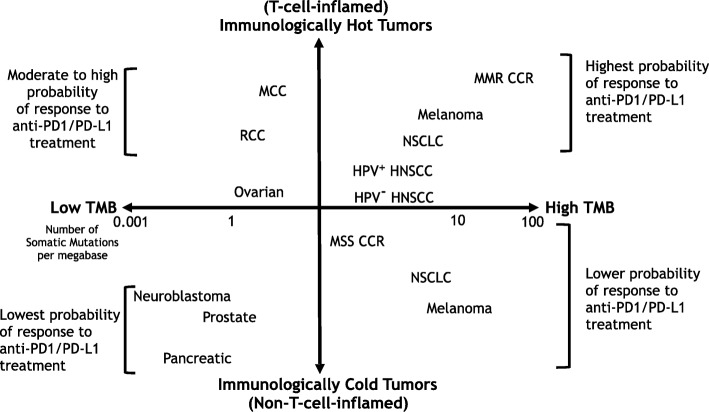
Tumors responding to immune checkpoint inhibitors (ICIs) have a higher level of immune infiltrates and/or an Interferon (IFN) signature indicative of a T-cell-inflamed phenotype. Melanoma and lung cancer demonstrate high response rates to ICIs and are commonly referred to as "hot tumors". These are in sharp contrast to tumors with low immune infiltrates called "cold tumors" or non-T-cell-inflamed cancers, such as those from the prostate and pancreas. Classification of tumors based on their immune phenotype can partially explain clinical response to ICIs. However, this model alone cannot fully explain the lack of response among many patients treated with ICIs.Dichotomizing tumors based on their mutation profile into high tumor mutation burden (TMB) or low TMB, such as many childhood malignancies, can also, to some extent, explain the clinical response to immunotherapy. This model mainly focuses on a tumor's genotype rather than its immune phenotype. High TMB tumors often have higher levels of neoantigens that can be recognized by the immune system. In the current era of immunotherapy, with the lack of definitive biomarkers, we need to evaluate tumors based on both their immune phenotype and genomic mutation profile to determine which patients have a higher likelihood of responding to treatment with ICIs.
Overview
The claims and statistics of this paper haven’t been checked yet.
Free: it reads the open-access text and checks the first 5 claims that cite a source we can check. Create a free account to check every claim.
Integrity signals
Registry
Cites
Statistics
Figures
Verification
Claims the paper makes
The claims and statistics of this paper haven’t been checked yet.
Free: it reads the open-access text and checks the first 5 claims that cite a source we can check. Create a free account to check every claim.
Claims other papers make about this one
Each is checked against this paper’s own text: does it say what the citing paper says it does?
In the citing paper
“Given this contribution of mutational burden to ICI efficacy, tumors with low mutational burdens, such as prostate and pancreatic cancers, might be expected to respond poorly to ICIs, and this is indeed the case (88).”
From Immune Checkpoint Inhibitors for the Treatment of Cancer: Clinical Impact and Mechanisms of Response and Resistance (2021) · cites this paper as [88]
Self-check
Percentages, sums and reported differences re-computed from the paper’s own numbers.
The self-check needs the paper’s full text.
Citations
Cites
Signatures of mutational processes in human cancer
Initiative, A. P. C. G., Alexandrov, L. B., ICGC Breast Cancer Consortium, ICGC MMML-Seq Consortium, PedBrain, I., Nik-Zainal, S., Wedge, D. C., Aparicio, S. A. J. R., Behjati, S., Biankin, A. V., et al. (2013) · Nature · doi:10.1038/nature12477 · Cited by 9,660 · cited 2×
“For example, ovarian cancer has a modest somatic mutation burden and is somewhat infiltrated by T-cells; however, it displays a low response rate to various ICIs [2 – 4].”
TGFβ attenuates tumour response to PD-L1 blockade by contributing to exclusion of T cells
Mariathasan, S., Turley, S. J., Nickles, D., Castiglioni, A., Yuen, K., Wang, Y., Kadel III, E. E., Koeppen, H., Astarita, J. L., Cubas, R., et al. (2018) · Nature · doi:10.1038/nature25501 · Cited by 5,400 · cited 1×
“This could be partially explained by the recent report that TGF β plays a crucial role in excluding T-cells from the tumor microenvironment [22].”
Elements of cancer immunity and the cancer–immune set point
Chen, D. S., & Mellman, I. (2017) · Nature · doi:10.1038/nature21349 · Cited by 5,352
Clonal neoantigens elicit T cell immunoreactivity and sensitivity to immune checkpoint blockade
McGranahan, N., Furness, A. J. S., Rosenthal, R., Ramskov, S., Lyngaa, R., Saini, S. K., Jamal-Hanjani, M., Wilson, G. A., Birkbak, N. J., Hiley, C. T., et al. (2016) · Science · doi:10.1126/science.aaf1490 · Cited by 3,065
Melanoma-intrinsic β-catenin signalling prevents anti-tumour immunity
Spranger, S., Bao, R., & Gajewski, T. F. (2015) · Nature · doi:10.1038/nature14404 · Cited by 2,830
Tumor Mutational Burden as an Independent Predictor of Response to Immunotherapy in Diverse Cancers
Goodman, A. M., Kato, S., Bazhenova, L., Patel, S. P., Frampton, G. M., Miller, V., Stephens, P. J., Daniels, G. A., & Kurzrock, R. (2017) · Molecular Cancer Therapeutics · doi:10.1158/1535-7163.mct-17-0386 · Cited by 2,264 · cited 1×
“Recently, TMB has been proposed as a biomarker of response to ICIs [10].”
Schadendorf, D., Hodi, F. S., Robert, C., Weber, J. S., Margolin, K., Hamid, O., Patt, D., Chen, T.-T., Berman, D. M., & Wolchok, J. D. (2015) · Journal of Clinical Oncology · doi:10.1200/jco.2014.56.2736 · Cited by 2,141 · cited 1×
“As one example, among advanced melanoma patients treated with ipili-mumab (an anti-CTLA-4 antibody), some remain alive ten years after treatment with this drug [1].”
Oncolytic virotherapy promotes intratumoral T cell infiltration and improves anti-PD-1 immunotherapy
Ribas, A., Dummer, R., Puzanov, I., VanderWalde, A., Andtbacka, R. H. I., Michielin, O., Olszanski, A. J., Malvehy, J., Cebon, J., Fernandez, E., et al. (2017) · Cell · doi:10.1016/j.cell.2017.08.027 · Cited by 1,520 · cited 1×
“…a cancer such as metastatic melanoma, which has high TMB, but is non-T-cell-inflamed (genomically high levels of mutations but phenotypically an immunologically cold tumor), can be rendered responsive to ICIs by treatment with a combination of oncolytic virus therapy and anti-PD-1 therapy [23].”
Targeting neoantigens to augment antitumour immunity
Yarchoan, M., Johnson, B. A., Lutz, E. R., Laheru, D. A., & Jaffee, E. M. (2017) · Nature Reviews Cancer · doi:10.1038/nrc.2016.154 · Cited by 997 · cited 1×
“However, the MCPyV positive-MCC tumors with low TMB have equivalent or higher response rates to ICIs than the MCPyV-negative MCC tumors [15].”
Turajlic, S., Litchfield, K., Xu, H., Rosenthal, R., McGranahan, N., Reading, J. L., Wong, Y. N. S., Rowan, A., Kanu, N., Al Bakir, M., et al. (2017) · The Lancet Oncology · doi:10.1016/s1470-2045(17)30516-8 · Cited by 911 · cited 1×
“Although a high prevalence of insertions and deletions (indels) can result in the formation of some neoantigens, RCC still has a significantly lower burden of somatic mutations than melanoma and NSCLC (true high TMB tumors) [13].”
Cited by
Items 201–300 of 626
Patients with Lung Cancer of Different Racial Backgrounds Harbor Distinct Immune Cell Profiles
Xu, Y., Zhang, L., Thaiparambil, J. T., Mai, S., Perera, D. N., Zhang, J., Pan, P., Coarfa, C., Ramos, K. S., Chen, S., et al. (2022) · Cancer Research Communications · doi:10.1158/2767-9764.crc-22-0057 · Cited by 23
“Tumors with ample T-cell inflitration and proinflammatory cytokine accumulation are commonly termed “hot tumors” (12, 13, 17).”
BackgroundSammons, S. L., Raskina, K., Danziger, N. A., Alder, L., Schrock, A. B., Venstrom, J. M., Knutson, K. L., Thompson, E. A., McGregor, K., Sokol, E. S., et al. (2022) · JCO Precision Oncology · doi:10.1200/po.22.00149 · Cited by 24
Tackling of Immunorefractory Tumors by Targeting Alternative Immune Checkpoints
Dulal, D., Boring, A. R., Terrero, D., Johnson, T. L., Tiwari, A. K., & Raman, D. (2023) · Cancers · doi:10.3390/cancers15102774 · Cited by 23
Type I interferon signaling pathway enhances immune-checkpoint inhibition in KRAS mutant lung tumors
Fernández-García, F., Fernández-Rodríguez, A., Torre, C. F., Piñeiro-Yáñez, E., Wang, H., Lechuga, C. G., Callejas, S., Álvarez, R., López-García, A., Esteban-Burgos, L., et al. (2024) · Proceedings of the National Academy of Sciences · doi:10.1073/pnas.2402913121 · Cited by 23
“These results strongly suggest that IFN - β as well as STING V154M expression transforms the immunologically “cold tumors” into immunologically “hot tumors” or T cell - inflamed tumors, which constitutes a requisite for response to immunotherapy treatments (31).”
Comprehensive Analyses of Immune Subtypes of Stomach Adenocarcinoma for mRNA Vaccination
You, W., Ouyang, J., Cai, Z., Chen, Y., & Wu, X. (2022) · Frontiers in Immunology · doi:10.3389/fimmu.2022.827506 · Cited by 23
“Tumors with high TMB have an elevated neoantigen load and a durable immune response (35).”
BackgroundZorko, N. A., & Ryan, C. J. (2021) · Prostate Cancer and Prostatic Diseases · doi:10.1038/s41391-021-00381-w · Cited by 22
“Rare prostate tumors considered “hot” typically are associated with microsatellite instability (10), increased neoantigens which are recognized by the immune system as foreign (14), and are more likely to respond to checkpoint inhibition (15)”
BackgroundGenomic landscape and gene expression profiles of feline oral squamous cell carcinoma
Rodney, A. R., Skidmore, Z. L., Grenier, J. K., Griffith, O. L., Miller, A. D., Chu, S., Ahmed, F., Bryan, J. N., Peralta, S., & Warren, W. C. (2023) · Frontiers in Veterinary Science · doi:10.3389/fvets.2023.1079019 · Cited by 22
“0 is associated with poor prognosis (45, 46).”
BackgroundModulation of T cell function and survival by the tumor microenvironment
Mani, N. L., Andrews, D., & Obeng, R. C. (2023) · Frontiers in Cell and Developmental Biology · doi:10.3389/fcell.2023.1191774 · Cited by 22
“High tumor mutational burden correlates with the presences of neoantigens and clinical response to immune checkpoint inhibitors (ICIs) (Maleki Vareki, 2018; Miao et al., 2018).”
BackgroundHennessy, M., Wahba, A., Felix, K., Cabrera, M., Segura, M. G., Kundra, V., Ravoori, M. K., Stewart, J., Kleinerman, E. S., Jensen, V. B., et al. (2020) · International Journal of Cancer · doi:10.1002/ijc.33382 · Cited by 22
“In “cold tumors” with low infiltrating T cells, such as osteosarcoma, the benefit of ICIs is less clear.(16) In preclinical murine models of osteosarcoma, when used alone or in combination with other therapies, antibodies against CTLA-4 or PD-1 have shown benefit by upregulating the antitumor activity of cytotoxic T c…”
BackgroundIn situ vaccination with nanoparticles for cancer immunotherapy: understanding the immunology
Mao, C., Gorbet, M.-J., Singh, A., Ranjan, A., & Fiering, S. (2020) · International Journal of Hyperthermia · doi:10.1080/02656736.2020.1810333 · Cited by 22
“CBT immunotherapy to treat metastatic disease is administered systemically, much like chemotherapy.”
InfluentialMarsavela, G., Johansson, P. A., Pereira, M. R., McEvoy, A. C., Reid, A. L., Robinson, C., Warburton, L., Khattak, M. A., Meniawy, T. M., Amanuel, B., et al. (2020) · Cancers · doi:10.3390/cancers12123793 · Cited by 22
Gao, P., Li, X., Duan, Z., Wang, Y., Li, Y., Wang, J., Luo, K., & Chen, J. (2025) · MedComm · doi:10.1002/mco2.70274 · Cited by 21
“Elevated mutation rates correlate with increased neoantigen presentation, enhancing tumor immunogenicity and improving immunotherapy responsiveness [184, 185].”
Shakiba, Y., Vorobyev, P. O., Naumenko, V., Кочетков, Д. В., Zajtseva, K. V., Valikhov, M. P., Yusubalieva, G. M., Gumennaya, Y. D., Emelyanov, E. A., Semkina, A. S., et al. (2023) · Viruses · doi:10.3390/v15040828 · Cited by 21
Das, S., Idate, R., Lana, S. E., Regan, D. P., & Duval, D. L. (2023) · Scientific Reports · doi:10.1038/s41598-023-37266-y · Cited by 21
“While several studies have shown improved responses to immune checkpoint inhibitors in tumors with high mutational burden 43,44 , a recent pan-cancer study revealed no significant association between mutational burden and CD8 + T-cell infiltration; however, tumor histo-type specific associations do…”
Roller, A., Davydov, I. I., Schwalie, P. C., Serrano‐Serrano, M. L., Heller, A., Staedler, N., Ferreira, C. S., Dietmann, G., Klaman, I., Valdeolivas, A., et al. (2024) · Journal for ImmunoTherapy of Cancer · doi:10.1136/jitc-2023-008185 · Cited by 22
Immune mechanisms in cancer patients that lead to poor outcomes of SARS-CoV-2 infection
LATIF, M. B., Shukla, S., Estrada, P. M. D. R., Ribeiro, S. P., Sékaly, R., & Sharma, A. (2021) · Translational research · doi:10.1016/j.trsl.2021.12.001 · Cited by 21
“Indeed, the tumor microenvironment (TME) of hot tumors includes several subsets of innate as well as adaptive immune cells that are endowed with a wide array of effector functions.(63,65) Specifically, cytokines and chemokines (including but not limited to; CCL2, CCL3, CCL4, CCL5, CXCL9, CXCL10, CCL17/22) produced by…”
Sasaki, T., Nishiwada, S., Nakagawa, K., Nagai, M., Terai, T., Hokuto, D., Yasuda, S., Matsuo, Y., Doi, S., & Sho, M. (2022) · International Journal of Clinical Oncology · doi:10.1007/s10147-022-02131-x · Cited by 21
“Cancer immunotherapy, such as immune checkpoint inhibitors (ICIs), has brought a paradigm shift in recent cancer treatments and is indicated for various cancers [13].”
BackgroundLiu, Z., Jin, K., Zeng, H., Shao, F., Chang, Y., Wang, Y., Xu, L., Wang, Z., Cui, X., Zhu, Y., et al. (2022) · European Journal of Cancer · doi:10.1016/j.ejca.2022.05.022 · Cited by 21
Identification of New Therapeutic Targets for Gastric Cancer With Bioinformatics
Yang, L., Wang, J., Zhang, T., Wang, H., & Li, L. (2020) · Frontiers in Genetics · doi:10.3389/fgene.2020.00865 · Cited by 20
“Patients with higher TMB have been found to have a better prognosis (Hellmann et al., 2018; Maleki Vareki, 2018; Wang F. et al., 2019; Kim et al., 2020).”
Jaeger, Z. J., Raval, N. S., Maverakis, N., Chen, D. Y., Ansstas, G., Hardi, A., & Cornelius, L. A. (2023) · Frontiers in Medicine · doi:10.3389/fmed.2023.1090737 · Cited by 20
“While new strategies are being investigated, we are interested in understanding whether and why molecular subtypes of melanoma may respond differently to ICIs (7).”
BackgroundWu, Q., Tao, X., Yang, L., Zheng, S., Lin, N., & Xie, X. (2023) · BMC Cancer · doi:10.1186/s12885-023-11241-2 · Cited by 20
“Those results revealed that tumors of high-risk groups are socalled immunologically “cold”, with immunosuppressive tumor microenvironment [65].”
BackgroundTherapeutic potential of tumor-infiltrating lymphocytes in non-small cell lung cancer
Plaugher, D. R., Childress, A. R., Gosser, C. M., Esoe, D.-P. I., Naughton, K. J., Hao, Z., & Brainson, C. F. (2024) · Cancer Letters · doi:10.1016/j.canlet.2024.217281 · Cited by 20
Scherwitzl, I., Opp, S., Hurtado, A. M., Pampeno, C., Loomis, C. A., Kannan, K. S., Yu, M., & Meruelo, D. (2020) · Molecular Therapy — Oncolytics · doi:10.1016/j.omto.2020.04.012 · Cited by 20
“It has been published that the tumor mutational load correlates with better response rates to immunotherapies.(61,62) Prostate cancer models have been described to have low tumor mutational burden and, therefore, are less sensitive to immunotherapies.”
BackgroundHintz, H. M., Snyder, K. M., Wu, J., Hullsiek, R., Dahlvang, J. D., Hart, G. T., Walcheck, B. K., & LeBeau, A. M. (2021) · Cancer Immunology Research · doi:10.1158/2326-6066.cir-21-0178 · Cited by 20
Evolving Management of Stage IV Melanoma
Switzer, B., Piperno-Neumann, S., Lyon, J., Buchbinder, E. I., & Puzanov, I. J. (2023) · American Society of Clinical Oncology Educational Book · doi:10.1200/edbk_397478 · Cited by 19
Guo, J., Tang, B., Fu, J., Zhu, X., Xie, W.-L., Wang, N., Ding, Z., Song, Z., Yang, Y., Xu, G., et al. (2023) · Cellular Oncology · doi:10.1007/s13402-023-00885-8 · Cited by 19
“Notably, an ample number of studies have already demonstrated the importance of preexisting CD8 + T cells in the TME for effective ICI intervention, and a lack of T-cell infiltration can make MMRd tumors insensitive to this treatment [15–17].”
BackgroundPatel, E., Malkova, N. V., CROWE, D. F., Pederzoli-Ribeil, M., Fantini, D., Fanny, M., Madala, H. R., Jenkins, K. A., Yerov, O., Greene, J., et al. (2023) · Molecular Cancer Therapeutics · doi:10.1158/1535-7163.mct-23-0336 · Cited by 19
“Thehot,cold,andmixeddesignationsarebasedon the published literature characterizing the immune contexture, check-point inhibitor responsiveness and tumor mutation burden for select indications (4, 7, 28).”
BackgroundEmerging immunotherapy and tumor microenvironment for advanced sarcoma: a comprehensive review
Huang, H. W., Fan, Y., Zhang, S., Bai, X., Wang, X., & Shan, F. (2025) · Frontiers in Immunology · doi:10.3389/fimmu.2025.1507870 · Cited by 22
McGoverne, I., Dunn, J., Batham, J., Tu, W. J., Chrisp, J. S., & Rao, S. (2020) · BMC Immunology · doi:10.1186/s12865-020-00353-0 · Cited by 19
“This phenomenon occurs because a high mutational burden tumor expresses more neoantigens; that is, cancer antigens that can be recognized, marked, and attacked by the immune system [16].”
BackgroundInfluentialTargeting Neoepitopes to Treat Solid Malignancies: Immunosurgery
de Sousa, E., Lérias, J. R., López-Beltrán, A., Paraschoudi, G., Condeço, C., Kamiki, J., António, P., Figueiredo, N., Carvalho, C. T., Castillo-Martín, M., et al. (2021) · Frontiers in Immunology · doi:10.3389/fimmu.2021.592031 · Cited by 19
Ferrall-Fairbanks, M. C., Chakiryan, N. H., Chobrutskiy, B. I., Kim, Y., Teer, J. K., Berglund, A., Mulé, J. J., Fournier, M., Siegel, E. M., Dhillon, J., et al. (2022) · Cancer Research · doi:10.1158/0008-5472.can-21-1747 · Cited by 19
Ottley, E., Pell, R., Brazier, B., Hollidge, J., Kartsonaki, C., Browning, L., O’Neill, E., & Kiltie, A. E. (2020) · The Journal of Pathology Clinical Research · doi:10.1002/cjp2.167 · Cited by 19
Epithelial-to-mesenchymal transition and its association with PD-L1 and CD8 in thyroid cancer
Aghajani, M. J., Yang, T., Schmitz, U., James, A. C., McCafferty, C. E., SOUZA, P. D., Niles, N., & Roberts, T. L. (2020) · Endocrine Connections · doi:10.1530/ec-20-0268 · Cited by 19
“Patient characteristics Number of Patients (n = 74) Age Median [range] <55 ≥55 51 [24-80] 44 30 Sex Male Female 9 65 TNM stage I/II III/IV 64 10 Tumour size <2 cm ≥2 cm 59 15 Multifocality Present Absent 14 60 Extrathyroidal extension Present Absent 15 59 Lymphovascular invasion Present Absent 6 68 Lymph node metastas…”
BackgroundSidiropoulos, D. N., Shin, S. M., Wetzel, M., Girgis, A. A., Bergman, D. R., Danilova, L., Perikala, S., Shu, D. H., Montagne, J. M., Deshpande, A. M., et al. (2025) · Cancer Immunology Research · doi:10.1158/2326-6066.cir-25-0387 · Cited by 18
Papaevangelou, E., Esteves, A. M., Dasgupta, P., & Galustian, C. (2023) · Frontiers in Immunology · doi:10.3389/fimmu.2023.1196829 · Cited by 18
“The low response of prostate cancer to immunotherapies has been attributed to the low somatic mutation burden, and the immunosuppressive prostate tumor microenvironment, which result in low number of neoantigens and poor infiltration of cytotoxic T cells, indicative of an immunologically “cold” non-T-cell inflamed tum…”
BackgroundLiang, X., Li, X., Wu, R., He, T., Liu, F., Li, L., Zhang, Y., Gong, S., Zhang, M., Kou, X., et al. (2024) · Advanced Science · doi:10.1002/advs.202401377 · Cited by 18
Sternberg, C., Raigel, M., Limberger, T., Trachtová, K., Schlederer, M., Lindner, D., Kodajova, P., Yang, J., Ziegler, R., Kalla, J., et al. (2024) · Molecular Cancer · doi:10.1186/s12943-024-02114-8 · Cited by 19
“PCa is also associated with low mutational burden and low immunogenicity [77], and thus little responsiveness to therapies based on immune checkpoint inhibitors [78].”
Qi, F., Fu, D., Cai, H., Zheng, Y., Wang, N., & Xu, Z. (2024) · Advanced Functional Materials · doi:10.1002/adfm.202418240 · Cited by 18
Genomic profile and immune contexture in colorectal cancer—relevance for prognosis and immunotherapy
Meršaková, S., Lasabová, Z., Strnádel, J., Kalman, M., Gabonova, E., Sabaka, P., Ciccocioppo, R., Rodrigo, L., Kružliak, P., & Mikolajčík, P. (2020) · Clinical and Experimental Medicine · doi:10.1007/s10238-020-00649-w · Cited by 18
“In the case of colorectal tumors, these are mainly MMR-deficient MSI tumors [52].”
BackgroundYang, Q., Gong, H., Liu, J., Ye, M., Zou, W., & Li, H. (2022) · Scientific Reports · doi:10.1038/s41598-022-17735-6 · Cited by 18
Golesworthy, B., Wang, Y., Tanti, A., Pacis, A., Romero, J. M., Cuggia, A., Domecq, C., Bourdel, G., Denroche, R. E., Jang, G. H., et al. (2022) · Frontiers in Oncology · doi:10.3389/fonc.2022.860767 · Cited by 17
“Durable treatment responses to ICIs have been demonstrated in cancers with T cell-inflamed phenotypes, but the ability of HR-d PDAC to induce anti-tumor immunity has not been established (18).”
BackgroundCirculating T-cell receptor repertoire for cancer early detection
Li, Y., Nahas, M. K., Stephens, D. P., Froburg, K., Hintz, E., Champagne, D., Lochab, A., Brown, M. A., Braun, J., Fortuño, M. A., et al. (2025) · npj Precision Oncology · doi:10.1038/s41698-025-01036-y · Cited by 17
“Lung cancer was selected as the initial indication for developing a TCR repertoire sequencing method for blood-based cancer screening, given the known clinical bene fi t of its early detection, limitations of current blood-based methods, and the presence of an adaptive immune response 28,29 .”
Diverse Neoantigens and the Development of Cancer Therapies
Srivastava, R. M., Purohit, T. A., & Chan, T. A.-T. (2020) · Seminars in Radiation Oncology · doi:10.1016/j.semradonc.2019.12.001 · Cited by 17
Fabian, K. P., Malamas, A. S., Padget, M. R., Solocinski, K., Wolfson, B., Fujii, R., Sater, H. A., Schlom, J., & Hodge, J. W. (2020) · Cancer Immunology Research · doi:10.1158/2326-6066.cir-20-0638 · Cited by 17
“Cancer Immunol Res; 9(2) February 2021 CANCER IMMUNOLOGY RESEARCH 248”
BackgroundInfluentialPrincipe, D. R. (2022) · Scientific Reports · doi:10.1038/s41598-022-15714-5 · Cited by 17
El‐Hajjar, M., Gerhardt, L., Hong, M. M. Y., Krishnamoorthy, M., Figueredo, R., Zheng, X., Koropatnick, J. D., & Vareki, S. M. (2022) · Molecular Therapy · doi:10.1016/j.ymthe.2022.08.025 · Cited by 16
Shen, Y., Xu, S., Ye, C., Li, Q., Chen, R., Wu, W., Jiang, Q., Jia, Y., Zhang, X., Fan, L., et al. (2023) · iScience · doi:10.1016/j.isci.2023.106003 · Cited by 16
Choi, J., Jang, H., Choi, J., Choi, Y., Yang, Y., Shim, M. K., & Kim, S. H. (2023) · Journal of Controlled Release · doi:10.1016/j.jconrel.2023.05.031 · Cited by 16
Shah, R. K., Cygan, E. E., Kozlik, T., Colina, A. S., & Zamora, A. E. (2023) · Frontiers in Immunology · doi:10.3389/fimmu.2023.1301100 · Cited by 16
Hossain, S. M., Carpenter, C., & Eccles, M. R. (2024) · International Journal of Molecular Sciences · doi:10.3390/ijms25137252 · Cited by 16
“[28–30] dMMR and MSI-H Tumours with mismatch repair deficiency (dMMR), either due to an inherited mutation or sporadic mutation, have a defect in one of the MMR genes ( MLH1 , PMS2 , MSH2 , or MSH6 ), resulting in the failure to repair errors in DNA replication.”
BackgroundNardone, V., Giannicola, R., Giannarelli, D., Saladino, R. E., Azzarello, D., Romeo, C., Bianco, G., Rizzo, M. R., Meo, I. D., Nesci, A., et al. (2021) · Life · doi:10.3390/life11111235 · Cited by 16
Ligon, J. A., Wessel, K. M., Shah, N. N., & Glod, J. W. (2022) · Frontiers in Immunology · doi:10.3389/fimmu.2022.846346 · Cited by 16
“melanoma) (1) with a tumor microenvironment (TME) marked by infiltrating CD8+ T-cells (2, 3), high programmed death ligand 1 (PD-L1) expression (4), or a high tumor mutational burden have shown remarkable responses to immunotherapy including immune checkpoint inhibitors (ICIs) (5).”
BackgroundZeng, X., Li, L., Hu, Z., & Peng, D. (2022) · Frontiers in Oncology · doi:10.3389/fonc.2022.832027 · Cited by 16
“An increasing number of studies reveal the correlation of high IFN-g levels with accelerated lymphocyte infiltration and the clinical benefit of PD1/PD-L1 immune checkpoint inhibition therapy (8, 9).”
BackgroundWang, Y., Jiao, X., Li, S., Chen, H., Wei, X. L., Liu, C. X., Gong, J., Zhang, X., Wang, X., Peng, Z., et al. (2022) · Cancer Biology and Medicine · doi:10.20892/j.issn.2095-3941.2020.0708 · Cited by 16
“In addition, tumor mutation burden (TMB) is an important but controversial biomarker for GI cancer patients in different trials 13,14 .”
Wu, L., Hu, X., Dai, H., Chen, K., & Liu, B. (2021) · Frontiers in Cell and Developmental Biology · doi:10.3389/fcell.2021.718912 · Cited by 16
Cancer evolution: Special focus on the immune aspect of cancer
Hu, X., Chen, Z., Wang, Z., & Xiao, Q. (2022) · Seminars in Cancer Biology · doi:10.1016/j.semcancer.2022.05.006 · Cited by 15
Očadlíková, D., Lussana, F., Fracchiolla, N., Bonifacio, M., Santoro, L. E., Delia, M., Chiaretti, S., Pasciolla, C., Cignetti, A., Forghieri, F., et al. (2023) · British Journal of Haematology · doi:10.1111/bjh.19104 · Cited by 15
“Since tumour burden is known to affect the immune response to immunotherapy, 15– 17 these findings may suggest that the capacity of blinatumomab to affect the composition and kinetics of circulating effector T-cell subsets may vary according to the disease status.”
BackgroundThe interplay between neoantigens and immune cells in sarcomas treated with checkpoint inhibition
Anzar, I., Malone, B., Samarakoon, P. S., Vardaxis, I., Simovski, B., Fontenelle, H., Meza‐Zepeda, L. A., Stratford, R., Keung, E. Z.-Y., Burgess, M. A., et al. (2023) · Frontiers in Immunology · doi:10.3389/fimmu.2023.1226445 · Cited by 15
Clonal Neoantigen: Emerging “Mechanism-based” Biomarker of Immunotherapy Response
Nemunaitis, J. J., Stanbery, L., Willoughby, D., Bognar, E., Brun, S., Walter, A., Monk, B. J., Rocconi, R. P., Choucair, K., & Coleman, R. L. (2023) · Cancers · doi:10.3390/cancers15235616 · Cited by 16
Poletto, S., Paruzzo, L., Nepote, A., Caravelli, D., Sangiolo, D., & Carnevale‐Schianca, F. (2023) · Cancers · doi:10.3390/cancers16010101 · Cited by 15
“Melanoma lesions present higher infiltration of T cells and lower myeloid cells, as compared to historically “cold” tumors such as pancreatic adenocarcinoma [108].”
BackgroundLi, H., Ni, H., Li, Y., Zhou, A., Qin, X., Li, Y., Che, L., Mo, H., Qin, C., & Li, J. (2024) · Cell Death Discovery · doi:10.1038/s41420-024-01984-7 · Cited by 15
Werner, W., Kuzminskaya, M., Lurje, I., Tacke, F., & Hammerich, L. (2024) · Seminars in Liver Disease · doi:10.1055/a-2334-8311 · Cited by 15
Che, J., Liu, Y., Liu, Y., Song, J., Cui, H., Feng, D., Tian, A., Zhang, Z., & Xu, Y. (2025) · Frontiers in Immunology · doi:10.3389/fimmu.2025.1544882 · Cited by 15
Lorentzen, H. F. (2020) · Acta Dermato Venereologica · doi:10.2340/00015555-3568 · Cited by 15
“T-cell inflamed) vs tumours with high or low mutational burden (18).”
BackgroundImmunotherapy and Radioimmunotherapy for Desmoplastic Small Round Cell Tumor
Espinosa-Cotton, M. M., & Cheung, N. V. (2021) · Frontiers in Oncology · doi:10.3389/fonc.2021.772862 · Cited by 15
“In contrast to melanoma and other tumors that are responsive to checkpoint inhibition, DSRCT appears to be an immunologically “cold” tumor, that is to say it is not heavily populated by tumor infiltrating lymphocytes (TILs) (73).”
BackgroundWang, A.-J., Gao, Y., Shi, Y., Dai, M., & Cai, H. (2022) · Frontiers in Pharmacology · doi:10.3389/fphar.2022.1093666 · Cited by 15
““T cell-inflamed” (hot) tumors that already have an ongoing anti-tumor T-cell response are more responsive to ICIs while “immune excluded” (cold) tumors are less responsive (Maleki Vareki, 2018).”
BackgroundFan, Y.-C., Fong, Y.-C., Kuo, C., Li, C.-W., Chen, W., Lin, J.-D., Bürtin, F., Linnebacher, M., Bui, Q. T., Lee, K., et al. (2023) · Cell & Bioscience · doi:10.1186/s13578-023-01090-8 · Cited by 15
“Clinical responses to immune checkpoint inhibitors have shown that pancreatic and prostate cancers belong to the category of “cold” tumors, while melanomas and lung cancers are classified as “hot” tumors [68].”
BackgroundA review of strategies to overcome immune resistance in the treatment of advanced prostate cancer
Sooi, K. W. X., Walsh, R., Kumarakulasinghe, N. B., Wong, A., & Ngoi, N. Y. L. (2023) · Cancer Drug Resistance · doi:10.20517/cdr.2023.48 · Cited by 15
Voutsadakis, I. A. (2020) · Chinese Clinical Oncology · doi:10.21037/cco.2020.03.03 · Cited by 15
“Tumors have been divided to cold or non-inflamed and hot or inflamed depending on their infiltration with cells of the immune system (71).”
BackgroundAmrein, M. A., Bührer, E. D., Amrein, M. L., Li, Q., Rothschild, S. I., Riether, C., Jaggi, R. B., Savic-Prince, S., Bubendorf, L., Gautschi, O. P., et al. (2020) · Cancer Immunology Immunotherapy · doi:10.1007/s00262-020-02688-4 · Cited by 15
Liu, Q., Li, R., Wu, H., & Liang, Z. (2023) · BMC Cancer · doi:10.1186/s12885-023-10678-9 · Cited by 15
The reactive stroma response regulates the immune landscape in prostate cancer
Thomas, R., Jerome, J. M., Krieger, K. L., Ashraf, N., & Rowley, D. R. (2024) · Journal of Translational Genetics and Genomics · doi:10.20517/jtgg.2024.15 · Cited by 14
Dowdell, A. K., Meng, R., Vita, A., Bapat, B., Hanes, D. A., Chang, S., Harold, L., Schmidt, M., Wong, C., Poon, H., et al. (2024) · JCO Oncology Practice · doi:10.1200/op.24.00226 · Cited by 14
Wieleba, I., Wojas‐Krawczyk, K., Krawczyk, P. A., & Milanowski, J. (2022) · International Journal of Molecular Sciences · doi:10.3390/ijms23042261 · Cited by 14
Erickson, T. A., Shih, Y.-P., Fass, J. N., Jang, M., & Tran, E. (2022) · Thyroid · doi:10.1089/thy.2022.0020 · Cited by 14
“12,13 Indeed, ICI therapy has the greatest efficacy in solid cancers which tend to have high tumor mutation burdens, 14,15 as only * 1% of somatic mutations are thought to be immunogenic.”
Villaruz, L. C., Blumenschein, G. R., Otterson, G. A., & Leal, T. A. B. (2023) · Cancer · doi:10.1002/cncr.34683 · Cited by 14
Ramon, J., Engelen, Y., Keersmaecker, H. D., Goemaere, I., Punj, D., Morales, J. M., Bonte, C., Berx, G., Hoste, E., Stremersch, S., et al. (2023) · Journal of Controlled Release · doi:10.1016/j.jconrel.2023.12.006 · Cited by 14
Benign tumors in TSC are amenable to treatment by GD3 CAR T cells in mice
Thomas, A., Sumughan, S., Dellacecca, E. R., Shivde, R. S., Lancki, N., Mukhatayev, Z., Vaca, C. C., Han, F., Barse, L. W., Henning, S. W., et al. (2021) · JCI Insight · doi:10.1172/jci.insight.152014 · Cited by 14
“Spontaneous responses to growing tumors, as well as the success of targeted therapies, are clearly associated with the tumor mutation burden (67).”
BackgroundDuan, J., Lv, G., Zhu, N., Chen, X., Shao, Y. W., Liu, Y., Wei, Z., & Shi, Y. (2022) · Thoracic Cancer · doi:10.1111/1759-7714.14329 · Cited by 14
“High TMB tumors can yield more immunogenic neoantigens to be recognized by the immune system, such as CD8+ effector T cells.(40,41) A previous study suggested that a high mutation burden is associated with increased tumor infiltration by activated T cells in the case of lung squamous cell carcinoma.”
BackgroundMarchesi, S., Marinello, A., Ambrosini, P., Cavalli, C., Russo, G. L., & Occhipinti, M. A. (2025) · npj Precision Oncology · doi:10.1038/s41698-025-01011-7 · Cited by 13
Advancement and Perspective of Nanozyme in Cancer Diagnosis and Treatment Applications
Ding, Z., Sang, Q., Wang, Y., & Qian, K. (2025) · ACS Applied Materials & Interfaces · doi:10.1021/acsami.5c10701 · Cited by 13
Chai, R., Fan, Y., Zhao, J., He, F., Li, J., & Han, Y. (2020) · Annals of Translational Medicine · doi:10.21037/atm-20-4297 · Cited by 13
“Another extensively studied predictive biomarker tumor mutation burden (TMB) reflects the expression level of unstable genome induced neoantigens (8), which is promising in clinical application but with the limitation of high cost and shortage of consensus on detection methods (9,10).”
BackgroundOvercoming selection bias in synthetic lethality prediction
Seale, C., Tepeli, Y. I., & Gonçalves, J. P. (2022) · Bioinformatics · doi:10.1093/bioinformatics/btac523 · Cited by 13
Preclinical Study of Plasmodium Immunotherapy Combined with Radiotherapy for Solid Tumors
Tao, Z., Ding, W., Cheng, Z., Feng, Y., Kang, Z., Qiu, R., Zhao, S., Hu, W. J., Zhou, F., Wu, D., et al. (2022) · Cells · doi:10.3390/cells11223600 · Cited by 13
Chemokine receptor 4 expression is correlated with the occurrence and prognosis of gastric cancer
Li, Y., Wang, H., Wang, J., Sun, B., & Li, L. (2020) · FEBS Open Bio · doi:10.1002/2211-5463.12864 · Cited by 13
Prognostic Factors in Advanced Non-Small Cell Lung Cancer Patients Treated with Immunotherapy
Rocco, D., Gravara, L. D., Ragone, A., Sapio, L., Naviglio, S., & Gridelli, C. (2023) · Cancers · doi:10.3390/cancers15194684 · Cited by 14
Fan, Y., Chiu, A., Zhao, F., & George, J. T. (2024) · Oncotarget · doi:10.18632/oncotarget.28666 · Cited by 12
CD8+ T cell-based immunotherapy: Promising frontier in human diseases
Ton, N. Q. C., Deka, G., & Park, P. (2025) · Biochemical Pharmacology · doi:10.1016/j.bcp.2025.116909 · Cited by 12
Integration of transcriptomics data into agent-based models of solid tumor metastasis
Retzlaff, J., Lai, X., Berking, C., & Vera, J. (2023) · Computational and Structural Biotechnology Journal · doi:10.1016/j.csbj.2023.02.014 · Cited by 12
“…resistance mechanisms are: a) cancer cell motility, previously suggested as a mechanism of resistance [7]; b) CTL infiltration, known to play a role in discriminating the immune "hot" and "cold" tumors [22]; and c) suppressing immune signals, which can be mediated by TGF β [45], IDO [4] and others.”
BackgroundKostecki, K. L., Iida, M., Wiley, A. L., Kimani, S. G., Crossman, B. E., Tetreault, K., Alexandridis, R. A., Yu, M., Hong, S., Salgia, R., et al. (2023) · Head & Neck · doi:10.1002/hed.27340 · Cited by 12
“5–7 However, some cancers, including melanoma and non-small cell lung cancer (NSCLC), have relatively “hot” TIMEs with high levels of T cell and other proinflammatory cell infiltration.(5,8,9) These cancers also typically have higher response rates to ICIs, such as those targeting programmed death ligand 1 (PDL1).”
BackgroundImmune Checkpoint Inhibitors for Pediatric Cancers: Is It Still a Stalemate?
Jaing, T., Wang, Y.-L., & Chiu, C.-C. (2024) · Pharmaceuticals · doi:10.3390/ph17080991 · Cited by 12
“Childhood cancers are often categorized as “cold tumors”, known for having low mutational burdens and fewer infiltrating T cells [63].”
BackgroundYu, G., Zhang, Z., Eresen, A., Hou, Q., Amirrad, F., Webster, S., Nauli, S. M., Yaghmai, V., & Zhang, Z. (2024) · International Journal of Molecular Sciences · doi:10.3390/ijms252212038 · Cited by 12
Yang, D., Yu, J., Han, B., Sun, Y., Mo, S., & Hu, J. (2021) · Frontiers in Cell and Developmental Biology · doi:10.3389/fcell.2021.618313 · Cited by 12
“ICIs appear to be more effective against tumors when they have been infiltrated by lymphocytes (Maleki Vareki, 2018).”
BackgroundVaccination against Cancer or Infectious Agents during Checkpoint Inhibitor Therapy
Nasti, T. H., & Eberhardt, C. S. (2021) · Vaccines · doi:10.3390/vaccines9121396 · Cited by 12
Comprehensive analysis of tumor mutation burden and immune microenvironment in prostate cancer
Liao, J., Yuan, Y., & Xu, X. (2022) · Clinical & Translational Oncology · doi:10.1007/s12094-022-02857-0 · Cited by 11
“This may explain why some PRAD patients do not benefit from ICIS treatment [11].”
BackgroundZeng, C., Yu, H., Liu, X., Liu, Q., & Jin, J. (2022) · BioMed Research International · doi:10.1155/2022/9710540 · Cited by 11
“” In contrast, “cold tumors” have lower levels of immune infiltration and are less responsive to immune checkpoint inhibitors [44].”
BackgroundClinical Outcomes in COVID-19 Patients Treated with Immunotherapy
Hatic, H., Hearld, K. R., Das, D. G., & Deshane, J. S. (2022) · Cancers · doi:10.3390/cancers14235954 · Cited by 11
Mattila, J., Sormunen, S., Heikkilä, N., Mattila, I. P., Saramäki, J., & Arstila, T. P. (2023) · Cancer Medicine · doi:10.1002/cam4.6002 · Cited by 11
“43 In this study, we found no significant difference be-tween WT and Neo-associated TCR α sequences in the fraction of sequences found in the thymus or in their respective relative clone sizes.”
BackgroundDahis, D., Dion, M. Z., Cryer, A. M., Dosta, P., Gilboa, T., Alonso, M., Lewandowski, M., Puigmal, N., Taboada, G. M., Azhari, H., et al. (2023) · Advanced Functional Materials · doi:10.1002/adfm.202301659 · Cited by 11
Suto, H., Funakoshi, Y., Nagatani, Y., Imamura, Y., Toyoda, M., Kiyota, N., Matsumoto, H., Tanaka, S., Takai, R., Hasegawa, H., et al. (2021) · Journal of Cancer Research and Therapeutics · doi:10.4103/jcrt.jcrt_1092_20 · Cited by 11
Metadata
- Authors
- Maleki Vareki, S.
- Venue
- Journal for ImmunoTherapy of Cancer
- Publisher
- BMJ
- Published
- 2018-12
- Volume
- 6
- Issue
- 1
- Pages
- 157-157
- ISSN
- 2051-1426 (ISSN-L)
- PMC
- PMC6307306
- OpenAlex
- W2905817704
- Cited by
- 569
- References
- 26
- Citations by year
- 2026: 34 · 2025: 68 · 2024: 73 · 2023: 82 · 2022: 102 · 2021: 96 · 2020: 88 · 2019: 26
- FWCI
- 19.69
- Type
- journal article
- Language
- en
- Open access
- gold
- doi.org
- Licence
- cc-by
- creativecommons.org/licenses/by/4.0/ (tdm)
- Locations
- Journal for ImmunoTherapy of Cancer (publishedVersion, cc-by)
- Europe PMC (PubMed Central) (publishedVersion, cc-by)
- PubMed Central (publishedVersion, cc-by)
- PubMed (publishedVersion)
- DOAJ (DOAJ: Directory of Open Access Journals) (submittedVersion)
- Funders
- Institute of Cancer Research (MOP#389137)
- Topics
- Health Sciences › Medicine › Oncology › Cancer Immunotherapy and Biomarkers
- Life Sciences › Immunology and Microbiology › Immunology › Immunotherapy and Immune Responses
- Life Sciences › Biochemistry, Genetics and Molecular Biology › Cancer Research › Cancer Genomics and Diagnostics
- Keywords
- tumor mutational burden, immune checkpoint inhibitors, tumor immune phenotype, interferon signature, T cell infiltration, neoantigens, immunotherapy response prediction, biomarkers, melanoma, lung cancer, pediatric malignancies
- MeSH terms
- Antineoplastic Agents, Immunological, Genotype, Humans, Mutation, Neoplasms, Phenotype, T-Lymphocytes, Biomarkers
About these checks
Registry, retraction, Cites and statistics results are computed, not judged, with one exception: a printed reference that no index lists is read once by a model before it counts as a citation error. Claims are extracted by a model and kept only when their quote appears verbatim in the text; each cited source is then checked, with a model’s help, for whether it says what the claim relies on. Those verdicts can be wrong — read the claim’s quote and the cited source before relying on one.
Statistics and arithmetic are recomputed, not judged.
Confidence bands are shown only for fields calibrated on our annotated test set. None is calibrated yet, so no band is shown.
What counts as a claim ›How we measure confidence ›How we check this ›
Are you an author, or do you see a problem with this page? Request a review
Data sources
Bibliographic data: Semantic Scholar, OpenAlex, Crossref.
Contains information from the Semantic Scholar Academic Graph Datasets, made available under the ODC Attribution License (ODC-BY 1.0).
Semantic Scholar’s data is described in: Kinney, R., et al. (2023). The Semantic Scholar Open Data Platform. arXiv:2301.10140.
