

High and low mutational burden tumors versus immunologically hot and cold tumors and response to immune checkpoint inhibitors
Open accessThe DOI matches its Crossref record; 26 of the 26 references it cites were found in a registry or an index.
Abstract
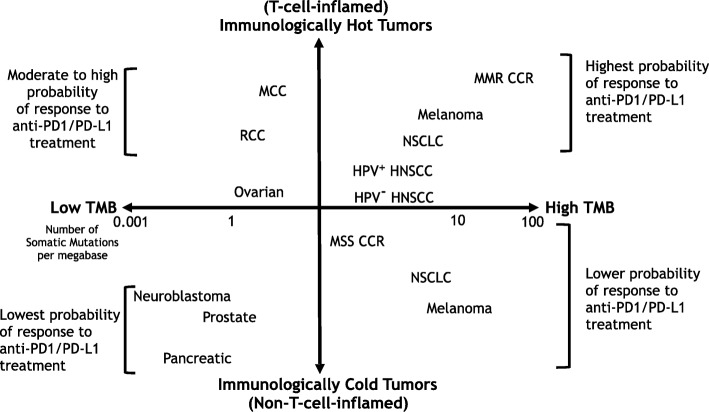
Tumors responding to immune checkpoint inhibitors (ICIs) have a higher level of immune infiltrates and/or an Interferon (IFN) signature indicative of a T-cell-inflamed phenotype. Melanoma and lung cancer demonstrate high response rates to ICIs and are commonly referred to as "hot tumors". These are in sharp contrast to tumors with low immune infiltrates called "cold tumors" or non-T-cell-inflamed cancers, such as those from the prostate and pancreas. Classification of tumors based on their immune phenotype can partially explain clinical response to ICIs. However, this model alone cannot fully explain the lack of response among many patients treated with ICIs.Dichotomizing tumors based on their mutation profile into high tumor mutation burden (TMB) or low TMB, such as many childhood malignancies, can also, to some extent, explain the clinical response to immunotherapy. This model mainly focuses on a tumor's genotype rather than its immune phenotype. High TMB tumors often have higher levels of neoantigens that can be recognized by the immune system. In the current era of immunotherapy, with the lack of definitive biomarkers, we need to evaluate tumors based on both their immune phenotype and genomic mutation profile to determine which patients have a higher likelihood of responding to treatment with ICIs.
Overview
The claims and statistics of this paper haven’t been checked yet.
Free: it reads the open-access text and checks the first 5 claims that cite a source we can check. Create a free account to check every claim.
Integrity signals
Registry
Cites
Statistics
Figures
Verification
Claims the paper makes
The claims and statistics of this paper haven’t been checked yet.
Free: it reads the open-access text and checks the first 5 claims that cite a source we can check. Create a free account to check every claim.
Claims other papers make about this one
Each is checked against this paper’s own text: does it say what the citing paper says it does?
In the citing paper
“Given this contribution of mutational burden to ICI efficacy, tumors with low mutational burdens, such as prostate and pancreatic cancers, might be expected to respond poorly to ICIs, and this is indeed the case (88).”
From Immune Checkpoint Inhibitors for the Treatment of Cancer: Clinical Impact and Mechanisms of Response and Resistance (2021) · cites this paper as [88]
Self-check
Percentages, sums and reported differences re-computed from the paper’s own numbers.
The self-check needs the paper’s full text.
Citations
Cites
Signatures of mutational processes in human cancer
Initiative, A. P. C. G., Alexandrov, L. B., ICGC Breast Cancer Consortium, ICGC MMML-Seq Consortium, PedBrain, I., Nik-Zainal, S., Wedge, D. C., Aparicio, S. A. J. R., Behjati, S., Biankin, A. V., et al. (2013) · Nature · doi:10.1038/nature12477 · Cited by 9,660 · cited 2×
“For example, ovarian cancer has a modest somatic mutation burden and is somewhat infiltrated by T-cells; however, it displays a low response rate to various ICIs [2 – 4].”
TGFβ attenuates tumour response to PD-L1 blockade by contributing to exclusion of T cells
Mariathasan, S., Turley, S. J., Nickles, D., Castiglioni, A., Yuen, K., Wang, Y., Kadel III, E. E., Koeppen, H., Astarita, J. L., Cubas, R., et al. (2018) · Nature · doi:10.1038/nature25501 · Cited by 5,400 · cited 1×
“This could be partially explained by the recent report that TGF β plays a crucial role in excluding T-cells from the tumor microenvironment [22].”
Elements of cancer immunity and the cancer–immune set point
Chen, D. S., & Mellman, I. (2017) · Nature · doi:10.1038/nature21349 · Cited by 5,352
Clonal neoantigens elicit T cell immunoreactivity and sensitivity to immune checkpoint blockade
McGranahan, N., Furness, A. J. S., Rosenthal, R., Ramskov, S., Lyngaa, R., Saini, S. K., Jamal-Hanjani, M., Wilson, G. A., Birkbak, N. J., Hiley, C. T., et al. (2016) · Science · doi:10.1126/science.aaf1490 · Cited by 3,065
Melanoma-intrinsic β-catenin signalling prevents anti-tumour immunity
Spranger, S., Bao, R., & Gajewski, T. F. (2015) · Nature · doi:10.1038/nature14404 · Cited by 2,830
Tumor Mutational Burden as an Independent Predictor of Response to Immunotherapy in Diverse Cancers
Goodman, A. M., Kato, S., Bazhenova, L., Patel, S. P., Frampton, G. M., Miller, V., Stephens, P. J., Daniels, G. A., & Kurzrock, R. (2017) · Molecular Cancer Therapeutics · doi:10.1158/1535-7163.mct-17-0386 · Cited by 2,264 · cited 1×
“Recently, TMB has been proposed as a biomarker of response to ICIs [10].”
Schadendorf, D., Hodi, F. S., Robert, C., Weber, J. S., Margolin, K., Hamid, O., Patt, D., Chen, T.-T., Berman, D. M., & Wolchok, J. D. (2015) · Journal of Clinical Oncology · doi:10.1200/jco.2014.56.2736 · Cited by 2,141 · cited 1×
“As one example, among advanced melanoma patients treated with ipili-mumab (an anti-CTLA-4 antibody), some remain alive ten years after treatment with this drug [1].”
Oncolytic virotherapy promotes intratumoral T cell infiltration and improves anti-PD-1 immunotherapy
Ribas, A., Dummer, R., Puzanov, I., VanderWalde, A., Andtbacka, R. H. I., Michielin, O., Olszanski, A. J., Malvehy, J., Cebon, J., Fernandez, E., et al. (2017) · Cell · doi:10.1016/j.cell.2017.08.027 · Cited by 1,520 · cited 1×
“…a cancer such as metastatic melanoma, which has high TMB, but is non-T-cell-inflamed (genomically high levels of mutations but phenotypically an immunologically cold tumor), can be rendered responsive to ICIs by treatment with a combination of oncolytic virus therapy and anti-PD-1 therapy [23].”
Targeting neoantigens to augment antitumour immunity
Yarchoan, M., Johnson, B. A., Lutz, E. R., Laheru, D. A., & Jaffee, E. M. (2017) · Nature Reviews Cancer · doi:10.1038/nrc.2016.154 · Cited by 997 · cited 1×
“However, the MCPyV positive-MCC tumors with low TMB have equivalent or higher response rates to ICIs than the MCPyV-negative MCC tumors [15].”
Turajlic, S., Litchfield, K., Xu, H., Rosenthal, R., McGranahan, N., Reading, J. L., Wong, Y. N. S., Rowan, A., Kanu, N., Al Bakir, M., et al. (2017) · The Lancet Oncology · doi:10.1016/s1470-2045(17)30516-8 · Cited by 911 · cited 1×
“Although a high prevalence of insertions and deletions (indels) can result in the formation of some neoantigens, RCC still has a significantly lower burden of somatic mutations than melanoma and NSCLC (true high TMB tumors) [13].”
Cited by
Items 301–400 of 626
Klein, S., & Duda, D. G. (2021) · Cancers · doi:10.3390/cancers13194919 · Cited by 11
van Dam, S., Krijgsman, D., Küçükköse, E., Verdonschot, M. E. L., Amini, M., Blokx, W. A. M., van Eijs, M. J. M., Verheijden, R. J., Kranenburg, O., Suijkerbuijk, K. P. M., et al. (2025) · British Journal of Cancer · doi:10.1038/s41416-025-03137-8 · Cited by 10
Immunologic specificity in glioblastoma: Antigen discovery and translational implications
Hill, C. M., Wang, A. Z., Hsueh, B., Ramirez, R., Sherpa, N. D., Costa, M. A., Williams, O., Mao, L., & Dunn, G. P. (2025) · Neuro-Oncology Advances · doi:10.1093/noajnl/vdaf028 · Cited by 10
“64,65 Since ICB’s mechanism of action leverages the tumor immunity cycle, 66,67 which requires the presentation of TAs, 32 then transitively, high TMB likely corresponds to a response to antigen therapy.”
Thiopurine 6TG treatment increases tumor immunogenicity and response to immune checkpoint blockade
Nazerai, L., Willis, S. C., Yankilevich, P., Leo, L. D., Bosisio, F. M., Frías, A., Bertolotto, C., Nersting, J., Thastrup, M., Buus, S., et al. (2022) · OncoImmunology · doi:10.1080/2162402x.2022.2158610 · Cited by 10
Alnukhali, M., Altabbakh, O., Farooqi, A. A., Pollack, A. S., Daunert, S., Deo, S. K., & Tao, W. (2024) · Current Medicinal Chemistry · doi:10.2174/0109298673273303231208071403 · Cited by 10
Roncato, R., Polesel, J., Tosi, F., Peruzzi, E., Brugugnoli, E., Pantano, C. L., FURFARO, M., Girolamo, F. G. D., Nani, A., Pani, A., et al. (2024) · Oncology Research Featuring Preclinical and Clinical Cancer Therapeutics · doi:10.32604/or.2024.049181 · Cited by 10
Reveneau, M.-F., Masliah‐Planchon, J., Delgado‐Fernández, M., Ouikene, A., Dron, B., Dadamessi, I., Dayen, C., Golmard, L., & Chauffert, B. (2024) · Frontiers in Oncology · doi:10.3389/fonc.2024.1410322 · Cited by 10
The Role of Immunotherapy in Salivary Gland Cancer: A Systematic Review
Kim, S., Tasoulas, J., Sheth, S. H., Yarbrough, W. G., Hackman, T., Amelio, A. L., & Sullivan, C. B. (2025) · Ear Nose & Throat Journal · doi:10.1177/01455613251324353 · Cited by 10
Pruis, M. A., Groenendijk, F. H., Badloe, K. S., van Puffelen, A. J., Robbrecht, D. G. J., Dinjens, W. N. M., Sleijfer, S., Dingemans, A. C., von der Thüsen, J. H., Roepman, P., et al. (2022) · British Journal of Cancer · doi:10.1038/s41416-022-01841-3 · Cited by 10
Ferronika, P., Dhiyani, S. A., Budiarti, T., Widodo, I., Rinonce, H. T., & Anwar, S. L. (2022) · Diagnostics · doi:10.3390/diagnostics12122987 · Cited by 10
Construction of an immunogenic cell death-based risk score prognosis model in breast cancer
Li, Y., Feng, J., Wang, T., Li, M., Zhang, H., Rong, Z., Cheng, W., Duan, Y., Chen, Z., Hu, A., et al. (2022) · Frontiers in Genetics · doi:10.3389/fgene.2022.1069921 · Cited by 10
“Since high TMB is associated with more neoantigens that could be recognized by the immune system, we analyzed somatic mutation profiles between the two risk groups (Maleki Vareki, 2018).”
BackgroundMetronomic chemotherapy combined with endocrine therapy: are we challenging some dogmas?
Caparica, R., Angelis, C. D., Fêde, Â., Werutsky, G., & de Azambuja, E. (2020) · Expert Review of Anticancer Therapy · doi:10.1080/14737140.2020.1782200 · Cited by 10
“into ‘hot tumors’, an effect that could enhance the activity of immune checkpoint inhibitors [27,29,74].”
BackgroundSuto, H., 須藤, 洋., & ストウ, ヒ. (2021) · Kobe University Repository Kernel (Kobe University) · Cited by 10
Comparing DC subsets in solid tumors: what about DC3s?
Pachocki, C. J., Boes, M. L., & Affandi, A. J. (2024) · Immunotherapy Advances · doi:10.1093/immadv/ltaf021 · Cited by 9
“Conversely, in pancreatic ductal adenocarcinoma (PDAC) and prostate cancer, the TME is notoriously immunosuppressive and low in T cells and (subsets of) DCs, contributing to their unresponsiveness to immune checkpoint inhibitors [10].”
Liu, J., Lin, F., Hu, G., Zhang, R., Gong, C., Sun, X., & Mi, P. (2026) · Journal of Controlled Release · doi:10.1016/j.jconrel.2026.114671 · Cited by 9
Markelic, M. B., Mojić, M., Drača, D., Jelača, S., Jović, Z., Purić, M., Koruga, D. L., Mijatović, S., & Maksimović‐Ivanić, D. (2023) · Nanomaterials · doi:10.3390/nano13030372 · Cited by 9
Shatila, M., Ma, W., Cui, Y., Naz, S., Thomas, A. S., Toni, E. N. D., Török, H., Khaled, N. B., Altan, M., Schneider, B. J., et al. (2023) · Journal of Cancer Research and Clinical Oncology · doi:10.1007/s00432-023-04736-9 · Cited by 9
Zhang, J., Song, L., Li, G., Liang, A., Cai, X.-T., Huang, Y., Zhu, X. M., & Zhou, X. (2023) · Journal of Cancer Research and Clinical Oncology · doi:10.1007/s00432-023-05435-1 · Cited by 9
“High TMB is associated with better response to ICB therapy due to the increased production of neoantigens (Maleki Vareki 2018), which facilitates immune recognition of the tumor (Zhang et al. 2023).”
BackgroundCuproptosis engineered nanomaterials: The silent warrior against cancer
Dongsar, T. S., Dongsar, T. T., Nasir, N., Wahab, S., Sahebkar, A., Gupta, G., & Kesharwani, P. (2024) · Applied Materials Today · doi:10.1016/j.apmt.2024.102305 · Cited by 9
Liu, Y., Cheng, L., Huang, W., Cheng, X. M., Peng, W., & Shi, D. (2021) · Journal of Immunology Research · doi:10.1155/2021/2048833 · Cited by 9
“In these cases, more mutations of tumor driver genes occurred, but more neoantigens would also be presented to trigger immune response [40].”
BackgroundYan, Y., Cao, X., Wang, Z., Huang, Z., Cai, J., Tang, P., Yang, C., Zhang, F., Xia, S., & Shen, B. (2022) · Frontiers in Molecular Biosciences · doi:10.3389/fmolb.2022.815290 · Cited by 9
Lin, Y., Zhu, J., Ma, R., Meng, W., Wang, Z.-Y., Li, X.-B., Ma, R., Wu, H., Xu, H.-B., Gao, Y., et al. (2023) · Molecular Cancer Research · doi:10.1158/1541-7786.mcr-22-0801 · Cited by 9
Primary malignant melanoma of the biliary tract: A case report and literature review
Cameselle‐García, S., Pérez, J. L. F., Areses, M. C., Castro, J. D. F.-D., Reboredo, J. M., & García-Mata, J. (2019) · World Journal of Clinical Cases · doi:10.12998/wjcc.v7.i16.2302 · Cited by 9
Gambichler, T., & Susok, L. (2020) · Immunotherapy · doi:10.2217/imt-2019-0183 · Cited by 9
Ecology of Fear: Spines, Armor and Noxious Chemicals Deter Predators in Cancer and in Nature
Peplinski, J., Malone, M. A., Fowler, K. J., Potratz, E. J., Pergams, A. G., Charmoy, K. L., Rasheed, K., Avdieiev, S. S., Whelan, C. J., & Brown, J. S. (2021) · Frontiers in Ecology and Evolution · doi:10.3389/fevo.2021.682504 · Cited by 9
“Tumors can be classified as hot versus cold depending upon the amount of immune infiltration (Maley et al., 2017; Vareki, 2018), and hot tumors are thought to be more responsive to immunotherapies that challenge or target the cancer’s anti-predator adaptations (de Guillebon et al., 2020).”
BackgroundAndersson, P., & Ostheimer, C. (2019) · Frontiers in Immunology · doi:10.3389/fimmu.2019.02083 · Cited by 9
“First, many tumors have low tumor mutational burden (TMB), and therefore only produce limited antigens that can be recognized by endogenous T cells (1).”
BackgroundSpecific antitumour immunity and mechanisms of tumour escape from immunological surveillance
Султанбаев, А. В., Тузанкина, И. А., Мусин, Ш. И., Kolyadina, I. V., Меньшиков, К. В., Султанбаев, М. В., Gilyazova, I. R., & Kudlay, D. A. (2024) · P A Herzen Journal of Oncology · doi:10.17116/onkolog20241306170 · Cited by 8
Elliot, T. A. E., Lecky, D. A. J., & Bending, D. (2023) · Essays in Biochemistry · doi:10.1042/ebc20220247 · Cited by 8
Multiplex plasma protein assays as a diagnostic tool for lung cancer
Ahamed, M. T., Forshed, J., Levitsky, A., Lehtiö, J., Bajalan, A., Pernemalm, M., Eriksson, L. E., & Andersson, B. (2024) · Cancer Science · doi:10.1111/cas.16300 · Cited by 8
MCRS1 sensitizes T cell–dependent immunotherapy by augmenting MHC-I expression in solid tumors
Li, X., Han, Y., Jin, Z., Jiang, K., Xue, K., Wang, J., Qian, Y., Xiang, Q., Zhu, S., Yan, R., et al. (2024) · The Journal of Experimental Medicine · doi:10.1084/jem.20240959 · Cited by 8
“Reduced MHC-I antigen presentation represents a common obstacle for immunotherapy in many types of cancers beyond PDAC (Maleki Vareki, 2018).”
Nair, S. S., Chakravarty, D., Balan, S., Hakansson, A. K., Duval, M. X., Davicioni, E., Liu, Y., Bhardwaj, S., Thin, T. H., Garcia-Barros, M., et al. (2025) · Med · doi:10.1016/j.medj.2025.100879 · Cited by 8
Huang, H., Wang, Z., Li, Y., Zhao, Q., & Niu, Z. (2021) · Journal of Gastrointestinal Oncology · doi:10.21037/jgo-21-47 · Cited by 8
“TMB-H has been reported to be associated with better outcomes in many cancers (57).”
BackgroundCavitation-Mediated Immunomodulation and Its Use with Checkpoint Inhibitors
Maardalen, M., Carlisle, R. C., & Coussios, C. C. (2023) · Pharmaceutics · doi:10.3390/pharmaceutics15082110 · Cited by 8
Lin, X., Wang, X., Gu, Q., Lei, D., Liu, X., & Yao, C. (2021) · Biomedical Materials · doi:10.1088/1748-605x/abe7b3 · Cited by 8
Novel Insights of Anti-EGFR Therapy in HNSCC: Combined with Immunotherapy or Not?
Lin, D., Wang, Y., Yao, X., Ren, Y., & Zhou, X. (2022) · Current Oncology Reports · doi:10.1007/s11912-022-01349-2 · Cited by 8
Lin, Z., Zhang, Y., & Zhang, L. (2020) · 癌症:英文版 · doi:10.1002/cac2.12070 · Cited by 8
Sidiropoulos, D. N., Shin, S. M., Wetzel, M., Girgis, A. A., Bergman, D. R., Danilova, L., Perikala, S., Shu, D. H., Montagne, J. M., Deshpande, A. M., et al. (2024) · bioRxiv (Cold Spring Harbor Laboratory) · doi:10.1101/2024.09.22.613714 · Cited by 8
Chantzoura, E., Altman-Sharoni, E., Michelet, X., Popis, M. C., Niedzielska, M., Joshi, B. P., Masakayan, R., Rubí-Sans, G., Addis, S., Keith, J. G., et al. (2025) · Cancer Immunology Research · doi:10.1158/2326-6066.cir-25-0349 · Cited by 7
Immunological mechanisms and antibody-drug conjugates targeting B7-H3 and B7-H4 in ovarian cancer
Brown, E. F., Colombo, I., Madariaga, A., & Kasherman, L. (2025) · Frontiers in Immunology · doi:10.3389/fimmu.2025.1683674 · Cited by 8
Molecular Signature Expands the Landscape of Driver Negative Thyroid Cancers
Bim, L. V., Carneiro, T. N. R., Buzatto, V. C., Colozza‐Gama, G. A., Koyama, F. C., Thomaz, D. M. D., Paniza, A. C. D. J., Lee, E. A., Galante, P. A. F., & Cerutti, J. M. (2021) · Cancers · doi:10.3390/cancers13205184 · Cited by 7
Hu, J., Song, F., Kang, W., Xia, F., Song, Z., Wang, Y., Li, J., & Zhao, Q. (2023) · Frontiers in Pharmacology · doi:10.3389/fphar.2023.1162563 · Cited by 7
“Numerous reports have shown that tumor cells with higher TMB were more easily recognized by the immune system, and immunotherapy was more likely to respond (Maleki, 2018).”
BackgroundNew approaches and prospects of immunotherapy and gene therapy for prostate cancer
Bibi, R., & Sarkar, K. (2024) · Journal of Translational Genetics and Genomics · doi:10.20517/jtgg.2023.50 · Cited by 7
Tokat, Ü. M., Adibi, A., Aydın, E., Özgü, E., Bilgiç, Ş. N., Tutar, O., Doğançay, M. Ö., Demiray, İ., & Demiray, M. (2024) · Current Oncology · doi:10.3390/curroncol31100434 · Cited by 7
“These genomic parameters could be complemented by immunophenotypic data to better discriminate between immune cold and hot tumors, thus responding to the ICIs [76].”
BackgroundThe role of the CXCL12/CXCR4 axis in the immunotherapy of non-small cell lung cancer
Rogado, J., Pozo, F., Troulé, K., Pacheco, M., Adrados, M., Sánchez-Torres, J. M., Al‐Shahrour, F., Aspa, J., Alfranca, A., Romero-Laorden, N., et al. (2024) · Clinical & Translational Oncology · doi:10.1007/s12094-024-03828-3 · Cited by 7
Kılıç, İ. B., Weberova, P., VanDyke, D., Šírová, M., Kubesova, K., Fabilane, C. S., Mazhara, V., Liu, K., Běhalová, K., Ptacek, B., et al. (2025) · Journal for ImmunoTherapy of Cancer · doi:10.1136/jitc-2024-010465 · Cited by 7
“52 Since the strong antitumor activity of ICIs+IL-2cx relies on stimulation of tumor-specific CD8 + T cells that are reinvigorated by ICIs, it is possible that efficacy would be lower in poorly immunogenic tumors.”
Chiaro, J., Peltonen, K., Õunap, K., Bailey, A., Feola, S., Wojciechowski, S., Es-Haghi, M., Azkargorta, M., Elortza, F., Russo, S., et al. (2025) · npj Vaccines · doi:10.1038/s41541-025-01234-6 · Cited by 7
“Thelowtumormutationburden(TMB) 22,23,33,34 in ovarian cancer makes it inconvenient to target tumor-speci fi c antigens (TSAs) resulting from mutations for vaccine development.”
Howard, F. H. N., Conner, J., Danson, S. J., & Muthana, M. (2022) · Frontiers in Molecular Biosciences · doi:10.3389/fmolb.2022.889395 · Cited by 7
“…immunity (Chen et al., 2000; Ricca et al., 2018); 2) the type of cancer being targeted (their immune phenotype and genomic mutation profile) (Maleki Vareki, 2018; Bonaventura et al., 2019); and 3) metabolic, nutritional, and microbiome status (Harper et al., 2020; Sumbria et al., 2020).”
BackgroundXiong, S., Zhu, W., Wu, L., Zhou, T., Wang, W., Zhang, O., Xiong, X., Liu, Z., & Luo, D. (2023) · Cancer Immunology Immunotherapy · doi:10.1007/s00262-023-03495-3 · Cited by 7
Prognostic Value and Immune Signatures of Anoikis-related Genes in Breast Cancer
Wu, Q., Yang, L., Lin, N., Zheng, S., & Xie, X. (2024) · Journal of Immunotherapy · doi:10.1097/cji.0000000000000523 · Cited by 7
“52 This study was innovative that it took anoikis as the starting point, aiming to identify a potential new biomarker for predicting the outcome of breast cancer, and a predictive model was developed using ANRGs.”
Fighting Pancreatic Cancer with a Vaccine-Based Winning Combination: Hope or Reality?
Brugiapaglia, S., Spagnolo, F., Intonti, S., Novelli, F., & Curcio, C. (2024) · Cells · doi:10.3390/cells13181558 · Cited by 7
Chemokine clouding and liver cancer heterogeneity: Does it impact clinical outcomes?
Ahmad, M., Dhasmana, A., Harne, P. S., Zamir, A., & Hafeez, B. B. (2022) · Seminars in Cancer Biology · doi:10.1016/j.semcancer.2022.02.015 · Cited by 7
Sunpaweravong, P., Thongwatchara, P., Chotipanvithayakul, R., Sangkhathat, S., & Thongsuksai, P. (2022) · Clinical Medicine Insights Oncology · doi:10.1177/11795549221092747 · Cited by 7
Wang, X., Wang, Z.-Q., Mu, Z.-Y., Zhu, L.-P., Zhong, C., & Guo, S. (2022) · Medicine · doi:10.1097/md.0000000000029715 · Cited by 7
“Thus, the current study aimed to systematically assess the clinical efficacy and safety of immune checkpoint inhibitors in mCRPC, and also performed subgroup analysis to determine the efficacy among patients with different ICIs.”
BackgroundInfluentialYi-ran, Z., Zhang, L., Li, F., He, J., Xuan, J.-F., Chen, C., Gong, C., & Pan, Y.-L. (2022) · Journal of Oncology · doi:10.1155/2022/8394816 · Cited by 7
“It is suggested that low-risk patients are immunogenetically “hot” tumors and high-risk patients are immunogenetically “cold” tumors [26].”
BackgroundCerqueira, O. L. D., Antunes, F., de Assis, N. G., Cardoso, E. C., Clavijo-Salomon, M. A., Domingues, A. C. M., Tessarollo, N. G., & Strauss, B. E. (2022) · Frontiers in Molecular Biosciences · doi:10.3389/fmolb.2022.777775 · Cited by 7
“Since melanomas have a high mutational burden, which is reflected in the higher levels of neoantigens, they are more likely to promote immune response and be recognized by the immune system (Maleki Vareki, 2018).”
Kleef, R., Dank, M., Herold, M., Ágoston, E. I., Lohinszky, J., Martinek, E., Herold, Z., & Szász, A. M. (2023) · Scientific Reports · doi:10.1038/s41598-023-47802-5 · Cited by 6
““hot” and respond well to immune checkpoint inhibitor (ICI) therapy 3 .”
Meng, R., Dowdell, A. K., Vita, A., Hanes, D. A., Bapat, B., Chang, S., Harold, L., Schmidt, M., Wong, C., Poon, H., et al. (2024) · ESMO Real World Data and Digital Oncology · doi:10.1016/j.esmorw.2024.100057 · Cited by 6
Integrating mechanism-based T cell phenotypes into a model of tumor–immune cell interactions
Tangella, N., Cess, C. G., Ildefonso, G. V., & Finley, S. D. (2024) · APL Bioengineering · doi:10.1063/5.0205996 · Cited by 6
The phenogenomic landscapes of pleural mesothelioma tumor microenvironment predict clinical outcomes
Torricelli, F., Spada, F., Bishop, C., Todd, K., Nonaka, D., Petrov, N., Barberio, M. T., Ramsay, A. G., Ellis, R., Ciarrocchi, A., et al. (2025) · Journal of Translational Medicine · doi:10.1186/s12967-025-06193-z · Cited by 7
Advancements in intratumoral therapies for liver tumors
Raman, S. S., Cutler, N. R., Jj, S., Hecht, J. R., Finn, R. S., Anand, S. R., Chiang, J., & Lu, D. (2026) · Frontiers in Oncology · doi:10.3389/fonc.2026.1726128 · Cited by 6
Dong, Y., Zhao, Z., Simayi, M., Chen, C., Xu, Z., Lv, D., & Tang, B. (2022) · Frontiers in Genetics · doi:10.3389/fgene.2022.860067 · Cited by 6
“Moreover, there is little information on reliable biomarkers to distinguish cold from hot tumors, including CM (Maleki Vareki, 2018; Long et al., 2022).”
BackgroundImmunotherapy for GI Malignancies, Ready for Prime Time?
Tieniber, A. D., Perez, J. E., Hanna, A. N., & DeMatteo, R. P. (2022) · Annals of Surgical Oncology · doi:10.1245/s10434-022-12668-w · Cited by 6
“Some tumors can be ‘‘hot’’ and naturally contain abundant immune cells, whereas others are ‘‘cold,’’ with few intratumoral immune cells.(3) However, the immune response typically fails to suppress tumor growth because cancer cells deploy several mechanisms to escape immune control, including downregulation of HLA clas…”
BackgroundPark, J. Y., Kang, M., Lim, S., Cho, H., Yang, S., Baek, S. Y., Tan, L., Song, C., Lee, M., Yeom, B., et al. (2024) · Chemical Engineering Journal · doi:10.1016/j.cej.2024.157037 · Cited by 6
Han, J. H., Yuk, H. D., Jeong, S., Jeong, C. W., Kwak, C. H., Kim, J., & Ku, J. H. (2024) · Regional Anesthesia & Pain Medicine · doi:10.1136/rapm-2024-105949 · Cited by 6
Chi, S., Ma, J., Ding, Y., Lu, Z., Zhou, Z., Wang, M., Li, G., & Chen, Y. (2025) · Life Sciences · doi:10.1016/j.lfs.2025.123396 · Cited by 6
Sarcomas—A barren immunological wasteland or field of opportunity for immunotherapy?
Atherton, M. J., Lenz, J., & Mason, N. J. (2020) · Veterinary and Comparative Oncology · doi:10.1111/vco.12595 · Cited by 6
Role of Metabolism in Adoptive T Cell Therapy: Strategies and Challenges
Tan, G. H., & Wong, C. C. (2022) · Antioxidants and Redox Signaling · doi:10.1089/ars.2022.0037 · Cited by 6
Longuespée, R., Theile, D., Zörnig, I., Hassel, J. C., Lindner, J. R., Haefeli, W. E., & Fresnais, M. (2022) · International Journal of Cancer · doi:10.1002/ijc.34366 · Cited by 6
“Cold tumors (ie, tumors with low immune infiltrates) seem to not respond to ICIs contrarily to hot tumors (ie, tumor with high immune infiltrates).(46,47) Spatial information through histology coupled to MS-based “spatialomics”(48) may then be highly valuable for patient stratification.”
BackgroundAlotaibi, F., Alshammari, K. M., Alotaibi, B. A., & Alsaab, H. O. (2024) · Frontiers in Pharmacology · doi:10.3389/fphar.2023.1280591 · Cited by 6
“One of the tumor characteristics that may be more responsive to immune checkpoint blockade is the so-called “ immunologically hot ” tumors (Vareki, 2018).”
BackgroundHains, A. E., Uppal, S., Cao, J. Z., Salwen, H. R., Applebaum, M. A., Cohn, S. L., & Godley, L. A. (2022) · Epigenetics · doi:10.1080/15592294.2022.2106078 · Cited by 6
“paucity of recurrent somatic genetic alterations has driven a search for epigenetic modifications that contribute to NB pathogenesis [5,7].”
BackgroundPham, T. M. Q., Nguyễn, T. N., Nguyen, B. Q. T., Tran, T. P. D., Pham, N. M. D., Nguyen, H. T. P., Ho, T. K. C., Nguyen, D. V. L., Nguyen, H. T., Tran, D. H., et al. (2024) · eLife · doi:10.7554/elife.94658 · Cited by 6
Peters, S., Oliner, K. S., L’Hernault, A., Ratcliffe, M., Madison, H., Lai, Z., Stewart, R., Mann, H., Lowery, C., Garon, E. B., et al. (2025) · ESMO Open · doi:10.1016/j.esmoop.2025.105058 · Cited by 5
van Amerongen, R. A., Tuit, S., Remst, D. F. G., Wouters, A. K., Siekman, S. L., Hagedoorn, R. S., van der Steen, D. M., Kester, M. G. D., de Ru, A. H., van der Horst, G., et al. (2025) · Cancer Immunology Research · doi:10.1158/2326-6066.cir-24-0119 · Cited by 5
Jiang, Z., Maggs, L., Zhou, K., Zou, C., Huang, J., Wang, X., & Zhang, Y. (2025) · World Journal of Urology · doi:10.1007/s00345-025-05760-9 · Cited by 5
“ICD is mediated by the exposure and release of damage-associated molecular patterns (DAMPs) that activate dendritic cells (DCs).”
Kokolus, K. M., Huck, C. J., Connors, E., Gomez, E. C., Wang, J., Obermajer, N., Basse, P. H., & Kaliński, P. (2025) · Journal for ImmunoTherapy of Cancer · doi:10.1136/jitc-2025-012307 · Cited by 5
Um, Y. J., Kwak, D., Kim, S. Y., Chang, H. J., Yum, S. H., Hwang, J.-S., Kim, J. E., Jung, J. Y., Hong, S. H., Park, S., et al. (2025) · International Immunopharmacology · doi:10.1016/j.intimp.2025.115653 · Cited by 5
Exploring the application of PD-1/PD-L1 inhibitors for ovarian cancer
Miao, X., Wang, Z., Liu, D., Ji, S., Li, J., & Zhang, S. (2025) · Cancer Treatment and Research Communications · doi:10.1016/j.ctarc.2025.101053 · Cited by 5
Hussain, T., Saha, D., & Chakraborty, A. (2025) · Journal of Cancer Immunology · doi:10.33696/cancerimmunol.7.113 · Cited by 5
Nazerai, L., Tsiavou, C., Vardouli, L., Schmiegelow, K., & Zio, D. D. (2025) · Proceedings of the National Academy of Sciences · doi:10.1073/pnas.2423246122 · Cited by 5
Kostecki, K. L., Harmon, R. L., Iida, M., Harris, M. A., Crossman, B. E., Bruce, J. Y., Salgia, R., & Wheeler, D. L. (2025) · Cancers · doi:10.3390/cancers17060994 · Cited by 5
Nucleotide polymorphism in ARDS outcome: a whole exome sequencing association study
Xu, J., Liu, A., Wu, Z., Xie, J., Qu, X., Li, C., Meng, S., Liu, S., Yang, C., Liu, L., et al. (2021) · Annals of Translational Medicine · doi:10.21037/atm-20-5728 · Cited by 5
“High TMB often correlates with a higher probability of tumor neoantigens, which could be recognized by lymphocytes (18,19), so it is hypothesized that the tumors with the highest TMB might be more likely to respond to immune checkpoint blockade therapy.”
BackgroundWang, Z., & Zhang, S. (2021) · Bioscience Reports · doi:10.1042/bsr20211241 · Cited by 5
Motofei, I. G. (2021) · Expert Opinion on Drug Safety · doi:10.1080/14740338.2022.2020243 · Cited by 5
The Road to CAR T-Cell Therapies for Pediatric CNS Tumors: Obstacles and New Avenues
Burns, I., Gwynne, W. D., Suk, Y., Custers, S., Chaudhry, I., Venugopal, C., & Singh, S. K. (2022) · Frontiers in Oncology · doi:10.3389/fonc.2022.815726 · Cited by 5
Guo, T., Wang, J., Yan, S., Meng, X., Zhang, X., Xu, S., Ren, S., & Huang, Y. (2022) · Frontiers in Endocrinology · doi:10.3389/fendo.2022.1037099 · Cited by 5
“Occasionally, higher TMB has more neoantigens that the immune system can recognize and is an indicator of immunotherapy sensitivity (62).”
BackgroundRevskij, D., Runst, J., Umstätter, C., Ehlers, L., Rohde, S., Zechner, D., Bastian, M., Müller‐Hilke, B., Fuellen, G., Henze, L., et al. (2022) · Hepatobiliary & pancreatic diseases international · doi:10.1016/j.hbpd.2022.12.003 · Cited by 5
Rojas‐Domínguez, A., Martínez-Vargas, I. U., & Alvarado, M. (2025) · Computers in Biology and Medicine · doi:10.1016/j.compbiomed.2025.109717 · Cited by 5
Kim, K., Gupta, S. K., Gupta, S., Mittar, P., Minimo, C., & Tester, W. J. (2020) · Thoracic Cancer · doi:10.1111/1759-7714.13629 · Cited by 5
A hypoxia‐related lncRNA model for prediction of head and neck squamous cell carcinoma prognosis
Xiang, J., He, Y., Li, Y., Wu, K., Cheng, M., Wang, Y., & Chen, R. (2022) · Cancer Medicine · doi:10.1002/cam4.5102 · Cited by 5
Heterogeneity and efficacy of immunotherapy in multiple cancer: insights from a meta-analysis
Wu, W., Liu, B., Zhang, Q., Zhang, X., Feng, P., Jia, Y.-L., & Xue, X. (2025) · Biological Procedures Online · doi:10.1186/s12575-025-00274-5 · Cited by 4
Zhu, T., Wei, T.-F., Yang, M., Xu, J., Jiang, H., He, W., Zheng, J., & Dai, H. (2025) · Oncology Research Featuring Preclinical and Clinical Cancer Therapeutics · doi:10.32604/or.2025.070180 · Cited by 4
“Melanoma is typically considered an immune “hot” tumor, characterized by a T cell-rich microenvironment and responsiveness ICI therapy [18], whereas HCC exhibits features of an immune “cold” tumor, with limited effector T cell infiltration and a more immunosuppressive microenvironment [19].”
Exercise and CD8+ T cells: mechanisms of immune modulation in antitumor responses
Liu, L., Deng, Z., Fang, R., Zou, M., Ren, J., Gao, Y., Peng, J., & Hao, L. (2026) · Journal of Molecular Medicine · doi:10.1007/s00109-026-02659-9 · Cited by 5
van den Broecke, L., der Vreken, A. V., Watté, F., Meeus, F., Veirman, K. D., Breckpot, K., Bruyne, E. D., & Menu, E. (2026) · Signal Transduction and Targeted Therapy · doi:10.1038/s41392-026-02923-x · Cited by 5
“223,224 However, even in responsive patients, treatment can be associated with irAEs due to the breakdown of peripheral tolerance, highlighting the need to balance therapeutic ef fi cacy with safety.”
Semiz, H. S., Küçük, Ü., Kısa, E., Keskinkılıç, M., Süyün, D. E., Arayıcı, M. E., Atağ, E., & Karaoğlu, A. (2022) · The Prostate · doi:10.1002/pros.24432 · Cited by 4
“Prostate cancer is a tumor with low antitumor T‐cell response (cold tumor).(1) Therefore, immunotherapy treatments could not be included in the treatment of prostate cancer until recently.”
BackgroundTada, T., Norton, T. D., Leibowitz, R., & Landau, N. R. (2024) · Journal for ImmunoTherapy of Cancer · doi:10.1136/jitc-2023-008761 · Cited by 4
FGL2 as a predictive biomarker for prognosis and immunotherapy in bladder cancer
Huang, Z., Wang, Z., Xu, C., Yan, Y., Cao, X., Zhang, F., & Shen, B. Q. (2024) · International Journal of Medical Sciences · doi:10.7150/ijms.91874 · Cited by 4
“A previous study reported that higher IPS was positively correlated with enhanced immunogenicity [32], suggesting that FGL2 could be a favorable signature for predicting the immunotherapy effect in BLCA patients.”
BackgroundZhang, J., Yü, P., Zhao, Q., Guo, R., Shan, J., Liu, F., Wang, J., & Zhang, Y. (2022) · Molecular and Cellular Probes · doi:10.1016/j.mcp.2022.101804 · Cited by 4
Zeng, C., Zhang, L., Luo, C., Yang, C. G., Huang, X., Fan, L., Li, J., Chen, F., & Luo, Z. (2022) · BMC Cancer · doi:10.1186/s12885-022-09647-5 · Cited by 4
Tumor Heterogeneity Confounds Lymphocyte Metrics in Diagnostic Lung Cancer Biopsies
Elfving, H., Thurfjell, V., Mattsson, J. S. M., Backman, M., Strell, C., & Micke, P. (2023) · Archives of Pathology & Laboratory Medicine · doi:10.5858/arpa.2022-0327-oa · Cited by 4
“53,54 This concept has been developed mainly in melanoma patients but has also been explored in other cancer types.”
Saller, J. J., Qin, D., Felder, S. I., & Coppola, D. (2020) · Clinical Colorectal Cancer · doi:10.1016/j.clcc.2020.02.003 · Cited by 4
Metadata
- Authors
- Maleki Vareki, S.
- Venue
- Journal for ImmunoTherapy of Cancer
- Publisher
- BMJ
- Published
- 2018-12
- Volume
- 6
- Issue
- 1
- Pages
- 157-157
- ISSN
- 2051-1426 (ISSN-L)
- PMC
- PMC6307306
- OpenAlex
- W2905817704
- Cited by
- 569
- References
- 26
- Citations by year
- 2026: 34 · 2025: 68 · 2024: 73 · 2023: 82 · 2022: 102 · 2021: 96 · 2020: 88 · 2019: 26
- FWCI
- 19.69
- Type
- journal article
- Language
- en
- Open access
- gold
- doi.org
- Licence
- cc-by
- creativecommons.org/licenses/by/4.0/ (tdm)
- Locations
- Journal for ImmunoTherapy of Cancer (publishedVersion, cc-by)
- Europe PMC (PubMed Central) (publishedVersion, cc-by)
- PubMed Central (publishedVersion, cc-by)
- PubMed (publishedVersion)
- DOAJ (DOAJ: Directory of Open Access Journals) (submittedVersion)
- Funders
- Institute of Cancer Research (MOP#389137)
- Topics
- Health Sciences › Medicine › Oncology › Cancer Immunotherapy and Biomarkers
- Life Sciences › Immunology and Microbiology › Immunology › Immunotherapy and Immune Responses
- Life Sciences › Biochemistry, Genetics and Molecular Biology › Cancer Research › Cancer Genomics and Diagnostics
- Keywords
- tumor mutational burden, immune checkpoint inhibitors, tumor immune phenotype, interferon signature, T cell infiltration, neoantigens, immunotherapy response prediction, biomarkers, melanoma, lung cancer, pediatric malignancies
- MeSH terms
- Antineoplastic Agents, Immunological, Genotype, Humans, Mutation, Neoplasms, Phenotype, T-Lymphocytes, Biomarkers
About these checks
Registry, retraction, Cites and statistics results are computed, not judged, with one exception: a printed reference that no index lists is read once by a model before it counts as a citation error. Claims are extracted by a model and kept only when their quote appears verbatim in the text; each cited source is then checked, with a model’s help, for whether it says what the claim relies on. Those verdicts can be wrong — read the claim’s quote and the cited source before relying on one.
Statistics and arithmetic are recomputed, not judged.
Confidence bands are shown only for fields calibrated on our annotated test set. None is calibrated yet, so no band is shown.
What counts as a claim ›How we measure confidence ›How we check this ›
Are you an author, or do you see a problem with this page? Request a review
Data sources
Bibliographic data: Semantic Scholar, OpenAlex, Crossref.
Contains information from the Semantic Scholar Academic Graph Datasets, made available under the ODC Attribution License (ODC-BY 1.0).
Semantic Scholar’s data is described in: Kinney, R., et al. (2023). The Semantic Scholar Open Data Platform. arXiv:2301.10140.
