

Expression site of P2RY12 in residential microglial cells in astrocytomas correlates with M1 and M2 marker expression and tumor grade
Open accessThe DOI matches its Crossref record; 41 of the 41 references it cites were found in a registry or an index.
Abstract
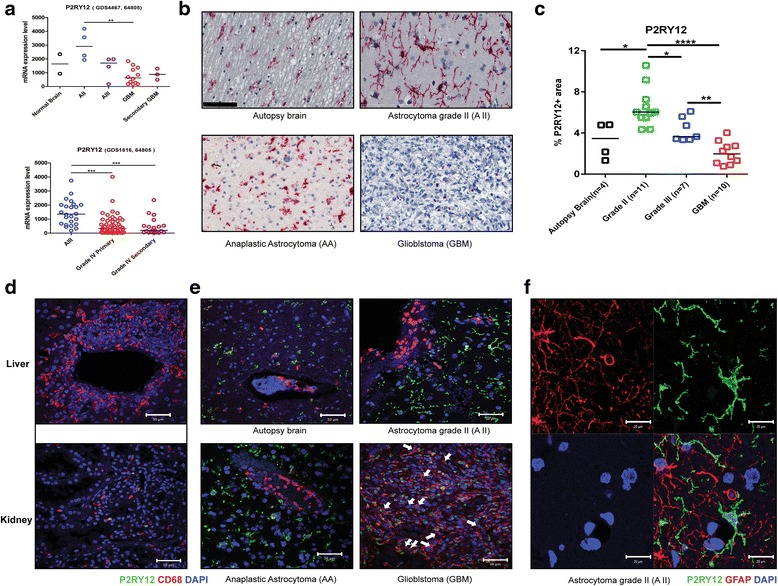
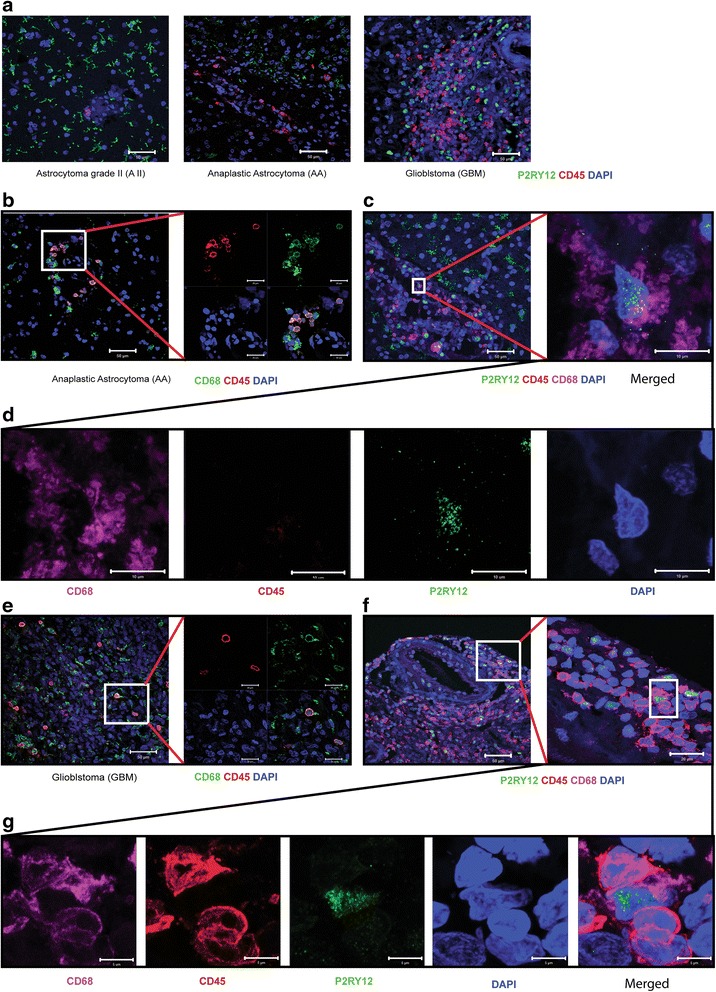
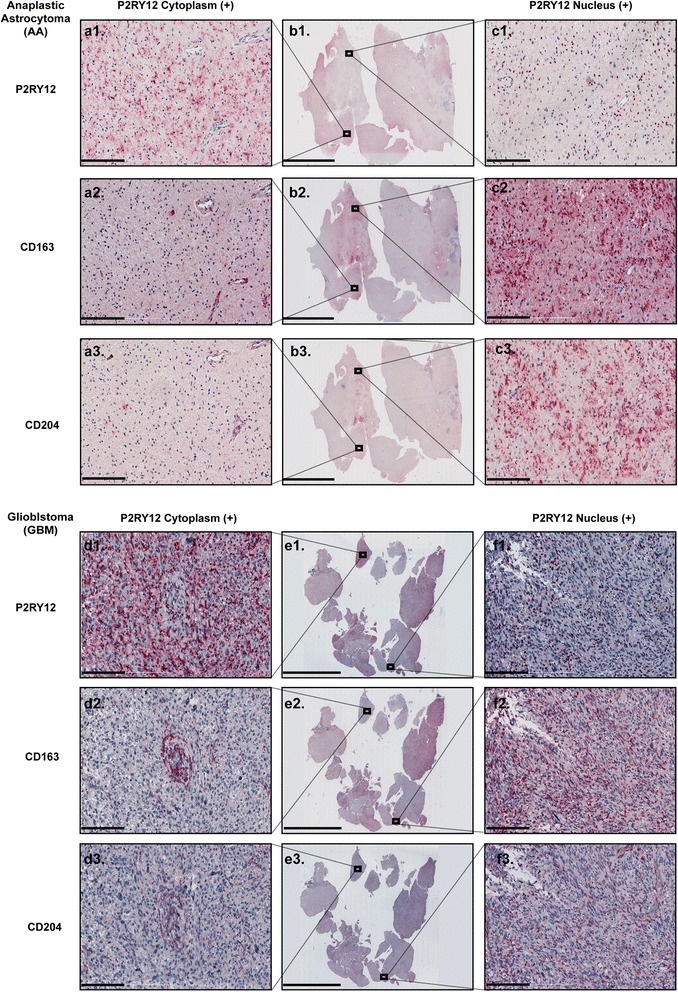
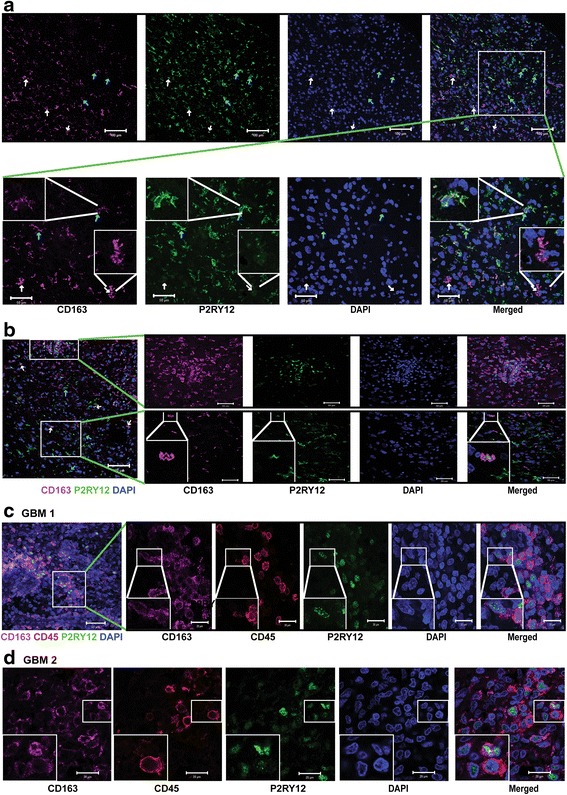
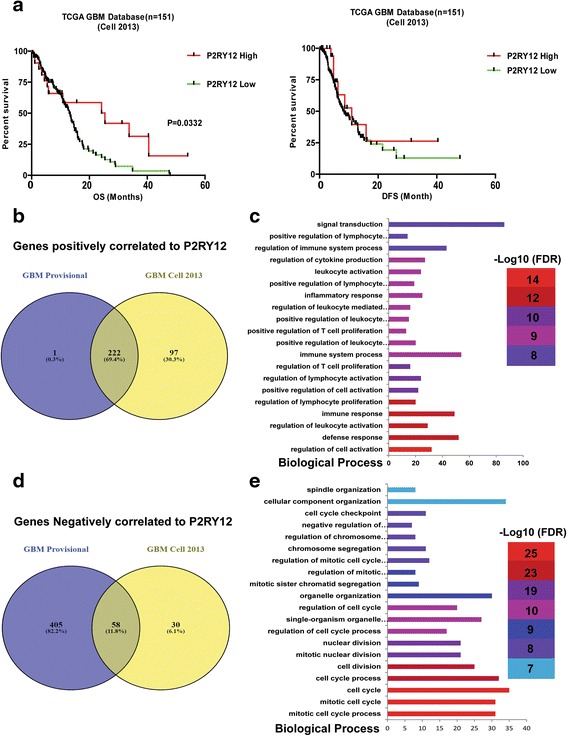
The role of resident microglial cells in the pathogenesis and progression of glial tumors is still obscure mainly due to a lack of specific markers. Recently P2RY12, a P2 purinergic receptor, was introduced as a specific marker for microglial cells under normal and pathologic conditions. Here we analyzed the expression of P2RY12 in astrocytomas of various malignancy grades in relation to markers for M1 and M2 macrophage activation profiles by using two web-based glioma datasets and confocal immunohistochemistry to 28 astrocytoma samples grades II-IV. In the gliomas, P2RY12 immunoreactivity delineated CD68 negative cells with otherwise microglial features from CD68 positive tumor associated macrophages (TAMs). The presence of P2RY12 positive cells correlated positively with overall survival. P2RY12 mRNA levels and membrane-bound localization of P2RY12 were inversely correlated with increasing malignancy grade, and the expression site of P2RY12 shifted from cytoplasmic in low-grade gliomas, to nuclear in high-grade tumors. The cytoplasmic expression of P2RY12 was associated with the expression of M1 markers, characteristic of the pro-inflammatory macrophage response. In contrast, the nuclear localization of P2RY12 was predominant in the higher graded tumors and associated with the expression of the M2 marker CD163.We conclude that P2RY12 is a specific marker for resident microglia in glioma and its expression and localization correspond to tumor grade and predominant stage of M1/M2 immune response.
Overview
The claims and statistics of this paper haven’t been checked yet.
Free: it reads the open-access text and checks the first 5 claims that cite a source we can check. Create a free account to check every claim.
Integrity signals
Registry
Cites
Statistics
Figures
Verification
Claims the paper makes
The claims and statistics of this paper haven’t been checked yet.
Free: it reads the open-access text and checks the first 5 claims that cite a source we can check. Create a free account to check every claim.
Claims other papers make about this one
Each is checked against this paper’s own text: does it say what the citing paper says it does?
In the citing paper
“Several of these microglial genes were also observed in human microglia, including P2RY12 and TMEM119 (REFs25,33–36).”
From Microglial signatures and their role in health and disease (2018) · cites this paper as [34]
Self-check
Percentages, sums and reported differences re-computed from the paper’s own numbers.
The self-check needs the paper’s full text.
Citations
Cites
Integrative Analysis of Complex Cancer Genomics and Clinical Profiles Using the cBioPortal
Gao, J., Aksoy, B. A., Dogrusoz, U., Dresdner, G., Gross, B., Sumer, S. O., Sun, Y., Jacobsen, A., Sinha, R., Larsson, E., et al. (2013) · Science Signaling · doi:10.1126/scisignal.2004088 · Cited by 15,160 · cited 1×
“To study the relation between P2RY12 mRNA expression levels and markers for microglia identification, a mutual exclusivity analysis was performed as described previously [8, 9].”
Polazzi, E., Mengoni, I., Caprini, M., Peña-Altamira, E., Kurtys, E., & Monti, B. (2013) · Neurosignals · doi:10.1159/000337115 · Cited by 8,994
The Somatic Genomic Landscape of Glioblastoma
Brennan, C. W., Verhaak, R. G. W., McKenna, A., Campos, B., Noushmehr, H., Salama, S. R., Zheng, S., Chakravarty, D., Sanborn, J. Z., Berman, S. H., et al. (2013) · Cell · doi:10.1016/j.cell.2013.09.034 · Cited by 5,016 · cited 2×
“RNA-sequencing data of P2RY12 combined with clinical data were obtained from two TCGA glioblastoma databases (Provisional: 166 GBM patients [4].”
The M1 and M2 paradigm of macrophage activation: Time for reassessment
Martinez, F. O., & Gordon, S. (2014) · F1000Prime Reports · doi:10.12703/p6-13 · Cited by 4,689 · cited 1×
“Recent studies addressing the phenotypic adaptations of peripheral macrophages in cancer have shown that tumor associated macrophages (TAMs), similar to the M1 and M2 activation states of macrophages, display particular marker profiles of pro- and anti-oncogenic action [25, 31].”
Microglia-mediated neurotoxicity: uncovering the molecular mechanisms
Block, M. L., Zecca, L., & Hong, J.-S. (2007) · Nature Reviews Neuroscience · doi:10.1038/nrn2038 · Cited by 4,110 · cited 1×
“Upon activation, the cells take on an amoeboid shape and initiate the paracrine recruitment of bloodderived macrophages into the altered brain parenchyma, initiating an inflammatory response [2, 11].”
Tumor-Associated Macrophages: From Mechanisms to Therapy
Noy, R., & Pollard, J. W. (2014) · Immunity · doi:10.1016/j.immuni.2014.06.010 · Cited by 4,089
Identification of a unique TGF-β–dependent molecular and functional signature in microglia
Butovsky, O., Jedrychowski, M. P., Moore, C. S., Cialic, R., Lanser, A. J., Gabriely, G., Koeglsperger, T., Dake, B., Wu, P. M., Doykan, C. E., et al. (2014) · Nature Neuroscience · doi:10.1038/nn.3599 · Cited by 2,543 · cited 1×
“Recently, the Purinergic Receptor P2Y12 (P2RY12) was proposed as a specific marker for healthy rodent CNS microglial cells, discriminating these cells from other types of tissue resident macrophages or blood-derived monocytes [5].”
New tools for studying microglia in the mouse and human CNS
Bennett, M. L., Bennett, F. C., Liddelow, S. A., Ajami, B., Zamanian, J. L., Fernhoff, N. B., Mulinyawe, S. B., Bohlen, C. J., Adil, A., Tucker, A., et al. (2016) · Proceedings of the National Academy of Sciences · doi:10.1073/pnas.1525528113 · Cited by 1,804
The role of microglia and macrophages in glioma maintenance and progression
Hambardzumyan, D., Gutmann, D. H., & Kettenmann, H. (2016) · Nature Neuroscience · doi:10.1038/nn.4185 · Cited by 1,683 · cited 2×
“Recent reports have pointed to the heterogeneity of microglial cells [10].”
Microglia as a source and target of cytokines
Hanisch, U. (2002) · Glia · doi:10.1002/glia.10161 · Cited by 1,645
The P2Y12 receptor regulates microglial activation by extracellular nucleotides
Haynes, S. E., Hollopeter, G., Yang, G., Kurpius, D., Dailey, M. E., Gan, W.-B., & Julius, D. (2006) · Nature Neuroscience · doi:10.1038/nn1805 · Cited by 1,542 · cited 3×
“P2RY12 deficiency in P2RY12 knockdown mice significantly compromised microglial chemotaxis and extension of microglial foot processes in response to CNS injury [12, 29].”
Microglia emerge from erythromyeloid precursors via Pu.1- and Irf8-dependent pathways
Kierdorf, K., Erny, D., Goldmann, T., Sander, V., Schulz, C., Perdiguero, E. G., Wieghofer, P., Heinrich, A., Riemke, P., Hölscher, C., et al. (2013) · Nature Neuroscience · doi:10.1038/nn.3318 · Cited by 1,457 · cited 1×
“Likewise, IRF8, a transcription factor for the function and development of microglia cells [14, 15] is expressed simultaneous with P2RY12 in both GBM and low grade gliomas.”
Microglia development and function
Nayak, D., Roth, T. L., & McGavern, D. B. (2014) · Annual Review of Immunology · doi:10.1146/annurev-immunol-032713-120240 · Cited by 1,154 · cited 1×
“As major contributors to the immune status of the central nervous system (CNS) microglial cells scan the CNS for cellular debris by continuously protract and retract their cell processes [26].”
The Role of Microglia in the Healthy Brain: Figure 1.
Tremblay, M.-È., Stevens, B., Sierra, A., Wake, H., Bessis, A., & Nimmerjahn, A. (2011) · The Journal of Neuroscience · doi:10.1523/jneurosci.4158-11.2011 · Cited by 992 · cited 1×
“The microglial survey mediates the immune response, supports the homeostasis of the neurons and, in collaboration with astrocytes, maintains the integrity of the blood-brain barrier (BBB) [23, 32, 37].”
Selective Ablation of Proliferating Microglial Cells Exacerbates Ischemic Injury in the Brain
Lalancette-Hébert, M., Gowing, G., Simard, A., Weng, Y. C., & Kriz, J. (2007) · The Journal of Neuroscience · doi:10.1523/jneurosci.5360-06.2007 · Cited by 874 · cited 1×
“Microglia serves additional, only partly known, roles in repair processes following the acute stage of tissue damage [18, 27].”
InfluentialPossible involvement of the M2 anti‐inflammatory macrophage phenotype in growth of human gliomas
Komohara, Y., Ohnishi, K., Kuratsu, J., & Takeya, M. (2008) · The Journal of Pathology · doi:10.1002/path.2370 · Cited by 738 · cited 1×
“In contrast, TAMs that promote tumor progression are associated with an immunosuppressive response; contribute to tumor angiogenesis and proliferation, and are associated with poor clinical outcomes [10, 17, 33] and these cells are referred to as M2-like cells.”
Macrophages and cancer: from mechanisms to therapeutic implications
Ostuni, R., Kratochvill, F., Murray, P. J., & Natoli, G. (2015) · Trends in Immunology · doi:10.1016/j.it.2015.02.004 · Cited by 683 · cited 1×
“Recent studies addressing the phenotypic adaptations of peripheral macrophages in cancer have shown that tumor associated macrophages (TAMs), similar to the M1 and M2 activation states of macrophages, display particular marker profiles of pro- and anti-oncogenic action [25, 31].”
Jay, T. R., Miller, C. M., Cheng, P. J., Graham, L. C., Bemiller, S., Broihier, M. L., Xu, G., Margevicius, D., Karlo, J. C., Sousa, G. L., et al. (2015) · Journal of Experimental Medicine · doi:10.1084/jem.20142322 · Cited by 682 · cited 2×
“The microglial marker Iba-1 is coexpressed with CD45 and is therefore, not discriminative between residential microglia and monocytic cells that migrated into the brain [13].”
Regulation of macrophage development and function in peripheral tissues
Lavin, Y., Mortha, A., Rahman, A., & Merad, M. (2015) · Nature Reviews Immunology · doi:10.1038/nri3920 · Cited by 680 · cited 1×
“Microglial cells are brain-specific tissue resident macrophages that are directly derived from yolk-sac erythromyeloid precursor cells (EMP) during embryonic development [19].”
Mutual exclusivity analysis identifies oncogenic network modules
Ciriello, G., Cerami, E., Sander, C., & Schultz, N. (2012) · Genome Research · doi:10.1101/gr.125567.111 · Cited by 675 · cited 1×
“To study the relation between P2RY12 mRNA expression levels and markers for microglia identification, a mutual exclusivity analysis was performed as described previously [8, 9].”
Macrophage Ontogeny Underlies Differences in Tumor-Specific Education in Brain Malignancies
Bowman, R. L., Klemm, F., Akkari, L., Pyonteck, S. M., Sevenich, L., Quail, D. F., Dhara, S., Simpson, K., Gardner, E. E., Iacobuzio-Donahue, C. A., et al. (2016) · Cell Reports · doi:10.1016/j.celrep.2016.10.052 · Cited by 619 · cited 1×
“In addition, transcriptional data of P2ry12 in a murine glioma model were obtained from the GEO database (GSE 86573) [3].”
Butowski, N., Colman, H., De Groot, J. F., Omuro, A. M., Nayak, L., Wen, P. Y., Cloughesy, T. F., Marimuthu, A., Haidar, S., Perry, A., et al. (2016) · Neuro-Oncology · doi:10.1093/neuonc/nov245 · Cited by 593 · cited 2×
“P2RY12 was claimed as a specific marker for microglial cells in human brains [1, 6, 34].”
Zhang, M., He, Y., Sun, X., Li, Q., Wang, W., Zhao, A., & Di, W. (2014) · Journal of Ovarian Research · doi:10.1186/1757-2215-7-19 · Cited by 528 · cited 1×
“tumor growth and prolonging patient survival [28, 39].”
Purinergic receptor P2RY12-dependent microglial closure of the injured blood–brain barrier
Lou, N., Takano, T., Pei, Y., Xavier, A. L., Goldman, S. A., & Nedergaard, M. (2016) · Proceedings of the National Academy of Sciences · doi:10.1073/pnas.1520398113 · Cited by 364 · cited 1×
“The microglial survey mediates the immune response, supports the homeostasis of the neurons and, in collaboration with astrocytes, maintains the integrity of the blood-brain barrier (BBB) [23, 32, 37].”
Adenosine A2A receptor mediates microglial process retraction
Orr, A. G., Orr, A. L., Li, X.-J., Gross, R. E., & Traynelis, S. F. (2009) · Nature Neuroscience · doi:10.1038/nn.2341 · Cited by 362 · cited 1×
“High concentrations of purinergic nucleotides and nucleosides such as adenosine and ATP were shown to work in synergy with LPS activation of microglial cells, promoting chemo repulsion away from the ATP source, a process that is associated with increased local adenosine A2A receptor signaling [16, 30].”
Factors regulating microglia activation
Kierdorf, K., & Prinz, M. (2013) · Frontiers in Cellular Neuroscience · doi:10.3389/fncel.2013.00044 · Cited by 360 · cited 1×
“Likewise, IRF8, a transcription factor for the function and development of microglia cells [14, 15] is expressed simultaneous with P2RY12 in both GBM and low grade gliomas.”
The molecular profile of microglia under the influence of glioma
Li, W., & Graeber, M. B. (2012) · Neuro-Oncology · doi:10.1093/neuonc/nos116 · Cited by 340 · cited 1×
“In glioblastoma, microglia displays a pro-oncogenic phenotype resembling that of M2-like macrophages, because the cells are in a microenvironment rich in glioma (stem) cell derived factors like TGF-β1, MCP-1, PGE-2, and soluble colony stimulating factors [22].”
Microglia function in brain tumors
Watters, J. J., Schartner, J. M., & Badie, B. (2005) · Journal of Neuroscience Research · doi:10.1002/jnr.20485 · Cited by 329 · cited 1×
“release of cytokines and proteases [24, 35, 38].”
Microglia Stimulate the Invasiveness of Glioma Cells by Increasing the Activity of Metalloprotease-2
Markovic, D. S., Glass, R., Synowitz, M., Rooijen, N. V., & Kettenmann, H. (2005) · Journal of Neuropathology & Experimental Neurology · doi:10.1097/01.jnen.0000178445.33972.a9 · Cited by 317 · cited 1×
“release of cytokines and proteases [24, 35, 38].”
Microglia provide neuroprotection after ischemia
Neumann, J., Gunzer, M., Gutzeit, H. O., Ullrich, O., Reymann, K. G., & Dinkel, K. (2006) · The FASEB Journal · doi:10.1096/fj.05-4882fje · Cited by 287 · cited 1×
“Microglia serves additional, only partly known, roles in repair processes following the acute stage of tissue damage [18, 27].”
InfluentialSelective expression of Gi/o‐coupled ATP receptor P2Y12 in microglia in rat brain
Sasaki, Y., Hoshi, M., Akazawa, C., Nakamura, Y., Tsuzuki, H., Inoue, K., & Kohsaka, S. (2003) · Glia · doi:10.1002/glia.10293 · Cited by 237
Glioma Grade Is Associated with the Accumulation and Activity of Cells Bearing M2 Monocyte Markers
Prosniak, M., Harshyne, L. A., Andrews, D. W., Kenyon, L. C., Bedelbaeva, K., Apanasovich, T. V., Heber-Katz, E., Curtis, M. T., Cotzia, P., & Hooper, D. C. (2013) · Clinical Cancer Research · doi:10.1158/1078-0432.ccr-12-1940 · Cited by 203 · cited 1×
“In contrast, TAMs that promote tumor progression are associated with an immunosuppressive response; contribute to tumor angiogenesis and proliferation, and are associated with poor clinical outcomes [10, 17, 33] and these cells are referred to as M2-like cells.”
Agonist-independent Nuclear Localization of the Apelin, Angiotensin AT1, and Bradykinin B2 Receptors
Lee, D. K., Lança, A. J., Cheng, R., Nguyen, T., Ji, X. D., Gobeil, F., Chemtob, S., George, S. R., & O'Dowd, B. F. (2004) · Journal of Biological Chemistry · doi:10.1074/jbc.m306377200 · Cited by 190 · cited 2×
“These receptors include the receptors for apelin, angiotensin II AT1, parathyroid hormone, glutamate mGluR5, endothelin ETA and ETB, and the prostaglandins EP1, EP3, and EP4 [21].”
Koizumi, S., Ohsawa, K., Inoue, K., & Kohsaka, S. (2013) · Glia · doi:10.1002/glia.22358 · Cited by 184 · cited 3×
“The environmental changes taking place under various pathological conditions cause ATP/ADP leaks that are noticed by the P2RY12 receptors of microglia and lead to changes affecting the cell processes and motility of the cells [16].”
P2Y12 receptors: structure and function
Cattaneo, M. (2015) · Journal of Thrombosis and Haemostasis · doi:10.1111/jth.12952 · Cited by 180 · cited 2×
“P2RY12 belongs to the family of P2 purinergic receptors, consisting of seven transmembrane G protein coupled receptors (GPCRs) that contribute to ATP-and ADP-mediated cell migration in vitro [7].”
P2Y12receptor‐mediated integrin‐β1 activation regulates microglial process extension induced by ATP
Ohsawa, K., Irino, Y., Sanagi, T., Nakamura, Y., Suzuki, E., Inoue, K., & Kohsaka, S. (2010) · Glia · doi:10.1002/glia.20963 · Cited by 155
Microglia dynamics and function in the CNS
Parkhurst, C. N., & Gan, W.-B. (2010) · Current Opinion in Neurobiology · doi:10.1016/j.conb.2010.07.002 · Cited by 132 · cited 1×
“The microglial survey mediates the immune response, supports the homeostasis of the neurons and, in collaboration with astrocytes, maintains the integrity of the blood-brain barrier (BBB) [23, 32, 37].”
The invasion promoting effect of microglia on glioblastoma cells is inhibited by cyclosporin A
Sliwa, M., Markovic, D., Gabrusiewicz, K., Synowitz, M., Glass, R., Zawadzka, M., Wesolowska, A., Kettenmann, H., & Kaminska, B. (2007) · Brain · doi:10.1093/brain/awl263 · Cited by 132 · cited 1×
“release of cytokines and proteases [24, 35, 38].”
Szulzewsky, F., Arora, S., de Witte, L., Ulas, T., Markovic, D., Schultze, J. L., Holland, E. C., Synowitz, M., Wolf, S. A., & Kettenmann, H. (2016) · Glia · doi:10.1002/glia.23014 · Cited by 117
Lecchi, A., Razzari, C., Paoletta, S., Dupuis, A., Nakamura, L., Ohlmann, P., Gachet, C., Jacobson, K. A., Zieger, B., & Cattaneo, M. (2014) · Blood · doi:10.1182/blood-2013-07-517896 · Cited by 47
Zheng, P., van der Weiden, M., & Kros, J. M. (2013) · Journal of Cellular Physiology · doi:10.1002/jcp.24538 · Cited by 16 · cited 1×
“The staining procedure and scanning of the stained sections were performed according to the protocol described previously [40].”
Self-citation
Cited by
Microglial signatures and their role in health and disease
Butovsky, O., & Weiner, H. L. (2018) · Nature Reviews Neuroscience · doi:10.1038/s41583-018-0057-5 · Cited by 1,046
Microglia and Neuroinflammation: What Place for P2RY12?
Gómez Morillas, A., Besson, V. C., & Lerouet, D. (2021) · International Journal of Molecular Sciences · doi:10.3390/ijms22041636 · Cited by 214
Lee, J., Kim, D. E., Griffin, P., Sheehan, P. W., Kim, D., Musiek, E. S., & Yoon, S. (2020) · Aging Cell · doi:10.1111/acel.13078 · Cited by 152
“Recently, the purinergic receptor P2Y12R, a Gi/o-coupled ATP receptor, was proposed as a specific marker for rodent microglia, particularly for the M2 phenotype (Butovsky et al., 2014; Moore et al., 2015; Zhu et al., 2017).”
BackgroundMicroglia and the Purinergic Signaling System
Calovi, S., Mut-Arbona, P., & Sperlágh, B. (2019) · Neuroscience · doi:10.1016/j.neuroscience.2018.12.021 · Cited by 133
Walker, D. G., Tang, T. M., Mendsaikhan, A., Tooyama, I., Serrano, G. E., Sue, L. I., Beach, T. G., & Lue, L.-F. (2020) · International Journal of Molecular Sciences · doi:10.3390/ijms21020678 · Cited by 128
“P2RY12-expressing microglia in astrocytomas were increased in low-grade but reduced in high-grade tumors [31].”
Background
Metadata
- Authors
- Zhu, C., Kros, J. M., van der Weiden, M., Zheng, P., Cheng, C., & Mustafa, D. A. M.
- Affiliations
- Erasmus MC (NL)
- Corresponding author
- Mustafa, Dana A. M.
- Venue
- Acta Neuropathologica Communications
- Published
- 2017-01-10
- Volume
- 5
- Issue
- 1
- Pages
- 4-4
- ISSN
- 2051-5960 (ISSN-L)
- PMC
- PMC5223388
- OpenAlex
- W2570663248
- Cited by
- 81
- References
- 41
- Citations by year
- 2026: 9 · 2025: 6 · 2024: 8 · 2023: 3 · 2022: 13 · 2021: 12 · 2020: 11 · 2019: 7 · 2018: 9 · 2017: 3
- FWCI
- 4.09
- Type
- journal article
- Language
- en
- Open access
- gold
- doi.org
- Licence
- cc-by
- Locations
- Acta Neuropathologica Communications (publishedVersion, cc-by)
- PubMed Central (publishedVersion, cc-by)
- PubMed (publishedVersion)
- EUR Research Repository (Erasmus University Rotterdam) (publishedVersion, other-oa)
- EUR Research Repository (Erasmus University Rotterdam) (submittedVersion, other-oa)
- RePub (Erasmus University Rotterdam) (submittedVersion, other-oa)
- Utrecht University Repository (Utrecht University) (submittedVersion, other-oa)
- RePub (Erasmus University Rotterdam) (submittedVersion)
- Funders
- Chinese Scholarship Council (201206230102)
- Netherlands Foundation for Cardiovascular Excellence (CVON2014-11 RECONNECT)
- VIDI grant (91714302)
- KWF Kankerbestrijding (KWF EMCR 2009-4553)
- Topics
- Life Sciences › Neuroscience › Neurology › Neuroinflammation and Neurodegeneration Mechanisms
- Health Sciences › Medicine › Oncology › Glioma Diagnosis and Treatment
- Life Sciences › Biochemistry, Genetics and Molecular Biology › Physiology › Adenosine and Purinergic Signaling
- Keywords
- P2Y12 receptor, astrocytoma, tumor-associated macrophages, M1 macrophages, M2 macrophages, tumor grade, CD163, CD68, purinergic receptors, nuclear localization, overall survival
- MeSH terms
- CD68 Molecule, Adult, Astrocytoma, Brain, Brain Neoplasms, Cell Nucleus, Cytoplasm, Female, Humans, Immunohistochemistry, Male, Middle Aged, RNA, Messenger, Biomarkers, Tumor, Antigens, Differentiation, Myelomonocytic, Antigens, CD, Gene Expression Regulation, Neoplastic, Survival Analysis, Databases, Factual, Treatment Outcome, Sequence Analysis, RNA, Microglia, Microscopy, Confocal, Neoplasm Grading
About these checks
Registry, retraction, Cites and statistics results are computed, not judged, with one exception: a printed reference that no index lists is read once by a model before it counts as a citation error. Claims are extracted by a model and kept only when their quote appears verbatim in the text; each cited source is then checked, with a model’s help, for whether it says what the claim relies on. Those verdicts can be wrong — read the claim’s quote and the cited source before relying on one.
Statistics and arithmetic are recomputed, not judged.
Confidence bands are shown only for fields calibrated on our annotated test set. None is calibrated yet, so no band is shown.
What counts as a claim ›How we measure confidence ›How we check this ›
Are you an author, or do you see a problem with this page? Request a review
Data sources
Bibliographic data: Semantic Scholar, OpenAlex, Crossref.
Contains information from the Semantic Scholar Academic Graph Datasets, made available under the ODC Attribution License (ODC-BY 1.0).
Semantic Scholar’s data is described in: Kinney, R., et al. (2023). The Semantic Scholar Open Data Platform. arXiv:2301.10140.
