

Improved cardiorespiratory fitness after occupational rehabilitation in merged diagnostic groups
Open accessThe DOI matches its Crossref record; 34 of the 35 references it cites were found in a registry or an index, and 1 are not checked yet; 4 of the 21 sources its claims cite were checked for support.
Abstract
Background: Various occupational inpatient rehabilitation programs are established in Norway. This study aimed to assess change in cardiorespiratory fitness, pain, anxiety, depression, and quality of life in persons on long-term sick leave due to musculoskeletal-, mental or unspecific disorders after participation in multicomponent inpatient occupational rehabilitation. Methods: Twenty-five women and five men (mean age 45.2 years, SD 6.7, range 30-57) volunteered to participate in the study. The participants attended either 8 or 17 full days of occupational multicomponent rehabilitation including physical exercise, cognitive behavioral therapy in the form of acceptance and commitment therapy (ACT), and development of a tailored plan for return to work. Cardiorespiratory fitness was assessed by the Åstrand/Ryhming cycle test at the start and end of rehabilitation program, and at one-year follow-up. Changes in somatic and mental health were measured by questionnaires up to 4 months after start of the program. Results: Linear mixed models showed that the maximal oxygen uptake increased by 1.1 mL°kg-1°min- 1 during the rehabilitation program and by 3.7 mL°kg-1°min-1 at one-year follow-up. There were minor improvements in somatic and mental health, and quality of life. Conclusions: This study indicates that occupational inpatient multicomponent rehabilitation including physical exercise and ACT may promote a long-term increase in physical exercise that is sufficient to induce a significant increase in cardiorespiratory fitness. © 2018 The Author(s).
Verified 2026-11-22 · 1 reference not checked yet
Overview
CoChat Summary
## TL;DR
In 30 participants on long-term sick leave with musculoskeletal, mental, or unspecific disorders, an inpatient multicomponent occupational rehabilitation program was associated with higher estimated maximal oxygen uptake at program end and at 1-year follow-up. Pain, anxiety, depression, and quality of life showed only minor, non-significant changes.
## Key findings
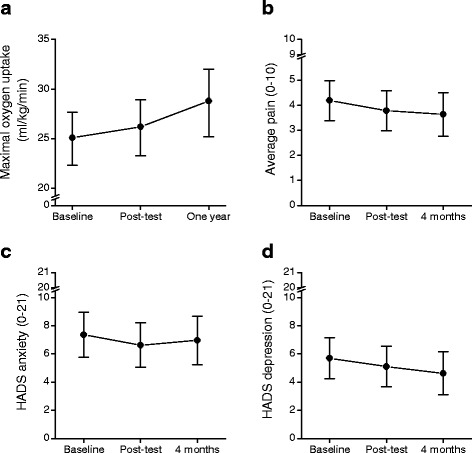
- Maximal oxygen uptake increased from 25.1 ml/kg/min at baseline to 26.2 ml/kg/min after rehabilitation (P = 0.031) and to 28.8 ml/kg/min at 1-year follow-up (P < 0.001) in the mixed-effects analysis.
- In the complete-case analysis, maximal oxygen uptake increased from 31.9 to 36.9 ml/kg/min from baseline to 1-year follow-up (Wilcoxon test, P < 0.01).
- The paper reports a 1.1 mL·kg−1·min−1 increase during rehabilitation and a 3.7 mL·kg−1·min−1 increase at 1 year.
- Pain, anxiety, depression, and quality of life showed no significant change at post-test and 4-month follow-up (P ≥ 0.086 for all comparisons).
## Methods
- Design: Prospective pre-post study with follow-up; participants were assessed at baseline, after rehabilitation, and for cardiorespiratory fitness again at about 1 year.
- Sample/program: 30 patients (25 women, 5 men; mean age 45.2 years) on 2–12 months sick leave with ICPC-2 diagnoses in the L, P, or A categories, enrolled in either a short or long inpatient multicomponent rehabilitation program at Hysnes Rehabilitation Center.
- Analysis: Cardiorespiratory fitness was measured with the Åstrand/Ryhming cycle test; outcomes were analyzed with multilevel mixed-effects linear regression, with a Wilcoxon matched-pairs signed rank test in complete cases for the 1-year fitness outcome.
## Limitations
- The authors state it was a small, non-controlled study with 30 participants at baseline and only 10 at the 1-year follow-up, and they note possible attrition bias because baseline maximal oxygen uptake and pain differed between those who did and did not attend follow-up.
- They state cardiorespiratory fitness was measured with an indirect estimate of maximal oxygen uptake (Åstrand/Ryhming test), which may be less certain than direct measurement; they also note it can systematically underestimate maximal oxygen uptake in unfit individuals.
- Evident from the text: there was no control group, so changes cannot be causally attributed to the intervention alone.
Model-written summary. Check it against the paper before relying on it.
Integrity signals
Registry
Cites
Statistics
Figures
Verification
Claims the paper makes
3 Valid · 0 Not valid · 10 Not checked · 20 Own results and interpretations
Every source the paper cites for this claim was checked and supports it.
In the paper
“However, occupational physical activity does not seem to have the required intensity to improve cardiorespiratory fitness [35].”
§ Improved cardiorespiratory fitness after occupational rehabilitation in merged diagnostic groups > Discussion
What the sources say
- Supportedcites [35] Holtermann A Krause N van der Beek AJ Straker L The physical activity paradox: six reasons why occupational physical activity (OPA) does not confer the cardiovascular health benefits that leisure time physical activity does Br J Sports Med 2018 52 149 150 10.1136/bjsports-2017-097965 28798040 source
In reason 1 of the proposed mechanisms, the paper states that occupational physical activity is generally too low in intensity to maintain or improve cardiorespiratory fitness. It explains that improving fitness requires short periods of high-intensity activity, consistent with the citing sentence’s cautious wording. (LLM, conf=0.94)
hedged- Asserted: passes — The authors put it forward as true.
- Checkable: passes — It can be checked against evidence.
- Load-bearing: unclear — It is unclear whether the paper’s conclusions depend on it.
- Based: passes — The paper gives a reason why it holds.
- Supported
Every source the paper cites for this claim was checked and supports it.
In the paper
“Although there was no control group in this study, a large reference material shows that the expected age-related reduction in maximal oxygen uptake is close to 1% per year [27].”
§ Improved cardiorespiratory fitness after occupational rehabilitation in merged diagnostic groups > Discussion
What the sources say
- Supportedcites [27] Loe H Rognmo Ø Saltin B Wisløff U Aerobic capacity reference data in 3816 healthy men and women 20–90 years PLoS One 2013 8 e64319 10.1371/journal.pone.0064319 23691196 PMC3654926 source
The Discussion reports an approximately 10% decline per decade in maximal oxygen uptake for both sexes across the 40–69-year age groups, equivalent to about 1% per year. The paper does not present that rate as uniform across all ages. (LLM, conf=0.90)
plainstates a cause- Asserted: passes — The authors put it forward as true.
- Checkable: passes — It can be checked against evidence.
- Load-bearing: unclear — It is unclear whether the paper’s conclusions depend on it.
- Based: passes — The paper gives a reason why it holds.
- Supported
A result the paper reports from its own data — it cites no other source for it, so there is none to check. The quote shows it is in the paper.
In the paper
“Linear mixed models showed that the maximal oxygen uptake increased by 1.1 mL°kg-1°min− 1 during the rehabilitation program and by 3.7 mL°kg-1°min− 1 at one-year follow-up.”
- Also stated in: § Results · plain
“Multilevel mixed-effects linear regression showed that the maximal oxygen uptake (Fig. 1) increased significantly from 25.1 ml/kg/min (95% CI 22.5–27.9) at baseline to 26.2 (95% CI 23.5–29.1; P = 0.031) after the rehabilitation program and to 28.8 (95% CI 25.6–32.4; P < 0.001) at one-year follow-up.”
- Also stated in: § Discussion · hedged
“The 3.7 ml/min/kg improvement in maximal oxygen uptake in the participants in this study may have important health benefits.”
§ Improved cardiorespiratory fitness after occupational rehabilitation in merged diagnostic groups > Abstract > Results
plainstates a causen = 5- Asserted: passes — The authors put it forward as true.
- Checkable: passes — It can be checked against evidence.
- Load-bearing: passes — The paper’s conclusions depend on it.
- Based: passes — The paper gives a reason why it holds.
- Also stated in: § Results · plain
A result the paper reports from its own data — it cites no other source for it, so there is none to check. The quote shows it is in the paper.
In the paper
“This model-based approach reduced the magnitude of the change from baseline to the one-year follow-up compared to the secondary analysis of complete cases (increment of 3.7 vs. 5.0 ml/min/kg).”
§ Improved cardiorespiratory fitness after occupational rehabilitation in merged diagnostic groups > Discussion
plainstates a cause- Asserted: passes — The authors put it forward as true.
- Checkable: passes — It can be checked against evidence.
- Load-bearing: unclear — It is unclear whether the paper’s conclusions depend on it.
- Based: passes — The paper gives a reason why it holds.
A result the paper reports from its own data — it cites no other source for it, so there is none to check. The quote shows it is in the paper.
In the paper
“The baseline score on maximal oxygen uptake was significantly lower in the initial study sample compared to the group who performed the one-year follow-up.”
§ Improved cardiorespiratory fitness after occupational rehabilitation in merged diagnostic groups > Discussion
plainstates an association- Asserted: passes — The authors put it forward as true.
- Checkable: passes — It can be checked against evidence.
- Load-bearing: passes — The paper’s conclusions depend on it.
- Based: passes — The paper gives a reason why it holds.
12 more claims
Create a free account to see all 33 claims and to verify the 2 references still open.
- Probably not a substantial claim. 12
- It may state two separate claims as one. 11
Claims other papers make about this one
Each is checked against this paper’s own text: does it say what the citing paper says it does?
In the citing paper
“We previously reported that a sub-sample of participants in I-MORE improved their cardiorespiratory fitness during the program, and increased further after a year (40).”
Citations
Cites
The Hospital Anxiety and Depression Scale
Zigmond, A. S., & Snaith, R. P. (1983) · Acta Psychiatrica Scandinavica · doi:10.1111/j.1600-0447.1983.tb09716.x · Cited by 47,139
Depression and quality of life in older persons: A review
Sivertsen, H., Bjørkløf, G. H., Engedal, K., Selbæk, G., & Helvik, A.-S. (2015) · Dementia and Geriatric Cognitive Disorders · doi:10.1159/000437299 · Cited by 14,152
The validity of the Hospital Anxiety and Depression Scale
Bjelland, I., Dahl, A. A., Haug, T. T., & Neckelmann, D. (2002) · Journal of Psychosomatic Research · doi:10.1016/s0022-3999(01)00296-3 · Cited by 9,779 · cited 1×
“A cutoff score of 8 has been shown to give an optimal balance between sensitivity and specificity on both subscales [19].”
Background(1999) · Cited by 5,934
Kodama, S. (2009) · JAMA · doi:10.1001/jama.2009.681 · Cited by 3,035 · cited 1×
“In a recent meta-analysis [30] a dose-response analysis of cardiorespiratory fitness as predictor of all-cause mortality and cardiovascular disease and coronary heart disease were performed.”
MethodÅstrand, P. O., & Ryhming, I. (1954) · Journal of Applied Physiology · doi:10.1152/jappl.1954.7.2.218 · Cited by 1,558 · cited 1×
“Maximal oxygen uptake (mL, kg (1), min (1)) was estimated by taking the average of the two last measurements of the HR, and applying this value to the Åstrand/Ryhming nomogram [15], corrected by the Åstrand age factor [16, 17].”
MethodThe 15D instrument of health-related quality of life: properties and applications
Sintonen, H. (2001) · Annals of Medicine · doi:10.3109/07853890109002086 · Cited by 1,217 · cited 1×
“Health-related quality of life was assessed with 15D [21].”
MethodVeehof, M. M., Trompetter, H. R., Bohlmeijer, E. T., & Schreurs, K. M. G. (2016) · Cognitive Behaviour Therapy · doi:10.1080/16506073.2015.1098724 · Cited by 737 · cited 1×
“Still, in a recent meta-analysis of acceptance- and mindfulness-based interventions for chronic pain [32], small but significant short- and”
BackgroundForman, E. M., Herbert, J. D., Moitra, E., Yeomans, P. D., & Geller, P. A. (2007) · Behavior Modification · doi:10.1177/0145445507302202 · Cited by 687 · cited 1×
“Some studies have suggested that ACT may reduce chronic pain [10], depression [11, 12], and anxiety [11, 13].”
BackgroundHoltermann, A., Krause, N., van der Beek, A. J., & Straker, L. (2018) · British Journal of Sports Medicine · doi:10.1136/bjsports-2017-097965 · Cited by 667 · cited 1×
“However, occupational physical activity does not seem to have the required intensity to improve cardiorespiratory fitness [35].”
Background(2009) · Nutrition Reviews · doi:10.1111/j.1753-4887.2008.00136.x · Cited by 593
Sickness, Disability and Work: Breaking the Barriers: A Synthesis of Findings across OECD Countries
OECD (2010) · OECD eBooks · doi:10.1787/9789264088856-en · Cited by 557
Roemer, L., Orsillo, S. M., & Salters-Pedneault, K. (2008) · Journal of Consulting and Clinical Psychology · doi:10.1037/a0012720 · Cited by 554 · cited 1×
“Some studies have suggested that ACT may reduce chronic pain [10], depression [11, 12], and anxiety [11, 13].”
BackgroundWetherell, J. L., Afari, N., Rutledge, T., Sorrell, J. T., Stoddard, J. A., Petkus, A. J., Solomon, B. C., Lehman, D. H., Liu, L., Lang, A. J., et al. (2011) · PAIN · doi:10.1016/j.pain.2011.05.016 · Cited by 508 · cited 1×
“Some studies have suggested that ACT may reduce chronic pain [10], depression [11, 12], and anxiety [11, 13].”
Background2008 physical activity guidelines for Americans; be active, healthy, and happy!
Fulton, J. E., & Kohl, H. W. (2008) · Cited by 267
Estimating the minimum important change in the 15D scores
Alanne, S., Roine, R. P., Räsänen, P., Vainiola, T., & Sintonen, H. (2015) · Quality of Life Research · doi:10.1007/s11136-014-0787-4 · Cited by 231
Aerobic Capacity Reference Data in 3816 Healthy Men and Women 20–90 Years
Loe, H., Rognmo, Ø., Saltin, B., & Wisløff, U. (2013) · PLoS ONE · doi:10.1371/journal.pone.0064319 · Cited by 216 · cited 2×
“Finally, the study sample consisted mainly of women (83%), which generally have lower cardiorespiratory fitness than men [27].”
BackgroundMethodTime course of the adaptive responses of aerobic power and heart rate to training
HICKSON, R. C., HAGBERG, J. M., EHSANI, A. A., & HOLLOSZY, J. O. (1981) · Medicine & Science in Sports & Exercise · doi:10.1249/00005768-198101000-00012 · Cited by 187 · cited 1×
“Similar results have been found after short training interventions in healthy persons [23, 24], but these studies employed training with very high intensity.”
ResultKeller, A., Hellesnes, J., & Jens I. Brox, A. (2001) · Spine · doi:10.1097/00007632-200104010-00017 · Cited by 152 · cited 1×
“To evaluate within-subject changes, the Åstrand/Ryhming cycle test has been suggested to be a useful measurement, and the reliability is confirmed by several studies [33, 34], which was also illustrated in this study where a small but statistically significant 1.”
MethodNon-pharmacological treatment of chronic widespread musculoskeletal pain
Mannerkorpi, K., & Henriksson, C. M. (2007) · Best Practice & Research Clinical Rheumatology · doi:10.1016/j.berh.2007.04.001 · Cited by 144 · cited 2×
“However, improvement in cardiovascular fitness was recently found in fibromyalgia patients performing a 12 week intervention with moderate intensity exercise [25], and a review by Mannerkorpi and Henriksson [26] found that exercise at 55–90% of maximum HR improved cardiovascular fitness in patients with chronic widesp…”
BackgroundRobroek, S. J., Reeuwijk, K. G., Hillier, F. C., Bambra, C. L., van Rijn, R. M., & Burdorf, A. (2013) · Scandinavian Journal of Work, Environment & Health · doi:10.5271/sjweh.3354 · Cited by 144 · cited 1×
“Furthermore, physical exercise is associated with reduced risk of sickness absence and disability pension [2, 6, 7], although not all studies report such associations [8].”
BackgroundA Pilot Study of Acceptance and Commitment Therapy for Promotion of Physical Activity
Butryn, M. L., Forman, E., Hoffman, K., Shaw, J., & Juarascio, A. (2011) · Journal of Physical Activity and Health · doi:10.1123/jpah.8.4.516 · Cited by 134 · cited 2×
“A pilot study by Butryn and colleagues [28] investigating whether ACT promotes short-term increase in physical activity in healthy females, reported that ACT increased the level of physical activity more than an educational intervention during 8 weeks followup.”
BackgroundResultValidity of the Astrand-Ryhming nomogram for predicting maximal oxygen intake.
Cink, R. E., & Thomas, T. R. (1981) · British Journal of Sports Medicine · doi:10.1136/bjsm.15.3.182 · Cited by 126 · cited 2×
“Measuring HR at submaximal loads and extrapolating them into the expected ageadjusted maximal (HR) values is commonly used as an indirect measurement of maximal oxygen uptake [17].”
MethodFolke, F., Parling, T., & Melin, L. (2012) · Cognitive and Behavioral Practice · doi:10.1016/j.cbpra.2012.01.002 · Cited by 100
(2001) · PubMed · Cited by 89
The Impact of Health Behaviour on Long Term Sickness Absence: Results from DWECS/DREAM
CHRISTENSEN, K. B., LUND, T., LABRIOLA, M., BÜLTMANN, U., & VILLADSEN, E. (2007) · Industrial Health · doi:10.2486/indhealth.45.348 · Cited by 69 · cited 1×
“Furthermore, physical exercise is associated with reduced risk of sickness absence and disability pension [2, 6, 7], although not all studies report such associations [8].”
BackgroundCardiovascular adaptations to 10 days of cycle exercise
Mier, C. M., Turner, M. J., Ehsani, A. A., & Spina, R. J. (1997) · Journal of Applied Physiology · doi:10.1152/jappl.1997.83.6.1900 · Cited by 57 · cited 1×
“Similar results have been found after short training interventions in healthy persons [23, 24], but these studies employed training with very high intensity.”
ResultLahti, J., Laaksonen, M., Lahelma, E., & Rahkonen, O. (2010) · Preventive Medicine · doi:10.1016/j.ypmed.2010.02.007 · Cited by 54
Fimland, M. S., Vasseljen, O., Gismervik, S., Rise, M. B., Halsteinli, V., Jacobsen, H. B., Borchgrevink, P. C., Tenggren, H., & Johnsen, R. (2014) · BMC Public Health · doi:10.1186/1471-2458-14-368 · Cited by 49 · cited 1×
“The occupational multicomponent rehabilitation program at Hysnes Rehabilitation Center have been described in detail elsewhere [14].”
MethodSelf-citationKangasniemi, A. M., Lappalainen, R., Kankaanpää, A., Tolvanen, A., & Tammelin, T. (2015) · BMC Public Health · doi:10.1186/s12889-015-1604-x · Cited by 37 · cited 2×
“However, the study found differences between the groups in change of cognitions related to exercise and physical activity, in favor of the ACT group [29].”
ResultBardal, E. M., Roeleveld, K., & Mork, P. J. (2015) · Journal of Rehabilitation Medicine · doi:10.2340/16501977-1966 · Cited by 35 · cited 1×
“However, improvement in cardiovascular fitness was recently found in fibromyalgia patients performing a 12 week intervention with moderate intensity exercise [25], and a review by Mannerkorpi and Henriksson [26] found that exercise at 55–90% of maximum HR improved cardiovascular fitness in patients with chronic widesp…”
BackgroundSelf-citationAasdahl, L., Pape, K., Vasseljen, O., Johnsen, R., Gismervik, S., Jensen, C., & Fimland, M. S. (2017) · Journal of Occupational Rehabilitation · doi:10.1007/s10926-016-9679-5 · Cited by 30 · cited 1×
“Recently, a larger study of patients with musculoskeletal, psychological or unspecified disorders enrolled at the same rehabilitation center reported improved quality of life from baseline to 12 months, while only marginal changes were found for pain, anxiety and depression [31].”
BackgroundSelf-citationKangasniemi, A. M., Lappalainen, R., Kankaanpää, A., Kulmala, J., Hakonen, H., & Tammelin, T. (2013) · BMC Public Health · doi:10.1186/1471-2458-13-671 · Cited by 28
Leisure‐time physical activity and disability pension: 9 years follow‐up of the HUNT S tudy, Norway
Fimland, M. S., Vie, G., Johnsen, R., Nilsen, T. I. L., Krokstad, S., & Bjørngaard, J. H. (2015) · Scandinavian Journal of Medicine & Science in Sports · doi:10.1111/sms.12369 · Cited by 25
Self-citation(1994) · PubMed
Research works printed but not linked: 2
- Fimland MS Woodhouse A Vasseljen O Gismervik S Jacobsen HB Johnsen R Can physical activity reduce sickness absence and disability pension? Norwegian J Physiother 2013 80 18 23
- Bahr R Hallén J Medbø JI Testing av Idrettsutøvere: Universitetsforlaget 1992
Cited by
Gismervik, S. Ø., Aasdahl, L., Vasseljen, O., Fors, E. A., Rise, M. B., Johnsen, R., Hara, K., Jacobsen, H. B., Pape, K., Fleten, N., et al. (2020) · Scandinavian Journal of Work, Environment & Health · doi:10.5271/sjweh.3882 · Cited by 37
“participants in I-MORE improved their cardiorespiratory fitness during the program, and increased further after a year (40).”
BackgroundSelf-citationAcceptance and Commitment Therapy on physical activity: A systematic review
Manchón, J., Quiles, M. J., Zarceño, E. L., & López-Roig, S. (2020) · Journal of Contextual Behavioral Science · doi:10.1016/j.jcbs.2020.07.008 · Cited by 35
Wasshenova, E. V., Boardley, D., Geers, A. L., Tull, M. T., & Steiner, V. (2022) · American Journal of Health Education · doi:10.1080/19325037.2022.2142334 · Cited by 3
“Increases in physical activity after ACT interventions have been observed at 1 month(21), 3 months, 6 months, and a year.(29) Of the studies reviewed, one study was conducted with patients in cardiac rehabilitation.”
Background
Metadata
- Authors
- Nordstoga, A. L., Mork, P. J., & Steiro Fimland, M.
- Affiliations
- Norwegian University of Science and Technology (NO)
- Corresponding author
- Nordstoga, Anne Lovise
- Venue
- Annals of Occupational and Environmental Medicine
- Published
- 2018-02-28
- Volume
- 30
- Issue
- 1
- Pages
- 16-16
- ISSN
- 2052-4374 (ISSN-L)
- PMC
- PMC5831230
- OpenAlex
- W2796208102
- Semantic Scholar
- ca7c25d0e5cb182348349372371f5def50d6256d
- Cited by
- 3
- References
- 35
- Citations by year
- 2022: 1 · 2020: 2
- FWCI
- 1.20
- Type
- journal article
- Language
- en
- Open access
- gold
- doi.org
- Licence
- cc-by
- Locations
- Annals of Occupational and Environmental Medicine (publishedVersion, cc-by)
- Europe PMC (PubMed Central) (publishedVersion, cc-by)
- PubMed Central (publishedVersion, cc-by)
- PubMed (publishedVersion)
- BIBSYS Brage (BIBSYS (Norway)) (acceptedVersion, cc-by)
- DOAJ (DOAJ: Directory of Open Access Journals) (submittedVersion, cc-by-sa)
- NORA - Norwegian Open Research Archives (submittedVersion, cc-by)
- Funders
- The research council of Norway
- KLP - Kommunal Landspensjonskasse, Norway
- Topics
- Health Sciences › Health Professions › Physical Therapy, Sports Therapy and Rehabilitation › Medical Practices and Rehabilitation
- Health Sciences › Medicine › Public Health, Environmental and Occupational Health › Workplace Health and Well-being
- Health Sciences › Health Professions › Physical Therapy, Sports Therapy and Rehabilitation › Musculoskeletal pain and rehabilitation
- Keywords
- cardiorespiratory fitness, vocational rehabilitation, inpatient rehabilitation, long-term sick leave, musculoskeletal disorders, mental illness, acceptance and commitment therapy, cognitive behavioral therapy, return to work, physical activity, quality of life, pain, anxiety, depression
About these checks
Registry, retraction, Cites and statistics results are computed, not judged, with one exception: a printed reference that no index lists is read once by a model before it counts as a citation error. Claims are extracted by a model and kept only when their quote appears verbatim in the text; each cited source is then checked, with a model’s help, for whether it says what the claim relies on. Those verdicts can be wrong — read the claim’s quote and the cited source before relying on one.
A language model drew the claims from the paper on 2026-10-11, under version 3 of the claim definition (model deepseek-v4.1-flash, prompt extract-v3).
A second model labelled each claim on 2026-10-11 (model jev-1.13-20260917, definition revision gold-guideline-v0.2).
Cited sources are checked with a language model’s help (gpt-6-sol).
Statistics and arithmetic are recomputed, not judged.
Confidence bands are shown only for fields calibrated on our annotated test set. None is calibrated yet, so no band is shown.
What counts as a claim ›How we measure confidence ›How we check this ›
Are you an author, or do you see a problem with this page? Request a review
Data sources
Bibliographic data: Semantic Scholar, OpenAlex, Crossref.
Contains information from the Semantic Scholar Academic Graph Datasets, made available under the ODC Attribution License (ODC-BY 1.0).
Semantic Scholar’s data is described in: Kinney, R., et al. (2023). The Semantic Scholar Open Data Platform. arXiv:2301.10140.
