

Impact of ChatGPT on ESL students’ academic writing skills: a mixed methods intervention study
Open accessThe DOI matches its Crossref record; 57 of the 57 references it cites were found in a registry or an index; 10 of the 56 sources its claims cite were checked for support.
Abstract
A mixed methods intervention study reporting significant positive impact of ChatGPT as a formative feedback tool on undergraduate ESL students' academic writing skills and positive perceptions.
Overview
CoChat Summary
TL;DR
This mixed methods intervention study found that using ChatGPT as a formative feedback tool significantly improved undergraduate ESL students’ academic writing skills, with the experimental group outperforming the comparison group on post-test and delayed post-test. Students’ focus group perceptions of ChatGPT’s impact were also overwhelmingly positive, though some concerns about dependence and reduced creativity were reported.
Key findings
- The experimental group’s writing scores improved significantly across pre-test, post-test, and delayed post-test: one-way RM ANOVA, F(2, 72) = 330.704, p = 5.146e-37, η² = 0.902. Bonferroni comparisons showed pre-test to post-test p < 0.001, d = -3.300; pre-test to delayed post-test p < 0.001, d = -3.898; post-test to delayed post-test p < 0.01, d = -0.598.
- The experimental group outperformed the comparison group on the post-test: t(70) = -5.643, p = 3.297e-7, with EG M = 19.216, SD = 2.485 vs. CG M = 16.371, SD = 1.695. The difference remained significant on the delayed post-test: t(70) = -9.371, p = 5.544e-14, with EG M = 20.419, SD = 2.575 vs. CG M = 15.400, SD = 1.897.
- Focus group data were coded under content, organization, and grammar. Positive codes included generation of more ideas (22 references), focused information on the topic (21), promotion of learner autonomy (19), promotion of collaboration (15), faster writing speed (13), creation of strong topic sentences (13), easy to stay focused (22), strong connection between main idea and supporting details (17), improving accuracy in sentence structure (22), and reliable source of grammar (21). Negative codes included less motivation to think (4), more machine dependence (3), imposing a pattern on writing (2), hindering creative organization (2), reduction in attention to grammatical accuracy (5), and increase in machine-dependence (3).
Methods
- Mixed methods intervention design with a quasi-experimental component. Participants were first-year science and engineering ESL students at an elite private university in India, aged 18–19. Initially 78 EG and 56 CG students consented; final reported data included 35 EG and 37 CG students who attended all six intervention hours and took the pre-, post-, and delayed post-tests. Five students participated in all three focus group discussions.
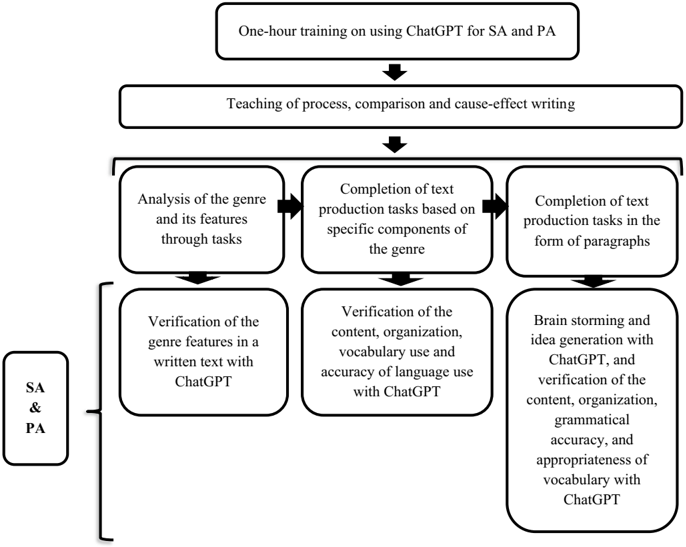
- The experimental group received one-hour training on using ChatGPT for self- and peer assessment, then was taught process, comparison, and cause-effect writing for six hours with ChatGPT used for SA and PA. Data came from three writing tests (process, comparison, cause-effect) scored with rubrics covering content, organization, grammar, and vocabulary; inter-rater Cohen’s Kappa was >0.8. A delayed post-test was conducted almost two months after the post-test.
- Quantitative analysis used one-way RM ANOVA, Bonferroni post-hoc tests, independent samples t-tests, Levene’s test, Shapiro-Wilk test, and Grubb’s test. Qualitative FGD transcripts were coded using a phronetic iterative approach, and quantitative and qualitative findings were triangulated.
Limitations
- The paper states that the study focused on only three writing genres, the intervention lasted only six hours, and student artefacts were not included. It notes that the intact classroom prevented going beyond the prescribed syllabus, focusing on more components, or extending the intervention, and that privacy and copyright issues made artefact collection difficult. It also states that argumentative writing was ignored, that generalization should be carefully worded, and that the absence of artefacts hurts the validity of claims.
- Evident from the text: the final analytic sample was relatively small (35 EG and 37 CG), and the qualitative perception data came from only five students who participated in all three FGDs, limiting breadth.
- Evident from the text: the study was conducted in a single course and institution with first-year science and engineering students, so findings may not transfer to other ESL/EFL populations, genres, or instructional contexts.
Model-written summary. Check it against the paper before relying on it.
Integrity signals
Registry
Cites
Statistics
Figures
Verification
Claims the paper makes
9 Valid · 3 Not valid · 31 Not checked · 63 Own results and interpretations
The cited sources that could be checked couldn’t confirm or dispute this claim.
In the paper
“Since it can automatically train itself and learn from previous conversations (Chan & Hu, 2023)”
§ Impact of ChatGPT on ESL students' academic writing skills: a mixed methods intervention study > Literature review
What the sources say
- Could not verifycites Chan & Hu, 2023 matched to “Students’ voices on generative AI: perceptions, benefits, and challenges in higher education” (2023) sourceExperimental — accuracy not yet measured
The “Generative Artificial Intelligence” section (p. 2) says ChatGPT was pre-trained on text and can maintain coherent conversations. Searches for “learn from previous conversations” and “automatically train itself” found no passage saying it trains itself or learns from conversations; pre-training alone does not establish either claim. (LLM, conf=0.77)
plain- Asserted: passes — The authors put it forward as true.
- Checkable: passes — It can be checked against evidence.
- Load-bearing: unclear — It is unclear whether the paper’s conclusions depend on it.
- Based: passes — The paper gives a reason why it holds.
- Could not verify
The sources with a verdict support this claim; the rest weren’t checked yet, have no full text we could read, or their verdicts aren’t rated yet.
In the paper
“In terms of organization, the perceived impact confirms the findings of Allagui (2023) and Marzuki et al. (2023), who highlight the help with the organization of content in their study.”
§ Impact of ChatGPT on ESL students' academic writing skills: a mixed methods intervention study > Students' positive outlook
What the sources say
- Not checked — no full text of the sourcecites Allagui (2023) matched to “Chatbot Feedback on Students’ Writing: Typology of Comments and Effectiveness” (2023) source
- Supportedcites Marzuki et al. (2023) matched to “The impact of AI writing tools on the content and organization of students’ writing: EFL teachers’ perspective” (2023) source
In section 5 (Discussion), Marzuki et al. report that all four participating teachers recognized AI writing tools as helping the clarity and logical progression of students’ writing. This supports the citing sentence’s claim about a perceived benefit for organizing content; the supplied passage does not give a page number. (LLM, conf=0.93)
plain- Asserted: passes — The authors put it forward as true.
- Checkable: passes — It can be checked against evidence.
- Load-bearing: unclear — It is unclear whether the paper’s conclusions depend on it.
- Based: passes — The paper gives a reason why it holds.
A result the paper reports from its own data — it cites no other source for it, so there is none to check. The quote shows it is in the paper.
In the paper
“A significant difference was observed between the post-test and delayed post-test scores (p < 0.01, d = -0.598)”
§ Impact of ChatGPT on ESL students' academic writing skills: a mixed methods intervention study > Positive impact of ChatGPT as a feedback tool
plain- Asserted: passes — The authors put it forward as true.
- Checkable: passes — It can be checked against evidence.
- Load-bearing: unclear — It is unclear whether the paper’s conclusions depend on it.
- Based: passes — The paper gives a reason why it holds.
A result the paper reports from its own data — it cites no other source for it, so there is none to check. The quote shows it is in the paper.
In the paper
“In their comments on the impact of ChatGPT as a feedback tool on organization in writing, it was an overwhelming claim that ChatGPT made it easier to stay focused on the topic when writing.”
§ Impact of ChatGPT on ESL students' academic writing skills: a mixed methods intervention study > It might be a concern that my dependence might discourage me to do things on my own when writing. What if I won't want to write on my own? It can be scary, but I don't know. (S5, FGD 3)
boostedstates a cause- Asserted: passes — The authors put it forward as true.
- Checkable: passes — It can be checked against evidence.
- Load-bearing: unclear — It is unclear whether the paper’s conclusions depend on it.
- Based: passes — The paper gives a reason why it holds.
- Rests on an assumption not shown here.
A result the paper reports from its own data — it cites no other source for it, so there is none to check. The quote shows it is in the paper.
In the paper
“Though the CG and the EG students demonstrated improved writing skills during the period under consideration, the EG's performance was significantly better than their CG peers across two post-intervention tests.”
§ Impact of ChatGPT on ESL students' academic writing skills: a mixed methods intervention study > Positive impact on writing skills
boostedstates a cause- Asserted: passes — The authors put it forward as true.
- Checkable: passes — It can be checked against evidence.
- Load-bearing: passes — The paper’s conclusions depend on it.
- Based: passes — The paper gives a reason why it holds.
27 more claims
Create a free account to see all 106 claims and to verify the 5 references still open.
- Probably not a substantial claim. 62
- It may state two separate claims as one. 37
Claims other papers make about this one
Each is checked against this paper’s own text: does it say what the citing paper says it does?
The source backs part of the claim, not all of it — or backs it for a different population, condition or comparison.
In the citing paper
“Intervention studies have shown that using ChatGPT as a formative feedback tool can enhance writing accuracy, organization, and learner engagement while reducing anxiety (Khampusaen, 2025; Mahapatra, 2024).”
From Perceptions vs. practices: academic integrity and actual ChatGPT use among EFL students (2026) · cites this paper as Mahapatra, 2024
Experimental — accuracy not yet measuredThe source backs part of the claim, not all of it — or backs it for a different population, condition or comparison.
In the citing paper
“align with the intervention results of (Khampusaen 2025) and (Mahapatra 2024), who reported that ethically integrated AI feedback enhanced writing fluency and confidence.”
From Perceptions vs. practices: academic integrity and actual ChatGPT use among EFL students (2026) · cites this paper as Mahapatra 2024
Experimental — accuracy not yet measuredThe source backs part of the claim, not all of it — or backs it for a different population, condition or comparison.
In the citing paper
“In the realm of early intervention, positive outcomes on writing performance [5], [6], self-regulated learning and motivation [6] have been reported when LLMs are systematically integrated into instruction”
From Generative AI as an Automated Written Corrective Feedback Provider in EFL Academic Writing: A Mixed-Methods Investigation of Accuracy Gains, Feedback Quality, and Learner Engagement (2026) · cites this paper as [6]
Experimental — accuracy not yet measuredThe source backs part of the claim, not all of it — or backs it for a different population, condition or comparison.
In the citing paper
“The generally positive perception of ChatGPT's support in writing, particularly in grammar correction, idea generation, and coherence.Aligned with the findings of Song and Song (2023), Mahapatra (2024), and Barrot (2023), who observed that ChatGPT enhanced writing fluency and lexical richness.”
From An Investigation into the Usage of ChatGPT in Academic Writing by EFL University Students in North and East Syria: A Cross-Sectional Study (2025) · cites this paper as Mahapatra (2024)
Experimental — accuracy not yet measuredThe cited source says what the claim attributes to it.
In the citing paper
“Similarly, Mahapatra (2024) noted the significant positive effect of using ChatGPT as a feedback tool on students' writing skills.”
From An Investigation into the Usage of ChatGPT in Academic Writing by EFL University Students in North and East Syria: A Cross-Sectional Study (2025) · cites this paper as Mahapatra (2024)
2 more claims about this paper
Create a free account to see every claim other papers make about this one.
Statistics recomputed
Every reported test result, recomputed from its test statistic and degrees of freedom. A result shows as not adding up only once an independent check has confirmed it.
- Consistentt(70) = -5.643reported p = 3.297e-7 · recomputed p < .001
“t(70) = -5.643,p = 3.297e-7”
- Consistentt(70) = -9.371reported p = 5.544e-14 · recomputed p < .001
“t(70) = -9.371,p = 5.544e-14”
Self-check
Percentages, sums and reported differences re-computed from the paper’s own numbers.
Each contradiction between two passages listed here was confirmed by an independent check.
Rated minor: it would not touch a result — a value no result rests on, a p-value that stays on the same side of the significance level, or a conflict that is clerical, resolved elsewhere in the paper, or outside its own findings.
In the paper
§ Impact of ChatGPT on ESL students' academic writing skills: a mixed methods intervention study > Participants
“Thus, 35 students from the EG and 37 students from the CG were included in the study.”
§ Impact of ChatGPT on ESL students' academic writing skills: a mixed methods intervention study > Conclusion
“| Score | CG | 35 | 15.400 | 1.897 | 0.321 | | | EG | 37 | 20.419 | 2.575 | 0.423 |”
Citations
Cites
Designing and Conducting Mixed Methods Research
Robinson, P. (2007) · Australian and New Zealand Journal of Public Health · doi:10.1111/j.1753-6405.2007.00096.x · Cited by 23,258
Designing and Conducting Mixed Methods Research, 3rd ed.
Creswell, J. W. (2018) · Cited by 13,713
Qualitative Research Methods: Collecting Evidence, Crafting Analysis, Communicating Impact
Tracy, S. J. (2012) · Cited by 4,135
Students' voices on generative ai: perceptions, benefits, and challenges in higher education
Chan, C. K. Y., & Hu, W. (2023) · arXiv · doi:10.48550/arxiv.2305.00290 · Cited by 2,504 · cited 1×
“Since it can automatically train itself and learn from previous conversations (Chan & Hu, 2023), students can receive tailored feedback suitable for individual needs.”
BackgroundStudents’ voices on generative AI: perceptions, benefits, and challenges in higher education
Chan, C. K. Y., & Hu, W. (2023) · International Journal of Educational Technology in Higher Education · doi:10.1186/s41239-023-00411-8 · Cited by 2,301 · cited 1×
“Since it can automatically train itself and learn from previous conversations (Chan & Hu, 2023), students can receive tailored feedback suitable for individual needs.”
BackgroundLanguage Learning with Technology: Perspectives from Asia
(2021) · Springer eBooks · doi:10.1007/978-981-16-2697-5 · Cited by 2,206
ChatGPT: Bullshit spewer or the end of traditional assessments in higher education?
(2023) · Journal of Applied Learning & Teaching · doi:10.37074/jalt.2023.6.1.9 · Cited by 1,806 · cited 4×
“Many existing studies utilized these tools for formative purposes (Rudolph et al., 2023) and found similar results.”
BackgroundMethodResultInfluentialChatGPT for Language Teaching and Learning
Kohnke, L., Moorhouse, B. L., & Zou, D. (2023) · RELC Journal · doi:10.1177/00336882231162868 · Cited by 1,371
Gao, C. A., Howard, F. M., Markov, N. S., Dyer, E. C., Ramesh, S., Luo, Y., & Pearson, A. T. (2022) · doi:10.1101/2022.12.23.521610 · Cited by 1,099 · cited 1×
“It has been reported as capable of producing high-quality texts (Gao et al., 2022), offering feedback on text organization, language use and recommending corrections (Ohio University, 2023), logically organizing content, adding appropriate supporting details and conclusion (Fitria, 2023).”
BackgroundGao, C. A., Howard, F. M., Markov, N. S., Dyer, E. C., Ramesh, S., Luo, Y., & Pearson, A. T. (2023) · npj Digital Medicine · doi:10.1038/s41746-023-00819-6 · Cited by 1,099
Research works printed but not linked: 2
- 30. Mathur, M., & Mahapatra, S. (2022). Impact of ePortfolio assessment as an instructional strategy on students' academic speaking skills: An experimental study. CALL-EJ, 23(3), 1-23.
- 43. Tai, A. M. Y., Meyer, M., Varidel, M., Prodan, A., Vogel, M., Iorfino, F., & Krausz, R. M. (2023). Exploring the potential and limita- tions of ChatGPT for academic peer-reviewed writing: Addressing linguistic injustice and ethical concerns. Journal of Academic Language and Learning, 17(1), T16-T30.
Cited by
Does ChatGPT enhance student learning? A systematic review and meta-analysis of experimental studies
Deng, R., Jiang, M., Yu, X., Lu, Y., & Liu, S. (2025) · Computers & Education · doi:10.1016/j.compedu.2024.105224 · Cited by 531
Wang, J., & Fan, W. (2025) · Humanities and Social Sciences Communications · doi:10.1057/s41599-025-04787-y · Cited by 322
RetractedWang, H., Dang, A., Wu, Z., & Mac, S. (2024) · Computers and Education: Artificial Intelligence · doi:10.1016/j.caeai.2024.100326 · Cited by 272
“They can assist student writers during the planning, drafting, and revising phases of academic writing, and provide suggestions that address their writing needs from linguistic nuances to genre-specific features (Alharbi, 2023; Liu et al., 2024; Mahapatra, 2024; Yan, 2023).”
BackgroundGenerative AI (GenAI) in the language classroom: A systematic review
Lee, S., Choe, H., Zou, D., & Jeon, J. (2026) · Interactive Learning Environments · doi:10.1080/10494820.2025.2498537 · Cited by 158
“Pedagogical limitations ( n = 21) included reduced motivation and engagement (Karataş et al., 2024; Mahapatra, 2024; Wiboolyasarin et al., 2024), fewer hands-on practice opportunities (Karataş et al., 2024; D. Yan, 2023), diminished creativity (Mahapatra, 2024; Zou & Huang, 2023), and limited…”
InfluentialDesign and assessment of AI-based learning tools in higher education: a systematic review
Luo, J., Zheng, C., Yin, J., & Teo, H. (2025) · International Journal of Educational Technology in Higher Education · doi:10.1186/s41239-025-00540-2 · Cited by 343
Lo, C. K., Yu, P. L. H., Xu, S., Ng, D. T. K., & Jong, M. S.-Y. (2024) · Smart Learning Environments · doi:10.1186/s40561-024-00342-5 · Cited by 138
Sun, L., & Zhou, L. (2024) · Journal of Educational Computing Research · doi:10.1177/07356331241277937 · Cited by 129
“Comparatively, students in the humanities and social sciences may be more likely to utilize Gen-AI for text generation and language learning to enhance writing skills (Mahapatra, 2024) and language acquisition (Guo et al., 2023).”
Ahmed, Z., Shanto, S. S., Rime, M. H. K., Morol, M. K., Fahad, N., Hossen, M. J., & Abdullah-Al-Jubair, M. (2024) · IEEE Access · doi:10.1109/access.2024.3461874 · Cited by 123
“Collaboration with educational institutions will be crucial to incorporate GAI-related topics into teacher education programs and student curricula, ensuring that both educators and learners are well-prepared for the GAI-driven future of education [35], [77], [81].”
BackgroundQadhi, S. M., Alduais, A., Chaaban, Y., & Khraisheh, M. (2024) · Information · doi:10.3390/info15060325 · Cited by 106
Liu, X., Guo, B., He, W., & Hu, X. (2025) · Journal of Educational Computing Research · doi:10.1177/07356331251329185 · Cited by 89
(2024) · International Journal of TESOL Studies · doi:10.58304/ijts.20240304 · Cited by 87
Li, B., Tan, Y. L., Wang, C., & Lowell, V. L. (2025) · Computers and Education Artificial Intelligence · doi:10.1016/j.caeai.2025.100445 · Cited by 301
Acosta-Enriquez, B. G., Arbulú Pérez Vargas, C. G., Huamaní Jordan, O., Arbulú Ballesteros, M. A., & Paredes Morales, A. E. (2024) · Computers and Education: Artificial Intelligence · doi:10.1016/j.caeai.2024.100320 · Cited by 64
Zare, J., Ranjbaran, F., & Derakhshan, A. (2025) · Applied Linguistics · doi:10.1093/applin/amaf045 · Cited by 88
Experimental evidence of the effects of large language models versus web search on depth of learning
Melumad, S., & Yun, J. H. (2025) · PNAS Nexus · doi:10.1093/pnasnexus/pgaf316 · Cited by 61
“Most of the extant evidence comes from comparisons of LLM-aided versus unaided (human-led) student achievement, where several studies have found that using LLMs can improve academic performance in tasks such as coding (16) and second-language writing (17, 18).”
Alsofyani, A. H., & Barzanji, A. M. (2025) · Journal of Educational Computing Research · doi:10.1177/07356331241307297 · Cited by 61
RETRACTED: The impact of generative AI on essay revisions and student engagement
Lo, N., Wong, A., & Chan, S. (2025) · Computers and Education Open · doi:10.1016/j.caeo.2025.100249 · Cited by 97
RetractedWang, P., Jing, Y., & Shen, S. (2025) · The Internet and Higher Education · doi:10.1016/j.iheduc.2025.100996 · Cited by 122
Technology and innovation in shaping the future of education
Çelık, F., & Baturay, M. H. (2024) · Smart Learning Environments · doi:10.1186/s40561-024-00339-0 · Cited by 95
García-Alonso, E. M., León-Mejía, A. C., Sánchez-Cabrero, R., & Guzmán-Ordaz, R. (2024) · Behavioral Sciences · doi:10.3390/bs14070612 · Cited by 53
“This adaptability makes it a valuable asset for language acquisition, enhancing writing proficiency, and synthesizing information across diverse research domains [18–24].”
BackgroundYik, B. J., & Dood, A. J. (2024) · Journal of Chemical Education · doi:10.1021/acs.jchemed.4c00235 · Cited by 83
Generative AI and L2 Written Feedback Studies: A Scoping Review
Crosthwaite, P., & Sun, S. (2026) · RELC Journal · doi:10.1177/00336882251386530 · Cited by 50
ChatGPT as a tool for self-directed foreign language learning
Dizon, G. (2024) · Innovation in Language Learning and Teaching · doi:10.1080/17501229.2024.2413406 · Cited by 86
Zou, B., Wang, C., He, H., Li, C., Purwanto, E., & Wang, P. (2025) · Learning and Motivation · doi:10.1016/j.lmot.2025.102158 · Cited by 46
Artificial intelligence-powered tools and academic writing: to use or not to use ChatGPT
Al-Sofi, B. (2024) · Saudi Journal of Language Studies · doi:10.1108/sjls-06-2024-0029 · Cited by 45
AI vs. teacher feedback on EFL argumentative writing: a quantitative study
Alnemrat, A., Aldamen, H. A. K., Almashour, M., Al‐Deaibes, M., & Alsharefeen, R. (2025) · Frontiers in Education · doi:10.3389/feduc.2025.1614673 · Cited by 114
The Impact of ChatGPT on Students' Academic Achievement: A Meta‐Analysis
Liu, Z., Zuo, H., & Lu, Y. (2025) · Journal of Computer Assisted Learning · doi:10.1111/jcal.70096 · Cited by 44
Meniado, J. C., Huyen, D. T. T., Panyadilokpong, N., & Lertkomolwit, P. (2024) · Computers and Education Artificial Intelligence · doi:10.1016/j.caeai.2024.100313 · Cited by 145
Rahimi, A. R., Sheyhkholeslami, M., & Pour, A. M. (2024) · Computers in Human Behavior Reports · doi:10.1016/j.chbr.2024.100539 · Cited by 72
Alkamel, M. A. A., & Alwagieh, N. A. S. (2024) · Social Sciences & Humanities Open · doi:10.1016/j.ssaho.2024.101095 · Cited by 41
EFL Learners’ English Writing Feedback and Their Perception of Using ChatGPT
Mun, C.-Y. (2024) · STEM Journal · doi:10.16875/stem.2024.25.2.26 · Cited by 104
ChatGPT in Education: An Effect in Search of a Cause
Weidlich, J., Gašević, D., Drachsler, H., & Kirschner, P. (2025) · Journal of Computer Assisted Learning · doi:10.1111/jcal.70105 · Cited by 52
Almanea, M. (2026) · Computer Assisted Language Learning · doi:10.1080/09588221.2024.2410158 · Cited by 40
“The positive attitude toward ChatGPT use in EFL in this study is consistent with Gao et al. (2024), Jeon and Lee (2023), and Mahapatra (2024).”
InfluentialWang, L., & Ren, B. (2024) · Education Sciences · doi:10.3390/educsci14121329 · Cited by 38
Hwang, H., Chang, X., & Sun, J. (2025) · Journal of Second Language Writing · doi:10.1016/j.jslw.2025.101230 · Cited by 88
Huang, Y.-M., Chen, P.-H., Lee, H.-Y., Sandnes, F. E., & Wu, T.-T. (2025) · Computers in Human Behavior · doi:10.1016/j.chb.2025.108659 · Cited by 35
A Meta‐Analysis of the Impact of Generative Artificial Intelligence on Learning Outcomes
Ma, N., & Zhong, Z. (2025) · Journal of Computer Assisted Learning · doi:10.1111/jcal.70117 · Cited by 78
Zafar, S., Shaheen, F., & Rehan, J. (2024) · iRASD Journal of Educational Research · doi:10.52131/jer.2024.v5i1.2463 · Cited by 32
“ChatGPT's capacity to identify and analyze open-text answers and help ESL students write academically are notable AI contributions to higher education(Mahapatra, 2024) .”
BackgroundChatGPT in Academic Writing: A Scientometric Analysis of Literature Published Between 2022 and 2023
Lendvai, G. F. (2025) · Journal of Empirical Research on Human Research Ethics · doi:10.1177/15562646251350203 · Cited by 60
Khampusaen, D. (2025) · LEARN Journal: Language Education and Acquisition Research Network · doi:10.70730/pgcq9242 · Cited by 31
“For example, research by Livberber and Ayvaz (2023), and Mahapatra (2024) highlights the specific improvements in grammar, mechanics, and organizational skills obtained through AI assistance.”
Effects of GenAI Interventions on Student Academic Performance: A Meta-Analysis
Gu, J., & Yan, Z. (2025) · Journal of Educational Computing Research · doi:10.1177/07356331251349620 · Cited by 30
“Pedagogical methods in which GenAI is integrated can also vary across different studies (e.g., ChatGPT-based fl ipped learning, Li, 2023; using ChatGPT for self-and peer assessment, Mahapatra, 2024).”
ChatGPT in ESL Higher Education: Enhancing Writing, Engagement, and Learning Outcomes
Deep, P. D., Martirosyan, N., Ghosh, N., & Rahaman, M. S. (2025) · doi:10.20944/preprints202503.1665.v1 · Cited by 30
Generative AI Tools in Higher Education: A Meta-Analysis of Cognitive Impact
Qu, X., Sherwood, J., Liu, P., & Aleisa, N. (2025) · CHI Conference Extended Abstracts on Human Factors in Computing Systems (CHI EA) · doi:10.1145/3706599.3719841 · Cited by 69
The value of GenAI for peer feedback provision: student perceptions and impacts
Noroozi, O., Haddadian, G., Gao, X., Schunn, C. D., Alqassab, M., & Banihashem, S. K. (2025) · International Journal of Educational Technology in Higher Education · doi:10.1186/s41239-025-00558-6 · Cited by 38
Chuang, P.-L., & Yan, X. (2025) · System · doi:10.1016/j.system.2025.103846 · Cited by 67
Impact of generative AI dialogic feedback on different stages of programming problem solving
Gong, X., Li, Z., & Qiao, A. (2025) · Education and Information Technologies · doi:10.1007/s10639-024-13173-1 · Cited by 26
“As artificial intelligence advances, GenAIDF has been gradually replacing traditional dialogue formats (Kohnke et al., 2023 ; Mahapatra, 2024 ).”
Xu, J. H., & Liu, Q. (2025) · Learning and Motivation · doi:10.1016/j.lmot.2025.102100 · Cited by 46
Exploring the impact of artificial intelligence on English language teaching: A meta-analysis
Ekizer, F. N. (2025) · Acta Psychologica · doi:10.1016/j.actpsy.2025.105649 · Cited by 80
ChatGPT in ESL Higher Education: Enhancing Writing, Engagement, and Learning Outcomes
(2025) · doi:10.3390/info16040316 · Cited by 30
Leveraging ChatGPT for Second Language Writing Feedback and Assessment
Li, M. (2024) · International Journal of Computer-Assisted Language Learning and Teaching · doi:10.4018/ijcallt.360382 · Cited by 43
Wu, Y. (2024) · Transactions on Social Science Education and Humanities Research · doi:10.62051/4se95x52 · Cited by 42
Designing chatbots in language classrooms: an empirical investigation from user learning experience
Wiboolyasarin, W., Wiboolyasarin, K., Tiranant, P., Boonyakitanont, P., & Jinowat, N. (2024) · Smart Learning Environments · doi:10.1186/s40561-024-00319-4 · Cited by 45
Xiao-hua, L., Xiao, Y., & Li, D. (2025) · International Journal of Educational Technology in Higher Education · doi:10.1186/s41239-025-00567-5 · Cited by 46
Jamshed, M., Ahmed, A. S. M. M., Sarfaraj, M., & Warda, W. U. (2024) · International Journal of Interactive Mobile Technologies (iJIM) · doi:10.3991/ijim.v18i19.50361 · Cited by 24
Luo, L., & Yusuf, A. (2026) · Assessment & Evaluation in Higher Education · doi:10.1080/02602938.2025.2548919 · Cited by 21
“Studies show that tools such as Grammarly and ChatGPT provide real-time support on grammar, vocabulary, and organization, which enable learners to engage in cycles of performance monitoring and refinement (Mahapatra 2024; Marzuki et al. 2023).”
Wang, P., Liu, T., Yang, Y., & Xiang, X. (2025) · British Journal of Educational Technology · doi:10.1111/bjet.70018 · Cited by 21
Sun, L., & Zhou, L. (2024) · Education and Information Technologies · doi:10.1007/s10639-024-13236-3 · Cited by 40
Kızıltaş, Y. (2025) · Journal of Educational Computing Research · doi:10.1177/07356331251365187 · Cited by 46
How do pre-service language teachers perceive generative AIs’ affordance?:A case of ChatGPT
Butler, Y. G., & Jiang, S. (2025) · System · doi:10.1016/j.system.2025.103606 · Cited by 37
Bui, T. T. U., & Tong, T. V. A. (2025) · AsiaCALL Online Journal · doi:10.54855/acoj.251615 · Cited by 44
Wang, M., & Akhter, S. (2025) · British Educational Research Journal · doi:10.1002/berj.4137 · Cited by 29
RetractedNguyen, T. Y. P., Nguyen, N. T., & Phan, N. K. H. (2025) · International journal of AI in language education. · doi:10.54855/ijaile.25212 · Cited by 31
George-Reyes, C. E., Vilhunen, E., Martínez, R. A., & López-Caudana, E. O. (2024) · Frontiers in Education · doi:10.3389/feduc.2024.1378564 · Cited by 33
Almashour, M., Aldamen, H. A. K., & Jarrah, M. A. (2025) · Frontiers in Education · doi:10.3389/feduc.2025.1611147 · Cited by 42
Amani, N., & Bisriyah, M. (2025) · IJELTAL (Indonesian Journal of English Language Teaching and Applied Linguistics) · doi:10.21093/ijeltal.v10i1.1942 · Cited by 17
“Accordingly, ChatGPT provides interactive feedback on content and organization, with studies such as that by Mahapatra (2024) showing the positive contribution to the writing ability of ESL learners.”
The perceived impact of artificial intelligence on academic learning
Dogaru, M., Pisică, O., Popa, C.-Ș., Răgman, A.-A., & Tololoi, I.-R. (2025) · Frontiers in Artificial Intelligence · doi:10.3389/frai.2025.1611183 · Cited by 55
Cengiz, B. C., Bilki, Z., Ataş, A. H., & Celik, B. (2025) · System · doi:10.1016/j.system.2025.103837 · Cited by 22
Nañola, E. L., Arroyo, R. L., Hermosura, N. J. T., Ragil, M., Sabanal, J. N. U., & Mendoza, H. (2025) · System · doi:10.1016/j.system.2025.103611 · Cited by 30
Hoomanfard, M. H., & Shamsi, Y. (2025) · Journal of English for Academic Purposes · doi:10.1016/j.jeap.2025.101570 · Cited by 33
Javed, F. (2024) · Emerald Group Publishing Limited eBooks · doi:10.1108/978-1-83549-486-820241015 · Cited by 26
Effectiveness of Generative AI in Automated Written Corrective Feedback With Prompting
Wu, J., Li, J., Ge, Z.-G., Xu, M., Li, L., & Zhang, R. (2025) · Journal of Educational Computing Research · doi:10.1177/07356331251359430 · Cited by 22
Arifin, M. A., Rahman, A. A., Balla, A., Susanto, A. K., & Pratiwi, A. C. (2025) · Changing English · doi:10.1080/1358684x.2024.2418132 · Cited by 13
“…could allow students to provide model essays with both academic and casual tones (Yan 2023), brainstorm and outline ideas (Barrett and Pack 2023; Mahapatra 2024; Zou and Huang 2023), determine the coherence and cohesion of an essay (Kohnke, Moorhouse, and Zou 2023; Yoon, Miszoglad, and Pierce…”
InfluentialLi, Y., Shadiev, R., & Chiu, T. K. F. (2025) · TechTrends · doi:10.1007/s11528-025-01140-7 · Cited by 59
You’ve Got AI Friend in Me: LLMs as Collaborative Learning Partners
Oppenheimer, D. M., Cash, T. N., & Pensky, A. C. (2025) · International Journal of Artificial Intelligence in Education · doi:10.1007/s40593-025-00521-6 · Cited by 24
Milton, C., Vidhya, L., & Thiruvengadam, G. (2024) · Advanced Education · doi:10.20535/2410-8286.315068 · Cited by 23
ChatGPT and the development of core language skills: An exploratory study of EFL college students
Al-Obaydi, L. H., Pikhart, M., & Hossain, M. K. (2025) · Contemporary Educational Technology · doi:10.30935/cedtech/17242 · Cited by 41
Tai, H., Lin, M., & Chen, Y. (2025) · International Journal of Applied Linguistics · doi:10.1111/ijal.12777 · Cited by 25
From Struggle to Mastery: AI-Powered Writing Skills in ESL Education
Jaramillo, J. J., Chiappe, A., & Sáez-Delgado, F. (2025) · Applied Sciences · doi:10.3390/app15148079 · Cited by 34
Alyasin, A., & Shah, M. A. (2026) · Ampersand · doi:10.1016/j.amper.2026.100256 · Cited by 32
Appliances of Generative AI-Powered Language Tools in Academic Writing: A Scoping Review
Raitskaya, L., & Тихонова, Е. В. (2024) · Journal of language and Education · doi:10.17323/jle.2024.24181 · Cited by 29
On the nascency of ChatGPT in foreign language teaching and learning
Fang, S., & Han, Z. (2025) · Annual Review of Applied Linguistics · doi:10.1017/s026719052510010x · Cited by 43
Second language writing anxiety and ChatGPT adoption as an automated writing evaluation tool
Liu, Z. (2024) · Journal of Applied Research in Higher Education · doi:10.1108/jarhe-06-2024-0260 · Cited by 19
Bekturova, M., Tulepova, S., & Zhaitapova, A. (2025) · Education and Information Technologies · doi:10.1007/s10639-024-13306-6 · Cited by 22
Generative AI’s Impact on Graduate Student Professional Writing Productivity and Quality
Connell Pensky, A. E., Usdan, J. H., & Chang, H. (2025) · International Journal of Artificial Intelligence in Education · doi:10.1007/s40593-025-00528-z · Cited by 9
Medina, W. A. A., Velásquez, C. H. F., Olivares-Zegarra, S., Morales-Romero, G., Quispe-Andía, A., Aybar-Bellido, I., Palacios-Huaraca, C., Aldana-Trejo, F., & Alvarado-Bravo, N. (2024) · International Journal of Learning Teaching and Educational Research · doi:10.26803/ijlter.23.12.19 · Cited by 23
Rahimi, A. R., & Mosalli, Z. (2025) · Smart Learning Environments · doi:10.1186/s40561-025-00368-3 · Cited by 21
Enhancing the Learning Experience with AI
Runceanu, A., Balan, A., Gavanescu, L., Neagu, M.-M., Cojocaru, C., Borcoși, I., & Bălăcescu, A. (2025) · Information · doi:10.3390/info16050410 · Cited by 11
Chinese EFL learners’ engagement with ChatGPT feedback on academic writing: A case study in Malaysia
Kailin, Z., & Saeed, M. A. (2025) · Computers & composition/Computers and composition · doi:10.1016/j.compcom.2025.102976 · Cited by 24
Liang, H., & Mao, X. (2025) · International Journal of Educational Development · doi:10.1016/j.ijedudev.2025.103434 · Cited by 19
Dal, M., & TUNAGÜR, M. (2025) · Bingöl Üniversitesi Sosyal Bilimler Enstitüsü Dergisi · doi:10.29029/busbed.1621042 · Cited by 11
Alanazi, S. M., Elmotri, B., Khamis, G. S. M., & Darem, A. A. (2025) · International Journal of ADVANCED AND APPLIED SCIENCES · doi:10.21833/ijaas.2025.02.022 · Cited by 18
Du, C., & Yang, Y. (2025) · System · doi:10.1016/j.system.2025.103828 · Cited by 18
Mariyono, D., & Hidayatullah, A. N. A. (2025) · Applied Computational Intelligence and Soft Computing · doi:10.1155/acis/8584141 · Cited by 19
Yang, S., Liu, Y., & Wu, T. (2024) · Digital Applied Linguistics · doi:10.29140/dal.v1.2244 · Cited by 19
Yıldız, M., Topuz, A. C., Polat, H., Taşlıbeyaz, E., Kurşun, E., & Yeşilyurt, S. (2025) · Educational Psychology · doi:10.1080/01443410.2025.2539797 · Cited by 10
Undergraduate students’ learning outcomes with ChatGPT: A meta-analytic study
Mo, F., Huang, J., Yang, Y., Ozen, Z., Maeda, Y., & Olenchak, F. R. (2025) · Computers and Education Artificial Intelligence · doi:10.1016/j.caeai.2025.100536 · Cited by 33
Generative Artificial Intelligence in Enhancing English Language Skills: A Systematic Review
G., A., & S, P. K. N. (2025) · Studies in Media and Communication · doi:10.11114/smc.v13i4.7763 · Cited by 21
Li, X., & Awang, M. M. B. (2026) · European Journal of Education · doi:10.1111/ejed.70490 · Cited by 7
Artificial intelligence dependency among educators: a scale development and validation study
Uyar, A., Karafil, B., & KARAKUYU, A. (2026) · Education and Information Technologies · doi:10.1007/s10639-025-13862-5 · Cited by 12
Enoch, S. K., Mejira, A., Bayor, N., Nyemewero, I., & Godfred, A. A. (2024) · American Journal of Technology · doi:10.58425/ajt.v3i1.301 · Cited by 12
Metadata
- Authors
- Mahapatra, S.
- Affiliations
- Birla Institute of Technology and Science - Hyderabad Campus (IN)
- Corresponding author
- Mahapatra, Santosh
- ORCID
- Mahapatra, Santosh
- Venue
- Smart Learning Environments
- Published
- 2024-02-13
- Volume
- 11
- Issue
- 1
- ISSN
- 2196-7091 (ISSN-L)
- OpenAlex
- W4391780419
- Semantic Scholar
- 7b9c6b77170c1dbfbc869f6ee60c60a6f33a5c8a
- Cited by
- 398
- References
- 51
- Citations by year
- 2026: 192 · 2025: 154 · 2024: 52
- FWCI
- 623.94
- Type
- journal article
- Language
- en
- Open access
- gold
- doi.org
- Licence
- cc-by
- creativecommons.org/licenses/by/4.0 (tdm)
- creativecommons.org/licenses/by/4.0 (vor)
- Locations
- Smart Learning Environments (publishedVersion, cc-by)
- DOAJ (DOAJ: Directory of Open Access Journals) (submittedVersion)
- Topics
- Social Sciences › Arts and Humanities › Language and Linguistics › EFL/ESL Teaching and Learning
- Social Sciences › Education › Artificial Intelligence in Education
- Social Sciences › Education › English Language Learning and Teaching
- Keywords
- ChatGPT, academic writing skills, ESL learners, formative feedback, generative AI, automated writing evaluation, dialogic feedback, student perceptions, writing instruction
About these checks
Registry, retraction, Cites and statistics results are computed, not judged, with one exception: a printed reference that no index lists is read once by a model before it counts as a citation error. Claims are extracted by a model and kept only when their quote appears verbatim in the text; each cited source is then checked, with a model’s help, for whether it says what the claim relies on. Those verdicts can be wrong — read the claim’s quote and the cited source before relying on one.
The claim verdicts this report counts are experimental: their accuracy is not yet measured.
A language model drew the claims from the paper on 2026-10-10, under version 3 of the claim definition (model deepseek-v4.1-flash, prompt extract-v3).
A second model labelled each claim on 2026-10-10 (model jev-1.13-20260917, definition revision gold-guideline-v0.2).
Cited sources are checked with a language model’s help (gpt-6-sol).
Statistics and arithmetic are recomputed, not judged.
Confidence bands are shown only for fields calibrated on our annotated test set. None is calibrated yet, so no band is shown.
What counts as a claim ›How we measure confidence ›How we check this ›
Are you an author, or do you see a problem with this page? Request a review
Data sources
Bibliographic data: Semantic Scholar, OpenAlex, Crossref.
Contains information from the Semantic Scholar Academic Graph Datasets, made available under the ODC Attribution License (ODC-BY 1.0).
Semantic Scholar’s data is described in: Kinney, R., et al. (2023). The Semantic Scholar Open Data Platform. arXiv:2301.10140.
