

Fostering computational thinking through educational robotics: a model for creative computational problem solving
Open accessThe DOI matches its Crossref record; 54 of the 55 references it cites were found in a registry or an index; 9 of the 62 sources its claims cite were checked for support.
Abstract
Educational robotics is increasingly used in classrooms to implement activities aimed at fostering the development of students’ computational thinking skills.
Overview
CoChat Summary
TL;DR
The paper proposes the Creative Computational Problem Solving (CCPS) model to guide educational robotics activities for computational thinking and tests it in a Thymio lawnmower mission. With 29 primary students, scheduled blocking/partial blocking of the programming interface reduced the trial-and-error PROG-EVAL loop and promoted more balanced CT phase use.
Key findings
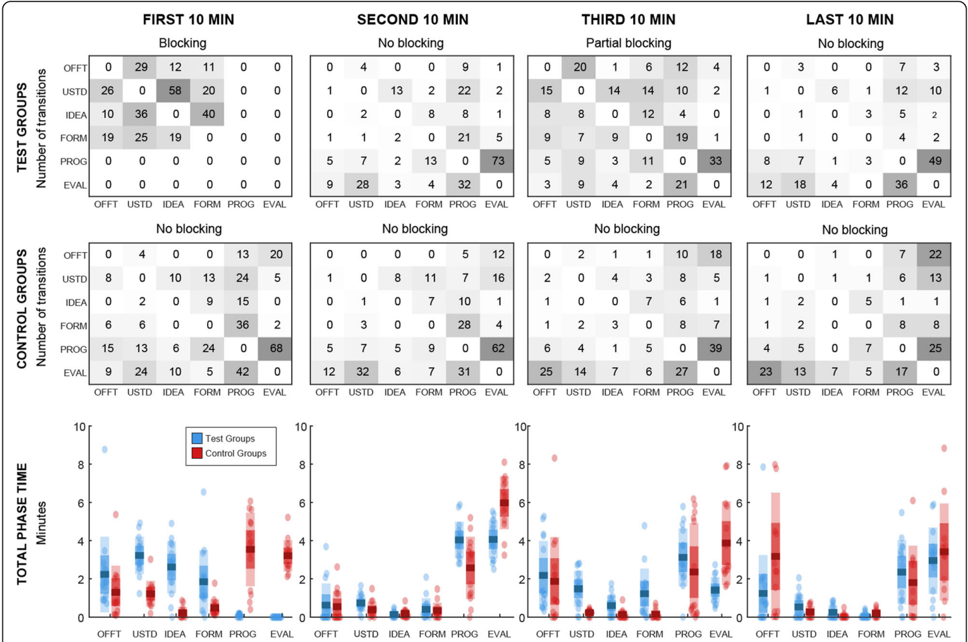
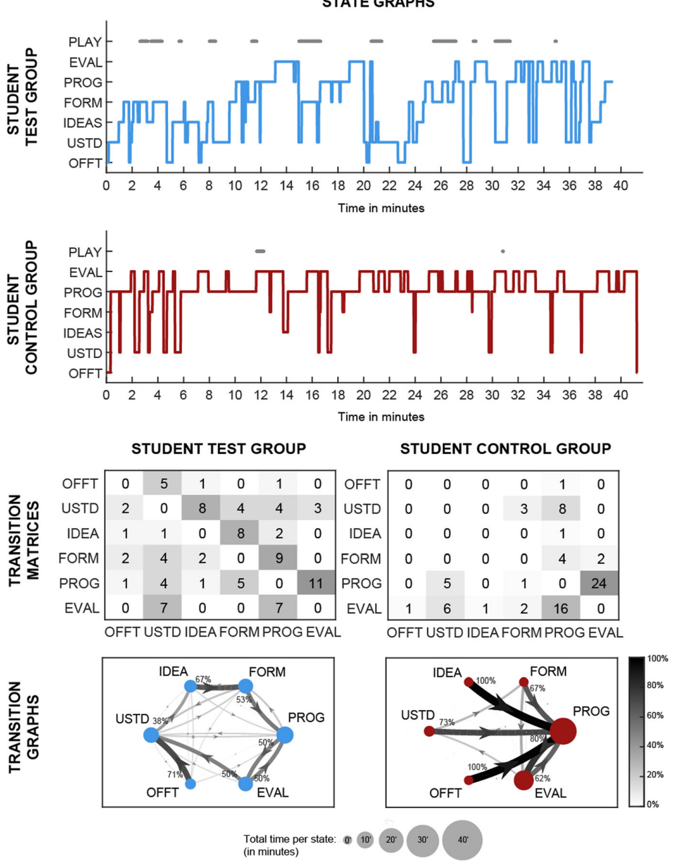
- Control groups with unlimited programming access stayed largely in PROG-EVAL: first three quarters averaged 22/30 min in PROG/EVAL vs. 8/30 min in USTD/IDEA/FORM/OFFT; off-task behavior rose in the last quarter (3/10 min).
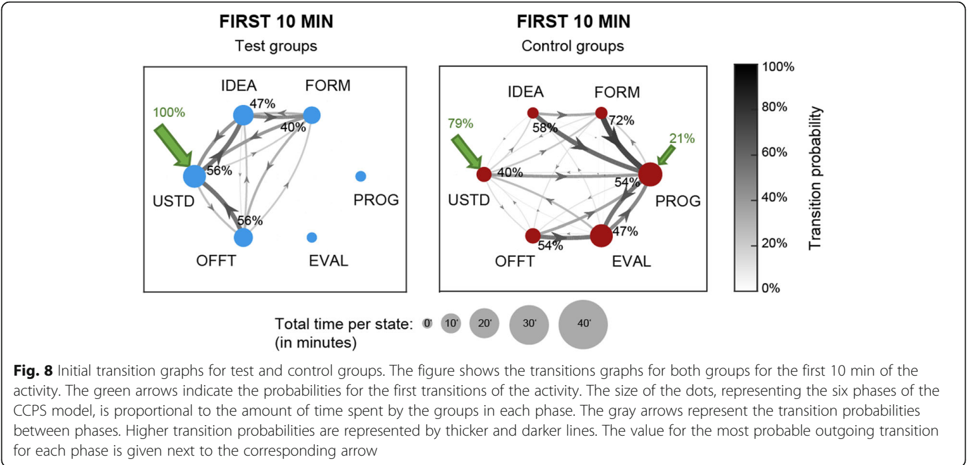
- Test groups with blocking distributed time more evenly: first three quarters averaged 13/30 min in PROG/EVAL and 12/30 min in USTD/IDEA/FORM; all 15 test students started with USTD, and off-task behavior did not increase in the last quarter.
- Partial blocking supported gradual progression and debugging: high PROG-EVAL transitions occurred without executing code; test groups had more playground interactions (93 vs. 59 total).
- Task performance: all five test groups covered at least six lawn squares and two completed all eight; control groups included two that covered only four squares and two that covered six, with one completing all eight.
Methods
- Experimental study with two conditions: control groups had 40 min free access to playground, Thymio, and VPL; test groups had 10 min full VPL blocking, 10 min free, 10 min partial blocking (VPL but no code execution), and 10 min free.
- Sample: 29 primary school students (13 girls, 16 boys, ages 9–10), randomly assigned to groups of 2–3 and to test/control; all had prior Thymio/VPL lessons (1 h/week for 12 weeks).
- Video analysis: two independent evaluators mapped behavior to CCPS phases (USTD, IDEA, FORM, PROG, EVAL, OFFT); inter-rater Cohen’s kappa was 0.59 < k < 0.84; 2162 transitions were mapped over 400 min (1072 test, 1090 control), with transition matrices and time-per-phase analyses.
Limitations
- Paper states small sample due to limited classroom access, though 2162 mapped transitions were considered sufficient for model verification; future work should test teacher-perceived value, other intervention hypotheses, and longitudinal learning gains.
- Evident from text: short experimental duration (two 45-min sessions/40-min activity) and no delayed learning-outcome measure beyond lawnmower task performance; findings may be limited to this age group and context (9–10-year-olds in one Swiss canton with prior Thymio/VPL experience).
- Evident from text: behavioral coding relies on evaluator interpretation despite substantial agreement; data are not publicly available due to sensitivity of under-age participants’ data.
Model-written summary. Check it against the paper before relying on it.
Integrity signals
Registry
Cites
Statistics
Figures
Verification
Claims the paper makes
9 Valid · 2 Not valid · 27 Not checked · 104 Own results and interpretations
The cited sources support only part of this claim — read each source’s verdict below.
In the paper
“The programming activity is thus not the only one that is important for CT skills development.Instead, evaluating (i.e., testing and observing) can be considered equally important.”
§ Fostering computational thinking through educational robotics: a model for creative computational problem solving > CT development with ER is more than just programming a robot
What the sources say
- Partly supportedcites Romero et al., 2017 matched to “Computational thinking development through creative programming in higher education” (2017) sourceExperimental — accuracy not yet measured
The ‘Computational thinking components within the #5c21’ section treats programming and evaluation as separate components of computational thinking, and ‘From code writing to creative programming’ describes testing models. The paper does not say that evaluation is equally important to programming for CT development or specifically equate evaluation with ‘testing and observing.’ (LLM, conf=0.78)
plain- Asserted: passes — The authors put it forward as true.
- Checkable: passes — It can be checked against evidence.
- Load-bearing: passes — The paper’s conclusions depend on it.
- Based: passes — The paper gives a reason why it holds.
- Partly supported
The sources with a verdict support this claim; the rest weren’t checked yet, have no full text we could read, or their verdicts aren’t rated yet.
In the paper
“In many different learning situations, however, researchers have shown that a pure trial-and-error-approach may limit skill development (Antle, 2013;Sadik, Leftwich, & Nadiruzzaman, 2017;Tsai, Hsu, & Tsai, 2012).”
§ Fostering computational thinking through educational robotics: a model for creative computational problem solving > CT development with ER is more than just programming a robot
What the sources say
- Supportedcites Antle, 2013 matched to “Exploring how children use their hands to think: an embodied interactional analysis” (2013) source
The Recommendations for design (section 8) say that a static trial-and-error approach may support task completion but not skills development. This directly supports the hedged claim. (LLM, conf=0.92)
- Not checked — no full text of the sourcecites Sadik, Leftwich, & Nadiruzzaman, 2017 matched to “Computational Thinking Conceptions and Misconceptions: Progression of Preservice Teacher Thinking During Computer Science Lesson Planning” (2017) source
- Not checked — no full text of the sourcecites Tsai, Hsu, & Tsai, 2012 matched to “Investigation of High School Students’ Online Science Information Searching Performance: The Role of Implicit and Explicit Strategies” (2012) source
hedgedstates a possible cause- Asserted: passes — The authors put it forward as true.
- Checkable: passes — It can be checked against evidence.
- Load-bearing: passes — The paper’s conclusions depend on it.
- Based: passes — The paper gives a reason why it holds.
- Supported
The cited sources support only part of this claim — read each source’s verdict below.
In the paper
“The latest meta-analyses carried out on ER and CT (Hsu, Chang, & Hung, 2018;Jung & Won, 2018;Shute et al., 2017) have mentioned only four works between 2006 and 2018 that elaborated how ER activities should be implemented in order to foster CT skills in K-5 education (particularly for grades 3 and 4, i.e., for students of age between 8 and 10 years old).”
§ Fostering computational thinking through educational robotics: a model for creative computational problem solving > Introduction
What the sources say
- Not checked — no full text of the sourcecites Hsu, Chang, & Hung, 2018 matched to “How to learn and how to teach computational thinking: Suggestions based on a review of the literature” (2018) source
- Partly supportedcites Jung & Won, 2018 matched to “Systematic Review of Research Trends in Robotics Education for Young Children” (2018) sourceExperimental — accuracy not yet measured
Section 3.2.1 (p. 8) reports that kindergarten children learned computational-thinking concepts through robotics, supporting the general connection between educational robotics and computational thinking. It does not say that only four works from 2006–2018 described how to implement such activities for grades 3–4; the review mainly targets preschool and kindergarten children (Data Collection, p. 2). (LLM, conf=0.84)
- Not checked — no full text of the sourcecites Shute et al., 2017 matched to “Demystifying computational thinking” (2017) source
plain- Asserted: passes — The authors put it forward as true.
- Checkable: passes — It can be checked against evidence.
- Load-bearing: passes — The paper’s conclusions depend on it.
- Based: passes — The paper gives a reason why it holds.
A result the paper reports from its own data — it cites no other source for it, so there is none to check. The quote shows it is in the paper.
In the paper
“This phase was not considered a priori, however, the experiments with students showed that offtask behavior is part of the reality in classrooms and should therefore be included in the model.”
§ Fostering computational thinking through educational robotics: a model for creative computational problem solving > Formulating the behavior (FORM)
plain- Asserted: passes — The authors put it forward as true.
- Checkable: passes — It can be checked against evidence.
- Load-bearing: passes — The paper’s conclusions depend on it.
- Based: passes — The paper gives a reason why it holds.
A result the paper reports from its own data — it cites no other source for it, so there is none to check. The quote shows it is in the paper.
In the paper
“The results suggest that (i) a non-instructional approach for educational robotics activities (i.e., unlimited access to the programming interface) promotes a trial-and-error behavior;”
§ Fostering computational thinking through educational robotics: a model for creative computational problem solving > Abstract
hedgedstates a cause- Asserted: passes — The authors put it forward as true.
- Checkable: passes — It can be checked against evidence.
- Load-bearing: passes — The paper’s conclusions depend on it.
- Based: passes — The paper gives a reason why it holds.
63 more claims
Create a free account to see all 142 claims and to verify the 1 reference still open.
- Probably not a substantial claim. 49
- It may state two separate claims as one. 39
- The quote only partly states this claim. 3
Self-check
Percentages, sums and reported differences re-computed from the paper’s own numbers.
Each contradiction between two passages listed here was confirmed by an independent check.
Rated minor: it would not touch a result — a value no result rests on, a p-value that stays on the same side of the significance level, or a conflict that is clerical, resolved elsewhere in the paper, or outside its own findings.
In the paper
§ Fostering computational thinking through educational robotics: a model for creative computational problem solving > Limitations and future work
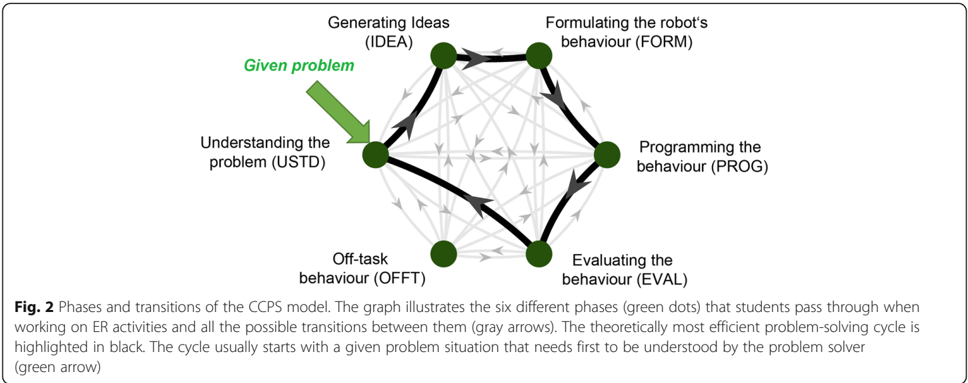
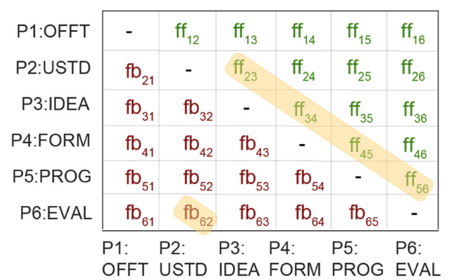
“The theoretically most efficient problemsolving cycle is highlighted in yellow (ff 23 -ff 34 -ff 45 -ff 56 -ff 62 )”
§ Fostering computational thinking through educational robotics: a model for creative computational problem solving > Formulating the behavior (FORM)
“In this model, special emphasis is therefore placed on the cycle considering the transitions ff 23 -ff 34ff 45 -ff 56 -fb 62 (highlighted in yellow in Fig. 3)”
Citations
Cites
The Measurement of Observer Agreement for Categorical Data
Landis, J. R., & Koch, G. G. (1977) · Biometrics · doi:10.2307/2529310 · Cited by 81,148
Wing, J. M. (2006) · Communications of the ACM · doi:10.1145/1118178.1118215 · Cited by 8,102
Observing Interaction: An Introduction to Sequential Analysis
Willson, V. L., Bakeman, R., & Gottman, J. M. (1988) · Journal of Educational Statistics · doi:10.2307/1164658 · Cited by 2,301
Barr, V., & Stephenson, C. (2011) · ACM Inroads · doi:10.1145/1929887.1929905 · Cited by 1,692
Defining Computational Thinking for Mathematics and Science Classrooms
Weintrop, D., Beheshti, E., Horn, M., Orton, K., Jona, K., Trouille, L., & Wilensky, U. (2016) · Journal of Science Education and Technology · doi:10.1007/s10956-015-9581-5 · Cited by 1,609
Demystifying computational thinking
Shute, V. J., Sun, C., & Asbell-Clarke, J. (2017) · Educational Research Review · doi:10.1016/j.edurev.2017.09.003 · Cited by 1,466
Observing Interaction: An Introduction to Sequential Analysis
Bakeman, R., & Gottman, J. M. (1997) · doi:10.1017/cbo9780511527685 · Cited by 1,439
Computational thinking and tinkering: Exploration of an early childhood robotics curriculum
Bers, M. U., Flannery, L., Kazakoff, E. R., & Sullivan, A. (2014) · Computers & Education · doi:10.1016/j.compedu.2013.10.020 · Cited by 959
Hsu, T.-C., Chang, S.-C., & Hung, Y.-T. (2018) · Computers & Education · doi:10.1016/j.compedu.2018.07.004 · Cited by 788
Atmatzidou, S., & Demetriadis, S. (2016) · Robotics and Autonomous Systems · doi:10.1016/j.robot.2015.10.008 · Cited by 630
Research works printed but not linked: 2
- 17. Eguchi, A. (2014). Robotics as a learning tool for educational transformation. In D. Alimisis, G. Granosik, & M. Moro (Eds.), 4th International Workshop Teaching Robotics, Teaching with Robotics & 5th International Conference Robotics in Education, (pp. 27-34). Padova: RIE ISBN 978-88-95872-06-3. Available at http://www.terecop.eu/TRTWR-RIE2014/files/00_WFr1/00_WFr1_04.pdf. Accessed 6 June 2020.
- 50. Sullivan, A., Bers, M., & Mihm, C. (2017). Imagining, playing, and coding with kibo: Using robotics to foster computational thinking in young children. In Proceedings of the International Conference on Computational Thinking Education. Wanchai: Available at https://ase.tufts.edu/devtech/publications/ Sullivan_Bers_Mihm_KIBOHongKong%20.pdf. Accessed 6 June 2020.
Cited by
Sun, D., Boudouaia, A., Zhu, C., & Li, Y. (2024) · International Journal of Educational Technology in Higher Education · doi:10.1186/s41239-024-00446-5 · Cited by 190
On Computational Thinking and STEM Education
Li, Y., Schoenfeld, A. H., diSessa, A. A., Graesser, A. C., Benson, L. C., English, L. D., & Duschl, R. A. (2020) · Journal for STEM Education Research · doi:10.1007/s41979-020-00044-w · Cited by 184
“Thus, some researchers proposed alternative approaches to develop problem-solving-oriented CT such as, “ systematic CT ” (Michaelson 2018) and “ creative computational problem solving ” (Chevalier et al. 2020).”
BackgroundYang, Q.-F., Lian, L.-W., & Zhao, J.-H. (2023) · International Journal of Educational Technology in Higher Education · doi:10.1186/s41239-023-00391-9 · Cited by 152
Chen, P., Yang, D., Metwally, A. H. S., Lavonen, J., & Wang, X. (2023) · International Journal of STEM Education · doi:10.1186/s40594-023-00434-7 · Cited by 275
“Therefore, tangible materials should be used to cultivate CT and problem-solving skills (Chevalier et al., 2020).”
BackgroundEducational Robotics for Developing Computational Thinking in Young Learners: A Systematic Review
Ching, Y., & Hsu, Y. (2023) · TechTrends · doi:10.1007/s11528-023-00841-1 · Cited by 196
“Only a handful of studies (e.g., Baek et al., 2019; Chevalier et al., 2020; Chiazzese et al., 2019; Shen et al., 2022) adopted a more macro view and measured CT in terms of a set of problem-solving processes such as understanding the problem, generating ideas, formulating the behavior, programming…”
InfluentialChevalier, M., Giang, C., El-Hamamsy, L., Bonnet, E., Papaspyros, V., Pellet, J.-P., Audrin, C., Romero, M., Baumberger, B., & Mondada, F. (2022) · Computers & Education · doi:10.1016/j.compedu.2022.104431 · Cited by 84
“They accomplished the task more quickly (Siegfried et al., 2017; Mayer, 2004; Biesta & Burbules, 2003) but to the detriment of developing all the cognitive processes necessary in CT (Chevalier & Giang et al., 2020).”
InfluentialSelf-citationYang, F.-C. O., Lai, H., & Wang, Y. (2022) · Computers & Education · doi:10.1016/j.compedu.2022.104721 · Cited by 152
Artificial intelligence-based robots in education: A systematic review of selected SSCI publications
Chu, S.-T., Hwang, G.-J., & Tu, Y.-F. (2022) · Computers and Education: Artificial Intelligence · doi:10.1016/j.caeai.2022.100091 · Cited by 88
Sun, D., Ouyang, F., Li, Y., & Zhu, C. (2021) · International Journal of STEM Education · doi:10.1186/s40594-021-00311-1 · Cited by 88
“…learning analytics could be integrated into future research to synchronize audio discourse data, video recording data, facial expressions and eye tracking movements to better reveal the programming learning patterns (e.g., Chevalier et al., 2020; Sun & Hsu, 2019; Zatarain Cabada et al., 2018).”
BackgroundComputer science education and K-12 students’ computational thinking: A systematic review
Lee, S. J., Francom, G. M., & Nuatomue, J. N. (2022) · International Journal of Educational Research · doi:10.1016/j.ijer.2022.102008 · Cited by 105
El‐Hamamsy, L., Zapata-Cáceres, M., Martín, E., Francesco Mondada, C., Zufferey, J. D., & Bruno, B. (2022) · Journal of Educational Computing Research · doi:10.1177/07356331221081753 · Cited by 105
“Indeed, the cCTt does not provide insight into students’ thought processes when engaged in CT-related problem solving tasks (Chevalier et al. 2020), their transversal competences (both inter-personal and intrapersonal), and their perception of “of themselves and their relationships with others and the technological wo…”
BackgroundMethodInfluentialSelf-citationMadariaga, L., Allendes, C., Nussbaum, M., Barrios, G., & Acevedo, N. (2022) · Computers & Education · doi:10.1016/j.compedu.2022.104664 · Cited by 68
Lee, H.-Y., Wu, T.-T., Lin, C.-J., Wang, W.-S., & Huang, Y.-M. (2024) · Journal of Educational Computing Research · doi:10.1177/07356331231211916 · Cited by 52
“This improves their logical reasoning and organizational skills (Chevalier et al., 2020; Lai & Wong, 2022).”
BackgroundTselegkaridis, S., & Sapounidis, T. (2022) · Education Sciences · doi:10.3390/educsci12050305 · Cited by 69
Ouyang, F., Dai, X., & Chen, S. (2022) · International Journal of STEM Education · doi:10.1186/s40594-022-00361-z · Cited by 51
“Future studies can further synchronize audio discourse data, video recording data, facial expressions and eye tracking movements to better reveal the collaborative programming learning patterns (e.g., Chevalier et al., 2020; Sun & Hsu, 2019; Zatarain Cabada et al., 2018).”
BackgroundEducational Robotics and Robot Creativity: An Interdisciplinary Dialogue
Gubenko, A., Kirsch, C., Smilek, J. N., Lubart, T., & Houssemand, C. (2021) · Frontiers in Robotics and AI · doi:10.3389/frobt.2021.662030 · Cited by 70
“The process of a robot ’ s design is followed by an iterative, trial-and-error phase of programming the robot ’ s moves, testing, and modifying its design and software code (Nemiro et al., 2017; Alves-Oliveira, 2020; Chevalier et al., 2020).”
BackgroundMethodSeven HCI Grand Challenges Revisited: Five-Year Progress
Stephanidis, C., Salvendy, G., Antona, M., Duffy, V. G., Gao, Q., Karwowski, W., Konomi, S., Nah, F. F., Ntoa, S., Rau, P. P., et al. (2025) · International Journal of Human-Computer Interaction · doi:10.1080/10447318.2025.2450411 · Cited by 70
“However, many researchers pointed out a lack of operational instructions or design frameworks for educators in the design, implementation, and assessment of these systems (Chevalier et al., 2020; Jahnke & Liebscher, 2020).”
A Proposed Taxonomy of Teaching Models in STEM Education: Robotics as an Example
Zhong, B., Liu, X., Xia, L., & Sun, W. (2022) · Sage Open · doi:10.1177/21582440221099525 · Cited by 44
“Chevalier et al. (2020) concurred, arguing that educational robotics may foster students’ computational thinking through creative computational problem solving.”
BackgroundJiang, H., Islam, A. Y. M. A., Gu, X., & Guan, J. (2023) · Journal of Research in Science Teaching · doi:10.1002/tea.21899 · Cited by 56
Ryalat, M., Almtireen, N., Al-refai, G., ElMoaqet, H., & Rawashdeh, N. A. (2025) · Journal of Sensor and Actuator Networks · doi:10.3390/jsan14040076 · Cited by 71
Formation of Computational Thinking Skills Using Computer Games in Teaching Mathematics
Soboleva, E. V., Sabirova, E. G., Babieva, N. S., Sergeeva, M. G., & Torkunova, J. V. (2021) · Eurasia Journal of Mathematics Science and Technology Education · doi:10.29333/ejmste/11177 · Cited by 54
“Chevalier et al. (2020) develop this idea and add that the solution in this case can be performed by a person or a machine, or, more generally, a combination of people and machines.”
BackgroundMarín, J. A. M., García-Tudela, P. A., & Dúo-Terrón, P. (2024) · Heliyon · doi:10.1016/j.heliyon.2024.e29177 · Cited by 91
Hongquan, B., Wang, X., & Zhao, L. (2021) · Frontiers in Psychology · doi:10.3389/fpsyg.2021.771221 · Cited by 62
“…and skills of CT in different educational situations by various means including programming (Basu et al., 2017; Bati, 2021), educational robotics (Chevalier et al., 2020; Qu and Fok, 2021), unplugged activities (Kuo and Hsu, 2020; Huang and Looi, 2021), games/simulations (Danial et al., 2021;…”
BackgroundThe symbiotic relationship between educational robotics and computer science in formal education
El‐Hamamsy, L., Bruno, B., Chessel-Lazzarotto, F., Chevalier, M., Roy, D., Zufferey, J. D., & Mondada, F. (2021) · Education and Information Technologies · doi:10.1007/s10639-021-10494-3 · Cited by 39
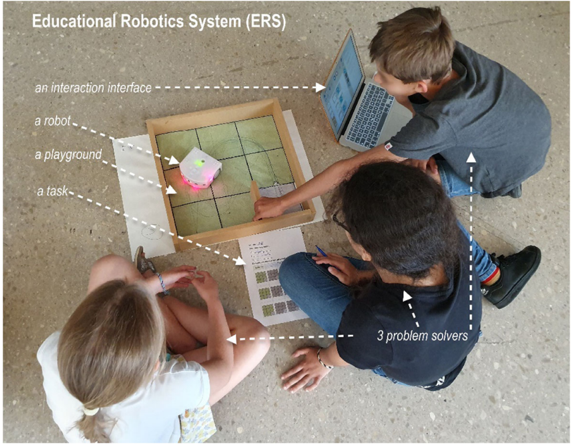
“…relies on moving the focus away from “the robot” to consider the broader Educational Robotics System (i.e., the tasks, the interface and the robot; Giang et al., 2019), to be put in relation with the instruction modality, the learning objectives and the assessment tools and goals (Giang, 2020).”
BackgroundSelf-citationLai, X., Ye, J., & Wong, G. K. W. (2023) · Journal of Computer Assisted Learning · doi:10.1111/jcal.12845 · Cited by 41
Wu, T., Asmara, A., Huang, Y., & Hapsari, I. P. (2024) · SAGE Open · doi:10.1177/21582440241249897 · Cited by 87
Sun, L., Hu, L., & Zhou, D. (2022) · Thinking Skills and Creativity · doi:10.1016/j.tsc.2022.101043 · Cited by 39
Revolutionizing ESL Teaching with Generative Artificial Intelligence—Take ChatGPT as an Example
Huyue Liao1, H. X. (2023) · International Journal of New Developments in Education · doi:10.25236/ijnde.2023.052008 · Cited by 48
“Cooperation; Communication Communication; Creative Thinking Creative thinking; Critical Thinking critical thinking) skills as well as problem-solving, selfefficacy, and even computational programming thinking[5].”
BackgroundTankiz, E., & Uslu, N. A. (2022) · Technology Knowledge and Learning · doi:10.1007/s10758-022-09593-y · Cited by 38
“, 2020; Karakasis & Xinogalos, 2020), and educational robotics (Chevalier et al., 2020; Kert et al., 2020; Shen et al., 2020).”
BackgroundAmnouychokanant, V., Boonlue, S., Chuathong, S., & Thamwipat, K. (2021) · International Journal of Emerging Technologies in Learning (iJET) · doi:10.3991/ijet.v16i13.22591 · Cited by 33
GAMIFIED EDUCATIONAL ROBOTS LEAD AN INCREASE IN MOTIVATION AND CREATIVITY IN STEM EDUCATION
Chen, T.-I., Lin, S.-K., & Chung, H.-C. (2023) · Journal of Baltic Science Education · doi:10.33225/jbse/23.22.427 · Cited by 55
“Research has shown that using educational robots in STEM curricula positively influences students’ problem-solving and teamwork skills (Chevalier et al., 2020; Madariaga et al., 2023).”
Wu, C., Chien, Y.-C., Chou, M.-T., & Huang, Y. (2025) · Humanities and Social Sciences Communications · doi:10.1057/s41599-025-04502-x · Cited by 50
“Furthermore, it has become increasingly common in K – 12 education (Chevalier et al., 2020; Hsu et al., 2018; Lee et al., 2020; Lye and Koh 2014).”
Hsu, T., Chang, C., Wu, L., & Looi, C. (2022) · Frontiers in Psychology · doi:10.3389/fpsyg.2022.888215 · Cited by 44
“Instructors can thus plan some proper instructional interventions that will assist students in building a well-settled strategy in the classroom practice of ERs (Chevalier et al., 2020).”
BackgroundMethodResultInfluentialDesign Thinking as an Auxiliary Tool for Educational Robotics Classes
Tramonti, M., Dochshanov, A. M., & Zhumabayeva, A. (2023) · Applied Sciences · doi:10.3390/app13020858 · Cited by 31
Sun, L., Hu, L., Zhou, D., & Yang, W. (2022) · Interactive Learning Environments · doi:10.1080/10494820.2022.2042311 · Cited by 34
“Chevalier et al. (2020) constructed an operational framework to support the teachers in designing, implementing, and evaluating the educational robot activities aimed at developing the CT skills, and also provided the preliminary evidence for activities that require speci fi c teaching interventions.”
BackgroundRagusa, G., & Leung, L. (2023) · Sensors · doi:10.3390/s23239335 · Cited by 22
“Chevalier and colleagues underscore [11] these efforts in their discussion of computational thinking-related pedagogical approaches.”
BackgroundHaşlaman, T., Mumcu, F., & Uslu, N. A. (2024) · Education and Information Technologies · doi:10.1007/s10639-024-12583-5 · Cited by 44
“The literature review shows that games (e.g., Berland & Lee, 2011; Rose et al., 2020), educational robotics (e.g., Chevalier et al., 2020; Kert et al., 2020), and programming (e.g., Chen et al., 2017; Duncan, & Bell, 2015) have gained prominence in developing CT skills.”
Wang, H., Luo, N., Zhou, T., & Yang, S. (2024) · Sustainability · doi:10.3390/su16124987 · Cited by 32
El‐Hamamsy, L., Zapata-Cáceres, M., Marcelino, P., Bruno, B., Zufferey, J. D., Martín, E., & Román-González, . (2022) · Frontiers in Psychology · doi:10.3389/fpsyg.2022.1082659 · Cited by 28
“(2021), employ direct observations of students’ thought processes and strategies (Lye and Koh, 2014; Chevalier et al., 2020), or learning analytics and educational data mining techniques (Cock et al.”
BackgroundAccessible Maker-Based Approaches to Educational Robotics in Online Learning
Mehrotra, A., Giang, C., El‐Hamamsy, L., Guinchard, A., Dame, A., Zahnd, G., & Mondada, F. (2021) · IEEE Access · doi:10.1109/access.2021.3094158 · Cited by 25
“As presented in previous works [16], [34], ER activities usually consist of three types of cognitive artifacts: the playgrounds, the robots, and the interaction/programming interfaces.”
BackgroundSelf-citationExploring the Effectiveness of STEAM Integrated Approach via Scratch on Computational Thinking
Samsudin, M. A., Tan, W.-L., Ismail, M. E., Ahmad, N. J., & Talib, C. A. (2021) · Eurasia Journal of Mathematics Science and Technology Education · doi:10.29333/ejmste/11403 · Cited by 33
“Some researchers proposed alternative methods to develop problem-solving with CT such as, “systematic CT” (Michaelson, 2018) and “creative computational problem solving” (Chevalier et al., 2020).”
MethodCano, S. P. (2022) · Electronics · doi:10.3390/electronics11030395 · Cited by 30
A Systematic Literature Review on STEM Research in Early Childhood
Tselegkaridis, S., & Sapounidis, T. (2022) · Lecture notes in educational technology · doi:10.1007/978-981-19-0568-1_7 · Cited by 22
Investigating Children's Programming Skills Through Play with Robots (KIBO)
Lee, J., Md-Yunus, S., & Lee, J. O. (2023) · Early Childhood Education Journal · doi:10.1007/s10643-023-01563-y · Cited by 19
“Despite the growing body of studies investigating the effectiveness of using educational robots in interdisciplinary settings for young children (Chevalier et al., 2020; Govind & Bers, 2021), there is still a need for further research in this area (Di Lieto et al., 2016).”
Experimenting with computational thinking for knowledge transfer in engineering robotics
Chichekian, T., Trudeau, J., Jawhar, T., & Corliss, D. (2023) · Journal of Computer Assisted Learning · doi:10.1111/jcal.12921 · Cited by 26
Anđić, B., Maričić, M., Mumcu, F., Prodromou, T., Leoste, J., Saimon, M., & Lavicza, Z. (2024) · Smart Learning Environments · doi:10.1186/s40561-024-00298-6 · Cited by 32
“Chevalier et al. (2020) and Tikva and Tambouris (2021) point out that there is not enough research looking at the type of instruction that should be used in ER of primary school students.”
InfluentialTeachers’ Perspective on Fostering Computational Thinking Through Educational Robotics
Chevalier, M., El‐Hamamsy, L., Giang, C., Bruno, B., & Mondada, F. (2021) · Advances in intelligent systems and computing · doi:10.1007/978-3-030-82544-7_17 · Cited by 26
“1 [3]) which was mediated by the CCPS model.”
BackgroundMethodInfluentialSelf-citationCollaborative Learning in K-12 Computational Thinking Education: A Systematic Review
Yin, S. X., Goh, D. H., & Quek, C. L. (2024) · Journal of Educational Computing Research · doi:10.1177/07356331241249956 · Cited by 20
“…frameworks, four were used to analyze the behavior and interaction during the CL process: the CSCL framework (Stahl et al., 2006) (S1), group investigation framework (Shachar & Fischer, 2004) (S9), CCPS model (Chevalier et al., 2020) (S17), and the ICAP framework (Weinberger & Fischer, 2006) (S39).”
Hsiao, H., Chen, J.-H., Chang, T.-L., Li, P.-H., & Chung, G.-H. (2024) · Journal of Science Education and Technology · doi:10.1007/s10956-024-10119-7 · Cited by 21
“Some studies have suggested that utilizing educational robots for teaching appears to boost students’ interest and motivation and facilitate learning processes (Anwar et al., 2019; Chevalier et al., 2020).”
Examining Teachers’ Intention to integrate Robotics-based Storytelling Activities in Primary Schools
Tengler, K., & Sabitzer, B. (2022) · International Journal of Interactive Mobile Technologies (iJIM) · doi:10.3991/ijim.v16i06.28905 · Cited by 18
Holo, O. E., Kveim, E. N., Lysne, M. S., Taraldsen, L. H., & Haara, F. O. (2022) · Education Inquiry · doi:10.1080/20004508.2022.2072575 · Cited by 26
“(Chevalier et al., 2020) worked on how to structure the problem-solving process so that the students could postpone the computer programming process and avoid the “trial and error” phase for as long as possible.”
BackgroundHsu, T., Chang, C., & Liang, Y.-S. (2023) · IEEE Transactions on Learning Technologies · doi:10.1109/tlt.2023.3249749 · Cited by 21
“ERs are not only widely used to promote students’ computational thinking (CT) skills (e.g., [5]) but also have become an interdisciplinary pathway to integrate language development with CT learning [6], [7].”
BackgroundAdaptation of the Computational Thinking Skills Assessment Tool (TechCheck-K) in Early Childhood
Metin, Ş., Başaran, M., SEHERYELİ, M. Y., Relkin, E., & Kalyenci, D. (2024) · Journal of Science Education and Technology · doi:10.1007/s10956-023-10089-2 · Cited by 24
“…CT assessment to establish the competencies required from children, to follow their development, and ultimately to contribute to the design and enrichment of the curriculum (Chevalier et al., 2020; El-Hamamsy et al., 2022; Relkin & Bers, 2021; Weintrop et al., 2021; Zapata-Cáceres et al., 2020).”
Learning Performance of Different Genders’ Computational Thinking
Hsu, T., Chang, C., Wong, L. H., & Aw, G. P. (2022) · Sustainability · doi:10.3390/su142416514 · Cited by 26
Meseguer, G. O., & Sánchez, J. L. S. (2023) · RIED Revista Iberoamericana de Educación a Distancia · doi:10.5944/ried.27.1.37572 · Cited by 38
Do School Activities Foster Creative Thinking? An Analysis of PISA Results
Hernández-Ramos, J., & Araya, R. (2025) · Education Sciences · doi:10.3390/educsci15020133 · Cited by 37
“This finding suggests that educational approaches should consider a more holistic integration of programming skills, ensuring that they are taught as technical competencies and linked to the development of broader cognitive skills (Avello et al., 2020; Chevalier et al., 2020).”
Enhancing rural students’ computer science self-efficacy in a robotics-based language arts course
Tang, H., Qian, Y., & Porter-Voss, S. (2024) · Education and Information Technologies · doi:10.1007/s10639-024-12875-w · Cited by 18
“…of all ages to develop 21st century skills, such as encouraging the development of critical problem-solving skills, fostering collaboration and communication, and inspire meaningful student engagement with the learning material (Chevalier et al., 2020 ; Hong et al., 2021 ; Qian & Choi, 2023 ).”
de Souza, I. M. L., Andrade, W. L., & Sampaio, L. M. R. (2021) · Informatics in Education · doi:10.15388/infedu.2022.06 · Cited by 16
“The school where we carried out this study received the first robotics tools in the year 2013 and, although it offered the Computer Science course in High School, as well as others international situations (Chevalier et al. , 2020), these tools were not used in the school day-to-day.”
MethodResultGao, X., Yang, Y., Du, Y., & Sun, D. (2024) · Journal of Educational Computing Research · doi:10.1177/07356331241303067 · Cited by 23
“Students who primarily use the trial-and-error strategy tend to spend most of their time in the loop of random revisions and immediate testing for correctness, with little re fl ection on their actions (Chevalier et al., 2020).”
Rahimi, A. R., & Sevilla‐Pavón, A. (2025) · Computers in Human Behavior Reports · doi:10.1016/j.chbr.2025.100607 · Cited by 19
Educational Robotics and Game-Based Interventions for Overcoming Dyscalculia: A Pilot Study
Stasolla, F., Curcio, E., Borgese, A., Passaro, A., Gioia, M. D., Zullo, A., & Martini, E. (2025) · Computers · doi:10.3390/computers14050201 · Cited by 23
“Addressing these barriers requires strategic policy interventions, professional development programs, and cross-sector collaborations to ensure equitable access to robotics-based education [37].”
Sun, D., Ouyang, F., Li, Y., Zhu, C., & Zhou, Y. J. (2024) · Journal of Computer Assisted Learning · doi:10.1111/jcal.12939 · Cited by 15
Dökme, Ï., & Hancıoğlu, Z. Ş. (2025) · Education and Information Technologies · doi:10.1007/s10639-025-13318-w · Cited by 25
“With the help of microcontrollers that can be programmed with a variety of software applications and block programming tools, even kids in elementary and secondary schools may complete STEM projects (Alfieri et al., 2015; Chevalier et al., 2020; Ouyang & Xu, 2024).”
Brender, J., El‐Hamamsy, L., Bruno, B., Chessel-Lazzarotto, F., Zufferey, J. D., & Mondada, F. (2021) · Lecture notes in computer science · doi:10.1007/978-3-030-86436-1_6 · Cited by 24
Self-citationLiu, B., & Lu, Z. (2023) · ICST Transactions on Scalable Information Systems · doi:10.4108/eetsis.v10i3.3048 · Cited by 13
“The author contends that educators are rethinking their roles in the classroom due to students' increased ability to tailor their schooling to meet their specific needs, regardless of where they happen to be physically located [21].”
Three +1 Perspectives on Computational Thinking
Nicolajsen, S. M., Pischetola, M., Grabarczyk, P., & Brabrand, C. (2021) · Koli Calling International Conference on Computing Education Research · doi:10.1145/3488042.3490024 · Cited by 12
FADE-CTP: A Framework for the Analysis and Design of Educational Computational Thinking Problems
Adorni, G., Piatti, A., Bumbacher, E. W., Negrini, L., Mondada, F., Assaf, D., Mangili, F., & Gambardella, L. M. (2025) · Technology Knowledge and Learning · doi:10.1007/s10758-025-09833-x · Cited by 22
Self-citationTailoring AI agents for early learning: The Creative Project Approach
Yang, W., Li, H., & Lee, J. C. (2025) · Computers and Education Artificial Intelligence · doi:10.1016/j.caeai.2025.100473 · Cited by 13
Zhang, X., Tlili, A., Guo, J., Griffiths, D., Huang, R., Looi, C., & Burgos, D. (2023) · The Journal of Educational Research · doi:10.1080/00220671.2023.2167798 · Cited by 12
“Several studies have used robots, digital tools and mobile devices to develop the CT competencies of primary school students (Chevalier et al., 2020; Chiazzese et al., 2019).”
Student and teacher co-agency when combining CT with arts and design in a cross-curricular project
Mannila, L., Leinonen, T., Bauters, M., & Veermans, M. (2023) · Computers and Education Open · doi:10.1016/j.caeo.2023.100132 · Cited by 15
“Another common research topic focuses on the tools used, such as un-plugged programming [5,10,17]), the programming environment Scratch (e.g., [25,64,103]), robotics (e.g., [2,13]) or microcontrollers (e. g., [27]).”
BackgroundResearch, Development and Innovation: An Extracurricular Club Case Study
Huerta, H., Diaz, C., Bribiesca, M. G. A., et al. (2022) · IEEE Access · doi:10.1109/access.2022.3169790 · Cited by 8
“Other approaches which may enhance the results of the classical PBL have been presented [23], [24].”
BackgroundChildren's computational thinking as the development of a possibility space
Kopcha, T. J., & Ocak, C. (2023) · Computers and Education Open · doi:10.1016/j.caeo.2023.100156 · Cited by 17
Vidal-Silva, C. L., Cobo, J., Tupac-Yupanqui, M., Serrano, J. C., & Sánchez-Ortíz, A. (2024) · IEEE Access · doi:10.1109/access.2024.3449228 · Cited by 18
“This skill involves problem-solving, algorithmic thinking, and the ability to break down complex tasks into smaller, manageable parts [13].”
BackgroundCritical Thinking Skills Profile of High School Students in AP Chemistry Learning
Raslan, G. (2023) · Lecture notes in civil engineering · doi:10.1007/978-3-031-27462-6_8 · Cited by 21
Green STEM to Improve Mathematics Proficiency: ESA Mission Space Lab
Garcia-Piqueras, M., & Ruiz-Gallardo, J.-R. (2021) · Mathematics · doi:10.3390/math9172066 · Cited by 7
Kwon, K., Kim, H., Kim, K., Seo, M., & Brush, T. A. (2025) · Journal of Research on Technology in Education · doi:10.1080/15391523.2025.2492604 · Cited by 9
“Educational robotics involve sensorimotor experiences through bodily movements, such as placing and moving the robot using gestures while planning programming (Chevalier et al., 2020; Ching & Hsu, 2023).”
Moreno-León, J., Román-González, ., Martín, E., Zapata-Cáceres, M., Jiménez, M., & Robles, G. (2025) · Thinking Skills and Creativity · doi:10.1016/j.tsc.2025.101879 · Cited by 15
Qin, L., & Derakhshan, A. (2026) · Language Teaching Research · doi:10.1177/13621688261441862 · Cited by 11
Kanaki, K., & Kalogiannakis, M. (2023) · Research on Preschool and Primary Education · doi:10.55976/rppe.12023217739-50 · Cited by 15
“Capitalizing on young children's natural tendency to explore STEM challenges (Foti, 2021), developmentally appropriate STEM educational activities are employed in order to foster CT (Chevalier et al., 2020; Wang et al., 2022), and improve students' environmental awareness (Helvaci & Helvaci, 2019).”
BackgroundEl‐Hamamsy, L., Bruno, B., Kovacs, H., Chevalier, M., Zufferey, J. D., & Francesco Mondada, C. (2022) · Australasian Computing Education Conference · doi:10.1145/3511861.3511883 · Cited by 7
“The above principle has motivated numerous researchers to investigate how CS, or Educational Robotics (often used as a medium to teach CS [16]) can be leveraged in various disciplinary contexts [8, 20, 32] such as maths [4, 7, 8, 25, 48], sciences [38, 48], languages [42], or in the context of transversal skills such…”
BackgroundSelf-citationLiao, Y., Kim, J., Ottenbreit-Leftwich, A. T., Karlin, M., & Guo, M. (2024) · ACM Transactions on Computing Education · doi:10.1145/3688854 · Cited by 11
Wang, J., Yang, W., & Yeung, M. K.-C. (2024) · Thinking Skills and Creativity · doi:10.1016/j.tsc.2024.101729 · Cited by 11
Jiang, X., Harteveld, C., Yang, Y., Fung, A. Y. H., Huang, X., & Chen, S. (2023) · Educational Technology Research and Development · doi:10.1007/s11423-023-10240-1 · Cited by 9
Yüksel, A. O. (2022) · Journal of Computer and Education Research · doi:10.18009/jcer.1012635 · Cited by 7
The Effects of Educational Robotics on STEM Students' Engagement and Reflective Thinking
Ahmadaliev, D., Metwally, A. H. S., Yousef, A. M. F., & Shuxratov, D. (2022) · IEEE Frontiers in Education Conference (FIE) · doi:10.1109/fie56618.2022.9962498 · Cited by 16
“Thus, student's learning should be designed more engaging and entertaining [6].”
BackgroundDawana, I. R., & Dwikoranto, D. (2024) · Prisma Sains Jurnal Pengkajian Ilmu dan Pembelajaran Matematika dan IPA IKIP Mataram · doi:10.33394/j-ps.v12i1.8467 · Cited by 11
“Learners must be able to identify problems, formulate hypotheses, and test these hypotheses through experiments or calculations (Ananda & Atmojo, 2022; Chevalier et al., 2020; Is’ ad & Sukarmin, 2022; Schukajlow et al., 2022).”
BackgroundTren penelitian kemampuan pemecahan masalah pada pendidikan matematika: Analisis bibliometrik
Wahyuni, A., Kusumah, Y. S., Martadiputra, B. A. P., & Zafrullah, Z. (2024) · JPMI (Jurnal Pembelajaran Matematika Inovatif) · doi:10.22460/jpmi.v7i2.22329 · Cited by 6
“Dengan fokus utama pada Collaborative Learning , kluster ini menekankan pentingnya kerjasama siswa dalam menyelesaikan masalah matematika, sementara Interventions mengindikasikan upaya terarah untuk meningkatkan metode pembelajaran, khususnya dalam konteks pemecahan masalah (Chevalier et al., 2020).”
BackgroundGong, X., Xu, W., Qiao, A., & Li, Z. (2025) · Journal of Computer Assisted Learning · doi:10.1111/jcal.70007 · Cited by 8
A Gender-Related Analysis of a Robots' Math Class
Plangg, S., & Fuchs, K. J. (2022) · International Journal for Technology in Mathematics Education · doi:10.1564/tme_v29.3.03 · Cited by 8
Developing STEM and Team-working Skills Through Collaborative Space Robotics Missions
Su, K., Bonnet, E., & Francesco Mondada, C. (2021) · IEEE AFRICON · doi:10.1109/africon51333.2021.9570851 · Cited by 5
Self-citationEducational Robotics Applied to Computational Thinking Development: A Systematic Mapping Study
de Souza, I. M. L., Andrade, W. L., & Sampaio, L. M. R. (2021) · IEEE Frontiers in Education Conference (FIE) · doi:10.1109/fie49875.2021.9637185 · Cited by 8
Mukhasheva, M., Ыбыраимжанов, К., Naubaeva, K., Mamekova, A., & Almukhambetova, B. (2023) · European Journal of Educational Research · doi:10.12973/eu-jer.12.4.1683 · Cited by 15
“Educational robotics, in particular, is designed to cultivate computational thinking (Chevalier et al., 2020) referred to as formulating the solution to an issue in a way that can be processed by machines or humans (Kert et al., 2020).”
Fostering computational thinking with simulated 3D robots in secondary education
Martín, L. C., Hijón‐Neira, R., Pizarro, C., & Cañas, J. M. (2024) · Computer Applications in Engineering Education · doi:10.1002/cae.22740 · Cited by 11
“A guided intervention was performed, following [20] where they found that a noninstructional approach for ER promoted a trial ‐ and ‐ error behavior, and also that a guided path on the programming interface fostered the cognitive process of students and provided better scaffolding.”
Jobaida, N., Shidujaman, M., Mahbub, A., Samani, H. A., Premachandra, C., Uddin, M. F., & Alam, S. B. (2024) · International Conference on Image Processing and Robotics (ICIPRoB) · doi:10.1109/iciprob62548.2024.10543739 · Cited by 6
“The approaches to ER have traditionally been separated into both "Learning about Robots" and "Learning with Robots," or "Robotics for Education" and "Education in Robotics" [1].”
BackgroundMethodJackson, D. W., Cheng, Y., Meng, Q., & Xu, Y. (2022) · Disciplinary and Interdisciplinary Science Education Research · doi:10.1186/s43031-022-00046-1 · Cited by 7
Educational Robotics in Online Distance Learning: An Experience from Primary School
Giang, C., & Negrini, L. (2021) · Advances in intelligent systems and computing · doi:10.1007/978-3-030-82544-7_4 · Cited by 10
Self-citationĐạt, L. C., Pham, H. T., & Nga, N. T. (2025) · Eurasia Journal of Mathematics Science and Technology Education · doi:10.29333/ejmste/16414 · Cited by 11
“Educational robotics has been identified as a promising approach for young learners to develop CT skills, owing to its ability to provide physical, interactive learning experiences and immediate feedback (Chevalier et al., 2020).”
Computational Thinking Skills to Solve Kinematics Problems at High Cognitive Level Cases
Rabiudin, R., Afifi, E. H. N., Hastuti, T. W., & Nisa, D. C. (2023) · Jurnal Penelitian Pendidikan IPA · doi:10.29303/jppipa.v9i12.5775 · Cited by 7
“This is similar to the general definition of computer rational thinking, which emphasizes several procedures for solving problems or cases by sorting each condition and variable in the case and then identifying them in the partition (Chevalier et al., 2020; Hershkovitz et al., 2019).”
MethodRobotics and Coding: A Framework for Examining Cognitive Demand
Bloodworth, A., Conner, A., Miller, C., Franco, L., Foutz, T. L., & Hill, R. B. (2023) · Journal of Technology Education · doi:10.21061/jte.631 · Cited by 7
Ghosh, A., Malva, L., & Singla, A. K. (2024) · ACM Technical Symposium on Computer Science Education (SIGCSE) · doi:10.1145/3626252.3630778 · Cited by 5
“These assessment tools are essential for tracking the progress of students, guiding the design of curricula, and supporting teachers as well as researchers to assist students in the acquisition of CT skills [4, 9, 15, 31].”
Background
Metadata
- Authors
- Chevalier, M., Giang, C., Piatti, A., & Mondada, F.
- Affiliations
- Haute École Pédagogique du Canton de Vaud (CH)
- University of Applied Sciences and Arts of Southern Switzerland (CH)
- Corresponding author
- Chevalier, Morgane
- Venue
- International Journal of STEM Education
- Published
- 2020-08-03
- Volume
- 7
- Issue
- 1
- ISSN
- 2196-7822 (ISSN-L)
- OpenAlex
- W3046440829
- Cited by
- 223
- References
- 55
- Citations by year
- 2026: 36 · 2025: 37 · 2024: 47 · 2023: 41 · 2022: 36 · 2021: 25 · 2020: 1
- FWCI
- 23.95
- Type
- journal article
- Language
- en
- Open access
- gold
- doi.org
- Licence
- cc-by
- creativecommons.org/licenses/by/4.0 (tdm)
- creativecommons.org/licenses/by/4.0 (vor)
- Locations
- International Journal of STEM Education (publishedVersion, cc-by)
- DOAJ (DOAJ: Directory of Open Access Journals) (submittedVersion, cc-by-sa)
- Infoscience (Ecole Polytechnique Fédérale de Lausanne) (submittedVersion, cc-by-nc-nd)
- Funders
- National Centre of Competence in Research Robotics (51NF40-185543)
- Topics
- Physical Sciences › Computer Science › Computer Science Applications › Teaching and Learning Programming
- Social Sciences › Education › Educational Robotics and Engineering
- Physical Sciences › Engineering › Mechanical Engineering › Design Education and Practice
- Keywords
- educational robotics, computational thinking, teaching model, scaffolding, elementary school students, creative problem solving, problem understanding, idea generation, solution formulation
About these checks
Registry, retraction, Cites and statistics results are computed, not judged, with one exception: a printed reference that no index lists is read once by a model before it counts as a citation error. Claims are extracted by a model and kept only when their quote appears verbatim in the text; each cited source is then checked, with a model’s help, for whether it says what the claim relies on. Those verdicts can be wrong — read the claim’s quote and the cited source before relying on one.
The claim verdicts this report counts are experimental: their accuracy is not yet measured.
A language model drew the claims from the paper on 2026-10-10, under version 3 of the claim definition (model deepseek-v4.1-flash, prompt extract-v3).
A second model labelled each claim on 2026-10-10 (model jev-1.13-20260917, definition revision gold-guideline-v0.2).
Cited sources are checked with a language model’s help (gpt-6-sol).
Statistics and arithmetic are recomputed, not judged.
Confidence bands are shown only for fields calibrated on our annotated test set. None is calibrated yet, so no band is shown.
What counts as a claim ›How we measure confidence ›How we check this ›
Are you an author, or do you see a problem with this page? Request a review
Data sources
Bibliographic data: Semantic Scholar, OpenAlex, Crossref.
Contains information from the Semantic Scholar Academic Graph Datasets, made available under the ODC Attribution License (ODC-BY 1.0).
Semantic Scholar’s data is described in: Kinney, R., et al. (2023). The Semantic Scholar Open Data Platform. arXiv:2301.10140.
