

Fostering computational thinking through educational robotics: a model for creative computational problem solving
Open accessThe DOI matches its Crossref record; 54 of the 55 references it cites were found in a registry or an index; 9 of the 62 sources its claims cite were checked for support.
Abstract
Educational robotics is increasingly used in classrooms to implement activities aimed at fostering the development of students’ computational thinking skills.
Overview
CoChat Summary
TL;DR
The paper proposes the Creative Computational Problem Solving (CCPS) model to guide educational robotics activities for computational thinking and tests it in a Thymio lawnmower mission. With 29 primary students, scheduled blocking/partial blocking of the programming interface reduced the trial-and-error PROG-EVAL loop and promoted more balanced CT phase use.
Key findings
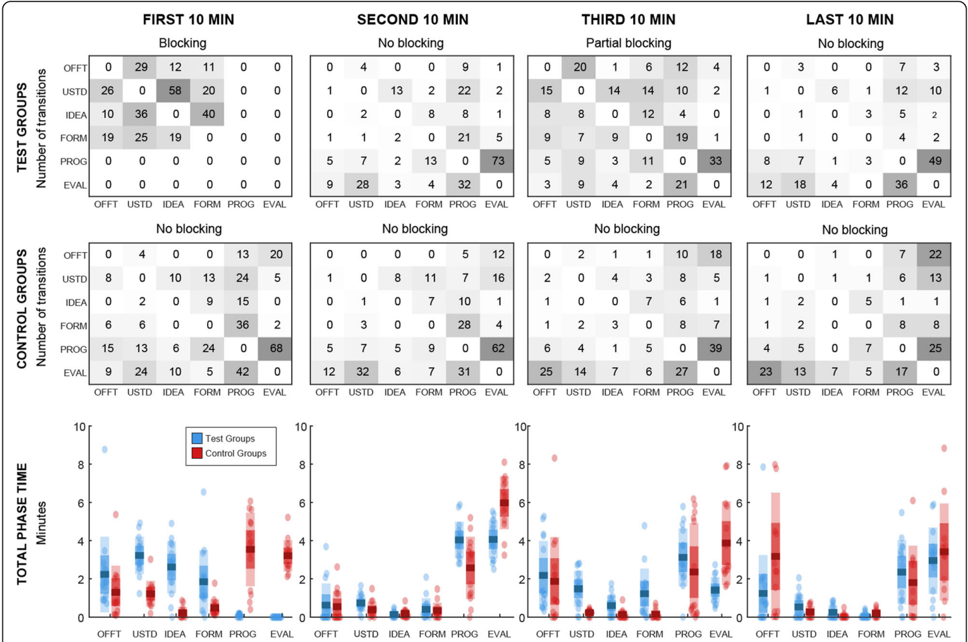
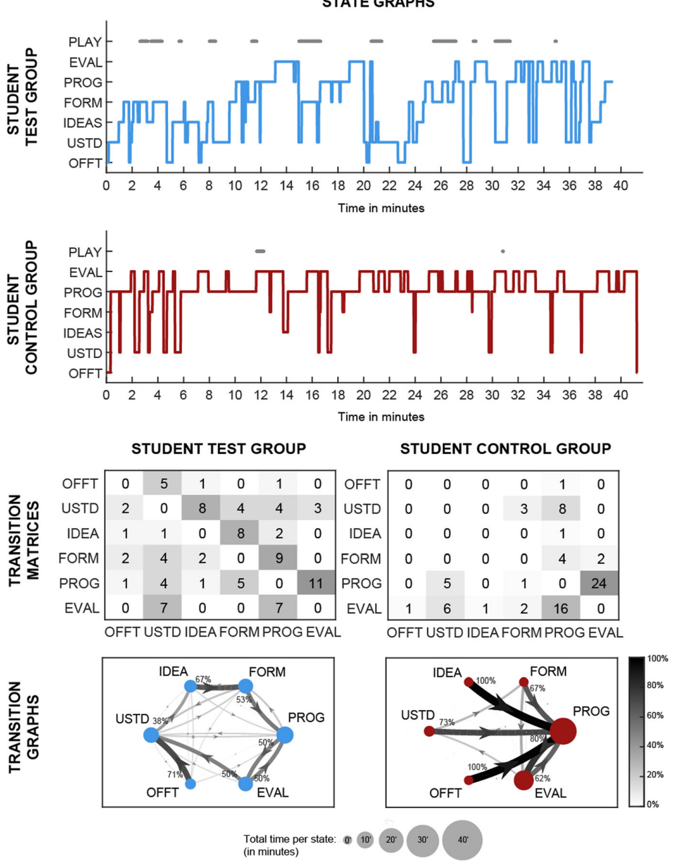
- Control groups with unlimited programming access stayed largely in PROG-EVAL: first three quarters averaged 22/30 min in PROG/EVAL vs. 8/30 min in USTD/IDEA/FORM/OFFT; off-task behavior rose in the last quarter (3/10 min).
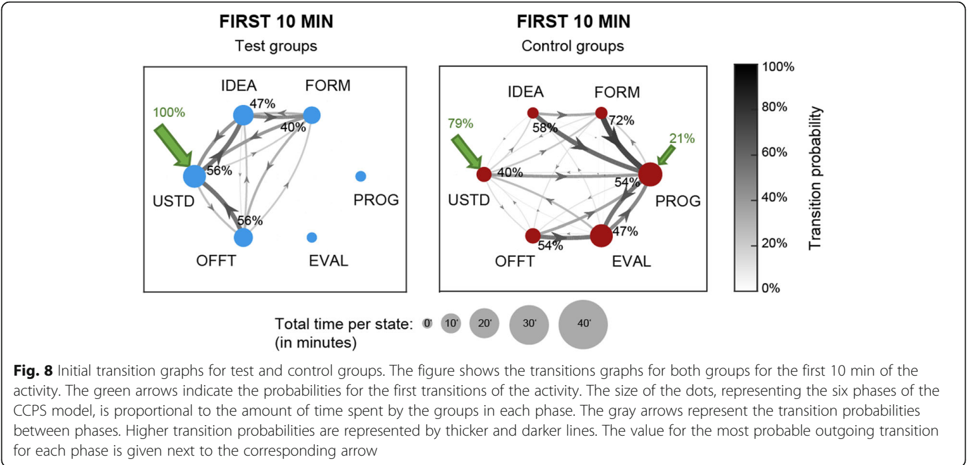
- Test groups with blocking distributed time more evenly: first three quarters averaged 13/30 min in PROG/EVAL and 12/30 min in USTD/IDEA/FORM; all 15 test students started with USTD, and off-task behavior did not increase in the last quarter.
- Partial blocking supported gradual progression and debugging: high PROG-EVAL transitions occurred without executing code; test groups had more playground interactions (93 vs. 59 total).
- Task performance: all five test groups covered at least six lawn squares and two completed all eight; control groups included two that covered only four squares and two that covered six, with one completing all eight.
Methods
- Experimental study with two conditions: control groups had 40 min free access to playground, Thymio, and VPL; test groups had 10 min full VPL blocking, 10 min free, 10 min partial blocking (VPL but no code execution), and 10 min free.
- Sample: 29 primary school students (13 girls, 16 boys, ages 9–10), randomly assigned to groups of 2–3 and to test/control; all had prior Thymio/VPL lessons (1 h/week for 12 weeks).
- Video analysis: two independent evaluators mapped behavior to CCPS phases (USTD, IDEA, FORM, PROG, EVAL, OFFT); inter-rater Cohen’s kappa was 0.59 < k < 0.84; 2162 transitions were mapped over 400 min (1072 test, 1090 control), with transition matrices and time-per-phase analyses.
Limitations
- Paper states small sample due to limited classroom access, though 2162 mapped transitions were considered sufficient for model verification; future work should test teacher-perceived value, other intervention hypotheses, and longitudinal learning gains.
- Evident from text: short experimental duration (two 45-min sessions/40-min activity) and no delayed learning-outcome measure beyond lawnmower task performance; findings may be limited to this age group and context (9–10-year-olds in one Swiss canton with prior Thymio/VPL experience).
- Evident from text: behavioral coding relies on evaluator interpretation despite substantial agreement; data are not publicly available due to sensitivity of under-age participants’ data.
Model-written summary. Check it against the paper before relying on it.
Integrity signals
Registry
Cites
Statistics
Figures
Verification
Claims the paper makes
9 Valid · 2 Not valid · 27 Not checked · 104 Own results and interpretations
The cited sources support only part of this claim — read each source’s verdict below.
In the paper
“The programming activity is thus not the only one that is important for CT skills development.Instead, evaluating (i.e., testing and observing) can be considered equally important.”
§ Fostering computational thinking through educational robotics: a model for creative computational problem solving > CT development with ER is more than just programming a robot
What the sources say
- Partly supportedcites Romero et al., 2017 matched to “Computational thinking development through creative programming in higher education” (2017) sourceExperimental — accuracy not yet measured
The ‘Computational thinking components within the #5c21’ section treats programming and evaluation as separate components of computational thinking, and ‘From code writing to creative programming’ describes testing models. The paper does not say that evaluation is equally important to programming for CT development or specifically equate evaluation with ‘testing and observing.’ (LLM, conf=0.78)
plain- Asserted: passes — The authors put it forward as true.
- Checkable: passes — It can be checked against evidence.
- Load-bearing: passes — The paper’s conclusions depend on it.
- Based: passes — The paper gives a reason why it holds.
- Partly supported
The sources with a verdict support this claim; the rest weren’t checked yet, have no full text we could read, or their verdicts aren’t rated yet.
In the paper
“In many different learning situations, however, researchers have shown that a pure trial-and-error-approach may limit skill development (Antle, 2013;Sadik, Leftwich, & Nadiruzzaman, 2017;Tsai, Hsu, & Tsai, 2012).”
§ Fostering computational thinking through educational robotics: a model for creative computational problem solving > CT development with ER is more than just programming a robot
What the sources say
- Supportedcites Antle, 2013 matched to “Exploring how children use their hands to think: an embodied interactional analysis” (2013) source
The Recommendations for design (section 8) say that a static trial-and-error approach may support task completion but not skills development. This directly supports the hedged claim. (LLM, conf=0.92)
- Not checked — no full text of the sourcecites Sadik, Leftwich, & Nadiruzzaman, 2017 matched to “Computational Thinking Conceptions and Misconceptions: Progression of Preservice Teacher Thinking During Computer Science Lesson Planning” (2017) source
- Not checked — no full text of the sourcecites Tsai, Hsu, & Tsai, 2012 matched to “Investigation of High School Students’ Online Science Information Searching Performance: The Role of Implicit and Explicit Strategies” (2012) source
hedgedstates a possible cause- Asserted: passes — The authors put it forward as true.
- Checkable: passes — It can be checked against evidence.
- Load-bearing: passes — The paper’s conclusions depend on it.
- Based: passes — The paper gives a reason why it holds.
- Supported
The cited sources support only part of this claim — read each source’s verdict below.
In the paper
“The latest meta-analyses carried out on ER and CT (Hsu, Chang, & Hung, 2018;Jung & Won, 2018;Shute et al., 2017) have mentioned only four works between 2006 and 2018 that elaborated how ER activities should be implemented in order to foster CT skills in K-5 education (particularly for grades 3 and 4, i.e., for students of age between 8 and 10 years old).”
§ Fostering computational thinking through educational robotics: a model for creative computational problem solving > Introduction
What the sources say
- Not checked — no full text of the sourcecites Hsu, Chang, & Hung, 2018 matched to “How to learn and how to teach computational thinking: Suggestions based on a review of the literature” (2018) source
- Partly supportedcites Jung & Won, 2018 matched to “Systematic Review of Research Trends in Robotics Education for Young Children” (2018) sourceExperimental — accuracy not yet measured
Section 3.2.1 (p. 8) reports that kindergarten children learned computational-thinking concepts through robotics, supporting the general connection between educational robotics and computational thinking. It does not say that only four works from 2006–2018 described how to implement such activities for grades 3–4; the review mainly targets preschool and kindergarten children (Data Collection, p. 2). (LLM, conf=0.84)
- Not checked — no full text of the sourcecites Shute et al., 2017 matched to “Demystifying computational thinking” (2017) source
plain- Asserted: passes — The authors put it forward as true.
- Checkable: passes — It can be checked against evidence.
- Load-bearing: passes — The paper’s conclusions depend on it.
- Based: passes — The paper gives a reason why it holds.
A result the paper reports from its own data — it cites no other source for it, so there is none to check. The quote shows it is in the paper.
In the paper
“This phase was not considered a priori, however, the experiments with students showed that offtask behavior is part of the reality in classrooms and should therefore be included in the model.”
§ Fostering computational thinking through educational robotics: a model for creative computational problem solving > Formulating the behavior (FORM)
plain- Asserted: passes — The authors put it forward as true.
- Checkable: passes — It can be checked against evidence.
- Load-bearing: passes — The paper’s conclusions depend on it.
- Based: passes — The paper gives a reason why it holds.
A result the paper reports from its own data — it cites no other source for it, so there is none to check. The quote shows it is in the paper.
In the paper
“The results suggest that (i) a non-instructional approach for educational robotics activities (i.e., unlimited access to the programming interface) promotes a trial-and-error behavior;”
§ Fostering computational thinking through educational robotics: a model for creative computational problem solving > Abstract
hedgedstates a cause- Asserted: passes — The authors put it forward as true.
- Checkable: passes — It can be checked against evidence.
- Load-bearing: passes — The paper’s conclusions depend on it.
- Based: passes — The paper gives a reason why it holds.
63 more claims
Create a free account to see all 142 claims and to verify the 1 reference still open.
- Probably not a substantial claim. 49
- It may state two separate claims as one. 39
- The quote only partly states this claim. 3
Self-check
Percentages, sums and reported differences re-computed from the paper’s own numbers.
Each contradiction between two passages listed here was confirmed by an independent check.
Rated minor: it would not touch a result — a value no result rests on, a p-value that stays on the same side of the significance level, or a conflict that is clerical, resolved elsewhere in the paper, or outside its own findings.
In the paper
§ Fostering computational thinking through educational robotics: a model for creative computational problem solving > Limitations and future work
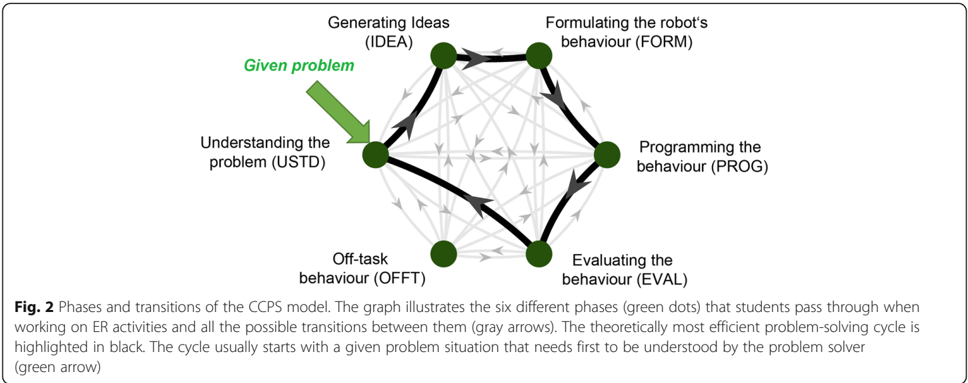
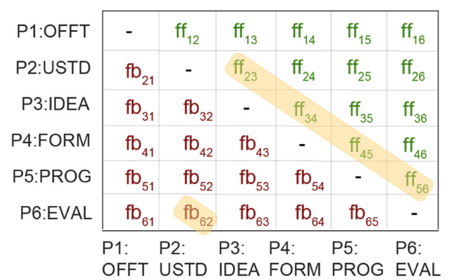
“The theoretically most efficient problemsolving cycle is highlighted in yellow (ff 23 -ff 34 -ff 45 -ff 56 -ff 62 )”
§ Fostering computational thinking through educational robotics: a model for creative computational problem solving > Formulating the behavior (FORM)
“In this model, special emphasis is therefore placed on the cycle considering the transitions ff 23 -ff 34ff 45 -ff 56 -fb 62 (highlighted in yellow in Fig. 3)”
Citations
Cites
The Measurement of Observer Agreement for Categorical Data
Landis, J. R., & Koch, G. G. (1977) · Biometrics · doi:10.2307/2529310 · Cited by 81,148
Wing, J. M. (2006) · Communications of the ACM · doi:10.1145/1118178.1118215 · Cited by 8,102
Observing Interaction: An Introduction to Sequential Analysis
Willson, V. L., Bakeman, R., & Gottman, J. M. (1988) · Journal of Educational Statistics · doi:10.2307/1164658 · Cited by 2,301
Barr, V., & Stephenson, C. (2011) · ACM Inroads · doi:10.1145/1929887.1929905 · Cited by 1,692
Defining Computational Thinking for Mathematics and Science Classrooms
Weintrop, D., Beheshti, E., Horn, M., Orton, K., Jona, K., Trouille, L., & Wilensky, U. (2016) · Journal of Science Education and Technology · doi:10.1007/s10956-015-9581-5 · Cited by 1,609
Demystifying computational thinking
Shute, V. J., Sun, C., & Asbell-Clarke, J. (2017) · Educational Research Review · doi:10.1016/j.edurev.2017.09.003 · Cited by 1,466
Observing Interaction: An Introduction to Sequential Analysis
Bakeman, R., & Gottman, J. M. (1997) · doi:10.1017/cbo9780511527685 · Cited by 1,439
Computational thinking and tinkering: Exploration of an early childhood robotics curriculum
Bers, M. U., Flannery, L., Kazakoff, E. R., & Sullivan, A. (2014) · Computers & Education · doi:10.1016/j.compedu.2013.10.020 · Cited by 959
Hsu, T.-C., Chang, S.-C., & Hung, Y.-T. (2018) · Computers & Education · doi:10.1016/j.compedu.2018.07.004 · Cited by 788
Atmatzidou, S., & Demetriadis, S. (2016) · Robotics and Autonomous Systems · doi:10.1016/j.robot.2015.10.008 · Cited by 630
Design for classroom orchestration
Dillenbourg, P. (2013) · Computers & Education · doi:10.1016/j.compedu.2013.04.013 · Cited by 386 · cited 3×
“Based on the findings of similar approaches implemented for inquiry-based learning (Bumbacher et al., 2018; Dillenbourg, 2013; Perez et al., 2017), the main idea is to introduce strategic pauses to the students to reinforce the three phases preceding the PROG phase.”
BackgroundMethodInfluentialSupporting all learners in school-wide computational thinking: A cross-case qualitative analysis
Israel, M., Pearson, J. N., Tapia, T., Wherfel, Q. M., & Reese, G. (2015) · Computers & Education · doi:10.1016/j.compedu.2014.11.022 · Cited by 333
Systematic Review of Research Trends in Robotics Education for Young Children
Jung, S., & Won, E.-S. (2018) · Sustainability · doi:10.3390/su10040905 · Cited by 288
Leonard, J., Buss, A., Gamboa, R., Mitchell, M., Fashola, O. S., Hubert, T., & Almughyirah, S. (2016) · Journal of Science Education and Technology · doi:10.1007/s10956-016-9628-2 · Cited by 275
Robotics and computational thinking in primary school
Chalmers, C. (2018) · International Journal of Child-Computer Interaction · doi:10.1016/j.ijcci.2018.06.005 · Cited by 263 · cited 1×
“Indeed, previous works have argued that ER can be considered an appropriate tool for the development of CT skills (Bers, Flannery, Kazakoff, & Sullivan, 2014; Bottino & Chioccariello, 2014; Catlin & Woollard, 2014; Chalmers, 2018; Eguchi, 2016; Leonard et al., 2016; Miller & Nourbakhsh, 2016).”
MethodComputational thinking development through creative programming in higher education
Romero, M., Lepage, A., & Lille, B. (2017) · International Journal of Educational Technology in Higher Education · doi:10.1186/s41239-017-0080-z · Cited by 250
Computational Thinking Is More about Thinking than Computing
Li, Y., Schoenfeld, A. H., diSessa, A. A., Graesser, A. C., Benson, L. C., English, L. D., & Duschl, R. A. (2020) · Journal for STEM Education Research · doi:10.1007/s41979-020-00030-2 · Cited by 244
Learning Programming at the Computational Thinking Level via Digital Game-Play
Kazimoglu, C., Kiernan, M., Bacon, L., & MacKinnon, L. (2012) · Procedia Computer Science · doi:10.1016/j.procs.2012.04.056 · Cited by 203
Papert, S. (1982) · Birkhäuser Basel eBooks · doi:10.1007/978-3-0348-5357-6 · Cited by 203
La motivation en contexte scolaire
Viau, R. (1994) · Bibliothèque et Archives nationales du Québec (Québec government) · Cited by 181
Ioannou, A., & Makridou, E. (2018) · Education and Information Technologies · doi:10.1007/s10639-018-9729-z · Cited by 180
Repenning, A., Webb, D. C., Koh, K. H., Nickerson, H., Miller, S. B., Brand, C., Horses, I. H. M., Basawapatna, A., Gluck, F., Grover, R., et al. (2015) · ACM Transactions on Computing Education · doi:10.1145/2700517 · Cited by 178 · cited 1×
“At the same time, some researchers have pointed out that the development of CT competencies also involves a certain creative act (Brennan & Resnick, 2012; DeSchry-ver & Yadav, 2015; Repenning et al., 2015; Romero et al., 2017; Shute et al., 2017).”
BackgroundBringing Robotics to Formal Education: The Thymio Open-Source Hardware Robot
Mondada, F., Bonani, M., Riedo, F., Briod, M., Pereyre, L., Retornaz, P., & Magnenat, S. (2017) · IEEE Robotics & Automation Magazine · doi:10.1109/mra.2016.2636372 · Cited by 148
A framework for computational thinking across the curriculum
Perković, L., Settle, A., Hwang, S., & Jones, J. (2010) · Proceedings of the fifteenth annual conference on Innovation and technology in computer science education · doi:10.1145/1822090.1822126 · Cited by 130
Collaborative learning in an educational robotics environment
Denis, B., & Hubert, S. (2001) · Computers in Human Behavior · doi:10.1016/s0747-5632(01)00018-8 · Cited by 122
Emerging Research, Practice, and Policy on Computational Thinking
(2017) · doi:10.1007/978-3-319-52691-1 · Cited by 120
Thymio II, a robot that grows wiser with children
Riedo, F., Chevalier, M., Magnenat, S., & Mondada, F. (2013) · 2013 IEEE Workshop on Advanced Robotics and its Social Impacts · doi:10.1109/arso.2013.6705527 · Cited by 115
Self-citationMiller, D. P., & Nourbakhsh, I. (2016) · Springer handbooks · doi:10.1007/978-3-319-32552-1_79 · Cited by 111
Lumsdaine, E., & Lumsdaine, M. (1995) · IEEE Potentials · doi:10.1109/45.464655 · Cited by 106 · cited 4×
“Similar to the model of Lumsdaine and Lumsdaine (1994), the proposed model involves the definition of different phases and iterations.”
BackgroundMethodInfluentialDefining a New 21st Century Skill-Computational Thinking: Concepts and Trends
Haseski, H. I., Ilic, U., & Tugtekin, U. (2018) · International Education Studies · doi:10.5539/ies.v11n4p29 · Cited by 105
La motivation en contexte scolairePreprint
Guerrién, A. (2023) · HAL (Le Centre pour la Communication Scientifique Directe) · Cited by 89
Identifying Productive Inquiry in Virtual Labs Using Sequence Mining
Perez, S., Massey-Allard, J., Butler, D., Ives, J., Bonn, D., Yee, N., & Roll, I. (2017) · Lecture Notes in Computer Science · doi:10.1007/978-3-319-61425-0_24 · Cited by 79
Exploring how children use their hands to think: an embodied interactional analysis
Antle, A. N. (2013) · Behaviour & Information Technology · doi:10.1080/0144929x.2011.630415 · Cited by 76 · cited 2×
“Indeed, previous work has argued that trial-and-error strategies may not be considered optimal, since they may “ support task completion but not skills development ” (Antle, 2013).”
BackgroundGiannakoulas, A., & Xinogalos, S. (2018) · Education and Information Technologies · doi:10.1007/s10639-018-9702-x · Cited by 74
What is the point of group discussion in mathematics?
Hoyles, C. (1985) · Educational Studies in Mathematics · doi:10.1007/bf02400938 · Cited by 71 · cited 2×
“These iterations can be explained by the feedback inherent to dialog which occurs during collaborative situations (Hoyles, 1985).”
BackgroundCreative Problem Solving Preferences: Their Identification and Implications
Puccio, G. (1999) · Creativity and Innovation Management · doi:10.1111/1467-8691.00134 · Cited by 66 · cited 2×
“This perspective refers to creative problem solving which involves “ a series of distinct mental operations such as collecting information, defining problems, generating ideas, developing solutions, and taking action ” (Puccio, 1999).”
BackgroundWhat is the point of group discussion in mathematics?
Hoyles, C. (1985) · Educational Studies in Mathematics · doi:10.1007/pl00020740 · Cited by 62 · cited 2×
“These iterations can be explained by the feedback inherent to dialog which occurs during collaborative situations (Hoyles, 1985).”
Kazimoglu, C., Kiernan, M., Bacon, L., & MacKinnon, L. (2011) · International Journal of Game-Based Learning · doi:10.4018/ijgbl.2011070103 · Cited by 59
Bumbacher, E., Salehi, S., Wieman, C., & Blikstein, P. (2018) · Journal of Science Education and Technology · doi:10.1007/s10956-017-9719-8 · Cited by 59
(2015) · The Journal of Technology and Teacher Education · Cited by 58
Educational robots and computational thinking
Catlin, D., & Woollard, J. (2014) · ePrints Soton (University of Southampton) · Cited by 52
Exploring Escape Games as a Teaching Tool in Educational Robotics
Giang, C., Chevalier, M., Negrini, L., Peleg, R., Bonnet, E., Piatti, A., & Francesco Mondada, C. (2019) · Advances in intelligent systems and computing · doi:10.1007/978-3-030-18141-3_8 · Cited by 50 · cited 1×
“Among others, ER activities have been praised for the development of important twenty-first century skills such as creativity (Eguchi, 2014; Negrini & Giang, 2019; Romero, Lepage, & Lille, 2017) and collaboration (Denis & Hubert, 2001; Giang et al., 2019).”
BackgroundSelf-citationTsai, M.-J., Hsu, C.-Y., & Tsai, C.-C. (2012) · Journal of Science Education and Technology · doi:10.1007/s10956-011-9307-2 · Cited by 47 · cited 1×
“In many different learning situations, however, researchers have shown that a pure trial-and-error-approach may limit skill development (Antle, 2013; Sadik, Leftwich, & Nadiruzza-man, 2017; Tsai, Hsu, & Tsai, 2012).”
BackgroundA Two Years Informal Learning Experience Using the Thymio Robot
Riedo, F., Rétornaz, P., Bergeron, L., Nyffeler, N., & Mondada, F. (2012) · Advances in Autonomous Mini Robots · doi:10.1007/978-3-642-27482-4_7 · Cited by 41
Sadik, O., Leftwich, A.-O., & Nadiruzzaman, H. (2017) · Emerging Research, Practice, and Policy on Computational Thinking · doi:10.1007/978-3-319-52691-1_14 · Cited by 40
Heuristics for the Development and Evaluation of Educational Robotics Systems
Giang, C., Piatti, A., & Mondada, F. (2019) · IEEE Transactions on Education · doi:10.1109/te.2019.2912351 · Cited by 40 · cited 2×
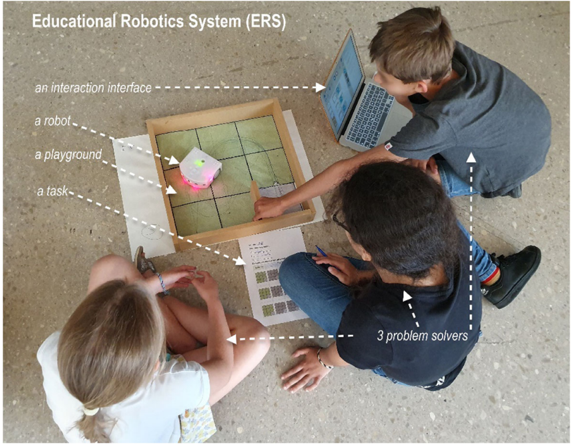
“This set of components is fundamental to any kind of ER activity and has been previously referred to as an Educational Robotics System (ERS) by Giang, Piatti, and Mondada (2019).”
BackgroundMethodSelf-citationBehavior and Sequential Analyses: Principles and Practice
Sharpe, T., & Koperwas, J. (2003) · doi:10.4135/9781412983518 · Cited by 38 · cited 1×
“The videos were recorded from different kinds of ER activities and allowed to establish criterion standards (Sharpe & Koperwas, 2003) that are not limited to one specific ER activity.”
MethodBuss, A. R., & Gamboa, R. A. (2017) · Springer eBooks · doi:10.1007/978-3-319-52691-1_12 · Cited by 31 · cited 2×
“In many cases, teachers let the students work in the project without any particular constraints (Buss & Gamboa, 2017; Sadik et al., 2017).”
BackgroundHow do pupils perceive educational robotics as a tool to improve their 21st century skills?
Negrini, L., & Giang, C. (2019) · Journal of e-Learning and Knowledge Society · doi:10.20368/1971-8829/1628 · Cited by 28 · cited 1×
“Among others, ER activities have been praised for the development of important twenty-first century skills such as creativity (Eguchi, 2014; Negrini & Giang, 2019; Romero, Lepage, & Lille, 2017) and collaboration (Denis & Hubert, 2001; Giang et al., 2019).”
BackgroundSelf-citationVisual Programming Language for Thymio II Robot
Shin, J., Siegwart, R., & Magnenat, S. (2014) · ETH Zurich · doi:10.3929/ethz-a-010144554 · Cited by 26
Robotics in Education: Current Research and Innovations
(2020) · Advances in Intelligent Systems and Computing · doi:10.1007/978-3-030-26945-6 · Cited by 24
Computational Thinking with Educational Robotics
Eguchi, A. (2016) · Society for Information Technology & Teacher Education International Conference · Cited by 19
(2012) · Cited by 7
Sullivan, A., & Bers, M. U. (2017) · Advances in early childhood and K-12 education · doi:10.4018/978-1-5225-3200-2.ch007 · Cited by 1
(2011) · American Educational Research Association Annual Meeting
Research works printed but not linked: 2
- 17. Eguchi, A. (2014). Robotics as a learning tool for educational transformation. In D. Alimisis, G. Granosik, & M. Moro (Eds.), 4th International Workshop Teaching Robotics, Teaching with Robotics & 5th International Conference Robotics in Education, (pp. 27-34). Padova: RIE ISBN 978-88-95872-06-3. Available at http://www.terecop.eu/TRTWR-RIE2014/files/00_WFr1/00_WFr1_04.pdf. Accessed 6 June 2020.
- 50. Sullivan, A., Bers, M., & Mihm, C. (2017). Imagining, playing, and coding with kibo: Using robotics to foster computational thinking in young children. In Proceedings of the International Conference on Computational Thinking Education. Wanchai: Available at https://ase.tufts.edu/devtech/publications/ Sullivan_Bers_Mihm_KIBOHongKong%20.pdf. Accessed 6 June 2020.
Cited by
Sun, D., Boudouaia, A., Zhu, C., & Li, Y. (2024) · International Journal of Educational Technology in Higher Education · doi:10.1186/s41239-024-00446-5 · Cited by 190
On Computational Thinking and STEM Education
Li, Y., Schoenfeld, A. H., diSessa, A. A., Graesser, A. C., Benson, L. C., English, L. D., & Duschl, R. A. (2020) · Journal for STEM Education Research · doi:10.1007/s41979-020-00044-w · Cited by 184
“Thus, some researchers proposed alternative approaches to develop problem-solving-oriented CT such as, “ systematic CT ” (Michaelson 2018) and “ creative computational problem solving ” (Chevalier et al. 2020).”
BackgroundYang, Q.-F., Lian, L.-W., & Zhao, J.-H. (2023) · International Journal of Educational Technology in Higher Education · doi:10.1186/s41239-023-00391-9 · Cited by 152
Chen, P., Yang, D., Metwally, A. H. S., Lavonen, J., & Wang, X. (2023) · International Journal of STEM Education · doi:10.1186/s40594-023-00434-7 · Cited by 275
“Therefore, tangible materials should be used to cultivate CT and problem-solving skills (Chevalier et al., 2020).”
BackgroundEducational Robotics for Developing Computational Thinking in Young Learners: A Systematic Review
Ching, Y., & Hsu, Y. (2023) · TechTrends · doi:10.1007/s11528-023-00841-1 · Cited by 196
“Only a handful of studies (e.g., Baek et al., 2019; Chevalier et al., 2020; Chiazzese et al., 2019; Shen et al., 2022) adopted a more macro view and measured CT in terms of a set of problem-solving processes such as understanding the problem, generating ideas, formulating the behavior, programming…”
Influential
Metadata
- Authors
- Chevalier, M., Giang, C., Piatti, A., & Mondada, F.
- Affiliations
- Haute École Pédagogique du Canton de Vaud (CH)
- University of Applied Sciences and Arts of Southern Switzerland (CH)
- Corresponding author
- Chevalier, Morgane
- Venue
- International Journal of STEM Education
- Published
- 2020-08-03
- Volume
- 7
- Issue
- 1
- ISSN
- 2196-7822 (ISSN-L)
- OpenAlex
- W3046440829
- Cited by
- 223
- References
- 55
- Citations by year
- 2026: 36 · 2025: 37 · 2024: 47 · 2023: 41 · 2022: 36 · 2021: 25 · 2020: 1
- FWCI
- 23.95
- Type
- journal article
- Language
- en
- Open access
- gold
- doi.org
- Licence
- cc-by
- creativecommons.org/licenses/by/4.0 (tdm)
- creativecommons.org/licenses/by/4.0 (vor)
- Locations
- International Journal of STEM Education (publishedVersion, cc-by)
- DOAJ (DOAJ: Directory of Open Access Journals) (submittedVersion, cc-by-sa)
- Infoscience (Ecole Polytechnique Fédérale de Lausanne) (submittedVersion, cc-by-nc-nd)
- Funders
- National Centre of Competence in Research Robotics (51NF40-185543)
- Topics
- Physical Sciences › Computer Science › Computer Science Applications › Teaching and Learning Programming
- Social Sciences › Education › Educational Robotics and Engineering
- Physical Sciences › Engineering › Mechanical Engineering › Design Education and Practice
- Keywords
- educational robotics, computational thinking, teaching model, scaffolding, elementary school students, creative problem solving, problem understanding, idea generation, solution formulation
About these checks
Registry, retraction, Cites and statistics results are computed, not judged, with one exception: a printed reference that no index lists is read once by a model before it counts as a citation error. Claims are extracted by a model and kept only when their quote appears verbatim in the text; each cited source is then checked, with a model’s help, for whether it says what the claim relies on. Those verdicts can be wrong — read the claim’s quote and the cited source before relying on one.
The claim verdicts this report counts are experimental: their accuracy is not yet measured.
A language model drew the claims from the paper on 2026-10-10, under version 3 of the claim definition (model deepseek-v4.1-flash, prompt extract-v3).
A second model labelled each claim on 2026-10-10 (model jev-1.13-20260917, definition revision gold-guideline-v0.2).
Cited sources are checked with a language model’s help (gpt-6-sol).
Statistics and arithmetic are recomputed, not judged.
Confidence bands are shown only for fields calibrated on our annotated test set. None is calibrated yet, so no band is shown.
What counts as a claim ›How we measure confidence ›How we check this ›
Are you an author, or do you see a problem with this page? Request a review
Data sources
Bibliographic data: Semantic Scholar, OpenAlex, Crossref.
Contains information from the Semantic Scholar Academic Graph Datasets, made available under the ODC Attribution License (ODC-BY 1.0).
Semantic Scholar’s data is described in: Kinney, R., et al. (2023). The Semantic Scholar Open Data Platform. arXiv:2301.10140.
