

Enhancing mathematical problem posing competence: a meta-analysis of intervention studies
Open accessThe DOI matches its Crossref record; 126 of the 129 references it cites were found in a registry or an index; 3 of the 43 sources its claims cite were checked for support.
Abstract
Mathematical problem posing, generally defined as the process of interpreting given situations and formulating meaningful mathematical problems, is academically important, and thus several interventions have been used to enhance this competence among students and teachers. Yet little is known about the interventions’ various components and their relative or combined effectiveness. In this meta-analysis of 26 intervention studies in mathematics, we identified nine intervention components and found that the interventions had a medium, positive, and significant mean weighted effect size. A stepwise meta-regression analysis revealed that intervention efficacy varied by moderators relevant to the research design, sample characteristics, and intervention characteristics. The findings obtained from this meta-analysis are expected to serve as a foundation for future efforts to design and implement (more) effective interventions to improve mathematical problem posing competence.
Overview
CoChat Summary
TL;DR
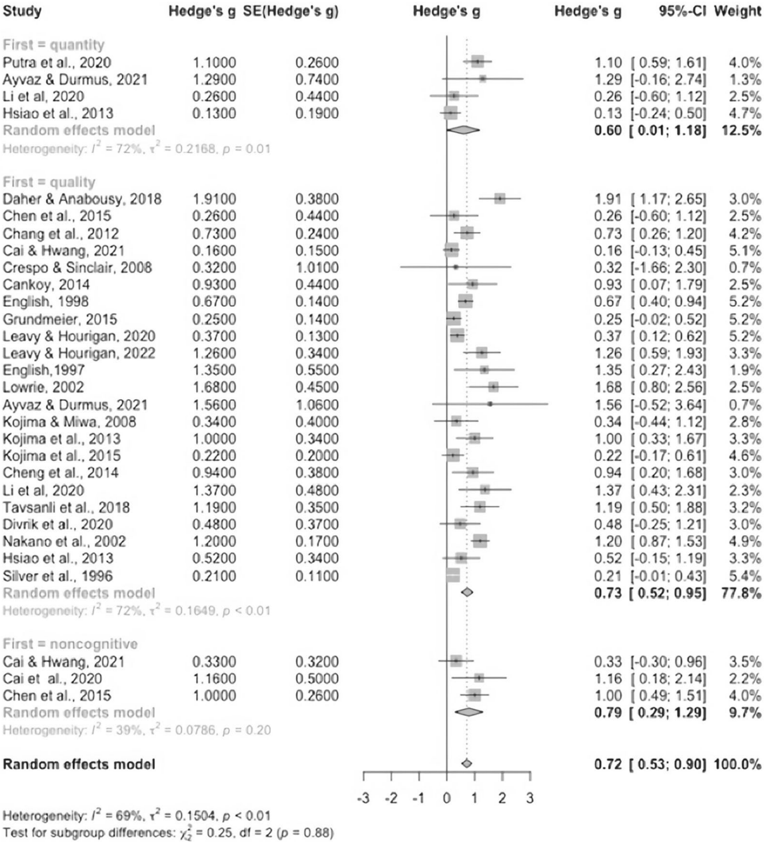
This meta-analysis of 26 intervention studies found that interventions to enhance mathematical problem posing competence had a medium, positive, significant overall effect (g = 0.72, 95% CI [0.53, 0.90], p < .001). Effects varied by research design, sample level, sample size, and intervention component number/mode/type, while intervention duration was not a significant moderator.
Key findings
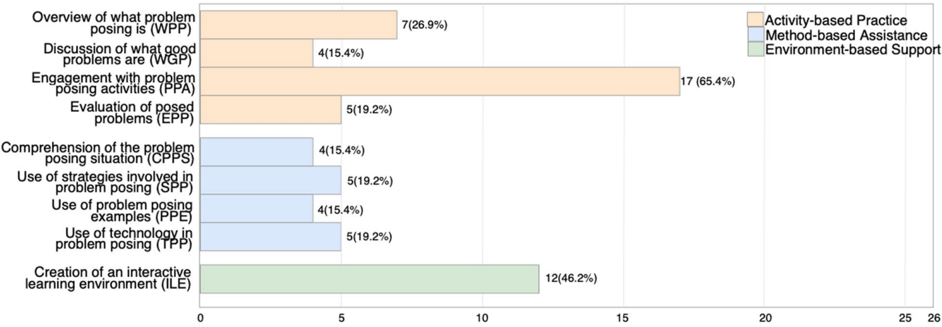
- Nine intervention components were identified under activity-based practice, method-based assistance, and environment-based support; the most common were engagement with problem posing activities (65.4%, n = 17) and creation of an interactive learning environment (46.2%, n = 12).
- The overall treatment effect was medium, positive, and significant (g = 0.72, 95% CI [0.53, 0.90], p < 0.001). Cluster effects were 0.73 for quality of posed problems, 0.60 for quantity of posed problems, and 0.79 for noncognitive outcomes, with no significant between-cluster variance (p = 0.88).
- Moderators: K-12 students showed 89% and 96% higher effect sizes than prospective teachers (p < 0.001) and in-service teachers (p < 0.01); small groups (< 25) showed 72% higher effects than large groups (> 50) (p < 0.1); interventions with more than one component showed 63% higher effects than single-component interventions (p < 0.05); one-based support showed 64% and 186% higher effects than two-based (p < 0.05) and mixed-based support (p < 0.01); method-based assistance showed 84% higher effects (p < 0.1) and environment-based support 83% higher effects (p < 0.05). Pre-post design showed 58% higher effects than pre-post-control (p < 0.1). Duration was not a significant moderator.
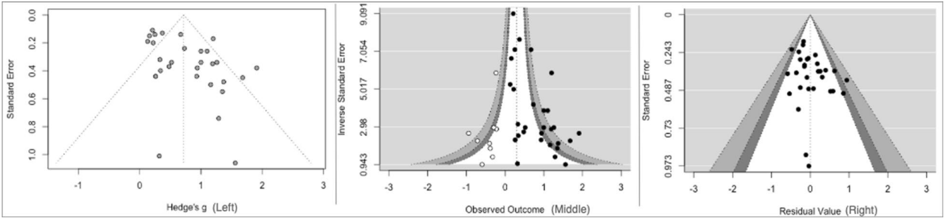
- Publication bias: Egger’s test was significant (p < 0.05); trim-and-fill imputed nine missing negative studies and reduced the point estimate to r = 0.5109 (95% CI [0.304, 0.715]); mixed-effects meta-regression for funnel plot asymmetry was not significant (z = 1.719, p > 0.05), so the authors concluded there was not enough evidence of publication bias.
Methods
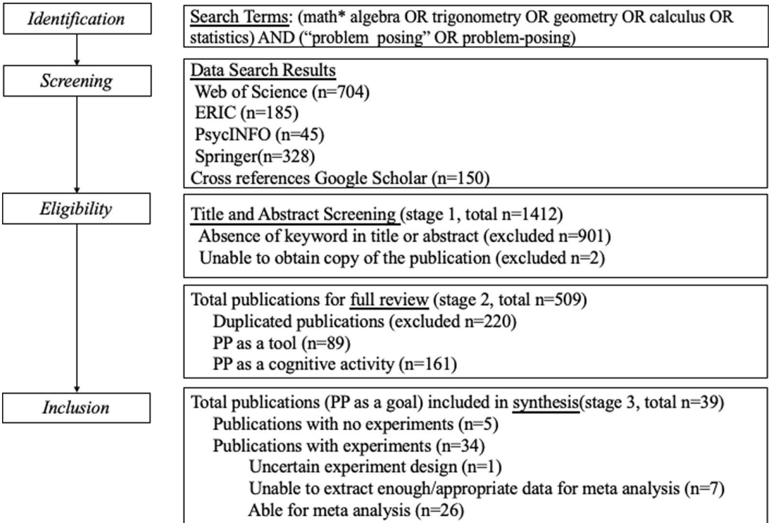
- PRISMA systematic search in July 2021 across Web of Science, ERIC, PsycINFO, and Springer, plus the first 15 pages of Google Scholar; inclusion required peer-reviewed journal articles or book chapters, English, publication between January 1990 and June 2021, problem posing as a goal, and quantitative data sufficient for effect size calculation. From 1,412 records, 509 underwent full review, 39 were retained, and 26 were included in the meta-analysis.
- Two trained research assistants extracted and coded data; inter-rater reliability was Cohen’s kappa = 0.9. Intervention components were categorized using the constant comparative method into activity-based practice, method-based assistance, and environment-based support.
- Random-effects meta-analysis used Hedge’s g; change-score effect sizes were transformed to a raw-score metric. A stepwise meta-regression tested moderators; one outlier (Kalmpourtzis, 2019, g = 3.32) was removed. Publication bias was assessed with Egger’s test, trim-and-fill, and mixed-effects meta-regression.
Limitations
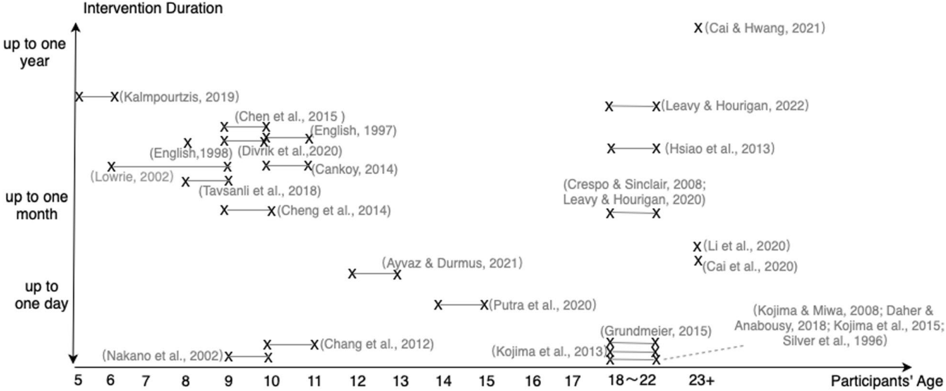
- Paper-stated: the authors could not access several potential studies; they excluded conference publications; publication bias may still have influenced findings despite statistical tests; considerable between-study heterogeneity suggests unaccounted moderators; intervention duration was measured as the time over which an intervention was spread rather than actual treatment time, possibly diluting effects; some moderator findings used p < 0.10 and are less robust.
- Paper-stated: future meta-analyses should explore additional moderators such as dependent measure type (researcher-developed vs. standardized measures) and study quality rating.
- Evident from the text: only 26 studies were included, many moderator categories likely contained few studies; residual heterogeneity remained high (I² = 75.3% with the outlier; 69.2% without it); only English-language peer-reviewed publications were included; and most studies (19/26) were published after 2010.
Model-written summary. Check it against the paper before relying on it.
Integrity signals
Registry
Cites
Statistics
Figures
Verification
Claims the paper makes
2 Valid · 0 Not valid · 34 Not checked · 57 Own results and interpretations
The cited sources support only part of this claim — read each source’s verdict below.
In the paper
“While these reviews occasionally ventured into a few studies examining the effect of engaging in problem posing activities on the development of problem posing, their primary focus remained on demonstrating the merit of problem posing as a tool on a broad-based impact for learning mathematics as opposed to examining problem posing as a goal.”
§ Enhancing mathematical problem posing competence: a meta-analysis of intervention studies > Interventions to enhance mathematical problem posing competence
What the sources say
- Partly supportedcites Rosli et al., 2014 matched to “The Effects of Problem Posing on Student Mathematical Learning: A Meta-Analysis” (2014) sourceExperimental — accuracy not yet measured
Our copy supports the 'as a tool / broad-based impact' half: Section 3 ('The Need for a Meta-Analytic Review') frames the synthesis as concerned with 'problem posing as an effective classroom interventional tool for the teaching and learning of mathematics', and the Discussion/Conclusion report 'broad potential benefits on students' mathematics achievement, problem solving skills, levels of problems posed, and attitudes toward mathematics'. However, the same section states that 'to date, there is only one review of the literature available' (Silver, 1994, summarizing the nature, processes and perspectives of problem posing), so the claim's plural 'prior reviews' overstates what the source says, and no passage in our copy draws the tool-versus-goal distinction or says prior reviews only occasionally ventured into studies on the development of problem posing itself (searched: 'problem posing as a goal', 'development of problem posing ability', 'previous reviews focused on broad impact'). (LLM, conf=0.68)
- Partly supportedcites Kul & Çelik, 2020 matched to “A Meta-Analysis of the Impact of Problem Posing Strategies on Students’ Learning of Mathematics” (2020) sourceExperimental — accuracy not yet measured
The Introduction (p. 1, 'only two meta-analysis studies... directly address and measure the effectiveness of problem-posing'; Cantürk-Günhan, Geçici & Günkaya 2019 'only concentrated on the effectiveness of problem posing method on student academic success') and the Discussion (p. 4) do support the 'broad-based impact on learning mathematics' half of the claim, and the paper elsewhere notes the community sees problem posing 'as a tool' (citing Cai et al., 2015). But our copy never frames prior reviews as 'tool rather than goal'; indeed it records that Rosli, Capraro & Capraro (2014) computed a separate effect size for 'level of problems posed' (0.77, Introduction and Discussion), i.e. problem posing as an outcome itself, so the 'as opposed to examining problem posing as a goal' characterisation is the citing authors' framing rather than this paper's. (LLM, conf=0.70)
- Not checked — no full text of the sourcecites Wang et al., 2022 matched to “A Meta-Analysis on the Effects of Problem-Posing in Mathematics Education on Performance and Dispositions” (2022) source
plain- Asserted: passes — The authors put it forward as true.
- Checkable: passes — It can be checked against evidence.
- Load-bearing: passes — The paper’s conclusions depend on it.
- Based: passes — The paper gives a reason why it holds.
- Partly supported
The cited sources support only part of this claim — read each source’s verdict below.
In the paper
“Each layer of a context, whether at the micro (individual), meso (team or organization), or macro (system) level, can affect the intervention's effectiveness (Moullin et al., 2020).”
§ Enhancing mathematical problem posing competence: a meta-analysis of intervention studies > Conclusions
What the sources say
- Partly supportedcites Moullin et al., 2020 matched to “Ten recommendations for using implementation frameworks in research and practice” (2020) sourceExperimental — accuracy not yet measured
The 'Use a framework(s) at micro level to conduct and tailor implementation' section does state that 'Each layer of a context (e.g., organization, profession, team, individual) requires ongoing individual tailoring of implementation strategies,' and the 'Determine implementation determinants' section notes frameworks include determinants 'found to influence implementation outcomes,' with the 'Select a suitable framework(s)' section adding outer-context layers (policy, government, community norms). So the multi-layer context point is supported, but our copy never uses the micro/meso/macro taxonomy, and what it says context layers affect is implementation strategies, implementation outcomes and 'implementation effectiveness' — not the intervention's (clinical) effectiveness as the citing sentence states. (LLM, conf=0.72)
plainstates a possible cause- Asserted: passes — The authors put it forward as true.
- Checkable: passes — It can be checked against evidence.
- Load-bearing: unclear — It is unclear whether the paper’s conclusions depend on it.
- Based: passes — The paper gives a reason why it holds.
- Partly supported
A result the paper reports from its own data — it cites no other source for it, so there is none to check. The quote shows it is in the paper.
In the paper
“A stepwise meta-regression analysis revealed that intervention efficacy varied by moderators relevant to the research design, sample characteristics, and intervention characteristics.”
§ Enhancing mathematical problem posing competence: a meta-analysis of intervention studies > Abstract
plainstates an association- Asserted: passes — The authors put it forward as true.
- Checkable: passes — It can be checked against evidence.
- Load-bearing: passes — The paper’s conclusions depend on it.
- Based: passes — The paper gives a reason why it holds.
A result the paper reports from its own data — it cites no other source for it, so there is none to check. The quote shows it is in the paper.
In the paper
““overview of what problem posing is” in 26.9% of the reviewed studies (WPP, n = 7)”
§ Enhancing mathematical problem posing competence: a meta-analysis of intervention studies > Intervention components incorporated in studies
plainn = 7- Asserted: passes — The authors put it forward as true.
- Checkable: passes — It can be checked against evidence.
- Load-bearing: unclear — It is unclear whether the paper’s conclusions depend on it.
- Based: passes — The paper gives a reason why it holds.
A result the paper reports from its own data — it cites no other source for it, so there is none to check. The quote shows it is in the paper.
In the paper
““evaluation of posed problems” in 19.2% of the reviewed studies (EPP, n = 5)”
§ Enhancing mathematical problem posing competence: a meta-analysis of intervention studies > Intervention components incorporated in studies
plainn = 5- Asserted: passes — The authors put it forward as true.
- Checkable: passes — It can be checked against evidence.
- Load-bearing: unclear — It is unclear whether the paper’s conclusions depend on it.
- Based: passes — The paper gives a reason why it holds.
40 more claims
Create a free account to see all 93 claims and to verify the 26 references still open.
- It may state two separate claims as one. 26
- Probably not a substantial claim. 25
- The quote only partly states this claim. 1
Claims other papers make about this one
Each is checked against this paper’s own text: does it say what the citing paper says it does?
In the citing paper
“In our recent meta-analysis (Zhang et al., 2024), we summarized various intervention components aimed at fostering mathematical problem-posing competence and we examined overall intervention efficacy as well as the effects of moderators.”
From Approaches to Supporting and Measuring Mathematical Problem Posing: A Systematic Review of Interventions in Mathematics Education (2025) · cites this paper as Zhang et al., 2024
Statistics recomputed
Every reported test result, recomputed from its test statistic and degrees of freedom. A result shows as not adding up only once an independent check has confirmed it.
- ConsistentF(11, 18) = 3.474reported p < .01 · recomputed p = .009
“F(11,18) = 3.474, p < .01”
- ConsistentQ(38) = 150.5reported p < .05 · recomputed p < .001
“Q (38) = 150.5,p < .05”
- Consistentz = 1.719reported p > .05 · recomputed p = .086
“(z = 1.719, p > .05”
Self-check
Percentages, sums and reported differences re-computed from the paper’s own numbers.
Each contradiction between two passages listed here was confirmed by an independent check.
Rated minor: it would not touch a result — a value no result rests on, a p-value that stays on the same side of the significance level, or a conflict that is clerical, resolved elsewhere in the paper, or outside its own findings.
In the paper
§ Enhancing mathematical problem posing competence: a meta-analysis of intervention studies > Description of selected studies
“The studies were conducted in ten different countries/districts (Australia, China, Cyprus, Greece, Indonesia, Ireland, Israel, Japan, Turkey, USA)”
§ Enhancing mathematical problem posing competence: a meta-analysis of intervention studies > Conclusions
“| Cheng et al. (2014) | J. Comput. Educ | Taiwan | -Experimental | 3 weeks | 29 fourth graders | PPA |”
Rated minor: it would not touch a result — a value no result rests on, a p-value that stays on the same side of the significance level, or a conflict that is clerical, resolved elsewhere in the paper, or outside its own findings.
In the paper
§ Enhancing mathematical problem posing competence: a meta-analysis of intervention studies > Risk of publication bias
“we used a symmetric distribution of effect size as indicated by a statistically significant Egger's test”
§ Enhancing mathematical problem posing competence: a meta-analysis of intervention studies > Publication bias
“Results of the Egger's test showed the coefficient for the modified effect standard deviation was significant for the models (p < 0.05), indicating that the effect size distribution was asymmetric”
Rated minor: it would not touch a result — a value no result rests on, a p-value that stays on the same side of the significance level, or a conflict that is clerical, resolved elsewhere in the paper, or outside its own findings.
In the paper
§ Enhancing mathematical problem posing competence: a meta-analysis of intervention studies > Conclusions
“| Chen et al. (2015) | Chapter | China | -Explore the concept | 11 units, 90 min | 69 fourth graders | WPP |”
§ Enhancing mathematical problem posing competence: a meta-analysis of intervention studies > References
“Enhancing the development of Chinese fifth-graders' problem-posing and problem-solving abilities, beliefs, and attitudes: A design experiment.”
Rated minor: it would not touch a result — a value no result rests on, a p-value that stays on the same side of the significance level, or a conflict that is clerical, resolved elsewhere in the paper, or outside its own findings.
In the paper
§ Enhancing mathematical problem posing competence: a meta-analysis of intervention studies > The treatment effect on mathematical problem posing competence
“For the model without outliers that included 31 effect sizes from all 26 studies”
§ Enhancing mathematical problem posing competence: a meta-analysis of intervention studies > The treatment effect on mathematical problem posing competence
“the mean effect across 30 effect sizes from the 25 studies that included no outliers”
Citations
Cites
Statistical Power Analysis for the Behavioral Sciences
Muller, K. (1989) · Technometrics · doi:10.1080/00401706.1989.10488618 · Cited by 99,167
Basics of Qualitative Research: Grounded Theory Procedures and Techniques
Long, D. R., Strauss, A., & Corbin, J. (1993) · The Modern Language Journal · doi:10.2307/328955 · Cited by 17,576
Duval, S., & Tweedie, R. (2000) · Biometrics · doi:10.1111/j.0006-341x.2000.00455.x · Cited by 14,099 · cited 1×
“We excluded the outlier (the study by Kalmpourtzis, 2019) because its unusually huge effect size of g = 3.32 would likely bias the overall ES (Lipsey & Wilson, 2001 and not enough evidence showed that plot asymmetry was caused by publication bias (Duval & Tweedie, 2000) (funnel plot is shown in Fig.”
BackgroundInfluentialPage, M. J., Moher, D., Bossuyt, P. M., Boutron, I., Hoffmann, T. C., Mulrow, C. D., Shamseer, L., Tetzlaff, J. M., Akl, E. A., Brennan, S. E., et al. (2021) · BMJ · doi:10.1136/bmj.n160 · Cited by 13,262 · cited 1×
“We followed standardized guidelines for systematic reviews by Preferred Reporting Items for Systematic Reviews and Meta-analysis (PRISMA) (Page et al., 2021).”
MethodToward an experimental ecology of human development.
Bronfenbrenner, U. (1977) · American Psychologist · doi:10.1037/0003-066x.32.7.513 · Cited by 10,853 · cited 1×
“…mathematical problem posing competence, including the mechanisms underlying the more or less effective interventions and moderators’ influence on intervention efficacy, help deepen theoretical understanding of this competence and how to promote it (Bronfendrenner, 1977; Snyder et al., 2019).”
BackgroundLakens, D. (2013) · Frontiers in Psychology · doi:10.3389/fpsyg.2013.00863 · Cited by 10,303 · cited 1×
“As Lakens (2013) explained, the increased statistical power and sensitivity in within-participants designs allow for the detection of smaller, yet significant, treatment effects that might be missed in between-participants designs.”
Background(2000) · Cited by 9,198
Cohen, J. (1992) · Current Directions in Psychological Science · doi:10.1111/1467-8721.ep10768783 · Cited by 5,870
How to perform a meta-analysis with R: a practical tutorial
Balduzzi, S., Rücker, G., & Schwarzer, G. (2019) · Evidence Based Mental Health · doi:10.1136/ebmental-2019-300117 · Cited by 5,827
The Handbook of Research Synthesis and Meta-Analysis
(2019) · doi:10.7758/9781610448864 · Cited by 4,553
Research works printed but not linked: 9
- Bevan, D., Williams, A. M., & Capraro, M. M. (2019). Strike a pose: The impact of problem-posing on elementary students' mathematical attitudes and achievement. In N. Jarmila & M. Hana (Eds.), International symposium elementary mathematics teaching (pp. 80-88). Prague.
- Brown, S. I., & Walter, M. I. (1993). Problem posing in mathematics education.
- Chinese Ministry of Education. (2022). Quanrizhi yiwu jiaoyu shuxue kecheng biaozhun [Mathematics Curriculum Standard of compulsory education (2022 version)]. People’s Education Press.
- Hawkins, D. (2000). The roots of literacy. University Press of Colorado.
- Ministry of Education of Italy. (2007). Indicazioni per il curriculo. Ministero della Pubblica Istruzione.
- National Council of Teachers of Mathematics (NCTM). (2000). Principles and standards for school mathematics. Author.
- Priest, D. J. (2009). A problem-posing intervention in the development of prob- lem-solving competence of underachieving, middle-year students (Ph.D. thesis , Queensland University of Technology). https:// eprin ts. qut. edu. au/ 31740/
- Stoyanova, E., & Ellerton, N. F. (1996). A framework for research into students' problem posing in school mathematics. In P. Clarkson (Ed.), Technol- ogy in Mathematics Education (pp. 518-525). Mathematics Education Research Group of Australasia.
- Zheng, L., Bhagat, K. K., Zhen, Y., & Zhang, X. (2020). The effectiveness of the flipped classroom on students' learning achievement and learning motivation. Journal of Educational Technology & Society, 23(1), 1-15.
Cited by
Rahmah, S., & Lubis, A. H. (2024) · Journal of Indonesian Primary School. · doi:10.62945/jips.v1i4.409 · Cited by 302
What Research Says About Teaching Mathematics Through Problem Posing
Cai, J. (2022) · Éducation et didactique · doi:10.4000/educationdidactique.10642 · Cited by 114
Bognar, B., Horvat, S. M., & Matić, L. J. (2025) · Education Sciences · doi:10.3390/educsci15010076 · Cited by 74
Chaiarwut, S., Srikoon, S., Siritaratiwat, A., & Kwangmuang, P. (2025) · Social Sciences & Humanities Open · doi:10.1016/j.ssaho.2025.101338 · Cited by 35
Zhang, L., Stylianides, A. J., & Stylianides, G. J. (2025) · International Journal of Science and Mathematics Education · doi:10.1007/s10763-025-10542-1 · Cited by 17
Self-citationSiregar, T. (2025) · Preprints.org · doi:10.20944/preprints202510.1549.v1 · Cited by 20
Feng, M., Wijaya, T. T., Ananda, R., & Du, W. (2025) · Scientific Reports · doi:10.1038/s41598-025-14459-1 · Cited by 10
Shao, H., & Tang, G. (2025) · International Conference on Educational and Information Technology · doi:10.1109/iceit64364.2025.10975950 · Cited by 7
Bokhove, C. (2025) · Asian Journal for Mathematics Education · doi:10.1177/27527263251346212 · Cited by 7
Mathematical Problem-Posing Research: Revisiting Some Answered and Unanswered Questions
Ölmez, İ. B., Han, J., Hwang, S., & Cai, J. (2025) · Avances de Investigación en Educación Matemática · doi:10.35763/aiem28.8124 · Cited by 4
Patac, A. V., & Patac, L. P. (2025) · Journal of Honai Math · doi:10.30862/jhm.v8i2.749 · Cited by 4
An exploration of teachers' perspectives on computational thinking in mathematics learning
Hartawan, I. G. N. Y., Pujawan, I. G. N., & Wibawa, N. A. (2026) · Indonesian Journal of Educational Development (IJED) · doi:10.59672/ijed.v6i4.5594 · Cited by 4
La enseñanza de la resolución de problemas matemáticos mediante estrategias heurísticas
Yumbla, E. S. M., Kuja, D. J., & Marivel, S. S. M. (2025) · DISCE Revista Científica Educativa y Social · doi:10.69821/disce.v2i1.36 · Cited by 3
Reviewing the Current State of Knowledge in Mathematical Problem-Posing Research
Ölmez, İ. B., Hwang, S., Han, J., & Cai, J. (2026) · Research in mathematics education · doi:10.1007/978-3-032-05493-7_8 · Cited by 3
Sarira, G., Wijayati, N., Widiyatmoko, A., & Subali, B. (2026) · JOURNAL OF EDUCATIONAL SCIENCES · doi:10.31258/jes.10.1.p.2128-2140 · Cited by 2
Innovative approaches to the formation of mathematical competence of future primary school teachers
Коберник, Г. (2025) · Scientific Bulletin of Mukachevo State University Series “Pedagogy and Psychology” · doi:10.52534/msu-pp1.2025.71 · Cited by 1
Bosra, N., Naufal, M. A., Ja’faruddin, J., & Johnny, J. (2025) · Venn Journal of Sustainable Innovation on Education Mathematics and Natural Sciences · doi:10.53696/venn.v4i2.293 · Cited by 2
Zhang, L., Stylianides, G. J., & Stylianides, A. J. (2026) · Research in mathematics education · doi:10.1007/978-3-032-05493-7_19 · Cited by 1
Self-citationRomadhona, F., Kamid, K., & Rohati, R. (2025) · Journal of General Education and Humanities · doi:10.58421/gehu.v4i1.382
Prospective Teachers' Representation of Numeracy Context in Posing Numeration Tasks Design
Indrawatiningsih, N., Masriyah, M., Sari, Y. M., Milla, Y. I. E., Saadah, N., Fauzi, H. A. P., & Putri, O. M. A. (2025) · SAR Journal - Science and Research · doi:10.18421/sar82-03
Ulusoy, F. (2025) · Advances in computational intelligence and robotics book series · doi:10.4018/979-8-3373-1998-8.ch007
Ahmed, I., & Zafar, J. M. (2025) · Journal of Asian Development Studies · doi:10.62345/jads.2025.14.3.129
Arcavi, A. (2025) · Research in mathematics education · doi:10.1007/978-3-031-99082-3_7
Agbozo, K. K., Bonyah, E., & Boateng, F. O. (2026) · European Journal of Education Studies · doi:10.46827/ejes.v13i1.6470
Wulandari, I. G. A. P. A., Lay, Y. O., Ananta, P. A., Hamzah, A., & Biaf, C. S. M. (2026) · Journal of General Education and Humanities · doi:10.58421/gehu.v5i2.939
Bislig, C., Argente, J., Bato, S. A., Besinga, S., Dañas, C., & Sagun, J. (2026) · International Journal For Multidisciplinary Research · doi:10.36948/ijfmr.2026.v08i03.75645
Crodua, J. B., & Luzano, J. F. (2026) · International Journal of Multidisciplinary Applied Business and Education Research · doi:10.11594/ijmaber.07.04.16
KEMAMPUAN PROBLEM POSING TIPE POST SOLUTION PADA MATERI BANGUN DATAR DAN BANGUN RUANG
Rozzaaq, A. F., Santia, I., & Hima, L. R. (2025) · Jurnal Koulutus · doi:10.51158/6qjj5y19
Problem posing in mathematics education: Research trends and global collaborations over four decades
Serin, M. K. (2026) · Eurasia Journal of Mathematics Science and Technology Education · doi:10.29333/ejmste/18590
van Bommel, J., Ebbelind, A., & Palmér, H. (2026) · LUMAT International Journal on Math Science and Technology Education · doi:10.31129/lumat.14.4.2804
Juniarmi, I., Rohati, R., Nusantara, D. S., & Kumalasari, A. (2026) · Journal of General Education and Humanities · doi:10.58421/gehu.v5i3.1356
Dhruev, K., & Stylianides, G. J. (2026) · International Journal of Mathematical Education in Science and Technology · doi:10.1080/0020739x.2026.2693806
Self-citationPitron, N. A., Sauhana, N., Redina, A. S., Fajriyanti, A. N., & Mawardi, M. (2026) · Pubmedia Jurnal Penelitian Tindakan Kelas Indonesia · doi:10.47134/ptk.v3i4.2858
Shang, X., Zhao, X., Wang, S., Jing, B., & Lee, C.-Y. (2026) · International Journal of Educational Research · doi:10.1016/j.ijer.2026.103075
Yudiana, Y., Zen, Z., Hidayati, A., Amsal, M. F., & Rayendra (2026) · ARMADA Jurnal Penelitian Multidisiplin · doi:10.55681/armada.v4i7.3157
Sabri, S., Bosra, N., & Upu, H. (2026) · Venn Journal of Sustainable Innovation on Education Mathematics and Natural Sciences · doi:10.53696/venn.v5i3.506
Constructing Mathematical Meaning through Authentic Nutrition Problems in Higher EducationPreprint
Morales–Maure, L., de Talavera, M. M., Marimón, O. G., & García, D. G. (2026) · Research Square · doi:10.21203/rs.3.rs-10685039/v1
Ergene, Ö., ERGENE, B. Ç., & Kurtça, T. T. (2026) · BMC Psychology · doi:10.1186/s40359-026-05569-0
A contextual problem-posing hypercontent model for vocational mathematics learning
Haryanti, S., Japar, M., & Salsabila, E. (2026) · Journal of Education and Learning (EduLearn) · doi:10.11591/edulearn.v20i4.27123
Rahayu, D. S., Resti, N. C., & Pebriyanti, P. (2025) · Proceeding International Conference on Education
Men, F. E., Mandur, K., Jamun, Y. M., & Bagio, S. T. R. (2026) · EMTEKA Jurnal Pendidikan Matematika · doi:10.24127/emteka.v7i2.11678
Sánchez-Acevedo, N., & Silva, S. R. (2026) · Acta Scientiae · doi:10.64856/acta.scientiae.8355
Owens, E. M., & Nolan, B. C. (2026) · Frontiers in Education · doi:10.3389/feduc.2026.1851481
Raquel, J. D. (2026) · JOURNAL OF MATHEMATICS LEARNING INNOVATION (JMLI) · doi:10.35905/jmlipare.v5i2.18510
Zhang, L., Stylianides, A. J., & Stylianides, G. (2026) · Mathematical Thinking and Learning · doi:10.1080/10986065.2026.2747795
Self-citationLiu, C., Ji, Z., & Deng, L. (2026) · Humanities and Social Sciences Communications · doi:10.1057/s41599-026-09434-8
Wenno, I., Irianto, D. M., & Sutini, A. (2026) · Lentera Negeri · doi:10.29210/994270
Okuyucu, M. A. (2026) · Bidge Yayınları eBooks · doi:10.70269/10.70269/4255455593
Utami, M. (2026) · Al Adzkiya International of Education and Sosial (AIoES) Journal · doi:10.55311/aioes.v7i2.456
The impact of peer tutoring on students’ higher-order thinking: A meta-analysis
Zhang, C., Zhou, Z., Ma, L., Liu, H., & Huang, Q. (2026) · Thinking Skills and Creativity · doi:10.1016/j.tsc.2026.102416
Jufri, W. N., Arnawa, I. M., Musdi, E., Abdullah, R., Hidayati, A., & Arifin, A. S. R. (2026) · International Journal of Information and Education Technology · doi:10.18178/ijiet.2026.16.11.2743
Metadata
- Authors
- Zhang, L., Stylianides, G. J., & Stylianides, A. J.
- Affiliations
- Southwest University (CN)
- University of Oxford (GB)
- University of Cambridge (GB)
- Corresponding author
- Zhang, Ling
- Venue
- International Journal of STEM Education
- Published
- 2024-09-28
- Volume
- 11
- Issue
- 1
- ISSN
- 2196-7822 (ISSN-L)
- OpenAlex
- W4402943496
- Semantic Scholar
- af4ca2c4d6b240c3f0e43525b6162e48eb4b2908
- Cited by
- 51
- References
- 125
- Citations by year
- 2026: 31 · 2025: 19 · 2024: 1
- FWCI
- 2.35
- Type
- journal article
- Language
- en
- Open access
- gold
- doi.org
- Licence
- cc-by-nc-nd
- creativecommons.org/licenses/by-nc-nd/4.0 (tdm)
- creativecommons.org/licenses/by-nc-nd/4.0 (vor)
- Locations
- International Journal of STEM Education (publishedVersion, cc-by-nc-nd)
- Oxford University Research Archive (ORA) (University of Oxford) (submittedVersion, other-oa)
- Apollo (University of Cambridge) (submittedVersion, cc-by)
- Apollo (University of Cambridge) (submittedVersion, cc-by-nc-nd)
- DOAJ (DOAJ: Directory of Open Access Journals) (submittedVersion)
- Apollo (cc-by)
- Funders
- Chongqing Postdoctoral Fellowship (2020379)
- Topics
- Social Sciences › Education › Mathematics Education and Pedagogy
- Social Sciences › Education › Mathematics Education and Teaching Techniques
- Social Sciences › Education › Mathematics Education and Programs
- Keywords
- mathematical problem posing, mathematics education intervention, intervention components, intervention effectiveness
About these checks
Registry, retraction, Cites and statistics results are computed, not judged, with one exception: a printed reference that no index lists is read once by a model before it counts as a citation error. Claims are extracted by a model and kept only when their quote appears verbatim in the text; each cited source is then checked, with a model’s help, for whether it says what the claim relies on. Those verdicts can be wrong — read the claim’s quote and the cited source before relying on one.
The claim verdicts this report counts are experimental: their accuracy is not yet measured.
A language model drew the claims from the paper on 2026-11-15, under version 3 of the claim definition (model deepseek-v4.1-flash, prompt extract-v3).
A second model labelled each claim on 2026-11-15 (model jev-1.13-20260917, definition revision gold-guideline-v0.2).
Cited sources are checked with a language model’s help (qwen3.8-omni-flash).
Statistics and arithmetic are recomputed, not judged.
Confidence bands are shown only for fields calibrated on our annotated test set. None is calibrated yet, so no band is shown.
What counts as a claim ›How we measure confidence ›How we check this ›
Are you an author, or do you see a problem with this page? Request a review
Data sources
Bibliographic data: Semantic Scholar, OpenAlex, Crossref.
Contains information from the Semantic Scholar Academic Graph Datasets, made available under the ODC Attribution License (ODC-BY 1.0).
Semantic Scholar’s data is described in: Kinney, R., et al. (2023). The Semantic Scholar Open Data Platform. arXiv:2301.10140.
