

Enhancing mathematical problem posing competence: a meta-analysis of intervention studies
Open accessThe DOI matches its Crossref record; 126 of the 129 references it cites were found in a registry or an index; 3 of the 43 sources its claims cite were checked for support.
Abstract
Mathematical problem posing, generally defined as the process of interpreting given situations and formulating meaningful mathematical problems, is academically important, and thus several interventions have been used to enhance this competence among students and teachers. Yet little is known about the interventions’ various components and their relative or combined effectiveness. In this meta-analysis of 26 intervention studies in mathematics, we identified nine intervention components and found that the interventions had a medium, positive, and significant mean weighted effect size. A stepwise meta-regression analysis revealed that intervention efficacy varied by moderators relevant to the research design, sample characteristics, and intervention characteristics. The findings obtained from this meta-analysis are expected to serve as a foundation for future efforts to design and implement (more) effective interventions to improve mathematical problem posing competence.
Overview
CoChat Summary
TL;DR
This meta-analysis of 26 intervention studies found that interventions to enhance mathematical problem posing competence had a medium, positive, significant overall effect (g = 0.72, 95% CI [0.53, 0.90], p < .001). Effects varied by research design, sample level, sample size, and intervention component number/mode/type, while intervention duration was not a significant moderator.
Key findings
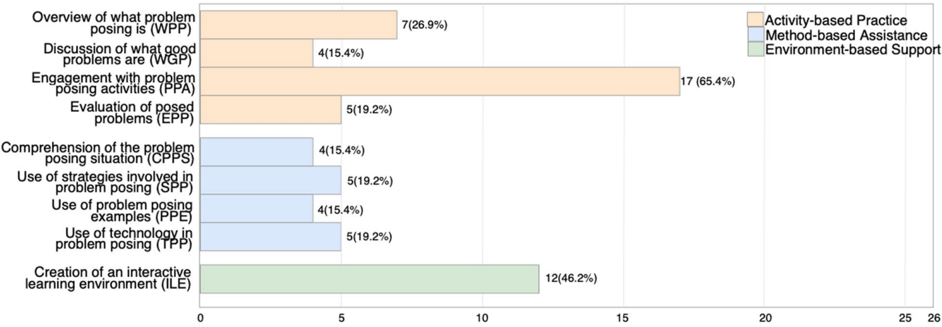
- Nine intervention components were identified under activity-based practice, method-based assistance, and environment-based support; the most common were engagement with problem posing activities (65.4%, n = 17) and creation of an interactive learning environment (46.2%, n = 12).
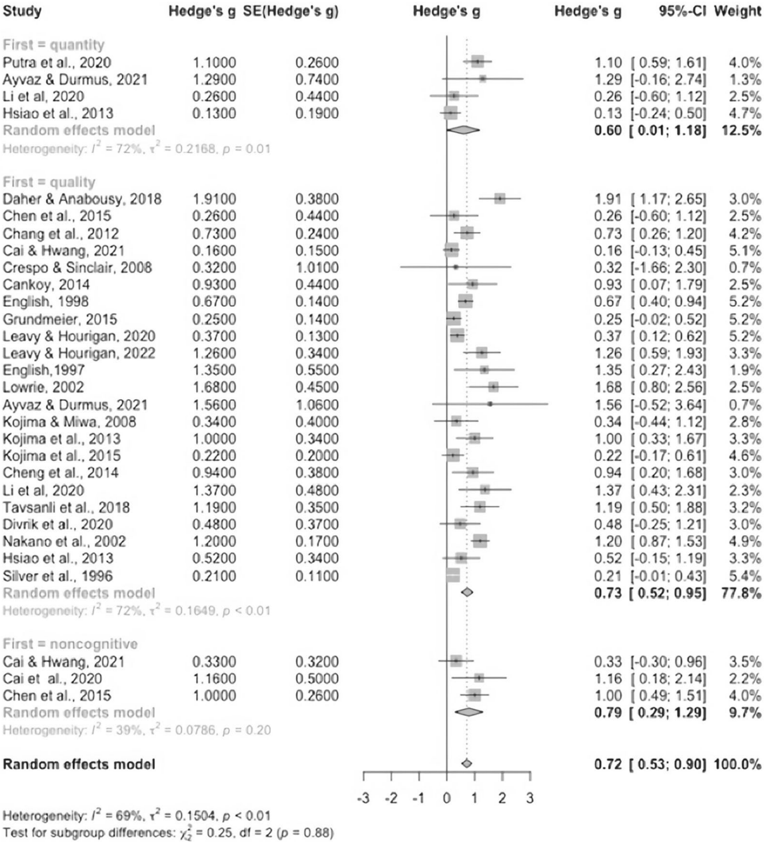
- The overall treatment effect was medium, positive, and significant (g = 0.72, 95% CI [0.53, 0.90], p < 0.001). Cluster effects were 0.73 for quality of posed problems, 0.60 for quantity of posed problems, and 0.79 for noncognitive outcomes, with no significant between-cluster variance (p = 0.88).
- Moderators: K-12 students showed 89% and 96% higher effect sizes than prospective teachers (p < 0.001) and in-service teachers (p < 0.01); small groups (< 25) showed 72% higher effects than large groups (> 50) (p < 0.1); interventions with more than one component showed 63% higher effects than single-component interventions (p < 0.05); one-based support showed 64% and 186% higher effects than two-based (p < 0.05) and mixed-based support (p < 0.01); method-based assistance showed 84% higher effects (p < 0.1) and environment-based support 83% higher effects (p < 0.05). Pre-post design showed 58% higher effects than pre-post-control (p < 0.1). Duration was not a significant moderator.
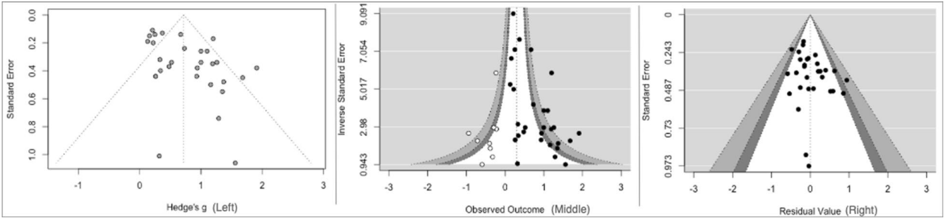
- Publication bias: Egger’s test was significant (p < 0.05); trim-and-fill imputed nine missing negative studies and reduced the point estimate to r = 0.5109 (95% CI [0.304, 0.715]); mixed-effects meta-regression for funnel plot asymmetry was not significant (z = 1.719, p > 0.05), so the authors concluded there was not enough evidence of publication bias.
Methods
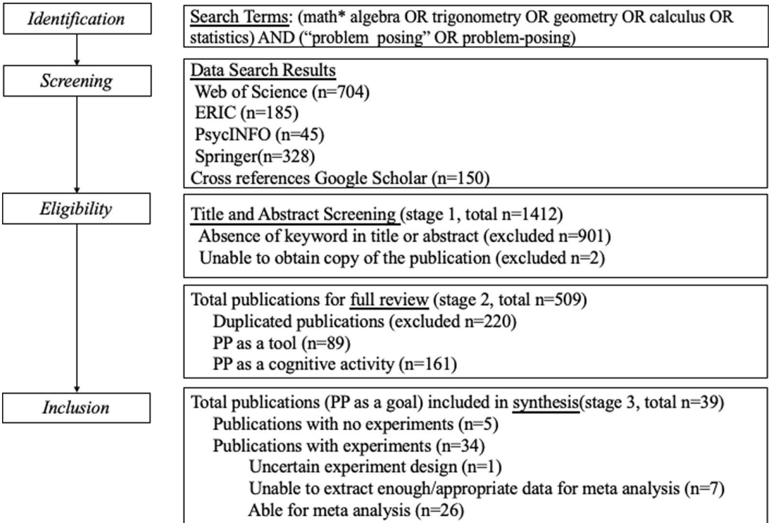
- PRISMA systematic search in July 2021 across Web of Science, ERIC, PsycINFO, and Springer, plus the first 15 pages of Google Scholar; inclusion required peer-reviewed journal articles or book chapters, English, publication between January 1990 and June 2021, problem posing as a goal, and quantitative data sufficient for effect size calculation. From 1,412 records, 509 underwent full review, 39 were retained, and 26 were included in the meta-analysis.
- Two trained research assistants extracted and coded data; inter-rater reliability was Cohen’s kappa = 0.9. Intervention components were categorized using the constant comparative method into activity-based practice, method-based assistance, and environment-based support.
- Random-effects meta-analysis used Hedge’s g; change-score effect sizes were transformed to a raw-score metric. A stepwise meta-regression tested moderators; one outlier (Kalmpourtzis, 2019, g = 3.32) was removed. Publication bias was assessed with Egger’s test, trim-and-fill, and mixed-effects meta-regression.
Limitations
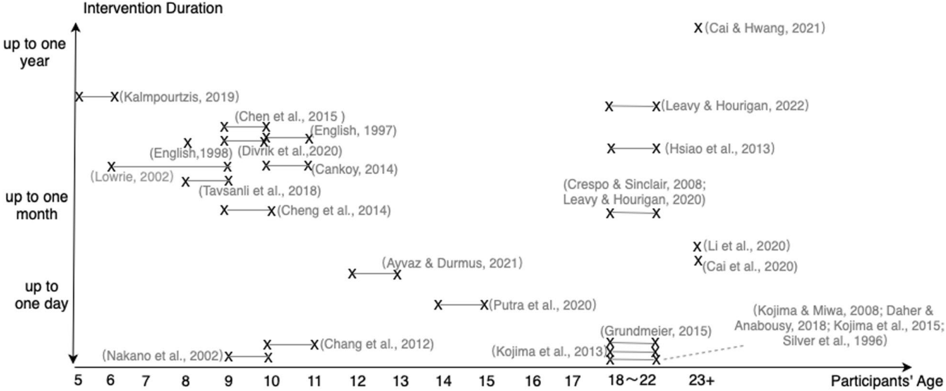
- Paper-stated: the authors could not access several potential studies; they excluded conference publications; publication bias may still have influenced findings despite statistical tests; considerable between-study heterogeneity suggests unaccounted moderators; intervention duration was measured as the time over which an intervention was spread rather than actual treatment time, possibly diluting effects; some moderator findings used p < 0.10 and are less robust.
- Paper-stated: future meta-analyses should explore additional moderators such as dependent measure type (researcher-developed vs. standardized measures) and study quality rating.
- Evident from the text: only 26 studies were included, many moderator categories likely contained few studies; residual heterogeneity remained high (I² = 75.3% with the outlier; 69.2% without it); only English-language peer-reviewed publications were included; and most studies (19/26) were published after 2010.
Model-written summary. Check it against the paper before relying on it.
Integrity signals
Registry
Cites
Statistics
Figures
Verification
Claims the paper makes
2 Valid · 0 Not valid · 34 Not checked · 57 Own results and interpretations
The cited sources support only part of this claim — read each source’s verdict below.
In the paper
“While these reviews occasionally ventured into a few studies examining the effect of engaging in problem posing activities on the development of problem posing, their primary focus remained on demonstrating the merit of problem posing as a tool on a broad-based impact for learning mathematics as opposed to examining problem posing as a goal.”
§ Enhancing mathematical problem posing competence: a meta-analysis of intervention studies > Interventions to enhance mathematical problem posing competence
What the sources say
- Partly supportedcites Rosli et al., 2014 matched to “The Effects of Problem Posing on Student Mathematical Learning: A Meta-Analysis” (2014) sourceExperimental — accuracy not yet measured
Our copy supports the 'as a tool / broad-based impact' half: Section 3 ('The Need for a Meta-Analytic Review') frames the synthesis as concerned with 'problem posing as an effective classroom interventional tool for the teaching and learning of mathematics', and the Discussion/Conclusion report 'broad potential benefits on students' mathematics achievement, problem solving skills, levels of problems posed, and attitudes toward mathematics'. However, the same section states that 'to date, there is only one review of the literature available' (Silver, 1994, summarizing the nature, processes and perspectives of problem posing), so the claim's plural 'prior reviews' overstates what the source says, and no passage in our copy draws the tool-versus-goal distinction or says prior reviews only occasionally ventured into studies on the development of problem posing itself (searched: 'problem posing as a goal', 'development of problem posing ability', 'previous reviews focused on broad impact'). (LLM, conf=0.68)
- Partly supportedcites Kul & Çelik, 2020 matched to “A Meta-Analysis of the Impact of Problem Posing Strategies on Students’ Learning of Mathematics” (2020) sourceExperimental — accuracy not yet measured
The Introduction (p. 1, 'only two meta-analysis studies... directly address and measure the effectiveness of problem-posing'; Cantürk-Günhan, Geçici & Günkaya 2019 'only concentrated on the effectiveness of problem posing method on student academic success') and the Discussion (p. 4) do support the 'broad-based impact on learning mathematics' half of the claim, and the paper elsewhere notes the community sees problem posing 'as a tool' (citing Cai et al., 2015). But our copy never frames prior reviews as 'tool rather than goal'; indeed it records that Rosli, Capraro & Capraro (2014) computed a separate effect size for 'level of problems posed' (0.77, Introduction and Discussion), i.e. problem posing as an outcome itself, so the 'as opposed to examining problem posing as a goal' characterisation is the citing authors' framing rather than this paper's. (LLM, conf=0.70)
- Not checked — no full text of the sourcecites Wang et al., 2022 matched to “A Meta-Analysis on the Effects of Problem-Posing in Mathematics Education on Performance and Dispositions” (2022) source
plain- Asserted: passes — The authors put it forward as true.
- Checkable: passes — It can be checked against evidence.
- Load-bearing: passes — The paper’s conclusions depend on it.
- Based: passes — The paper gives a reason why it holds.
- Partly supported
The cited sources support only part of this claim — read each source’s verdict below.
In the paper
“Each layer of a context, whether at the micro (individual), meso (team or organization), or macro (system) level, can affect the intervention's effectiveness (Moullin et al., 2020).”
§ Enhancing mathematical problem posing competence: a meta-analysis of intervention studies > Conclusions
What the sources say
- Partly supportedcites Moullin et al., 2020 matched to “Ten recommendations for using implementation frameworks in research and practice” (2020) sourceExperimental — accuracy not yet measured
The 'Use a framework(s) at micro level to conduct and tailor implementation' section does state that 'Each layer of a context (e.g., organization, profession, team, individual) requires ongoing individual tailoring of implementation strategies,' and the 'Determine implementation determinants' section notes frameworks include determinants 'found to influence implementation outcomes,' with the 'Select a suitable framework(s)' section adding outer-context layers (policy, government, community norms). So the multi-layer context point is supported, but our copy never uses the micro/meso/macro taxonomy, and what it says context layers affect is implementation strategies, implementation outcomes and 'implementation effectiveness' — not the intervention's (clinical) effectiveness as the citing sentence states. (LLM, conf=0.72)
plainstates a possible cause- Asserted: passes — The authors put it forward as true.
- Checkable: passes — It can be checked against evidence.
- Load-bearing: unclear — It is unclear whether the paper’s conclusions depend on it.
- Based: passes — The paper gives a reason why it holds.
- Partly supported
A result the paper reports from its own data — it cites no other source for it, so there is none to check. The quote shows it is in the paper.
In the paper
“A stepwise meta-regression analysis revealed that intervention efficacy varied by moderators relevant to the research design, sample characteristics, and intervention characteristics.”
§ Enhancing mathematical problem posing competence: a meta-analysis of intervention studies > Abstract
plainstates an association- Asserted: passes — The authors put it forward as true.
- Checkable: passes — It can be checked against evidence.
- Load-bearing: passes — The paper’s conclusions depend on it.
- Based: passes — The paper gives a reason why it holds.
A result the paper reports from its own data — it cites no other source for it, so there is none to check. The quote shows it is in the paper.
In the paper
““overview of what problem posing is” in 26.9% of the reviewed studies (WPP, n = 7)”
§ Enhancing mathematical problem posing competence: a meta-analysis of intervention studies > Intervention components incorporated in studies
plainn = 7- Asserted: passes — The authors put it forward as true.
- Checkable: passes — It can be checked against evidence.
- Load-bearing: unclear — It is unclear whether the paper’s conclusions depend on it.
- Based: passes — The paper gives a reason why it holds.
A result the paper reports from its own data — it cites no other source for it, so there is none to check. The quote shows it is in the paper.
In the paper
““evaluation of posed problems” in 19.2% of the reviewed studies (EPP, n = 5)”
§ Enhancing mathematical problem posing competence: a meta-analysis of intervention studies > Intervention components incorporated in studies
plainn = 5- Asserted: passes — The authors put it forward as true.
- Checkable: passes — It can be checked against evidence.
- Load-bearing: unclear — It is unclear whether the paper’s conclusions depend on it.
- Based: passes — The paper gives a reason why it holds.
40 more claims
Create a free account to see all 93 claims and to verify the 26 references still open.
- It may state two separate claims as one. 26
- Probably not a substantial claim. 25
- The quote only partly states this claim. 1
Claims other papers make about this one
Each is checked against this paper’s own text: does it say what the citing paper says it does?
In the citing paper
“In our recent meta-analysis (Zhang et al., 2024), we summarized various intervention components aimed at fostering mathematical problem-posing competence and we examined overall intervention efficacy as well as the effects of moderators.”
From Approaches to Supporting and Measuring Mathematical Problem Posing: A Systematic Review of Interventions in Mathematics Education (2025) · cites this paper as Zhang et al., 2024
Statistics recomputed
Every reported test result, recomputed from its test statistic and degrees of freedom. A result shows as not adding up only once an independent check has confirmed it.
- ConsistentF(11, 18) = 3.474reported p < .01 · recomputed p = .009
“F(11,18) = 3.474, p < .01”
- ConsistentQ(38) = 150.5reported p < .05 · recomputed p < .001
“Q (38) = 150.5,p < .05”
- Consistentz = 1.719reported p > .05 · recomputed p = .086
“(z = 1.719, p > .05”
Self-check
Percentages, sums and reported differences re-computed from the paper’s own numbers.
Each contradiction between two passages listed here was confirmed by an independent check.
Rated minor: it would not touch a result — a value no result rests on, a p-value that stays on the same side of the significance level, or a conflict that is clerical, resolved elsewhere in the paper, or outside its own findings.
In the paper
§ Enhancing mathematical problem posing competence: a meta-analysis of intervention studies > Description of selected studies
“The studies were conducted in ten different countries/districts (Australia, China, Cyprus, Greece, Indonesia, Ireland, Israel, Japan, Turkey, USA)”
§ Enhancing mathematical problem posing competence: a meta-analysis of intervention studies > Conclusions
“| Cheng et al. (2014) | J. Comput. Educ | Taiwan | -Experimental | 3 weeks | 29 fourth graders | PPA |”
Rated minor: it would not touch a result — a value no result rests on, a p-value that stays on the same side of the significance level, or a conflict that is clerical, resolved elsewhere in the paper, or outside its own findings.
In the paper
§ Enhancing mathematical problem posing competence: a meta-analysis of intervention studies > Risk of publication bias
“we used a symmetric distribution of effect size as indicated by a statistically significant Egger's test”
§ Enhancing mathematical problem posing competence: a meta-analysis of intervention studies > Publication bias
“Results of the Egger's test showed the coefficient for the modified effect standard deviation was significant for the models (p < 0.05), indicating that the effect size distribution was asymmetric”
Rated minor: it would not touch a result — a value no result rests on, a p-value that stays on the same side of the significance level, or a conflict that is clerical, resolved elsewhere in the paper, or outside its own findings.
In the paper
§ Enhancing mathematical problem posing competence: a meta-analysis of intervention studies > Conclusions
“| Chen et al. (2015) | Chapter | China | -Explore the concept | 11 units, 90 min | 69 fourth graders | WPP |”
§ Enhancing mathematical problem posing competence: a meta-analysis of intervention studies > References
“Enhancing the development of Chinese fifth-graders' problem-posing and problem-solving abilities, beliefs, and attitudes: A design experiment.”
Rated minor: it would not touch a result — a value no result rests on, a p-value that stays on the same side of the significance level, or a conflict that is clerical, resolved elsewhere in the paper, or outside its own findings.
In the paper
§ Enhancing mathematical problem posing competence: a meta-analysis of intervention studies > The treatment effect on mathematical problem posing competence
“For the model without outliers that included 31 effect sizes from all 26 studies”
§ Enhancing mathematical problem posing competence: a meta-analysis of intervention studies > The treatment effect on mathematical problem posing competence
“the mean effect across 30 effect sizes from the 25 studies that included no outliers”
Citations
Cites
Statistical Power Analysis for the Behavioral Sciences
Muller, K. (1989) · Technometrics · doi:10.1080/00401706.1989.10488618 · Cited by 99,167
Basics of Qualitative Research: Grounded Theory Procedures and Techniques
Long, D. R., Strauss, A., & Corbin, J. (1993) · The Modern Language Journal · doi:10.2307/328955 · Cited by 17,576
Duval, S., & Tweedie, R. (2000) · Biometrics · doi:10.1111/j.0006-341x.2000.00455.x · Cited by 14,099 · cited 1×
“We excluded the outlier (the study by Kalmpourtzis, 2019) because its unusually huge effect size of g = 3.32 would likely bias the overall ES (Lipsey & Wilson, 2001 and not enough evidence showed that plot asymmetry was caused by publication bias (Duval & Tweedie, 2000) (funnel plot is shown in Fig.”
BackgroundInfluentialPage, M. J., Moher, D., Bossuyt, P. M., Boutron, I., Hoffmann, T. C., Mulrow, C. D., Shamseer, L., Tetzlaff, J. M., Akl, E. A., Brennan, S. E., et al. (2021) · BMJ · doi:10.1136/bmj.n160 · Cited by 13,262 · cited 1×
“We followed standardized guidelines for systematic reviews by Preferred Reporting Items for Systematic Reviews and Meta-analysis (PRISMA) (Page et al., 2021).”
MethodToward an experimental ecology of human development.
Bronfenbrenner, U. (1977) · American Psychologist · doi:10.1037/0003-066x.32.7.513 · Cited by 10,853 · cited 1×
“…mathematical problem posing competence, including the mechanisms underlying the more or less effective interventions and moderators’ influence on intervention efficacy, help deepen theoretical understanding of this competence and how to promote it (Bronfendrenner, 1977; Snyder et al., 2019).”
BackgroundLakens, D. (2013) · Frontiers in Psychology · doi:10.3389/fpsyg.2013.00863 · Cited by 10,303 · cited 1×
“As Lakens (2013) explained, the increased statistical power and sensitivity in within-participants designs allow for the detection of smaller, yet significant, treatment effects that might be missed in between-participants designs.”
Background(2000) · Cited by 9,198
Cohen, J. (1992) · Current Directions in Psychological Science · doi:10.1111/1467-8721.ep10768783 · Cited by 5,870
How to perform a meta-analysis with R: a practical tutorial
Balduzzi, S., Rücker, G., & Schwarzer, G. (2019) · Evidence Based Mental Health · doi:10.1136/ebmental-2019-300117 · Cited by 5,827
The Handbook of Research Synthesis and Meta-Analysis
(2019) · doi:10.7758/9781610448864 · Cited by 4,553
Outlier and influence diagnostics for meta-analysis
Viechtbauer, W., & Cheung, M. W.-L. (2010) · Research Synthesis Methods · doi:10.1002/jrsm.11 · Cited by 2,949
Morris, S. B., & DeShon, R. P. (2002) · Psychological Methods · doi:10.1037/1082-989x.7.1.105 · Cited by 2,502
Knowledge translation of research findings
Grimshaw, J. M., Eccles, M. P., Lavis, J. N., Hill, S. J., & Squires, J. E. (2012) · Implementation Science · doi:10.1186/1748-5908-7-50 · Cited by 2,407
Peters, J. L., Sutton, A. J., Jones, D. R., Abrams, K. R., & Rushton, L. (2008) · Journal of Clinical Epidemiology · doi:10.1016/j.jclinepi.2007.11.010 · Cited by 2,053 · cited 1×
“Given that any factor which is associated with both study effect and study size could confound the true association and cause as asymmetric funnel (Peters et al., 2008), we applied the trim and fill analysis of the random effects model imputed nine missing negative studies and reduced the point…”
MethodBernard, R. M., Abrami, P. C., Lou, Y., Borokhovski, E., Wade, A., Wozney, L., Wallet, P. A., Fiset, M., & Huang, B. (2004) · Review of Educational Research · doi:10.3102/00346543074003379 · Cited by 1,761
Beyond Dichotomies: Competence Viewed as a Continuum
Blömeke, S., Gustafsson, J.-E., & Shavelson, R. J. (2015) · Zeitschrift für Psychologie · doi:10.1027/2151-2604/a000194 · Cited by 1,205
Einstein, A., & Infeld, L. (1938) · University Press eBooks · Cited by 1,152
Estimation of effect size from a series of independent experiments.
Hedges, L. V. (1982) · Psychological Bulletin · doi:10.1037//0033-2909.92.2.490 · Cited by 1,062
Cognitive Science and Mathematics Education
Schoenfeld, A. H. (2013) · Routledge eBooks · doi:10.4324/9780203062685 · Cited by 993
Publication bias: evidence of delayed publication in a cohort study of clinical research projects
Stern, J. M., & Simes, R. J. (1997) · BMJ · doi:10.1136/bmj.315.7109.640 · Cited by 818 · cited 1×
“Also, studies with significant outcomes tend to get published more than those with nonsignificant outcomes (Stern & Simes, 1997).”
BackgroundDesigning Experiments and Analyzing Data: A Model Comparison Perspective.
Serlin, R. C., Maxwell, S. E., & Delaney, H. D. (1991) · Journal of the American Statistical Association · doi:10.2307/2289744 · Cited by 812
Torgesen, J. K. (2000) · Learning Disabilities Research and Practice · doi:10.1207/sldrp1501_6 · Cited by 785
Depaepe, F., Verschaffel, L., & Kelchtermans, G. (2013) · Teaching and Teacher Education · doi:10.1016/j.tate.2013.03.001 · Cited by 624
Ten recommendations for using implementation frameworks in research and practice
Moullin, J. C., Dickson, K. S., Stadnick, N. A., Albers, B., Nilsen, P., Broder-Fingert, S., Mukasa, B., & Aarons, G. A. (2020) · Implementation Science Communications · doi:10.1186/s43058-020-00023-7 · Cited by 488 · cited 1×
“Each layer of a context, whether at the micro (individual), meso (team or organization), or macro (system) level, can affect the intervention’s effectiveness (Moullin et al., 2020).”
BackgroundA guiding framework and approach for implementation research in substance use disorders treatment.
Damschroder, L. J., & Hagedorn, H. J. (2011) · Psychology of Addictive Behaviors · doi:10.1037/a0022284 · Cited by 427 · cited 1×
“Such information is necessary to direct the design and implementation of effective interventions (Damschroder & Hagedorn, 2011; Sheridan et al., 2019).”
Background(2012) · TigerPrints (Clemson University) · Cited by 402
Liu, Y., & Pásztor, A. (2022) · Thinking Skills and Creativity · doi:10.1016/j.tsc.2022.101069 · Cited by 400 · cited 1×
“…mathematical dispositions compared to shorter-duration interventions, but several other studies found that delivering medium-duration interventions was the primary source of heterogeneity and influenced the most the effect size of learning achievement (Liu & Pásztor, 2022; Zheng et al., 2020).”
ResultA meta-analysis of the impact of technology on learning effectiveness of elementary students
Chauhan, S. (2017) · Computers & Education · doi:10.1016/j.compedu.2016.11.005 · Cited by 395
An Analysis of Arithmetic Problem Posing by Middle School Students
Silver, E. A., & Cai, J. (1996) · Journal for Research in Mathematics Education · doi:10.2307/749846 · Cited by 379
The psychology of invention in the mathematical field.
Johnson, D. M. (1945) · Psychological Bulletin · doi:10.1037/h0052525 · Cited by 377
Designing Experiments and Analyzing Data: A Model Comparison Perspective
Maxwell, S. E., & Delaney, H. D. (2003) · Routledge eBooks · doi:10.4324/9781410609243 · Cited by 374
Methodological Issues in Combining Diverse Study Types in Systematic Reviews
Harden, A., & Thomas, J. (2005) · International Journal of Social Research Methodology · doi:10.1080/13645570500155078 · Cited by 371 · cited 2×
“Particularly, in terms of the data coding of the “inter-vention components” for RQ1, we considered the question “how participants experienced problem posing?” according to the guidance for systematic reviews proposed by Harden and Thomas (2005).”
MethodSquires, J. E., Sullivan, K., Eccles, M. P., Worswick, J., & Grimshaw, J. M. (2014) · Implementation Science · doi:10.1186/s13012-014-0152-6 · Cited by 368
Tipton, E., & Pustejovsky, J. E. (2015) · Journal of Educational and Behavioral Statistics · doi:10.3102/1076998615606099 · Cited by 362 · cited 1×
“We used small-sample adjusted t -test to determine if there was a relationship between moderators and effect sizes in the population as well as adjusted F -test to assess model fit (Tipton & Pustejovsky, 2015).”
MethodLo, C. K., Hew, K. F., & Chen, G. (2017) · Educational Research Review · doi:10.1016/j.edurev.2017.08.002 · Cited by 335
Cai, J., & Hwang, S. (2002) · The Journal of Mathematical Behavior · doi:10.1016/s0732-3123(02)00142-6 · Cited by 320
Problem-Posing Research in Mathematics Education: Some Answered and Unanswered Questions
Cai, J., Hwang, S., Jiang, C., & Silber, S. (2015) · Springer eBooks · doi:10.1007/978-1-4614-6258-3_1 · Cited by 315
Children's Problem Posing within Formal and Informal Contexts
English, L. D. (1998) · Journal for Research in Mathematics Education · doi:10.2307/749719 · Cited by 304
Designing Experiments and Analyzing Data: Model Comparison Perspective
Maxwell, S. E., Delaney, H. D., & Kelley, K. (2018) · Thammasat University Digital Collections · Cited by 298
Sheridan, S. M., Smith, T. E., Moorman Kim, E., Beretvas, S. N., & Park, S. (2019) · Review of Educational Research · doi:10.3102/0034654318825437 · Cited by 296
Garzón, J., Kinshuk, Baldiris, S., Gutiérrez, J., & Pavón, J. (2020) · Educational Research Review · doi:10.1016/j.edurev.2020.100334 · Cited by 291
Publication bias: what is it? How do we measure it? How do we avoid it?
Song, F., Hooper, & Loke, Y. (2013) · Open Access Journal of Clinical Trials · doi:10.2147/oajct.s34419 · Cited by 275
Learning to pose mathematical problems: Exploring changes in preservice teachers' practices
Crespo, S. (2003) · Educational Studies in Mathematics · doi:10.1023/a:1024364304664 · Cited by 269
Embedding game-based problem-solving phase into problem-posing system for mathematics learning
Chang, K.-E., Wu, L.-J., Weng, S.-E., & Sung, Y.-T. (2012) · Computers & Education · doi:10.1016/j.compedu.2011.10.002 · Cited by 253
Do instructional interventions influence college students’ critical thinking skills? A meta-analysis
Niu, L., Behar-Horenstein, L. S., & Garvan, C. W. (2013) · Educational Research Review · doi:10.1016/j.edurev.2012.12.002 · Cited by 244 · cited 4×
“The significance level was set at 0.10, consistent with Niu et al. (2013).”
BackgroundMethodResultInfluentialCrespo, S., & Sinclair, N. (2008) · Journal of Mathematics Teacher Education · doi:10.1007/s10857-008-9081-0 · Cited by 225
Cai, J., & Hwang, S. (2020) · International Journal of Educational Research · doi:10.1016/j.ijer.2019.01.001 · Cited by 215
The Development of Fifth-Grade Children's Problem-Posing Abilities
English, L. D. (1997) · Educational Studies in Mathematics · doi:10.1023/a:1002963618035 · Cited by 178
Borde, R., Smith, J. J., Sutherland, R., Nathan, N., & Lubans, D. R. (2017) · Obesity Reviews · doi:10.1111/obr.12517 · Cited by 177
Language Factors in Mathematics Teaching and Learning
Ellerton, N. F., & Clarkson, P. C. (1996) · Springer eBooks · doi:10.1007/978-94-009-1465-0_30 · Cited by 175
Empirical research on problem solving and problem posing: a look at the state of the art
Liljedahl, P., & Cai, J. (2021) · ZDM – Mathematics Education · doi:10.1007/s11858-021-01291-w · Cited by 171
Cognitive and Mathematical Profiles for Different Forms of Learning Difficulties
Cirino, P. T., Fuchs, L. S., Elias, J. T., Powell, S. R., & Schumacher, R. F. (2015) · Journal of Learning Disabilities · doi:10.1177/0022219413494239 · Cited by 170
Biçer, A. (2021) · International Journal of Education in Mathematics Science and Technology · doi:10.46328/ijemst.1254 · Cited by 157
Hanna, G., & Jahnke, H. N. (1996) · Springer eBooks · doi:10.1007/978-94-009-1465-0_27 · Cited by 136
The state of educational intervention research as viewed through the lens of literacy intervention
Pressley, M., Graham, S., & Harris, K. (2006) · British Journal of Educational Psychology · doi:10.1348/000709905x66035 · Cited by 123
Cai, J., & Leikin, R. (2020) · Educational Studies in Mathematics · doi:10.1007/s10649-020-10008-x · Cited by 122
Danusso, L., Testa, I., & Vicentini, M. (2009) · International Journal of Science Education · doi:10.1080/09500690902833221 · Cited by 121
On the Relationship Between Problem Posing, Problem Solving, and Creativity in the Primary School
Bonotto, C., & Santo, L. D. (2015) · Springer eBooks · doi:10.1007/978-1-4614-6258-3_5 · Cited by 115
What Research Says About Teaching Mathematics Through Problem Posing
Cai, J. (2022) · Éducation et didactique · doi:10.4000/educationdidactique.10642 · Cited by 114
Ellerton, N. F. (2013) · Educational Studies in Mathematics · doi:10.1007/s10649-012-9449-z · Cited by 107
Proof and proving in school and university mathematics education research: a systematic review
Stylianides, G. J., Stylianides, A. J., & Μούτσιος-Ρέντζος, Α. (2023) · ZDM · doi:10.1007/s11858-023-01518-y · Cited by 107
Self-citationThe Effects of Problem Posing on Student Mathematical Learning: A Meta-Analysis
Rosli, R., Capraro, M. M., & Capraro, R. M. (2014) · International Education Studies · doi:10.5539/ies.v7n13p227 · Cited by 106
Cai, J., Chen, T., Li, X., Xu, R., Zhang, S., Hu, Y., Zhang, L., & Song, N. (2020) · International Journal of Educational Research · doi:10.1016/j.ijer.2019.02.004 · Cited by 106
Self-citationAssessing Students' Mathematical Problem Posing
Silver, E. A., & Cai, J. (2005) · Teaching Children Mathematics · doi:10.5951/tcm.12.3.0129 · Cited by 104
Stylianides, A. J., & Stylianides, G. J. (2013) · ZDM · doi:10.1007/s11858-013-0501-y · Cited by 102
Self-citationBicer, A., Lee, Y., Perihan, C., Capraro, M. M., & Capraro, R. M. (2020) · Educational Studies in Mathematics · doi:10.1007/s10649-020-09995-8 · Cited by 96
On understanding mathematical problem-posing processes
Cai, J., & Rott, B. (2023) · ZDM · doi:10.1007/s11858-023-01536-w · Cited by 88
Li, X., Song, N., Hwang, S., & Cai, J. (2020) · Educational Studies in Mathematics · doi:10.1007/s10649-020-09981-0 · Cited by 87
Leavy, A., & Hourigan, M. (2020) · Journal of Mathematics Teacher Education · doi:10.1007/s10857-018-09425-w · Cited by 73
An Analysis of Arithmetic Problem Posing by Middle School Students
Silver, E. A., & Cai, J. (1996) · Journal for Research in Mathematics Education · doi:10.5951/jresematheduc.27.5.0521 · Cited by 72
Mathematics Interventions for Upper Elementary and Secondary Students: A Meta-Analysis of Research
Stevens, E. A., Rodgers, M. A., & Powell, S. R. (2018) · Remedial and Special Education · doi:10.1177/0741932517731887 · Cited by 71
Interventions for academically underachieving students: A systematic review and meta-analysis
Snyder, K. E., Fong, C. J., Painter, J. K., Pittard, C. M., Barr, S. M., & Patall, E. A. (2019) · Educational Research Review · doi:10.1016/j.edurev.2019.100294 · Cited by 70
Technology in Mathematics Education: A Catalyst for Diversity Leadership
Eley, P. M. (2015) · IGI Global eBooks · doi:10.4018/978-1-4666-7363-2.ch017 · Cited by 70
Cai, J., & Hwang, S. (2021) · ZDM – Mathematics Education · doi:10.1007/s11858-021-01252-3 · Cited by 68
Determinants of inappropriate empirical antibiotic treatment: systematic review and meta-analysis
Carrara, E., Pfeffer, I., Zusman, O., Leibovici, L., & Paul, M. (2017) · International Journal of Antimicrobial Agents · doi:10.1016/j.ijantimicag.2017.12.013 · Cited by 67
Intensive Intervention in Mathematics
Powell, S. R., & Fuchs, L. S. (2015) · Learning Disabilities Research and Practice · doi:10.1111/ldrp.12087 · Cited by 66
Van Harpen, X. Y., & Presmeg, N. C. (2013) · Educational Studies in Mathematics · doi:10.1007/s10649-012-9456-0 · Cited by 65
Divrik, R., Pilten, P., & Taş, A. M. (2021) · lnternational Electronic Journal of Elementary Education · doi:10.26822/iejee.2021.191 · Cited by 61
Myers, J. A., Witzel, B. S., Powell, S. R., Li, H., Pigott, T. D., Xin, Y. P., & Hughes, E. M. (2022) · Review of Educational Research · doi:10.3102/00346543211070049 · Cited by 60
The effects of problem-posing intervention types on elementary students’ problem-solving
Kopparla, M., Bicer, A., Vela, K., Lee, Y., Bevan, D., Kwon, H., Caldwell, C., Capraro, M. M., & Capraro, R. M. (2019) · Educational Studies · doi:10.1080/03055698.2018.1509785 · Cited by 57
Realistic Mathematical Modeling and Problem Posing
Bonotto, C. (2009) · Springer eBooks · doi:10.1007/978-1-4419-0561-1_34 · Cited by 55
Problem posing via “what if not?” strategy in solid geometry — a case study
Lavy, I., & Bershadsky, I. (2003) · The Journal of Mathematical Behavior · doi:10.1016/j.jmathb.2003.09.007 · Cited by 55
Multiple moderator meta-analysis using the R-package Meta-CART
Li, X., Dusseldorp, E., Su, X., & Meulman, J. J. (2020) · Behavior Research Methods · doi:10.3758/s13428-020-01360-0 · Cited by 55
Zhang, L., Cai, J., Song, N., Zhang, H., Chen, T., Zhang, Z., & Guo, F. (2022) · ZDM – Mathematics Education · doi:10.1007/s11858-021-01324-4 · Cited by 55
Self-citationWang, M., Walkington, C., & Rouse, A. (2022) · Investigations in Mathematics Learning · doi:10.1080/19477503.2022.2105104 · Cited by 55
Affective field during collaborative problem posing and problem solving: a case study
Schindler, M., & Bakker, A. (2020) · Educational Studies in Mathematics · doi:10.1007/s10649-020-09973-0 · Cited by 53
Leavy, A., & Hourigan, M. (2021) · Journal of Mathematics Teacher Education · doi:10.1007/s10857-021-09490-8 · Cited by 50
Powell, S. R., Fuchs, L. S., Fuchs, D., Cirino, P. T., & Fletcher, J. M. (2009) · Journal of Learning Disabilities · doi:10.1177/0022219408326211 · Cited by 46
AYVAZ, Ü., & Durmuş, S. (2021) · Thinking Skills and Creativity · doi:10.1016/j.tsc.2021.100846 · Cited by 45
Lowrie, T. (2002) · Mathematics Education Research Journal · doi:10.1007/bf03217355 · Cited by 42
Conceptualizing Problem Posing via Transformation
Milinković, Ј. (2015) · Springer eBooks · doi:10.1007/978-1-4614-6258-3_3 · Cited by 35
The Use of Webquest to Enhance The Mathematical Problem-Posing Skills of Pre-Service Teachers.
Elwan, R. A. (2007) · International Journal for Technology in Mathematics Education · Cited by 33
INTERLOCKED PROBLEM POSING AND CHILDREN’S PROBLEM POSING PERFORMANCE IN FREE STRUCTURED SITUATIONS
Cankoy, O. (2014) · International Journal of Science and Mathematics Education · doi:10.1007/s10763-013-9433-9 · Cited by 33
Chen, L., Van Dooren, W., & Verschaffel, L. (2015) · Mathematical Problem Posing · doi:10.1007/978-1-4614-6258-3_15 · Cited by 32
Problem-posing triggers or where do mathematics competition problems come from?
Kontorovich, I. (2020) · Educational Studies in Mathematics · doi:10.1007/s10649-020-09964-1 · Cited by 32
A Meta-Analysis of the Impact of Problem Posing Strategies on Students’ Learning of Mathematics
KUL, Ü., & ÇELİK, S. (2020) · Revista Romaneasca pentru Educatie Multidimensionala · doi:10.18662/rrem/12.3/325 · Cited by 31
What Do High School Teachers Mean by Saying “I Pose My Own Problems”?
Klinshtern, M., Koichu, B., & Berman, A. (2015) · Springer eBooks · doi:10.1007/978-1-4614-6258-3_22 · Cited by 29
IKIP Siliwangi, C., Putra, H. D., Herman, T., Universitas Pendidikan Indonesia, B., Sumarmo, U., & Universitas Pendidikan Indonesia, B. (2020) · International Journal of Instruction · doi:10.29333/iji.2020.13143a · Cited by 28
Holmlund, H., & Silva, O. (2014) · Journal of Human Capital · doi:10.1086/676460 · Cited by 26
Posing Mathematical Problems: An Exploratory Study
Silver, E. A., Mamona-Downs, J., Leung, S. S., & Kenney, P. A. (1996) · Journal for Research in Mathematics Education · doi:10.5951/jresematheduc.27.3.0293 · Cited by 25
Connecting game design with problem posing skills in early childhood
Kalmpourtzis, G. (2019) · British Journal of Educational Technology · doi:10.1111/bjet.12607 · Cited by 25
Deficiencies of Reporting in Meta-Analyses and Some Remedies
Harwell, M., & Maeda, Y. (2008) · The Journal of Experimental Education · doi:10.3200/jexe.76.4.403-430 · Cited by 24
Integrating worked examples into problem posing in a web-based learning environment
Hsiao, J. Y., Hung, C.-L., Lan, Y.-F., & Jeng, Y. C. (2013) · The Turkish Online Journal of Educational Technology · Cited by 24
Experimental study of learning support through examples in mathematical problem posing
Kojima, K., Miwa, K., & Matsui, T. (2015) · Research and Practice in Technology Enhanced Learning · doi:10.1007/s41039-015-0001-5 · Cited by 23
Developing the Problem-Posing Abilities of Prospective Elementary and Middle School Teachers
Grundmeier, T. A. (2015) · Mathematical Problem Posing · doi:10.1007/978-1-4614-6258-3_20 · Cited by 22
TAVŞANLI, Ö. F., Ülger, T. K., & Kaldırım, A. (2018) · Pegem Journal of Education and Instruction · doi:10.14527/pegegog.2018.016 · Cited by 16
Toh, T. L., Santos‐Trigo, M., Chua, P. H., Abdullah, N. A., & Zhang, D. (2023) · Springer eBooks · doi:10.1007/978-981-99-7205-0 · Cited by 16
Investigating the Impact of Field Trips on Teachers’ Mathematical Problem Posing
Courtney, S. A., Caniglia, J. C., & Singh, R. (2013) · Journal of Experiential Education · doi:10.1177/1053825913498369 · Cited by 14
Using Digital Technology for Mathematical Problem Posing
Abramovich, S., & Cho, E. K. (2015) · Mathematical Problem Posing · doi:10.1007/978-1-4614-6258-3_4 · Cited by 13
(2018) · Journal of Mathematics Education · doi:10.26711/007577152790026 · Cited by 13
Xia, X., Lü, C., Wang, B., & Song, Y. (2007) · Frontiers of Education in China · doi:10.1007/s11516-007-0030-y · Cited by 11
Frank, J. L. (2020) · Policy Insights from the Behavioral and Brain Sciences · doi:10.1177/2372732219898703 · Cited by 10
Öçal, M. F., Kar, T., Güler, G., & İpek, A. S. (2020) · Journal of Research in Mathematics Education · doi:10.17583/redimat.2020.3879 · Cited by 9
PROBLEM POSING BY NOVICE AND EXPERTS: COMPARISON BETWEEN S TUDENTS AND TEACHERS
Voica, C., & Pelczer, I. (2010) · Cited by 8
Identifying competent problem posers and exploring their characteristics
Zhang, L., Stylianides, A. J., & Stylianides, G. J. (2023) · The Journal of Mathematical Behavior · doi:10.1016/j.jmathb.2023.101086 · Cited by 8
Self-citationSilver, E. A. (2023) · Springer eBooks · doi:10.1007/978-981-99-7205-0_14 · Cited by 8
An Evaluation of Intelligent Learning Environment for Problem Posing
Nakano, A., Hirashima, T., & Takeuchi, A. (2002) · Lecture Notes in Computer Science · doi:10.1007/3-540-47987-2_86 · Cited by 7
Early Care and Education Quality Improvement: A Typology of Intervention ApproachesPreprint
Boller, K., Tarrant, K., & Schaack, D. D. (2014) · RePEc: Research Papers in Economics · Cited by 7
Computer-supported problem posing by annotated expressions: content-first design and evaluation
Cheng, H. N. H., Weng, Y.-L., & Chan, T.-W. (2014) · Journal of Computers in Education · doi:10.1007/s40692-014-0019-5 · Cited by 6
A System that Facilitates Diverse Thinking in Problem Posing
Kojima, K., & Miwa, K. (2008) · International Journal of Artificial Intelligence in Education · doi:10.3233/irg-2008-18(3)03 · Cited by 5
Kojima, K., Miwa, K., & Matsui, T. (2013) · International Journal of Artificial Intelligence in Education · doi:10.3233/jai-130035 · Cited by 5
Flexibility of Pre-services Teachers in Problem Posing in Different Environments
Daher, W., & Anabousy, A. (2018) · ICME-13 Monographs · doi:10.1007/978-3-319-73156-8_9 · Cited by 5
Otun, W. I., & Njoku, O. G. (2020) · Journal of Educational Research in Developing Areas · doi:10.47434/jereda/1.2.2020.140 · Cited by 5
Problem Posing Among Preservice and Inservice Mathematics Teachers
Joaquin, M. N. B. (2023) · Springer eBooks · doi:10.1007/978-981-99-7205-0_10 · Cited by 5
Encouraging students’ problem posing through importing visual images into mathematical software
Aydin, H., & Monaghan, J. (2018) · Teaching Mathematics and its Applications: An International Journal of the IMA · doi:10.1093/teamat/hrx005 · Cited by 4
Problematizing the notion of problem posing expertise
Zhang, L., Stylianides, A. J., & Stylianides, G. J. (2022) · HAL · Cited by 3
Self-citationDahlan, T., Darhim, D., Juandi, D., Gardenia, N., & Kandaga, T. (2021) · Kalamatika: Jurnal Pendidikan Matematika · doi:10.22236/kalamatika.vol6no2.2021pp171-180 · Cited by 2
Contreras, J. (2015) · THE MATHEMATICS EDUCATOR · doi:10.63301/tme.v17i2.1914 · Cited by 1
(1994) · for the learning of mathematics
Research works printed but not linked: 9
- Bevan, D., Williams, A. M., & Capraro, M. M. (2019). Strike a pose: The impact of problem-posing on elementary students' mathematical attitudes and achievement. In N. Jarmila & M. Hana (Eds.), International symposium elementary mathematics teaching (pp. 80-88). Prague.
- Brown, S. I., & Walter, M. I. (1993). Problem posing in mathematics education.
- Chinese Ministry of Education. (2022). Quanrizhi yiwu jiaoyu shuxue kecheng biaozhun [Mathematics Curriculum Standard of compulsory education (2022 version)]. People’s Education Press.
- Hawkins, D. (2000). The roots of literacy. University Press of Colorado.
- Ministry of Education of Italy. (2007). Indicazioni per il curriculo. Ministero della Pubblica Istruzione.
- National Council of Teachers of Mathematics (NCTM). (2000). Principles and standards for school mathematics. Author.
- Priest, D. J. (2009). A problem-posing intervention in the development of prob- lem-solving competence of underachieving, middle-year students (Ph.D. thesis , Queensland University of Technology). https:// eprin ts. qut. edu. au/ 31740/
- Stoyanova, E., & Ellerton, N. F. (1996). A framework for research into students' problem posing in school mathematics. In P. Clarkson (Ed.), Technol- ogy in Mathematics Education (pp. 518-525). Mathematics Education Research Group of Australasia.
- Zheng, L., Bhagat, K. K., Zhen, Y., & Zhang, X. (2020). The effectiveness of the flipped classroom on students' learning achievement and learning motivation. Journal of Educational Technology & Society, 23(1), 1-15.
Cited by
Rahmah, S., & Lubis, A. H. (2024) · Journal of Indonesian Primary School. · doi:10.62945/jips.v1i4.409 · Cited by 302
What Research Says About Teaching Mathematics Through Problem Posing
Cai, J. (2022) · Éducation et didactique · doi:10.4000/educationdidactique.10642 · Cited by 114
Bognar, B., Horvat, S. M., & Matić, L. J. (2025) · Education Sciences · doi:10.3390/educsci15010076 · Cited by 74
Chaiarwut, S., Srikoon, S., Siritaratiwat, A., & Kwangmuang, P. (2025) · Social Sciences & Humanities Open · doi:10.1016/j.ssaho.2025.101338 · Cited by 35
Zhang, L., Stylianides, A. J., & Stylianides, G. J. (2025) · International Journal of Science and Mathematics Education · doi:10.1007/s10763-025-10542-1 · Cited by 17
Self-citation
Metadata
- Authors
- Zhang, L., Stylianides, G. J., & Stylianides, A. J.
- Affiliations
- Southwest University (CN)
- University of Oxford (GB)
- University of Cambridge (GB)
- Corresponding author
- Zhang, Ling
- Venue
- International Journal of STEM Education
- Published
- 2024-09-28
- Volume
- 11
- Issue
- 1
- ISSN
- 2196-7822 (ISSN-L)
- OpenAlex
- W4402943496
- Semantic Scholar
- af4ca2c4d6b240c3f0e43525b6162e48eb4b2908
- Cited by
- 51
- References
- 125
- Citations by year
- 2026: 31 · 2025: 19 · 2024: 1
- FWCI
- 2.35
- Type
- journal article
- Language
- en
- Open access
- gold
- doi.org
- Licence
- cc-by-nc-nd
- creativecommons.org/licenses/by-nc-nd/4.0 (tdm)
- creativecommons.org/licenses/by-nc-nd/4.0 (vor)
- Locations
- International Journal of STEM Education (publishedVersion, cc-by-nc-nd)
- Oxford University Research Archive (ORA) (University of Oxford) (submittedVersion, other-oa)
- Apollo (University of Cambridge) (submittedVersion, cc-by)
- Apollo (University of Cambridge) (submittedVersion, cc-by-nc-nd)
- DOAJ (DOAJ: Directory of Open Access Journals) (submittedVersion)
- Apollo (cc-by)
- Funders
- Chongqing Postdoctoral Fellowship (2020379)
- Topics
- Social Sciences › Education › Mathematics Education and Pedagogy
- Social Sciences › Education › Mathematics Education and Teaching Techniques
- Social Sciences › Education › Mathematics Education and Programs
- Keywords
- mathematical problem posing, mathematics education intervention, intervention components, intervention effectiveness
About these checks
Registry, retraction, Cites and statistics results are computed, not judged, with one exception: a printed reference that no index lists is read once by a model before it counts as a citation error. Claims are extracted by a model and kept only when their quote appears verbatim in the text; each cited source is then checked, with a model’s help, for whether it says what the claim relies on. Those verdicts can be wrong — read the claim’s quote and the cited source before relying on one.
The claim verdicts this report counts are experimental: their accuracy is not yet measured.
A language model drew the claims from the paper on 2026-11-15, under version 3 of the claim definition (model deepseek-v4.1-flash, prompt extract-v3).
A second model labelled each claim on 2026-11-15 (model jev-1.13-20260917, definition revision gold-guideline-v0.2).
Cited sources are checked with a language model’s help (qwen3.8-omni-flash).
Statistics and arithmetic are recomputed, not judged.
Confidence bands are shown only for fields calibrated on our annotated test set. None is calibrated yet, so no band is shown.
What counts as a claim ›How we measure confidence ›How we check this ›
Are you an author, or do you see a problem with this page? Request a review
Data sources
Bibliographic data: Semantic Scholar, OpenAlex, Crossref.
Contains information from the Semantic Scholar Academic Graph Datasets, made available under the ODC Attribution License (ODC-BY 1.0).
Semantic Scholar’s data is described in: Kinney, R., et al. (2023). The Semantic Scholar Open Data Platform. arXiv:2301.10140.
