

Factors influencing consumers’ purchase intention of green sportswear
Open accessThe DOI matches its Crossref record; 54 of the 57 references it cites were found in a registry or an index, and 1 are not checked yet.
Abstract
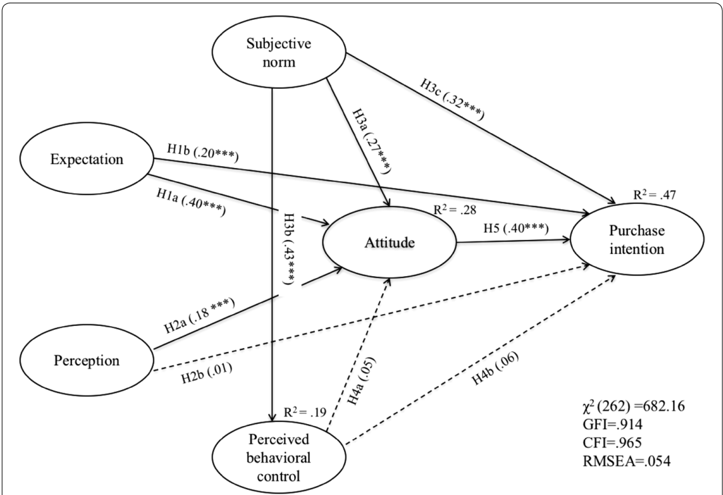
The purpose of this study was to examine consumers’ purchase intention for green sportswear by investigating the effects of their expectation, perception, subjective norm, perceived behavior control, and attitude on purchasing green sportswear. The study further investigated differential influences towards purchase intention for green sportswear between non-green and green product users. A within-subjects research design was used to empirically test our conceptual model, which was expanded from the theory of planned behavior by adding two additional predictors (expectation and perception). An online survey was conducted with a nationwide convenience sample of U.S. consumers whose ages ranged from 18 to 74 years, and a total of 542 usable responses were obtained. The results of the overall model testing confirmed the significant effects of expectation, perception, subjective norm, and attitude on consumers’ purchase intention for green sportswear. The findings from the comparative model testing indicated significant differences between non-green and green product users in terms of the effects of expectation and perceived behavior control on participants’ green sportswear purchase intention. The outcomes of this study offer useful insights for developing effective strategies for consumers to generate more positive perception, expectation, and attitude towards purchasing green sportswear. This study also suggests potential ways for apparel retailers to develop effective marketing strategies for this sportswear segment to satisfy the values of potential customers.
Overview
The claims and statistics of this paper haven’t been checked yet.
Free: it reads the open-access text and checks the first 5 claims that cite a source we can check. Create a free account to check every claim.
Integrity signals
Registry
Cites
Statistics
Figures
Verification
Claims the paper makes
The claims and statistics of this paper haven’t been checked yet.
Free: it reads the open-access text and checks the first 5 claims that cite a source we can check. Create a free account to check every claim.
Claims other papers make about this one
Each is checked against this paper’s own text: does it say what the citing paper says it does?
The source backs part of the claim, not all of it — or backs it for a different population, condition or comparison.
In the citing paper
“Green products are often more costly than traditional products”
From The Influencing Factors of Consumers’ Purchase Intention toward Green Products: A Case of Consumers in Saudi Arabia (2022) · cites this paper as Nam et al., 2017
Experimental — accuracy not yet measuredThe cited source says what the claim attributes to it.
In the citing paper
“This is especially true for consumers with low concern for the environment who are not willing to pay extra money for acquiring green products”
From The Influencing Factors of Consumers’ Purchase Intention toward Green Products: A Case of Consumers in Saudi Arabia (2022) · cites this paper as Nam et al., 2017
The cited source says what the claim attributes to it.
In the citing paper
“In the context of the affecting factors that are specifically related to the TPB constructs-perceived behavioral control, subjective norms, and attitude (Nam et al., 2017)-findings have endorsed the significant influences of attitude and subjective norms on consumers' intentions to purchase green sportswear.”
From The Influencing Factors of Consumers’ Purchase Intention toward Green Products: A Case of Consumers in Saudi Arabia (2022) · cites this paper as Nam et al., 2017
The cited source says what the claim attributes to it.
In the citing paper
“the product's price plays an important role when a consumer makes a purchasing decision”
From The Influencing Factors of Consumers’ Purchase Intention toward Green Products: A Case of Consumers in Saudi Arabia (2022) · cites this paper as Nam et al., 2017
The cited source says what the claim attributes to it.
In the citing paper
“This result corresponds with the outcomes of Nam et al. (2017) and Choi and Johnson (2019), which demonstrated no considerable impact of perceived behavioral control on attitude.”
From The Influencing Factors of Consumers’ Purchase Intention toward Green Products: A Case of Consumers in Saudi Arabia (2022) · cites this paper as Nam et al. (2017)
1 more claim about this paper
Create a free account to see every claim other papers make about this one.
Self-check
Percentages, sums and reported differences re-computed from the paper’s own numbers.
The self-check needs the paper’s full text.
Citations
Cites
The theory of planned behavior
Ajzen, I. (1991) · Organizational Behavior and Human Decision Processes · doi:10.1016/0749-5978(91)90020-t · Cited by 134,657
Herne, H., Cooley, W. W., & Lohnes, P. R. (1973) · Journal of the Royal Statistical Society. Series A (General) · doi:10.2307/2344428 · Cited by 35,697
(1980) · Medical Entomology and Zoology · Cited by 25,810
A conceptual model of service quality and its implications for future research
Parasuraman, A., Zeithaml, V. A., & Berry, L. L. (1985) · Journal of Marketing · doi:10.1177/002224298504900403 · Cited by 21,645
(2008) · Environmental Chemometrics · doi:10.1201/9781420067972-10 · Cited by 8,170
Perceived Behavioral Control, Self‐Efficacy, Locus of Control, and the Theory of Planned Behavior 1
Ajzen, I. (2002) · Journal of Applied Social Psychology · doi:10.1111/j.1559-1816.2002.tb00236.x · Cited by 7,629 · cited 2×
“The findings are contradicted by Ajzen (2002) and previous studies, where PBC positively influences consumers’ attitude and purchase intention (Gopi and Ramayah 2007; Kang et al.”
BackgroundResultPrediction of goal-directed behavior: Attitudes, intentions, and perceived behavioral control
Ajzen, I., & Madden, T. J. (1986) · Journal of Experimental Social Psychology · doi:10.1016/0022-1031(86)90045-4 · Cited by 5,718 · cited 1×
“PBC is not only a powerful factor influencing to attitude and behavior change, but also is related to salient beliefs that have been regarded as important resources for decision-making (Armitage and Talibudeen 2010; Ajzen and Madden 1986).”
BackgroundA Dynamic Process Model of Service Quality: From Expectations to Behavioral Intentions
Boulding, W., Kalra, A., Staelin, R., & Zeithaml, V. A. (1993) · Journal of Marketing Research · doi:10.1177/002224379303000102 · Cited by 3,416 · cited 1×
“Perceived product quality associated with consumers’ expectation and perception has a direct positive influence on consumers’ purchase intention (Boulding et al. 1993; Tsiotsou 2006).”
BackgroundTargeting consumers who are willing to pay more for environmentally friendly products
Laroche, M., Bergeron, J., & Barbaro‐Forleo, G. (2001) · Journal of Consumer Marketing · doi:10.1108/eum0000000006155 · Cited by 2,974
Predicting green product consumption using theory of planned behavior and reasoned action
Paul, J., Modi, A., & Patel, J. (2016) · Journal of Retailing and Consumer Services · doi:10.1016/j.jretconser.2015.11.006 · Cited by 2,399
Research works printed but not linked: 4
- Ko, S. B. (2012). Predictors of purchase intention toward green apparel products in the US and China (Unpublished doctoral dissertation). Stillwater: Oklahoma State University.
- Kotler, P., & Keller, K. L. (2006). Marketing management (12th ed.). Upper Saddle River: Pearson Prentice Hall Inc.
- Mandese, J. (1991). New study finds green confusion. Advertising Age, 62(45), 1-56.
- Oliver, R. L. (1981). Measurement and evaluation of satisfaction processes in retail settings. Journal of Retailing, 57(3), 25-48.
Cited by
Items 101–200 of 261
Almohammadi, H. G., & Abdulghaffar, N. A. (2022) · Journal of Sustainable Development · doi:10.5539/jsd.v15n4p136 · Cited by 9
“Therefore, the current study corroborates a number of previous studies (Chen & Chai, 2010; Gani, 2017; Jaiswal & Kant, 2018; Joshi & Rahman, 2015; Nam et al., 2017) that showed green purchase intention was completely and significantly driven by consumer attitude toward green products.”
BackgroundResultInfluentialCabrera, C. A. L., Ong, A. K. S., Diaz, J. F. T., Cahigas, M. M. L., & Gumasing, M. J. J. (2025) · Humanities and Social Sciences Communications · doi:10.1057/s41599-025-05205-z · Cited by 9
“To which, a strong positive correlation was found between customers ’ willingness to spend more (PECC) on sustainable clothing and AT for sustainable apparel (Nam et al. 2017).”
Wu, H., Liow, G., Zhou, Z., & Li, J. (2025) · Frontiers in Public Health · doi:10.3389/fpubh.2025.1612480 · Cited by 9
Exploring Factors Influencing Repurchase Intention of Thai Cultural Design Cloth Products
Yoopetch, C., Damrongmahasawat, S., & Promsiri, T. (2024) · Journal of Ecohumanism · doi:10.62754/joe.v3i6.3990 · Cited by 9
“The study of Nam et al. (2017) and Yusuf and Zulfitri (2021) also supported the significant relationship between subjective norms and attitude.”
BackgroundUsing Citizen Science to understand plastic pollution: Implications for science and participants
Severin, M. I., Hooyberg, A., Everaert, G., & Catarino, A. I. (2023) · Lirias · Cited by 10
Tjokrosoeharto, M. A., & Paramita, E. L. (2021) · Diponegoro International Journal of Business · doi:10.14710/dijb.4.2.2021.136-146 · Cited by 9
Exploring Consumers' Second-hand Apparel Consumption Intention and Main Influential Factors
Almeida, A. R. D. S. (2020) · Portuguese National Funding Agency for Science, Research and Technology (RCAAP Project by FCT) · doi:10.34626/hkv1-t889 · Cited by 9
Young Consumers Purchase Intention of Eco-Labelled Products: Evidence from Malaysia
Yahya, W. K., Braun-Scheeff, A.-S., & Hashim, N. H. (2022) · International Journal of Academic Research in Business and Social Sciences · doi:10.6007/ijarbss/v12-i1/12079 · Cited by 8
“Also, according to the TPB, attitude plays a significant role in predicting the purchase intention, which was confirmed in various research (Jin, Zhao, & SantibanezGonzalez, 2020; Mufidah et al., 2018; Nam et al., 2017; Wang, 2015; Wong et al., 2018).”
BackgroundDeterminants of E-Hailing Service Adoption among University Students in Peninsular Malaysia
Yan, E. X., Jusoh, Z. M., Zainudin, N., & Osman, S. (2024) · International Journal of Academic Research in Business and Social Sciences · doi:10.6007/ijarbss/v14-i10/23281 · Cited by 8
Choosing clean: Do Indian consumers intend to purchase microplastic-free personal care products
Alex, R. K., Aboobaker, N., & Devipriya, S. P. (2025) · Cleaner and Responsible Consumption · doi:10.1016/j.clrc.2025.100312 · Cited by 8
Kamis, F. F., Ramlee, S. I. F., & Zulkiffli, W. F. W. (2021) · AIP conference proceedings · doi:10.1063/5.0055763 · Cited by 8
Emerging market's consumer intention towards the use of eco-friendly shopping bags in retail stores
Chatrakamollathas, S., & Nuengchamnong, T. (2024) · Transnational Corporation Review · doi:10.1016/j.tncr.2024.200050 · Cited by 9
Liu, S., Gong, H., & Zheng, C. (2025) · Transportation Research Part F Traffic Psychology and Behaviour · doi:10.1016/j.trf.2025.103335 · Cited by 7
Green threads: Unveiling sustainable fashion preferences among Indonesian gen Z consumers
Anisah, T. N., Luthfiana, D. N., Kumar, V., Ernestivita, G., Harnaji, B., & Najmudin, M. (2024) · Asian Management and Business Review · doi:10.20885/ambr.vol4.iss2.art13 · Cited by 9
Cao, L., Hou, Y., Shen, X., Feng, S., Liu, C., & Huang, Q. (2024) · Buildings · doi:10.3390/buildings14092744 · Cited by 7
Lee, J., Son, J., & Lim, S. (2025) · Journal of Global Fashion Marketing · doi:10.1080/20932685.2024.2434861 · Cited by 7
“Particularly, the study confirmed the previous studies on sustainable sportswear purchase intention, where attitude, subjective norms, and behavioral control are positively related to the purchase intention of sustainable sportswear (Nam et al., 2017; Watts & Chi, 2017).”
Siuda, D. (2022) · Problemy Zarządzania - Management Issues · doi:10.7172/1644-9584.96.11 · Cited by 7
Intention to Revisit Culinary Tourism
Roslina, Jimad, H., & Sari, A. (2023) · Advances in Social Science, Education and Humanities Research/Advances in social science, education and humanities research · doi:10.2991/978-2-38476-046-6_20 · Cited by 7
Li, Y., Xin, T., & Zhang, D. (2023) · Uppsala University Publications (Uppsala University) · Cited by 7
Khan, M. I. (2025) · Journal of contemporary business research. · doi:10.1177/3049513x251375247 · Cited by 6
Analyzing The Behavior Of SMEs To Use External Financing Using Theory Of Planned Behavior
Bailusy, M. N., Amarullah, D., & Ikbal, I. R. (2023) · Conference on Economic and Business Innovation (CEBI) · doi:10.31328/cebi.v3i1.393 · Cited by 7
Mursalat, A., Ikbal, M., Akbar, Thamrin, N. T., Herman, B., & Asra, R. (2025) · Jurnal AGRISEP Kajian Masalah Sosial Ekonomi Pertanian dan Agribisnis · doi:10.31186/jagrisep.24.01.37-52 · Cited by 6
“Subjective norms significantly and positively influence behavioral intention (Nam et al., 2017).”
Determinants of Consumers‟ Willingness to Pay for Green Products: The Moderating Role of Price
Keat, K. K., & Mah, W. L. (2020) · International Journal of Economics and Management Studies · doi:10.14445/23939125/ijems-v7i6p107 · Cited by 7
Carissa, Ayuaspharalinda, R., Tanuwidjaja, I. P., & Yuniarty, Y. (2021) · International Conference on Information Management and Technology (ICIMTech) · doi:10.1109/icimtech53080.2021.9535041 · Cited by 6
“Perceived behavioral control and subjective norms were found not to influence attitudes towards the influence of beauty in line with previous studies [29]–[31] and are known to contradict previous studies [2], [40].”
ResultPROPAGANDA NO FACEBOOK FUNCIONA? MENSURAÇÃO E ELABORAÇÃO DE UMA ESCALA DE ATITUDE
Lucian, R., & Dornelas, J. S. (2018) · REAd Revista Eletrônica de Administração (Porto Alegre) · doi:10.1590/1413-2311.202.77577 · Cited by 7
Yuanjue, Y., Senathirajah, A. R. B. S., Ramasamy, G., Qazi, S., Fauzee, M. S. O., Haque, R., & Lertatthakornkit, T. (2025) · WSEAS TRANSACTIONS ON BUSINESS AND ECONOMICS · doi:10.37394/23207.2025.22.192 · Cited by 5
Sportswear and activewear: Analysis of recent trends from sustainability standpoint
Nayak, R. (2025) · Elsevier eBooks · doi:10.1016/b978-0-443-18872-5.00011-8 · Cited by 5
Hashim, H. F., Rahman, H. A., & Zain, I. N. M. (2023) · Malaysian Journal of Society and Space · doi:10.17576/geo-2023-1901-12 · Cited by 5
Pengaruh Penggunaan Rayyanza Malik Ahmad (Cipung) sebagai Endorser terhadap Minat Beli Konsumen
Siregar, E. P., & Saktiana, G. M. (2024) · Jurnal Manajerial Dan Kewirausahaan · doi:10.24912/jmk.v6i3.31601 · Cited by 4
Interpreting the Functional Properties of Sportswear
Bajpai, J. D., Kapoor, G., & Tulsyan, S. (2021) · International Journal of Scientific and Research Publications · doi:10.29322/ijsrp.11.06.2021.p11415 · Cited by 5
“Multiple studies suggest the importance of subjective norms has direct, significant relationships with attitude, perceived behavioral control, and purchase intention.(23) A lot of companies have also realized the importance of incorporating such factors that influence the sports person directly to boost their confiden…”
BackgroundMendon, S., Salins, M., & Aithal, P. S. (2020) · SSRN Electronic Journal · doi:10.2139/ssrn.3512860 · Cited by 5
“purchase intention is possible through environmental [65-67].”
BackgroundMinbale, E., Bizuneh, B., Seife, W., Hailemariam, S. S., & Bitew, K. (2025) · Cogent Business & Management · doi:10.1080/23311975.2025.2503420 · Cited by 4
“…those from developing countries such as Mozambique (John & Brady, 2011), and tunisia have unfavorable intentions for locally manufactured products (nam et al., 2017). in addition, intention varies from time to time (kim & karpova, 2010). under the discussion, the following hypothesis is…”
Xie, W., & Iyer, L. S. (2025) · Journal of Fashion Marketing and Management · doi:10.1108/jfmm-08-2024-0299 · Cited by 4
Rehman, Z. U., Lohana, S., & Irfan, M. (2024) · Global Conference on Wireless and Optical Technologies (GCWOT) · doi:10.1109/gcwot63882.2024.10805697 · Cited by 4
Wilbourn, K., Kim, H. M., & Yang, K. (2024) · Journal of Marketing Development and Competitiveness · doi:10.33423/jmdc.v18i4.7417 · Cited by 4
“This finding presents an opportunity to target the active circular group, consisting largely of Gen Z and millennial consumers, by enhancing product quality and communicating reliable information on circular initiatives (Nam et al., 2017).”
Wardana, C. K., & Widowati, R. (2021) · Advances in economics, business and management research/Advances in Economics, Business and Management Research · doi:10.2991/aer.k.210121.053 · Cited by 4
“Furthermore, the research carried out by [21] exposed that consumers’ attitudes could mediate the relationship between subjective norms and purchase intention.”
BackgroundProbing Reluctance to Green Consumerism in an Emerging Economy: An Empirical Evidence
Pathak, K., Prakash, G., Shukla, A., & Mishra, A. (2023) · Gurukul Business Review · doi:10.48205/gbr.v19.9 · Cited by 4
“A purchase is termed as green when the consumer purchases products that are eco-friendly and recyclable (Choi & Johnson, 2019) Environmental attitude and subjective norms positively impact green product purchase (Nam et al., 2017).”
BackgroundBRAND HERITAGE, CORPORATE REPUTATION AND BRAND IMAGE ON BUYING INTENTION
Raharjo, G. P. A. (2020) · Journal of Applied Management and Business (JAMB) · doi:10.37802/jamb.v1i1.59 · Cited by 4
“The same thing was also expressed by [22], [23] which emphasized that in addition to social media, purchase intention was also influenced by the brand and country of origin of the brand.”
BackgroundFactors Influencing Buying Behaviour of Organic Food: An Empirical Study of Young Consumers in India
Matharu, G. K. (2019) · Cross Connect (Southern Cross University) · doi:10.25918/thesis.256 · Cited by 4
Vizcaino, N., & Kettunen, E. (2023) · DiVA - Jönköping University · Cited by 4
Alsuwaidan, M. S. M. (2023) · Victoria University Research Repository (Victoria University) · Cited by 4
Ogiemwonyi, O. (2021) · UTHM Institutional Repository (Universiti Tun Hussein Onn Malaysia) · Cited by 4
The impact of environmental knowledge on green purchasing intention: a higher-order model
Liu, M., Lyu, B., & Suwandej, N. (2026) · Scientific Reports · doi:10.1038/s41598-026-46964-2 · Cited by 3
“Perceived behavioral control (PBC) was measured in two dimensions and included six items, adapted from Nam et al. 38 and Al-Swidi et al. 39 .”
Kim, Y. D., Yu, H. Y., Nam, C., & Dabbs, S. M. (2023) · Sustainability and Sports Science Journal · doi:10.61486/vqno6883 · Cited by 3
Self-citationTan, G.-S., Aziz, K. A., Ying, T. L., Hew, W.-L., & Wirasari, I. (2024) · CSR, sustainability, ethics & governance · doi:10.1007/978-3-031-53877-3_39 · Cited by 3
Akkaya, Ö., & Edirneligil, A. (2025) · Advances in marketing, customer relationship management, and e-services book series · doi:10.4018/979-8-3693-3936-7.ch003 · Cited by 3
Family’s Green Brand Purchasing Behavior in Bali
Ekawati, N. W., Suasana, I. G. A. K. G., & Rahanatha, D. G. B. (2020) · Journal of Engineering and Applied Sciences · doi:10.36478/jeasci.2020.1473.1480 · Cited by 3
Haq, U. N., & Ite, T. A. (2022) · Tekstilec · doi:10.14502/tekstilec.65.2021036 · Cited by 3
Role of Digital Marketing in Influencing Women’s Perception towards Sustainable Products
Kumari, A., & Thakur, P. (2024) · International Journal of Advanced Research in Science Communication and Technology · doi:10.48175/ijarsct-18869 · Cited by 4
Unraveling Green Consumer Behaviour: A Systematic Literature Review
Bansah, P. F., Gaffar, V., Disman, D., & Yuliawati, A. K. (2024) · TIJAB (The International Journal of Applied Business) · doi:10.20473/tijab.v8.i2.2024.49605 · Cited by 3
Exploring Halal Groceries Purchase Intention of Muslim Customers at Artisanal Grocery Stores
Muhammad, N. S., Fuad, F. R. M., Thaheer, A. S. M., & Hamdan, F. (2019) · ADVANCES IN BUSINESS RESEARCH INTERNATIONAL JOURNAL · doi:10.24191/abrij.v5i3.4176 · Cited by 3
BÜYÜK, H. D., Ünal, S., & Erciş, A. (2020) · Eskişehir Osmangazi Üniversitesi İktisadi ve İdari Bilimler Dergisi · doi:10.17153/oguiibf.622873 · Cited by 3
Reflective-Impulsive Green Buying: Psychological Mechanism and Role of Product Information
Obukhovich, S., Deutsch, R., Strack, F., Sipilä, J., & Tarkiainen, A. (2024) · Developments in marketing science: proceedings of the Academy of Marketing Science · doi:10.1007/978-3-031-49039-2_11 · Cited by 3
Hamdiah, D. F. (2022) · Ultima Management Jurnal Ilmu Manajemen · doi:10.31937/manajemen.v14i2.2053 · Cited by 3
Shehneh, M., Kachkar, O. A., & Salman, G. G. (2024) · Preprints.org · doi:10.20944/preprints202405.2037.v1 · Cited by 3
Kimanthi, R. W. (2025) · Journal of Strategic Management · doi:10.53819/81018102t4347 · Cited by 2
Football Fans’ Purchase Intention of Sustainable Merchandise Products
Thormann, T. F., Braksiek, M., & Wicker, P. V. (2025) · Journal of Sport Management · doi:10.1123/jsm.2024-0348 · Cited by 2
Achchuthan, S., Jebarajakirthy, C., Maseeh, H. I., Sangroya, D., & Kumar, S. (2025) · European Journal of Marketing · doi:10.1108/ejm-06-2023-0499 · Cited by 2
Mohprasit, N. (2026) · Journal of Business Innovation and Sustainability (JBIS) · doi:10.71185/jbis.2026.281822 · Cited by 2
“Subjective norms also aid in understanding consumers' moral obligations when purchasing sustainable goods (Nam, Dong and Lee, 2017, p. 4).”
Criteria for sportswear preference of Turkish runners
Ural, Ö. (2021) · Industria Textila · doi:10.35530/it.072.03.1799 · Cited by 2
Setiawan, Y., & Hamdi, E. (2022) · Interdisciplinary Social Studies · doi:10.55324/iss.v2i1.310 · Cited by 2
“According to Nam et al. (2017), confirmation of expectations has proven effective for testing consumers' purchasing intentions.”
BackgroundDui, R. P., Siapno, E., & Paredes, M. P. L. (2024) · International Journal of Multidisciplinary Applied Business and Education Research · doi:10.11594/ijmaber.05.06.05 · Cited by 2
Wahab, R. A., & Salahudin, A. A. (2024) · Sarhad Journal of Agriculture · doi:10.17582/journal.sja/2024/40/s1.28.42 · Cited by 3
ANTESEDEN DARI NIAT PERILAKU PEMBELIAN PRODUK RAMAH LINGKUNGAN
Prahasta, G., & Pratomo, L. A. (2018) · Jurnal Manajemen · doi:10.25170/jm.v13i2.800 · Cited by 2
“Berkaitan dengan produk ramah lingkungan, beberapa studi mengungkapkan bahwa keinginan konsumen (purchase intention) dipengaruhi oleh beberapa faktor seperti personal norms, subjektif norms, attitude, perceived behavioral control, dan perception (Nam et al., 2017; Tang et al., 2014; Khare 2014).”
BackgroundEnvironmentally Friendly Textile Products: Conceptual Buying Behavior Model
Vukasović, T., & Zver, M. M. (2021) · Journal of textile and apparel technology and management · Cited by 2
External Environment and Individual Confidence Influence on Purchase Decisions
Rahmatullah, R., Anwar, N. A., Alisyahbana, A. N. Q. A., & Isma, A. (2022) · Pinisi Business Administration Review · doi:10.26858/pbar.v4i2.38045 · Cited by 2
“There are several factors that influence consumers in deciding to buy an item or product (Kumar & Ghodeswar, 2015; Martinho et al., 2015; Suleman & Zuniarti, 2019; Nam et al., 2017).”
BackgroundMuller, C., & Lennox, A. (2024) · African Journal for Physical Activity and Health Sciences (AJPHES) · doi:10.37597/ajphes.2024.30.4 · Cited by 2
Auralia, M., Mulyo, J. H., Suryantini, A., Firdauzi, A., & Megayana, P. (2025) · Agrisocionomics Jurnal Sosial Ekonomi Pertanian · doi:10.14710/agrisocionomics.v9i3.27278 · Cited by 2
“This is in line with research conducted by (Dilasari et al., 2022; Lukman, 2014; Nam et al., 2017) that tea companies need to increase brand equity and pay attention to consumer preferences for taste so that consumer buying interest will increase and can gain a broader market share.”
Proceedings of the International Conference of Applied Business and Management (ICABM2020)
Borges, A. P. (2020) · doi:10.58869/2020.01 · Cited by 2
Determinants of Green Practices Adoption Behaviours Amongst Airline Passengers in Malaysia
Wong (2019) · Knowledge based platform (Open University Malaysia) · Cited by 2
Xaba, N. A. (2022) · DUT Open Scholar (Durban University of Technology) · doi:10.51415/10321/4270 · Cited by 2
Traditional Japanese Material Practices as a Model for Sustainability in Clothing Design
Zemke, L. H. (2023) · Spectrum Research Repository (Concordia University) · Cited by 2
Uncovering impulse buying behaviour in sustainable settings
Beikverdi, L. (2024) · Theseus (Ammattikorkeakoulujen) · Cited by 2
Understanding the factors influencing green purchase intention.
Aigbe, V. C. O. (2020) · ResearchSpace (University of KwaZulu-Natal) · Cited by 3
Applying the Theory of Planned Behavior (TPB) in Investigating Consumption Behavior in Vietnam
Luong, H. T., Le, D. C., Tran, T., Nguyen, C. N. B., Tran, S. K., & Ngo, H. (2020) · European Journal of Business and Management · doi:10.7176/ejbm/12-18-16 · Cited by 1
Nabahani, P. R., Asih, D., Malihah, F. D., & Fajrin, N. K. (2024) · MIX JURNAL ILMIAH MANAJEMEN · doi:10.22441/jurnal_mix.2024.v14i1.014 · Cited by 1
Estudo da intenção de compra de cervejas artesanais
de Castro, N. S., Inácio, R. D. O., Rodrigues, M. D., & Ceribeli, H. B. (2024) · Revista Pensamento Contemporâneo em Administração · doi:10.12712/rpca.v18i1.60421 · Cited by 1
A SYSTEMATIC REVIEW OF SUSTAINABLE SPORTWEAR CONSUMPTION IN INDONESIA : TREND AND FUTURE DIRECTION
Widyanti, N., & Rusfian, E. Z. (2024) · International Journal of Social Service and Research · doi:10.46799/ijssr.v4i12.1155 · Cited by 1
ÖZTÜRK, E. (2024) · 3 SEKTÖR SOSYAL EKONOMİ DERGİSİ · doi:10.15659/3.sektor-sosyal-ekonomi.24.11.2544 · Cited by 1
Siwela, W. (2025) · Advances in computational intelligence and robotics book series · doi:10.4018/979-8-3693-6011-8.ch014 · Cited by 1
Meliana, H. (2024) · Journal of Economic Bussines and Accounting (COSTING) · doi:10.31539/costing.v7i6.12978 · Cited by 1
RESEARCH ON PROBLEMS AND CONSUMER EXPECTATIONS IN SPORTSWEAR PRODUCTS
Acar, E., & Güner, M. (2025) · International Journal of Research -GRANTHAALAYAH · doi:10.29121/granthaalayah.v13.i11.2025.6426 · Cited by 1
Irawan, A., Zalfaa, A., Sanawiri, B., Agusti, R. R., & Iqbal, M. (2025) · Jurnal Manajemen Teori dan Terapan | Journal of Theory and Applied Management · doi:10.20473/jmtt.v18i3.78379 · Cited by 1
“The advancement of technology and industrialization has generated substantial environmental challenges, particularly through pollution and ecosystem degradation (Nam et al., 2017).”
Determinants of Green Sports Product Purchase Intention Among Athletes in Türkiye
Erdeveciler, Ö., Akoğlu, H. E., Tuncel, S., Kumar, S., & Kumar, D. (2026) · Global Business Review · doi:10.1177/09721509261419201 · Cited by 1
A study on factors affecting green tech products adoption; Integrating TAM and TPB
Sangwan, P., Kumar, P., & Gautam, S. (2025) · Contaduría y Administración · doi:10.22201/fca.24488410e.2026.5467 · Cited by 1
“Positive subjective norms create a sense of social approval and conformity, reinforcing the belief that embracing greentech is the right thing to do (Nam et al., 2017).”
Antecedents of Green Product Purchase Intention: A Systematic Literature Review
Yadav, N., & Sijoria, C. (2026) · South Asian Journal of Management · doi:10.62206/sajm.32.4.2025.124-153 · Cited by 1
Jiang, Q., Oh, N., Ko, E., Taylor, C. R., & Kim, K. H. (2026) · Journal of Global Fashion Marketing · doi:10.1080/20932685.2026.2625338 · Cited by 1
“Measures of intention to wear were drawn from Man et al. (2021), while purchase intention items were adapted from Nam et al. (2017).”
Why Do Consumers Hesitate to Buy Green Sports Products? Key Barriers to Sustainable Consumption
Jang, W.-Y., & Kim, D.-H. (2026) · Sustainability · doi:10.3390/su18073417 · Cited by 1
Dimagi, W. G. T., & Herath, H. M. A. (2017) · Wayamba Journal of Management · doi:10.4038/wjm.v8i2.7508 · Cited by 1
Chuah, C. W., Ali, J., & Ali, M. (2017) · Universiti Utara Malaysia Institutional Repository (Universiti Utara Malaysia) · Cited by 1
Chinese Consumers’ Brand Avoidance: A Study of the Sportswear Market.
Lin, L. (2018) · NCSU Libraries Repository (North Carolina State University Libraries) · Cited by 1
Attitude towards Green Consumption among College and University Students in Bahawalpur Pakistan
Fazal, A. (2019) · Sustainable Business and Society in Emerging Economies · doi:10.26710/sbsee.v1i1.1004 · Cited by 1
“Nam et al. (2017) narrated that Roberts (1996) also described that purchase intention and attitude can also get positively influenced by perceived behavior control (Nam et al., 2017).”
BackgroundSustainable Trends & Practices in Management, Humanities & Social Science Research
Bhattacharjee, P., & Mukherjee, J. (2023) · doi:10.36426/excelleropen/isbn978-93-93734-83-92023/eojul23-04 · Cited by 1
รูปแบบพฤติกรรมการตัดสินใจเลือกซื้อรองเท้าสุขภาพของผู้บริโภคไทย
ไชยสอง, ไ. (2023) · Interdisciplinary Academic and Research Journal · doi:10.60027/iarj.2023.271781 · Cited by 1
-, L. S., -, L. A., -, C. R. J., -, H. S., & -, E.-S. M. (2024) · International Journal For Multidisciplinary Research · doi:10.36948/ijfmr.2024.v06i03.20625 · Cited by 1
Pratama, P., & Dirgantara, I. M. B. (2024) · Jurnal Samudra Ekonomi dan Bisnis · doi:10.33059/jseb.v15i2.8762 · Cited by 1
“Sometimes someone does cycling to be accepted in their social environment where everyone they know also does this activity and encourages them to do the same activity (Nam et al ., 2017).”
BackgroundInfluentialExploring the Impacts of Viral Captions in Digital Content Promotion on Impulse Buying Decisions
Sugiana, N. S. S., Hurriyati, R., Widjajanta, B., Rahayu, A., Wibowo, L. A., & Dirgantari, P. D. (2024) · Advances in economics, business and management research/Advances in Economics, Business and Management Research · doi:10.2991/978-94-6463-443-3_89 · Cited by 1
Future directions in sustainable design of sportswear and activewear
Maduna, L., Patnaik, A., & Isaacs, S. (2025) · Elsevier eBooks · doi:10.1016/b978-0-443-18872-5.00008-8 · Cited by 1
NC DOCKS at The University of North Carolina at Greensboro, & Williams, L. (. (2023) · NC Digital Online Collection of Knowledge and Scholarship (The University of North Carolina at Greensboro) · Cited by 1
Odos, F. A., Wijaya, C. S., Khalid, M., & Tamara, D. (2023) · JURNAL ILMIAH EDUNOMIKA · Cited by 1
Metadata
- Authors
- Nam, C., Dong, H., & Lee, Y.-A.
- Affiliations
- Iowa State University (US)
- Corresponding author
- Nam, Changhyun
- Venue
- Fashion and Textiles
- Published
- 2017-01-17
- Volume
- 4
- Issue
- 1
- ISSN
- 2198-0802 (ISSN-L)
- OpenAlex
- W2570501474
- Semantic Scholar
- b95ed3c5ffd554fbb023e2b70388fa187c3c7266
- Cited by
- 197
- References
- 57
- Citations by year
- 2026: 12 · 2025: 32 · 2024: 36 · 2023: 29 · 2022: 20 · 2021: 28 · 2020: 22 · 2019: 10 · 2018: 5 · 2017: 3
- FWCI
- 19.79
- Type
- journal article
- Language
- en
- Open access
- gold
- doi.org
- Licence
- cc-by
- creativecommons.org/licenses/by/4.0 (tdm)
- creativecommons.org/licenses/by/4.0 (vor)
- Locations
- Fashion and Textiles (publishedVersion, cc-by)
- Topics
- Social Sciences › Business, Management and Accounting › Marketing › Environmental Sustainability in Business
- Social Sciences › Business, Management and Accounting › Marketing › Consumer Perception and Purchasing Behavior
- Social Sciences › Business, Management and Accounting › Marketing › Consumer Retail Behavior Studies
- Keywords
- purchase intention, theory of planned behavior, consumer perception, subjective norms, perceived behavioral control, consumer attitudes, apparel marketing, sustainable fashion
About these checks
Registry, retraction, Cites and statistics results are computed, not judged, with one exception: a printed reference that no index lists is read once by a model before it counts as a citation error. Claims are extracted by a model and kept only when their quote appears verbatim in the text; each cited source is then checked, with a model’s help, for whether it says what the claim relies on. Those verdicts can be wrong — read the claim’s quote and the cited source before relying on one.
Statistics and arithmetic are recomputed, not judged.
Confidence bands are shown only for fields calibrated on our annotated test set. None is calibrated yet, so no band is shown.
What counts as a claim ›How we measure confidence ›How we check this ›
Are you an author, or do you see a problem with this page? Request a review
Data sources
Bibliographic data: Semantic Scholar, OpenAlex, Crossref.
Contains information from the Semantic Scholar Academic Graph Datasets, made available under the ODC Attribution License (ODC-BY 1.0).
Semantic Scholar’s data is described in: Kinney, R., et al. (2023). The Semantic Scholar Open Data Platform. arXiv:2301.10140.
