

Factors influencing consumers’ purchase intention of green sportswear
Open accessThe DOI matches its Crossref record; 54 of the 57 references it cites were found in a registry or an index, and 1 are not checked yet.
Abstract
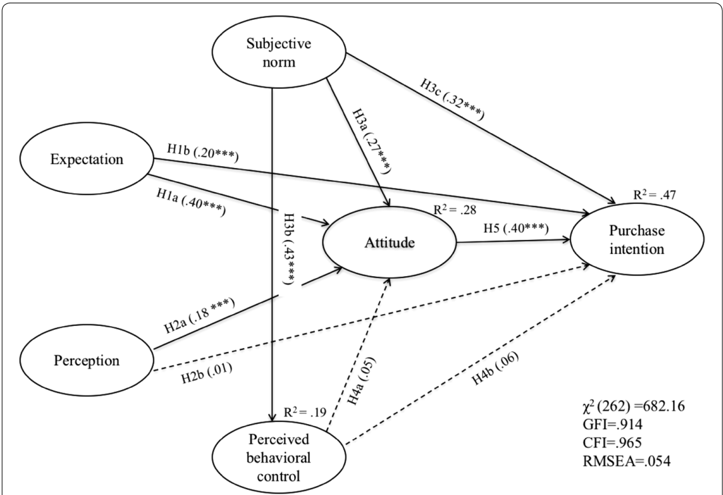
The purpose of this study was to examine consumers’ purchase intention for green sportswear by investigating the effects of their expectation, perception, subjective norm, perceived behavior control, and attitude on purchasing green sportswear. The study further investigated differential influences towards purchase intention for green sportswear between non-green and green product users. A within-subjects research design was used to empirically test our conceptual model, which was expanded from the theory of planned behavior by adding two additional predictors (expectation and perception). An online survey was conducted with a nationwide convenience sample of U.S. consumers whose ages ranged from 18 to 74 years, and a total of 542 usable responses were obtained. The results of the overall model testing confirmed the significant effects of expectation, perception, subjective norm, and attitude on consumers’ purchase intention for green sportswear. The findings from the comparative model testing indicated significant differences between non-green and green product users in terms of the effects of expectation and perceived behavior control on participants’ green sportswear purchase intention. The outcomes of this study offer useful insights for developing effective strategies for consumers to generate more positive perception, expectation, and attitude towards purchasing green sportswear. This study also suggests potential ways for apparel retailers to develop effective marketing strategies for this sportswear segment to satisfy the values of potential customers.
Overview
The claims and statistics of this paper haven’t been checked yet.
Free: it reads the open-access text and checks the first 5 claims that cite a source we can check. Create a free account to check every claim.
Integrity signals
Registry
Cites
Statistics
Figures
Verification
Claims the paper makes
The claims and statistics of this paper haven’t been checked yet.
Free: it reads the open-access text and checks the first 5 claims that cite a source we can check. Create a free account to check every claim.
Claims other papers make about this one
Each is checked against this paper’s own text: does it say what the citing paper says it does?
The source backs part of the claim, not all of it — or backs it for a different population, condition or comparison.
In the citing paper
“Green products are often more costly than traditional products”
From The Influencing Factors of Consumers’ Purchase Intention toward Green Products: A Case of Consumers in Saudi Arabia (2022) · cites this paper as Nam et al., 2017
Experimental — accuracy not yet measuredThe cited source says what the claim attributes to it.
In the citing paper
“This is especially true for consumers with low concern for the environment who are not willing to pay extra money for acquiring green products”
From The Influencing Factors of Consumers’ Purchase Intention toward Green Products: A Case of Consumers in Saudi Arabia (2022) · cites this paper as Nam et al., 2017
The cited source says what the claim attributes to it.
In the citing paper
“In the context of the affecting factors that are specifically related to the TPB constructs-perceived behavioral control, subjective norms, and attitude (Nam et al., 2017)-findings have endorsed the significant influences of attitude and subjective norms on consumers' intentions to purchase green sportswear.”
From The Influencing Factors of Consumers’ Purchase Intention toward Green Products: A Case of Consumers in Saudi Arabia (2022) · cites this paper as Nam et al., 2017
The cited source says what the claim attributes to it.
In the citing paper
“the product's price plays an important role when a consumer makes a purchasing decision”
From The Influencing Factors of Consumers’ Purchase Intention toward Green Products: A Case of Consumers in Saudi Arabia (2022) · cites this paper as Nam et al., 2017
The cited source says what the claim attributes to it.
In the citing paper
“This result corresponds with the outcomes of Nam et al. (2017) and Choi and Johnson (2019), which demonstrated no considerable impact of perceived behavioral control on attitude.”
From The Influencing Factors of Consumers’ Purchase Intention toward Green Products: A Case of Consumers in Saudi Arabia (2022) · cites this paper as Nam et al. (2017)
1 more claim about this paper
Create a free account to see every claim other papers make about this one.
Self-check
Percentages, sums and reported differences re-computed from the paper’s own numbers.
The self-check needs the paper’s full text.
Citations
Cites
The theory of planned behavior
Ajzen, I. (1991) · Organizational Behavior and Human Decision Processes · doi:10.1016/0749-5978(91)90020-t · Cited by 134,657
Herne, H., Cooley, W. W., & Lohnes, P. R. (1973) · Journal of the Royal Statistical Society. Series A (General) · doi:10.2307/2344428 · Cited by 35,697
(1980) · Medical Entomology and Zoology · Cited by 25,810
A conceptual model of service quality and its implications for future research
Parasuraman, A., Zeithaml, V. A., & Berry, L. L. (1985) · Journal of Marketing · doi:10.1177/002224298504900403 · Cited by 21,645
(2008) · Environmental Chemometrics · doi:10.1201/9781420067972-10 · Cited by 8,170
Perceived Behavioral Control, Self‐Efficacy, Locus of Control, and the Theory of Planned Behavior 1
Ajzen, I. (2002) · Journal of Applied Social Psychology · doi:10.1111/j.1559-1816.2002.tb00236.x · Cited by 7,629 · cited 2×
“The findings are contradicted by Ajzen (2002) and previous studies, where PBC positively influences consumers’ attitude and purchase intention (Gopi and Ramayah 2007; Kang et al.”
BackgroundResultPrediction of goal-directed behavior: Attitudes, intentions, and perceived behavioral control
Ajzen, I., & Madden, T. J. (1986) · Journal of Experimental Social Psychology · doi:10.1016/0022-1031(86)90045-4 · Cited by 5,718 · cited 1×
“PBC is not only a powerful factor influencing to attitude and behavior change, but also is related to salient beliefs that have been regarded as important resources for decision-making (Armitage and Talibudeen 2010; Ajzen and Madden 1986).”
BackgroundA Dynamic Process Model of Service Quality: From Expectations to Behavioral Intentions
Boulding, W., Kalra, A., Staelin, R., & Zeithaml, V. A. (1993) · Journal of Marketing Research · doi:10.1177/002224379303000102 · Cited by 3,416 · cited 1×
“Perceived product quality associated with consumers’ expectation and perception has a direct positive influence on consumers’ purchase intention (Boulding et al. 1993; Tsiotsou 2006).”
BackgroundTargeting consumers who are willing to pay more for environmentally friendly products
Laroche, M., Bergeron, J., & Barbaro‐Forleo, G. (2001) · Journal of Consumer Marketing · doi:10.1108/eum0000000006155 · Cited by 2,974
Predicting green product consumption using theory of planned behavior and reasoned action
Paul, J., Modi, A., & Patel, J. (2016) · Journal of Retailing and Consumer Services · doi:10.1016/j.jretconser.2015.11.006 · Cited by 2,399
Research works printed but not linked: 4
- Ko, S. B. (2012). Predictors of purchase intention toward green apparel products in the US and China (Unpublished doctoral dissertation). Stillwater: Oklahoma State University.
- Kotler, P., & Keller, K. L. (2006). Marketing management (12th ed.). Upper Saddle River: Pearson Prentice Hall Inc.
- Mandese, J. (1991). New study finds green confusion. Advertising Age, 62(45), 1-56.
- Oliver, R. L. (1981). Measurement and evaluation of satisfaction processes in retail settings. Journal of Retailing, 57(3), 25-48.
Cited by
Items 201–261 of 261
Rausch, T. M. (2021) · EPub Bayreuth (University of Bayreuth) · doi:10.15495/epub_ubt_00005420 · Cited by 1
Consumer Skepticism and Purchase Intention for Organic Apparel in Emerging EconomiesPreprint
Sandhya, G., & Venugopal, P. (2025) · Research Square · doi:10.21203/rs.3.rs-7360573/v1 · Cited by 1
Understanding purchase intentions of eco-labeled sportswear using the Theory of Planned Behavior
Terwee, T. H. (2023) · Portuguese National Funding Agency for Science, Research and Technology (RCAAP Project by FCT) · Cited by 1
Sustainability practices in the supply management in sports events
Veikkola, K. (2024) · LUTPub (LUT University) · Cited by 1
The Satisfaction and Behavioral Intention of Functional Cycling Wear Consumers
Ji, H., Lee, H., & Ahn, I. (2017) · The Korean Society of Costume · doi:10.7233/jksc.2017.67.7.118
The influence of situational factors and self-efficacy on consumers' activewear donation
Muller, N. (2019) · UpSpace Institutional Repository (University of Pretoria)
Wu, W., & Chen, C. W. K. (2020) · IOP Conference Series Earth and Environmental Science · doi:10.1088/1755-1315/576/1/012032
INTENTION OF ENTREPRENEURSHIP OF THE ECONOMIC FACULTY STUDENTS IN SURABAYA
Mujanah, S. (2020) · Journal of Applied Management and Business (JAMB) · doi:10.37802/jamb.v1i2.128
Ratilla, M. C., Dey, S. K., Cavite, H. J., Ratilla, T. C., & Chоvancοva, M. (2021) · International Scientific Conference Central and Eastern Europe in the Changing Business Environment · doi:10.18267/pr.2021.krn.4816.16
“Meanwhile, as positive perception about a product or service offering is integral to every purchase decision (Nam et al., 2017; Wee et al., 2014), the study provides insights to service and platform providers of P2P accommodation in designing effective business strategies.”
BackgroundLi, J. (2021) · NCSU Libraries Repository (North Carolina State University Libraries)
Bohari, F. S. M., Ishak, N. A., Samah, N. A. A., Shahruddin, R. M., & A.Jefri, N. N. J. (2018) · UMK Repository (Universiti Malaysia Kelantan)
The Investigation to the Learning Behaviour of Body Painting
WU, L.-A. (2022) · Archives of Business Research · doi:10.14738/abr.102.11713
İpek, İ., Demirel, B., İlter, B., & KANDEMİR, E. K. (2022) · Beykoz Akademi Dergisi · doi:10.14514/byk.m.26515393.2022.10/1.58-77
ETHICAL ETHNIC FASHION AND REPURCHASE INTENTION
MALAHAYATI, Ma’ruf, J. J., Lubis, P. H., & Utami, S. (2022) · Zenodo (CERN European Organization for Nuclear Research) · doi:10.5281/zenodo.6889724
Analysis of Factors Affecting Purchase Intention of Chinese Steel and Iron Products in Batam
Fernado, F., & Kesumahati, E. (2023) · EKONOMIS Journal of Economics and Business · doi:10.33087/ekonomis.v7i2.926
“Nam et al, (2017) studied trends in buying sportswear that has become the most recent casual uniform.”
BackgroundPerceived Authenticity, Satisfaction, Revisiting, Cultural Heritage Tourism, Kourd House, Sanandaj
Pourfaraj, A., & ahmadi, S. (2023) · Social Studies in Tourism · doi:10.61186/journalitor.36228.11.24.1
HIỀN, N. N. (2023) · Journal of Science and Technology - IUH · doi:10.46242/jstiuh.v66i06.4988
“Tiêu dùng xanh trong nhiều bối cảnh khác nhau đã được phân tích thông qua ý định mua trong các nghiên cứu trước đây (Jiang & Wu, 2022; Klein et al., 2019; Nam et al., 2017).”
Exploring determinants of purchase intent for chinese steel and iron goods in Batam
Kesumahati, E., & Fernado, F. (2024) · Jurnal Inovasi Ekonomi · doi:10.22219/jiko.v9i01.23470
Tekeli, S., & Yagci, M. I. (2024) · Hacettepe Üniversitesi İktisadi ve İdari Bilimler Fakültesi Dergisi · doi:10.17065/huniibf.1441430
Exploring the Circularity of Fast Fashion Using Goal Framing Theory
Wilbourne, K. (2022) · University of North Texas Digital Library (University of North Texas) · doi:10.12794/metadc1985862
Abdullah, M. A. F., & Purnama, Y. H. (2024) · Jurnal Ilmu Manajemen Terapan · doi:10.38035/jimt.v6i1.2800
Gualda-Gea, A., Terán-Yépez, E., & Marín-Carrillo, G. M. (2025) · Advances in business strategy and competitive advantage book series · doi:10.4018/979-8-3693-7853-3.ch015
What Drives Green Purchasing: Evidence From Mongolia
Baldangombo, U., Chuluunbaatar, B., & Batsukh, T. (2025) · European Journal of Business and Management · doi:10.7176/ejbm/17-5-06
Los retos de la gestión empresarial en el contexto de la pospandemia
de Tamaulipas, U. A., López, J. R. C., Villarreal, J. C. M., de Tamaulipas, U. A., Verástegui, J. L., & de Tamaulipas, U. A. (2024) · doi:10.29059/luat.407
Bansal, G. (2024) · Journal of Global Information and Business Strategy · doi:10.5958/2582-6115.2024.00020.5
SIKAP TERHADAP FASHION YANG SUSTAINABLE MEMPENGARUHI NIAT MEMBELI
Nurfiani, Susanti, S., & Malahayati (2024) · JURNAL KREASI RAKYAT · doi:10.64617/kreyat.v2i2.69-82
Zhou, Y., Hong, Y., Zeng, X., & Dai, X. (2025) · Textile Research Journal · doi:10.1177/00405175251355223
“38,41,42 For instance, Chi et al. 42 noted that enhancing PBC may boost consumers’ willingness to buy environmentally friendly clothing.”
InfluentialDecoding Gen Z’s Green Purchases: The Role of Product Attributes and Environmental Awareness
Barkah, B., Febriasari, P., & Listiana, E. (2025) · Dinasti International Journal of Education Management And Social Science · doi:10.38035/dijemss.v6i6.5243 · Cited by 1
Ong, Y.-K., Goh, Y.-N., & Lim, C.-N. (2025) · Advances in Science, Technology & Innovation/Advances in science, technology & innovation · doi:10.1007/978-3-031-89889-1_20
BRAND PERCEPTION DYNAMICS: A STUDY OF ADIDAS AND NIKE IN CZECH AND SWEDISH CONTEXTS
Voráček, J., Opelík, D., & Chudá, E. (2025) · EMC Review - Časopis za ekonomiju - APEIRON · doi:10.7251/emc250v008v
Akoğlu, H. E., İnce, U., & Turhan, F. H. (2025) · Yalova Üniversitesi spor bilimleri dergisi. · doi:10.70007/yalovaspor.1767226
Psychological Drivers and Behavioral Outcomes of Fast Fashion Consumption: A Meta-Analytic
Hsu, S.-C., Liao, Y., Huang, K.-C., Lin, L.-C., Thinh, V. T., Wu, W., & Sharma, K. (2025) · F1000Research · doi:10.12688/f1000research.170388.1
Fuchs, M. (2024) · Qucosa (Saxon State and University Library Dresden)
Sugiana, N. S. S. (2024) · Repository at Universitas Pendidikan Indonesia (Universitas Pendidikan Indonesia)
صورة العلامة و العوامل المؤثرة على نية شراء العطور الفاخرة دراسة حالة مدينتي تلمسان و سيدي بلعباس
Zaidi, O. C. (2017) · Dépôt Institutionnel de lUniversité de Tlemcen
Ayuste Alcántara, B. (2023) · Communities in ADDI (University of the Basque Country)
Cox Cuadros, D. S., & Sanchez Pro, M. (2024) · Repositorio Académico UPC (Universidad Peruana de Ciencias Aplicadas)
Nuñez Konoplyov, M., & Urruchi Valderrama, R. V. (2024) · Repositorio Académico UPC (Universidad Peruana de Ciencias Aplicadas)
García Vázquez, A. (2023) · UNED repository
Spindler, V. (2025) · Lirias (KU Leuven)
Türkiye'de sürdürülebilir moda: Tüketici ve pazarlamacıların perspektifleri ve anlayışlar
Shehneh, M. (2024) · Ibn Haldun University Institutional Repository (Yes)
Factors Influencing Working Adults’ Willingness to Plan for Long-Term Care in Malaysia
Chong, J. Y., Seow, A. N., & Yusof, N. A. M. (2025) · Advances in economics, business and management research/Advances in Economics, Business and Management Research · doi:10.2991/978-94-6463-968-1_20
From Sustainability Claims to Continued Patronage: Evidence from UNIQLO Consumers in Japan
Mohd‐Any, A. A., Sarker, M., & Kasai, S. (2026) · Asian Journal of Business and Accounting · doi:10.22452/ajba.vol19no1.10
Costa, R. D. M., Tortato, U., & Viacava, J. J. C. (2024) · LA Referencia (Red Federada de Repositorios Institucionales de Publicaciones Científicas)
Prasad, N. V., Ali, M. S. S., & Folarin, M. (2021) · UNSWorks (University of New South Wales, Sydney, Australia)
Turkish Consumers' Perceptions and Purchasing Behaviours Toward Organic Textile Products
Bilici, F. (2026) · İzmir İktisat Dergisi · doi:10.24988/ije.1619712
“…literature shows that consumers with sufficient knowledge and experience about sustainable textile products show behaviour towards developing positive perceptions and attitudes towards these products and that knowledge and experience lead to a stronger purchase intention (Nam, Dong & Lee, 2017).”
MODEL DAN STRATEGI TATA NIAGA MINYAK GORENG DALAM RANGKA PENINGKATAN KETAHANAN PANGAN
Yudhiawan, Y. (. (2026) · Neliti
Rashina, M., & Basheer, M. P. M. (2026) · Circular Economy and Sustainability · doi:10.1007/s43615-026-00900-8
de Araujo, R. R. (2026) · RIUnB Institutional Repository (University of Brasília)
Devarajan, G., & Sukı, N. M. (2026) · Journal of Applied Structural Equation Modeling · doi:10.47263/jasem.10(2)07
From Individual Traits to Behavioral Outcomes: A Meta-Analytic Approach
Lee, K.-I., Huang, K.-C., Liao, Y.-K., Vo, T. T., & Wu, W. Y. (2026) · F1000Research · doi:10.12688/f1000research.185694.1
Factores asociados al consumo de prendas de segunda mano en estudiantes universitarios colombianos
López-Rodríguez, C. E., Saavedra, A. P. C., Sánchez, C. R., & Casanova, N. A. R. (2026) · Economía Sociedad y Territorio · doi:10.22136/est20262489
THE EFFECTS OF UTILITARIAN AND HEDONIC VALUES ON PURCHASE INTENTION FOR SPORTS SHOES
Verona, C., Juniwati, J., Daud, I., Barkah, B., & Purmono, B. B. (2026) · JAMBURA Jurnal Ilmiah Manajemen dan Bisnis · doi:10.37479/jimb.v9i2.41289
Product Value and Purchase Preference Among Sneaker Buyers in Davao City
Batadlan, A., & Lau, K. F. (2026) · Journal of interdisciplinary perspectives · doi:10.69569/jip.2026.421x
Kimanthi, R. W., Makau, G., & Amuhaya, J. (2025) · African Journal of Emerging Issues
Bhawna, A. P. (2026) · European Economic Letters (EEL)
Factors influencing the buyer behaviour of Generation X and Y consumers in Johannesburg
Maqula, S. (2021) · Nelson Mandela University Research Repository
Tjandra, S. I., Marciano, D., & Katio, H. S. B. (2026) · Jurnal Relevansi Ekonomi Manajemen dan Bisnis · doi:10.61401/relevansi.v10i5.685
“These two pressures can either reinforce or dampen the pathway through which environmental cues eventually become purchase intention (Kim & Oh, 2020; Nam, Dong, & Lee, 2017).”
Sholeh, S. N., & Indarwati, T. A. (2026) · Manis Jurnal Manajemen dan Bisnis · doi:10.30598/manis.10.1.42-63
“Hasil ini mendukung mekanisme berurutan yang disarankan dalam penelitian pakaian olahraga di mana persepsi produk membentuk sikap yang selanjutnya memengaruhi niat (Nam et al., 2017).”
InfluentialVermaas, J., Monnapula, M., Bothma, C., Hugo, C. J., & Toit, A. D. (2026) · Textile Research Journal · doi:10.1177/00405175261498646
Metadata
- Authors
- Nam, C., Dong, H., & Lee, Y.-A.
- Affiliations
- Iowa State University (US)
- Corresponding author
- Nam, Changhyun
- Venue
- Fashion and Textiles
- Published
- 2017-01-17
- Volume
- 4
- Issue
- 1
- ISSN
- 2198-0802 (ISSN-L)
- OpenAlex
- W2570501474
- Semantic Scholar
- b95ed3c5ffd554fbb023e2b70388fa187c3c7266
- Cited by
- 197
- References
- 57
- Citations by year
- 2026: 12 · 2025: 32 · 2024: 36 · 2023: 29 · 2022: 20 · 2021: 28 · 2020: 22 · 2019: 10 · 2018: 5 · 2017: 3
- FWCI
- 19.79
- Type
- journal article
- Language
- en
- Open access
- gold
- doi.org
- Licence
- cc-by
- creativecommons.org/licenses/by/4.0 (tdm)
- creativecommons.org/licenses/by/4.0 (vor)
- Locations
- Fashion and Textiles (publishedVersion, cc-by)
- Topics
- Social Sciences › Business, Management and Accounting › Marketing › Environmental Sustainability in Business
- Social Sciences › Business, Management and Accounting › Marketing › Consumer Perception and Purchasing Behavior
- Social Sciences › Business, Management and Accounting › Marketing › Consumer Retail Behavior Studies
- Keywords
- purchase intention, theory of planned behavior, consumer perception, subjective norms, perceived behavioral control, consumer attitudes, apparel marketing, sustainable fashion
About these checks
Registry, retraction, Cites and statistics results are computed, not judged, with one exception: a printed reference that no index lists is read once by a model before it counts as a citation error. Claims are extracted by a model and kept only when their quote appears verbatim in the text; each cited source is then checked, with a model’s help, for whether it says what the claim relies on. Those verdicts can be wrong — read the claim’s quote and the cited source before relying on one.
Statistics and arithmetic are recomputed, not judged.
Confidence bands are shown only for fields calibrated on our annotated test set. None is calibrated yet, so no band is shown.
What counts as a claim ›How we measure confidence ›How we check this ›
Are you an author, or do you see a problem with this page? Request a review
Data sources
Bibliographic data: Semantic Scholar, OpenAlex, Crossref.
Contains information from the Semantic Scholar Academic Graph Datasets, made available under the ODC Attribution License (ODC-BY 1.0).
Semantic Scholar’s data is described in: Kinney, R., et al. (2023). The Semantic Scholar Open Data Platform. arXiv:2301.10140.
