

The DOI matches its Crossref record; 70 of the 70 references it cites were found in a registry or an index; 3 of the 51 sources its claims cite were checked for support.
Effects of therapeutic horseback riding on post-traumatic stress disorder in military veterans
Open accessAbstract
BACKGROUND: Large numbers of post-deployment U.S. veterans are diagnosed with post-traumatic stress disorder (PTSD) and/or traumatic brain injury (TBI), leading to an urgent need for effective interventions to reduce symptoms and increase veterans' coping. PTSD includes anxiety, flashbacks, and emotional numbing. The symptoms increase health care costs for stress-related illnesses and can make veterans' civilian life difficult. METHODS: We used a randomized wait-list controlled design with repeated measures of U.S. military veterans to address our specific aim to test the efficacy of a 6-week therapeutic horseback riding (THR) program for decreasing PTSD symptoms and increasing coping self-efficacy, emotion regulation, social and emotional loneliness. Fifty-seven participants were recruited and 29 enrolled in the randomized trial. They were randomly assigned to either the horse riding group (n = 15) or a wait-list control group (n = 14). The wait-list control group experienced a 6-week waiting period, while the horse riding group began THR. The wait-list control group began riding after 6 weeks of participating in the control group. Demographic and health history information was obtained from all the participants. PTSD symptoms were measured using the standardized PTSD Checklist-Military Version (PCL-M). The PCL-M as well as other instruments including, The Coping Self Efficacy Scale (CSES), The Difficulties in Emotion Regulation Scale (DERS) and The Social and Emotional Loneliness Scale for Adults-short version (SELSA) were used to access different aspects of individual well-being and the PTSD symptoms. RESULTS: Participants had a statistically significant decrease in PTSD scores after 3 weeks of THR (P ≤ 0.01) as well as a statistically and clinically significant decrease after 6 weeks of THR (P ≤ 0.01). Logistic regression showed that participants had a 66.7% likelihood of having lower PTSD scores at 3 weeks and 87.5% likelihood at 6 weeks. Under the generalized linear model(GLM), our ANOVA findings for the coping self-efficacy, emotion regulation, and social and emotional loneliness did not reach statistical significance. The results for coping self-efficacy and emotion regulation trended in the predicted direction. Results for emotional loneliness were opposite the predicted direction. Logistic regression provided validation that outcome effects were caused by riding longer. CONCLUSION: The findings suggest that THR may be a clinically effective intervention for alleviating PTSD symptoms in military veterans.
Overview
AI snapshot
Written from the paper’s full text.
TL;DR
In a randomized wait-list controlled trial of U.S. military veterans with PTSD or PTSD/TBI, a 6-week therapeutic horseback riding program was associated with statistically and clinically significant reductions in PTSD symptoms. Other outcomes—coping self-efficacy, emotion regulation, and social/emotional loneliness—did not reach statistical significance, though some trends moved in predicted directions.
Key findings
- PTSD symptoms decreased significantly after 3 weeks of THR (P ≤ 0.01) and after 6 weeks (P ≤ 0.01); mean improvements were 6 points at 3 weeks and 13 points at 6 weeks, meeting the paper’s cited 5-point response and 10-point clinically meaningful thresholds.
- Logistic regression showed a 66.7% likelihood of lower PTSD scores at 3 weeks and 87.5% at 6 weeks; overall participants had an 81.8% likelihood of improvement. 18/23 (78%) showed a decrease from baseline to 3 weeks, and 18/19 (94.74%) from baseline to 6 weeks.
- Coping self-efficacy, emotion regulation, and social/emotional loneliness did not reach statistical significance; CSES and DERS trended in the predicted direction, while SELSA trended opposite the predicted direction (increased loneliness).
- Instrument internal consistency was acceptable: PCL-M = 0.737, CSES = 0.868, DERS = 0.831, SELSA = 0.788.
Methods
- Randomized wait-list controlled design with repeated measures; veterans with PTSD or PTSD/TBI participated in a 6-week THR program once per week, while the wait-list control group waited 6 weeks and then rode. Inclusion criteria included age ≥18, no longer active duty, weight ≤220 lb, able to walk 25 ft without assistance, and willingness to ride.
- Measures included the PTSD Checklist-Military Version (PCL-M), Coping Self Efficacy Scale (CSES), Difficulties in Emotion Regulation Scale (DERS), and Social and Emotional Loneliness Scale for Adults-short version (SELSA), plus demographic and health history questionnaires.
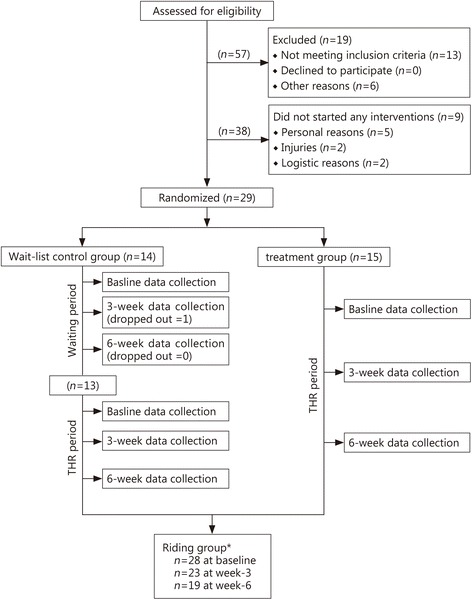
- Analysis used repeated measures ANOVA, t-tests on difference scores, and logistic regression in SPSS Version 24, with significance set at P = 0.05. The abstract reports 57 recruited and 29 enrolled/randomized (15 riding, 14 wait-list); the methods/results describe 38 enrolled, 29 participating in THR, and 29 subjects with complete data for analysis.
Limitations
- Paper-stated: small sample size limited power to detect changes in dependent variables; no longitudinal follow-up; the 6-week THR program may have been too short; recruitment was limited to veterans treated at the approving VA; travel, scheduling, weather, and staffing logistics complicated implementation; components of THR (e.g., grooming, staff interactions, driving, arena type) could not be isolated; selection bias exists because only veterans willing to ride enrolled; the SELSA may not capture spiritual/existential loneliness or experiential isolation.
- Evident from the text: sample-flow numbers are inconsistent across the abstract and methods/results (e.g., 57 recruited vs. 38 enrolled vs. 29 analyzed; varying n’s across tables), and the wait-list conversion design creates repeated treatment data that complicate independence assumptions.
Model-written summary. Check it against the paper before relying on it.
Integrity signals
Registry
Cites
Statistics
Figures
Verification
Claims the paper makes
43 Own result · 26 No full text of the sources · 22 Own interpretation · 18 Own method · 7 Not checked yet · 6 No basis given · 2 Partly supported · 2 Sources not found · 1 Supported so far · accuracy not yet measured
The sources with a verdict support this claim; the rest weren’t checked yet, have no full text we could read, or their verdicts aren’t rated yet.
In the paper
“Preliminary evidence suggests that PTSD and other anxiety/depression related mental health symptoms may also decrease with physical activity (PA) [47, 48].”
§ Effects of therapeutic horseback riding on post-traumatic stress disorder in military veterans > Background > Therapeutic horseback riding and treatment of PTSD
What the sources say
- Supportedcites [47] Assis MA, Mello MF, Scorza FA, Cadrobbi MP, Schooedl AF, Silva SG, et al. Evaluation of physical activity habits in patients with post-traumatic stress disorder. Clinics. 2008;63:473–8. https://doi.org/10.1590/S1807-59322008000400010 . source
The Introduction reports that a 12-session aerobic exercise program was followed by significant reductions in PTSD, anxiety, and depression symptoms. It also describes the evidence on exercise in PTSD as limited, consistent with the claim’s preliminary wording. (LLM, conf=0.93)
- Not checked — no full text of the sourcecites [48] Newman CL, Motta RW. The effects of aerobic exercise on childhood PTSD, anxiety, and depression. Int J Emerg Ment Health. 2007;9:133–58.
hedgedconditional- Asserted: passes — The authors put it forward as true.
- Checkable: passes — It can be checked against evidence.
- Load-bearing: passes — The paper’s conclusions depend on it.
- Based: passes — The paper gives a reason why it holds.
- Supported
A result the paper reports from its own data — it cites no other source for it, so there is none to check. The quote shows it is in the paper.
In the paper
“However, and importantly, changes in the DERS (which measured emotion regulation) and CSES (which measured coping self-efficacy) scores were in the predicted direction.”
- Also stated in: § Results · plain
“The results for coping self-efficacy and emotion regulation trended in the predicted direction.”
§ Effects of therapeutic horseback riding on post-traumatic stress disorder in military veterans > Results > Primary and secondary outcomes
plain- Asserted: passes — The authors put it forward as true.
- Checkable: passes — It can be checked against evidence.
- Load-bearing: unclear — It is unclear whether the paper’s conclusions depend on it.
- Based: passes — The paper gives a reason why it holds.
- Also stated in: § Results · plain
A result the paper reports from its own data — it cites no other source for it, so there is none to check. The quote shows it is in the paper.
In the paper
“Symptoms significantly decreased between baseline and week 3, F(1,17) = 10.678, P = 0.005”
- Also stated in: § Results · plain
“Participants had a statistically significant decrease in PTSD scores after 3 weeks of THR (P ≤ 0.01)”
§ Effects of therapeutic horseback riding on post-traumatic stress disorder in military veterans > Results > Primary and secondary outcomes
plaindirect- Asserted: passes — The authors put it forward as true.
- Checkable: passes — It can be checked against evidence.
- Load-bearing: passes — The paper’s conclusions depend on it.
- Based: passes — The paper gives a reason why it holds.
- Also stated in: § Results · plain
A result the paper reports from its own data — it cites no other source for it, so there is none to check. The quote shows it is in the paper.
In the paper
“while 18 out of 19 (94.74%) showed a decrease between baseline and week 6.”
§ Effects of therapeutic horseback riding on post-traumatic stress disorder in military veterans > Results > Primary and secondary outcomes
plain- Asserted: passes — The authors put it forward as true.
- Checkable: passes — It can be checked against evidence.
- Load-bearing: passes — The paper’s conclusions depend on it.
- Based: passes — The paper gives a reason why it holds.
A result the paper reports from its own data — it cites no other source for it, so there is none to check. The quote shows it is in the paper.
In the paper
“and also between week 3 and week 6 of riding, F(1,17) = 8.750, P = 0.009.”
§ Effects of therapeutic horseback riding on post-traumatic stress disorder in military veterans > Results > Primary and secondary outcomes
plaindirect- Asserted: passes — The authors put it forward as true.
- Checkable: passes — It can be checked against evidence.
- Load-bearing: passes — The paper’s conclusions depend on it.
- Based: passes — The paper gives a reason why it holds.
A result the paper reports from its own data — it cites no other source for it, so there is none to check. The quote shows it is in the paper.
In the paper
“and 87.5% likelihood at 6 weeks.”
§ Effects of therapeutic horseback riding on post-traumatic stress disorder in military veterans > Abstract > Results
plaincorrelational- Asserted: passes — The authors put it forward as true.
- Checkable: passes — It can be checked against evidence.
- Load-bearing: passes — The paper’s conclusions depend on it.
- Based: passes — The paper gives a reason why it holds.
A result the paper reports from its own data — it cites no other source for it, so there is none to check. The quote shows it is in the paper.
In the paper
“as well as a statistically and clinically significant decrease after 6 weeks of THR (P ≤ 0.01).”
§ Effects of therapeutic horseback riding on post-traumatic stress disorder in military veterans > Abstract > Results
plaindirect- Asserted: passes — The authors put it forward as true.
- Checkable: passes — It can be checked against evidence.
- Load-bearing: passes — The paper’s conclusions depend on it.
- Based: passes — The paper gives a reason why it holds.
A result the paper reports from its own data — it cites no other source for it, so there is none to check. The quote shows it is in the paper.
In the paper
“Logistic regression showed that participants had a 66.7% likelihood of having lower PTSD scores at 3 weeks”
§ Effects of therapeutic horseback riding on post-traumatic stress disorder in military veterans > Abstract > Results
plaincorrelational- Asserted: passes — The authors put it forward as true.
- Checkable: passes — It can be checked against evidence.
- Load-bearing: passes — The paper’s conclusions depend on it.
- Based: passes — The paper gives a reason why it holds.
A result the paper reports from its own data — it cites no other source for it, so there is none to check. The quote shows it is in the paper.
In the paper
“Eighteen of the 23 veterans (78%) (one veteran missed the 3-week data collection) who completed data collection at baseline and after 3 weeks of THR showed a decrease in PTSD symptoms”
§ Effects of therapeutic horseback riding on post-traumatic stress disorder in military veterans > Results > Primary and secondary outcomes
plain- Asserted: passes — The authors put it forward as true.
- Checkable: passes — It can be checked against evidence.
- Load-bearing: unclear — It is unclear whether the paper’s conclusions depend on it.
- Based: passes — The paper gives a reason why it holds.
A result the paper reports from its own data — it cites no other source for it, so there is none to check. The quote shows it is in the paper.
In the paper
“There were no adverse events (e.g., falls from a horse, biting, kicking, or injuries) during any riding session.”
§ Effects of therapeutic horseback riding on post-traumatic stress disorder in military veterans > Methods > Participants
plain- Asserted: passes — The authors put it forward as true.
- Checkable: passes — It can be checked against evidence.
- Load-bearing: unclear — It is unclear whether the paper’s conclusions depend on it.
- Based: passes — The paper gives a reason why it holds.
- Probably not a substantial claim. 46
- It may state two separate claims as one. 41
- The quote only partly states this claim. 1
The cited sources support only part of this claim — read each source’s verdict below.
In the paper
“The Difficulties in Emotion Regulation Scale (DERS) contains 36 items measuring the “modulation of emotional arousal; awareness, understanding, and acceptance of emotions; and ability to act in desired ways regardless of the emotional state” and is scored on a 5-point Likert-type scale ranging from 1 (‘almost never’) to 5 (‘almost always’) [63].”
§ Effects of therapeutic horseback riding on post-traumatic stress disorder in military veterans > Methods > Materials
What the sources say
- Partly supportedcites [63] Gratz KL, Roemer L. Multidimensional assessment of emotion regulation and dysregulation: development, factor structure, and initial validation of the difficulties in emotion regulation scale. J Psychopathol Behav Assess. 2004;26:41–54. https://doi.org/10.1007/s10862-008-9102-4 . sourceExperimental — accuracy not yet measured
The available passage (unlabeled section; no page given) explicitly says the DERS has 36 items. It does not describe all the emotional capacities listed in the claim or specify a 5-point response scale, so those parts of the citing sentence are not supported by our copy. (LLM, conf=0.88)
plain- Asserted: passes — The authors put it forward as true.
- Checkable: passes — It can be checked against evidence.
- Load-bearing: fails — The paper’s conclusions may not depend on it.
- Based: passes — The paper gives a reason why it holds.
Probably not a substantial claim. The paper’s conclusions may not depend on it. It may state two separate claims as one.
- Partly supported
The cited sources support only part of this claim — read each source’s verdict below.
In the paper
“THR has been implemented in adults and older adults with a variety of physical impairments [35–37] as well as defined physical and psychological disorders.”
§ Effects of therapeutic horseback riding on post-traumatic stress disorder in military veterans > Background > Therapeutic horseback riding and treatment of PTSD
What the sources say
- Partly supportedcites [35] Araujo TB, Silva NA, Costa JN, Pereira MM, Safons MP. Effect of equine-assisted therapy on the postural balance of the elderly. Braz J Phy Ther. 2011;15:414–9. https://doi.org/10.1590/S1413-35552011005000027 . sourceExperimental — accuracy not yet measured
The Abstract reports equine-assisted therapy in older adults, supporting its use in that age group. But the Selection of study group section describes independently functioning participants and excludes several disorders that cause balance problems; the Discussion calls the groups healthy. The paper therefore does not establish use in older adults with the variety of physical impairments attributed to it. The citation is attached to the physical-impairments clause, not the subsequent psychological-disorders clause. (LLM, conf=0.86)
- Not checked — no full text of the sourcecites [36] Farias-Tomaszewski S, Jenkins SR, Keller J. An evaluation of therapeutic horseback riding programs for adults with physical impairments. Ther Recreat J. 2001;35:250–7.
- Not checked — no full text of the sourcecites [37] Land G, Errington-Povalac E, Paul S. The effects of therapeutic riding on sitting posture in individuals with disabilities. Occup Ther Health Care. 2002;14:1–12. https://doi.org/10.1080/J003v14n01_01 . source
plain- Asserted: passes — The authors put it forward as true.
- Checkable: passes — It can be checked against evidence.
- Load-bearing: fails — The paper’s conclusions may not depend on it.
- Based: passes — The paper gives a reason why it holds.
Probably not a substantial claim. The paper’s conclusions may not depend on it. It may state two separate claims as one.
- Partly supported
A result the paper reports from its own data — it cites no other source for it, so there is none to check. The quote shows it is in the paper.
In the paper
“There were no statistically significant changes in the other primary and secondary outcome variables over time (i.e., coping self-efficacy, emotion regulation [mood], and perceived loneliness).”
- Also stated in: § Results · plain
“Under the generalized linear model(GLM), our ANOVA findings for the coping self-efficacy, emotion regulation, and social and emotional loneliness did not reach statistical significance.”
§ Effects of therapeutic horseback riding on post-traumatic stress disorder in military veterans > Results > Primary and secondary outcomes
plain- Asserted: passes — The authors put it forward as true.
- Checkable: passes — It can be checked against evidence.
- Load-bearing: unclear — It is unclear whether the paper’s conclusions depend on it.
- Based: passes — The paper gives a reason why it holds.
It may state two separate claims as one.
- Also stated in: § Results · plain
A result the paper reports from its own data — it cites no other source for it, so there is none to check. The quote shows it is in the paper.
In the paper
“The values for each instrument were as follows: PCL-M = 0.737, CSES = 0.868, DERS = 0.831, SELSA = 0.788.”
§ Effects of therapeutic horseback riding on post-traumatic stress disorder in military veterans > Results > Instrument performance
plain- Asserted: passes — The authors put it forward as true.
- Checkable: passes — It can be checked against evidence.
- Load-bearing: passes — The paper’s conclusions depend on it.
- Based: passes — The paper gives a reason why it holds.
It may state two separate claims as one.
A result the paper reports from its own data — it cites no other source for it, so there is none to check. The quote shows it is in the paper.
In the paper
“No phone calls were received addressing injuries or pains; the phone number was exclusively employed regarding scheduling issues.”
§ Effects of therapeutic horseback riding on post-traumatic stress disorder in military veterans > Methods > Participants
plain- Asserted: passes — The authors put it forward as true.
- Checkable: passes — It can be checked against evidence.
- Load-bearing: fails — The paper’s conclusions may not depend on it.
- Based: passes — The paper gives a reason why it holds.
Probably not a substantial claim. The paper’s conclusions may not depend on it.
A result the paper reports from its own data — it cites no other source for it, so there is none to check. The quote shows it is in the paper.
In the paper
“Changes in the SELSA were opposite the predicted direction (indicating increased loneliness).”
- Also stated in: § Results · plain
“Results for emotional loneliness were opposite the predicted direction.”
§ Effects of therapeutic horseback riding on post-traumatic stress disorder in military veterans > Results > Primary and secondary outcomes
plain- Asserted: passes — The authors put it forward as true.
- Checkable: passes — It can be checked against evidence.
- Load-bearing: unclear — It is unclear whether the paper’s conclusions depend on it.
- Based: passes — The paper gives a reason why it holds.
It may state two separate claims as one. The quote only partly states this claim.
- Also stated in: § Results · plain
A result the paper reports from its own data — it cites no other source for it, so there is none to check. The quote shows it is in the paper.
In the paper
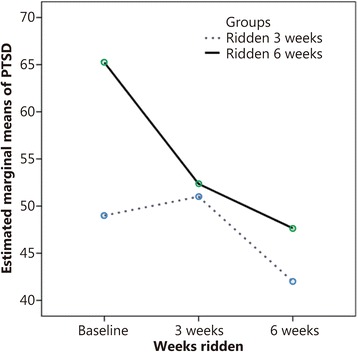
“the shorter riding group (1–3 weeks) did show a decline between the first and second measurement, but then showed a marked increase at the next measurement”
§ Effects of therapeutic horseback riding on post-traumatic stress disorder in military veterans > Results > Primary and secondary outcomes
plain- Asserted: passes — The authors put it forward as true.
- Checkable: passes — It can be checked against evidence.
- Load-bearing: unclear — It is unclear whether the paper’s conclusions depend on it.
- Based: passes — The paper gives a reason why it holds.
It may state two separate claims as one.
A result the paper reports from its own data — it cites no other source for it, so there is none to check. The quote shows it is in the paper.
In the paper
“The fact that there was no change in these scores during the control period, but there was a positive change during the riding period would support this notion.”
§ Effects of therapeutic horseback riding on post-traumatic stress disorder in military veterans > Discussion > Primary and secondary outcomes
hedged- Asserted: passes — The authors put it forward as true.
- Checkable: passes — It can be checked against evidence.
- Load-bearing: passes — The paper’s conclusions depend on it.
- Based: passes — The paper gives a reason why it holds.
It may state two separate claims as one.
A result the paper reports from its own data — it cites no other source for it, so there is none to check. The quote shows it is in the paper.
In the paper
“Our findings show that our participants’ mean improvements in PTSD symptoms were 6 points at the 3-week data point and 13 points at the 6-week data point while riding.”
§ Effects of therapeutic horseback riding on post-traumatic stress disorder in military veterans > Discussion > Primary and secondary outcomes
plain- Asserted: passes — The authors put it forward as true.
- Checkable: passes — It can be checked against evidence.
- Load-bearing: passes — The paper’s conclusions depend on it.
- Based: passes — The paper gives a reason why it holds.
It may state two separate claims as one.
A result the paper reports from its own data — it cites no other source for it, so there is none to check. The quote shows it is in the paper.
In the paper
“However, for PTSD symptoms, our findings demonstrated that 3 weeks was an effective intervention length and that even more improvement was noted at 6 weeks.”
§ Effects of therapeutic horseback riding on post-traumatic stress disorder in military veterans > Discussion > Limitations
boosteddirect- Asserted: passes — The authors put it forward as true.
- Checkable: passes — It can be checked against evidence.
- Load-bearing: passes — The paper’s conclusions depend on it.
- Based: passes — The paper gives a reason why it holds.
It may state two separate claims as one.
A result the paper reports from its own data — it cites no other source for it, so there is none to check. The quote shows it is in the paper.
In the paper
“Our findings regarding social and emotional loneliness were not statistically significant, and the trends were not in the predicted decreasing direction.”
§ Effects of therapeutic horseback riding on post-traumatic stress disorder in military veterans > Discussion > Primary and secondary outcomes
plain- Asserted: passes — The authors put it forward as true.
- Checkable: passes — It can be checked against evidence.
- Load-bearing: unclear — It is unclear whether the paper’s conclusions depend on it.
- Based: passes — The paper gives a reason why it holds.
It may state two separate claims as one.
A result the paper reports from its own data — it cites no other source for it, so there is none to check. The quote shows it is in the paper.
In the paper
“Our findings for coping self-efficacy, emotion regulation, and social and emotional loneliness did not reach statistical or clinical significance.”
§ Effects of therapeutic horseback riding on post-traumatic stress disorder in military veterans > Discussion > Primary and secondary outcomes
plain- Asserted: passes — The authors put it forward as true.
- Checkable: passes — It can be checked against evidence.
- Load-bearing: passes — The paper’s conclusions depend on it.
- Based: passes — The paper gives a reason why it holds.
It may state two separate claims as one.
A result the paper reports from its own data — it cites no other source for it, so there is none to check. The quote shows it is in the paper.
In the paper
“Globally, the highest level of PTSD symptoms was recorded at baseline, then there was a drop at 3 weeks of riding and a still further drop at 6 weeks of riding.”
§ Effects of therapeutic horseback riding on post-traumatic stress disorder in military veterans > Results > Primary and secondary outcomes
plaindirectn = 19- Asserted: passes — The authors put it forward as true.
- Checkable: passes — It can be checked against evidence.
- Load-bearing: passes — The paper’s conclusions depend on it.
- Based: passes — The paper gives a reason why it holds.
It may state two separate claims as one.
The paper states this without a source or data behind it here, so there is nothing to check it against. The quote shows it is in the paper.
In the paper
“Interactions between the veterans and the riding center and study staff were positive.”
§ Effects of therapeutic horseback riding on post-traumatic stress disorder in military veterans > Discussion > Primary and secondary outcomes
plain- Asserted: passes — The authors put it forward as true.
- Checkable: passes — It can be checked against evidence.
- Load-bearing: fails — The paper’s conclusions may not depend on it.
- Based: passes — The paper gives a reason why it holds.
Probably not a substantial claim. The paper’s conclusions may not depend on it.
A result the paper reports from its own data — it cites no other source for it, so there is none to check. The quote shows it is in the paper.
In the paper
“Nevertheless, we did find statistical and clinical significance in lowering PTSD symptom levels.”
§ Effects of therapeutic horseback riding on post-traumatic stress disorder in military veterans > Discussion > Limitations
plaindirectn = 38- Asserted: passes — The authors put it forward as true.
- Checkable: passes — It can be checked against evidence.
- Load-bearing: passes — The paper’s conclusions depend on it.
- Based: passes — The paper gives a reason why it holds.
It may state two separate claims as one.
A result the paper reports from its own data — it cites no other source for it, so there is none to check. The quote shows it is in the paper.
In the paper
“Those who rode for more sessions (4–6 weeks) evidenced much larger declines in PTSD scores than those who rode for fewer sessions, and the decline continued with each measurement.”
§ Effects of therapeutic horseback riding on post-traumatic stress disorder in military veterans > Results > Primary and secondary outcomes
plaincorrelationaln = 19- Asserted: passes — The authors put it forward as true.
- Checkable: passes — It can be checked against evidence.
- Load-bearing: passes — The paper’s conclusions depend on it.
- Based: passes — The paper gives a reason why it holds.
It may state two separate claims as one.
A result the paper reports from its own data — it cites no other source for it, so there is none to check. The quote shows it is in the paper.
In the paper
“The participants expressed sadness that the THR program was ending.”
§ Effects of therapeutic horseback riding on post-traumatic stress disorder in military veterans > Discussion > Primary and secondary outcomes
plain- Asserted: passes — The authors put it forward as true.
- Checkable: passes — It can be checked against evidence.
- Load-bearing: fails — The paper’s conclusions may not depend on it.
- Based: passes — The paper gives a reason why it holds.
Probably not a substantial claim. The paper’s conclusions may not depend on it.
What the paper did — it cites no source for this, so there is none to check. The quote shows it is in the paper.
In the paper
“The study had the approval of the VA Research and Development Committee at the Harry S. Truman Memorial Veterans Hospital, the University of Missouri Health Sciences Institutional Review Board and the Animal Care and Use Committee of the University.”
§ Effects of therapeutic horseback riding on post-traumatic stress disorder in military veterans > Methods > Participants
plain- Asserted: passes — The authors put it forward as true.
- Checkable: passes — It can be checked against evidence.
- Load-bearing: fails — The paper’s conclusions may not depend on it.
- Based: passes — The paper gives a reason why it holds.
Probably not a substantial claim. The paper’s conclusions may not depend on it. It may state two separate claims as one.
None of the sources cited for this claim have been checked yet.
In the paper
“The DERS was found to have a strong internal consistency (0.93) and tested well against the Negative Mood Regulation Scale (−0.69) [63].”
§ Effects of therapeutic horseback riding on post-traumatic stress disorder in military veterans > Methods > Materials
What the sources say
- Not checked yetcites [63] Gratz KL, Roemer L. Multidimensional assessment of emotion regulation and dysregulation: development, factor structure, and initial validation of the difficulties in emotion regulation scale. J Psychopathol Behav Assess. 2004;26:41–54. https://doi.org/10.1007/s10862-008-9102-4 . source
Checked before — its earlier verdict is held back until a new check runs.
boostedcorrelational- Asserted: passes — The authors put it forward as true.
- Checkable: passes — It can be checked against evidence.
- Load-bearing: fails — The paper’s conclusions may not depend on it.
- Based: passes — The paper gives a reason why it holds.
Probably not a substantial claim. The paper’s conclusions may not depend on it. It may state two separate claims as one.
- Not checked yet
What the paper did — it cites no source for this, so there is none to check. The quote shows it is in the paper.
In the paper
“Riding center staff were not aware of who had been assigned to either group.”
§ Effects of therapeutic horseback riding on post-traumatic stress disorder in military veterans > Methods > Participants
plain- Asserted: passes — The authors put it forward as true.
- Checkable: passes — It can be checked against evidence.
- Load-bearing: fails — The paper’s conclusions may not depend on it.
- Based: passes — The paper gives a reason why it holds.
Probably not a substantial claim. The paper’s conclusions may not depend on it.
What the paper did — it cites no source for this, so there is none to check. The quote shows it is in the paper.
In the paper
“All participants provided written informed consent, and their primary health care providers gave written assent for their participation in the THR program.”
§ Effects of therapeutic horseback riding on post-traumatic stress disorder in military veterans > Methods > Participants
plain- Asserted: passes — The authors put it forward as true.
- Checkable: passes — It can be checked against evidence.
- Load-bearing: fails — The paper’s conclusions may not depend on it.
- Based: passes — The paper gives a reason why it holds.
Probably not a substantial claim. The paper’s conclusions may not depend on it. It may state two separate claims as one.
In the paper
“The PCL-M has been found to have strong internal consistency (0.94–0.97), test-retest reliability (0.97 over 3 days), concurrent validity (0.77–0.93), and diagnostic efficiency with a sensitivity of 0.82 and specificity of 0.84 [60].”
§ Effects of therapeutic horseback riding on post-traumatic stress disorder in military veterans > Methods > Materials
What the sources say
- Not checked — no full text of the sourcecites [60] Weathers FW, Litz BT, Herman DS, Huska JA, Keane TM. Psychometric properties of nine scoring rules for the clinician-administered post-traumatic stress disorder scale. Psychol Assess. 1999;11:124–33. https://doi.org/10.1037/1040-3590.11.2.124 . source
boosted- Asserted: passes — The authors put it forward as true.
- Checkable: passes — It can be checked against evidence.
- Load-bearing: unclear — It is unclear whether the paper’s conclusions depend on it.
- Based: passes — The paper gives a reason why it holds.
It may state two separate claims as one.
What the paper did — it cites no source for this, so there is none to check. The quote shows it is in the paper.
In the paper
“We used a randomized wait-list controlled design with repeated measures of U.S. military veterans to address our specific aim to test the efficacy of a 6-week therapeutic horseback riding (THR) program for decreasing PTSD symptoms and increasing coping self-efficacy, emotion regulation, social and emotional loneliness.”
- Also stated in: § Statistical analysis · plain
“The THR program was a randomized wait-list controlled design, in which participants rode a horse or were wait-listed for prescribed times.”
§ Effects of therapeutic horseback riding on post-traumatic stress disorder in military veterans > Abstract > Methods
plainn = 29- Asserted: passes — The authors put it forward as true.
- Checkable: passes — It can be checked against evidence.
- Load-bearing: passes — The paper’s conclusions depend on it.
- Based: passes — The paper gives a reason why it holds.
It may state two separate claims as one.
- Also stated in: § Statistical analysis · plain
In the paper
“The instrument has strong internal consistency (0.80–0.91) and test-retest reliability (0.40–0.80) [62].”
§ Effects of therapeutic horseback riding on post-traumatic stress disorder in military veterans > Methods > Materials
What the sources say
- Not checked — no full text of the sourcecites [62] Chesney MA, Neilands TB, Chambers DB, Taylor JM, Folkman SA. Validity and reliability study of the coping self-efficacy scale. Brit J Health Psych. 2006;11:421–37. https://doi.org/10.1348/135910705X53155 . source
boosted- Asserted: passes — The authors put it forward as true.
- Checkable: passes — It can be checked against evidence.
- Load-bearing: fails — The paper’s conclusions may not depend on it.
- Based: passes — The paper gives a reason why it holds.
Probably not a substantial claim. The paper’s conclusions may not depend on it. It may state two separate claims as one.
In the paper
“The scale was found to have an internal consistency ranging from 0.87–0.90, to be significantly correlated with the long-established UCLA-Loneliness Scale, and has been extensively tested against other established measures [64].”
§ Effects of therapeutic horseback riding on post-traumatic stress disorder in military veterans > Methods > Materials
What the sources say
- Not checked — no full text of the sourcecites [64] DiTommaso E, Brannen C, Best LA. Measurement and validity characteristics of the short version of the social and emotional loneliness scale for adults. Educ Psychol Meas. 2004;64:99–119. https://doi.org/10.1177/0013164403258450 . source
plaincorrelational- Asserted: passes — The authors put it forward as true.
- Checkable: passes — It can be checked against evidence.
- Load-bearing: fails — The paper’s conclusions may not depend on it.
- Based: passes — The paper gives a reason why it holds.
Probably not a substantial claim. The paper’s conclusions may not depend on it. It may state two separate claims as one.
In the paper
“The PCL-M is a self-report measure of the 17 DSM-IV symptoms of PTSD asking about problems in response to “stressful military experiences” [59].”
§ Effects of therapeutic horseback riding on post-traumatic stress disorder in military veterans > Methods > Materials
What the sources say
- Not checked yetcites [59] U.S. Department of Veterans Affairs, National Center for PTSD. PTSD Checklist-Military Version (PCL-M). 2011. https://www.ptsd.va.gov/professional/assessment/screens/index.asp . Accessed 18 Oct 2017.
plain- Asserted: passes — The authors put it forward as true.
- Checkable: passes — It can be checked against evidence.
- Load-bearing: fails — The paper’s conclusions may not depend on it.
- Based: passes — The paper gives a reason why it holds.
Probably not a substantial claim. The paper’s conclusions may not depend on it.
What the paper did — it cites no source for this, so there is none to check. The quote shows it is in the paper.
In the paper
“First, relevant assumptions were evaluated, including normality, linearity and homoscedasticity. Each were within acceptable parameters for analysis by variance statistics (i.e., ANOVA).”
- Also stated in: § Statistical analysis · plain
“For inferential analyses, relevant statistical assumptions (including normality, linearity, homoscedasticity) were evaluated.”
§ Effects of therapeutic horseback riding on post-traumatic stress disorder in military veterans > Results > Primary and secondary outcomes
plainn = 29- Asserted: passes — The authors put it forward as true.
- Checkable: passes — It can be checked against evidence.
- Load-bearing: passes — The paper’s conclusions depend on it.
- Based: passes — The paper gives a reason why it holds.
Probably not a substantial claim. It may state two separate claims as one.
- Also stated in: § Statistical analysis · plain
What the paper did — it cites no source for this, so there is none to check. The quote shows it is in the paper.
In the paper
“They were randomly assigned to either the riding group (n = 15) or a wait-list control group (n = 14) based on their identification number (Fig. 1).”
§ Effects of therapeutic horseback riding on post-traumatic stress disorder in military veterans > Methods > Participants
plainn = 14- Asserted: passes — The authors put it forward as true.
- Checkable: passes — It can be checked against evidence.
- Load-bearing: passes — The paper’s conclusions depend on it.
- Based: passes — The paper gives a reason why it holds.
Probably not a substantial claim.
In the paper
“One important case study of a 44-year-old veteran with a spinal cord injury demonstrated both functional improvements, including increased regular PA, along with increases in self-esteem, self-control, and sense of independence [49].”
§ Effects of therapeutic horseback riding on post-traumatic stress disorder in military veterans > Background > Therapeutic horseback riding and treatment of PTSD
What the sources say
- Not checked — no full text of the sourcecites [49] Asselin G, Ward C, Penning JH, Ramanujam S, Neri R. Therapeutic horse-back riding of a spinal cord injured veteran: a case study. Rehabil Nurs. 2012;37:270–6. https://doi.org/10.1002/rnj.027 . source
boosteddirectSingle case- Asserted: passes — The authors put it forward as true.
- Checkable: passes — It can be checked against evidence.
- Load-bearing: unclear — It is unclear whether the paper’s conclusions depend on it.
- Based: passes — The paper gives a reason why it holds.
It may state two separate claims as one.
A conclusion the paper draws from its own results — it cites no other source for it, so there is none to check. The quote shows it is in the paper.
In the paper
“their individual relevance is perhaps less important than the complete THR experience because these components would not naturally occur in isolation.”
§ Effects of therapeutic horseback riding on post-traumatic stress disorder in military veterans > Discussion > Primary and secondary outcomes
hedged- Asserted: passes — The authors put it forward as true.
- Checkable: fails — It may be too vague to check against evidence.
- Load-bearing: passes — The paper’s conclusions depend on it.
- Based: passes — The paper gives a reason why it holds.
Probably not a substantial claim. It may be too vague to check against evidence.
In the paper
“Lanning and Krenek [51] used a 24-week THR program in their study, which demonstrated improvements in veterans’ physical health and depression levels.”
§ Effects of therapeutic horseback riding on post-traumatic stress disorder in military veterans > Discussion > Limitations
What the sources say
- Not checked — no full text of the sourcecites [51] MacLean B. Equine-assisted therapy. J Rehabil Res Dev 2011;48(7): ix-xii. https://doi.org/10.1682/JRRD.2011.05.0085 . source
boosteddirect- Asserted: passes — The authors put it forward as true.
- Checkable: passes — It can be checked against evidence.
- Load-bearing: unclear — It is unclear whether the paper’s conclusions depend on it.
- Based: passes — The paper gives a reason why it holds.
It may state two separate claims as one.
In the paper
“Veterans who participated in an equine assisted learning program (i.e., horses used to promote cognitive reframing and mindfulness) reported that the program had very positive benefits on their PTSD symptoms and coping skills [50].”
§ Effects of therapeutic horseback riding on post-traumatic stress disorder in military veterans > Background > Therapeutic horseback riding and treatment of PTSD
What the sources say
- Not matchedcites [50] Duncan CR, Critchley S, Marland J. Can praxis: a model of equine assisted learning (EAL) for PTSD. CMJ. 2014;14:64–9.
Couldn’t be matched to a paper in Crossref, so it can’t be checked.
plain- Asserted: passes — The authors put it forward as true.
- Checkable: passes — It can be checked against evidence.
- Load-bearing: fails — The paper’s conclusions may not depend on it.
- Based: passes — The paper gives a reason why it holds.
Probably not a substantial claim. The paper’s conclusions may not depend on it.
- Not matched
In the paper
“The Coping Self Efficacy Scale (CSES) is a 26-item 11-point analogue scale assessing individuals’ perceived ability to cope with life’s challenges or threats by using problem-focused coping, stopping of unpleasant emotions and thoughts, and getting support from family and friends [61].”
§ Effects of therapeutic horseback riding on post-traumatic stress disorder in military veterans > Methods > Materials
What the sources say
- Not checked yetcites [61] Bandura A. Self-efficacy: the exercise of control. New York: W. H. Freeman; 1997.
plain- Asserted: passes — The authors put it forward as true.
- Checkable: passes — It can be checked against evidence.
- Load-bearing: fails — The paper’s conclusions may not depend on it.
- Based: passes — The paper gives a reason why it holds.
Probably not a substantial claim. The paper’s conclusions may not depend on it.
In the paper
“Afflictive behavior between person and horse has been identified as a vital component of best practices in veterinary medicine when veterinarians work with horses [71].”
§ Effects of therapeutic horseback riding on post-traumatic stress disorder in military veterans > Discussion > Primary and secondary outcomes
What the sources say
- Not checked — no full text of the sourcecites [71] Payne E, DeAraugo J, Bennett P, McGreevy P. Exploring the existence and potential underpinnings of dog-human and horse-human attachment bonds. Behav Process. 2016;125:114–21. https://doi.org/10.1016/j.beproc.2015.10.004 . source
plain- Asserted: passes — The authors put it forward as true.
- Checkable: passes — It can be checked against evidence.
- Load-bearing: passes — The paper’s conclusions depend on it.
- Based: passes — The paper gives a reason why it holds.
Probably not a substantial claim.
In the paper
“Moreover, the anxiety associated with PTSD is known to induce veterans to avoid social contexts, leading to further isolation [51].”
§ Effects of therapeutic horseback riding on post-traumatic stress disorder in military veterans > Discussion > Primary and secondary outcomes
What the sources say
- Not checked — no full text of the sourcecites [51] MacLean B. Equine-assisted therapy. J Rehabil Res Dev 2011;48(7): ix-xii. https://doi.org/10.1682/JRRD.2011.05.0085 . source
boosteddirect- Asserted: passes — The authors put it forward as true.
- Checkable: passes — It can be checked against evidence.
- Load-bearing: fails — The paper’s conclusions may not depend on it.
- Based: passes — The paper gives a reason why it holds.
Probably not a substantial claim. The paper’s conclusions may not depend on it.
In the paper
“Our previous research demonstrated that emotionally stressed adult cancer patients who interacted quietly with a companion animal reported the visiting dog provided them comfort and was a confidant who made them happy and gave them energy [73].”
§ Effects of therapeutic horseback riding on post-traumatic stress disorder in military veterans > Discussion > Primary and secondary outcomes
What the sources say
- Not checked — no full text of the sourcecites [73] Johnson RA, Meadows RL, Haubner J, Sevedge K. Animal-assisted activity among patients with cancer: effects on mood, fatigue, self-perceived health, and sense of coherence. Oncol Nurs Forum. 2009;35:225–32. https://doi.org/10.1188/08.ONF.225-232 . source
boosteddirect- Asserted: passes — The authors put it forward as true.
- Checkable: passes — It can be checked against evidence.
- Load-bearing: passes — The paper’s conclusions depend on it.
- Based: passes — The paper gives a reason why it holds.
Probably not a substantial claim. It may state two separate claims as one.
A conclusion the paper draws from its own results — it cites no other source for it, so there is none to check. The quote shows it is in the paper.
In the paper
“Accessibility to riding centers may be an issue for veterans who wish to participate in THR.”
§ Effects of therapeutic horseback riding on post-traumatic stress disorder in military veterans > Discussion > Veterans’ perceptions of THR
hedgedconditionalSingle case- Asserted: passes — The authors put it forward as true.
- Checkable: passes — It can be checked against evidence.
- Load-bearing: fails — The paper’s conclusions may not depend on it.
- Based: passes — The paper gives a reason why it holds.
Probably not a substantial claim. The paper’s conclusions may not depend on it.
What the paper did — it cites no source for this, so there is none to check. The quote shows it is in the paper.
In the paper
“We suspect that the diminishing sample size may have limited our power to detect statistically significant changes in these two variables.”
§ Effects of therapeutic horseback riding on post-traumatic stress disorder in military veterans > Discussion > Primary and secondary outcomes
hedgedconditional- Asserted: passes — The authors put it forward as true.
- Checkable: passes — It can be checked against evidence.
- Load-bearing: passes — The paper’s conclusions depend on it.
- Based: passes — The paper gives a reason why it holds.
Probably not a substantial claim.
What the paper did — it cites no source for this, so there is none to check. The quote shows it is in the paper.
In the paper
“The THR sessions were conducted by a PATH-certified riding instructor and supervised by an occupational therapist.”
§ Effects of therapeutic horseback riding on post-traumatic stress disorder in military veterans > Methods > Procedures
plain- Asserted: passes — The authors put it forward as true.
- Checkable: passes — It can be checked against evidence.
- Load-bearing: fails — The paper’s conclusions may not depend on it.
- Based: passes — The paper gives a reason why it holds.
Probably not a substantial claim. The paper’s conclusions may not depend on it. It may state two separate claims as one.
What the paper did — it cites no source for this, so there is none to check. The quote shows it is in the paper.
In the paper
“What was done, however, was to objectively study the biophysiologic parameters at each phase of the THR process (e.g., driving to the stable) to better isolate the precise contribution of the actual time on the horse to the changes in the PTSD levels.”
§ Effects of therapeutic horseback riding on post-traumatic stress disorder in military veterans > Discussion > Primary and secondary outcomes
plain- Asserted: passes — The authors put it forward as true.
- Checkable: passes — It can be checked against evidence.
- Load-bearing: passes — The paper’s conclusions depend on it.
- Based: passes — The paper gives a reason why it holds.
Probably not a substantial claim.
What the paper did — it cites no source for this, so there is none to check. The quote shows it is in the paper.
In the paper
“We attempted to control for possible confounding effects of interpersonal interactions with riding center volunteers and study staff by instructing these individuals to minimize conversational initiation with the veterans.”
§ Effects of therapeutic horseback riding on post-traumatic stress disorder in military veterans > Discussion > Primary and secondary outcomes
plain- Asserted: passes — The authors put it forward as true.
- Checkable: passes — It can be checked against evidence.
- Load-bearing: fails — The paper’s conclusions may not depend on it.
- Based: passes — The paper gives a reason why it holds.
Probably not a substantial claim. The paper’s conclusions may not depend on it.
In the paper
“However, this exploratory study lacked a control condition, making effectiveness of THR difficult to evaluate.”
§ Effects of therapeutic horseback riding on post-traumatic stress disorder in military veterans > Background > Therapeutic horseback riding and treatment of PTSD
What the sources say
- Not checked — no full text of the sourcecites [52] Lanning BA, Krenek N. Examining effects of equine-assisted activities to help combat veterans improve quality of life. J Rehabil Res Dev. 2013;50(8): xv-xxii. https://doi.org/10.1682/JRRD.2013.07.0159 . source
plain- Asserted: passes — The authors put it forward as true.
- Checkable: passes — It can be checked against evidence.
- Load-bearing: unclear — It is unclear whether the paper’s conclusions depend on it.
- Based: passes — The paper gives a reason why it holds.
It may state two separate claims as one.
The paper states this without a source or data behind it here, so there is nothing to check it against. The quote shows it is in the paper.
In the paper
“THR may be a beneficial activity to reduce PTSD symptoms in veterans and also increase PA, reduce stress, enhance coping self-efficacy, and provide social support.”
§ Effects of therapeutic horseback riding on post-traumatic stress disorder in military veterans > Background > Therapeutic horseback riding and treatment of PTSD
hedgedconditional- Asserted: passes — The authors put it forward as true.
- Checkable: passes — It can be checked against evidence.
- Load-bearing: passes — The paper’s conclusions depend on it.
- Based: fails — The paper may give no reason why it holds.
Probably not a substantial claim. The paper may give no reason why it holds. It may state two separate claims as one.
In the paper
“This waitlist control design has been successfully employed in an equine program research with 131 adolescents in an 11-week equine facilitated learning program [55].”
§ Effects of therapeutic horseback riding on post-traumatic stress disorder in military veterans > Methods > Participants
What the sources say
- Not checked — no full text of the sourcecites [55] Pendry P, Carr AM, Smith AN, Roeter SM. Improving adolescent social competence and behavior: a randomized trial of an 11-week equine facilitated learning prevention program. J Primary Prevent. 2014;35:281–93. https://doi.org/10.1007/s10935-014-0350-7 . source
boosted- Asserted: passes — The authors put it forward as true.
- Checkable: passes — It can be checked against evidence.
- Load-bearing: fails — The paper’s conclusions may not depend on it.
- Based: passes — The paper gives a reason why it holds.
Probably not a substantial claim. The paper’s conclusions may not depend on it.
In the paper
“Veterans who took part in a THR program reported greater communication skills and self-awareness and self-esteem [51].”
§ Effects of therapeutic horseback riding on post-traumatic stress disorder in military veterans > Background > Therapeutic horseback riding and treatment of PTSD
What the sources say
- Not checked — no full text of the sourcecites [51] MacLean B. Equine-assisted therapy. J Rehabil Res Dev 2011;48(7): ix-xii. https://doi.org/10.1682/JRRD.2011.05.0085 . source
plaincorrelational- Asserted: passes — The authors put it forward as true.
- Checkable: passes — It can be checked against evidence.
- Load-bearing: unclear — It is unclear whether the paper’s conclusions depend on it.
- Based: passes — The paper gives a reason why it holds.
It may state two separate claims as one.
What the paper did — it cites no source for this, so there is none to check. The quote shows it is in the paper.
In the paper
“It is not realistic that each of these components could be studied separately in a randomized controlled trial”
§ Effects of therapeutic horseback riding on post-traumatic stress disorder in military veterans > Discussion > Primary and secondary outcomes
plain- Asserted: passes — The authors put it forward as true.
- Checkable: fails — It may be too vague to check against evidence.
- Load-bearing: passes — The paper’s conclusions depend on it.
- Based: passes — The paper gives a reason why it holds.
Probably not a substantial claim. It may be too vague to check against evidence.
A conclusion the paper draws from its own results — it cites no other source for it, so there is none to check. The quote shows it is in the paper.
In the paper
“Older veterans, such as the majority in our sample, may have been diagnosed with PTSD decades ago; THR may be particularly promising for them.”
§ Effects of therapeutic horseback riding on post-traumatic stress disorder in military veterans > Conclusions
hedgedconditional- Asserted: passes — The authors put it forward as true.
- Checkable: passes — It can be checked against evidence.
- Load-bearing: passes — The paper’s conclusions depend on it.
- Based: passes — The paper gives a reason why it holds.
It may state two separate claims as one.
In the paper
“A 10-point improvement is the minimum threshold for determining clinically meaningful improvement [66].”
§ Effects of therapeutic horseback riding on post-traumatic stress disorder in military veterans > Discussion > Primary and secondary outcomes
What the sources say
- Not checked yetcites [66] U.S. Dept. of Veterans Affairs, National Center for PTSD [Internet]. PTSD Checklist for DSM-5 (PCL-5). 2016. https://www.ptsd.va.gov/professional/assessment/adult-sr/ptsd-checklist.asp . Accessed 18 Oct 2017.
plain- Asserted: passes — The authors put it forward as true.
- Checkable: passes — It can be checked against evidence.
- Load-bearing: passes — The paper’s conclusions depend on it.
- Based: passes — The paper gives a reason why it holds.
Probably not a substantial claim.
In the paper
“A 5-point decrease is the minimum threshold used to determine that an individual has responded to a treatment modality [66].”
§ Effects of therapeutic horseback riding on post-traumatic stress disorder in military veterans > Discussion > Primary and secondary outcomes
What the sources say
- Not checked yetcites [66] U.S. Dept. of Veterans Affairs, National Center for PTSD [Internet]. PTSD Checklist for DSM-5 (PCL-5). 2016. https://www.ptsd.va.gov/professional/assessment/adult-sr/ptsd-checklist.asp . Accessed 18 Oct 2017.
plain- Asserted: passes — The authors put it forward as true.
- Checkable: passes — It can be checked against evidence.
- Load-bearing: passes — The paper’s conclusions depend on it.
- Based: passes — The paper gives a reason why it holds.
Probably not a substantial claim.
In the paper
“Other investigators have reported that human touch is an essential factor in the creation of human-horse affiliations [71].”
§ Effects of therapeutic horseback riding on post-traumatic stress disorder in military veterans > Discussion > Primary and secondary outcomes
What the sources say
- Not checked — no full text of the sourcecites [71] Payne E, DeAraugo J, Bennett P, McGreevy P. Exploring the existence and potential underpinnings of dog-human and horse-human attachment bonds. Behav Process. 2016;125:114–21. https://doi.org/10.1016/j.beproc.2015.10.004 . source
plaindirect- Asserted: passes — The authors put it forward as true.
- Checkable: passes — It can be checked against evidence.
- Load-bearing: fails — The paper’s conclusions may not depend on it.
- Based: passes — The paper gives a reason why it holds.
Probably not a substantial claim. The paper’s conclusions may not depend on it.
A conclusion the paper draws from its own results — it cites no other source for it, so there is none to check. The quote shows it is in the paper.
In the paper
“Furthermore, the length of our THR program may have been too short.”
§ Effects of therapeutic horseback riding on post-traumatic stress disorder in military veterans > Discussion > Limitations
hedged- Asserted: passes — The authors put it forward as true.
- Checkable: passes — It can be checked against evidence.
- Load-bearing: fails — The paper’s conclusions may not depend on it.
- Based: passes — The paper gives a reason why it holds.
Probably not a substantial claim. The paper’s conclusions may not depend on it.
A conclusion the paper draws from its own results — it cites no other source for it, so there is none to check. The quote shows it is in the paper.
In the paper
“While our findings showed beneficial outcomes in PTSD at the 3-week measurement, longer participation (six weeks) was beneficial for self-efficacy and emotion regulation.”
§ Effects of therapeutic horseback riding on post-traumatic stress disorder in military veterans > Discussion > Implications
plaindirect- Asserted: passes — The authors put it forward as true.
- Checkable: passes — It can be checked against evidence.
- Load-bearing: passes — The paper’s conclusions depend on it.
- Based: passes — The paper gives a reason why it holds.
It may state two separate claims as one.
A conclusion the paper draws from its own results — it cites no other source for it, so there is none to check. The quote shows it is in the paper.
In the paper
“A 3-week THR program was effective, and a 6-week program produced clinically significant outcomes in PTSD levels.”
§ Effects of therapeutic horseback riding on post-traumatic stress disorder in military veterans > Conclusions
plaindirect- Asserted: passes — The authors put it forward as true.
- Checkable: passes — It can be checked against evidence.
- Load-bearing: passes — The paper’s conclusions depend on it.
- Based: passes — The paper gives a reason why it holds.
It may state two separate claims as one.
In the paper
“Other investigators have advocated for an individualized approach to selecting “talkative volunteers” or less talkative volunteers as a match with each veteran’s needs, which may enhance veterans’ THR experience [51].”
§ Effects of therapeutic horseback riding on post-traumatic stress disorder in military veterans > Discussion > Primary and secondary outcomes
What the sources say
- Not checked — no full text of the sourcecites [51] MacLean B. Equine-assisted therapy. J Rehabil Res Dev 2011;48(7): ix-xii. https://doi.org/10.1682/JRRD.2011.05.0085 . source
hedgedconditional- Asserted: fails — The authors may not put it forward as true.
- Checkable: passes — It can be checked against evidence.
- Load-bearing: fails — The paper’s conclusions may not depend on it.
- Based: passes — The paper gives a reason why it holds.
Probably not a substantial claim. The authors may not put it forward as true. The paper’s conclusions may not depend on it.
In the paper
“Previously, THR participants have characterized horses as accepting and nonjudgmental [54].”
§ Effects of therapeutic horseback riding on post-traumatic stress disorder in military veterans > Background > Therapeutic horseback riding and treatment of PTSD
What the sources say
- Not checked — no full text of the sourcecites [54] Bizub AL, Joy A, Davidson L. Demonstrating the benefits of therapuetic horseback riding for individuals with psychiatric disability. Psychiatr Rehabil J. 2003;26:377–84. source
plain- Asserted: passes — The authors put it forward as true.
- Checkable: passes — It can be checked against evidence.
- Load-bearing: fails — The paper’s conclusions may not depend on it.
- Based: passes — The paper gives a reason why it holds.
Probably not a substantial claim. The paper’s conclusions may not depend on it.
A conclusion the paper draws from its own results — it cites no other source for it, so there is none to check. The quote shows it is in the paper.
In the paper
“which may have positively potentiated the effects of our intervention and is a strength of our design.”
§ Effects of therapeutic horseback riding on post-traumatic stress disorder in military veterans > Discussion > Primary and secondary outcomes
hedgedconditional- Asserted: passes — The authors put it forward as true.
- Checkable: fails — It may be too vague to check against evidence.
- Load-bearing: fails — The paper’s conclusions may not depend on it.
- Based: passes — The paper gives a reason why it holds.
Probably not a substantial claim. It may be too vague to check against evidence. The paper’s conclusions may not depend on it. It may state two separate claims as one.
A conclusion the paper draws from its own results — it cites no other source for it, so there is none to check. The quote shows it is in the paper.
In the paper
“THR may be more accessible to rural veterans who may have to travel long distances to reach VA treatment programs.”
§ Effects of therapeutic horseback riding on post-traumatic stress disorder in military veterans > Discussion > Veterans’ perceptions of THR
hedgedconditional- Asserted: passes — The authors put it forward as true.
- Checkable: passes — It can be checked against evidence.
- Load-bearing: fails — The paper’s conclusions may not depend on it.
- Based: fails — The paper may give no reason why it holds.
Probably not a substantial claim. The paper’s conclusions may not depend on it. The paper may give no reason why it holds.
In the paper
“A total summed score (possible range of 17 to 85) is obtained, and a score of at least 50 is indicative of a PTSD diagnosis [60].”
§ Effects of therapeutic horseback riding on post-traumatic stress disorder in military veterans > Methods > Materials
What the sources say
- Not checked — no full text of the sourcecites [60] Weathers FW, Litz BT, Herman DS, Huska JA, Keane TM. Psychometric properties of nine scoring rules for the clinician-administered post-traumatic stress disorder scale. Psychol Assess. 1999;11:124–33. https://doi.org/10.1037/1040-3590.11.2.124 . source
plain- Asserted: passes — The authors put it forward as true.
- Checkable: passes — It can be checked against evidence.
- Load-bearing: passes — The paper’s conclusions depend on it.
- Based: passes — The paper gives a reason why it holds.
Probably not a substantial claim. It may state two separate claims as one.
None of the sources cited for this claim have been checked yet.
In the paper
“Physical benefits of THR include improved sitting posture [37], motor function [45], postural balance [35, 38], decreased muscle tension [38, 41], improved balance and gait [42], and reduction of pain [38, 46].”
§ Effects of therapeutic horseback riding on post-traumatic stress disorder in military veterans > Background > Therapeutic horseback riding and treatment of PTSD
What the sources say
- Not checked — no full text of the sourcecites [37] Land G, Errington-Povalac E, Paul S. The effects of therapeutic riding on sitting posture in individuals with disabilities. Occup Ther Health Care. 2002;14:1–12. https://doi.org/10.1080/J003v14n01_01 . source
- Not matchedcites [45] Henriksen JD. Horseback riding for the handicapped. Arch Phys Med Rehabil. 1971;52:282–3.
Couldn’t be matched to a paper in Crossref, so it can’t be checked.
- Not checked yetcites [35] Araujo TB, Silva NA, Costa JN, Pereira MM, Safons MP. Effect of equine-assisted therapy on the postural balance of the elderly. Braz J Phy Ther. 2011;15:414–9. https://doi.org/10.1590/S1413-35552011005000027 . source
Checked before — its earlier verdict is held back until a new check runs.
- Not checked — no full text of the sourcecites [38] Hammer A, Nilsagård Y, Forsberg A, Pepa H, Skargren E, Öberg B. Evaluation of therapeutic riding (Sweden)/hippotherapy (United States). A single-subject experimental design study replicated in eleven patients with multiple sclerosis. Physiother Theory Pract. 2005;21:51–77. https://doi.org/10.1080/09593980590911525 . source
plaindirect- Asserted: passes — The authors put it forward as true.
- Checkable: passes — It can be checked against evidence.
- Load-bearing: passes — The paper’s conclusions depend on it.
- Based: passes — The paper gives a reason why it holds.
It may state two separate claims as one.
In the paper
“Other research demonstrated that quietly petting a dog was associated with a relaxation effect (lower blood pressure and cortisol levels) [74].”
§ Effects of therapeutic horseback riding on post-traumatic stress disorder in military veterans > Discussion > Primary and secondary outcomes
What the sources say
- Not checked — no full text of the sourcecites [74] Odendaal JSJ, Meintjes RA. Neurophysiological correlates of affiliative behaviour between humans and dogs. Vet J. 2003;165:296–301. https://doi.org/10.1016/S1090-0233(02)00237-X . source
boostedcorrelational- Asserted: passes — The authors put it forward as true.
- Checkable: passes — It can be checked against evidence.
- Load-bearing: fails — The paper’s conclusions may not depend on it.
- Based: passes — The paper gives a reason why it holds.
Probably not a substantial claim. The paper’s conclusions may not depend on it.
In the paper
“Volunteering has been found to be a meaningful activity for veterans, particularly those who served in combat [76].”
§ Effects of therapeutic horseback riding on post-traumatic stress disorder in military veterans > Discussion > Veterans’ perceptions of THR
What the sources say
- Not checked — no full text of the sourcecites [76] Nesbit R, Reingold DA. Soldiers to citizens: the link between military service and volunteering. Public Adm Rev. 2011;71:67–76. source
plaincorrelational- Asserted: passes — The authors put it forward as true.
- Checkable: passes — It can be checked against evidence.
- Load-bearing: fails — The paper’s conclusions may not depend on it.
- Based: passes — The paper gives a reason why it holds.
Probably not a substantial claim. The paper’s conclusions may not depend on it.
In the paper
“Another limitation is that it does not capture experiential isolation, which has been defined as failed inter-subjectivity [69].”
§ Effects of therapeutic horseback riding on post-traumatic stress disorder in military veterans > Discussion > Primary and secondary outcomes
What the sources say
- Not checked — no full text of the sourcecites [69] Stein JY, Tuval-Mashiach R. The social construction of loneliness: an integrative conceptualization. J Constr Psychol. 2014;7:122. https://doi.org/10.1037/a0036936 . source
plain- Asserted: passes — The authors put it forward as true.
- Checkable: passes — It can be checked against evidence.
- Load-bearing: fails — The paper’s conclusions may not depend on it.
- Based: passes — The paper gives a reason why it holds.
Probably not a substantial claim. The paper’s conclusions may not depend on it. It may state two separate claims as one.
A conclusion the paper draws from its own results — it cites no other source for it, so there is none to check. The quote shows it is in the paper.
In the paper
“Our findings provide empirical evidence that THR is effective at improving coping skills and in lessening one’s difficulty with emotional regulation, especially with longer riding interventions.”
§ Effects of therapeutic horseback riding on post-traumatic stress disorder in military veterans > Discussion > Primary and secondary outcomes
boosteddirect- Asserted: passes — The authors put it forward as true.
- Checkable: passes — It can be checked against evidence.
- Load-bearing: passes — The paper’s conclusions depend on it.
- Based: passes — The paper gives a reason why it holds.
It may state two separate claims as one.
The paper states this without a source or data behind it here, so there is nothing to check it against. The quote shows it is in the paper.
In the paper
“A common criticism of human-animal interaction research is that we cannot be sure that change is caused by only the animal because an animal handler is nearly always involved in such interactions.”
§ Effects of therapeutic horseback riding on post-traumatic stress disorder in military veterans > Discussion > Primary and secondary outcomes
plain- Asserted: passes — The authors put it forward as true.
- Checkable: passes — It can be checked against evidence.
- Load-bearing: fails — The paper’s conclusions may not depend on it.
- Based: fails — The paper may give no reason why it holds.
Probably not a substantial claim. The paper’s conclusions may not depend on it. The paper may give no reason why it holds.
What the paper did — it cites no source for this, so there is none to check. The quote shows it is in the paper.
In the paper
“Participants attended THR classes once per week for 6 weeks in accordance with the systematized THR curriculum developed by the research team, which included 2 occupational therapists and 2 PATH-certified riding instructors.”
§ Effects of therapeutic horseback riding on post-traumatic stress disorder in military veterans > Methods > Procedures
plain- Asserted: passes — The authors put it forward as true.
- Checkable: passes — It can be checked against evidence.
- Load-bearing: fails — The paper’s conclusions may not depend on it.
- Based: passes — The paper gives a reason why it holds.
Probably not a substantial claim. The paper’s conclusions may not depend on it.
What the paper did — it cites no source for this, so there is none to check. The quote shows it is in the paper.
In the paper
“We did not use a longitudinal follow-up.”
§ Effects of therapeutic horseback riding on post-traumatic stress disorder in military veterans > Discussion > Limitations
plain- Asserted: passes — The authors put it forward as true.
- Checkable: passes — It can be checked against evidence.
- Load-bearing: fails — The paper’s conclusions may not depend on it.
- Based: passes — The paper gives a reason why it holds.
Probably not a substantial claim. The paper’s conclusions may not depend on it.
A conclusion the paper draws from its own results — it cites no other source for it, so there is none to check. The quote shows it is in the paper.
In the paper
“THR is clearly not a replacement for conventional therapies used to treat PTSD, but as a complementary therapy, riding centers may be a readily accessible resource to veterans in rural areas.”
§ Effects of therapeutic horseback riding on post-traumatic stress disorder in military veterans > Discussion > Veterans’ perceptions of THR
boosted- Asserted: passes — The authors put it forward as true.
- Checkable: fails — It may be too vague to check against evidence.
- Load-bearing: passes — The paper’s conclusions depend on it.
- Based: passes — The paper gives a reason why it holds.
Probably not a substantial claim. It may be too vague to check against evidence. It may state two separate claims as one.
In the paper
“A single study was identified which showed quantitative decreases in depression and improvements in reported physical health due to a 24-week THR program [52].”
§ Effects of therapeutic horseback riding on post-traumatic stress disorder in military veterans > Background > Therapeutic horseback riding and treatment of PTSD
What the sources say
- Not checked — no full text of the sourcecites [52] Lanning BA, Krenek N. Examining effects of equine-assisted activities to help combat veterans improve quality of life. J Rehabil Res Dev. 2013;50(8): xv-xxii. https://doi.org/10.1682/JRRD.2013.07.0159 . source
plaindirect- Asserted: passes — The authors put it forward as true.
- Checkable: passes — It can be checked against evidence.
- Load-bearing: unclear — It is unclear whether the paper’s conclusions depend on it.
- Based: passes — The paper gives a reason why it holds.
It may state two separate claims as one.
In the paper
“The Social and Emotional Loneliness Scale for Adults-short version (SELSA) consists of 15 items assessing emotional, family, and romantic loneliness rated on a 7-point Likert-type scale ranging from 1 (‘strongly disagree’) to 7 (‘strongly agree’) [64].”
§ Effects of therapeutic horseback riding on post-traumatic stress disorder in military veterans > Methods > Materials
What the sources say
- Not checked — no full text of the sourcecites [64] DiTommaso E, Brannen C, Best LA. Measurement and validity characteristics of the short version of the social and emotional loneliness scale for adults. Educ Psychol Meas. 2004;64:99–119. https://doi.org/10.1177/0013164403258450 . source
plain- Asserted: passes — The authors put it forward as true.
- Checkable: passes — It can be checked against evidence.
- Load-bearing: fails — The paper’s conclusions may not depend on it.
- Based: passes — The paper gives a reason why it holds.
Probably not a substantial claim. The paper’s conclusions may not depend on it.
None of the sources cited for this claim have been checked yet.
In the paper
“Horses and THR have been previously used in treating PTSD; however, there are no randomized controlled trials studying the effectiveness of horses in reducing levels of PTSD [53].”
§ Effects of therapeutic horseback riding on post-traumatic stress disorder in military veterans > Background > Therapeutic horseback riding and treatment of PTSD
What the sources say
- Not checked yetcites [53] Cantin A, Marshall-Lucette S. Examining the literature on the efficacy of equine assisted therapy for people with mental health and behavioral disorders. Ment Health Learn. 2001;8:51–61. https://doi.org/10.5920/mhldrp.2011.8151 . source
Checked before — its earlier verdict is held back until a new check runs.
plain- Asserted: passes — The authors put it forward as true.
- Checkable: passes — It can be checked against evidence.
- Load-bearing: passes — The paper’s conclusions depend on it.
- Based: passes — The paper gives a reason why it holds.
It may state two separate claims as one.
- Not checked yet
In the paper
“One potential limitation of the SELSA with combat veterans is that loneliness, which may be associated with guilt and/or shame, is called spiritual or existential loneliness [56].”
§ Effects of therapeutic horseback riding on post-traumatic stress disorder in military veterans > Discussion > Primary and secondary outcomes
What the sources say
- Not checked — no full text of the sourcecites [56] Johnson RA, Meadows RL. Dog-walking: motivation for adherence to a walking program. Clin Nurs Res. 2010;19:387–402. https://doi.org/10.1177/1054773810373122 . source
hedgedcorrelational- Asserted: passes — The authors put it forward as true.
- Checkable: passes — It can be checked against evidence.
- Load-bearing: fails — The paper’s conclusions may not depend on it.
- Based: passes — The paper gives a reason why it holds.
Probably not a substantial claim. The paper’s conclusions may not depend on it.
A claim is checked only against the cited paper’s full text, never its abstract, and none is available for its sources.
In the paper
“Psychological improvements due to THR include increased self-efficacy, motivation, and courage [41–44], reduced psychological distress [44], and enhanced psychological well-being [37, 44].”
§ Effects of therapeutic horseback riding on post-traumatic stress disorder in military veterans > Background > Therapeutic horseback riding and treatment of PTSD
What the sources say
- Not checked — no full text of the sourcecites [41] Lechner HE, Feldhaus S, Gudmundsen L, Hegemann D, Michel D, Zäch GA, et al. The short-term effect of hippotherapy on spasticity in patients with spinal cord injury. Spinal Cord. 2003;41:502–5. https://doi.org/10.1038/sj.sc.3101492 . source
- Not checked — no full text of the sourcecites [42] Ungermann CM, Gras LZ. Therapeutic riding followed by rhythmic auditory stimulation to improve balance and gait in a subject with orthopedic pathologies. J Altern Complement Med. 2001;17:1191–5. https://doi.org/10.1089/acm.2009.0708 . source
- Not checked — no full text of the sourcecites [43] Biery MJ, Kauffman N. The effects of therapeutic horseback riding on balance. Adapt Phys Q. 1989;6:221–9. source
- Not checked — no full text of the sourcecites [44] Keren O, Reznik J, Groswasser Z. Combined motor disturbances following severe traumatic brain injury: an integrative long-term treatment approach. Brain Inj. 2001;15:633–8. https://doi.org/10.1080/02699050118042 . source
- Not checked — no full text of the sourcecites [37] Land G, Errington-Povalac E, Paul S. The effects of therapeutic riding on sitting posture in individuals with disabilities. Occup Ther Health Care. 2002;14:1–12. https://doi.org/10.1080/J003v14n01_01 . source
plaindirect- Asserted: passes — The authors put it forward as true.
- Checkable: passes — It can be checked against evidence.
- Load-bearing: passes — The paper’s conclusions depend on it.
- Based: passes — The paper gives a reason why it holds.
It may state two separate claims as one.
The authors state this as an assumption.
Independence of observations was presumed.
“Independence of observations was also presumed.”
The paper relies on this without support.
None of the prior veteran-reported THR studies employed widely used and standardized instruments to measure outcomes.
“While these studies provide veteran reported evidence of THR, none employed widely used and standardized instruments to measure outcomes.”
The authors state this as an assumption.
The wait-list control group would not have changes in outcome measures during the 6-week waitlist control period.
“Veterans assigned to the waitlist control group were not expected to have any changes in outcome measures during the 6-week waitlist control period.”
Statistics recomputed
Every reported test result, recomputed from its test statistic and degrees of freedom. A result shows as not adding up only once an independent check has confirmed it.
- ConsistentF(1, 17) = 10.678reported p = .005 · recomputed p = .005
“F(1,17) = 10.678, p = .005”
- ConsistentF(1, 17) = 8.75reported p = .009 · recomputed p = .009
“F(1,17) = 8.750, p = .009”
Self-check
Percentages, sums and reported differences re-computed from the paper’s own numbers.
Each contradiction between two passages listed here was confirmed by an independent check.
Rated minor: it would not touch a result — a value no result rests on, a p-value that stays on the same side of the significance level, or a conflict that is clerical, resolved elsewhere in the paper, or outside its own findings.
In the paper
“This increased the baseline treatment group data to 23 participants.”
§ Effects of therapeutic horseback riding on post-traumatic stress disorder in military veterans > Methods > Participants
Reported 23 · recomputed 28
Rated minor: it would not touch a result — a value no result rests on, a p-value that stays on the same side of the significance level, or a conflict that is clerical, resolved elsewhere in the paper, or outside its own findings.
In the paper
§ Effects of therapeutic horseback riding on post-traumatic stress disorder in military veterans > Methods > Procedures
“Subsequent data collection (which required 15–20 min to complete) occurred 3 times for participants randomly assigned to the wait-list control group: at baseline, week 3 of THR, and week 6 of THR.”
§ Effects of therapeutic horseback riding on post-traumatic stress disorder in military veterans > Methods > Procedures
“Data collection occurred 5 times for participants assigned to the wait-list control group-control period: at baseline (6 weeks before the start of the THR), control period week 3 (3 weeks before the start of the THR), and control period week 6 (which also served as the THR baseline), as well as THR weeks 3 and 6.”
Citations
Cites
Self-efficacy: The exercise of control
Bandura, A., Freeman, W. H., & Lightsey, R. (1999) · Journal of Cognitive Psychotherapy · doi:10.1891/0889-8391.13.2.158 · Cited by 46,835
Stress, social support, and the buffering hypothesis
Cohen, S., & Wills, T. A. (1985) · Psychological Bulletin · doi:10.1037/0033-2909.98.2.310 · Cited by 18,093
Gratz, K. L., & Roemer, L. (2004) · Journal of Psychopathology and Behavioral Assessment · doi:10.1023/b:joba.0000007455.08539.94 · Cited by 8,942 · cited 1×
“The Difficulties in Emotion Regulation Scale (DERS) contains 36 items measuring the “modulation of emotional arousal; awareness, understanding, and acceptance of emotions; and ability to act in desired ways regardless of the emotional state” and is scored on a 5-point Likert-type scale ranging from 1 (‘almost never’)…”
BackgroundA cognitive model of posttraumatic stress disorder
Ehlers, A., & Clark, D. M. (2000) · Behaviour Research and Therapy · doi:10.1016/s0005-7967(99)00123-0 · Cited by 6,147
Meta-analysis of risk factors for posttraumatic stress disorder in trauma-exposed adults
Brewin, C. R., Andrews, B., & Valentine, J. D. (2000) · Journal of Consulting and Clinical Psychology · doi:10.1037/0022-006x.68.5.748 · Cited by 5,243
Self-Efficacy Beliefs of Adolescents
Pajares, F., & Urdan, T. (2006) · Emerald Group Publishing Limited eBooks · doi:10.1108/978-1-60752-750-3 · Cited by 3,544
Toward an Emotion Nuanced Sensemaking Perspective of Organizational Consultation
Lundberg, C. C. (2000) · Emerald Group Publishing Limited eBooks · doi:10.1108/978-1-60752-837-120251015 · Cited by 3,340
Predictors of posttraumatic stress disorder and symptoms in adults: a meta-analysis
Ozer, E. J., Best, S. R., Lipsey, T. L., & Weiss, D. S. (2003) · Psychological Bulletin · doi:10.1037/0033-2909.129.1.52 · Cited by 3,322
Hoge, C. W., Auchterlonie, J. L., & Milliken, C. S. (2006) · JAMA · doi:10.1001/jama.295.9.1023 · Cited by 2,027
Milliken, C. S., Auchterlonie, J. L., & Hoge, C. W. (2007) · JAMA · doi:10.1001/jama.298.18.2141 · Cited by 1,640
Research works printed but not linked: 8
- Bandura A. Social foundations of thought and action: a social cognitive theory. Englewood Cliffs, NJ: Prentice-Hall; 1986.
- Schell TL, Marshall GN. Survey of individuals previously deployed for OEF/OIF. In: Tanielian T, Jaycox LH, editors. Nvisible wounds of war: psychological and cognitive Injuries,Their consequences, and services to assist recovery. Santa Monica, CA: Rand Corporation; 2008. p. 93.
- Strauss JL, Lang AJ. Complementary and alternative treatments for PTSD. PTSD Res Quart. 2012;23:1–3.
- McKay-Lyons M, Conway M, Roberts W. Effects of therapeutic riding on patients with multiple sclerosis: a preliminary trial. Physiother Can. 1988;40:104–9.
- Webster A, Pfotenhauer M, David E, Leyerer U, Rimpau W, Aldridge D, et al. Registration and evaluation of effects of hippotherapy with patients suffering from multiple sclerosis by means of electromyography and acceleration measurement. Sci J Therapeutic Riding. 1995;1:333–46.
- Duncan CR, Critchley S, Marland J. Can praxis: a model of equine assisted learning (EAL) for PTSD. CMJ. 2014;14:64–9.
- Nunnally JC, Bernstein IH. Psychometric theory (3rd ed.). New York: McGraw-Hill; 1994.
- Kazdin AE. Methodological issues and strategies in clinical research. 3rd ed. Washington DC: American Psychological Association; 2003.
Cited by
Sorted by citations
Romaniuk, M., Evans, J., & Kidd, C. (2018) · PLoS ONE · doi:10.1371/journal.pone.0203943 · Cited by 91
Equine‐assisted therapies using horses as healers: A concept analysis
White‐Lewis, S. (2019) · Nursing Open · doi:10.1002/nop2.377 · Cited by 76
Hediger, K., Wagner, J., Künzi, P., Haefeli, A., Theis, F., Grob, C., Pauli, E., & Gerger, H. (2021) · European Journal of Psychotraumatology · doi:10.1080/20008198.2021.1879713 · Cited by 61
Transition from military to civilian: Identity, social connectedness, and veteran wellbeing
Flack, M., & Kite, L. (2021) · PLOS ONE · doi:10.1371/journal.pone.0261634 · Cited by 67
Equine Assisted Therapy for Patients with Post Traumatic Stress Disorder: A Case Series Study
Shelef, A., Brafman, D., Rosing, T., Weizman, A., Stryjer, R., & Barak, Y. (2019) · Military Medicine · doi:10.1093/milmed/usz036 · Cited by 62
Metadata
- Authors
- Johnson, R. A., Albright, D. L., Marzolf, J. R., Bibbo, J. L., Yaglom, H. D., Crowder, S. M., Carlisle, G. K., Willard, A., Russell, C. L., Grindler, K., Osterlind, S., Wassman, M., & Harms, N.
- Affiliations
- Harry S. Truman Memorial Veterans' Hospital (US)
- University of Alabama (US)
- Purdue University West Lafayette (US)
- University of Missouri (US)
- University of Missouri–Kansas City (US)
- Enveloppes fluides : de la ville à l'exobiologie (FR)
- Corresponding author
- Johnson, Rebecca A.
- ORCID
- Venue
- Military Medical Research
- Publisher
- Elsevier BV
- Published
- 2018-01-19
- Volume
- 5
- Issue
- 1
- Pages
- 3-3
- ISSN
- 2054-9369 (ISSN-L)
- PMC
- PMC5774121
- OpenAlex
- W2790625360
- Semantic Scholar
- 94d71bcb96715b9cb069005bb59610725ee50124
- Cited by
- 105
- References
- 69
- Citations by year
- 2026: 7 · 2025: 18 · 2024: 15 · 2023: 17 · 2022: 15 · 2021: 15 · 2020: 6 · 2019: 10 · 2018: 2
- FWCI
- 9.53
- Type
- journal article
- Language
- en
- Open access
- diamond
- doi.org
- Licence
- cc-by
- Locations
- Military Medical Research (publishedVersion, cc-by)
- PubMed Central (publishedVersion, cc-by)
- PubMed (publishedVersion)
- DOAJ (DOAJ: Directory of Open Access Journals) (submittedVersion, cc-by-sa)
- Funders
- Horses and Humans Research Foundation (#00040568)
- University of Missouri Interdisciplinary Center on Aging (n/a)
- Topics
- Social Sciences › Psychology › Clinical Psychology › Posttraumatic Stress Disorder Research
- Life Sciences › Agricultural and Biological Sciences › Animal Science and Zoology › Human-Animal Interaction Studies
- Social Sciences › Psychology › Clinical Psychology › Psychotherapy Techniques and Applications
- Keywords
- therapeutic riding, post-traumatic stress disorder, military veterans, PTSD symptom reduction, coping self-efficacy, emotion regulation, equine-assisted therapy, traumatic brain injury
- MeSH terms
- Brain Injuries, Traumatic, Adaptation, Psychological, Adult, Aged, Female, Humans, Male, Middle Aged, Stress Disorders, Post-Traumatic, United States, United States Department of Veterans Affairs, Veterans, Logistic Models, Equine-Assisted Therapy
About these checks
Registry, retraction, Cites and statistics results are computed, not judged, with one exception: a printed reference that no index lists is read once by a model before it counts as a citation error. Claims are extracted by a model and kept only when their quote appears verbatim in the text; each cited source is then checked, with a model’s help, for whether it says what the claim relies on. Those verdicts can be wrong — read the claim’s quote and the cited source before relying on one.
A language model drew the claims from the paper on 2026-11-10, under version 3 of the claim definition (model deepseek-v4.1-flash, prompt extract-v3).
A second model labelled each claim on 2026-11-10 (model jev-1.13-20260917, definition revision gold-guideline-v0.2).
Cited sources are checked with a language model’s help (gpt-6-sol).
Statistics and arithmetic are recomputed, not judged.
Confidence bands are shown only for fields calibrated on our annotated test set. None is calibrated yet, so no band is shown.
What counts as a claim ›How we measure confidence ›How we check this ›
Are you an author, or do you see a problem with this page? Request a review
