

Home-Court Advantage and the Associations of Travel and Jet Lag with Team Performance in the Women’s National Basketball Association (WNBA)
Open accessThe DOI matches its Crossref record; 71 of the 71 references it cites were found in a registry or an index; 1 of the 87 sources its claims cite were checked for support.
Abstract
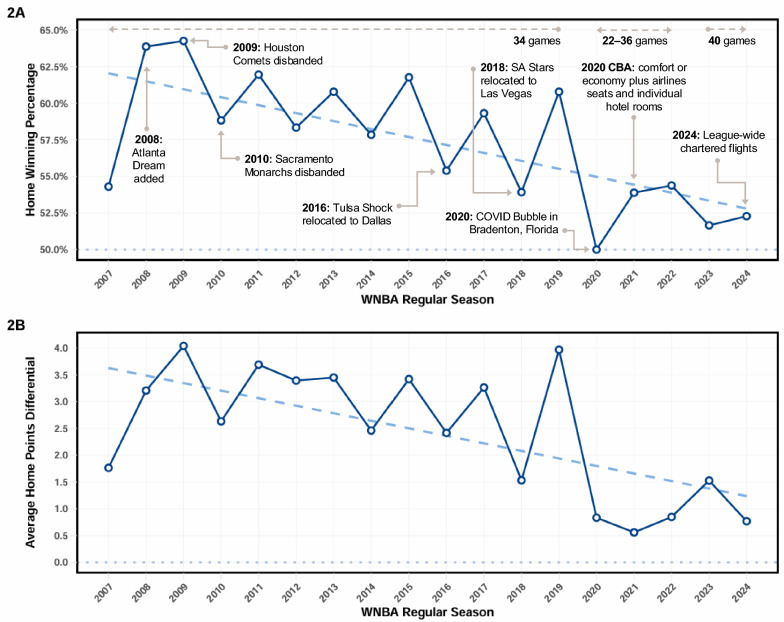
BACKGROUND: Travel-related fatigue and circadian disruption (i.e., jet lag) are well-established factors limiting performance in elite men's sport and are recognized contributors to home advantage. Yet evidence from women's professional leagues remains scarce. AIM: This study examined temporal trends in home-court advantage and assessed how cumulative travel burden and directional jet lag relate to performance in the Women's National Basketball Association (WNBA). METHODS: Game location, timing, and performance data from 3489 regular season WNBA games spanning 18 seasons (2007-2024) were analyzed using mixed-effects models adjusted for game time, team and opponent strength, and season. We quantified cumulative travel distance over the preceding seven days and directional jet lag based on eastward or westward travel adjusted for circadian resynchronization. RESULTS: Home-court advantage declined significantly over time (β = - 0.67, p = .002), from 64.3% in 2009 to 52.3% in 2024, coinciding with improved league-wide travel conditions. Greater recent travel distance was associated with worse performance among away teams (β = -0.04, p = .020), primarily driven by increased points conceded (β = 0.04, p = .018). Eastward jet lag was significantly associated with worse home team performance (β = -0.15, p = .049), with no such associations observed for westward jet lag or among away teams (all p ≥ .399). CONCLUSION: These findings provide the first large-scale evidence linking travel and circadian disruption to performance in the WNBA. Although home-court advantage has declined, travel-related challenges persist. Incorporating circadian principles into travel and recovery protocols may help improve performance, particularly as game schedules grow more congested with league expansion.
Overview
CoChat Summary
TL;DR
This study analyzed 3,489 WNBA regular-season games from 2007–2024 and found that home-court advantage declined significantly while travel-related factors remained associated with team performance. Greater recent travel distance was linked to worse away-team performance, and eastward jet lag was linked to worse home-team performance.
Key findings
- Home-court advantage declined significantly over 18 seasons (β = −0.67, p = .002), from 64.3% home win percentage in 2009 to 52.3% in 2024; home points differential also declined (β = −0.63, p = .005), from +4.0 points per game in 2009 to +0.8 in 2024.
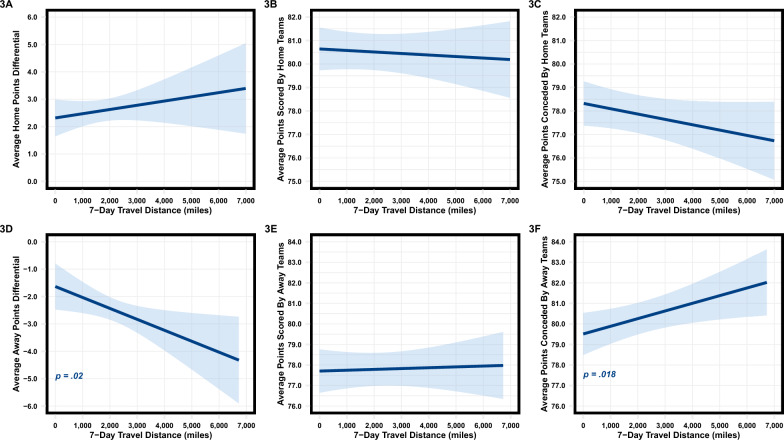
- Among away teams, greater cumulative travel distance over the prior 7 days was associated with worse points differential (β = −0.04, p = .020), driven by more points conceded (β = 0.04, p = .018); each additional 1,000 miles traveled corresponded to approximately 0.37 more points conceded. No significant associations were found for home teams.
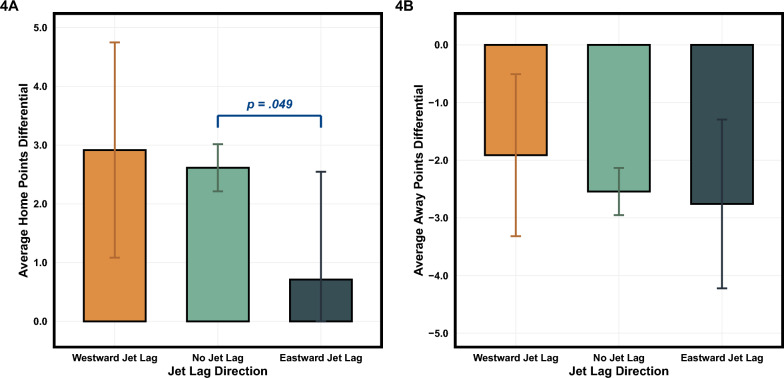
- Home teams with eastward jet lag had worse points differential than home teams with no jet lag (M = +0.69 vs +2.55; β = −0.15, p = .049). Westward jet lag and away-team jet lag showed no significant associations (all p ≥ .399).
Methods
- Retrospective analysis of 3,489 regular-season WNBA games from 18 seasons (2007–2024), compiled from ESPN.com via the wehoop R package and cross-referenced; the 2020 “Wubble” season was excluded from travel and jet lag analyses, as were Commissioner’s Cup Final games and two games with exceptional circumstances.
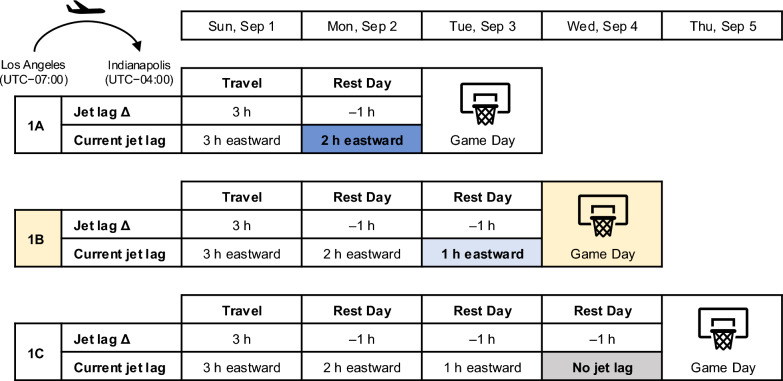
- Cumulative travel distance was calculated as miles traveled over the preceding 7 days using the Haversine formula; directional jet lag was estimated from time zones crossed minus 1 h/day resynchronization and coded as eastward, westward, or no jet lag.
- Mixed-effects linear models predicted team points differential, with travel distance and jet lag as primary predictors and covariates for game time, team/opponent strength, prior 10-day game congestion, and prior-game point differential; random intercepts for team and opponent were nested within season, and home and away games were analyzed separately.
Limitations
- The paper states that travel fatigue and circadian misalignment were estimated at the team level using a uniform 1-h/day resynchronization rate, so they do not account for inter- and intra-individual heterogeneity in circadian phase, circadian sensitivity, and sleep–wake behavior; estimates are approximations of average circadian misalignment.
- The paper states that travel distance and jet lag were based on game locations only because team itineraries, training venues, and practice schedules were not publicly available; the conservative assumption that teams departed immediately after each game may underestimate true travel demands and circadian disruption.
- The paper states that outcomes were global game performance indicators (point differential, points scored/conceded), not granular basketball statistics, and that residual contextual confounding and lack of a formal residual autocorrelation structure remain possible. Evident from the text: the observational design cannot establish causality, and the reported effect sizes are described as modest.
Model-written summary. Check it against the paper before relying on it.
Integrity signals
Registry
Cites
Statistics
Figures
Verification
Claims the paper makes
1 Valid · 2 Not valid · 40 Not checked · 80 Own results and interpretations
The sources with a verdict support this claim; the rest weren’t checked yet, have no full text we could read, or their verdicts aren’t rated yet.
In the paper
“As the average human endogenous circadian period is slightly longer than 24 h, humans have a natural tendency to delay rather than advance [67, 68].”
§ Home-Court Advantage and the Associations of Travel and Jet Lag with Team Performance in the Women’s National Basketball Association (WNBA) > Discussion > Directional Jet Lag and WNBA Team Performance
What the sources say
- Supportedcites [67] Khalsa SBS, Jewett ME, Cajochen C, Czeisler CA. A phase response curve to single bright light pulses in human subjects. J Physiol. 2003;549(3):945–52. 10.1113/jphysiol.2003.040477. 12717008 PMC2342968 source
The Discussion of Khalsa et al. (2003) refers explicitly to 'the longer-than-24 h average period expected for human subjects', and the Results/Discussion repeatedly adopt an average free-running (endogenous) circadian period of 24.18 h, i.e. a 0.18 h day-1 delay drift, as the baseline for the PRC analysis. That directly supports the claim's point that the average human endogenous period is slightly longer than 24 h. The only caveat is that this paper credits the 24.18 h value to Czeisler et al. 1999 rather than generating it, but it states and relies on it as its own working assumption, so the paraphrase is supported. (LLM, conf=0.85)
- Not checked yetcites [68] St Hilaire MA, Gooley JJ, Khalsa SBS, Kronauer RE, Czeisler CA, Lockley SW. Human phase response curve to a 1 h pulse of bright white light. J Physiol. 2012;590(13):3035–45. 10.1113/jphysiol.2012.227892. 22547633 PMC3406389 source
plain- Asserted: passes — The authors put it forward as true.
- Checkable: passes — It can be checked against evidence.
- Load-bearing: passes — The paper’s conclusions depend on it.
- Based: passes — The paper gives a reason why it holds.
- Supported
A result the paper reports from its own data — it cites no other source for it, so there is none to check. The quote shows it is in the paper.
In the paper
“Among home teams, cumulative travel distance over the prior seven days was not significantly associated with points differential (β = 0.02, 95% CI [−0.02, 0.05], t = 0.98, p = 0.325 and Fig. 3A), points scored (β = −0.01, 95% CI [–0.04, 0.03], t = –0.46, p = 0.647and Fig. 3B), or points conceded (β = −0.03, 95% CI [−0.06, 0.01], t = −1.59, p = 0.111 and Fig. 3C).”
§ Home-Court Advantage and the Associations of Travel and Jet Lag with Team Performance in the Women’s National Basketball Association (WNBA) > Results > Travel Distance and WNBA Team Performance
plain- Asserted: passes — The authors put it forward as true.
- Checkable: passes — It can be checked against evidence.
- Load-bearing: passes — The paper’s conclusions depend on it.
- Based: passes — The paper gives a reason why it holds.
A result the paper reports from its own data — it cites no other source for it, so there is none to check. The quote shows it is in the paper.
In the paper
“Home teams had a significantly worse points differential when playing with eastward jet lag compared to no jet lag.”
§ Home-Court Advantage and the Associations of Travel and Jet Lag with Team Performance in the Women’s National Basketball Association (WNBA) > Discussion > Directional Jet Lag and WNBA Team Performance
plainstates an association- Asserted: passes — The authors put it forward as true.
- Checkable: passes — It can be checked against evidence.
- Load-bearing: passes — The paper’s conclusions depend on it.
- Based: passes — The paper gives a reason why it holds.
A result the paper reports from its own data — it cites no other source for it, so there is none to check. The quote shows it is in the paper.
In the paper
“Adjusting for game time, team and opponent strength, jet lag, and game congestion, for every additional 1000 miles traveled, away teams conceded approximately 0.37 more points on average.”
§ Home-Court Advantage and the Associations of Travel and Jet Lag with Team Performance in the Women’s National Basketball Association (WNBA) > Results > Travel Distance and WNBA Team Performance
hedgedstates an association- Asserted: passes — The authors put it forward as true.
- Checkable: passes — It can be checked against evidence.
- Load-bearing: passes — The paper’s conclusions depend on it.
- Based: passes — The paper gives a reason why it holds.
A result the paper reports from its own data — it cites no other source for it, so there is none to check. The quote shows it is in the paper.
In the paper
“In contrast, among away teams, greater travel distance was significantly associated with worse points differential (β = −0.04, 95% CI [−0.07, −0.01], t = −2.32, p = 0.020 and Fig. 3D).”
§ Home-Court Advantage and the Associations of Travel and Jet Lag with Team Performance in the Women’s National Basketball Association (WNBA) > Results > Travel Distance and WNBA Team Performance
plainstates an association- Asserted: passes — The authors put it forward as true.
- Checkable: passes — It can be checked against evidence.
- Load-bearing: passes — The paper’s conclusions depend on it.
- Based: passes — The paper gives a reason why it holds.
42 more claims
Create a free account to see all 123 claims and to verify the 85 references still open.
- It may state two separate claims as one. 44
- Probably not a substantial claim. 47
Claims other papers make about this one
Each is checked against this paper’s own text: does it say what the citing paper says it does?
In the citing paper
“More recent WNBA evidence indicates that recent travel and jet lag may be associated with away-team performance”
From The Geography of Euroleague Basketball: Spatial Inequality, Travel Exposure and Home-Court Advantage in a Transnational League (2026) · cites this paper as Leota et al., 2026
In the citing paper
“The recent WNBA literature and broader travel research indicate that east-west direction and local start time can be more informative than distance alone (Huyghe et al., 2018;Leota et al., 2026).”
From The Geography of Euroleague Basketball: Spatial Inequality, Travel Exposure and Home-Court Advantage in a Transnational League (2026) · cites this paper as Leota et al., 2026
Self-check
Percentages, sums and reported differences re-computed from the paper’s own numbers.
Each contradiction between two passages listed here was confirmed by an independent check.
Rated minor: it would not touch a result — a value no result rests on, a p-value that stays on the same side of the significance level, or a conflict that is clerical, resolved elsewhere in the paper, or outside its own findings.
In the paper
§ Home-Court Advantage and the Associations of Travel and Jet Lag with Team Performance in the Women’s National Basketball Association (WNBA) > Discussion > Directional Jet Lag and WNBA Team Performance
“The magnitude of this difference (−1.86 points per game) is twice as large”
§ Home-Court Advantage and the Associations of Travel and Jet Lag with Team Performance in the Women’s National Basketball Association (WNBA) > Discussion > Directional Jet Lag and WNBA Team Performance
“the difference between the 6th (−2.68, Indiana Fever) and 9th (−3.30, Phoenix Mercury) best points differentials during the 2024 WNBA regular season.”
Rated minor: it would not touch a result — a value no result rests on, a p-value that stays on the same side of the significance level, or a conflict that is clerical, resolved elsewhere in the paper, or outside its own findings.
In the paper
§ Home-Court Advantage and the Associations of Travel and Jet Lag with Team Performance in the Women’s National Basketball Association (WNBA) > Results > Trends in WNBA Home Advantage
“In contrast, from 2018 through 2024, home teams won ≥ 55% of games in just one of seven (14%) seasons, reaching a low of 51.7% in 2023.”
§ Home-Court Advantage and the Associations of Travel and Jet Lag with Team Performance in the Women’s National Basketball Association (WNBA) > Results > Trends in WNBA Home Advantage
“Notably, home winning percentage was exactly 50.0% in the pandemic-impacted 2020 season which saw all games played at a neutral venue.”
Rated minor: it would not touch a result — a value no result rests on, a p-value that stays on the same side of the significance level, or a conflict that is clerical, resolved elsewhere in the paper, or outside its own findings.
In the paper
§ Home-Court Advantage and the Associations of Travel and Jet Lag with Team Performance in the Women’s National Basketball Association (WNBA) > Materials and Methods
“A total of 3489 regular season games (M = 205.24 per season, SD = 14.60) met the inclusion criteria for the travel and jet lag analyses.”
§ Home-Court Advantage and the Associations of Travel and Jet Lag with Team Performance in the Women’s National Basketball Association (WNBA) > Travel Predictors and Game Outcome Variables > Statistical Analysis
“| Total | 3493 | 100 | 3499 | 100 |”
Citations
Cites
Fitting Linear Mixed-Effects Models Using lme4
Bates, D., Mächler, M., Bolker, B., & Walker, S. (2015) · Journal of Statistical Software · doi:10.18637/jss.v067.i01 · Cited by 86,835
Stability, precision, and near-24-hour period of the human circadian pacemaker
Czeisler, C. A., Duffy, J. F., Shanahan, T. L., Brown, E. N., Mitchell, J. F., Rimmer, D. W., Ronda, J. M., Silva, E. J., Allan, J. S., Emens, J. S., et al. (1999) · Science · doi:10.1126/science.284.5423.2177 · Cited by 1,705
A Phase Response Curve to Single Bright Light Pulses in Human Subjects
Khalsa, S. B. S., Jewett, M. E., Cajochen, C., & Czeisler, C. A. (2003) · The Journal of Physiology · doi:10.1113/jphysiol.2003.040477 · Cited by 1,040
Bright light resets the human circadian pacemaker independent of the timing of the sleep-wake cycle
Czeisler, C. A., Allan, J. S., Strogatz, S. H., Ronda, J. M., Sánchez, R., Ríos, C. D., Freitag, W. O., Richardson, G. S., & Kronauer, R. E. (1986) · Science · doi:10.1126/science.3726555 · Cited by 770 · cited 1×
“Human circadian rhythms can be shifted earlier through a phase advance or later through a phase delay [66].”
Circadian Rhythms in Sports Performance—an Update
Drust, B., Waterhouse, J., Atkinson, G., Edwards, B., & Reilly, T. (2005) · Chronobiology International · doi:10.1081/cbi-200041039 · Cited by 636
Sex difference in the near-24-hour intrinsic period of the human circadian timing system
Duffy, J. F., Cain, S. W., Chang, A.-M., Phillips, A. J. K., Münch, M. Y., Gronfier, C., Wyatt, J. K., Dijk, D.-J., Wright, K. P., & Czeisler, C. A. (2011) · Proceedings of the National Academy of Sciences · doi:10.1073/pnas.1010666108 · Cited by 607
“Invisible sportswomen”: The sex data gap in sport and exercise science research
Cowley, E. S., Olenick, A. A., McNulty, K. L., & Ross, E. Z. (2021) · Women in Sport and Physical Activity Journal · doi:10.1123/wspaj.2021-0028 · Cited by 449 · cited 1×
“Second, unlike the vast majority of sports and exercise science research which centers on men athletes, this study addressed an important gap by focusing on professional women athletes, a critically underrepresented population in the field [75].”
Jet lag: trends and coping strategies
Waterhouse, J., Reilly, T., Atkinson, G., & Edwards, B. (2007) · The Lancet · doi:10.1016/s0140-6736(07)60529-7 · Cited by 430
Home Advantage in Sport: An Overview of Studies on the Advantage of Playing at Home
Nevill, A. M., & Holder, R. L. (1999) · Sports Medicine · doi:10.2165/00007256-199928040-00001 · Cited by 383
Spherical Trigonometry [R package geosphere version 1.5-10]
Hijmans, R. J. (2019) · Cited by 348
Sex Differences in Phase Angle of Entrainment and Melatonin Amplitude in Humans
Cain, S. W., Dennison, C. F., Zeitzer, J. M., Guzik, A. M., Khalsa, S. B. S., Santhi, N., Schoen, M. W., Czeisler, C. A., & Duffy, J. F. (2010) · Journal of Biological Rhythms · doi:10.1177/0748730410374943 · Cited by 330
Pollard, R., & Pollard, G. (2005) · Journal of Sports Sciences · doi:10.1080/02640410400021559 · Cited by 278
Human phase response curve to a 1 h pulse of bright white light
St Hilaire, M. A., Gooley, J. J., Khalsa, S. B. S., Kronauer, R. E., Czeisler, C. A., & Lockley, S. W. (2012) · The Journal of Physiology · doi:10.1113/jphysiol.2012.227892 · Cited by 277
Sleep, circadian rhythms, and athletic performance
Thun, E., Bjorvatn, B., Flo, E., Harris, A., & Pallesen, S. (2015) · Sleep Medicine Reviews · doi:10.1016/j.smrv.2014.11.003 · Cited by 262
The Impact of Circadian Phenotype and Time since Awakening on Diurnal Performance in Athletes
Facer-Childs, E., & Brandstaetter, R. (2015) · Current Biology · doi:10.1016/j.cub.2014.12.036 · Cited by 234
Self-citationThe Home Field Advantage in Athletics: A Meta‐Analysis
Jamieson, J. P. (2010) · Journal of Applied Social Psychology · doi:10.1111/j.1559-1816.2010.00641.x · Cited by 205
Sex differences in the circadian misalignment effects on energy regulation
Qian, J., Morris, C. J., Caputo, R., Wang, W., Garaulet, M., & Scheer, F. A. J. L. (2019) · Proceedings of the National Academy of Sciences · doi:10.1073/pnas.1914003116 · Cited by 140
Novel Approaches for Assessing Circadian Rhythmicity in Humans: A Review
Dijk, D.-J., & Duffy, J. F. (2020) · Journal of Biological Rhythms · doi:10.1177/0748730420940483 · Cited by 138
Samuels, C. H. (2012) · Clinical Journal of Sport Medicine · doi:10.1097/jsm.0b013e31824d2eeb · Cited by 128
The effect of high altitude commercial air travel on oxygen saturation
Humphreys, S. D. M., Deyermond, R. E., Bali, I., Stevenson, M., & Fee, J. P. H. (2005) · Anaesthesia · doi:10.1111/j.1365-2044.2005.04124.x · Cited by 123
Waterhouse, J., Reilly, T., & Edwards, B. (2004) · Journal of Sports Sciences · doi:10.1080/02640410400000264 · Cited by 110
Effect of airline travel on performance: a review of the literature
Leatherwood, W. E., & Dragoo, J. L. (2013) · British Journal of Sports Medicine · doi:10.1136/bjsports-2012-091449 · Cited by 108
Chellappa, S. L., Steiner, R., Oelhafen, P., & Cajochen, C. (2017) · Scientific Reports · doi:10.1038/s41598-017-13973-1 · Cited by 105 · cited 1×
“In an evolving evidence base, there are also reports of sex differences in light responsiveness and photic resetting [41, 42], which have further implications for entrainment capacity.”
Waterhouse, J., Edwards, B., Nevill, A., Carvalho, S., Atkinson, G., Buckley, P., Reilly, T., Godfrey, R., & Ramsay, R. (2002) · British Journal of Sports Medicine · doi:10.1136/bjsm.36.1.54 · Cited by 92
Greater Effect of East versus West Travel on Jet Lag, Sleep, and Team Sport Performance
FOWLER, P. M., KNEZ, W., CROWCROFT, S., MENDHAM, A. E., MILLER, J., SARGENT, C., HALSON, S., & DUFFIELD, R. (2017) · Medicine & Science in Sports & Exercise · doi:10.1249/mss.0000000000001374 · Cited by 87
Lastella, M., Roach, G. D., & Sargent, C. (2018) · Sleep Health · doi:10.1016/j.sleh.2018.10.013 · Cited by 75
Effect of time zone and game time changes on team performance: National Football League
JEHUE, R., STREET, D., & HUIZENGA, R. (1993) · Medicine & Science in Sports & Exercise · doi:10.1249/00005768-199301000-00017 · Cited by 74
Huyghe, T., Scanlan, A. T., Dalbo, V. J., & Calleja-González, J. (2018) · Sports · doi:10.3390/sports6030089 · Cited by 71
Roy, J., & Forest, G. (2018) · Journal of Sleep Research · doi:10.1111/jsr.12565 · Cited by 68
Interventions to Minimize Jet Lag After Westward and Eastward Flight
Roach, G. D., & Sargent, C. (2019) · Frontiers in Physiology · doi:10.3389/fphys.2019.00927 · Cited by 65
How to manage travel fatigue and jet lag in athletes? A systematic review of interventions
Janse van Rensburg, D. C., Jansen van Rensburg, A., Fowler, P., Fullagar, H., Stevens, D., Halson, S., Bender, A., Vincent, G., Claassen-Smithers, A., Dunican, I., et al. (2020) · British Journal of Sports Medicine · doi:10.1136/bjsports-2019-101635 · Cited by 64
How jet lag impairs Major League Baseball performance
Song, A., Severini, T., & Allada, R. (2017) · Proceedings of the National Academy of Sciences · doi:10.1073/pnas.1608847114 · Cited by 61
Baseball teams beaten by jet lag
Recht, L. D., Lew, R. A., & Schwartz, W. J. (1995) · Nature · doi:10.1038/377583a0 · Cited by 60
Evidence of gender imbalance across samples in sport and exercise psychology
Walton, C. C., Gwyther, K., Gao, C. X., Purcell, R., & Rice, S. M. (2024) · International Review of Sport and Exercise Psychology · doi:10.1080/1750984x.2022.2150981 · Cited by 57
McHill, A. W., & Chinoy, E. D. (2020) · Scientific Reports · doi:10.1038/s41598-020-78901-2 · Cited by 52
Bayesian analysis of home advantage in North American professional sports before and during COVID-19
Higgs, N., & Stavness, I. (2021) · Scientific Reports · doi:10.1038/s41598-021-93533-w · Cited by 49
Gold, silver or bronze: circadian variation strongly affects performance in Olympic athletes
Lok, R., Zerbini, G., Gordijn, M. C. M., Beersma, D. G. M., & Hut, R. A. (2020) · Scientific Reports · doi:10.1038/s41598-020-72573-8 · Cited by 44
Greater sensitivity of the circadian system of women to bright light, but not dim‐to‐moderate light
Vidafar, P., McGlashan, E. M., Burns, A. C., Anderson, C., Shechter, A., Lockley, S. W., Phillips, A. J. K., & Cain, S. W. (2024) · Journal of Pineal Research · doi:10.1111/jpi.12936 · Cited by 42
Measuring Circadian Advantage in Major League Baseball: A 10-Year Retrospective Study
Winter, W. C., Hammond, W. R., Green, N. H., Zhang, Z., & Bliwise, D. L. (2009) · International Journal of Sports Physiology and Performance · doi:10.1123/ijspp.4.3.394 · Cited by 41
Facility familiarity and the home advantage in professional sports
Loughead, T. M., Carron, A. V., Bray, S. R., & Kim, A. J. (2003) · International Journal of Sport and Exercise Psychology · doi:10.1080/1612197x.2003.9671718 · Cited by 40
The Negative Effects of Travel on Student Athletes Through Sleep and Circadian Disruption
Heller, H. C., Herzog, E. D., Brager, A. J., Poe, G. R., Allada, R., Scheer, F. A. J. L., Carskadon, M. A., de la Iglesia, H. O., Jang, R. S., Montero, A., et al. (2023) · Journal of Biological Rhythms · doi:10.1177/07487304231207330 · Cited by 40
Re‐entrainment of circadian rhythm of plasma melatonin on an 8‐h eastward flight
Takahashi, T., Sasaki, M., Itoh, H., Sano, H., Yamadera, W., Ozone, M., Obuchi, K., Nishimura, H., & Matsunaga, N. (1999) · Psychiatry and Clinical Neurosciences · doi:10.1046/j.1440-1819.1999.00537.x · Cited by 37
Detrimental effects of West to East transmeridian flight on jump performance
Chapman, D. W., Bullock, N., Ross, A., Rosemond, D., & Martin, D. T. (2012) · European Journal of Applied Physiology · doi:10.1007/s00421-011-2134-6 · Cited by 34
Urgent wake up call for the National Basketball Association
Singh, M., Bird, S., Charest, J., Huyghe, T., & Calleja-Gonzalez, J. (2021) · Journal of Clinical Sleep Medicine · doi:10.5664/jcsm.8938 · Cited by 30
Loat, C. E. R., & Rhodes, E. C. (1989) · Sports Medicine · doi:10.2165/00007256-198908040-00003 · Cited by 29
Home Advantage in Sport: Causes and the Effect on Performance
Gómez-Ruano, M. A., Pollard, R., & Lago-Peñas, C. (2021) · doi:10.4324/9781003081456 · Cited by 27
Leota, J., Hoffman, D., Czeisler, M. É., Mascaro, L., Drummond, S. P. A., Anderson, C., Rajaratnam, S. M. W., & Facer-Childs, E. R. (2022) · Frontiers in Physiology · doi:10.3389/fphys.2022.892681 · Cited by 27
Self-citationNBA team home advantage: Identifying key factors using an artificial neural network
Harris, A. R., & Roebber, P. J. (2019) · PLOS ONE · doi:10.1371/journal.pone.0220630 · Cited by 24
Effects of Long-Haul Travel on Recovery and Performance in Elite Athletes: A Systematic Review
Rossiter, A., Warrington, G. D., & Comyns, T. M. (2022) · Journal of Strength & Conditioning Research · doi:10.1519/jsc.0000000000004021 · Cited by 23
Leota, J., Hoffman, D., Mascaro, L., Czeisler, M. E., Nash, K., Drummond, S. P. A., Anderson, C., Rajaratnam, S. M. W., & Facer-Childs, E. R. (2022) · Journal of Sports Sciences · doi:10.1080/02640414.2022.2154933 · Cited by 23
Self-citationHorgan, B. G., Drew, M. K., Halson, S. L., Piromalli, L. E., Drinkwater, E. J., Chapman, D. W., & Haff, G. G. (2021) · Scandinavian Journal of Medicine & Science in Sports · doi:10.1111/sms.13866 · Cited by 22
Influence of Match Congestion on Performances in the National Basketball Association
Yang, J., Wu, C., Zhou, C., Zhang, S., Leicht, A. S., & Gomez, M.-Á. (2021) · Frontiers in Psychology · doi:10.3389/fpsyg.2021.630769 · Cited by 22
Cook, J. D., Charest, J., Walch, O., & Bender, A. M. (2022) · Chronobiology International · doi:10.1080/07420528.2022.2113093 · Cited by 21
Self-citationCharest, J., Cook, J. D., Bender, A. M., Walch, O., Grandner, M. A., & Samuels, C. H. (2022) · Journal of science and medicine in sport · doi:10.1016/j.jsams.2022.10.005 · Cited by 20
Self-citationSansone, P., Gasperi, L., Conte, D., Scanlan, A. T., Sampaio, J., & Gómez-Ruano, M. Á. (2024) · Journal of Sports Sciences · doi:10.1080/02640414.2024.2409557 · Cited by 20
Botonis, P. G., Toubekis, A. G., Hill, D. W., & Mündel, T. (2025) · Experimental Physiology · doi:10.1113/ep091831 · Cited by 17
Impact of jet lag on free throw shooting in the National Basketball Association
Glinski, J., & Chandy, D. (2022) · Chronobiology International · doi:10.1080/07420528.2022.2057321 · Cited by 16
Wang, X., Zhang, S., Gasperi, L., Robertson, S., & Ruano, M. A. G. (2023) · Chaos, Solitons & Fractals · doi:10.1016/j.chaos.2023.113698 · Cited by 13
Zacharko, M., Konefał, M., Radzimiński, Ł., Chmura, P., Błażejczyk, K., Chmura, J., & Andrzejewski, M. (2022) · Research in Sports Medicine · doi:10.1080/15438627.2020.1853545 · Cited by 11
Mascaro, L., Leota, J., Hoffman, D., Rajaratnam, S. M. W., Drummond, S. P. A., & Facer‐Childs, E. R. (2024) · Journal of Sleep Research · doi:10.1111/jsr.14186 · Cited by 11
Self-citationBové, D. S., Seibold, H., Boulesteix, A., Manitz, J., Gasparini, A., Günhan, B. K., Boix, O., Schüler, A., Fillinger, S., Nahnsen, S., et al. (2026) · Drug Discovery Today · doi:10.1016/j.drudis.2026.104613 · Cited by 8
Investigation of the effect of circadian rhythm on the performances of NBA teams
Özdalyan, F., Çene, E., Gümüş, H., & Açıkgöz, O. (2024) · Chronobiology International · doi:10.1080/07420528.2024.2325641 · Cited by 8
Mateus, N., Gonçalves, B., & Sampaio, J. (2021) · Home Advantage in Sport · doi:10.4324/9781003081456-23 · Cited by 6
The Home Advantage Phenomenon in Sport
Gómez-Ruano, M. A., & Pollard, R. (2021) · Home Advantage in Sport · doi:10.4324/9781003081456-2 · Cited by 5
The Influence of Travel in the Home Advantage Effect
Clements, E., Fowler, P. M., & Duffield, R. (2021) · Home Advantage in Sport · doi:10.4324/9781003081456-14 · Cited by 3
Circadian variation in coaches’ decision-making in the National Football League’s evening games
Bourgon, V., Duval, F. G., & Forest, G. (2024) · Chronobiology International · doi:10.1080/07420528.2024.2393880 · Cited by 3
Uchiyama, K., Peeling, P., Halson, S. L., Reid, M., Wallman, K., Walsh, J., Russell, S., Thomas, S., & Girard, O. (2025) · International Journal of Sports Physiology and Performance · doi:10.1123/ijspp.2024-0328 · Cited by 3
How different weekly game loads affect performance in elite women’s EuroLeague basketball
Gasperi, L., Wang, X., Gómez, M.-Á., Filho, E., Sampaio, J., & Gong, B. (2026) · International Journal of Performance Analysis in Sport · doi:10.1080/24748668.2025.2552584 · Cited by 2
Integrating a Practical Sport Analytics Course into Sport Management Education
Congelio, B. J. (2024) · The COSMA journal. · doi:10.25035/cosma.01.01.07 · Cited by 2
(1999) · Journal of sport behavior
Research works printed but not linked: 1
- Cohen K. Stop the work stoppages: a mixed-mode dispute resolution process to prevent an NBA lockout or strike. Cardozo Arts Entertain Law J. 2026;44(1):205.
Cited by
STUPARIU, M. I., FEFLEA, I., & GHERDAN, J.-M. (2026) · GeoSport for Society · doi:10.30892/gss.2506-156
Metadata
- Authors
- Leota, J., Miller, D. J., Czeisler, M. É., Cook, J., Mascaro, L., Smithies, T. D., Nelthropp, A., & Facer-Childs, E. R.
- Affiliations
- Brigham and Women's Hospital (US)
- Central Queensland University (AU)
- University of Wisconsin–Madison (US)
- Monash University (AU)
- Corresponding author
- Leota, Josh
- Venue
- Sports Medicine - Open
- Published
- 2026-07-09
- Volume
- 12
- Issue
- 1
- ISSN
- 2198-9761 (ISSN-L)
- PMC
- PMC13350567
- OpenAlex
- W7167849162
- Cited by
- 1
- References
- 70
- Citations by year
- 2026: 1
- FWCI
- 3.26
- Type
- journal article
- Language
- en
- Open access
- gold
- doi.org
- Licence
- cc-by-nc-nd
- creativecommons.org/licenses/by-nc-nd/4.0 (tdm)
- creativecommons.org/licenses/by-nc-nd/4.0 (vor)
- Locations
- Sports Medicine - Open (publishedVersion, cc-by-nc-nd)
- PubMed (publishedVersion)
- PubMed Central (publishedVersion, cc-by-nc-nd)
- DOAJ (DOAJ: Directory of Open Access Journals) (submittedVersion)
- Funders
- Wu Tsai Human Performance Alliance
- Monash University
- Topics
- Social Sciences › Economics, Econometrics and Finance › Economics and Econometrics › Sports Analytics and Performance
- Health Sciences › Medicine › Orthopedics and Sports Medicine › Sports Performance and Training
- Social Sciences › Psychology › Developmental and Educational Psychology › Sport Psychology and Performance
- Keywords
- home court advantage, travel fatigue, jet lag, circadian rhythm disruption, women's professional basketball, WNBA, team performance, game scheduling, recovery protocols
About these checks
Registry, retraction, Cites and statistics results are computed, not judged, with one exception: a printed reference that no index lists is read once by a model before it counts as a citation error. Claims are extracted by a model and kept only when their quote appears verbatim in the text; each cited source is then checked, with a model’s help, for whether it says what the claim relies on. Those verdicts can be wrong — read the claim’s quote and the cited source before relying on one.
A language model drew the claims from the paper on 2026-11-19, under version 3 of the claim definition (model deepseek-v4.1-flash, prompt extract-v3).
A second model labelled each claim on 2026-11-19 (model jev-1.13-20260917, definition revision gold-guideline-v0.2).
Cited sources are checked with a language model’s help (qwen3.8-omni-flash).
Statistics and arithmetic are recomputed, not judged.
Confidence bands are shown only for fields calibrated on our annotated test set. None is calibrated yet, so no band is shown.
What counts as a claim ›How we measure confidence ›How we check this ›
Are you an author, or do you see a problem with this page? Request a review
Data sources
Bibliographic data: Semantic Scholar, OpenAlex, Crossref.
Contains information from the Semantic Scholar Academic Graph Datasets, made available under the ODC Attribution License (ODC-BY 1.0).
Semantic Scholar’s data is described in: Kinney, R., et al. (2023). The Semantic Scholar Open Data Platform. arXiv:2301.10140.
