

A brief CBT intervention for depersonalisation/derealisation in psychosis: study protocol for a feasibility randomised controlled trial
Open accessThe DOI matches its Crossref record; 46 of the 49 references it cites were found in a registry or an index; 8 of the 42 sources its claims cite were checked for support.
Abstract
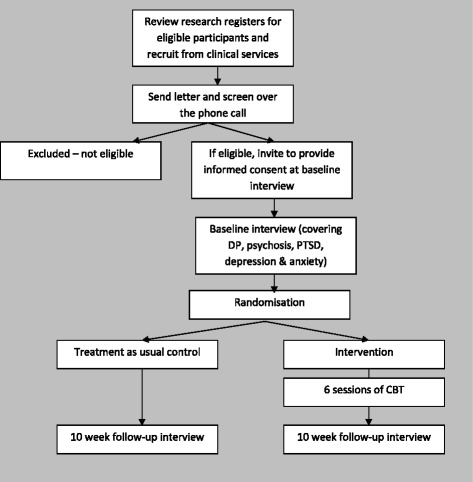
Background: Depersonalisation is the experience of being detached or disconnected from one's experience. Studies suggest that clinically significant levels of depersonalisation are common in individuals who have psychotic symptoms and are associated with increased impairment. However, to date, there have been no studies that have investigated an intervention designed to target clinically significant depersonalisation in such patient groups. This study aims to determine the feasibility and acceptability of a brief intervention targeting clinically significant depersonalisation in those who also have current psychotic symptoms. Methods/design: The feasibility of delivering six sessions of cognitive behavioural therapy for depersonalisation in psychosis patients will be evaluated using a single-blinded randomised controlled trial with a treatment as usual control condition. Participants will be assessed at baseline and then randomised to either the treatment or control arm. Participants randomised to the treatment arm will be offered six sessions of individual cognitive behavioural therapy delivered over a maximum of 10 weeks. Therapy will focus on an individualised shared formulation of depersonalisation experiences and behavioural, cognitive, emotional regulation and thinking process strategies to decrease distress associated with depersonalisation. Participants will be assessed again at a 10-week (post-randomisation) follow-up assessment. The primary outcomes of interest will be those assessing the feasibility and acceptability of the intervention including rates of referral, eligibility and acceptance to participate; attendance at therapy sessions and completion of homework tasks; satisfaction with the intervention; maintenance of blinding; and therapist competence. Secondary outcomes will be data on clinical outcome measures of depersonalisation and positive symptoms of psychosis, anxiety, depression and post-traumatic stress. Discussion: This study will determine the feasibility of delivering six sessions of cognitive behavioural therapy for individuals with current psychotic symptoms who also experience clinically significant levels of depersonalisation. The results will provide information to inform a larger randomised trial to assess intervention efficacy. © 2016 The Author(s).
Overview
CoChat Summary
## TL;DR
This is a study protocol for a single-blinded feasibility RCT testing whether six sessions of CBT for depersonalisation can be delivered to adults with current psychotic symptoms and clinically significant depersonalisation. The trial is designed to assess feasibility and acceptability, not efficacy, and to generate parameters for a later larger trial.
## Key findings
- The planned sample is 30 adults aged 18–70 with current psychotic symptoms and depersonalisation above the Cambridge Depersonalisation Scale (CDS) threshold of 75.
- Participants in the intervention arm will receive six individual CBT sessions over a maximum of 10 weeks, alongside treatment as usual.
- The primary outcomes are feasibility/acceptability metrics: referral, eligibility, acceptance, attendance, homework completion, satisfaction, maintenance of blinding, and therapist competence.
- The study will collect secondary clinical outcome data on depersonalisation, positive psychotic symptoms, anxiety, depression, and post-traumatic stress, but the paper does not report results because it is a protocol.
## Methods
- Design: Single-blinded randomised controlled feasibility trial with a treatment as usual control condition; baseline and 10-week post-randomisation follow-up assessments.
- Sample/data: Planned recruitment of 30 adults aged 18–70 from a secondary care mental health trust in South London; inclusion required current psychotic symptoms and DPD-level depersonalisation, with several exclusions including insufficient capacity, insufficient English, intellectual disability, head injury, substance misuse, organic psychosis cause, or current psychotherapy/CBT.
- Analysis: Primarily descriptive; feasibility estimated using proportions and 95% CIs, with continuous variables summarised by mean, SD, median, and IQR.
## Limitations
- The paper explicitly states this is a feasibility study and no a priori power calculation was conducted; it is not powered to detect statistically significant differences.
- The text makes evident that it is a protocol, so no outcome data or efficacy conclusions are reported yet.
- The study is limited to a single secondary care trust in South London and excludes people with limited English or current psychotherapy, which may constrain generalisability.
Model-written summary. Check it against the paper before relying on it.
Integrity signals
Registry
Cites
Statistics
Figures
Verification
Claims the paper makes
6 Valid · 0 Not valid · 25 Not checked · 8 Own results and interpretations
Every source the paper cites for this claim was checked and supports it.
In the paper
“It is also now well established that rates of trauma are high in psychosis [15].”
§ A brief CBT intervention for depersonalisation/derealisation in psychosis: study protocol for a feasibility randomised controlled trial > Background > Dissociation and psychosis—common factors or pathway?
What the sources say
- Supportedcites [15] Varese F Smeets F Drukker M Lieverse R Lataster T Viechtbauer W Childhood adversities increase the risk of psychosis: a meta-analysis of patient-control, prospective- and cross-sectional cohort studies Schizophr Bull 2012 38 4 661 71 10.1093/schbul/sbs050 22461484 PMC3406538 source
The Results (Sensitivity Analyses; page unavailable) report a significant association between childhood adversity and psychosis in patient-control studies. The Discussion likewise describes childhood trauma as substantially associated with psychosis, supporting the broad statement that trauma is common among people with psychosis. The paper’s evidence specifically concerns childhood trauma and adversity. (LLM, conf=0.85)
boosted- Asserted: passes — The authors put it forward as true.
- Checkable: passes — It can be checked against evidence.
- Load-bearing: unclear — It is unclear whether the paper’s conclusions depend on it.
- Based: passes — The paper gives a reason why it holds.
- Supported
The cited sources support only part of this claim — read each source’s verdict below.
In the paper
“Recent population-based studies in both the UK and the United States of America (USA) show high rates of lifetime experiences of sexual and physical abuse in those diagnosed with a psychotic disorder [16, 17].”
§ A brief CBT intervention for depersonalisation/derealisation in psychosis: study protocol for a feasibility randomised controlled trial > Background > Dissociation and psychosis—common factors or pathway?
What the sources say
- Partly supportedcites [16] Bebbington PE Bhugra D Brugha T Singleton N Farrell M Jenkins R Psychosis, victimisation and childhood disadvantage: evidence from the second British National Survey of psychiatric morbidity Br J Psychiatry 2004 185 220 6 10.1192/bjp.185.3.220 15339826 sourceExperimental — accuracy not yet measured
The Results report that a UK population-survey group with definite or probable psychosis had the highest prevalence of nearly all the victimisation experiences studied, with the largest odds ratio for sexual abuse. The paper also examines violence in the home and assault, but does not clearly identify these measures as respondents’ experiences of physical abuse. The USA finding is not assessed here because the sentence also cites another source. (LLM, conf=0.82)
- Not checked — no full text of the sourcecites [17] Shevlin M Dorahy MT Adamson G Trauma and psychosis: an analysis of the National Comorbidity Survey Am J Psychiatr 2007 164 166 9 10.1176/ajp.2007.164.1.166 17202562 source
plainstates an association- Asserted: passes — The authors put it forward as true.
- Checkable: passes — It can be checked against evidence.
- Load-bearing: unclear — It is unclear whether the paper’s conclusions depend on it.
- Based: passes — The paper gives a reason why it holds.
- Partly supported
Every source the paper cites for this claim was checked and supports it.
In the paper
“Further, in a critical review of studies examining trauma in those with severe mental illnesses, rates of trauma exposure were between 49 and 100 % [18].”
§ A brief CBT intervention for depersonalisation/derealisation in psychosis: study protocol for a feasibility randomised controlled trial > Background > Dissociation and psychosis—common factors or pathway?
What the sources say
- Supportedcites [18] Grubaugh AL Zinzow HM Paul L Egede LE Frueh BC Trauma exposure and posttraumatic stress disorder in adults with severe mental illness: a critical review Clin Psychol Rev 2011 31 6 883 99 10.1016/j.cpr.2011.04.003 21596012 PMC3148295 source
The review’s “Traumatic Event Exposure” section states that trauma exposure among individuals with severe mental illness ranged from 49% to 100% in the study samples. Its Introduction identifies the paper as a review of trauma exposure in adults with severe mental illness. (LLM, conf=0.95)
plain- Asserted: passes — The authors put it forward as true.
- Checkable: passes — It can be checked against evidence.
- Load-bearing: unclear — It is unclear whether the paper’s conclusions depend on it.
- Based: passes — The paper gives a reason why it holds.
- Supported
A claim is checked only against the cited paper’s full text, never its abstract, and none is available for its sources.
In the paper
“Studies suggest that clinically significant levels of depersonalisation are common in individuals who have psychotic symptoms and are associated with increased impairment.”
- Also stated in: § Summary and research questions · hedged
“Depersonalisation symptoms appear to be prevalent in people diagnosed with psychotic disorders and when present, depersonalisation symptoms are linked with more severe psychotic symptoms.”
§ A brief CBT intervention for depersonalisation/derealisation in psychosis: study protocol for a feasibility randomised controlled trial > Abstract > Background
What the sources say
- Not checked — no full text of the sourcecites [25] Schafer I Aderhold V Freyberger HJ Spitzer C Moskowitz A Schafer I Dorahy MJ Dissociative symptoms in schizophrenia Psychosis, trauma and dissociation: emerging perspectives on severe psychopathology 2008 Chichester Wiley-Blackwell 151 64 source
- Not checked — no full text of the sourcecites [26] Perona-Garcelan S Carrascoso-Lopez F Garcia-Montes JM Vallina-Fernandez O Perez-Alverez M Ductor-Recuerda MJ Depersonalisation as a mediator in the relationship between self-focused attention and auditory hallucinations J Trauma Dissociation 2011 12 5 535 48 10.1080/15299732.2011.602181 21967180 source
- Not checked — no full text of the sourcecites [27] Perona-Garcelan S Garcia-Montes JM Ductor-Recuerda MJ Vallina-Fernandez O Cuevas-Yust C Perez-Alverez M Relationship of metacognition, absorption, and depersonalisation in patients with auditory hallucinations Br J Clin Psychol 2012 51 100 18 10.1111/j.2044-8260.2011.02015.x 22268544 source
- Not checked — no full text of the sourcecites [28] Cernis E, Dunn G, Startup H, Kingdon D, Wingham G, Pugh K et al. Depersonalisation in patients with persecutory delusions. Journal of Nervous and Mental Disease. 2014;202(10). doi:10.1097/NMD.0000000000000185. 25198701 source
hedgedstates an association- Asserted: passes — The authors put it forward as true.
- Checkable: passes — It can be checked against evidence.
- Load-bearing: passes — The paper’s conclusions depend on it.
- Based: passes — The paper gives a reason why it holds.
- Also stated in: § Summary and research questions · hedged
In the paper
“Considering the well-established link between trauma and dissociation and the high rates of trauma experiences in psychosis, it is therefore not surprising that dissociation is also common in psychosis [19].”
§ A brief CBT intervention for depersonalisation/derealisation in psychosis: study protocol for a feasibility randomised controlled trial > Background > Dissociation and psychosis—common factors or pathway?
What the sources say
- Not checked — no full text of the sourcecites [19] Pilton M Varese F Berry K Bucci S The relationship between dissociation and voices: a systematic literature review and meta-analysis Clin Psychol Rev 2015 40 138 55 10.1016/j.cpr.2015.06.004 26117061 source
boostedstates an association- Asserted: passes — The authors put it forward as true.
- Checkable: passes — It can be checked against evidence.
- Load-bearing: passes — The paper’s conclusions depend on it.
- Based: passes — The paper gives a reason why it holds.
12 more claims
Create a free account to see all 39 claims and every source verdict.
- Probably not a substantial claim. 21
- It may state two separate claims as one. 7
Citations
Cites
An inventory for measuring depression
BECK, A. T. (1961) · Archives of General Psychiatry · doi:10.1001/archpsyc.1961.01710120031004 · Cited by 38,032 · cited 1×
“– Beck Depression Inventory (BDI; [38]).”
An inventory for measuring clinical anxiety: Psychometric properties.
Beck, A. T., Epstein, N., Brown, G., & Steer, R. A. (1988) · Journal of Consulting and Clinical Psychology · doi:10.1037/0022-006x.56.6.893 · Cited by 14,407 · cited 1×
“– Beck Anxiety Inventory (BAI; [39]).”
CONSORT 2010 Statement: updated guidelines for reporting parallel group randomised trials
the CONSORT Group, Schulz, K. F., Altman, D. G., & Moher, D. (2010) · BMC Medicine · doi:10.1186/1741-7015-8-18 · Cited by 13,371
CONSORT 2010 Statement: updated guidelines for reporting parallel group randomised trials
Schulz, K. F., Altman, D. G., Moher, D., & for the CONSORT Group (2010) · BMJ · doi:10.1136/bmj.c332 · Cited by 9,329
Scoville, W. B. (1949) · Journal of neurosurgery · doi:10.3171/jns.1949.6.1.0065 · Cited by 7,381
Foa, E. B., Cashman, L., Jaycox, L., & Perry, K. (1997) · Psychological Assessment · doi:10.1037/1040-3590.9.4.445 · Cited by 2,709 · cited 1×
“– Post-traumatic Diagnosis Scale (PDS; [40].”
Varese, F., Smeets, F., Drukker, M., Lieverse, R., Lataster, T., Viechtbauer, W., Read, J., van Os, J., & Bentall, R. P. (2012) · Schizophrenia Bulletin · doi:10.1093/schbul/sbs050 · Cited by 2,436 · cited 1×
“It is also now well established that rates of trauma are high in psychosis [15].”
BackgroundCONSORT 2010 statement: Updated guidelines for reporting parallel group randomised trials
Schulz, K. F., Altman, D. G., & Moher, D. (2010) · Journal of Pharmacology and Pharmacotherapeutics · doi:10.4103/0976-500x.72352 · Cited by 2,165
A cognitive model of the positive symptoms of psychosis
GARETY, P. A., KUIPERS, E., FOWLER, D., FREEMAN, D., & BEBBINGTON, P. E. (2001) · Psychological Medicine · doi:10.1017/s0033291701003312 · Cited by 1,546 · cited 2×
“Depersonalisation symptoms could be considered a type of anomalous experience [23, 28], and although to the authors’ knowledge there are no empirical studies which have explored the appraisals of depersonalisation symptoms in those with psychosis, and in particular whether these symptoms might give rise to psychotic e…”
BackgroundWhat is a pilot or feasibility study? A review of current practice and editorial policy
Arain, M., Campbell, M. J., Cooper, C. L., & Lancaster, G. A. (2010) · BMC Medical Research Methodology · doi:10.1186/1471-2288-10-67 · Cited by 1,483 · cited 1×
“As this is a feasibility study and the aim is to provide estimates of key parameters for a future trial rather than to power the current study to detect statistically significant differences, an a priori power calculation was not conducted [32].”
BackgroundDIAGNOSTIC AND STATISTICAL MANUAL OF MENTAL DISORDERS, FIFTH EDITION
Abbas, A., & Aminoroaia, M. (2013) · Cited by 1,479
HADDOCK, G., McCARRON, J., TARRIER, N., & FARAGHER, E. B. (1999) · Psychological Medicine · doi:10.1017/s0033291799008661 · Cited by 1,461 · cited 1×
“– The Psychotic Symptom Rating Scale (PSYRATS; [37]).”
On the use of a pilot sample for sample size determination
Browne, R. H. (1995) · Statistics in Medicine · doi:10.1002/sim.4780141709 · Cited by 1,007 · cited 1×
“Population variances will be determined using the upper 80th nonparametric bootstrap percentile of confidence intervals around the estimates [42].”
MethodCognitive Therapy of Substance Abuse
Beck, A. T., Wright, F. D., Newman, C. F., Liese, B. S., & Stein, D. J. (1995) · Journal of Cognitive Psychotherapy · doi:10.1891/0889-8391.9.2.136 · Cited by 677
Morrison, A. P. (2001) · Behavioural and Cognitive Psychotherapy · doi:10.1017/s1352465801003010 · Cited by 673 · cited 1×
“[29, 30]), appraisals of anomalous experiences as personally relevant, threatening and/or attributed to an external cause are proposed to contribute to the development of psychotic symptoms.”
BackgroundAre there two qualitatively distinct forms of dissociation? A review and some clinical implications
Holmes, E. A., Brown, R. J., Mansell, W., Fearon, R. P., Hunter, E. C. M., Frasquilho, F., & Oakley, D. A. (2005) · Clinical Psychology Review · doi:10.1016/j.cpr.2004.08.006 · Cited by 619 · cited 2×
“However, more recent theoretical reviews have suggested that dissociation may be best considered as comprising of two categories of phenomena: detachment and compartmentalisation [8], although these are not necessarily mutually exclusive.”
BackgroundSelf-citationCognitive therapy of substance abuse
Frances, R. J. (1994) · General Hospital Psychiatry · doi:10.1016/0163-8343(94)90121-x · Cited by 575 · cited 1×
“The interview will collect data on their impressions of and satisfaction with the intervention using questions based on the Satisfaction of Therapy Questionnaire [36], altered to capture aspects of improvement/satisfaction related to depersonalisation symptoms.”
MethodBebbington, P. E., Bhugra, D., Brugha, T., Singleton, N., Farrell, M., Jenkins, R., Lewis, G., & Meltzer, H. (2004) · British Journal of Psychiatry · doi:10.1192/bjp.185.3.220 · Cited by 562
Jauhar, S., McKenna, P. J., Radua, J., Fung, E., Salvador, R., & Laws, K. R. (2014) · British Journal of Psychiatry · doi:10.1192/bjp.bp.112.116285 · Cited by 517
The Cambridge Depersonalisation Scale: a new instrument for the measurement of depersonalisation
Sierra, M., & Berrios, G. E. (2000) · Psychiatry Research · doi:10.1016/s0165-1781(00)00100-1 · Cited by 467 · cited 5×
“Abbreviations BAI, Beck Anxiety Inventory; BDI, Beck Depression Inventory; CBT, cognitive behavioural therapy; CDS, Cambridge Depersonalisation Scale; CI, confidence intervals; DPD, depersonalisation disorder; PDS, Post-traumatic Diagnosis Scale; PSYRATS, The Psychotic Symptom Rating Scale; PTSD, post-traumatic stress…”
MethodInfluentialAdvances in understanding and treating persecutory delusions: a review
Freeman, D., & Garety, P. (2014) · Social Psychiatry and Psychiatric Epidemiology · doi:10.1007/s00127-014-0928-7 · Cited by 348 · cited 1×
“Likewise, cognitive models of psychosis [23] emphasise the role of emotional processes, particularly anxiety, in the onset and maintenance cycle of psychotic symptoms [5, 24].”
BackgroundThe epidemiology of depersonalisation and derealisation
Sierra, M., David, A. S., & Hunter, E. C. M. (2004) · Social Psychiatry and Psychiatric Epidemiology · doi:10.1007/s00127-004-0701-4 · Cited by 316
Self-citationGrubaugh, A. L., Zinzow, H. M., Paul, L., Egede, L. E., & Frueh, B. C. (2011) · Clinical Psychology Review · doi:10.1016/j.cpr.2011.04.003 · Cited by 287 · cited 1×
“Further, in a critical review of studies examining trauma in those with severe mental illnesses, rates of trauma exposure were between 49 and 100 % [18].”
BackgroundDissociation mediates the relationship between childhood trauma and hallucination-proneness
Varese, F., Barkus, E., & Bentall, R. P. (2012) · Psychological Medicine · doi:10.1017/s0033291711001826 · Cited by 275 · cited 1×
“There has been an increasing interest in the presence of dissociative experiences in psychotic disorders, in part due to common aetiological factors of trauma and anxiety, and the potential for dissociation to play a mediating role in psychosis [12–14].”
BackgroundLongden, E., Madill, A., & Waterman, M. G. (2012) · Psychological Bulletin · doi:10.1037/a0025995 · Cited by 248 · cited 2×
“Dissociation has long been considered a psychological defence mechanism to protect the individual against intolerable events such as trauma (see [14]).”
BackgroundCognitive Therapy of Substance Abuse: Theoretical Rationale: (495912006-008)
Wright, F. D., Beck, A. T., Newman, C. F., & Liese, B. S. (1993) · PsycEXTRA Dataset · doi:10.1037/e495912006-008 · Cited by 234
Trauma and Psychosis: An Analysis of the National Comorbidity Survey
Shevlin, M., Dorahy, M. J., & Adamson, G. (2007) · American Journal of Psychiatry · doi:10.1176/ajp.2007.164.1.166 · Cited by 221 · cited 1×
“Recent population-based studies in both the UK and the United States of America (USA) show high rates of lifetime experiences of sexual and physical abuse in those diagnosed with a psychotic disorder [16, 17].”
BackgroundDepersonalisation disorder: a cognitive–behavioural conceptualisation
Hunter, E. C. M., Phillips, M. L., Chalder, T., Sierra, M., & David, A. S. (2003) · Behaviour Research and Therapy · doi:10.1016/s0005-7967(03)00066-4 · Cited by 185 · cited 3×
“Additionally, the cognitive model of DPD [20] has emphasised the role of anxiety and cognitive processes common to anxiety disorders, in the development and maintenance of DPD.”
BackgroundMethodInfluentialSelf-citation(1980) · doi:10.1037/t00834-000 · Cited by 168
The relationship between dissociation and voices: A systematic literature review and meta-analysis
Pilton, M., Varese, F., Berry, K., & Bucci, S. (2015) · Clinical Psychology Review · doi:10.1016/j.cpr.2015.06.004 · Cited by 141 · cited 1×
“Considering the well-established link between trauma and dissociation and the high rates of trauma experiences in psychosis, it is therefore not surprising that dissociation is also common in psychosis [19].”
BackgroundCognitive-behaviour therapy for depersonalisation disorder: an open study
Hunter, E. C. M., Baker, D., Phillips, M. L., Sierra, M., & David, A. S. (2005) · Behaviour Research and Therapy · doi:10.1016/j.brat.2004.08.003 · Cited by 96 · cited 2×
“A study of CBT for DPD [31] focused on generating less”
BackgroundMethodSelf-citationThe prevalence and correlates of trauma-related symptoms in schizophrenia spectrum disorder
Lysaker, P. H., & LaRocco, V. A. (2008) · Comprehensive Psychiatry · doi:10.1016/j.comppsych.2007.12.003 · Cited by 94 · cited 1×
“[29, 30]), appraisals of anomalous experiences as personally relevant, threatening and/or attributed to an external cause are proposed to contribute to the development of psychotic symptoms.”
BackgroundUnderstanding and treating depersonalisation disorder
Medford, N., Sierra, M., Baker, D., & David, A. S. (2005) · Advances in Psychiatric Treatment · doi:10.1192/apt.11.2.92 · Cited by 93
Self-citationImproving cognitive treatments for delusions
Freeman, D. H. (2011) · Schizophrenia Research · doi:10.1016/j.schres.2011.08.012 · Cited by 92 · cited 2×
“One such approach is the ‘the causalinterventionalist’ approach [4], whereby a single hypothesised maintenance factor is targeted with CBT in order to reduce both this problem (e.”
BackgroundCognitive Behavioural Approaches to the Understanding and Treatment of Dissociation
(2013) · Routledge eBooks · doi:10.4324/9780203502082 · Cited by 92
Prevalence and childhood antecedents of depersonalization syndrome in a UK birth cohort
Lee, W. E., Kwok, C. H. T., Hunter, E. C. M., Richards, M., & David, A. S. (2012) · Social Psychiatry and Psychiatric Epidemiology · doi:10.1007/s00127-010-0327-7 · Cited by 72 · cited 1×
“Further, a longitudinal study of over 3000 participants in the UK found that childhood anxiety was a significant predictor of adult depersonalisation experiences [22].”
BackgroundSelf-citationFreeman, D., Startup, H., Dunn, G., Černis, E., Wingham, G., Pugh, K., Cordwell, J., & Kingdon, D. (2013) · Journal of Psychiatric Research · doi:10.1016/j.jpsychires.2013.06.016 · Cited by 71 · cited 1×
“Likewise, cognitive models of psychosis [23] emphasise the role of emotional processes, particularly anxiety, in the onset and maintenance cycle of psychotic symptoms [5, 24].”
BackgroundWhat’s really wrong with cognitive behavioral therapy for psychosis?
Thomas, N. (2015) · Frontiers in Psychology · doi:10.3389/fpsyg.2015.00323 · Cited by 55
Perona‐Garcelán, S., García‐Montes, J. M., Ductor‐Recuerda, M. J., Vallina‐Fernández, O., Cuevas‐Yust, C., Pérez‐Álvarez, M., Salas‐Azcona, R., & Gómez‐Gómez, M. T. (2012) · British Journal of Clinical Psychology · doi:10.1111/j.2044-8260.2011.02015.x · Cited by 50
Kirkbride, J. B., Errázuriz, A., Croudace, T. J., Morgan, C., Jackson, D., McCrone, P., Murray, R. M., & Jones, P. B. (2012) · Cited by 48
Jamieson, J. (1996) · Psychiatric Bulletin · doi:10.1192/pb.20.9.550 · Cited by 40
Attributions, appraisals and attention for symptoms in depersonalisation disorder
Hunter, E. C. M., Salkovskis, P. M., & David, A. S. (2014) · Behaviour Research and Therapy · doi:10.1016/j.brat.2013.11.005 · Cited by 39 · cited 1×
“Experimental research provides support for the influence of cognitive processes of attention, catastrophic appraisals and attribution biases in DPD [21].”
BackgroundSelf-citationPerona-Garcelán, S., Carrascoso-López, F., García-Montes, J. M., Vallina-Fernández, O., Pérez-Álvarez, M., Ductor-Recuerda, M. J., Salas-Azcona, R., Cuevas-Yust, C., & Gómez-Gómez, M. T. (2011) · Journal of Trauma & Dissociation · doi:10.1080/15299732.2011.602181 · Cited by 32
Depersonalization in Patients With Persecutory Delusions
Černis, E., Dunn, G., Startup, H., Kingdon, D., Wingham, G., Pugh, K., Cordwell, J., Mander, H., & Freeman, D. (2014) · Journal of Nervous & Mental Disease · doi:10.1097/nmd.0000000000000185 · Cited by 14
Dissociative Symptoms in Schizophrenia
Schäfer, I., Aderhold, V., Freyberger, H. J., & Spitzer, C. (2008) · Psychosis, Trauma and Dissociation · doi:10.1002/9780470699652.ch11 · Cited by 13 · cited 1×
“vestigating dissociation in psychosis [25].”
(2014) · Diagnostic and Statistical Manual of Mental Disorders, 5th Edition · doi:10.1176/appi.books.9780890425596.411590 · Cited by 4
Research works printed but not linked: 3
- National Institute for Health and Care Excellence (NICE) Psychosis and schizophrenia in adults: prevention and management [CG178] 2014 London NICE 32207892
- Moskowitz A Read J Farrelly S Rudegeair T Williams O Are psychotic symptoms traumatic in origin and dissociative in kind? Dissociation and the dissociative disorders: DSM-V and beyond 2011 New York Routledge 521 34
- Steinberg M. Structured clinical interview for DSM-IV dissociative disorders (SCID-D). Washington, DC: American Psychiatric Press; 1994.
Cited by
Williams, J., Bucci, S., Berry, K., & Varese, F. (2018) · Clinical Psychology Review · doi:10.1016/j.cpr.2018.05.009 · Cited by 126
Rafiq, S., Campodonico, C., & Varese, F. (2018) · Acta Psychiatrica Scandinavica · doi:10.1111/acps.12969 · Cited by 108
“cognitive behaviour therapy for depersonalisation; 121), their evaluation in clients with SMIs is in its infancy (122).”
BackgroundPienkos, E., Giersch, A., Hansen, M., Humpston, C., McCarthy-Jones, S., Mishara, A., Nelson, B., Park, S., Raballo, A., Sharma, R., et al. (2019) · Schizophrenia Bulletin · doi:10.1093/schbul/sby057 · Cited by 93
Kotera, Y., Maxwell-Jones, R., Edwards, A.-M., & Knutton, N. (2021) · International Journal of Environmental Research and Public Health · doi:10.3390/ijerph18105308 · Cited by 75
Varese, F., Douglas, M., Dudley, R. E. J., Bowe, S. E., Christodoulides, T., Common, S., Grace, T., Lumley, V., McCartney, L., Pace, S. M., et al. (2020) · Psychology and Psychotherapy Theory Research and Practice · doi:10.1111/papt.12304 · Cited by 50
Metadata
- Authors
- Farrelly, S., Peters, E., Azis, M., David, A., & Hunter, E. C.
- Affiliations
- King's College London (GB)
- Corresponding author
- Farrelly, Simone
- Venue
- Pilot and Feasibility Studies
- Published
- 2016-08-11
- Volume
- 2
- Issue
- 1
- Pages
- 47-47
- ISSN
- 2055-5784 (ISSN-L)
- PMC
- PMC5154060
- OpenAlex
- W2508883987
- Semantic Scholar
- 00fb0834a45a9eca2ce3d76b7b920f54e198ef1d
- Cited by
- 15
- References
- 49
- Citations by year
- 2026: 1 · 2024: 3 · 2023: 1 · 2021: 3 · 2020: 1 · 2018: 4 · 2017: 2
- FWCI
- 1.78
- Type
- journal article
- Language
- en
- Open access
- gold
- doi.org
- Licence
- cc-by
- Locations
- Pilot and Feasibility Studies (publishedVersion, cc-by)
- PubMed Central (publishedVersion, cc-by)
- PubMed (publishedVersion)
- UCL Discovery (University College London) (submittedVersion)
- Research Portal (King's College London) (submittedVersion, cc-by)
- Topics
- Health Sciences › Medicine › Psychiatry and Mental health › Psychosomatic Disorders and Their Treatments
- Health Sciences › Medicine › Psychiatry and Mental health › Schizophrenia research and treatment
- Social Sciences › Psychology › Experimental and Cognitive Psychology › Anxiety, Depression, Psychometrics, Treatment, Cognitive Processes
- Keywords
- depersonalization, derealization, psychosis, cognitive behavioral therapy, brief intervention, feasibility, acceptability, positive symptoms, anxiety, depression, post-traumatic stress, emotion regulation
About these checks
Registry, retraction, Cites and statistics results are computed, not judged, with one exception: a printed reference that no index lists is read once by a model before it counts as a citation error. Claims are extracted by a model and kept only when their quote appears verbatim in the text; each cited source is then checked, with a model’s help, for whether it says what the claim relies on. Those verdicts can be wrong — read the claim’s quote and the cited source before relying on one.
The claim verdicts this report counts are experimental: their accuracy is not yet measured.
A language model drew the claims from the paper on 2026-10-11, under version 3 of the claim definition (model deepseek-v4.1-flash, prompt extract-v3).
A second model labelled each claim on 2026-10-11 (model jev-1.13-20260917, definition revision gold-guideline-v0.2).
Cited sources are checked with a language model’s help (gpt-6-sol).
Statistics and arithmetic are recomputed, not judged.
Confidence bands are shown only for fields calibrated on our annotated test set. None is calibrated yet, so no band is shown.
What counts as a claim ›How we measure confidence ›How we check this ›
Are you an author, or do you see a problem with this page? Request a review
Data sources
Bibliographic data: Semantic Scholar, OpenAlex, Crossref.
Contains information from the Semantic Scholar Academic Graph Datasets, made available under the ODC Attribution License (ODC-BY 1.0).
Semantic Scholar’s data is described in: Kinney, R., et al. (2023). The Semantic Scholar Open Data Platform. arXiv:2301.10140.
