

Reducing stigma among healthcare providers to improve mental health services (RESHAPE): protocol for a pilot cluster randomized controlled trial of a stigma reduction intervention for training primary healthcare workers in Nepal
Open accessThe DOI matches its Crossref record; 107 of the 108 references it cites were found in a registry or an index.
Abstract
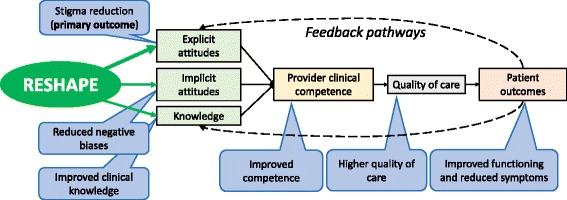
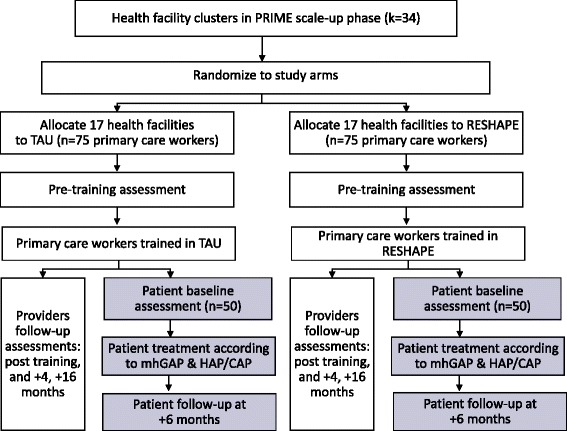
Non-specialist healthcare providers, including primary and community healthcare workers, in low- and middle-income countries can effectively treat mental illness. However, scaling-up mental health services within existing health systems has been limited by barriers such as stigma against people with mental illness. Therefore, interventions are needed to address attitudes and behaviors among non-specialists. Aimed at addressing this gap, REducing Stigma among HealthcAre Providers to ImprovE mental health services (RESHAPE) is an intervention in which social contact with mental health service users is added to training for non-specialist healthcare workers integrating mental health services into primary healthcare. This protocol describes a mixed methods pilot and feasibility study in primary care centers in Chitwan, Nepal. The qualitative component will include key informant interviews and focus group discussions. The quantitative component consists of a pilot cluster randomized controlled trial (c-RCT), which will establish parameters for a future effectiveness study of RESHAPE compared to training as usual (TAU). Primary healthcare facilities (the cluster unit, k = 34) will be randomized to TAU or RESHAPE. The direct beneficiaries of the intervention are the primary healthcare workers in the facilities (n = 150); indirect beneficiaries are their patients (n = 100). The TAU condition is existing mental health training and supervision for primary healthcare workers delivered through the Programme for Improving Mental healthcarE (PRIME) implementing the mental health Gap Action Programme (mhGAP). The primary objective is to evaluate acceptability and feasibility through qualitative interviews with primary healthcare workers, trainers, and mental health service users. The secondary objective is to collect quantitative information on health worker outcomes including mental health stigma (Social Distance Scale), clinical knowledge (mhGAP), clinical competency (ENhancing Assessment of Common Therapeutic factors, ENACT), and implicit attitudes (Implicit Association Test, IAT), and patient outcomes including stigma-related barriers to care, daily functioning, and symptoms. The pilot and feasibility study will contribute to refining recommendations for implementation of mhGAP and other mental health services in primary healthcare settings in low-resource health systems. The pilot c-RCT findings will inform an effectiveness trial of RESHAPE to advance the evidence-base for optimal approaches to training and supervision for non-specialist providers. ClinicalTrials.gov identifier, NCT02793271
Overview
The claims and statistics of this paper haven’t been checked yet.
Free: it reads the open-access text and checks the first 5 claims that cite a source we can check. Create a free account to check every claim.
Integrity signals
Registry
Cites
Statistics
Figures
Verification
Claims the paper makes
The claims and statistics of this paper haven’t been checked yet.
Free: it reads the open-access text and checks the first 5 claims that cite a source we can check. Create a free account to check every claim.
Claims other papers make about this one
Each is checked against this paper’s own text: does it say what the citing paper says it does?
The check wasn’t confident either way, so it gives no verdict — never disputed.
In the citing paper
“While the SDS does not have validated cut-offs, scores of 6 to 10, 11–16, and ≥17 typically reflect low, moderate and high levels of stigma respectively (Kohrt et al., 2018).”
From Siyakhana: A Hybrid Type 2 Effectiveness-Implementation Stepped-Wedge Trial to Reduce Stigma Towards Substance Use and Depression Among Community Health Workers in HIV/TB Care in South Africa (2025) · cites this paper as Kohrt et al., 2018
Experimental — accuracy not yet measured
Self-check
Percentages, sums and reported differences re-computed from the paper’s own numbers.
The self-check needs the paper’s full text.
Citations
Cites
The PHQ-9: Validity of a brief depression severity measure
Kroenke, K., Spitzer, R. L., & Williams, J. B. W. (2001) · Journal of General Internal Medicine · doi:10.1046/j.1525-1497.2001.016009606.x · Cited by 44,910
Three Approaches to Qualitative Content Analysis
Hsieh, H.-F., & Shannon, S. E. (2005) · Qualitative Health Research · doi:10.1177/1049732305276687 · Cited by 44,601 · cited 1×
“[102] for themes of cultural acceptability, experience”
Tong, A., Sainsbury, P., & Craig, J. (2007) · International Journal for Quality in Health Care · doi:10.1093/intqhc/mzm042 · Cited by 42,509 · cited 1×
“Following the Consolidated Criteria for Reporting Qualitative Studies (COREQ), we will document the process according to the 32-item checklist [104].”
The cochrane database of systematic reviews
Geddes, J. (1996) · Journal of Psychosomatic Research · doi:10.1016/s0022-3999(96)90063-x · Cited by 5,989
Cochrane Database of Systematic Reviews
(2011) · Progress in Neurology and Psychiatry · doi:10.1002/pnp.208 · Cited by 4,667
A tutorial on pilot studies: the what, why and how
Thabane, L., Ma, J., Chu, R., Cheng, J., Ismaila, A., Rios, L. P., Robson, R., Thabane, M., Giangregorio, L., & Goldsmith, C. H. (2010) · BMC Medical Research Methodology · doi:10.1186/1471-2288-10-1 · Cited by 3,384
Handbook of Psychotherapy and Behavior Change
Sanford, E. F. (1988) · American Journal of Psychotherapy · doi:10.1176/appi.psychotherapy.1988.42.1.153 · Cited by 2,567
Grand challenges in global mental health
Collins, P. Y., Patel, V., Joestl, S. S., March, D., Insel, T. R., Daar, A. S., Bordin, I. A., Costello, E. J., Durkin, M., Fairburn, C., et al. (2011) · Nature · doi:10.1038/475027a · Cited by 2,043
Self-citationEnabling the implementation of evidence based practice: a conceptual framework.
Kitson, A., Harvey, G., & McCormack, B. (1998) · Quality in Health Care · doi:10.1136/qshc.7.3.149 · Cited by 1,985
The role and interpretation of pilot studies in clinical research
Leon, A. C., Davis, L. L., & Kraemer, H. C. (2011) · Journal of Psychiatric Research · doi:10.1016/j.jpsychires.2010.10.008 · Cited by 1,917
Research works printed but not linked: 5
- Nyblade L Disentangling stigma to find entry points for intervention Sex Health Exch 2016 2 5
- Frank JD, Frank JB: Persuasion and healing: a comparative study of psychotherapy, third edn. Baltimore: Johns Hopkins University Press; 1991.
- Central Bureau of Statistics Statistical year book of Nepal-2013 Ramshahpath, Thapathali, Kathmandu 2013 Nepal Government of Nepal, National Planning Commission Secretariat
- WHO mhGAP intervention guide for mental, neurological and substance-use disorders in non-specialized health settings: mental health Gap Action Programme (mhGAP) 2010 Geneva WHO Press 83 23741783
- WHO Mental health action plan 2013–2020 2013 Geneva World Health Organization
Cited by
Items 101–150 of 150
Experience-Dependent Plasticity in the Hippocampus
West, G. L., & Bohbot, V. D. (2020) · Cambridge University Press eBooks · doi:10.1017/9781108695374.019
Global Mental Health Perspectives on Rural and Remote Mental Health Provision
White, R. G., Islam, N., & Kasujja, R. (2019) · Springer eBooks · doi:10.1007/978-981-10-5012-1_3-1
WHO-mhGAP, MHPSS, IHME, and Other Internet Resources to Address the Global Burden of Mental Health
Kohn, R. (2021) · Springer eBooks · doi:10.1007/978-3-319-70134-9_116-1 · Cited by 1
How Social Coordination and Cooperation are Achieved
Kirmayer, L. J., Worthman, C. M., Kitayama, S., Lemelson, R., & Cummings, C. A. (2020) · Cambridge University Press eBooks · doi:10.1017/9781108695374.013
Kirmayer, L. J., Worthman, C. M., Kitayama, S., Lemelson, R., & Cummings, C. A. (2020) · Cambridge University Press eBooks · doi:10.1017/9781108695374.001
The Co-emergence of Culture, Mind, and Brain
Kirmayer, L. J., Worthman, C. M., Kitayama, S., Lemelson, R., & Cummings, C. A. (2020) · Cambridge University Press eBooks · doi:10.1017/9781108695374.004
Kirmayer, L. J., Worthman, C. M., Kitayama, S., Lemelson, R., & Cummings, C. A. (2020) · Cambridge University Press eBooks · doi:10.1017/9781108695374.008
Kirmayer, L. J., Worthman, C. M., Kitayama, S., Lemelson, R., & Cummings, C. A. (2020) · Cambridge University Press eBooks · doi:10.1017/9781108695374.017
Stuart, H. L., & Sartorius, N. (2022) · Oxford University Press eBooks · doi:10.1093/med/9780197555804.003.0011
Stuart, H. L., & Sartorius, N. (2022) · Oxford University Press eBooks · doi:10.1093/med/9780197555804.003.0008
Eleven Steps to Build an Anti-stigma Program
Stuart, H. L., & Sartorius, N. (2022) · Oxford University Press eBooks · doi:10.1093/med/9780197555804.003.0004
Cultures Count: They Stigmatize and Destigmatize Mental Illnesses
Stuart, H. L., & Sartorius, N. (2022) · Oxford University Press eBooks · doi:10.1093/med/9780197555804.003.0002
Stuart, H. L., & Sartorius, N. (2022) · Oxford University Press eBooks · doi:10.1093/med/9780197555804.003.0007
Stuart, H. L., & Sartorius, N. (2022) · Oxford University Press eBooks · doi:10.1093/med/9780197555804.003.0006
Stuart, H. L., & Sartorius, N. (2022) · Oxford University Press eBooks · doi:10.1093/med/9780197555804.003.0005
Paradigms Found in Fighting Stigma
Stuart, H. L., & Sartorius, N. (2022) · Oxford University Press eBooks · doi:10.1093/med/9780197555804.003.0003
WHO-mhGAP, MHPSS, IHME, and Other Internet Resources to Address the Global Burden of Mental Health
Kohn, R. (2021) · Springer eBooks · doi:10.1007/978-3-030-57296-9_116
Kirmayer, L. J., Worthman, C. M., Kitayama, S., Lemelson, R., & Cummings, C. A. (2020) · Cambridge University Press eBooks · doi:10.1017/9781108695374.029
Stuart, H., & Sartorius, N. (2022) · Oxford University Press eBooks · doi:10.1093/med/9780197555804.002.0006
Stuart, H., & Sartorius, N. (2022) · Oxford University Press eBooks · doi:10.1093/med/9780197555804.002.0004
Stuart, H. L., & Sartorius, N. (2022) · Oxford University Press eBooks · doi:10.1093/med/9780197555804.005.0001
Stuart, H., & Sartorius, N. (2022) · Oxford University Press eBooks · doi:10.1093/med/9780197555804.002.0003
(2023) · Cambridge Prisms Global Mental Health · doi:10.1017/gmh.2023.73.pr9
(2023) · Cambridge Prisms Global Mental Health · doi:10.1017/gmh.2023.73.pr8
Rai, S. (2023) · Cambridge Prisms Global Mental Health · doi:10.1017/gmh.2023.73.pr6
Self-citation(2023) · Cambridge Prisms Global Mental Health · doi:10.1017/gmh.2023.73.pr7
(2023) · Cambridge Prisms Global Mental Health · doi:10.1017/gmh.2023.73.pr5
(2023) · Cambridge Prisms Global Mental Health · doi:10.1017/gmh.2023.73.pr4
Rai, S. (2023) · Cambridge Prisms Global Mental Health · doi:10.1017/gmh.2023.73.pr1
Self-citation(2023) · Cambridge Prisms Global Mental Health · doi:10.1017/gmh.2023.73.pr3
(2023) · Cambridge Prisms Global Mental Health · doi:10.1017/gmh.2023.73.pr2
Najib, D. A., & Adawiyah, P. R. (2023) · Pubmedia Social Sciences and Humanities · doi:10.47134/pssh.v1i2.114
Supporting Informal Caregivers of Persons with Mental Disorders in Sub-Saharan Africa
Silaule, O., & Casteleijn, D. (2025) · Springer eBooks · doi:10.1007/978-3-031-65179-3_12
Asibey, B. O., Marjadi, B., & Conroy, E. (2025) · BMC Public Health · doi:10.1186/s12889-025-24669-x
“Like the RESHAPE (reducing Stigma among healthcare providers to improve mental health services) intervention in Nepal [44], a connect-based intervention which promotes contacts between trainees and the homeless population (via placements) could increase self-awareness, reduce stigmatising…”
Rose, A. L. (2023) · University Libraries (University of Maryland) · doi:10.13016/bxof-w2k8
Additional file 1 of Traditional and biomedical care pathways for mental well‐being in rural Nepal
Pham, T. V., Koirala, R., & Kohrt, B. A. (2021) · Figshare · doi:10.6084/m9.figshare.13545817
Self-citationAdditional file 2 of Traditional and biomedical care pathways for mental well‐being in rural Nepal
Pham, T. V., Koirala, R., & Kohrt, B. A. (2021) · Figshare · doi:10.6084/m9.figshare.13545820
Self-citationKohrt, B. A., Turner, E. L., Gurung, D., Wang, X., Neupane, M., Luitel, N. P., Kartha, M. R., Poudyal, A., Singh, R., Rai, S., et al. (2022) · Figshare · doi:10.6084/m9.figshare.20086187
Self-citationMellor, K. (2022) · Oxford University Research Archive (ORA) (University of Oxford) · doi:10.5287/ora-ovzgwyejr
Psychotherapists’ Attitudes Toward and Experiences With E-therapy in Trinidad and Tobago
James, A. C. (2024) · ScholarWorks (Walden University)
Pigeon-Gagné, É. (2021) · Archipel (Université du Québec à Montréal) · Cited by 1
Niidumaa, K. (2025) · DSpace repository (University of Tartu)
Fahma, H. (2026) · ABDIMASKU JURNAL PENGABDIAN MASYARAKAT · doi:10.62411/ja.v9i1.3145
“Temuan ini konsisten dengan penelitian sebelumnya, yang menyebutkan bahwa pelatihan partisipatif efektif meningkatkan kapasitas kader kesehatan dalam deteksi dini masalah kesehatan mental [10], [11], [12].”
Ubo, R. M., & Subida, M. D. (2026) · International Journal of Science and Research (IJSR) · doi:10.21275/sr26103185717
Thapa, S., Ross, N., Giri, S., Ahmed, K. Y., Bhattarai, S., Fogden, D. G., Basnet, A., & Allan, J. (2026) · The Lancet Regional Health - Southeast Asia · doi:10.1016/j.lansea.2026.100803
“51 Given that young people from Nepal and other South Asian countries are a growing part of the global workforce, targeted programs to strengthen mental health literacy, healthcare access, and community support in similar settings are increasingly globally important.”
การเฝ้าระวังสุขภาพจิตเชิงรุกในสถานการณ์วิกฤต : บทเรียนจากสถานการณ์ชายแดนไทย-กัมพูชา
สุรอรุณสัมฤทธิ์, บ., ตันอารีย์, อ., มากคล้าย, ก., สรรพโส, ศ., & อินทร์เชื้อ, ส. (2026) · Journal of Mental Health of Thailand - วารสารสุขภาพจิต แห่งประเทศไทย · doi:10.64838/jmht.2026.286782
Pilot Feasibility Study of an Anti-Stigma Intervention for Romanian Psychiatry Trainees
Manescu, E. A., Henderson, C., & Mihai, A. (2026) · Healthcare · doi:10.3390/healthcare14131972
“These observations are consistent with prior evidence indicating that attitudinal components related to intrinsic motivation and self-perception are more stable than those linked to perceived knowledge or role definition, which typically require continuous reinforcement to maintain [37–39].”
Communication Barriers in Patient-Provider Interactions in Health Care: Scoping Review
Chowdhury, M. H., & Liu, Y. (2026) · Journal of Medical Internet Research · doi:10.2196/79744
“Additionally, empathy and stigma-reduction training improve mental health engagement [63,288,289].”
Pillay, S. R., Procter, J.-L., Dlamini, T., Madlala, N., Victor, C. J., McLachlan, C., Msweli, S., & Nel, J. A. (2026) · South African Journal of Psychology · doi:10.1177/00812463261481323
“Tools such as implicit bias tests and structured reflective models support professionals in uncovering blind spots (Hays, 2001; Kohrt et al., 2018).”
Alsaadi, A. M. (2024) · Review of Contemporary Philosophy
Metadata
- Authors
- Kohrt, B. A., Jordans, M. J. D., Turner, E. L., Sikkema, K. J., Luitel, N. P., Rai, S., Singla, D. R., Lamichhane, J., Lund, C., & Patel, V.
- Affiliations
- Duke University (US)
- King's College London (GB)
- University of Toronto (CA)
- University of Cape Town (ZA)
- Harvard University (US)
- Corresponding author
- Kohrt, Brandon A.
- ORCID
- Venue
- Pilot and Feasibility Studies
- Published
- 2018-01-24
- Volume
- 4
- Issue
- 1
- Pages
- 36-36
- ISSN
- 2055-5784 (ISSN-L)
- PMC
- PMC5781273
- OpenAlex
- W2786948863
- Cited by
- 141
- References
- 108
- Citations by year
- 2026: 5 · 2025: 9 · 2024: 5 · 2023: 22 · 2022: 29 · 2021: 14 · 2020: 42 · 2019: 9 · 2018: 6
- FWCI
- 24.03
- Type
- journal article
- Language
- en
- Open access
- gold
- doi.org
- Licence
- cc-by
- creativecommons.org/licenses/by/4.0/ (tdm)
- creativecommons.org/licenses/by/4.0/ (vor)
- Locations
- Pilot and Feasibility Studies (publishedVersion, cc-by)
- Europe PMC (PubMed Central) (publishedVersion, cc-by)
- PubMed Central (publishedVersion, cc-by)
- PubMed (publishedVersion)
- TSpace (University of Toronto) (submittedVersion, cc-by)
- Digital Access to Scholarship at Harvard (DASH) (Harvard University) (submittedVersion, cc-by)
- DOAJ (DOAJ: Directory of Open Access Journals) (submittedVersion)
- DukeSpace (Duke University) (submittedVersion, cc-by-nc-nd)
- Research Portal (King's College London) (submittedVersion, cc-by)
- Open University of Cape Town (University of Cape Town) (submittedVersion)
- Greater South Information System
- Funders
- National Institute of Mental Health (K01MH104310)
- Department for International Development, UK Government
- Topics
- Health Sciences › Medicine › Psychiatry and Mental health › Mental Health Treatment and Access
- Health Sciences › Health Professions › General Health Professions › Health Policy Implementation Science
- Social Sciences › Psychology › Clinical Psychology › Psychiatric care and mental health services
- Keywords
- mental health stigma, stigma reduction interventions, primary health care workers, mental health training, integration of mental health into primary care, mental health service users, Implicit Association Test, ENACT, Mental Health Gap Action Programme, prime numbers, low- and middle-income countries, Nepal, feasibility and acceptability, barriers to mental health care
About these checks
Registry, retraction, Cites and statistics results are computed, not judged, with one exception: a printed reference that no index lists is read once by a model before it counts as a citation error. Claims are extracted by a model and kept only when their quote appears verbatim in the text; each cited source is then checked, with a model’s help, for whether it says what the claim relies on. Those verdicts can be wrong — read the claim’s quote and the cited source before relying on one.
Statistics and arithmetic are recomputed, not judged.
Confidence bands are shown only for fields calibrated on our annotated test set. None is calibrated yet, so no band is shown.
What counts as a claim ›How we measure confidence ›How we check this ›
Are you an author, or do you see a problem with this page? Request a review
Data sources
Bibliographic data: Semantic Scholar, OpenAlex, Crossref.
Contains information from the Semantic Scholar Academic Graph Datasets, made available under the ODC Attribution License (ODC-BY 1.0).
Semantic Scholar’s data is described in: Kinney, R., et al. (2023). The Semantic Scholar Open Data Platform. arXiv:2301.10140.
