

Acceptability of mindfulness from the perspective of stroke survivors and caregivers: a qualitative study
Open accessThe DOI matches its Crossref record; 44 of the 44 references it cites were found in a registry or an index.
Abstract
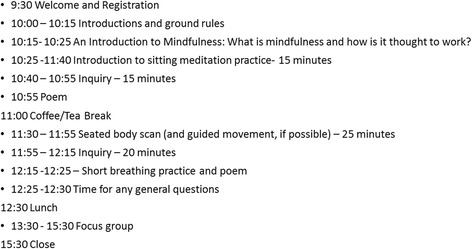
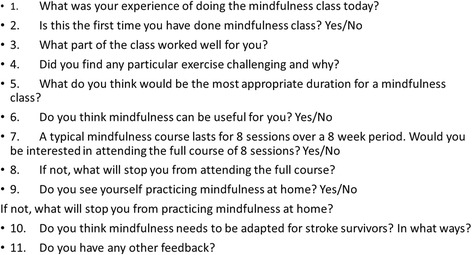
BACKGROUND: Depression is very common among stroke survivors with estimated prevalence rates of approximately 33% among stroke survivors, but treatment options are limited. Mindfulness-Based Stress Reduction (MBSR) is an effective treatment for depression generally, but benefits in stroke patients are unclear. The aim of this study was to determine the feasibility of delivering MBSR to stroke survivors and their caregivers in the community. We conducted a study to gain views of MBSR as a potential treatment option among stroke survivors and their caregivers in the community. METHODS: Participants were recruited from an urban community in Scotland (UK) using newspaper adverts, social media and support groups run by health charities. A 2-h MBSR taster session was delivered by two experienced mindfulness instructors, followed by focus group sessions with all participants on their user experience and suggestions for MBSR modifications for stroke survivors. The focus group sessions were audio recorded and transcribed verbatim. Transcript data were analysed thematically using the framework approach. RESULTS: The study sample consisted of 28 participants (16 females); there were 21 stroke survivors (11 females) and 7 caregivers (5 females). The median age for participants was 60 years.Most participants described the MBSR taster session as a positive experience. The main challenge reported was trying to maintain focus and concentration throughout the MBSR session. Some participants expressed reservations about the duration of standard mindfulness course sessions, suggesting a preference for shorter sessions. The potential for achieving better control over negative thoughts and emotions was viewed as a potential facilitator for future MBSR participation. Participants suggested having an orientation session prior to starting an 8-week course as a means of developing familiarity with the MBSR instructor and other participants. CONCLUSION: It was feasible to recruit 21 stroke survivors and 7 caregivers for MBSR taster sessions in the community. A shorter MBSR session and an orientation session prior to the full course are suggestions for potential MBSR modifications for stroke survivors, which needs further research and evaluation.
Overview
The claims and statistics of this paper haven’t been checked yet.
Free: it reads the open-access text and checks the first 5 claims that cite a source we can check. Create a free account to check every claim.
Integrity signals
Registry
Cites
Statistics
Figures
Verification
Claims the paper makes
The claims and statistics of this paper haven’t been checked yet.
Free: it reads the open-access text and checks the first 5 claims that cite a source we can check. Create a free account to check every claim.
Claims other papers make about this one
Each is checked against this paper’s own text: does it say what the citing paper says it does?
The source backs part of the claim, not all of it — or backs it for a different population, condition or comparison.
In the citing paper
“Present research studies are focused on either the informal caregiver or the stroke survivor; however, given the symbiotic nature of this relationship, it is suggested that the stroke survivor and informal caregiver be addressed as a dyad.4,9,64,65”
From Nursing Implications of Mindfulness-Informed Interventions for Stroke Survivors and Their Families. (2022) · cites this paper as [4]
Experimental — accuracy not yet measuredThe cited source says what the claim attributes to it.
In the citing paper
“Evidence suggests that mindfulness is acceptable and feasible among stroke survivors and their caregivers.4,5”
From Nursing Implications of Mindfulness-Informed Interventions for Stroke Survivors and Their Families. (2022) · cites this paper as [4]
The cited source says what the claim attributes to it.
In the citing paper
“There is compelling evidence for the interdependence of psychological health poststroke in both informal caregivers and stroke survivors.4,9,64”
From Nursing Implications of Mindfulness-Informed Interventions for Stroke Survivors and Their Families. (2022) · cites this paper as [4]
Self-check
Percentages, sums and reported differences re-computed from the paper’s own numbers.
The self-check needs the paper’s full text.
Citations
Cites
Development and validation of a geriatric depression screening scale: a preliminary report
Yesavage, J. A., Brink, T. L., Rose, T. L., Lum, O., Huang, V., Adey, M., & Leirer, V. O. (1982) · Journal of Psychiatric Research · doi:10.1016/0022-3956(82)90033-4 · Cited by 15,025 · cited 4×
“The questionnaire also included three self-rated symptom scores: Geriatric Depression Scale (GDS-15) [25], Zung’s self-rating scale for anxiety [26] and the Perceived Stress Scale (PSS) [27].”
MethodInfluentialGale, N. K., Heath, G., Cameron, E., Rashid, S., & Redwood, S. (2013) · BMC Medical Research Methodology · doi:10.1186/1471-2288-13-117 · Cited by 10,865 · cited 1×
“The data from the transcripts were analysed using an inductive approach guided by the framework analysis method [31].”
MethodA Rating Instrument For Anxiety Disorders
Zung, W. W. K. (1971) · Psychosomatics · doi:10.1016/s0033-3182(71)71479-0 · Cited by 4,578 · cited 2×
“The questionnaire also included three self-rated symptom scores: Geriatric Depression Scale (GDS-15) [25], Zung’s self-rating scale for anxiety [26] and the Perceived Stress Scale (PSS) [27].”
MethodThe effect of mindfulness based therapy on anxiety and depression: A meta analytic review
Hofmann, S. G., Sawyer, A. T., Witt, A. A., & Oh, D. (2010) · Journal of Consulting and Clinical Psychology · doi:10.1037/a0018555 · Cited by 3,846
Cognitive Stimulation in Patients with Dementia: Randomized Controlled Trial
Mapelli, D., Di Rosa, E., Nocita, R., & Sava, D. (2013) · Dementia and Geriatric Cognitive Disorders Extra · doi:10.1159/000353457 · Cited by 3,453
Preventing stroke: saving lives around the world
Strong, K., Mathers, C., & Bonita, R. (2007) · The Lancet Neurology · doi:10.1016/s1474-4422(07)70031-5 · Cited by 1,503 · cited 1×
“A global estimate suggests that the number of stroke survivors is likely to rise to 77 million people by 2030 [6].”
BackgroundFrequency of Depression After Stroke: A Systematic Review of Observational Studies
Hackett, M. L., Yapa, C., Parag, V., & Anderson, C. S. (2005) · Stroke · doi:10.1161/01.str.0000165928.19135.35 · Cited by 1,464
COHEN, S., & JANICKI‐DEVERTS, D. (2012) · Journal of Applied Social Psychology · doi:10.1111/j.1559-1816.2012.00900.x · Cited by 1,187
Johnston, S. C., Mendis, S., & Mathers, C. D. (2009) · The Lancet Neurology · doi:10.1016/s1474-4422(09)70023-7 · Cited by 977 · cited 1×
“The stroke mortality rate varies among different countries, with relatively low mortality reported in middle- and high-income countries [1].”
BackgroundBohlmeijer, E., Prenger, R., Taal, E., & Cuijpers, P. (2010) · Journal of Psychosomatic Research · doi:10.1016/j.jpsychores.2009.10.005 · Cited by 822
Stroke Incidence and Mortality Trends in US Communities, 1987 to 2011
Koton, S., Schneider, A. L. C., Rosamond, W. D., Shahar, E., Sang, Y., Gottesman, R. F., & Coresh, J. (2014) · JAMA · doi:10.1001/jama.2014.7692 · Cited by 547
Frequency of Anxiety after Stroke: A Systematic Review and Meta-Analysis of Observational Studies
Burton, C. A. C., Murray, J., Holmes, J., Astin, F., Greenwood, D., & Knapp, P. (2013) · International Journal of Stroke · doi:10.1111/j.1747-4949.2012.00906.x · Cited by 427
Owolabi, M., Akarolo-Anthony, S., Akinyemi, R., Arnett, D., Gebregziabher, M., Jenkins, C., Tiwari, H., Arulogun, O., Akpalu, A., Sarfo, F., et al. (2015) · Cardiovascular Journal Of Africa · doi:10.5830/cvja-2015-038 · Cited by 420
Interventions for treating depression after stroke
Hackett, M. L., Anderson, C. S., House, A., & Xia, J. (2008) · Cochrane Database of Systematic Reviews · doi:10.1002/14651858.cd003437.pub3 · Cited by 387
Poststroke Depression: A Review
Robinson, R. G., & Spalletta, G. (2010) · The Canadian Journal of Psychiatry · doi:10.1177/070674371005500602 · Cited by 315 · cited 2×
“5% (range 8 to 44%) for post-stroke minor depression—DSMIV classification [8].”
BackgroundAbbott, R. A., Whear, R., Rodgers, L. R., Bethel, A., Thompson Coon, J., Kuyken, W., Stein, K., & Dickens, C. (2014) · Journal of Psychosomatic Research · doi:10.1016/j.jpsychores.2014.02.012 · Cited by 313
Interventions for Treating Depression After Stroke
Hackett, M. L., Anderson, C. S., House, A. O., & Xia, J. (2009) · Stroke · doi:10.1161/strokeaha.109.547059 · Cited by 276
Depression after Stroke and Risk of Mortality: A Systematic Review and Meta-Analysis
Bartoli, F., Lillia, N., Lax, A., Crocamo, C., Mantero, V., Carrà, G., Agostoni, E., & Clerici, M. (2013) · Stroke Research and Treatment · doi:10.1155/2013/862978 · Cited by 273 · cited 1×
“In addition, a review assessing post-stroke mortality reported increased odds of mortality for a period of 2 to 5 years among patients with depressive symptoms based on findings from 13 studies including 59,598 patients with stroke [10].”
BackgroundInterventions for preventing depression after stroke
Hackett, M. L., Anderson, C. S., House, A., & Halteh, C. (2008) · Cochrane Database of Systematic Reviews · doi:10.1002/14651858.cd003689.pub3 · Cited by 264
Validation of the Perceived Stress Scale in a community sample of older adults
Ezzati, A., Jiang, J., Katz, M. J., Sliwinski, M. J., Zimmerman, M. E., & Lipton, R. B. (2014) · International Journal of Geriatric Psychiatry · doi:10.1002/gps.4049 · Cited by 253 · cited 5×
“The mean PSS score, which measures psychological stress, was 21.7 among the study participants.”
MethodInfluentialDepression Among Caregivers of Stroke Survivors
Berg, A., Palomäki, H., Lönnqvist, J., Lehtihalmes, M., & Kaste, M. (2005) · Stroke · doi:10.1161/01.str.0000155690.04697.c0 · Cited by 244
Lee, S., Shafe, A. C. E., & Cowie, M. R. (2011) · BMJ Open · doi:10.1136/bmjopen-2011-000269 · Cited by 224
Johansson, B., Bjuhr, H., & Rönnbäck, L. (2012) · Brain Injury · doi:10.3109/02699052.2012.700082 · Cited by 218
Screening for poststroke major depression: a meta-analysis of diagnostic validity studies
Meader, N., Moe-Byrne, T., Llewellyn, A., & Mitchell, A. J. (2014) · Journal of Neurology, Neurosurgery & Psychiatry · doi:10.1136/jnnp-2012-304194 · Cited by 195
Mindfulness based interventions in multiple sclerosis–a systematic review
Simpson, R., Booth, J., Lawrence, M., Byrne, S., Mair, F., & Mercer, S. (2014) · BMC Neurology · doi:10.1186/1471-2377-14-15 · Cited by 195
Self-citationDenno, M. S., Gillard, P. J., Graham, G. D., DiBonaventura, M. D., Goren, A., Varon, S. F., & Zorowitz, R. (2013) · Archives of Physical Medicine and Rehabilitation · doi:10.1016/j.apmr.2013.03.014 · Cited by 157
Ostwald, S. K., Bernal, M. P., Cron, S. G., & Godwin, K. M. (2009) · Topics in Stroke Rehabilitation · doi:10.1310/tsr1602-93 · Cited by 135
Anxiety and depression after stroke: a 5 year follow-up
Lincoln, N. B., Brinkmann, N., Cunningham, S., Dejaeger, E., De Weerdt, W., Jenni, W., Mahdzir, A., Putman, K., Schupp, W., Schuback, B., et al. (2013) · Disability and Rehabilitation · doi:10.3109/09638288.2012.691939 · Cited by 133 · cited 1×
“A multi-national study of 220 patients observed that the prevalence of depression remained as high as 33% for up to 5 years post stroke [9].”
BackgroundLawrence, M., Booth, J., Mercer, S., & Crawford, E. (2013) · International Journal of Stroke · doi:10.1111/ijs.12135 · Cited by 132 · cited 3×
“Hence, large-scale, robust randomised controlled trials (RCTs) are needed before recommending integration of MBIs into routine clinical practice [23].”
BackgroundSelf-citationEpidemiological Factors of Stroke: A Survey of the Current Status in China
Sun, H., Zou, X., & Liu, L. (2013) · Journal of Stroke · doi:10.5853/jos.2013.15.2.109 · Cited by 116
Quality of life of post-stroke patients and their caregivers.
Opara, J. A., & Jaracz, K. (2010) · PubMed Central · Cited by 101
Long-Term Health-Related Quality of Life of Stroke Survivors and Their Spousal Caregivers
Godwin, K. M., Ostwald, S. K., Cron, S. G., & Wasserman, J. (2013) · Journal of Neuroscience Nursing · doi:10.1097/jnn.0b013e31828a410b · Cited by 91 · cited 1×
“In addition, there is also evidence that stroke survivors and their carers mutually influenced each other’s emotional state [14, 15].”
BackgroundInterventions for Preventing Depression After Stroke
Hackett, M. L., Anderson, C. S., House, A. O., & Halteh, C. (2009) · Stroke · doi:10.1161/strokeaha.109.547042 · Cited by 87 · cited 3×
“Two Cochrane reviews assessed the benefits of psychological interventions for prevention [16] and for treatment of depressive symptoms [17] among stroke survivors.”
BackgroundUlrichsen, K. M., Kaufmann, T., Dørum, E. S., Kolskår, K. K., Richard, G., Alnæs, D., Arneberg, T. J., Westlye, L. T., & Nordvik, J. E. (2016) · Frontiers in Psychology · doi:10.3389/fpsyg.2016.00912 · Cited by 86 · cited 1×
“Three systematic reviews have explored the benefits of MBIs among stroke survivors [23, 32, 33] and have identified four original studies [34–37].”
BackgroundAdaptation of mindfulness-based stress reduction program for addiction relapse prevention.
Vallejo, Z., & Amaro, H. (2009) · The Humanistic Psychologist · doi:10.1080/08873260902892287 · Cited by 81 · cited 1×
“MBI modifications have been successfully implemented by other studies in a healthcare setting for other health conditions such as multiple sclerosis and drug addiction [42, 43].”
BackgroundJoo, H. M., Lee, S. J., Chung, Y. G., & Shin, I. Y. (2010) · Journal of Korean Neurosurgical Society · doi:10.3340/jkns.2010.47.5.345 · Cited by 72
Keyworth, C., Knopp, J., Roughley, K., Dickens, C., Bold, S., & Coventry, P. (2014) · Behavioral Medicine · doi:10.1080/08964289.2013.834865 · Cited by 59 · cited 1×
“Previous qualitative studies on MBSR for coronary heart disease patients, diabetes patients and breast cancer survivors have reported similar findings [40, 41].”
ResultMindfulness-based stress reduction in Parkinson’s disease: a systematic review
McLean, G., Lawrence, M., Simpson, R., & Mercer, S. W. (2017) · BMC Neurology · doi:10.1186/s12883-017-0876-4 · Cited by 59
Self-citationOptimising mindfulness-based stress reduction for people with multiple sclerosis
Simpson, R., Byrne, S., Wood, K., Mair, F. S., & Mercer, S. W. (2018) · Chronic Illness · doi:10.1177/1742395317715504 · Cited by 59 · cited 1×
“MBI modifications have been successfully implemented by other studies in a healthcare setting for other health conditions such as multiple sclerosis and drug addiction [42, 43].”
BackgroundSelf-citationSchellekens, M. P. J., Jansen, E. T. M., Willemse, H. H. M. A., van Laarhoven, H. W. M., Prins, J. B., & Speckens, A. E. M. (2016) · Supportive Care in Cancer · doi:10.1007/s00520-015-2954-8 · Cited by 47 · cited 1×
“Previous qualitative studies on MBSR for coronary heart disease patients, diabetes patients and breast cancer survivors have reported similar findings [40, 41].”
ResultExpanding Poststroke Depression Research: Movement Toward a Dyadic Perspective
McCarthy, M. J., Lyons, K. S., & Powers, L. E. (2011) · Topics in Stroke Rehabilitation · doi:10.1310/tsr1805-450 · Cited by 39 · cited 1×
“In addition, there is also evidence that stroke survivors and their carers mutually influenced each other’s emotional state [14, 15].”
BackgroundMindfulness-based interventions in epilepsy: a systematic review
Wood, K., Lawrence, M., Jani, B., Simpson, R., & Mercer, S. W. (2017) · BMC Neurology · doi:10.1186/s12883-017-0832-3 · Cited by 38
Self-citationSUBARACHNOID HAEMORRHAGE AND INTRACRANIAL ANEURYSMS: WHAT NEUROLOGISTS NEED TO KNOW
Kirkpatrick, P. J. (2002) · Journal of Neurology Neurosurgery & Psychiatry · doi:10.1136/jnnp.73.suppl_1.i28 · Cited by 31 · cited 1×
“The mean PSS score, which measures the mean age of participants in our study was approximately 56 years while the mean age of stroke survivors in the Western world has been reported as 75 years [38]; our sample may not be representative of average stroke survivors.”
BackgroundMagnusson, G., Ballegaard, S., Karpatschof, B., & Nyboe, J. (2010) · The Journal of Alternative and Complementary Medicine · doi:10.1089/acm.2009.0097 · Cited by 18
Research works printed but not linked: 2
- MRC Developing and evaluating complex interventions [internet] 2006 1 39
- Moustgaard A Bedard M Felteau M Mindfulness-based cognitive therapy (MBCT) for individuals who had a stroke: results from a pilot study J Cogn Rehabil 2007 25 1 10
Cited by
Wang, X., Smith, C., Ashley, L., & Hyland, M. E. (2019) · Frontiers in Psychology · doi:10.3389/fpsyg.2019.00391 · Cited by 40
Simpson, R., Simpson, S., Wasilewski, M., Mercer, S., & Lawrence, M. (2022) · Disability and Rehabilitation · doi:10.1080/09638288.2021.1964622 · Cited by 30
Self-citationChen, J., Xiao, H., Chen, Y., Sun, H., Chen, S., & Zheng, J. (2020) · European Journal of Cancer Care · doi:10.1111/ecc.13324 · Cited by 26
Mindfulness Meditation Effects on Poststroke Spasticity: A Feasibility Study
Wathugala, M., Saldana, D., Juliano, J. M., Chan, J., & Liew, S.-L. (2019) · Journal of Evidence-Based Integrative Medicine · doi:10.1177/2515690x19855941 · Cited by 23
Mindfulness Measurement Instruments: A Systematic Review
Gherardi‐Donato, E. C. D. S., de Moraes, V. S., Esper, L. H., Zanetti, A. C. G., & Fernandes, M. N. D. F. (2020) · International Journal of Psychiatry Research · doi:10.33425/2641-4317.1066 · Cited by 27
“There is strong evidence that the use of mindfulness practice had beneficial results for the patients participating in the studies for the treatment of pathologies such as anorexia, obesity, bulimia, stroke, and coronary diseases [29-33].”
Metadata
- Authors
- Jani, B. D., Simpson, R., Lawrence, M., Simpson, S., & Mercer, S. W.
- Affiliations
- University of Glasgow (GB)
- Glasgow Caledonian University (GB)
- Corresponding author
- Jani, Bhautesh Dinesh
- Venue
- Pilot and Feasibility Studies
- Published
- 2018-02-26
- Volume
- 4
- Issue
- 1
- Pages
- 57-57
- ISSN
- 2055-5784 (ISSN-L)
- PMC
- PMC5827989
- OpenAlex
- W2794960055
- Semantic Scholar
- b33fde669109493e94b1e9ab25dc78383a00b8ec
- Cited by
- 45
- References
- 44
- Citations by year
- 2026: 3 · 2025: 10 · 2024: 10 · 2023: 3 · 2022: 6 · 2021: 7 · 2020: 4 · 2019: 2
- FWCI
- 3.82
- Type
- journal article
- Language
- en
- Open access
- gold
- doi.org
- Licence
- cc-by
- Locations
- Pilot and Feasibility Studies (publishedVersion, cc-by)
- PubMed Central (publishedVersion, cc-by)
- PubMed (publishedVersion)
- ENLIGHTEN (Jurnal Bimbingan dan Konseling Islam) (acceptedVersion, cc-by-sa)
- ResearchOnline (Glasgow Caledonian University) (acceptedVersion, cc-by)
- ResearchOnline (submittedVersion, cc-by)
- DOAJ (DOAJ: Directory of Open Access Journals) (submittedVersion, cc-by-sa)
- Edinburgh Research Explorer (University of Edinburgh) (submittedVersion, cc-by)
- Funders
- R S Mcdonald (171516-01)
- Topics
- Social Sciences › Psychology › Clinical Psychology › Mindfulness and Compassion Interventions
- Health Sciences › Medicine › Rehabilitation › Stroke Rehabilitation and Recovery
- Health Sciences › Medicine › Oncology › Cancer survivorship and care
- Keywords
- mindfulness-based stress reduction, stroke survivors, stroke caregivers, depression, acceptability, feasibility, community-based intervention, user experience, session duration, orientation sessions
About these checks
Registry, retraction, Cites and statistics results are computed, not judged, with one exception: a printed reference that no index lists is read once by a model before it counts as a citation error. Claims are extracted by a model and kept only when their quote appears verbatim in the text; each cited source is then checked, with a model’s help, for whether it says what the claim relies on. Those verdicts can be wrong — read the claim’s quote and the cited source before relying on one.
Statistics and arithmetic are recomputed, not judged.
Confidence bands are shown only for fields calibrated on our annotated test set. None is calibrated yet, so no band is shown.
What counts as a claim ›How we measure confidence ›How we check this ›
Are you an author, or do you see a problem with this page? Request a review
Data sources
Bibliographic data: Semantic Scholar, OpenAlex, Crossref.
Contains information from the Semantic Scholar Academic Graph Datasets, made available under the ODC Attribution License (ODC-BY 1.0).
Semantic Scholar’s data is described in: Kinney, R., et al. (2023). The Semantic Scholar Open Data Platform. arXiv:2301.10140.
