

Milk handling practices and consumption behavior among Borana pastoralists in southern Ethiopia
Open accessThe DOI matches its Crossref record; 53 of the 53 references it cites were found in a registry or an index.
Abstract
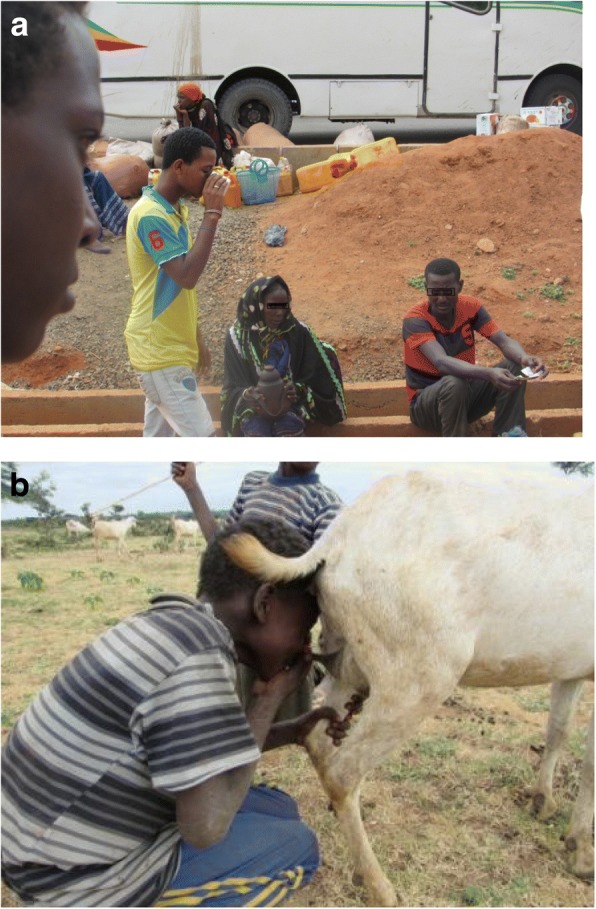
BACKGROUND: Safety and wholesomeness of milk intended for human consumption are influenced by various interlinked factors. However, information on what these factors are, especially in the pastoral traditional communities of Ethiopia, is largely lacking. The objective of this study is to assess the hygienic milk production, processing and consumption practices, and behaviors of Borana pastoralists. METHODS: The study used qualitative participatory research methods. Individual semi-structured interviews, focus group discussions, informal discussions, and observations were carried out on (1) milk handling practices, (2) perceptions of quality and safety of milk, including perceived criteria for good milk, (3) awareness of milk-borne diseases, and (4) perception towards milk boiling practices. The interviews and discussions were audio recorded, transcribed, and analyzed by identifying themes. RESULTS: Some risky behaviors related to milk handling and consumption were identified. These include unhygienic conditions in handling milk and milk products, consumption behaviors such as consuming raw milk purchased from markets, and children directly consuming milk from the udder of animals (e.g., goats). There was a very strong reluctance to boil milk before consumption mainly because of the misconception that nutrients in the milk are destroyed when milk is boiled and "boiled milk is dead". On the other hand, potential risk mitigation practices were identified such as smoking of milk containers (which may help reduce microbial growth), processing milk through fermentation, consuming milk in boiled tea, and a recent trend towards boiling milk for babies. However, the latter was not motivated by concern over microbial hazards but the belief that raw milk could form curds in children's stomach which might then suffocate them. CONCLUSION: The findings highlight the need to promote hygienic handling practices of milk and closely engage with local communities to improve their understanding of milk safety to facilitate change in practices. Educating pastoralists on good milk production practices should be given priority. One of the ways to do this could be by strengthening the integration of milk hygiene in research and development programs as an entry point for behavioral change towards the safe handling and consumption of milk and milk products.
Overview
The claims and statistics of this paper haven’t been checked yet.
Free: it reads the open-access text and checks the first 5 claims that cite a source we can check. Create a free account to check every claim.
Integrity signals
Registry
Cites
Statistics
Figures
Verification
Claims the paper makes
The claims and statistics of this paper haven’t been checked yet.
Free: it reads the open-access text and checks the first 5 claims that cite a source we can check. Create a free account to check every claim.
Claims other papers make about this one
Each is checked against this paper’s own text: does it say what the citing paper says it does?
The source backs part of the claim, not all of it — or backs it for a different population, condition or comparison.
In the citing paper
“Interestingly, the reviewed studies also suggest a congruence in consumers' and vendors' understanding of food choice motives, the use of physical attributes for assessing quality and safety of animal-source foods, and applying practices that eliminated or reduced the risk or level of concern they had about food safety (Amenu et al., 2019;Dewe, 2014;Melesse et al., 2019).”
From Food safety-related perspectives and practices of consumers and vendors in Ethiopia: A scoping review. (2022) · cites this paper as Amenu et al., 2019
Experimental — accuracy not yet measuredThe cited source says what the claim attributes to it.
In the citing paper
“Two studies explored consumer willingness-to-pay for quality and safety attributes, and four studies (consumer-focused: n = 2; consumers and vendors: n= 2) assessed how perceptions influence practices (Amenu et al., 2019;Ayza & Yilma, 2014;Tolosa et al., 2016;Trübswasser et al., 2020).”
From Food safety-related perspectives and practices of consumers and vendors in Ethiopia: A scoping review. (2022) · cites this paper as Amenu et al., 2019
Self-check
Percentages, sums and reported differences re-computed from the paper’s own numbers.
The self-check needs the paper’s full text.
Citations
Cites
The Global Burden of Nontyphoidal Salmonella Gastroenteritis
Majowicz, S. E., Musto, J., Scallan, E., Angulo, F. J., Kirk, M., O’Brien, S. J., Jones, T. F., Fazil, A., & Hoekstra, R. M. (2010) · Clinical Infectious Diseases · doi:10.1086/650733 · Cited by 2,442
(2005) · Cited by 1,913
Food-borne diseases—The challenges of 20 years ago still persist while new ones continue to emerge
Newell, D. G., Koopmans, M., Verhoef, L., Duizer, E., Aidara-Kane, A., Sprong, H., Opsteegh, M., Langelaar, M., Threfall, J., Scheutz, F., et al. (2010) · International Journal of Food Microbiology · doi:10.1016/j.ijfoodmicro.2010.01.021 · Cited by 1,257
Acheson, D., & Hohmann, E. L. (2001) · Clinical Infectious Diseases · doi:10.1086/318457 · Cited by 991
Encyclopedia of Food Microbiology
(2014) · Elsevier eBooks · doi:10.1016/c2009-1-61842-6 · Cited by 952
Oliver, S. P., Jayarao, B. M., & Almeida, R. A. (2005) · Foodborne Pathogens and Disease · doi:10.1089/fpd.2005.2.115 · Cited by 902
Salmonella: A review on pathogenesis, epidemiology and antibiotic resistance
Eng, S.-K., Pusparajah, P., Ab Mutalib, N.-S., Ser, H.-L., Chan, K.-G., & Lee, L.-H. (2015) · Frontiers in Life Science · doi:10.1080/21553769.2015.1051243 · Cited by 859
Campylobacter spp. as a Foodborne Pathogen: A Review
Silva, J., Leite, D., Fernandes, M., Mena, C., Gibbs, P. A., & Teixeira, P. (2011) · Frontiers in Microbiology · doi:10.3389/fmicb.2011.00200 · Cited by 643 · cited 1×
“Campylobacter is another common bacterial foodborne pathogen that affects humans and resulting in a range of symptoms from mild to severe bloody diarrhea [12].”
BackgroundFood Safety in Low and Middle Income Countries
Grace, D. (2015) · International Journal of Environmental Research and Public Health · doi:10.3390/ijerph120910490 · Cited by 544
Self-citationEscherichia coli O157:H7: Animal Reservoir and Sources of Human Infection
Ferens, W. A., & Hovde, C. J. (2011) · Foodborne Pathogens and Disease · doi:10.1089/fpd.2010.0673 · Cited by 537
Raw or heated cow milk consumption: Review of risks and benefits
Claeys, W. L., Cardoen, S., Daube, G., De Block, J., Dewettinck, K., Dierick, K., De Zutter, L., Huyghebaert, A., Imberechts, H., Thiange, P., et al. (2013) · Food Control · doi:10.1016/j.foodcont.2012.09.035 · Cited by 519
Milk and Dairy Products in Human Nutrition: Production, Composition and Health
(2013) · Wiley eBooks · doi:10.1002/9781118534168 · Cited by 481
Food Safety Hazards Associated with Consumption of Raw Milk
Oliver, S. P., Boor, K. J., Murphy, S. C., & Murinda, S. E. (2009) · Foodborne Pathogens and Disease · doi:10.1089/fpd.2009.0302 · Cited by 417
Banatvala, N., Griffin, P. M., Greene, K. D., Barrett, T. J., Bibb, W. F., Green, J. H., & Wells, J. G. (2001) · The Journal of Infectious Diseases · doi:10.1086/319269 · Cited by 312
Milk and dairy products in human nutrition
Renner, E. (1983) · Medical Entomology and Zoology · Cited by 292
Unpasteurized Milk: A Continued Public Health Threat
LeJeune, J. T., & Rajala-Schultz, P. J. (2009) · Clinical Infectious Diseases · doi:10.1086/595007 · Cited by 288
Zika virus in Brazil and the danger of infestation by Aedes (Stegomyia) mosquitoes
Marcondes, C. B., & Ximenes, M. D. F. F. D. M. (2015) · Revista da Sociedade Brasileira de Medicina Tropical · doi:10.1590/0037-8682-0220-2015 · Cited by 280
Functionality of liquid smoke as an all-natural antimicrobial in food preservation
Lingbeck, J. M., Cordero, P., O'Bryan, C. A., Johnson, M. G., Ricke, S. C., & Crandall, P. G. (2014) · Meat Science · doi:10.1016/j.meatsci.2014.02.003 · Cited by 244
Review of the sensitivity of different foodborne pathogens to fermentation
Adams, M. R., & Nicolaides, L. (1997) · Food Control · doi:10.1016/s0956-7135(97)00016-9 · Cited by 214
Consumption of animal source foods and dietary diversity reduce stunting in children in Cambodia
Darapheak, C., Takano, T., Kizuki, M., Nakamura, K., & Seino, K. (2013) · International Archives of Medicine · doi:10.1186/1755-7682-6-29 · Cited by 179
Mondal, D., Haque, R., Sack, R. B., Kirkpatrick, B. D., & Petri, W. A. (2009) · The American Journal of Tropical Medicine and Hygiene · doi:10.4269/ajtmh.2009.80.824 · Cited by 143
Milk-borne infections. An analysis of their potential effect on the milk industry
Dhanashekar, R., Akkinepalli, S., & Nellutla, A. (2012) · GERMS · doi:10.11599/germs.2012.1020 · Cited by 136
Field survey and literature review on traditional fermented milk products of Ethiopia
Gonfa, A., Foster, H. A., & Holzapfel, W. H. (2001) · International Journal of Food Microbiology · doi:10.1016/s0168-1605(01)00492-5 · Cited by 136
Mhone, T. A., Matope, G., & Saidi, P. T. (2011) · International Journal of Food Microbiology · doi:10.1016/j.ijfoodmicro.2011.08.028 · Cited by 119
Sources of human non-typhoid salmonellosis: a review
Neto, O. C. D. F., Filho, R. P., Barrow, P., & Berchieri, Â. (2010) · Brazilian Journal of Poultry Science · doi:10.1590/s1516-635x2010000100001 · Cited by 117
Kivaria, F. M., Noordhuizen, J. P. T. M., & Kapaga, A. M. (2006) · Tropical Animal Health and Production · doi:10.1007/s11250-006-4339-y · Cited by 117
Improving Food Safety in the Domestic Environment: The Need for a Transdisciplinary Approach
Fischer, A. R. H., Jong, A. E. I. D., de Jonge, R., Frewer, L. J., & Nauta, M. J. (2005) · Risk Analysis · doi:10.1111/j.1539-6924.2005.00618.x · Cited by 114
Microbiological Quality and Safety Assessment of the Rwandan Milk and Dairy Chain
Kamana, O., Ceuppens, S., Jacxsens, L., Kimonyo, A., & Uyttendaele, M. (2014) · Journal of Food Protection · doi:10.4315/0362-028x.jfp-13-230 · Cited by 81
How Clean Must Our Drinking Water Be: The Importance of Protective Immunity
Frost, F. J., Roberts, M., Kunde, T. R., Craun, G., Tollestrup, K., Harter, L., & Muller, T. (2005) · The Journal of Infectious Diseases · doi:10.1086/427561 · Cited by 70
Role of camel milk in pastoral livelihoods in Kenya: contribution to household diet and income
Elhadi, Y. A., Nyariki, D. M., & Wasonga, O. V. (2015) · Pastoralism Research Policy and Practice · doi:10.1186/s13570-015-0028-7 · Cited by 67
Makita, K., Desissa, F., Teklu, A., Zewde, G., & Grace, D. (2011) · International Journal of Food Microbiology · doi:10.1016/j.ijfoodmicro.2011.10.028 · Cited by 64
Self-citationSeroepidemiological study of livestock brucellosis in a pastoral region
Megersa, B., Biffa, D., Abunna, F., Regassa, A., Godfroid, J., & Skjerve, E. (2011) · Epidemiology and Infection · doi:10.1017/s0950268811001178 · Cited by 58
guide To Good Dairy Farming Practice
Tekola, B. G. (2011) · Cited by 53
Sperber, W. H. (2004) · Food Control · doi:10.1016/j.foodcont.2003.10.012 · Cited by 51
Microbiology Handbook:Dairy Products
Fernandes, R. (2008) · Cited by 49
Tsegaye, M., & Ashenafi, M. (2005) · International Journal of Food Microbiology · doi:10.1016/j.ijfoodmicro.2004.12.006 · Cited by 47
Microbiological Quality of Milk in Tanzania: From Maasai Stable to African Consumer Table
Schoder, D., Maichin, A., Lema, B., & Laffa, J. (2013) · Journal of Food Protection · doi:10.4315/0362-028x.jfp-13-101 · Cited by 46
Opsteegh, M., & van der Giessen, J. W. B. (2011) · International Journal of Food Microbiology · doi:10.1016/j.ijfoodmicro.2011.01.036 · Cited by 42
Megersa, B., Regassa, A., Kumsa, B. E., & Abunna, F. (2008) · Animal Science Journal · doi:10.1111/j.1740-0929.2008.00560.x · Cited by 36
Risk of Escherichia coli O157:H7 transmission linked to the consumption of raw milk
Lye, Y. L., Afsah‐Hejri, L., Chang, W. S., Loo, Y. Y., Puspanadan, S., Kuan, C. H., Goh, S. G., Shahril, N., Rukayadi, Y., Khatib, A., et al. (2013) · Universiti Putra Malaysia Institutional Repository (Universiti Putra Malaysia) · Cited by 35
Ashenafi, M. (1996) · International Dairy Journal · doi:10.1016/0958-6946(94)00037-9 · Cited by 32
Yilma, Z., Faye, B., & Loiseau, G. (2006) · Food Control · doi:10.1016/j.foodcont.2006.10.002 · Cited by 31
Kamana, O., Jacxsens, L., Kimonyo, A., & Uyttendaele, M. (2016) · International Journal of Dairy Technology · doi:10.1111/1471-0307.12322 · Cited by 30
Diarrhoea, vomiting and the role of milk consumption: perceived and identified risk in Bamako (Mali)
Hetzel, M., Bonfoh, B., Farah, Z., Traoré, M., Simbé, C. F., Alfaroukh, I. O., Schelling, E., Tanner, M., & Zinsstag, J. (2004) · Tropical Medicine & International Health · doi:10.1111/j.1365-3156.2004.01306.x · Cited by 29
Wafula, N. W., Matofari, J. W., & Nduko, J. M. (2016) · Pastoralism Research Policy and Practice · doi:10.1186/s13570-016-0064-y · Cited by 28
Amenu, K., Szonyi, B., Grace, D., & Wieland, B. (2017) · BMC Veterinary Research · doi:10.1186/s12917-017-1222-1 · Cited by 26
Self-citationRisk Factors for Symptoms of Gastrointestinal Illness in Rural Town Isiolo, Kenya
Kaindi, D. W. M., Schelling, E., Wangoh, J., Imungi, J. K., Farah, Z., & Meile, L. (2011) · Zoonoses and Public Health · doi:10.1111/j.1863-2378.2011.01425.x · Cited by 24
Improving the safety and quality of milk
Griffiths, M. W. (2010) · Woodhead Publishing Limited eBooks · doi:10.1533/9781845699420 · Cited by 24
Infectious Agents of Food- and Water-Borne Illnesses
Fleckenstein, J. M., Bartels, S. R., Drevets, P. D., Bronze, M. S., & Drevets, D. A. (2010) · The American Journal of the Medical Sciences · doi:10.1097/maj.0b013e3181e99893 · Cited by 23
Zeynudin, A., Hemalatha, K., & Kannan, S. (2013) · PubMed · Cited by 23
Status of bovine tuberculosis and its zoonotic implications in Borana zone, Southern Ethiopia
Duguma, A., Abera, S., Zewdie, W., Belina, D., & Haro, G. (2016) · Tropical Animal Health and Production · doi:10.1007/s11250-016-1213-4 · Cited by 15
Vairamuthu, S., Sinniah, J., & Nagalingam, K. (2009) · Tropical Animal Health and Production · doi:10.1007/s11250-009-9427-3 · Cited by 14
Editorial: Microbial Food Safety along the Dairy Chain
Fox, E. M., Fanning, S., Corsetti, A., & JORDAN, K. N. (2017) · Frontiers in Microbiology · doi:10.3389/fmicb.2017.01612 · Cited by 5
Research works printed but not linked: 2
- Sadler K Catley A Milk Matters: the role and value of Milk in the diets of Somali pastoralist children in Liben and Shinile, Ethiopia 2009 Addis Ababa Feinstein international center, Tufts University and save the children
- Péladeau N QDA Miner 2014 Montréal Provalis Res
Cited by
Human campylobacteriosis: A public health concern of global importance
Igwaran, A., & Okoh, A. I. (2019) · Heliyon · doi:10.1016/j.heliyon.2019.e02814 · Cited by 332
Review of the prevalence of foodborne pathogens in milk and dairy products in Ethiopia
Keba, A., Rolon, M. L., Tamene, A., Dessie, K., Vipham, J., Kovač, J., & Zewdu, A. (2020) · International Dairy Journal · doi:10.1016/j.idairyj.2020.104762 · Cited by 102
Nyokabi, N. S., Luning, P. A., de Boer, I. J. M., Korir, L., Muunda, E., Bebe, B. O., Lindahl, J. F., Bett, B., & Oosting, S. J. (2021) · Food Control · doi:10.1016/j.foodcont.2021.108303 · Cited by 98
Deddefo, A., Mamo, G., Geresu, M. A., & Amenu, K. (2023) · BMC Microbiology · doi:10.1186/s12866-022-02746-0 · Cited by 57
Self-citationAlemayehu, G., Mamo, G., Desta, H., Alemu, B., & Wieland, B. (2021) · One Health · doi:10.1016/j.onehlt.2021.100223 · Cited by 77
“Similarly, women are responsible for milking in Borana pastoral communities [4].”
BackgroundSelf-citation
Metadata
- Authors
- Amenu, K., Wieland, B., Szonyi, B., & Grace, D.
- Affiliations
- Addis Ababa University (ET)
- International Livestock Research Institute (KE)
- Corresponding author
- Amenu, Kebede
- Venue
- Journal of Health, Population and Nutrition
- Published
- 2019-02-07
- Volume
- 38
- Issue
- 1
- Pages
- 6-6
- ISSN
- 1606-0997 (ISSN-L)
- 2072-1315
- PMC
- PMC6367795
- OpenAlex
- W2920902942
- Cited by
- 92
- References
- 53
- Citations by year
- 2026: 11 · 2025: 14 · 2024: 18 · 2023: 19 · 2022: 11 · 2021: 11 · 2020: 5 · 2019: 3
- FWCI
- 5.79
- Type
- journal article
- Language
- en
- Open access
- gold
- doi.org
- Licence
- cc-by
- creativecommons.org/licenses/by/4.0/ (tdm)
- Locations
- Journal of Health Population and Nutrition (publishedVersion, cc-by)
- Europe PMC (PubMed Central) (publishedVersion, cc-by)
- PubMed Central (publishedVersion, cc-by)
- PubMed (publishedVersion)
- CGSPace A Repository of Agricultural Research Outputs (Consultative Group for International Agricultural Research) (submittedVersion, cc-by)
- DOAJ (DOAJ: Directory of Open Access Journals) (submittedVersion)
- Funders
- Deutscher Akademischer Austauschdienst
- CRP Livestock
- Topics
- Life Sciences › Agricultural and Biological Sciences › Food Science › Food Safety and Hygiene
- Life Sciences › Agricultural and Biological Sciences › Food Science › Salmonella and Campylobacter epidemiology
- Life Sciences › Agricultural and Biological Sciences › Animal Science and Zoology › Milk Quality and Mastitis in Dairy Cows
- Keywords
- milk handling practices, Borana pastoralists, milk safety, raw milk consumption, milk-borne infection, milk hygiene, dairy fermentation, child feeding practices
- MeSH terms
- Farmers, Animals, Consumer Behavior, Dairying, Ethiopia, Female, Food Contamination, Food Handling, Food Microbiology, Goats, Humans, Interviews as Topic, Health Knowledge, Attitudes, Practice, Male, Milk, Risk-Taking
About these checks
Registry, retraction, Cites and statistics results are computed, not judged, with one exception: a printed reference that no index lists is read once by a model before it counts as a citation error. Claims are extracted by a model and kept only when their quote appears verbatim in the text; each cited source is then checked, with a model’s help, for whether it says what the claim relies on. Those verdicts can be wrong — read the claim’s quote and the cited source before relying on one.
Statistics and arithmetic are recomputed, not judged.
Confidence bands are shown only for fields calibrated on our annotated test set. None is calibrated yet, so no band is shown.
What counts as a claim ›How we measure confidence ›How we check this ›
Are you an author, or do you see a problem with this page? Request a review
Data sources
Bibliographic data: Semantic Scholar, OpenAlex, Crossref.
Contains information from the Semantic Scholar Academic Graph Datasets, made available under the ODC Attribution License (ODC-BY 1.0).
Semantic Scholar’s data is described in: Kinney, R., et al. (2023). The Semantic Scholar Open Data Platform. arXiv:2301.10140.
