

Partnership dynamics and the fertility gap between Sweden and Spain
Open accessThe DOI matches its Crossref record; 60 of the 60 references it cites were found in a registry or an index.
Abstract
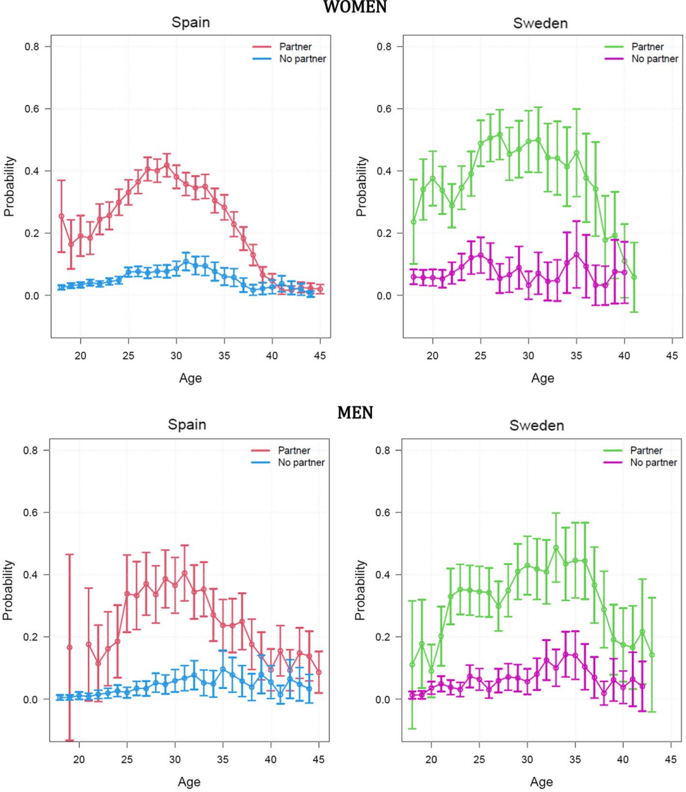
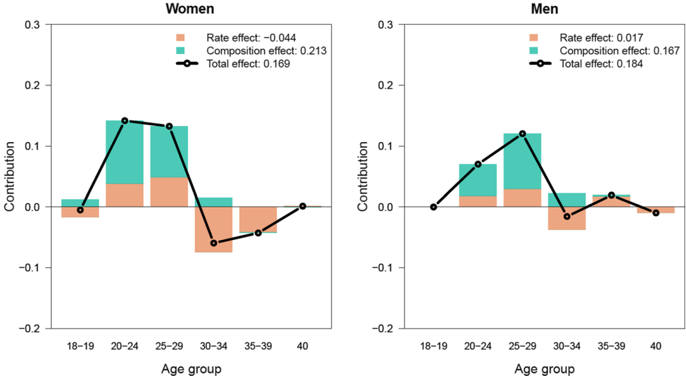
Below-replacement fertility has persisted across European countries for a few decades, though, with variation. Delays in age at first union and first birth have been key factors in the declining fertility levels within these societies. While the vast majority of births occurs within a stable partnership, the link between partnership formation and childbearing is rarely taken into account. In this paper, we examine the role of partnership formation in explaining the gap between Sweden and Spain regarding transitions to first birth. We utilize data from the 2018 Spanish Fertility Survey and the 2012/2013 Swedish Generations and Gender Survey to explore transition probabilities to first birth and implement Kitagawa decomposition and standardization techniques. Results show that having a partner is a strong predictor of becoming a first-time parent in the next 3 years, mainly within the ages 25 to 35. On average, Swedish first-birth transition probabilities for women are only 12% higher than probabilities of Spanish counterparts within this age range, suggesting that the proportion of partnerships formed plays a crucial role in explaining the fertility gap. Decomposition results confirm that before age 30, 74% of the difference in first-order births among women are due to the difference in partnership composition. We further find that earlier union formation in Spain could potentially reduce childlessness levels. Overall, our study highlights the importance of examining the role of partnership dynamics in fertility studies.
Overview
The claims and statistics of this paper haven’t been checked yet.
Free: it reads the open-access text and checks the first 5 claims that cite a source we can check. Create a free account to check every claim.
Integrity signals
Registry
Cites
Statistics
Figures
Verification
Claims the paper makes
The claims and statistics of this paper haven’t been checked yet.
Free: it reads the open-access text and checks the first 5 claims that cite a source we can check. Create a free account to check every claim.
Self-check
Percentages, sums and reported differences re-computed from the paper’s own numbers.
The self-check needs the paper’s full text.
Citations
Cites
Social Foundations of Postindustrial Economies
Esping-Andersen, G. (1999) · doi:10.1093/0198742002.001.0001 · Cited by 6,253
The Unfolding Story of the Second Demographic Transition
Lesthaeghe, R. (2010) · Population and Development Review · doi:10.1111/j.1728-4457.2010.00328.x · Cited by 1,794 · cited 4×
“Why we don’t have to believe without doubting in the" Second Demographic Transition"—some agnostic comments.”
BackgroundInfluentialThe Emergence of Lowest‐Low Fertility in Europe During the 1990s
Kohler, H., Billari, F. C., & Ortega, J. A. (2002) · Population and Development Review · doi:10.1111/j.1728-4457.2002.00641.x · Cited by 1,451 · cited 1×
“Specifically, Italy and Spain were the pioneers of low fertility from the early-1990s (Kohler et al., 2002).”
BackgroundFamily Ties in Western Europe: Persistent Contrasts
Reher, D. S. (1998) · Population and Development Review · doi:10.2307/2807972 · Cited by 1,356 · cited 3×
“Partnership formation occurring later among the Spanish may be due to several features, one of them being Spain’s familistic welfare regime (Esping-Andersen, 1999) and strong family ties (Reher, 1998).”
BackgroundThe Gender Revolution: A Framework for Understanding Changing Family and Demographic Behavior
Goldscheider, F., Bernhardt, E., & Lappegård, T. (2015) · Population and Development Review · doi:10.1111/j.1728-4457.2015.00045.x · Cited by 1,209 · cited 1×
“For instance, Spain is less advanced in the stages of the Second Demographic Transition (Lesthaeghe, 2010) and Gender Revolution (Esping-Andersen & Billari, 2015; Goldscheider et al., 2015) compared to Sweden—a paradigm example of being the most advanced in both theories.”
BackgroundGender Equity in Theories of Fertility Transition
McDonald, P. (2000) · Population and Development Review · doi:10.1111/j.1728-4457.2000.00427.x · Cited by 1,154 · cited 2×
“…(Alderotti et al., 2021; Matysiak et al., 2021; Vignoli et al., 2020), and gender-related (Esping-Andersen & Billari, 2015; Goldscheider et al., 2015; McDonald, 2000) reasons have been posited to contribute to cross-national differences in low fertility settings, and are generally assumed to…”
BackgroundEconomic Recession and Fertility in the Developed World
Sobotka, T., Skirbekk, V., & Philipov, D. (2011) · Population and Development Review · doi:10.1111/j.1728-4457.2011.00411.x · Cited by 863
Re‐theorizing Family Demographics
Esping‐Andersen, G., & Billari, F. C. (2015) · Population and Development Review · doi:10.1111/j.1728-4457.2015.00024.x · Cited by 763 · cited 2×
“For instance, Spain is less advanced in the stages of the Second Demographic Transition (Lesthaeghe, 2010) and Gender Revolution (Esping-Andersen & Billari, 2015; Goldscheider et al., 2015) compared to Sweden—a paradigm example of being the most advanced in both theories.”
BackgroundCultural Dynamics and Economic Theories of Fertility Change
Lesthaeghe, R., & Surkyn, J. (1988) · Population and Development Review · doi:10.2307/1972499 · Cited by 712 · cited 1×
“Cultural (Lesthaeghe, 2010; Lesthaeghe & Surkyn, 1988; Reher, 1998; Van de Kaa, 1987), economic (Alderotti et al., 2021; Matysiak et al., 2021; Vignoli et al., 2020), and gender-related (Esping-Andersen & Billari, 2015; Goldscheider et al., 2015; McDonald, 2000) reasons have been posited to…”
Balbo, N., Billari, F. C., & Mills, M. (2013) · European Journal of Population / Revue européenne de Démographie · doi:10.1007/s10680-012-9277-y · Cited by 623
Patterns of low and lowest-low fertility in Europe
Billari, F., & Kohler, H.-P. (2004) · Population Studies · doi:10.1080/0032472042000213695 · Cited by 571 · cited 3×
“…but they have distinct patterns in the timing of adulthood transition event occurrences (earliest-early vs. latestlate, respectively) (Billari, 2004) and have different levels of below-replacement fertility (highest-low vs. lowest-low, respectively) (Billari & Kohler, 2004; Kohler et al., 2002).”
BackgroundInfluentialTowards a new pattern of transition to adulthood?
Billari, F. C., & Liefbroer, A. C. (2010) · Advances in Life Course Research · doi:10.1016/j.alcr.2010.10.003 · Cited by 551 · cited 2×
“The postponement of the transition to first child is strongly associated with other events such as leaving the parental home and, more importantly, forming unions (Baizán et al., 2003; Balbo et al., 2013; Billari & Liefbroer, 2010; Billari et al., 2007; Esteve et al., 2020).”
BackgroundTransition to Adulthood in Europe
Buchmann, M. C., & Kriesi, I. (2011) · Annual Review of Sociology · doi:10.1146/annurev-soc-081309-150212 · Cited by 491 · cited 1×
“Comparative research on the transitions to adulthood has extensively shown the diverging patterns across European societies (Billari, 2004; Billari & Liefbroer, 2010; Buchmann & Kriesi, 2011; Corijn & Klijzing, 2001).”
Background(1987) · Population · doi:10.3917/popu.p1987.42n1.0005 · Cited by 386
Two Is Best? The Persistence of a Two‐Child Family Ideal in Europe
Sobotka, T., & Beaujouan, É. (2014) · Population and Development Review · doi:10.1111/j.1728-4457.2014.00691.x · Cited by 348 · cited 1×
“Meaning, if partnership dynamics between the countries were more analogous, Swedish and Spanish fertility may not be as notably different, but instead, closer to their shared desired number of children (Sobotka & Beaujouan, 2014).”
BackgroundTransitions to Adulthood in Europe
(2001) · European Studies of Population · doi:10.1007/978-94-015-9717-3 · Cited by 292
Employment Instability and Fertility in Europe: A Meta-Analysis
Alderotti, G., Vignoli, D., Baccini, M., & Matysiak, A. (2021) · Demography · doi:10.1215/00703370-9164737 · Cited by 277 · cited 1×
“Kaa, 1987), economic (Alderotti et al., 2021; Matysiak et al., 2021; Vignoli et al., 2020), and gender-related (Esping-Andersen & Billari, 2015; Goldscheider et al.”
Incomplete reporting of men’s fertility in the united states and britain: A research note
Rendall, M. S., Clarke, L., Peters, H. E., Ranjit, N., & Verropoulou, G. (1999) · Demography · doi:10.2307/2648139 · Cited by 244
The Great Recession and Fertility in Europe: A Sub-national Analysis
Matysiak, A., Sobotka, T., & Vignoli, D. (2021) · European Journal of Population · doi:10.1007/s10680-020-09556-y · Cited by 242 · cited 1×
“Kaa, 1987), economic (Alderotti et al., 2021; Matysiak et al., 2021; Vignoli et al., 2020), and gender-related (Esping-Andersen & Billari, 2015; Goldscheider et al.”
Becoming an Adult in Europe: A Macro(/Micro)-Demographic Perspective
Billari, F. (2004) · Demographic Research · doi:10.4054/demres.2004.s3.2 · Cited by 229 · cited 4×
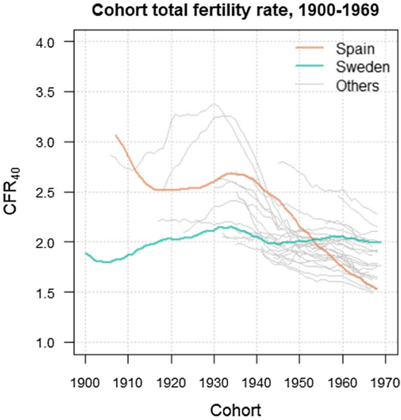
“Spain is known for its ‘latest-late’ transition to adulthood (Billari, 2004), whereas Sweden is not.”
BackgroundInfluentialChildlessness in Europe: Reconstructing Long-Term Trends Among Women Born in 1900–1972
Sobotka, T. (2017) · Demographic Research Monographs · doi:10.1007/978-3-319-44667-7_2 · Cited by 181 · cited 3×
“For example, singlehood and childlessness has been on the rise, and the Nordic countries have experienced an unexpected decline in period fertility (Esteve et al., 2016; Hellstrand et al., 2021; Reher & Requena, 2019; Sobotka, 2017).”
BackgroundUnderstanding Diversity in the Meaning of Cohabitation Across Europe
Hiekel, N., Liefbroer, A. C., & Poortman, A.-R. (2014) · European Journal of Population · doi:10.1007/s10680-014-9321-1 · Cited by 180 · cited 1×
“Additionally, co-residence with a stable partner has long been diffused across socio-economic groups in Sweden, and cohabitation is a family form that has been indistinguishable from marriage—legally and societally (Hiekel et al., 2014; Hoem & Hoem, 1988; Ohlsson-Wijk et al., 2020).”
BackgroundCohabitation, Marriage, and First Birth: The Interrelationship of Family Formation Events in Spain
Baizán, P., Aassve, A., & Billari, F. C. (2003) · European Journal of Population / Revue européenne de Démographie · doi:10.1023/a:1023343001627 · Cited by 168 · cited 3×
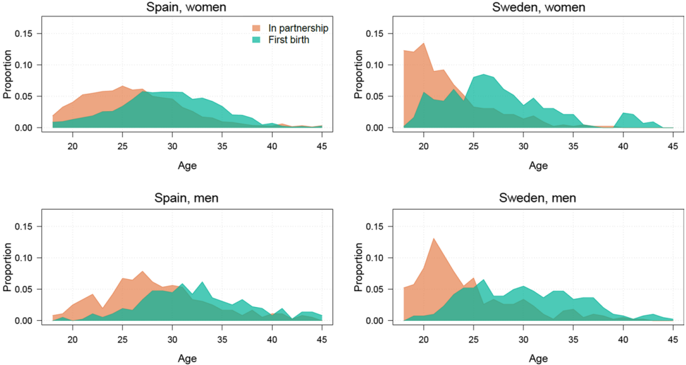
“would coincide with marriage and family formation in Spain (Baizán et al., 2003), and this is, indeed, what we observe in Fig.”
BackgroundInfluentialUncertainty and Narratives of the Future: A Theoretical Framework for Contemporary Fertility
Vignoli, D., Bazzani, G., Guetto, R., Minello, A., & Pirani, E. (2020) · The Springer Series on Demographic Methods and Population Analysis · doi:10.1007/978-3-030-48519-1_3 · Cited by 166 · cited 1×
“Kaa, 1987), economic (Alderotti et al., 2021; Matysiak et al., 2021; Vignoli et al., 2020), and gender-related (Esping-Andersen & Billari, 2015; Goldscheider et al.”
Cohort fertility decline in low fertility countries: Decomposition using parity progression ratios
Zeman, K., Beaujouan, E., Brzozowska, Z., & Sobotka, T. (2018) · Demographic Research · doi:10.4054/demres.2018.38.25 · Cited by 159
Fertility and Commitment: Bringing Men Back In
Goldscheider, F. K., & Kaufman, G. (1996) · Population and Development Review · doi:10.2307/2808006 · Cited by 150 · cited 1×
“2 The inclusion of men contributes to the increasing empirical evidence on male fertility, for which we know comparatively less than women (Goldscheider & Kaufman, 1996; Schoumaker, 2017, 2019).”
BackgroundColeman, D. (2004) · Vienna Yearbook of Population Research · doi:10.1553/populationyearbook2004s11 · Cited by 147 · cited 1×
“Initially, Spain became a paradox of the SDT because it combined low levels of fertility and postponement of first partnership formation with a small share of cohabitation and non-marital childbearing (Coleman, 2004; Dalla Zuanna & Micheli, 2004).”
BackgroundApproaching the Limit: Long‐Term Trends in Late and Very Late Fertility
Billari, F. C., Kohler, H., Andersson, G., & Lundström, H. (2007) · Population and Development Review · doi:10.1111/j.1728-4457.2007.00162.x · Cited by 145
Not Just Later, but Fewer: Novel Trends in Cohort Fertility in the Nordic Countries
Hellstrand, J., Nisén, J., Miranda, V., Fallesen, P., Dommermuth, L., & Myrskylä, M. (2021) · Demography · doi:10.1215/00703370-9373618 · Cited by 136
Childbearing preferences and family issues in Europe: evidence from the Eurobarometer 2006 survey
Testa, M. R. (2007) · Vienna Yearbook of Population Research · doi:10.1553/populationyearbook2007s357 · Cited by 123 · cited 1×
“The majority of first births occur within marriages or consensual unions in Europe (Kiernan, 1999) and the lack of a stable partner has been reported as one of the reasons for unrealized fertility desires in Europe (Esteve et al., 2021; Testa, 2007).”
BackgroundThe Quality of Male Fertility Data in Major U.S. Surveys
Joyner, K., Peters, H. E., Hynes, K., Sikora, A., Taber, J. R., & Rendall, M. S. (2012) · Demography · doi:10.1007/s13524-011-0073-9 · Cited by 118
Moving out the parental home and partnership formation as social determinants of low fertility
Esteve, A., Boertien, D., Mogi, R., & Lozano, M. (2020) · Vienna Yearbook of Population Research · doi:10.1553/populationyearbook2020.deb02 · Cited by 115
Self-citationRising Educational Participation and the Trend to Later Childbearing
Neels, K., Murphy, M., Ní Bhrolcháin, M., & Beaujouan, É. (2017) · Population and Development Review · doi:10.1111/padr.12112 · Cited by 111 · cited 1×
“For example, the age at first birth has been on the rise across European countries since the 1970s (Neels et al., 2017).”
BackgroundCohabitation in Western Europe.
KIERNAN, K. E. (1999) · PubMed · Cited by 111
Love, marriage, then the baby carriage? Marriage timing and childbearing in Sweden
Holland, J. A. (2013) · Demographic Research · doi:10.4054/demres.2013.29.11 · Cited by 98
Childbearing Across Partnerships in Australia, the United States, Norway, and Sweden
Thomson, E., Lappegård, T., Carlson, M., Evans, A., & Gray, E. (2014) · Demography · doi:10.1007/s13524-013-0273-6 · Cited by 97
Cohabitation in Spain: No Longer a Marginal Path to Family Formation
Dominguez‐Folgueras, M., & Castro‐Martin, T. (2013) · Journal of Marriage and Family · doi:10.1111/jomf.12013 · Cited by 87 · cited 4×
“Spain only started to observe notable increases in cohabitation since the 1990s, and marriage was the most common pathway to family formation before then (Domínguez-Folgueras & Castro-Martín, 2013; Martín-García, 2013).”
BackgroundInfluentialThe Swedish Family: Aspects of Contemporary Developments
Hoem, B., & Hoem, J. M. (1988) · Journal of Family Issues · doi:10.1177/019251388009003007 · Cited by 83 · cited 1×
“Additionally, co-residence with a stable partner has long been diffused across socio-economic groups in Sweden, and cohabitation is a family form that has been indistinguishable from marriage—legally and societally (Hiekel et al., 2014; Hoem & Hoem, 1988; Ohlsson-Wijk et al., 2020).”
BackgroundHow fertility and union stability interact in shaping new family patterns in Italy and Spain
Coppola, L., & Cesare, M. D. (2008) · Demographic Research · doi:10.4054/demres.2008.18.4 · Cited by 82 · cited 1×
“…as the increasing postponement of first union and childbearing, increasing levels of union dissolution (Bernardi & Martinez-Pastor, 2011; Castro-Martín, 1992; Coppola & Di Cesare, 2008), and increasing levels of cohabitation and non-marital childbearing (Domínguez-Folgueras & CastroMartín, 2013).”
BackgroundOhlsson‐Wijk, S. (2011) · Population Studies · doi:10.1080/00324728.2011.574724 · Cited by 81 · cited 2×
“Sweden, in particular, has had one of the highest shares of premarital cohabitation and the highest share of births within cohabitation (Holland, 2013; Ohlsson-Wijk, 2011).”
BackgroundGenerations and Gender Survey study profile
Gauthier, A. H., Cabaço, S. L. F., & Emery, T. (2018) · Longitudinal and Life Course Studies · doi:10.14301/llcs.v9i4.500 · Cited by 80 · cited 1×
“The GGS is an international compilation of fertility surveys containing rich microlevel information on life-courses and family dynamics (Gauthier et al., 2018; Vergauwen et al., 2015).”
BackgroundUncertain lives: Insights into the role of job precariousness in union formation in Italy
Vignoli, D., Tocchioni, V., & Salvini, S. (2016) · Demographic Research · doi:10.4054/demres.2016.35.10 · Cited by 66
Male Fertility Around the World and Over Time: How Different is it from Female Fertility?
Schoumaker, B. D. (2019) · Population and Development Review · doi:10.1111/padr.12273 · Cited by 64 · cited 1×
“2 The inclusion of men contributes to the increasing empirical evidence on male fertility, for which we know comparatively less than women (Goldscheider & Kaufman, 1996; Schoumaker, 2017, 2019).”
BackgroundWelfare States, Family Policies, and Fertility in Europe
Neyer, G. R. (2013) · Springer eBooks · doi:10.1007/978-90-481-8978-6_3 · Cited by 60
Delayed childbearing in contemporary Spain: trends and differentials
Martín, T. C. (1992) · European Journal of Population / Revue européenne de Démographie · doi:10.1007/bf01797211 · Cited by 59 · cited 1×
“…such as the increasing postponement of first union and childbearing, increasing levels of union dissolution (Bernardi & Martinez-Pastor, 2011; Castro-Martín, 1992; Coppola & Di Cesare, 2008), and increasing levels of cohabitation and non-marital childbearing (Domínguez-Folgueras &…”
BackgroundQuality of demographic data in GGS Wave 1
Vergauwen, J., Wood, J., De Wachter, D., & Neels, K. (2015) · Demographic Research · doi:10.4054/demres.2015.32.24 · Cited by 54
Family Forerunners? An Overview of Family Demographic Change in Sweden
Ohlsson‐Wijk, S., Turunen, J., & Andersson, G. (2020) · International handbooks of population · doi:10.1007/978-3-030-35079-6_5 · Cited by 49
Divorce risk factors and their variation over time in Spain
Bernardi, F., & Pastor, J. I. M. (2011) · Demographic Research · doi:10.4054/demres.2011.24.31 · Cited by 46 · cited 2×
“Moreover, cohabitation and non-marital childbearing were still considered marginal phenomena (DomínguezFolgueras & Castro-Martín, 2013), and divorce rates were still very low across the country (Bernardi & Martínez-Pastor, 2011; Castro-Martín, 1993; Miret-Gamundi, 1997).”
BackgroundDecline in fertility induced by economic recession in Spain
Puig‐Barrachina, V., Rodríguez‐Sanz, M., Domínguez‐Berjón, M. F., Martín, U., Luque-Fernández, M. Á., Ruiz, M., & Pérez, G. (2019) · Gaceta Sanitaria · doi:10.1016/j.gaceta.2019.05.011 · Cited by 43
Schoumaker, B. D. (2017) · Demographic Research · doi:10.4054/demres.2017.36.28 · Cited by 33 · cited 1×
“2 The inclusion of men contributes to the increasing empirical evidence on male fertility, for which we know comparatively less than women (Goldscheider & Kaufman, 1996; Schoumaker, 2017, 2019).”
BackgroundChildlessness in Twentieth-Century Spain: A Cohort Analysis for Women Born 1920–1969
Reher, D., & Requena, M. (2018) · European Journal of Population / Revue européenne de Démographie · doi:10.1007/s10680-018-9471-7 · Cited by 32
Entering first union: the choice between cohabitation and marriage among women in Italy and Spain
García‐Pereiro, T., Pace, R., & Didonna, M. G. (2014) · Journal of Population Research · doi:10.1007/s12546-014-9123-7 · Cited by 31
A Century of Nuptiality in Spain, 1900–2007
Muñoz-Pérez, F., & Valverde, J. R. (2011) · European Journal of Population / Revue européenne de Démographie · doi:10.1007/s10680-011-9234-1 · Cited by 27
Martín‐García, T. (2013) · Population review · doi:10.1353/prv.2013.0000 · Cited by 23 · cited 2×
“Spain only started to observe notable increases in cohabitation since the 1990s, and marriage was the most common pathway to family formation before then (Domínguez-Folgueras & Castro-Martín, 2013; Martín-García, 2013).”
BackgroundNuptiality patterns in Spain in the eighties.
Miret, P. (1997) · PubMed · Cited by 22
Is Two Still Best? Change in Parity-Specific Fertility Across Education in Low-Fertility Countries
Brzozowska, Z., Beaujouan, É., & Zeman, K. (2022) · Population Research and Policy Review · doi:10.1007/s11113-022-09716-4 · Cited by 17
Three Decades of Lowest-low Fertility in Spain, 1991 – 2018Preprint
Esteve, A., Lozano, M., Boertien, D., Mogi, R., & Cui, Q. (2021) · SocArXiv (OSF Preprints) · doi:10.31235/osf.io/45j23 · Cited by 15 · cited 2×
“Furthermore, the focus is placed on the transition to first birth, as it is the parity transition for which (not) having a partner matters the most (Esteve et al., 2021).”
BackgroundSelf-citationChanging nuptiality patterns in contemporary Spain.
Martín, T. C. (1994) · PubMed · Cited by 11
A Review of Policies and Practices Related to the “Highest-Low” Fertility of Sweden: A 2020 update
Andersson, G. (2020) · Figshare · doi:10.17045/sthlmuni.13217516.v2 · Cited by 4
A Review of Policies and Practices Related to the “Highest-Low” Fertility of Sweden: A 2020 update
Andersson, G. (2020) · Figshare · doi:10.17045/sthlmuni.13217516 · Cited by 4
Research works printed but not linked: 7
- Blossfeld, H.-P., Klijzing, E., Mills, M., & Kurz, K. (2005). Globalisation, uncertainty, and youth in society. Routledge.
- DallaZuanna, G., & Micheli, G. A. (Eds.). (2004). Strong family and low fertility: a paradox? New perspectives in interpreting contemporary family and reproductive behavior (Vol. 14). Berlin: Springer Science & Business Media.
- Esteve, A., Devolder, D., & Domingo, A. (2016). Childlessness in Spain: Tick Tock, Tick Tock, Tick Tock! Perspectives Demogràfiques, 1, 1-4.
- Eurostat. (2022a). Statistics database: Fertility indicators [demo_find]. Eurostat.
- Eurostat. (2022b). Statistics database: Estimated average age of young people leaving the parental household by sex [yth_demo_030]. Eurostat.
- Organisation for Economic Cooperation and Development (OECD). (2016). Education at a glance 2016. OECD.
- Perelli-Harris, B., Kreyenfeld, M., & Kubisch, K. (2011). Technical manual for the Harmonized Histories database (MPIDR Work- ing Paper No. 011). Max Planck Institute for Demographic Research.
Cited by
Delayed Fertility as a Driver of Fertility Decline?
Beaujouan, E. (2023) · The Springer Series on Demographic Methods and Population Analysis · doi:10.1007/978-3-031-29666-6_4 · Cited by 21
Tan, J., Cui, Q., & Uchikoshi, F. (2025) · Chinese Sociological Review · doi:10.1080/21620555.2025.2480296 · Cited by 18
“As detailed in studies by Cho and Retherford (1973) and Nishikido et al. (2022), the traditional methods involve calculating the numerator based only on births from married women within a specific age group.”
InfluentialSelf-citationKuang, B., Berrington, A. M., Vasireddy, S., & Kulu, H. (2025) · Demographic Research · doi:10.4054/demres.2025.52.7 · Cited by 26
Living apart together in contemporary Spain: Diverse motivations across life stages
Nishikido, M., & Martín, T. C. (2024) · Advances in Life Course Research · doi:10.1016/j.alcr.2024.100627 · Cited by 5
Self-citationUnrealized fertility in demography
Yeatman, S. E., & Smith‐Greenaway, E. (2025) · Demographic Research · doi:10.4054/demres.2025.53.36 · Cited by 8
“A lack of a suitable partner, either outright or through relationship dissolution, may contribute to involuntary childlessness or having fewer children than desired (Nishikido, Cui, and Esteve 2022).”
Metadata
- Authors
- Nishikido, M., Cui, Q., & Esteve, A.
- Affiliations
- Centre for Demographic Studies (ES)
- London School of Economics and Political Science (GB)
- Corresponding author
- Nishikido, Momoko
- Venue
- Genus
- Published
- 2022-08-12
- Volume
- 78
- Issue
- 1
- ISSN
- 0016-6987 (ISSN-L)
- 2035-5556
- OpenAlex
- W4291633121
- Cited by
- 15
- References
- 59
- Citations by year
- 2026: 2 · 2025: 7 · 2024: 3 · 2023: 3
- FWCI
- 5.42
- Type
- journal article
- Language
- en
- Open access
- gold
- doi.org
- Licence
- cc-by
- creativecommons.org/licenses/by/4.0 (tdm)
- creativecommons.org/licenses/by/4.0 (vor)
- Locations
- Genus (publishedVersion, cc-by)
- London School of Economics and Political Science Research Online (London School of Economics and Political Science) (acceptedVersion)
- London School of Economics and Political Science Theses Online (London School of Economics and Political Science) (acceptedVersion)
- Dipòsit Digital de Documents de la UAB (Universitat Autònoma de Barcelona) (submittedVersion, cc-by)
- DOAJ (DOAJ: Directory of Open Access Journals) (submittedVersion, cc-by-sa)
- Repositori digital de la UPF (Universitat Pompeu Fabra) (submittedVersion, cc-by)
- Funders
- Agència de Gestió d'Ajuts Universitaris i de Recerca
- Topics
- Social Sciences › Demography › Family Dynamics and Relationships
- Social Sciences › Gender Studies › Gender, Labor, and Family Dynamics
- Health Sciences › Medicine › Public Health, Environmental and Occupational Health › Reproductive Health and Contraception
- Keywords
- partnership development, fertility gap, below-replacement fertility, age at first birth, childlessness, transition probabilities, Kitagawa decomposition, childbearing
About these checks
Registry, retraction, Cites and statistics results are computed, not judged, with one exception: a printed reference that no index lists is read once by a model before it counts as a citation error. Claims are extracted by a model and kept only when their quote appears verbatim in the text; each cited source is then checked, with a model’s help, for whether it says what the claim relies on. Those verdicts can be wrong — read the claim’s quote and the cited source before relying on one.
Statistics and arithmetic are recomputed, not judged.
Confidence bands are shown only for fields calibrated on our annotated test set. None is calibrated yet, so no band is shown.
What counts as a claim ›How we measure confidence ›How we check this ›
Are you an author, or do you see a problem with this page? Request a review
Data sources
Bibliographic data: Semantic Scholar, OpenAlex, Crossref.
Contains information from the Semantic Scholar Academic Graph Datasets, made available under the ODC Attribution License (ODC-BY 1.0).
Semantic Scholar’s data is described in: Kinney, R., et al. (2023). The Semantic Scholar Open Data Platform. arXiv:2301.10140.
