

The Iranian form of psychometric properties of the Multidimensional Psychological Flexibility Inventory
Open accessThe DOI matches its Crossref record; 51 of the 52 references it cites were found in a registry or an index, and 1 are not checked yet; 6 of the 28 sources its claims cite were checked for support.
Abstract
The Multidimensional Psychological Flexibility Inventory (MPFI) is a new 60-item self-report scale developed to assess the specific components of psychological flexibility and inflexibility proposed in the Hexaflex model of Acceptance and Commitment Therapy (ACT). The present study sought to examine the psychometric properties of the Persian version of the MPFI-60 in a community sample of 307 Iranian adults. The original study supported a 12-factor second-order structure consisting of 6 dimensions for psychological flexibility and 6 dimensions for psychological inflexibility. The Persian MPFI-60 demonstrated acceptable semantic and test content, internal structure, correlations with other variables, and internal consistency. It also evidenced in relation to anxiety, stress, depression, and self-compassion. Overall, the results indicate that the Persian MPFI-60 is a psychometrically sound measure in the Iranian context that enables researchers and clinicians to comprehensively assess the components of psychological flexibility and inflexibility within the Hexaflex model. © 2022, The Author(s).
Verified 2026-11-25 · 1 reference not checked yet
Overview
CoChat Summary
TL;DR
This study translated the 60-item Multidimensional Psychological Flexibility Inventory (MPFI-60) into Persian and tested it in 307 Iranian adults. The Persian version showed acceptable semantic validity, content validity, factor structure, reliability, and expected correlations with anxiety, stress, depression, and self-compassion.
Key findings
- In semantic analysis with 14 respondents, all item impact scores were greater than 1.5, so all items were retained.
- Expert review by 12 experts found acceptable content validity, with CVI > 0.7 and CVR > 0.62.
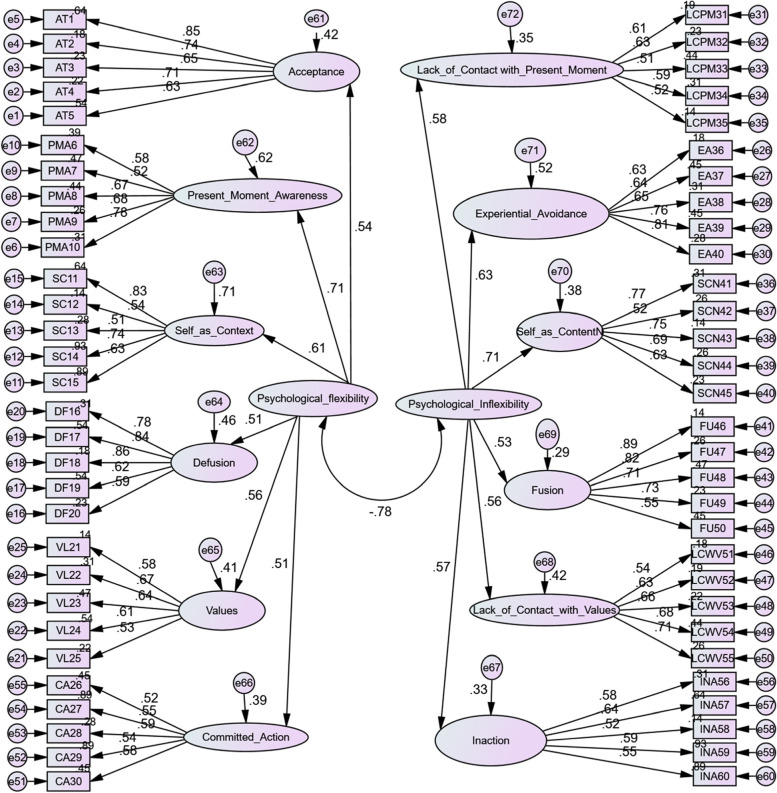
- Confirmatory factor analysis supported the 12-subscale second-order structure; fit indices were CMIN/df = 4.81, CFI = 0.93, RMSEA = 0.06, TLI = 0.92, and GFI = 0.92.
- The six flexibility subscales were negatively associated with depression, anxiety, and stress and positively associated with self-compassion; the six inflexibility subscales showed the opposite pattern. The paper also reports factor loadings above 0.5 and CR values of 0.71 to 0.81, with AVE values of 0.51 to 0.74.
Methods
- Cross-sectional psychometric validation of the Persian MPFI-60 in a community sample of 307 Iranian adults (226 women, 81 men), aged 18 to 48 years.
- The English MPFI-60 was translated into Persian using the Brislin approach, with online data collection from August 2021 to February 2022.
- Main analyses included semantic analysis, expert-based content validity (CVI, CVR), confirmatory factor analysis in AMOS, and Pearson correlations with DASS-21 and the Self-Compassion Scale.
Limitations
- The paper states that data were collected via an online survey and self-report questionnaires.
- The sample was recruited by convenience sampling and was predominantly female, which the paper says limits generalizability.
- The study was cross-sectional and used a general adult sample, so the authors note the need for longitudinal studies, test-retest reliability, and validation in clinical samples.
Model-written summary. Check it against the paper before relying on it.
Integrity signals
Registry
Cites
Statistics
Figures
Verification
Claims the paper makes
5 Valid · 1 Not valid · 11 Not checked · 22 Own results and interpretations
In the paper
“Similarly, the dimensions of psychological inflexibility correlate sensibly from 0.44 to 0.63 with each other (average common variance of 0.29), similar to the range (0.31 to 0.78) reported in the Rolffs's et al. (2018) study.”
§ The Iranian form of psychometric properties of the Multidimensional Psychological Flexibility Inventory > Discussion The present study aimed to extend research on multidimensional psychological flexibility and inflexibility to Eastern populations by translating the MPFI-60 into Persian and assessing its psychometric properties among an Iranian community sample of adults. The results of the semantic validity assessment using the impact score index confirmed the relevance, comprehensibly, and appropriateness of the translated MPFI-60 indicators. The results of quantitative content validity also showed acceptable content validity of the MPFI-60 items. Confirmatory factor analysis, consistent with previous psychometric work (Landi, Pakenham, Giovannetti, et al., 2021; Lin et al., 2020; Rolffs et al., 2018; Seidler et al., 2020; Thomas et al., 2021) and the Hexaflex model (Hayes et al., 1999, 2012), yielded a second-order factor structure consisting of six first-order factors for psychological flexibility (i.e., acceptance, present moment awareness, self as context, defusion, values, and committed action) and six first-order factors for psychological inflexibility (i.e., experiential avoidance, lack of contact with present moment, self as content, fusion, lack of contact with values, and inaction). The factor loading values of all indicators were above 0.5 (ranging from 0.51 to 0.89), so they all remained on the scale. The values of CR (within the range of 0.71 to 0.81) and AVE (within the range of 0.51 to 0.74) supported the acceptable construct reliability and convergent validity of the MPFI-60, respectively. The results of the correlation analysis support the Hexaflex model (Hayes et al., 1999, 2012) and the findings of previous research (Landi, Pakenham, Giovannetti, et al., 2021; Lin et al., 2020; Rolffs et al., 2018; Stabbe et al., 2019) suggesting that global psychological flexibility and psychological inflexibility and their subscales are related but distinct constructs that may change independently. The intercorrelations of the six flexibility subprocesses in Table 4 show moderate correlations (ranging from 0.38 to 0.57) with an average common variance of 0.21, similar to those reported by Rolffs et al. (2018). Although moderately correlated, each of the dimensions of psychological flexibility contains meaningful unique variance, and improvements in one dimension of psychological flexibility (e.g., acceptance) are not necessarily accompanied by improvements in other dimensions. Similarly, the dimensions of psychological inflexibility correlate sensibly from 0.44 to 0.63 with each other (average common variance of 0.29), similar to the range (0.31 to 0.78) reported in the Rolffs's et al. (2018) study. Accordingly, an inflexible client may be high on experiential avoidance but lower on other dimensions of psychological inflexibility. Moreover, the dimensions of flexibility are moderately correlated (−0.35 to −0.63) but distinct from their inflexibility counterparts. This implies that psychological flexibility and inflexibility are not simply two opposite ends of a single dimension but two distinct processes that should be considered independently. Convergent validity of the translated MPFI-60 was evidenced by significant positive relationships between global psychological inflexibility and its subscales with indicators of emotional distress (i.e., anxiety, stress, and depressive symptoms) and by opposite patterns of relationships for global psychological flexibility and its subscales. As hypothesized, higher levels of acceptance, present moment awareness, self as context, defusion, values, and committed action were negatively associated with anxiety, stress, and depressive symptoms. Higher scores on experiential avoidance, lack of contact with present moment, self as content, fusion, lack of contact with values, and inaction were positively associated with higher levels of anxiety, stress, and depressive symptoms. These results are in line with findings from previous research on the MPFI-60 (Landi, Pakenham, Giovannetti, et al., 2021; Lin et al., 2020; Rogge et al., 2019; Rolffs et al., 2018; Stabbe et al., 2019; Thomas et al., 2021). Moreover, scores on the global psychological flexibility and its subscale were positively associated with higher scores on self-compassion. In contrast, psychological inflexibility and its subscales were negatively related to self-compassion. This finding is consistent with previous studies (Farr et al., 2021; Marshall & Brockman, 2016; Mendes et al., 2022; Pyszkowska & Rönnlund, 2021; Rolffs et al., 2018) indicating that processes of psychological flexibility and inflexibility are related to self-compassion attitudes.
What the sources say
- Not checked — no full text of the sourcecites Rolffs's et al. (2018) matched to “Disentangling Components of Flexibility via the Hexaflex Model: Development and Validation of the Multidimensional Psychological Flexibility Inventory (MPFI)” (2018) source
plainstates an association- Asserted: passes — The authors put it forward as true.
- Checkable: passes — It can be checked against evidence.
- Load-bearing: passes — The paper’s conclusions depend on it.
- Based: passes — The paper gives a reason why it holds.
A result the paper reports from its own data — it cites no other source for it, so there is none to check. The quote shows it is in the paper.
In the paper
“yielded a second-order factor structure consisting of six first-order factors for psychological flexibility (i.e., acceptance, present moment awareness, self as context, defusion, values, and committed action)”
- Also stated in: § Discussion The present study aimed to extend research on multidimensional psychological flexibility and inflexibility to Eastern populations by translating the MPFI-60 into Persian and assessing its psychometric properties among an Iranian community sample of adults. The results of the semantic validity assessment using the impact score index confirmed the relevance, comprehensibly, and appropriateness of the translated MPFI-60 indicators. The results of quantitative content validity also showed acceptable content validity of the MPFI-60 items. Confirmatory factor analysis, consistent with previous psychometric work (Landi, Pakenham, Giovannetti, et al., 2021; Lin et al., 2020; Rolffs et al., 2018; Seidler et al., 2020; Thomas et al., 2021) and the Hexaflex model (Hayes et al., 1999, 2012), yielded a second-order factor structure consisting of six first-order factors for psychological flexibility (i.e., acceptance, present moment awareness, self as context, defusion, values, and committed action) and six first-order factors for psychological inflexibility (i.e., experiential avoidance, lack of contact with present moment, self as content, fusion, lack of contact with values, and inaction). The factor loading values of all indicators were above 0.5 (ranging from 0.51 to 0.89), so they all remained on the scale. The values of CR (within the range of 0.71 to 0.81) and AVE (within the range of 0.51 to 0.74) supported the acceptable construct reliability and convergent validity of the MPFI-60, respectively. The results of the correlation analysis support the Hexaflex model (Hayes et al., 1999, 2012) and the findings of previous research (Landi, Pakenham, Giovannetti, et al., 2021; Lin et al., 2020; Rolffs et al., 2018; Stabbe et al., 2019) suggesting that global psychological flexibility and psychological inflexibility and their subscales are related but distinct constructs that may change independently. The intercorrelations of the six flexibility subprocesses in Table 4 show moderate correlations (ranging from 0.38 to 0.57) with an average common variance of 0.21, similar to those reported by Rolffs et al. (2018). Although moderately correlated, each of the dimensions of psychological flexibility contains meaningful unique variance, and improvements in one dimension of psychological flexibility (e.g., acceptance) are not necessarily accompanied by improvements in other dimensions. Similarly, the dimensions of psychological inflexibility correlate sensibly from 0.44 to 0.63 with each other (average common variance of 0.29), similar to the range (0.31 to 0.78) reported in the Rolffs's et al. (2018) study. Accordingly, an inflexible client may be high on experiential avoidance but lower on other dimensions of psychological inflexibility. Moreover, the dimensions of flexibility are moderately correlated (−0.35 to −0.63) but distinct from their inflexibility counterparts. This implies that psychological flexibility and inflexibility are not simply two opposite ends of a single dimension but two distinct processes that should be considered independently. Convergent validity of the translated MPFI-60 was evidenced by significant positive relationships between global psychological inflexibility and its subscales with indicators of emotional distress (i.e., anxiety, stress, and depressive symptoms) and by opposite patterns of relationships for global psychological flexibility and its subscales. As hypothesized, higher levels of acceptance, present moment awareness, self as context, defusion, values, and committed action were negatively associated with anxiety, stress, and depressive symptoms. Higher scores on experiential avoidance, lack of contact with present moment, self as content, fusion, lack of contact with values, and inaction were positively associated with higher levels of anxiety, stress, and depressive symptoms. These results are in line with findings from previous research on the MPFI-60 (Landi, Pakenham, Giovannetti, et al., 2021; Lin et al., 2020; Rogge et al., 2019; Rolffs et al., 2018; Stabbe et al., 2019; Thomas et al., 2021). Moreover, scores on the global psychological flexibility and its subscale were positively associated with higher scores on self-compassion. In contrast, psychological inflexibility and its subscales were negatively related to self-compassion. This finding is consistent with previous studies (Farr et al., 2021; Marshall & Brockman, 2016; Mendes et al., 2022; Pyszkowska & Rönnlund, 2021; Rolffs et al., 2018) indicating that processes of psychological flexibility and inflexibility are related to self-compassion attitudes. · plain
“and six first-order factors for psychological inflexibility (i.e., experiential avoidance, lack of contact with present moment, self as content, fusion, lack of contact with values, and inaction).”
§ The Iranian form of psychometric properties of the Multidimensional Psychological Flexibility Inventory > Discussion The present study aimed to extend research on multidimensional psychological flexibility and inflexibility to Eastern populations by translating the MPFI-60 into Persian and assessing its psychometric properties among an Iranian community sample of adults. The results of the semantic validity assessment using the impact score index confirmed the relevance, comprehensibly, and appropriateness of the translated MPFI-60 indicators. The results of quantitative content validity also showed acceptable content validity of the MPFI-60 items. Confirmatory factor analysis, consistent with previous psychometric work (Landi, Pakenham, Giovannetti, et al., 2021; Lin et al., 2020; Rolffs et al., 2018; Seidler et al., 2020; Thomas et al., 2021) and the Hexaflex model (Hayes et al., 1999, 2012), yielded a second-order factor structure consisting of six first-order factors for psychological flexibility (i.e., acceptance, present moment awareness, self as context, defusion, values, and committed action) and six first-order factors for psychological inflexibility (i.e., experiential avoidance, lack of contact with present moment, self as content, fusion, lack of contact with values, and inaction). The factor loading values of all indicators were above 0.5 (ranging from 0.51 to 0.89), so they all remained on the scale. The values of CR (within the range of 0.71 to 0.81) and AVE (within the range of 0.51 to 0.74) supported the acceptable construct reliability and convergent validity of the MPFI-60, respectively. The results of the correlation analysis support the Hexaflex model (Hayes et al., 1999, 2012) and the findings of previous research (Landi, Pakenham, Giovannetti, et al., 2021; Lin et al., 2020; Rolffs et al., 2018; Stabbe et al., 2019) suggesting that global psychological flexibility and psychological inflexibility and their subscales are related but distinct constructs that may change independently. The intercorrelations of the six flexibility subprocesses in Table 4 show moderate correlations (ranging from 0.38 to 0.57) with an average common variance of 0.21, similar to those reported by Rolffs et al. (2018). Although moderately correlated, each of the dimensions of psychological flexibility contains meaningful unique variance, and improvements in one dimension of psychological flexibility (e.g., acceptance) are not necessarily accompanied by improvements in other dimensions. Similarly, the dimensions of psychological inflexibility correlate sensibly from 0.44 to 0.63 with each other (average common variance of 0.29), similar to the range (0.31 to 0.78) reported in the Rolffs's et al. (2018) study. Accordingly, an inflexible client may be high on experiential avoidance but lower on other dimensions of psychological inflexibility. Moreover, the dimensions of flexibility are moderately correlated (−0.35 to −0.63) but distinct from their inflexibility counterparts. This implies that psychological flexibility and inflexibility are not simply two opposite ends of a single dimension but two distinct processes that should be considered independently. Convergent validity of the translated MPFI-60 was evidenced by significant positive relationships between global psychological inflexibility and its subscales with indicators of emotional distress (i.e., anxiety, stress, and depressive symptoms) and by opposite patterns of relationships for global psychological flexibility and its subscales. As hypothesized, higher levels of acceptance, present moment awareness, self as context, defusion, values, and committed action were negatively associated with anxiety, stress, and depressive symptoms. Higher scores on experiential avoidance, lack of contact with present moment, self as content, fusion, lack of contact with values, and inaction were positively associated with higher levels of anxiety, stress, and depressive symptoms. These results are in line with findings from previous research on the MPFI-60 (Landi, Pakenham, Giovannetti, et al., 2021; Lin et al., 2020; Rogge et al., 2019; Rolffs et al., 2018; Stabbe et al., 2019; Thomas et al., 2021). Moreover, scores on the global psychological flexibility and its subscale were positively associated with higher scores on self-compassion. In contrast, psychological inflexibility and its subscales were negatively related to self-compassion. This finding is consistent with previous studies (Farr et al., 2021; Marshall & Brockman, 2016; Mendes et al., 2022; Pyszkowska & Rönnlund, 2021; Rolffs et al., 2018) indicating that processes of psychological flexibility and inflexibility are related to self-compassion attitudes.
plain- Asserted: passes — The authors put it forward as true.
- Checkable: passes — It can be checked against evidence.
- Load-bearing: passes — The paper’s conclusions depend on it.
- Based: passes — The paper gives a reason why it holds.
- Rests on an assumption not shown here.
- Also stated in: § Discussion The present study aimed to extend research on multidimensional psychological flexibility and inflexibility to Eastern populations by translating the MPFI-60 into Persian and assessing its psychometric properties among an Iranian community sample of adults. The results of the semantic validity assessment using the impact score index confirmed the relevance, comprehensibly, and appropriateness of the translated MPFI-60 indicators. The results of quantitative content validity also showed acceptable content validity of the MPFI-60 items. Confirmatory factor analysis, consistent with previous psychometric work (Landi, Pakenham, Giovannetti, et al., 2021; Lin et al., 2020; Rolffs et al., 2018; Seidler et al., 2020; Thomas et al., 2021) and the Hexaflex model (Hayes et al., 1999, 2012), yielded a second-order factor structure consisting of six first-order factors for psychological flexibility (i.e., acceptance, present moment awareness, self as context, defusion, values, and committed action) and six first-order factors for psychological inflexibility (i.e., experiential avoidance, lack of contact with present moment, self as content, fusion, lack of contact with values, and inaction). The factor loading values of all indicators were above 0.5 (ranging from 0.51 to 0.89), so they all remained on the scale. The values of CR (within the range of 0.71 to 0.81) and AVE (within the range of 0.51 to 0.74) supported the acceptable construct reliability and convergent validity of the MPFI-60, respectively. The results of the correlation analysis support the Hexaflex model (Hayes et al., 1999, 2012) and the findings of previous research (Landi, Pakenham, Giovannetti, et al., 2021; Lin et al., 2020; Rolffs et al., 2018; Stabbe et al., 2019) suggesting that global psychological flexibility and psychological inflexibility and their subscales are related but distinct constructs that may change independently. The intercorrelations of the six flexibility subprocesses in Table 4 show moderate correlations (ranging from 0.38 to 0.57) with an average common variance of 0.21, similar to those reported by Rolffs et al. (2018). Although moderately correlated, each of the dimensions of psychological flexibility contains meaningful unique variance, and improvements in one dimension of psychological flexibility (e.g., acceptance) are not necessarily accompanied by improvements in other dimensions. Similarly, the dimensions of psychological inflexibility correlate sensibly from 0.44 to 0.63 with each other (average common variance of 0.29), similar to the range (0.31 to 0.78) reported in the Rolffs's et al. (2018) study. Accordingly, an inflexible client may be high on experiential avoidance but lower on other dimensions of psychological inflexibility. Moreover, the dimensions of flexibility are moderately correlated (−0.35 to −0.63) but distinct from their inflexibility counterparts. This implies that psychological flexibility and inflexibility are not simply two opposite ends of a single dimension but two distinct processes that should be considered independently. Convergent validity of the translated MPFI-60 was evidenced by significant positive relationships between global psychological inflexibility and its subscales with indicators of emotional distress (i.e., anxiety, stress, and depressive symptoms) and by opposite patterns of relationships for global psychological flexibility and its subscales. As hypothesized, higher levels of acceptance, present moment awareness, self as context, defusion, values, and committed action were negatively associated with anxiety, stress, and depressive symptoms. Higher scores on experiential avoidance, lack of contact with present moment, self as content, fusion, lack of contact with values, and inaction were positively associated with higher levels of anxiety, stress, and depressive symptoms. These results are in line with findings from previous research on the MPFI-60 (Landi, Pakenham, Giovannetti, et al., 2021; Lin et al., 2020; Rogge et al., 2019; Rolffs et al., 2018; Stabbe et al., 2019; Thomas et al., 2021). Moreover, scores on the global psychological flexibility and its subscale were positively associated with higher scores on self-compassion. In contrast, psychological inflexibility and its subscales were negatively related to self-compassion. This finding is consistent with previous studies (Farr et al., 2021; Marshall & Brockman, 2016; Mendes et al., 2022; Pyszkowska & Rönnlund, 2021; Rolffs et al., 2018) indicating that processes of psychological flexibility and inflexibility are related to self-compassion attitudes. · plain
In the paper
“The intercorrelations of the six flexibility subprocesses in Table 4 show moderate correlations (ranging from 0.38 to 0.57) with an average common variance of 0.21, similar to those reported by Rolffs et al. (2018).”
§ The Iranian form of psychometric properties of the Multidimensional Psychological Flexibility Inventory > Discussion The present study aimed to extend research on multidimensional psychological flexibility and inflexibility to Eastern populations by translating the MPFI-60 into Persian and assessing its psychometric properties among an Iranian community sample of adults. The results of the semantic validity assessment using the impact score index confirmed the relevance, comprehensibly, and appropriateness of the translated MPFI-60 indicators. The results of quantitative content validity also showed acceptable content validity of the MPFI-60 items. Confirmatory factor analysis, consistent with previous psychometric work (Landi, Pakenham, Giovannetti, et al., 2021; Lin et al., 2020; Rolffs et al., 2018; Seidler et al., 2020; Thomas et al., 2021) and the Hexaflex model (Hayes et al., 1999, 2012), yielded a second-order factor structure consisting of six first-order factors for psychological flexibility (i.e., acceptance, present moment awareness, self as context, defusion, values, and committed action) and six first-order factors for psychological inflexibility (i.e., experiential avoidance, lack of contact with present moment, self as content, fusion, lack of contact with values, and inaction). The factor loading values of all indicators were above 0.5 (ranging from 0.51 to 0.89), so they all remained on the scale. The values of CR (within the range of 0.71 to 0.81) and AVE (within the range of 0.51 to 0.74) supported the acceptable construct reliability and convergent validity of the MPFI-60, respectively. The results of the correlation analysis support the Hexaflex model (Hayes et al., 1999, 2012) and the findings of previous research (Landi, Pakenham, Giovannetti, et al., 2021; Lin et al., 2020; Rolffs et al., 2018; Stabbe et al., 2019) suggesting that global psychological flexibility and psychological inflexibility and their subscales are related but distinct constructs that may change independently. The intercorrelations of the six flexibility subprocesses in Table 4 show moderate correlations (ranging from 0.38 to 0.57) with an average common variance of 0.21, similar to those reported by Rolffs et al. (2018). Although moderately correlated, each of the dimensions of psychological flexibility contains meaningful unique variance, and improvements in one dimension of psychological flexibility (e.g., acceptance) are not necessarily accompanied by improvements in other dimensions. Similarly, the dimensions of psychological inflexibility correlate sensibly from 0.44 to 0.63 with each other (average common variance of 0.29), similar to the range (0.31 to 0.78) reported in the Rolffs's et al. (2018) study. Accordingly, an inflexible client may be high on experiential avoidance but lower on other dimensions of psychological inflexibility. Moreover, the dimensions of flexibility are moderately correlated (−0.35 to −0.63) but distinct from their inflexibility counterparts. This implies that psychological flexibility and inflexibility are not simply two opposite ends of a single dimension but two distinct processes that should be considered independently. Convergent validity of the translated MPFI-60 was evidenced by significant positive relationships between global psychological inflexibility and its subscales with indicators of emotional distress (i.e., anxiety, stress, and depressive symptoms) and by opposite patterns of relationships for global psychological flexibility and its subscales. As hypothesized, higher levels of acceptance, present moment awareness, self as context, defusion, values, and committed action were negatively associated with anxiety, stress, and depressive symptoms. Higher scores on experiential avoidance, lack of contact with present moment, self as content, fusion, lack of contact with values, and inaction were positively associated with higher levels of anxiety, stress, and depressive symptoms. These results are in line with findings from previous research on the MPFI-60 (Landi, Pakenham, Giovannetti, et al., 2021; Lin et al., 2020; Rogge et al., 2019; Rolffs et al., 2018; Stabbe et al., 2019; Thomas et al., 2021). Moreover, scores on the global psychological flexibility and its subscale were positively associated with higher scores on self-compassion. In contrast, psychological inflexibility and its subscales were negatively related to self-compassion. This finding is consistent with previous studies (Farr et al., 2021; Marshall & Brockman, 2016; Mendes et al., 2022; Pyszkowska & Rönnlund, 2021; Rolffs et al., 2018) indicating that processes of psychological flexibility and inflexibility are related to self-compassion attitudes.
What the sources say
- Not checked — no full text of the sourcecites Rolffs et al. (2018) matched to “Disentangling Components of Flexibility via the Hexaflex Model: Development and Validation of the Multidimensional Psychological Flexibility Inventory (MPFI)” (2018) source
plainstates an association- Asserted: passes — The authors put it forward as true.
- Checkable: passes — It can be checked against evidence.
- Load-bearing: passes — The paper’s conclusions depend on it.
- Based: passes — The paper gives a reason why it holds.
What the paper did — it cites no source for this, so there is none to check. The quote shows it is in the paper.
In the paper
“The minimum ratio of cases to items was met in this study with 307 cases and 60 items.”
§ The Iranian form of psychometric properties of the Multidimensional Psychological Flexibility Inventory > Method > Data analyses
plainn = 307- Asserted: passes — The authors put it forward as true.
- Checkable: passes — It can be checked against evidence.
- Load-bearing: passes — The paper’s conclusions depend on it.
- Based: passes — The paper gives a reason why it holds.
What the paper did — it cites no source for this, so there is none to check. The quote shows it is in the paper.
In the paper
“the result showed that there were no outliers in the dataset”
§ The Iranian form of psychometric properties of the Multidimensional Psychological Flexibility Inventory > Results > Evidence based on internal structure
plain- Asserted: passes — The authors put it forward as true.
- Checkable: passes — It can be checked against evidence.
- Load-bearing: unclear — It is unclear whether the paper’s conclusions depend on it.
- Based: passes — The paper gives a reason why it holds.
3 more claims
Create a free account to see all 39 claims and to verify the 1 reference still open.
- Probably not a substantial claim. 15
- It may state two separate claims as one. 22
- The quote only partly states this claim. 3
Self-check
Percentages, sums and reported differences re-computed from the paper’s own numbers.
Each contradiction between two passages listed here was confirmed by an independent check.
Rated minor: it would not touch a result — a value no result rests on, a p-value that stays on the same side of the significance level, or a conflict that is clerical, resolved elsewhere in the paper, or outside its own findings.
In the paper
§ The Iranian form of psychometric properties of the Multidimensional Psychological Flexibility Inventory > Introduction
“We hypothesized that the 60-item MPFI would have a second-order factor structure consisting of psychological flexibility (6 items) and inflexibility (6 items) in the Iranian population.”
§ The Iranian form of psychometric properties of the Multidimensional Psychological Flexibility Inventory > Discussion
“yielded a second-order factor structure consisting of six first-order factors for psychological flexibility (i.e., acceptance, present moment awareness, self as context, defusion, values, and committed action) and six first-order factors for psychological inflexibility (i.e., experiential avoidance, lack of contact with present moment, self as content, fusion, lack of contact with values, and inaction)”
Citations
Cites
Principles and Practice of Structural Equation Modeling
Tabri, N., & Elliott, C. M. (2012) · Canadian Graduate Journal of Sociology and Criminology · doi:10.15353/cgjsc-rcessc.v1i1.25 · Cited by 38,891
(1998) · Cited by 36,049
Multivariate data analysis : a global perspective
Hair, J. F. (2010) · Cited by 20,126
(2014) · DigitalCommons - Kennesaw State University (Kennesaw State University) · Cited by 12,785
Using Self-Report Assessment Methods to Explore Facets of Mindfulness
Baer, R. A., Smith, G. T., Hopkins, J., Krietemeyer, J., & Toney, L. (2006) · Assessment · doi:10.1177/1073191105283504 · Cited by 7,511 · cited 1×
“…including the Multidimensional Experiential Avoidance Questionnaire (MEAQ; Gámez et al., 2011), the Five Facet Mindfulness Questionnaire (FFMQ; Baer et al., 2006), the Self-Compassion Scale (SCS; Neff, 2003), and the Comprehensive Assessment of ACT Processes (CompACT; Francis et al., 2016).”
BackgroundA QUANTITATIVE APPROACH TO CONTENT VALIDITY1
LAWSHE, C. H. (1975) · Personnel Psychology · doi:10.1111/j.1744-6570.1975.tb01393.x · Cited by 7,313 · cited 2×
“If the CVR value is greater than the Lawshe value (.62) (Lawshe, 1975), it means that the item has acceptable content validity (Cook & Beckman, 2006).”
BackgroundThe Development and Validation of a Scale to Measure Self-Compassion
NEFF, K. D. (2003) · Self and Identity · doi:10.1080/15298860309027 · Cited by 6,436 · cited 4×
“Abbreviations MPFI: The Multidimensional Psychological Flexibility Inventory; ACT : Accept‑ ance and commitment therapy; AAQ: Acceptance and Action Questionnaire; AAQ‑II: Acceptance and Action Questionnaire‑II; BEAQ: Brief Experiential Avoidance Questionnaire; MEAQ: Multidimensional Experiential Avoidance Questionnair…”
BackgroundMethodInfluential(1999) · Cited by 5,934
Bond, F. W., Hayes, S. C., Baer, R. A., Carpenter, K. M., Guenole, N., Orcutt, H. K., Waltz, T., & Zettle, R. D. (2011) · Behavior Therapy · doi:10.1016/j.beth.2011.03.007 · Cited by 3,950
Marsh, H. W., & Hocevar, D. (1985) · Psychological Bulletin · doi:10.1037//0033-2909.97.3.562 · Cited by 3,407 · cited 1×
“…to Kline (2015), acceptable factor loading values are non-negative, less than 1, and greater than 0.5), measurement model fit indices (according to Marsh and Hocevar (1985), CMIN/df between 1 and 5; root mean squared error of approximation (RMSEA) < 0.08; Tucker-Lewis index (TLI), comparative fit…”
InfluentialCognitive behaviour therapy for eating disorders: a “transdiagnostic” theory and treatment
Fairburn, C. G., Cooper, Z., & Shafran, R. (2003) · Behaviour Research and Therapy · doi:10.1016/s0005-7967(02)00088-8 · Cited by 3,374
Psychological flexibility as a fundamental aspect of health
Kashdan, T. B., & Rottenberg, J. (2010) · Clinical Psychology Review · doi:10.1016/j.cpr.2010.03.001 · Cited by 3,054 · cited 2×
“Numerous studies have shown that psychological flexibility is associated with well-being, life satisfaction, and lower levels of mental health problems (Kashdan & Rottenberg, 2010; Marshall & Brockman, 2016; Rogge et al., 2019).”
BackgroundMeasuring experiential avoidance: A preliminary test of a working model
Hayes, S. C., Strosahl, K., Wilson, K. G., Bissett, R. T., Pistorello, J., Toarmino, D., Polusny, M. A., Dykstra, T. A., Batten, S. V., Bergan, J., et al. (2004) · The Psychological Record · doi:10.1007/bf03395492 · Cited by 2,140
Current Concepts in Validity and Reliability for Psychometric Instruments: Theory and Application
Cook, D. A., & Beckman, T. J. (2006) · The American Journal of Medicine · doi:10.1016/j.amjmed.2005.10.036 · Cited by 1,745 · cited 2×
“If the value of the CVI is above 0.7, this indicates acceptable content validity of the item (Cook & Beckman, 2006).”
BackgroundInfluentialAcceptance and commitment therapy.
Hayes, S. C., & Lillis, J. (2012) · American Psychological Association eBooks · doi:10.1037/17335-000 · Cited by 1,543
Structural Equation Modeling With AMOS: Basic Concepts, Applications, and Programming
Byrne, B. M. (2013) · doi:10.4324/9781410600219 · Cited by 1,156
International Journal of Psychology
(2018) · International Journal of Psychology · doi:10.1002/(issn)1464-066x · Cited by 818
The empirical status of acceptance and commitment therapy: A review of meta-analyses
Gloster, A. T., Walder, N., Levin, M. E., Twohig, M. P., & Karekla, M. (2020) · Journal of Contextual Behavioral Science · doi:10.1016/j.jcbs.2020.09.009 · Cited by 622
Gámez, W., Chmielewski, M., Kotov, R., Ruggero, C., & Watson, D. (2011) · Psychological Assessment · doi:10.1037/a0023242 · Cited by 524 · cited 4×
“Several multidimensional measures have been developed to assess the specific components of the Hexaflex model of psychological flexibility, including the Multidimensional Experiential Avoidance Questionnaire (MEAQ; Gámez et al., 2011), the Five Facet Mindfulness Questionnaire (FFMQ; Baer et al.”
MethodInfluentialRolffs, J. L., Rogge, R. D., & Wilson, K. G. (2018) · Assessment · doi:10.1177/1073191116645905 · Cited by 504 · cited 28×
“These results are in line with findings from previous research on the MPFI-60 (Landi, Pakenham, Giovannetti, et al., 2021; Lin et al., 2020; Rogge et al., 2019; Rolffs et al., 2018; Stabbe et al., 2019; Thomas et al., 2021).”
BackgroundMethodResultInfluentialFrancis, A. W., Dawson, D. L., & Golijani-Moghaddam, N. (2016) · Journal of Contextual Behavioral Science · doi:10.1016/j.jcbs.2016.05.003 · Cited by 496 · cited 3×
“, 2006), the Self-Compassion Scale (SCS; Neff, 2003), and the Comprehensive Assessment of ACT Processes (CompACT; Francis et al., 2016).”
MethodLevin, M. E., Hildebrandt, M. J., Lillis, J., & Hayes, S. C. (2012) · Behavior Therapy · doi:10.1016/j.beth.2012.05.003 · Cited by 471 · cited 16×
“A growing body of evidence also suggests that psychological flexibility is the key mechanism for change in ACT (Levin et al., 2012), a third-wave behavioral therapy that is an effective treatment for a wide range of mental disorders, including depression, anxiety, chronic pain, eating disorders, substance use, and tra…”
BackgroundInfluentialThe Body Awareness Questionnaire: Reliability and Validity
Shields, S. A., Mallory, M. E., & Simon, A. (1989) · Journal of Personality Assessment · doi:10.1207/s15327752jpa5304_16 · Cited by 459
The brief experiential avoidance questionnaire: Development and initial validation
Gámez, W., Chmielewski, M., Kotov, R., Ruggero, C., Suzuki, N., & Watson, D. (2014) · Psychological Assessment · doi:10.1037/a0034473 · Cited by 450 · cited 1×
“…flexibility/inflexibility relied on unidimensional scales, including the Acceptance and Action Questionnaire (AAQ; Hayes et al., 2004), the Acceptance and Action Questionnaire-II (AAQ-II; Bond et al., 2011) and the Brief Experiential Avoidance Questionnaire (BEAQ; Gámez et al., 2014).”
BackgroundWhat Does the Acceptance and Action Questionnaire (AAQ-II) Really Measure?
Wolgast, M. (2014) · Behavior Therapy · doi:10.1016/j.beth.2014.07.002 · Cited by 421 · cited 1×
“…shown to capture difficult thoughts and feelings to which individuals respond, rather than measuring individuals’ tendency to react inflexibly to undesirable inner experiences (Kashdan et al., 2020; Landi, Pakenham, Crocetti, et al., 2021; Ong et al., 2020; Tyndall et al., 2019; Wolgast, 2014).”
BackgroundTyndall, I., Waldeck, D., Pancani, L., Whelan, R., Roche, B., & Dawson, D. L. (2019) · Journal of Contextual Behavioral Science · doi:10.1016/j.jcbs.2018.09.005 · Cited by 303
Broder, H. L., McGrath, C., & Cisneros, G. J. (2007) · Community Dentistry and Oral Epidemiology · doi:10.1111/j.1600-0528.2007.00401.x · Cited by 301
Psychological flexibility as a malleable public health target: Evidence from a representative sample
Gloster, A. T., Meyer, A. H., & Lieb, R. (2017) · Journal of Contextual Behavioral Science · doi:10.1016/j.jcbs.2017.02.003 · Cited by 272
Kashdan, T. B., Disabato, D. J., Goodman, F. R., Doorley, J. D., & McKnight, P. E. (2020) · Psychological Assessment · doi:10.1037/pas0000834 · Cited by 240 · cited 1×
“More recently, the AAQ-II and the BEAQ (the most widely used measures of psychological inflexibility) have been shown to capture difficult thoughts and feelings to which individuals respond, rather than measuring individuals’ tendency to react inflexibly to undesirable inner experiences (Kashdan et al., 2020; Landi, P…”
MethodRumination, experiential avoidance, and dysfunctional thinking in eating disorders.
Rawal, A., Park, R. J., & Williams, J. M. G. (2010) · Behaviour Research and Therapy · doi:10.1016/j.brat.2010.05.009 · Cited by 223
Pakenham, K. I., Landi, G., Boccolini, G., Furlani, A., Grandi, S., & Tossani, E. (2020) · Journal of Contextual Behavioral Science · doi:10.1016/j.jcbs.2020.07.003 · Cited by 210
The Relationships Between Psychological Flexibility, Self-Compassion, and Emotional Well-Being
Marshall, E.-J., & Brockman, R. N. (2016) · Journal of Cognitive Psychotherapy · doi:10.1891/0889-8391.30.1.60 · Cited by 184 · cited 2×
“Numerous studies have shown that psychological flexibility is associated with well-being, life satisfaction, and lower levels of mental health problems (Kashdan & Rottenberg, 2010; Marshall & Brockman, 2016; Rogge et al., 2019).”
BackgroundResultRogge, R. D., Daks, J. S., Dubler, B. A., & Saint, K. J. (2019) · Journal of Contextual Behavioral Science · doi:10.1016/j.jcbs.2019.10.001 · Cited by 109 · cited 1×
“Moreover, most items in the above scales are negatively worded to assess psychological inflexibility, and the reversed item scores are used as a measure of psychological flexibility (Rogge et al., 2019).”
MethodThe relation between anxiety disorder and experiential avoidance in inpatient adolescents
Venta, A., Sharp, C., & Hart, J. (2012) · Psychological Assessment · doi:10.1037/a0025362 · Cited by 100
Fonseca, S., Trindade, I. A., Mendes, A. L., & Ferreira, C. (2020) · Clinical Psychologist · doi:10.1111/cp.12194 · Cited by 89 · cited 1×
“In addition, psychological flexibility is known to be a protective factor that moderates the relationship between daily life stress, physical functioning, and mental health (Fonseca et al., 2020; Gloster et al., 2017; Pakenham et al., 2020).”
BackgroundOng, C. W., Pierce, B. G., Petersen, J. M., Barney, J. L., Fruge, J. E., Levin, M. E., & Twohig, M. P. (2020) · Journal of Contextual Behavioral Science · doi:10.1016/j.jcbs.2020.08.007 · Cited by 87
Stabbe, O. K., Rolffs, J. L., & Rogge, R. D. (2019) · Journal of Contextual Behavioral Science · doi:10.1016/j.jcbs.2019.03.003 · Cited by 78 · cited 3×
“…(Hayes et al., 1999, 2012) and the findings of previous research (Landi, Pakenham, Giovannetti, et al., 2021; Lin et al., 2020; Rolffs et al., 2018; Stabbe et al., 2019) suggesting that global psychological flexibility and psychological inflexibility and their subscales are related but…”
BackgroundResultMeyer, E. C., La Bash, H., DeBeer, B. B., Kimbrel, N. A., Gulliver, S. B., & Morissette, S. B. (2019) · Psychological Trauma: Theory, Research, Practice, and Policy · doi:10.1037/tra0000358 · Cited by 74 · cited 1×
“, 2011), and posttraumatic stress disorder (Meyer et al., 2019).”
Tavakoli, N., Broyles, A., Reid, E. K., Sandoval, J. R., & Correa-Fernández, V. (2019) · Journal of Contextual Behavioral Science · doi:10.1016/j.jcbs.2018.11.001 · Cited by 72 · cited 1×
“, 2019), anxiety and somatization (Tavakoli et al., 2019; Venta et al., 2012), eating disorders (Fairburn et al.”
BackgroundLife hassles, experiential avoidance and distressing delusional experiences
Goldstone, E., Farhall, J., & Ong, B. (2011) · Behaviour Research and Therapy · doi:10.1016/j.brat.2011.02.002 · Cited by 60 · cited 1×
“…depression (Gilbert et al., 2019), anxiety and somatization (Tavakoli et al., 2019; Venta et al., 2012), eating disorders (Fairburn et al., 2003; Rawal et al., 2010), substance use (Levin et al., 2012), psychosis (Goldstone et al., 2011), and posttraumatic stress disorder (Meyer et al., 2019).”
BackgroundLin, Y.-Y., Rogge, R. D., & Swanson, D. P. (2020) · Journal of Contextual Behavioral Science · doi:10.1016/j.jcbs.2019.11.008 · Cited by 58 · cited 21×
“These results are in line with findings from previous research on the MPFI-60 (Landi, Pakenham, Giovannetti, et al., 2021; Lin et al., 2020; Rogge et al., 2019; Rolffs et al., 2018; Stabbe et al., 2019; Thomas et al., 2021).”
BackgroundResultInfluential(2013) · Practice in Clinical Psychology · Cited by 57
Mendes, A. L., Canavarro, M. C., & Ferreira, C. (2022) · Current Psychology · doi:10.1007/s12144-021-02438-4 · Cited by 54 · cited 1×
“This finding is consistent with previous studies (Farr et al., 2021; Marshall & Brockman, 2016; Mendes et al., 2022; Pyszkowska & Rönnlund, 2021; Rolffs et al., 2018) indicating that processes of psychological flexibility and inflexibility are related to self-compassion attitudes.”
ResultAssociations between depression, anxious arousal and manifestations of psychological inflexibility
Gilbert, K. E., Tonge, N. A., & Thompson, R. J. (2019) · Journal of Behavior Therapy and Experimental Psychiatry · doi:10.1016/j.jbtep.2018.09.006 · Cited by 53 · cited 1×
“Psychological inflexibility is closely related to a variety of mental disorders, including depression (Gilbert et al., 2019), anxiety and somatization (Tavakoli et al.”
BackgroundLandi, G., Pakenham, K. I., Crocetti, E., Grandi, S., & Tossani, E. (2021) · Journal of Contextual Behavioral Science · doi:10.1016/j.jcbs.2021.05.004 · Cited by 51
Seidler, D., Stone, B., Clark, B. E., Koran, J., & Drake, C. E. (2020) · Journal of Contextual Behavioral Science · doi:10.1016/j.jcbs.2020.04.007 · Cited by 46 · cited 1×
“…factor analysis, consistent with previous psychometric work (Landi, Pakenham, Giovannetti, et al., 2021; Lin et al., 2020; Rolffs et al., 2018; Seidler et al., 2020; Thomas et al., 2021) and the Hexaflex model (Hayes et al., 1999, 2012), yielded a second-order factor structure consisting…”
ResultPyszkowska, A., & Rönnlund, M. (2021) · Frontiers in Psychology · doi:10.3389/fpsyg.2021.671746 · Cited by 45 · cited 1×
“This finding is consistent with previous studies (Farr et al., 2021; Marshall & Brockman, 2016; Mendes et al., 2022; Pyszkowska & Rönnlund, 2021; Rolffs et al., 2018) indicating that processes of psychological flexibility and inflexibility are related to self-compassion attitudes.”
ResultItalian validation of the Italian multidimensional psychological flexibility inventory (MPFI)
Landi, G., Pakenham, K. I., Giovannetti, A. M., Presti, G., Boccolini, G., Cola, A., Grandi, S., & Tossani, E. (2021) · Journal of Contextual Behavioral Science · doi:10.1016/j.jcbs.2021.05.007 · Cited by 39
Farr, J., Ononaiye, M., & Irons, C. (2021) · Psychology and Psychotherapy: Theory, Research and Practice · doi:10.1111/papt.12353 · Cited by 31 · cited 1×
“This finding is consistent with previous studies (Farr et al., 2021; Marshall & Brockman, 2016; Mendes et al., 2022; Pyszkowska & Rönnlund, 2021; Rolffs et al., 2018) indicating that processes of psychological flexibility and inflexibility are related to self-compassion attitudes.”
ResultAn Examination of the Factor Structure of the Multidimensional Psychological Flexibility Inventory.
Thomas, K. N., Bardeen, J. R., Witte, T. K., Rogers, T. A., Benfer, N., & Clauss, K. (2022) · Assessment · doi:10.1177/10731911211024353 · Cited by 24 · cited 1×
“These results are in line with findings from previous research on the MPFI-60 (Landi, Pakenham, Giovannetti, et al., 2021; Lin et al., 2020; Rogge et al., 2019; Rolffs et al., 2018; Stabbe et al., 2019; Thomas et al., 2021).”
ResultThe practice of clinical psychology.
Harrower, M. R. (1961) · Charles C Thomas Publisher eBooks · doi:10.1037/13136-000 · Cited by 21
Psychometric Properties and Factor Structure of Body Awareness Questionnaire
Taherifar, Z., Assistant Professor, D. O. P., DehghaniArani, F., Assistant Professor, D. O. P., Mootabi, F., Assistant Professor, F. R. I., Fata, L., Assistant Professor, I. U. O. M. S., AghababaeiNajar, Z., & B. S. in Psychology of Exceptional Children, S. B. U. (2019) · Biannual Journal of Contemporary Psychology · doi:10.29252/bjcp.14.1.69 · Cited by 6
Research works printed but not linked: 3
- Brislin RW Translation and content analysis of oral and written material Handbook of Cross-Cultural Psychology 1980 2 2 389 444
- Hajizadeh E Asghari M Statistical methods and analyses in health and biosciences a research methodological approach 2011 Jahade Daneshgahi Publications 395
- Tabachnick BG Fidell LS Using Multivariate Statistics: International Edition 2012 Harper & Row
Cited by
Identification of psychological flexibility and inflexibility profiles during the COVID‐19 pandemic
Pakenham, K. I., Landi, G., Cattivelli, R., Grandi, S., & Tossani, E. (2023) · Journal of Clinical Psychology · doi:10.1002/jclp.23536 · Cited by 20
Chen, H., Abdelrasheed, N. S. G., Mecheser, A. E., Tayyib, N. A., Ramaiah, P., Prasad, K., Estrada-Araoz, E. G., Alkhayyat, S., Ramadan, M. F., & Abdollahi, A. (2023) · Research Square · doi:10.21203/rs.3.rs-2925992/v1 · Cited by 6
Self-citationBarrado‐Moreno, V., Esteve, R., López-Martínez, A. E., & Ramírez‐Maestre, C. (2025) · Current Psychology · doi:10.1007/s12144-025-07421-x · Cited by 12
“…we expected to replicate the higher-order factor structure observed in previous studies that tested the internal structures of both the MPFI-60 (Azadfar et al., 2022; Landi et al., 2021; Lin et al., 2020 ; Rolffs et al., 2016; Seidler et al., 2020; Simkin et al., 2023; Sundström et al., 2023;…”
InfluentialMoosivand, M., Kulemarzi, M. J. B., Shirazi, M. S., & Zaremohzzabieh, Z. (2024) · BMC Psychology · doi:10.1186/s40359-024-01531-0 · Cited by 4
“Notably, previous studies validating the MPFI have predominantly focused on clinical and Iranian community samples of adults [22, 23].”
BackgroundMethodMultidimensional Psychological Flexibility Inventory (MPFI)
Rogge, R. D., & Lin, Y. (2024) · Springer eBooks · doi:10.1007/978-3-030-77644-2_114-1 · Cited by 5
Metadata
- Authors
- Azadfar, Z., Abdollahi, A., Patra, I., Chang, Y.-P., Alghazali, T., & Talib, S. G.
- Affiliations
- Alzahra University (IR)
- National Institute of Technology Durgapur (IN)
- Iraqi University (IQ)
- Al-Mustaqbal University (IQ)
- Corresponding author
- Abdollahi, Abbas
- Venue
- Psicologia: Reflexao e Critica
- Published
- 2022-09-29
- Volume
- 35
- Issue
- 1
- Pages
- 32-32
- ISSN
- 0102-7972 (ISSN-L)
- 1678-7153
- PMC
- PMC9519821
- OpenAlex
- W4297486077
- Cited by
- 20
- References
- 51
- Citations by year
- 2026: 7 · 2025: 7 · 2024: 3 · 2023: 3
- FWCI
- 2.52
- Type
- journal article
- Language
- en
- Open access
- gold
- doi.org
- Licence
- cc-by
- creativecommons.org/licenses/by/4.0 (tdm)
- creativecommons.org/licenses/by/4.0 (vor)
- Locations
- Psicologia Reflexão e Crítica (publishedVersion, cc-by)
- PubMed Central (publishedVersion, cc-by)
- PubMed (publishedVersion)
- LA Referencia (Red Federada de Repositorios Institucionales de Publicaciones Científicas) (publishedVersion, other-oa)
- Chinese Culture University Repository (submittedVersion)
- DOAJ (DOAJ: Directory of Open Access Journals) (submittedVersion, cc-by-sa)
- Greater South Information System
- Topics
- Social Sciences › Psychology › Clinical Psychology › Mindfulness and Compassion Interventions
- Social Sciences › Decision Sciences › Management Science and Operations Research › Psychometric Methodologies and Testing
- Social Sciences › Psychology › Experimental and Cognitive Psychology › Anxiety, Depression, Psychometrics, Treatment, Cognitive Processes
- Keywords
- psychological flexibility, psychological inflexibility, acceptance and commitment therapy, Persian translation, cross-cultural adaptation, psychometric properties, factor structure, anxiety, depression, stress, self-compassion, Iranian adults
About these checks
Registry, retraction, Cites and statistics results are computed, not judged, with one exception: a printed reference that no index lists is read once by a model before it counts as a citation error. Claims are extracted by a model and kept only when their quote appears verbatim in the text; each cited source is then checked, with a model’s help, for whether it says what the claim relies on. Those verdicts can be wrong — read the claim’s quote and the cited source before relying on one.
The claim verdicts this report counts are experimental: their accuracy is not yet measured.
A language model drew the claims from the paper on 2026-10-11, under version 3 of the claim definition (model deepseek-v4.1-flash, prompt extract-v3).
A second model labelled each claim on 2026-10-11 (model jev-1.13-20260917, definition revision gold-guideline-v0.2).
Statistics and arithmetic are recomputed, not judged.
Confidence bands are shown only for fields calibrated on our annotated test set. None is calibrated yet, so no band is shown.
What counts as a claim ›How we measure confidence ›How we check this ›
Are you an author, or do you see a problem with this page? Request a review
Data sources
Bibliographic data: Semantic Scholar, OpenAlex, Crossref.
Contains information from the Semantic Scholar Academic Graph Datasets, made available under the ODC Attribution License (ODC-BY 1.0).
Semantic Scholar’s data is described in: Kinney, R., et al. (2023). The Semantic Scholar Open Data Platform. arXiv:2301.10140.
