

The DOI matches its Crossref record; 110 of the 117 references it cites were found in a registry or an index, and 1 are not checked yet.
Why does peer instruction benefit student learning?
Open accessAbstract
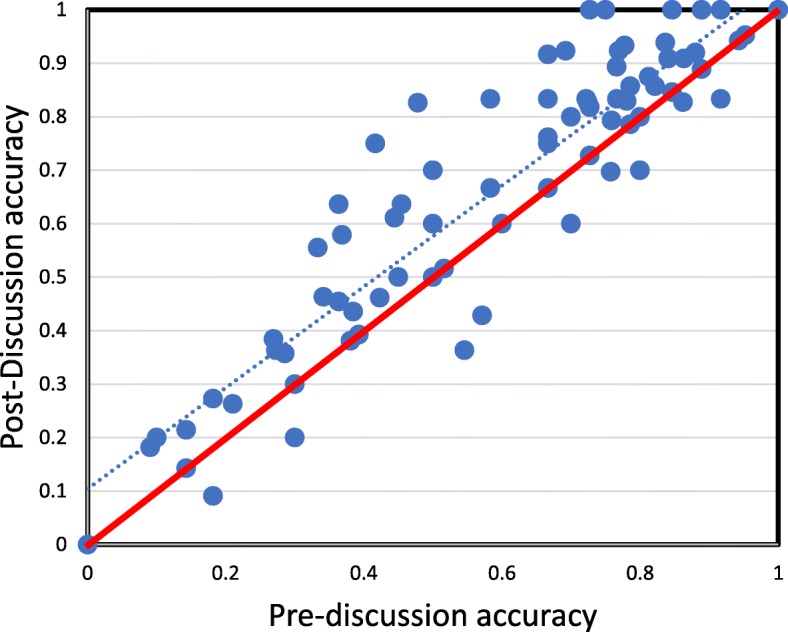
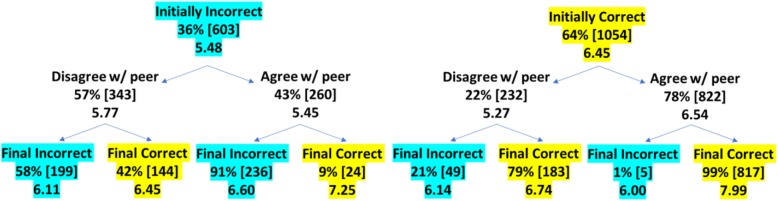
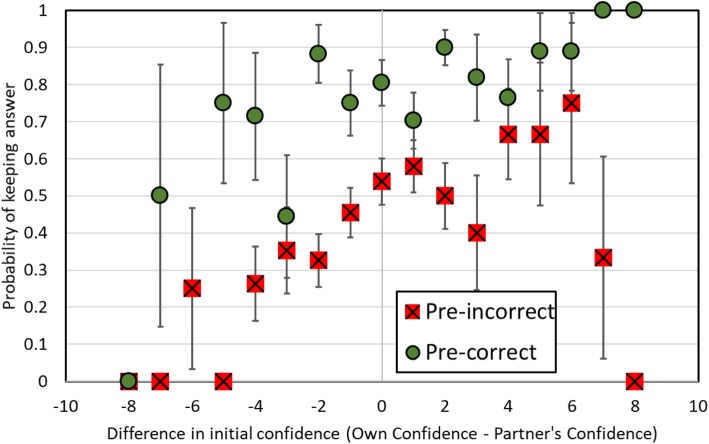
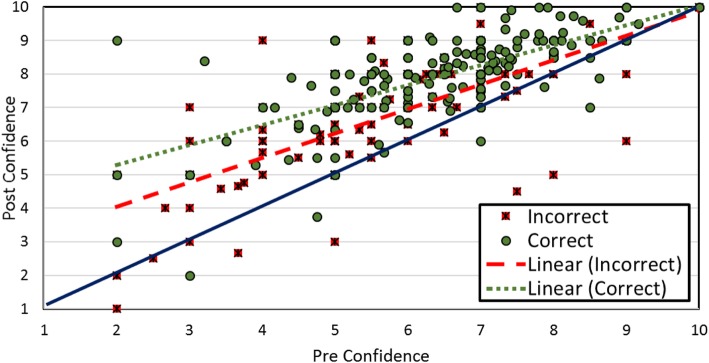
In peer instruction, instructors pose a challenging question to students, students answer the question individually, students work with a partner in the class to discuss their answers, and finally students answer the question again. A large body of evidence shows that peer instruction benefits student learning. To determine the mechanism for these benefits, we collected semester-long data from six classes, involving a total of 208 undergraduate students being asked a total of 86 different questions related to their course content. For each question, students chose their answer individually, reported their confidence, discussed their answers with their partner, and then indicated their possibly revised answer and confidence again. Overall, students were more accurate and confident after discussion than before. Initially correct students were more likely to keep their answers than initially incorrect students, and this tendency was partially but not completely attributable to differences in confidence. We discuss the benefits of peer instruction in terms of differences in the coherence of explanations, social learning, and the contextual factors that influence confidence and accuracy.
Overview
The claims and statistics of this paper haven’t been checked yet.
Run the check — free, no account needed. It reads the open-access text and checks the sources it cites.
Integrity signals
Registry
Cites
Statistics
Figures
Verification
Claims the paper makes
The claims and statistics of this paper haven’t been checked yet.
Run the check — free, no account needed. It reads the open-access text and checks the sources it cites.
Claims other papers make about this one
Each is checked against this paper’s own text: does it say what the citing paper says it does?
The cited source says what the claim attributes to it.
In the citing paper
“Prior research on peer instruction shows that when students can talk through their answers with a peer, they think more carefully about their reasoning, and this makes the assessment more collaborative and learning oriented (Tullis and Goldstone, 2020).”
From Generative AI-Enhanced Oral Exams in Economics Education (2026) · cites this paper as Tullis and Goldstone, 2020
Self-check
Percentages, sums and reported differences re-computed from the paper’s own numbers.
The self-check needs the paper’s full text.
Citations
Cites
Fitting Linear Mixed-Effects Models Using lme4
Bates, D., Mächler, M., Bolker, B., & Walker, S. (2015) · Journal of Statistical Software · doi:10.18637/jss.v067.i01 · Cited by 86,835
Mixed-effects modeling with crossed random effects for subjects and items
Baayen, R. H., Davidson, D. J., & Bates, D. M. (2008) · Journal of Memory and Language · doi:10.1016/j.jml.2007.12.005 · Cited by 8,540 · cited 1×
“In mixed-effect models with hundreds of observations, the t distribution effectively converges to the normal, so we compared the t statistic to the normal distribution for analyses involving continuous outcomes (i.e., confidence; Baayen, 2008).”
MethodReview of research in education
Shulman, L. S., Mowry, S., & Berliner, D. C. (1973) · F.E. Peacock eBooks · Cited by 7,754
Handbook of educational psychology
(1997) · Choice Reviews Online · doi:10.5860/choice.34-3084 · Cited by 4,850
Categorical data analysis: Away from ANOVAs (transformation or not) and towards logit mixed models
Jaeger, T. F. (2008) · Journal of Memory and Language · doi:10.1016/j.jml.2007.11.007 · Cited by 3,317 · cited 1×
“Finally, mixed effects models can predict the log odds (or logit) of a correct answer, which is needed when examining binary outcomes (i.e., correct or incorrect; Jaeger, 2008).”
BackgroundThe Journal of College Science Teaching
(1971) · Journal of Chemical Education · doi:10.1021/ed048p284 · Cited by 3,314
Analyzing Linguistic Data: A Practical Introduction to Statistics using R
Baayen, R. H. (2008) · doi:10.1017/cbo9780511801686 · Cited by 3,253
Test-Enhanced Learning: Taking Memory Tests Improves Long-Term Retention
Roediger, H. L., & Karpicke, J. D. (2006) · Psychological Science · doi:10.1111/j.1467-9280.2006.01693.x · Cited by 2,867
Peer Instruction: Ten years of experience and results
Crouch, C. H., & Mazur, E. (2001) · American Journal of Physics · doi:10.1119/1.1374249 · Cited by 2,682
Eliciting Self‐Explanations Improves Understanding
Michelene, T. H., Leeuw, N. D., Chiu, M., & Lavancher, C. (1994) · Cognitive Science · doi:10.1016/0364-0213(94)90016-7 · Cited by 2,492
Research works printed but not linked: 4
- Newbury, P., & Heiner, C. (2012). Ready, set, react! getting the most out of peer instruction using clickers. Retrieved October 28, 2015, from http://www.cwsei.ubc.ca/Files/ReadySetReact_3fold.pdf.
- Steiner, I. D. (1972). Group processes and productivity. New York: Academic Press.
- Vedder, P. (1985). Cooperative learning: A study on processes and effects of cooperation between primary school children. Westerhaven: Rijkuniversiteit Groningen.
- Wieman, C., Perkins, K., Gilbert, S., Benay, F., Kennedy, S., Semsar, K., et al. (2009). Clicker resource guide: An instructor’s guide to the effective use of personalresponse systems (clickers) in teaching. Vancouver: University of British Columbia Available from http://www.cwsei.ubc.ca/resources/files/Clicker_guide_CWSEI_CU-SEI.pdf.
Cited by
Sorted by citations
Carvalho, C., & Almeida, A. C. (2022) · Sustainability · doi:10.3390/su14105755 · Cited by 80
Perspectives on Active Learning: Challenges for Equitable Active Learning Implementation
Nardo, J. E., Chapman, N. C., Shi, E. Y., Wieman, C., & Salehi, S. (2022) · Journal of Chemical Education · doi:10.1021/acs.jchemed.1c01233 · Cited by 67
The neuroscience of active learning and direct instruction
Dubinsky, J. M., & Hamid, A. (2024) · Neuroscience & Biobehavioral Reviews · doi:10.1016/j.neubiorev.2024.105737 · Cited by 121
Molin, F., Haelermans, C., Cabus, S. J., & Groot, W. (2021) · Comput. Educ. · doi:10.1016/j.compedu.2021.104339 · Cited by 35
Fakoya, A. O. J., Ndrio, M., & McCarthy, K. J. (2023) · Advances in Medical Education and Practice · doi:10.2147/amep.s421400 · Cited by 34
Metadata
- Authors
- Tullis, J. G., & Goldstone, R. L.
- Affiliations
- University of Arizona (US)
- Indiana University Bloomington (US)
- Corresponding author
- Tullis, Jonathan G.
- Venue
- Cognitive Research: Principles and Implications
- Published
- 2020-04-09
- Volume
- 5
- Issue
- 1
- Pages
- 15-15
- ISSN
- 2365-7464 (ISSN-L)
- PMC
- PMC7145884
- OpenAlex
- W3015961046
- Cited by
- 153
- References
- 117
- Citations by year
- 2026: 28 · 2025: 34 · 2024: 31 · 2023: 21 · 2022: 27 · 2021: 11 · 2020: 1
- FWCI
- 22.77
- Type
- journal article
- Language
- en
- Open access
- gold
- doi.org
- Locations
- Cognitive Research Principles and Implications (publishedVersion, cc-by)
- PubMed Central (publishedVersion, cc-by)
- PubMed (publishedVersion)
- UA Campus Repository (The University of Arizona) (acceptedVersion, cc-by)
- DOAJ (DOAJ: Directory of Open Access Journals) (submittedVersion, cc-by-sa)
- Topics
- Social Sciences › Education › Innovative Teaching Methods
- Social Sciences › Psychology › Developmental and Educational Psychology › Innovative Teaching and Learning Methods
- Social Sciences › Psychology › Experimental and Cognitive Psychology › Visual and Cognitive Learning Processes
- Keywords
- peer instruction, student learning, confidence, accuracy, peer discussion, social learning, misconceptions, metacognition, undergraduate science education
- MeSH terms
- Academic Performance, Adult, Female, Humans, Learning, Male, Peer Group, Students, Universities, Young Adult
About these checks
Registry, retraction, Cites and statistics results are computed, not judged, with one exception: a printed reference that no index lists is read once by a model before it counts as a citation error. Claims are extracted by a model and kept only when their quote appears verbatim in the text; each cited source is then checked, with a model’s help, for whether it says what the claim relies on. Those verdicts can be wrong — read the claim’s quote and the cited source before relying on one.
Statistics and arithmetic are recomputed, not judged.
Confidence bands are shown only for fields calibrated on our annotated test set. None is calibrated yet, so no band is shown.
What counts as a claim ›How we measure confidence ›How we check this ›
Are you an author, or do you see a problem with this page? Request a review
