

The DOI matches its Crossref record; 110 of the 117 references it cites were found in a registry or an index, and 1 are not checked yet.
Why does peer instruction benefit student learning?
Open accessAbstract
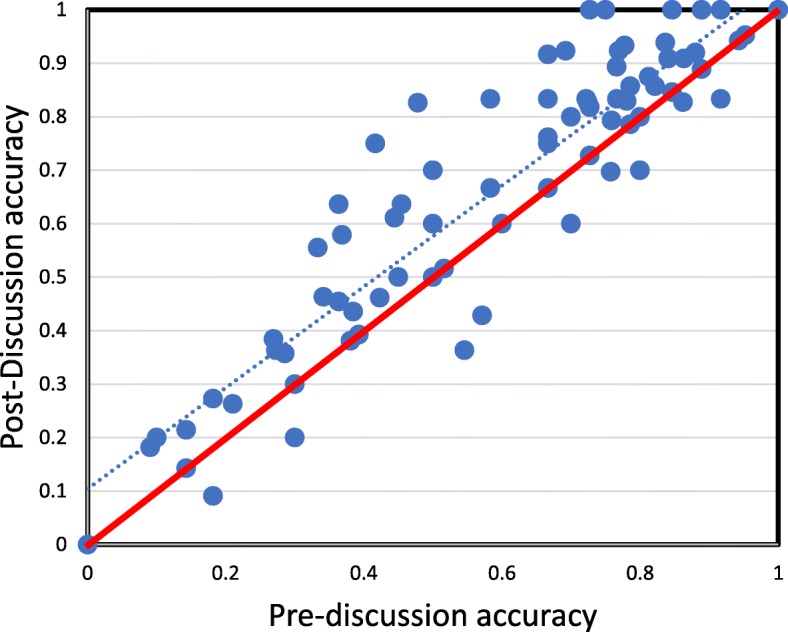
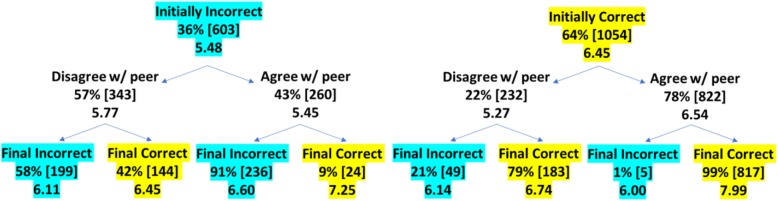
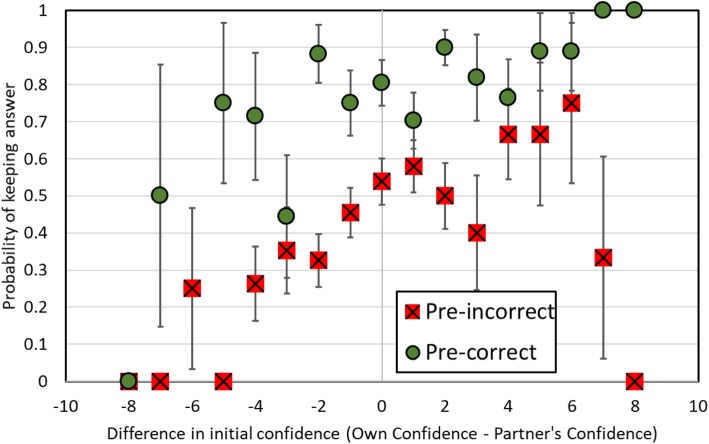
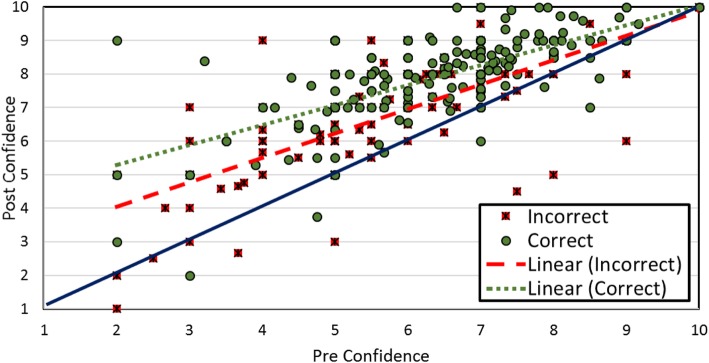
In peer instruction, instructors pose a challenging question to students, students answer the question individually, students work with a partner in the class to discuss their answers, and finally students answer the question again. A large body of evidence shows that peer instruction benefits student learning. To determine the mechanism for these benefits, we collected semester-long data from six classes, involving a total of 208 undergraduate students being asked a total of 86 different questions related to their course content. For each question, students chose their answer individually, reported their confidence, discussed their answers with their partner, and then indicated their possibly revised answer and confidence again. Overall, students were more accurate and confident after discussion than before. Initially correct students were more likely to keep their answers than initially incorrect students, and this tendency was partially but not completely attributable to differences in confidence. We discuss the benefits of peer instruction in terms of differences in the coherence of explanations, social learning, and the contextual factors that influence confidence and accuracy.
Overview
The claims and statistics of this paper haven’t been checked yet.
Run the check — free, no account needed. It reads the open-access text and checks the sources it cites.
Integrity signals
Registry
Cites
Statistics
Figures
Verification
Claims the paper makes
The claims and statistics of this paper haven’t been checked yet.
Run the check — free, no account needed. It reads the open-access text and checks the sources it cites.
Claims other papers make about this one
Each is checked against this paper’s own text: does it say what the citing paper says it does?
The cited source says what the claim attributes to it.
In the citing paper
“Prior research on peer instruction shows that when students can talk through their answers with a peer, they think more carefully about their reasoning, and this makes the assessment more collaborative and learning oriented (Tullis and Goldstone, 2020).”
From Generative AI-Enhanced Oral Exams in Economics Education (2026) · cites this paper as Tullis and Goldstone, 2020
Self-check
Percentages, sums and reported differences re-computed from the paper’s own numbers.
The self-check needs the paper’s full text.
Citations
Cites
Fitting Linear Mixed-Effects Models Using lme4
Bates, D., Mächler, M., Bolker, B., & Walker, S. (2015) · Journal of Statistical Software · doi:10.18637/jss.v067.i01 · Cited by 86,835
Mixed-effects modeling with crossed random effects for subjects and items
Baayen, R. H., Davidson, D. J., & Bates, D. M. (2008) · Journal of Memory and Language · doi:10.1016/j.jml.2007.12.005 · Cited by 8,540 · cited 1×
“In mixed-effect models with hundreds of observations, the t distribution effectively converges to the normal, so we compared the t statistic to the normal distribution for analyses involving continuous outcomes (i.e., confidence; Baayen, 2008).”
MethodReview of research in education
Shulman, L. S., Mowry, S., & Berliner, D. C. (1973) · F.E. Peacock eBooks · Cited by 7,754
Handbook of educational psychology
(1997) · Choice Reviews Online · doi:10.5860/choice.34-3084 · Cited by 4,850
Categorical data analysis: Away from ANOVAs (transformation or not) and towards logit mixed models
Jaeger, T. F. (2008) · Journal of Memory and Language · doi:10.1016/j.jml.2007.11.007 · Cited by 3,317 · cited 1×
“Finally, mixed effects models can predict the log odds (or logit) of a correct answer, which is needed when examining binary outcomes (i.e., correct or incorrect; Jaeger, 2008).”
BackgroundThe Journal of College Science Teaching
(1971) · Journal of Chemical Education · doi:10.1021/ed048p284 · Cited by 3,314
Analyzing Linguistic Data: A Practical Introduction to Statistics using R
Baayen, R. H. (2008) · doi:10.1017/cbo9780511801686 · Cited by 3,253
Test-Enhanced Learning: Taking Memory Tests Improves Long-Term Retention
Roediger, H. L., & Karpicke, J. D. (2006) · Psychological Science · doi:10.1111/j.1467-9280.2006.01693.x · Cited by 2,867
Peer Instruction: Ten years of experience and results
Crouch, C. H., & Mazur, E. (2001) · American Journal of Physics · doi:10.1119/1.1374249 · Cited by 2,682
Eliciting Self‐Explanations Improves Understanding
Michelene, T. H., Leeuw, N. D., Chiu, M., & Lavancher, C. (1994) · Cognitive Science · doi:10.1016/0364-0213(94)90016-7 · Cited by 2,492
Peer Instruction: A User's Manual
Mazur, E., & Hilborn, R. (1996) · Physics Today · doi:10.1063/1.881735 · Cited by 2,371
The concept of activity in Soviet psychology
Kozulin, A. (2002) · Routledge eBooks · doi:10.4324/9780203434185-9 · Cited by 2,114
Self‐Explanations: How Students Study and Use Examples in Learning to Solve Problems
Chi, M. T. H., Bassok, M., Lewis, M. W., Reimann, P., & Glaser, R. (1989) · Cognitive Science · doi:10.1207/s15516709cog1302_1 · Cited by 1,714
Clickers in the large classroom: Current research and best-practice tips
Caldwell, J. E. (2007) · CBE—Life Sciences Education · doi:10.1187/cbe.06-12-0205 · Cited by 1,291
Improved Learning in a Large-Enrollment Physics Class
Deslauriers, L., Schelew, E., & Wieman, C. (2011) · Science · doi:10.1126/science.1201783 · Cited by 1,270
Guided, Cooperative Learning and Individual Knowledge Acquisition
Brown, A. L., & Palincsar, A. S. (2018) · Routledge eBooks · doi:10.4324/9781315044408-13 · Cited by 1,097
Montaño, J., Toscano, J. J., Ramírez–Zavaleta, F., & Flores-Tlalpa, A. (2011) · conference · Cited by 981
Why Peer Discussion Improves Student Performance on In-Class Concept Questions
Smith, M. K., Wood, W. B., Adams, W. K., Wieman, C., Knight, J. K., Guild, N., & Su, T. T. (2009) · Science · doi:10.1126/science.1165919 · Cited by 956
Aleven, V. A. W. M. M., & Koedinger, K. R. (2002) · Cognitive Science · doi:10.1207/s15516709cog2602_1 · Cited by 895
Quality of Learning With an Active Versus Passive Motivational Set
Benware, C., & Deci, E. L. (1984) · American Educational Research Journal · doi:10.3102/00028312021004755 · Cited by 856
Group Processes in the Classroom
Berliner, D. C., & Calfee, R. C. (2013) · Routledge eBooks · doi:10.4324/9780203053874-35 · Cited by 842
Advice taking in decision making: egocentric discounting and reputation formation
Yaniv, I., & Kleinberger, E. (2000) · Organizational Behavior and Human Decision Processes · doi:10.1006/obhd.2000.2909 · Cited by 701
Receiving other people’s advice: Influence and benefit
Yaniv, I. (2004) · Organizational Behavior and Human Decision Processes · doi:10.1016/j.obhdp.2003.08.002 · Cited by 652
Cognitive Interdependence in Close Relationships
Wegner, D. M., Giuliano, T., & Hertel, P. T. (1985) · Compatible and Incompatible Relationships · doi:10.1007/978-1-4612-5044-9_12 · Cited by 647
Metcalfe, J. (2016) · Annual Review of Psychology · doi:10.1146/annurev-psych-010416-044022 · Cited by 615
On the cognitive benefits of teaching.
Bargh, J. A., & Schul, Y. (1980) · Journal of Educational Psychology · doi:10.1037/0022-0663.72.5.593 · Cited by 593
Taking Advice: Accepting Help, Improving Judgment, and Sharing Responsibility
Harvey, N., & Fischer, I. (1997) · Organizational Behavior and Human Decision Processes · doi:10.1006/obhd.1997.2697 · Cited by 592
Demonstrability and social combination processes on mathematical intellective tasks
Laughlin, P. R., & Ellis, A. L. (1986) · Journal of Experimental Social Psychology · doi:10.1016/0022-1031(86)90022-3 · Cited by 533
Collective memory: Collaborative and individual processes in remembering.
Weldon, M. S., & Bellinger, K. D. (1997) · Journal of Experimental Psychology: Learning, Memory, and Cognition · doi:10.1037/0278-7393.23.5.1160 · Cited by 498 · cited 1×
“While this might be interpreted as “process loss” (Steiner, 1972; Weldon & Bellinger, 1997), that would assume that there is sufficient information contained within the dyad to ascertain the correct answer.”
BackgroundAtkinson, R. K., Renkl, A., & Merrill, M. M. (2003) · Journal of Educational Psychology · doi:10.1037/0022-0663.95.4.774 · Cited by 491
Metacognitive and control strategies in study-time allocation.
Son, L. K., & Metcalfe, J. (2000) · Journal of Experimental Psychology Learning Memory and Cognition · doi:10.1037//0278-7393.26.1.204 · Cited by 470
Social interaction and cognitive development in children
Perret‐Clermont, A. (1980) · Archive ouverte UNIGE (University of Geneva) · Cited by 460
Cueing and Cognitive Conflict in Judge-Advisor Decision Making
Sniezek, J. A., & Buckley, T. (1995) · Organizational Behavior and Human Decision Processes · doi:10.1006/obhd.1995.1040 · Cited by 445
Promoting Transfer: Effects of Self-Explanation and Direct Instruction
Rittle‐Johnson, B. (2006) · Child Development · doi:10.1111/j.1467-8624.2006.00852.x · Cited by 423
Bielaczyc, K., Pirolli, P. L., & Brown, A. L. (1995) · Cognition and Instruction · doi:10.1207/s1532690xci1302_3 · Cited by 422
The Emergence of Abstract Representations in Dyad Problem Solving
Schwartz, D. L. (1995) · Journal of the Learning Sciences · doi:10.1207/s15327809jls0403_3 · Cited by 410
Laughlin, P. R., Hatch, E. C., Silver, J. S., & Boh, L. (2006) · Journal of Personality and Social Psychology · doi:10.1037/0022-3514.90.4.644 · Cited by 390
Designing effective questions for classroom response system teaching
Beatty, I. D., Gerace, W. J., Leonard, W. J., & Dufresne, R. J. (2005) · American Journal of Physics · doi:10.1119/1.2121753 · Cited by 379
Peer Instruction A User's Manual
Mazur, E. (2013) · Cited by 376
Learning from Worked-Out Examples: The Effects of Example Variability and Elicited Self-Explanations
Renkl, A., Stark, R., Gruber, H., & Mandl, H. (1998) · Contemporary Educational Psychology · doi:10.1006/ceps.1997.0959 · Cited by 374
Järvelä, S., Kirschner, P. A., Panadero, E., Malmberg, J., Phielix, C., Jaspers, J., Koivuniemi, M., & Järvenoja, H. (2015) · Educational Technology Research and Development · doi:10.1007/s11423-014-9358-1 · Cited by 373
Facilitating Elaborative Learning Through Guided Student-Generated Questioning
King, A. (1992) · Educational Psychologist · doi:10.1207/s15326985ep2701_8 · Cited by 359
Peer instruction: From Harvard to the two-year college
Lasry, N., Mazur, E., & Watkins, J. (2008) · American Journal of Physics · doi:10.1119/1.2978182 · Cited by 358
Accuracy and confidence in group judgment
Sniezek, J. A., & Henry, R. A. (1989) · Organizational Behavior and Human Decision Processes · doi:10.1016/0749-5978(89)90055-1 · Cited by 354
Teaching and Learning Mathematical Problem Solving
(2013) · Routledge eBooks · doi:10.4324/9780203063545 · Cited by 330
Effects of Frequent Classroom Testing
Bangert‐Drowns, R. L., Kulik, J. A., & Kulik, C. C. (1991) · The Journal of Educational Research · doi:10.1080/00220671.1991.10702818 · Cited by 320
MERCIER, H., & SPERBER, D. (2017) · doi:10.2307/j.ctv2sp3dd8 · Cited by 317
A model of the self-explanation effect.
VanLehn, K., Jones, R. M., & Chi, M. T. H. (1992) · Journal of the Learning Sciences · doi:10.1207/s15327809jls0201_1 · Cited by 305
Scaffolding Deep Comprehension Strategies Through Point&Query, AutoTutor, and iSTART
Graesser, A. C., McNamara, D. S., & VanLehn, K. (2005) · Educational Psychologist · doi:10.1207/s15326985ep4004_4 · Cited by 285
The Benefit of Additional Opinions
Yaniv, I. (2004) · Current Directions in Psychological Science · doi:10.1111/j.0963-7214.2004.00278.x · Cited by 279
Intuitive evaluation of likelihood judgment producers: evidence for a confidence heuristic
Price, P. C., & Stone, E. R. (2004) · Journal of Behavioral Decision Making · doi:10.1002/bdm.460 · Cited by 272 · cited 1×
“…& Fischer, 1997; Yaniv, 2004a, 2004b; Yaniv & Choshen-Hillel, 2012) and (2) the more confident the advisor is, the more strongly they influence your decision (Kuhn & Sniezek, 1996; Price & Stone, 2004; Sah, Moore, & MacCoun, 2013; Sniezek & Buckley, 1995; Van Swol & Sniezek, 2005; Yaniv, 2004b).”
Smith, M. K., Wood, W., Krauter, K., & Knight, J. K. (2011) · CBE - Life Sciences Education · doi:10.1187/cbe.10-08-0101 · Cited by 269
Small-Group Interactions as a Source of Learning Opportunities in Second-Grade Mathematics
Yackel, E., Cobb, P., & Wood, T. L. (1991) · Journal for Research in Mathematics Education · doi:10.2307/749187 · Cited by 266
A realistic test of individual versus group consensus decision making.
Michaelsen, L. K., Watson, W. E., & Black, R. H. (1989) · Journal of Applied Psychology · doi:10.1037/0021-9010.74.5.834 · Cited by 264
Understanding feedback: A learning theory perspective
Thurlings, M., Vermeulen, M., Bastiaens, T., & Stijnen, S. (2013) · Educational Research Review · doi:10.1016/j.edurev.2012.11.004 · Cited by 257
Collaborative Reasoning: Evidence for Collective Rationality
Moshman, D., & Geil, M. (1998) · Thinking & Reasoning · doi:10.1080/135467898394148 · Cited by 252
Learning from Examples Via Self-Explanations
Michelene, T. H. (2018) · Routledge eBooks · doi:10.4324/9781315044408-8 · Cited by 244
Chapter 6: Cooperative Activities in the Classroom
Bossert, S. T. (1988) · Review of Research in Education · doi:10.2307/1167365 · Cited by 237
Small-Group Interactions as a Source of Learning Opportunities in Second-Grade Mathematics
Yackel, E., Cobb, P., & Wood, T. L. (1991) · Journal for Research in Mathematics Education · doi:10.5951/jresematheduc.22.5.0390 · Cited by 235
Factors affecting the acceptance of expert advice
Swol, L. M. V., & Sniezek, J. A. (2005) · British Journal of Social Psychology · doi:10.1348/014466604x17092 · Cited by 234
Social Aspects of CSCL Environments: A Research Framework
Kreijns, K., Kirschner, P. A., & Vermeulen, M. (2013) · Educational Psychologist · doi:10.1080/00461520.2012.750225 · Cited by 234
Peer instruction improves performance on quizzes.
Rao, S. P., & DiCarlo, S. E. (2000) · AJP Advances in Physiology Education · doi:10.1152/advances.2000.24.1.51 · Cited by 226
Errors committed with high confidence are hypercorrected.
Butterfield, B., & Metcalfe, J. (2001) · Journal of Experimental Psychology: Learning, Memory, and Cognition · doi:10.1037/0278-7393.27.6.1491 · Cited by 223
Groups perform better than the best individuals on Letters-to-Numbers problems
Laughlin, P. R., Bonner, B. L., & Miner, A. G. (2002) · Organizational Behavior and Human Decision Processes · doi:10.1016/s0749-5978(02)00003-1 · Cited by 218
Peer instruction enhanced meaningful learning: ability to solve novel problems
Cortright, R. N., Collins, H. L., & DiCarlo, S. E. (2005) · AJP Advances in Physiology Education · doi:10.1152/advan.00060.2004 · Cited by 217
Henderson, C., & Dancy, M. H. (2009) · Physical Review Special Topics - Physics Education Research · doi:10.1103/physrevstper.5.020107 · Cited by 211
Phielix, C., Prins, F. J., Kirschner, P. A., Erkens, G., & Jaspers, J. (2010) · Computers in Human Behavior · doi:10.1016/j.chb.2010.06.024 · Cited by 190
Halving fail rates using peer instruction
Porter, L., Lee, C. B., & Simon, B. (2013) · ACM Technical Symposium on Computer Science Education (SIGCSE) · doi:10.1145/2445196.2445250 · Cited by 189
The ‘Millionaire’ method for encouraging participation
Beekes, W. (2006) · Active Learning in Higher Education · doi:10.1177/1469787406061143 · Cited by 189
Arguments, more than confidence, explain the good performance of reasoning groups.
Trouche, E., Sander, E., & Mercier, H. (2014) · Journal of Experimental Psychology General · doi:10.1037/a0037099 · Cited by 178
Clickers in the Classroom: How to Enhance Science Teaching Using Classroom Response Systems
Duncan, D. K. (2004) · Medical Entomology and Zoology · Cited by 172
Awareness of group performance in a CSCL-environment: Effects of peer feedback and reflection
Phielix, C., Prins, F. J., & Kirschner, P. A. (2009) · Computers in Human Behavior · doi:10.1016/j.chb.2009.10.011 · Cited by 167
The effects of self-explanation training on students' problem solving in high-school mathematics
Wong, R. M. F., Lawson, M. J., & Keeves, J. P. (2002) · Learning and Instruction · doi:10.1016/s0959-4752(01)00027-5 · Cited by 163
The Effect of Decision Strategy on Deciding to Defer Choice
Dhar, R. (1996) · Journal of Behavioral Decision Making · doi:10.1002/(sici)1099-0771(199612)9:4 · Cited by 158
Simon, B., Kohanfars, M., Lee, J., Tamayo, K. L. B., & Cutts, Q. I. (2010) · ACM Technical Symposium on Computer Science Education (SIGCSE) · doi:10.1145/1734263.1734381 · Cited by 157
Proceedings of the 41st Annual Conference of Cognitive Science Society
Goel, A., Seifert, C. M., & Freska, C. (2019) · Cited by 149
Socio-Cognitive Conflict and Cognitive Growth in Young Children.
Bearison, D. J. (1986) · Merrill-palmer Quarterly · Cited by 146
Murayama, K., Sakaki, M., Yan, V. X., & Smith, G. M. (2014) · Journal of Experimental Psychology Learning Memory and Cognition · doi:10.1037/a0036914 · Cited by 133
Sah, S., Moore, D. A., & MacCoun, R. J. (2013) · Organizational Behavior and Human Decision Processes · doi:10.1016/j.obhdp.2013.02.001 · Cited by 131
Shared Information, Cognitive Load, and Group Memory
Tindale, R. S., & Sheffey, S. (2002) · Group Processes & Intergroup Relations · doi:10.1177/1368430202005001535 · Cited by 127
Understanding Clicker Discussions: Student Reasoning and the Impact of Instructional Cues
Knight, J., Wise, S. B., & Southard, K. M. (2013) · CBE—Life Sciences Education · doi:10.1187/cbe.13-05-0090 · Cited by 112
Using Advice and Assessing Its Quality
Harvey, N., Harries, C., & Fischer, I. (2000) · Organizational Behavior and Human Decision Processes · doi:10.1006/obhd.1999.2874 · Cited by 111
Using Peer Instruction and I-Clickers to Enhance Student Participation in Calculus
Lucas, A. R. (2009) · PRIMUS · doi:10.1080/10511970701643970 · Cited by 100
2007 Physics Education Research Conference
Hsu, L., Henderson, C., & McCullough, L. (2007) · CERN Document Server (European Organization for Nuclear Research) · Cited by 99
Peer instruction enhanced student performance on qualitative problem-solving questions
Giuliodori, M. J., Lujan, H. L., & DiCarlo, S. E. (2006) · AJP Advances in Physiology Education · doi:10.1152/advan.00013.2006 · Cited by 96
Awareness of cognitive and social behaviour in a CSCL environment
Kirschner, P. A., Kreijns, K., Phielix, C., & Fransen, J. (2014) · Journal of Computer Assisted Learning · doi:10.1111/jcal.12084 · Cited by 93
The effect of grading incentive on student discourse in Peer Instruction
James, M. (2006) · American Journal of Physics · doi:10.1119/1.2198887 · Cited by 92
The hypercorrection effect persists over a week, but high-confidence errors return
Butler, A. C., Fazio, L. K., & Marsh, E. J. (2011) · Psychonomic Bulletin & Review · doi:10.3758/s13423-011-0173-y · Cited by 89
Yaniv, I., & Choshen‐Hillel, S. (2011) · Journal of Behavioral Decision Making · doi:10.1002/bdm.740 · Cited by 80
Perspective-taking in comprehension, production, and memory: An individual differences approach.
Ryskin, R. A., Benjamin, A. S., Tullis, J. G., & Brown‐Schmidt, S. (2015) · Journal of Experimental Psychology General · doi:10.1037/xge0000093 · Cited by 80
Self-citationLaughlin, P. R. (2011) · Princeton University Press eBooks · doi:10.1515/9781400836673 · Cited by 77
The Influence of Group Discussion on Students’ Responses and Confidence during Peer Instruction
Brooks, B., & Koretsky, M. D. (2011) · Journal of Chemical Education · doi:10.1021/ed101066x · Cited by 75
CAN GOOD QUESTIONS AND PEER DISCUSSION IMPROVE CALCULUS INSTRUCTION?
Miller, R. L., Santana-Vega, E., & Terrell, M. S. (2006) · PRIMUS · doi:10.1080/10511970608984146 · Cited by 74
Does Displaying the Class Results Affect Student Discussion during Peer Instruction?
Perez, K. E., Strauss, E. A., Downey, N., Galbraith, A. M., Jeanne, R. L., & Cooper, S. (2010) · CBE—Life Sciences Education · doi:10.1187/cbe.09-11-0080 · Cited by 68
When two heads are better than one and when they can be worse: The amplification hypothesis.
Koriat, A. (2015) · Journal of Experimental Psychology General · doi:10.1037/xge0000092 · Cited by 62
Jones, M. E., Antonenko, P., & Greenwood, C. (2012) · Journal of Computer Assisted Learning · doi:10.1111/j.1365-2729.2011.00470.x · Cited by 61
Versteeg, M., van Blankenstein, F. M., Putter, H., & Paul Steendijk, A. (2018) · Advances in Health Sciences Education · doi:10.1007/s10459-018-9858-6 · Cited by 61
Metacognitive Control of Learning and Remembering
Finley, J. R., Tullis, J. G., & Benjamin, A. S. (2010) · Springer eBooks · doi:10.1007/978-1-4419-5716-0_6 · Cited by 60
Self-citationMeta-Cognitive Strategy Instruction in Intelligent Tutoring Systems: How, When, and Why
Chi, M., & VanLehn, K. A. (2010) · Cited by 48
The efficacy of learners’ testing choices.
Tullis, J. G., Fiechter, J. L., & Benjamin, A. S. (2017) · Journal of Experimental Psychology Learning Memory and Cognition · doi:10.1037/xlm0000473 · Cited by 42
Self-citationUsing Peer Instruction to Teach Philosophy, Logic, and Critical Thinking
Butchart, S., Handfield, T., & Restall, G. (2009) · Teaching Philosophy · doi:10.5840/teachphil20093212 · Cited by 40
Nielsen, K. L., Hansen-Nygård, G., & Stav, J. (2012) · ISRN Education · doi:10.5402/2012/290157 · Cited by 32
Predicting others’ memory performance: The accuracy and bases of social metacognition
Tullis, J. G., & Fraundorf, S. H. (2017) · Journal of Memory and Language · doi:10.1016/j.jml.2017.03.003 · Cited by 30
Self-citationIntegration of Social Information by Human Groups
Granovskiy, B., Gold, J. M., Sumpter, D. J. T., & Goldstone, R. L. (2015) · Topics in Cognitive Science · doi:10.1111/tops.12150 · Cited by 27
Self-citationPredicting others’ knowledge: Knowledge estimation as cue utilization
Tullis, J. G. (2018) · Memory & Cognition · doi:10.3758/s13421-018-0842-4 · Cited by 27
Self-citationSmall Groups as a Setting For Research on Mathematical Problem Solving
Shulman, L. S. (2013) · Routledge eBooks · doi:10.4324/9780203063545-28 · Cited by 27
The use of concept tests and peer instruction in upper-division physics
Pollock, S. J., Chasteen, S. V., Dubson, M. A., Perkins, K. K., Singh, C., Sabella, M. S., & Rebello, N. S. (2010) · AIP conference proceedings · doi:10.1063/1.3515218 · Cited by 20
A Study of Peer Instruction Methods with High School Physics Students
Cummings, K., Roberts, S. G., Henderson, C., Sabella, M. S., & Hsu, L. (2008) · AIP conference proceedings · doi:10.1063/1.3021227 · Cited by 17
Understanding How Physics Faculty Use Peer Instruction
Turpen, C., Finkelstein, N. D., Hsu, L., Henderson, C., & McCullough, L. (2007) · AIP conference proceedings · doi:10.1063/1.2820934 · Cited by 12
Morgan, J. T., & Wakefield, C. (2012) · The journal of college science teaching · Cited by 10
Crowdsourcing effective educational interventionsPreprint
Priniski, J. H., & Horne, Z. (2019) · PsyArXiv (OSF Preprints) · doi:10.31234/osf.io/edk3m · Cited by 9
Research works printed but not linked: 4
- Newbury, P., & Heiner, C. (2012). Ready, set, react! getting the most out of peer instruction using clickers. Retrieved October 28, 2015, from http://www.cwsei.ubc.ca/Files/ReadySetReact_3fold.pdf.
- Steiner, I. D. (1972). Group processes and productivity. New York: Academic Press.
- Vedder, P. (1985). Cooperative learning: A study on processes and effects of cooperation between primary school children. Westerhaven: Rijkuniversiteit Groningen.
- Wieman, C., Perkins, K., Gilbert, S., Benay, F., Kennedy, S., Semsar, K., et al. (2009). Clicker resource guide: An instructor’s guide to the effective use of personalresponse systems (clickers) in teaching. Vancouver: University of British Columbia Available from http://www.cwsei.ubc.ca/resources/files/Clicker_guide_CWSEI_CU-SEI.pdf.
Cited by
Sorted by citations
Carvalho, C., & Almeida, A. C. (2022) · Sustainability · doi:10.3390/su14105755 · Cited by 80
Perspectives on Active Learning: Challenges for Equitable Active Learning Implementation
Nardo, J. E., Chapman, N. C., Shi, E. Y., Wieman, C., & Salehi, S. (2022) · Journal of Chemical Education · doi:10.1021/acs.jchemed.1c01233 · Cited by 67
The neuroscience of active learning and direct instruction
Dubinsky, J. M., & Hamid, A. (2024) · Neuroscience & Biobehavioral Reviews · doi:10.1016/j.neubiorev.2024.105737 · Cited by 121
Molin, F., Haelermans, C., Cabus, S. J., & Groot, W. (2021) · Comput. Educ. · doi:10.1016/j.compedu.2021.104339 · Cited by 35
Fakoya, A. O. J., Ndrio, M., & McCarthy, K. J. (2023) · Advances in Medical Education and Practice · doi:10.2147/amep.s421400 · Cited by 34
Metadata
- Authors
- Tullis, J. G., & Goldstone, R. L.
- Affiliations
- University of Arizona (US)
- Indiana University Bloomington (US)
- Corresponding author
- Tullis, Jonathan G.
- Venue
- Cognitive Research: Principles and Implications
- Published
- 2020-04-09
- Volume
- 5
- Issue
- 1
- Pages
- 15-15
- ISSN
- 2365-7464 (ISSN-L)
- PMC
- PMC7145884
- OpenAlex
- W3015961046
- Cited by
- 153
- References
- 117
- Citations by year
- 2026: 28 · 2025: 34 · 2024: 31 · 2023: 21 · 2022: 27 · 2021: 11 · 2020: 1
- FWCI
- 22.77
- Type
- journal article
- Language
- en
- Open access
- gold
- doi.org
- Locations
- Cognitive Research Principles and Implications (publishedVersion, cc-by)
- PubMed Central (publishedVersion, cc-by)
- PubMed (publishedVersion)
- UA Campus Repository (The University of Arizona) (acceptedVersion, cc-by)
- DOAJ (DOAJ: Directory of Open Access Journals) (submittedVersion, cc-by-sa)
- Topics
- Social Sciences › Education › Innovative Teaching Methods
- Social Sciences › Psychology › Developmental and Educational Psychology › Innovative Teaching and Learning Methods
- Social Sciences › Psychology › Experimental and Cognitive Psychology › Visual and Cognitive Learning Processes
- Keywords
- peer instruction, student learning, confidence, accuracy, peer discussion, social learning, misconceptions, metacognition, undergraduate science education
- MeSH terms
- Academic Performance, Adult, Female, Humans, Learning, Male, Peer Group, Students, Universities, Young Adult
About these checks
Registry, retraction, Cites and statistics results are computed, not judged, with one exception: a printed reference that no index lists is read once by a model before it counts as a citation error. Claims are extracted by a model and kept only when their quote appears verbatim in the text; each cited source is then checked, with a model’s help, for whether it says what the claim relies on. Those verdicts can be wrong — read the claim’s quote and the cited source before relying on one.
Statistics and arithmetic are recomputed, not judged.
Confidence bands are shown only for fields calibrated on our annotated test set. None is calibrated yet, so no band is shown.
What counts as a claim ›How we measure confidence ›How we check this ›
Are you an author, or do you see a problem with this page? Request a review
