

The DOI matches its Crossref record; 147 of the 152 references it cites were found in a registry or an index.
The effect of games and simulations on higher education: a systematic literature review
Open accessAbstract
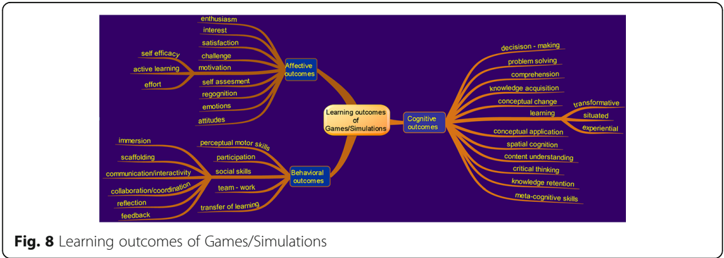
The focus of higher education institutions is the preparation of future professionals. To achieve this aim, innovative teaching methods are often deployed, including games and simulations, which form the subject of this paper. As the field of digital games and simulations is ever maturing, this paper attempts to systematically review the literature relevant to games and simulation pedagogy in higher education. Two researchers collaborate to apply a qualitative method, coding and synthesizing the results using multiple criteria. The main objective is to study the impact of games and simulations with regard to achieving specific learning objectives. On balance, results indicate that games and/or simulations have a positive impact on learning goals. The researchers identify three learning outcomes when integrating games into the learning process: cognitive, behavioural, and affective. As a final step, the authors consolidate evidence for the benefit of academics and practitioners in higher education interested in the efficient use of games and simulations for pedagogical purposes. Such evidence also provides potential options and pathways for future research.
Overview
The claims and statistics of this paper haven’t been checked yet.
Run the check — free, no account needed. It reads the open-access text and checks the sources it cites.
Integrity signals
Registry
Cites
Statistics
Figures
Verification
Claims the paper makes
The claims and statistics of this paper haven’t been checked yet.
Run the check — free, no account needed. It reads the open-access text and checks the sources it cites.
Claims other papers make about this one
Each is checked against this paper’s own text: does it say what the citing paper says it does?
In the citing paper
“Beyond the Longevity Games, practical simulations benefit students by preparing students for practical experiences (17–19).”
From Using generative AI for interview simulations to enhance student research skills in biology education (2025) · cites this paper as [18]
Self-check
Percentages, sums and reported differences re-computed from the paper’s own numbers.
The self-check needs the paper’s full text.
Citations
Cites
Rules of Play: Game Design Fundamentals
Salen, K., & Zimmerman, E. (2003) · Medical Entomology and Zoology · Cited by 5,438
A systematic literature review of empirical evidence on computer games and serious games
Connolly, T. M., Boyle, E. A., MacArthur, E., Hainey, T., & Boyle, J. M. (2012) · Computers & Education · doi:10.1016/j.compedu.2012.03.004 · Cited by 2,890
Merchant, Z., Goetz, E. T., Cifuentes, L., Keeney-Kennicutt, W., & Davis, T. J. (2014) · Computers & Education · doi:10.1016/j.compedu.2013.07.033 · Cited by 2,109
From visual simulation to virtual reality to games
Zyda, M. (2005) · Computer · doi:10.1109/mc.2005.297 · Cited by 2,077
A meta-analysis of the cognitive and motivational effects of serious games.
Wouters, P., van Nimwegen, C., van Oostendorp, H., & van der Spek, E. D. (2013) · Journal of Educational Psychology · doi:10.1037/a0031311 · Cited by 1,864
Digital Games, Design, and Learning: A Systematic Review and Meta-Analysis
Clark, D. B., Tanner-Smith, E. E., & Killingsworth, S. S. (2016) · Review of Educational Research · doi:10.3102/0034654315582065 · Cited by 1,274
The learning effects of computer simulations in science education
Rutten, N., van Joolingen, W., & van der Veen, J. T. (2011) · Computers & Education · doi:10.1016/j.compedu.2011.07.017 · Cited by 1,079
A META‐ANALYTIC EXAMINATION OF THE INSTRUCTIONAL EFFECTIVENESS OF COMPUTER‐BASED SIMULATION GAMES
SITZMANN, T. (2011) · Personnel Psychology · doi:10.1111/j.1744-6570.2011.01190.x · Cited by 882
Serious games as new educational tools: how effective are they? A meta‐analysis of recent studies
Girard, C., Écalle, J., & Magnan, A. (2012) · Journal of Computer Assisted Learning · doi:10.1111/j.1365-2729.2012.00489.x · Cited by 738
Our Princess Is in Another Castle
Young, M. F., Slota, S. T., Cutter, A. B., Jalette, G., Mullin, G., Lai, B., Simeoni, Z., Tran, M. T., & Yukhymenko–Lescroart, M. A. (2012) · Review of Educational Research · doi:10.3102/0034654312436980 · Cited by 737
Research works printed but not linked: 11
- Ahmad, S. M. S., Fauzi, N. F. M., Hashim, A. A., & Zainon, W. M. N. W. (2013). A study on the effectiveness of computer games in teaching and learning. International Journal of Advanced Studies in Computers, Science and Engineering, 2(1), 1.
- Andreu Andrés, M. A., & García Casas, M. (2011). Perceptions of gaming as experiential learning by engineering students. International Journal of Engineering Education, 27(4), 795–804.
- Arias Aranda, D., Haro Domiguez, C., & Romerosa Martinez, M. M. (2010). An innovative approach to the learning process in management: The use of simulators in higher education. REVISTA DE EDUCACION, 353, 333–334.
- Bausch, L., Beran, J., Cahanes, S., & Krug, L. (2008). Physiological responses while playing Nintendo Wii sports. Journal of Undergraduate Kinesiology Research, 3, 19–25.
- Chiang, Y. T., Lin, S. S. J., Cheng, C. Y., & Liu, E. Z. F. (2011). Exploring online game players’ flow experiences and positive affect. The Turkish Online Journal of Educational Technology, 10(1), 106–114.
- Cvetić, B., Vasiljević, D., & Danilović, M. (2013). DRP game: New tool to enhance teaching and learning in logistics and supply chain management. In 1st Logistics International Conference (pp. 299-303).
- Hsu, Y.-C., Ho, H. N. J., Tsai, C.-C., Hwang, G.-J., Chu, H.-C., Wang, C.-Y., & Chen, N.-S. (2012). Research trends in technology-based learning from 2000 to 2009: A content analysis of publications in selected journals. Educational Technology & Society, 15(2), 354–370.
- Liao, Y.-W., & Wang, Y.-S. (2011). Investigating the factors affecting students’ continuance intention to use business simulation games in the context of digital learning. In International Conference on Innovation, Management and Service (pp. 119-124).
- Pløhn, T. (2013). Nuclear mayhem-a pervasive game designed to support learning. In European Conference on Games Based Learning (p. 475). Academic Conferences international limited.
- Sawyer, B. (2002). Serious games: Improving public policy through game-based learning and simulation. USA: Woodrow Wilson International Center for Scholars.
- Tao, Y. H., Yeh, C. C. R., & Hung, K. C. (2015). Validating the learning cycle models of business simulation games via student perceived gains in skills and knowledge. Educational Technology & Society, 18(1), 77–90.
Cited by
Sorted by citations
Items 401–500 of 853
Alibeyoglu, M. C., Baskahya, Z. I., Ceyhan, G. D., Yildiz-Degirmenci, S., Demir, N., Etli, S., Girgin, G., Göktepe, E., Karga, B., Unsal, E., et al. (2024) · Advances in early childhood and K-12 education · doi:10.4018/979-8-3693-1710-5.ch003 · Cited by 3
Essential Primary Health Care Skills
Ziegler, E., Dickson, K., Silva, A., Pirani, S., Tyerman, J. J., & Luctkar‐Flude, M. (2025) · Nurse Educator · doi:10.1097/nne.0000000000001808 · Cited by 3
Chatzea, V., Panagiotakis, C., Vidakis, N., & Fanourgiakis, J. (2025) · Games for Health Journal · doi:10.1177/2161783x251361157 · Cited by 3
Understanding when anger becomes productive or destructive in collaborative educational games
Kim, T., & Tissenbaum, M. (2025) · International Journal of Computer-Supported Collaborative Learning · doi:10.1007/s11412-025-09459-2 · Cited by 3
Shekh-Abed, A. (2025) · Education Sciences · doi:10.3390/educsci15081045 · Cited by 4
Visualising quantum entanglement using interactive electronic quantum dice
Folkers, B., van Rossum, A., Brinkman, A., & Stadermann, K. (2026) · Physics Education · doi:10.1088/1361-6552/ae43aa · Cited by 3
Vaanathy, S., Charles, J., & Lekamge, S. (2023) · IEEE International Conference on Industrial and Information Systems (ICIIS) · doi:10.1109/iciis58898.2023.10253534 · Cited by 3
Evawati, D., & Susilowati (2023) · JURNAL IQRA · doi:10.25217/ji.v8i1.2734 · Cited by 3
Development of e-worksheet based on engineering design process for composition function material
Kurniawan, L. C., & Wahyuni, I. (2024) · Research and Development in Education (RaDEn) · doi:10.22219/raden.v4i1.32204 · Cited by 3
Toring, H., Benatiro, R. M., Legaspi, N., Cahayagan, M. L., Felix, R., Adaptar, A., Cortes, S. T., & Licen, C. R. (2024) · The International Journal of Aerospace Psychology · doi:10.1080/24721840.2024.2337622 · Cited by 3
Whitaker, B., & Whitaker, W. (2024) · Journal of Leadership Education · doi:10.1108/jole-05-2024-0066 · Cited by 3
Designing a Digital Interactive Simulation for Teaching Business Analytics, Strategy, and Economics
Kesse, M. (2024) · Journal of Applied Business and Economics · doi:10.33423/jabe.v26i5.7339 · Cited by 3
Coulon, T., Cheikh‐Ammar, M., Bourdeau, S., & Petit, M. (2025) · British Journal of Educational Technology · doi:10.1111/bjet.70009 · Cited by 3
Competence Training for Project Management
Marcelino, S., & Ezcurdia, A. P. (2020) · Advances in logistics, operations, and management science book series · doi:10.4018/978-1-7998-1934-9.ch008 · Cited by 4
Ma'rifah, Rachman, A., & Aslamiah, A. (2021) · Journal of K6 Education and Management · doi:10.11594/jk6em.04.01.10 · Cited by 3
Phanthaphoommee, N., Nomnian, S., Wiboolyasarin, W., Thumvichit, A., & Techawongstien, K. (2022) · International Journal of Mobile Learning and Organisation · doi:10.1504/ijmlo.2023.10048355 · Cited by 3
Sackett, E., & Amoroso, L. M. (2022) · Management Teaching Review · doi:10.1177/23792981221104197 · Cited by 3
Visualization, Serious Games and Decision Making
Benitez, A. F., Herrera, L. M. M., Pacheco-Velazquez, E. A., & Espinosa, J. M. M. (2022) · European Conference on Games Based Learning · doi:10.34190/ecgbl.16.1.695 · Cited by 3
Learning business through digital simulation: An analysis of student reflections
Barker, S. B., & Davy, M. (2019) · ASCILITE Publications · doi:10.14742/apubs.2019.2 · Cited by 3
Fostering Growth Mindset Principles in the Prevention of Type 2 Diabetes Through a Narrative Game
Raffali, A., & Asraf, R. M. (2023) · International Journal of Learning Teaching and Educational Research · doi:10.26803/ijlter.22.2.14 · Cited by 3
Malaysian nursing students’ satisfaction with structured online learning
Romli, M. H., Yunus, F. W., Foong, C. C., & Soh, K. L. (2023) · Innovations in Education and Teaching International · doi:10.1080/14703297.2023.2192512 · Cited by 4
Simulaciones de Liderazgo Escolar: Una Visión Panorámica de sus Publicaciones y Evolución
Jeldres, R., & Volante, P. (2023) · REICE Revista Iberoamericana sobre Calidad Eficacia y Cambio en Educación · doi:10.15366/reice2023.21.4.003 · Cited by 3
Mutiah, C., Abdurrahman, A., Halimatussakdiah, Bustami, Dewita, & Keumalahayati (2024) · Africa Journal of Nursing and Midwifery · doi:10.25159/2520-5293/13905 · Cited by 3
Characteristics of gamification as a method of adult education
Mironova, O. I., Ruonala, L. A., & researcher, I. (2023) · Педагогика и психология образования · doi:10.31862/2500-297x-2023-2-76-89 · Cited by 3
Tukiman, N., Yunos, N. M., Mulyadi, S. S., Alimon, N. I., Nurulazmi, N. H. D., & Halim, S. N. A. (2024) · International Journal of Academic Research in Progressive Education and Development · doi:10.6007/ijarped/v13-i3/22311 · Cited by 3
Motivation Elements in Game-Based Learning (GBL) for Tajweed Learning
Ramlan, N., Fabil, N., & Ismail, Z. (2024) · Journal of Advanced Research in Applied Sciences and Engineering Technology · doi:10.37934/araset.54.2.2031 · Cited by 3
Dalle, H., Yanny Trisyani, W., & Nuraeni, A. (2025) · Risk Management and Healthcare Policy · doi:10.2147/rmhp.s519931 · Cited by 3
Game-construction students experiences of educational games - gaming outcomes and learning outcomes
Mozelius, P. (2018) · International Journal of Information and Communication Technologies in Education · doi:10.1515/ijicte-2018-0005 · Cited by 3
Kerridge, C., & Simpson, C. (2020) · Journal of International Education in Business · doi:10.1108/jieb-07-2019-0034 · Cited by 3
Using Simulations To Improve Achievements And Motivation In Ict Studies
Zeichner, O. (2020) · i-manager s Journal on School Educational Technology · doi:10.26634/jsch.16.1.17426 · Cited by 3
VIRTUAL TERRESTRIAL LASER SCANNER SIMULATOR IN DIGITAL TWIN ENVIRONMENT
Popovas, D., Chizhova, M., Gorkovchuk, D., Gorkovchuk, J., Hess, M., & Lühmann, T. (2021) · ARQUEOLÓGICA 2.0 International Congress & GEORES - GEOmatics and pREServation · doi:10.4995/arqueologica9.2021.12091 · Cited by 3
Dāvidsone, A., Seppel, K., Telyčėnaitė, A., Matkevičienė, R., Uibu, M., Silkāne, V., Jurāne-Brēmane, A., & Allaje, Õ. (2021) · Human, Technologies and Quality of Education · doi:10.22364/htqe.2021.57 · Cited by 3
Collaborative Learning Using Escape Designs and Pedagogies. A Needs Analysis Protocol
Papamalis, F. E., Antoniou, P. E., Poultourtzidis, I., Nikolaidou, M., Poulton, T., & Bamidis, P. D. (2022) · Studies in health technology and informatics · doi:10.3233/shti220756 · Cited by 3
Ching, B. P., & Nasri, N. M. (2022) · International Journal of Academic Research in Progressive Education and Development · doi:10.6007/ijarped/v11-i2/14010 · Cited by 4
Catch Me If you Can: An Educational Serious Game to Teach Grammatical English Rules
Ayman, R., Ayman, R., & Sharaf, N. (2022) · Lecture notes in computer science · doi:10.1007/978-3-031-15325-9_15 · Cited by 3
Wie können unterschiedliche Aspekte diagnostischer Kompetenz gefördert werden?
Grotegut, L., & Klingsieck, K. B. (2022) · Zeitschrift für Pädagogische Psychologie · doi:10.1024/1010-0652/a000352 · Cited by 5
Game-based learning: An alternatif learning model in covid-19 distance learning
Susilawati, P. R., & Handoyo, L. D. (2022) · Biosfer · doi:10.21009/biosferjpb.25753 · Cited by 3
Luokkamäki, S., Härkänen, M., Saano, S., Kokkonen, K.-M., & Vehviläinen-Julkunen, K. M. (2023) · Journal of Medical Education · doi:10.5812/jme-129060 · Cited by 3
Mayub, A., Setiawan, A., Fahmizal, F., Wardaya, R. W., Lazfihma, L., Johan, H., & Nursaadah, E. (2023) · Jurnal Pendidikan IPA Indonesia · doi:10.15294/jpii.v12i4.44991 · Cited by 3
Açık ve uzaktan öğrenmede etkileşim üzerine bir bibliyometrik analiz çalışması
Çınar, E., Orhan, G., & Sezgin, S. (2024) · Açıköğretim Uygulamaları ve Araştırmaları Dergisi · doi:10.51948/auad.1509279 · Cited by 3
Motivation to Adopt Game-Based Learning (Gbl) for Employee Training and Development: A Case Study
Sugahara, S. (2018) · Journal of Entrepreneurship Education · Cited by 3
Technology implementation to promote digital learning
Latif, M. A., & Widiaty, I. (2021) · IOP Conference Series Materials Science and Engineering · doi:10.1088/1757-899x/1098/3/032006 · Cited by 3
Using Technology to Enhance Student Engagement in STEM Subjects in Higher Education
Chakabwata, W. (2022) · Advances in educational technologies and instructional design book series · doi:10.4018/978-1-6684-5920-1.ch009 · Cited by 3
Hastawan, A. F., Nashiroh, P. K., Firdaus, A. A., & Rossa, H. (2019) · Vocational Education International Conference (VEIC) · doi:10.2991/assehr.k.191217.016 · Cited by 3
Catastrophic co-production: A student-staff partnership for developing an educational game
Glover, N., Knox, K. J., Kirman, B. J., Topham, M., Westbury-Hawkins, K., & Holland, P. (2020) · International Journal for Students as Partners · doi:10.15173/ijsap.v4i2.4120 · Cited by 3
Acevedo, A. L. (2021) · Advances in educational technologies and instructional design book series · doi:10.4018/978-1-7998-6480-6.ch006 · Cited by 3
A Comprehensive View of Simulation
Angelini, M. L., & Heeswijk, M. D. W.-V. (2023) · Springer texts in education · doi:10.1007/978-3-031-21011-2_1 · Cited by 2
Comparing Pedagogical and Andragogical Approaches in Education
Singha, S., Rema, M. K., & Thomas, L. (2023) · Advances in educational marketing, administration, and leadership book series · doi:10.4018/978-1-6684-8332-9.ch003 · Cited by 2
Dankov, Y. (2024) · Lecture notes in networks and systems · doi:10.1007/978-3-031-53549-9_13 · Cited by 2
ENHANCING ENGAGEMENT AND RETENTION IN REGULATORY TRAINING: A SYSTEMATIC REVIEW
Seaba, V., & Alorh, C. (2022) · Open Journal of Educational Development · doi:10.52417/ojed.v3i2.709 · Cited by 2
What Are the Contributing Factors to Business Simulation Results in Entrepreneurial Education?
Spilbergs, A., Aksjonenko, A., Peiseniece, L., & Aksjoņenko, E. (2025) · Eurasian studies in business and economics · doi:10.1007/978-3-031-84319-8_1 · Cited by 2
Fecke, J., Lohberger, K., & Braun, E. (2025) · Computers & Education · doi:10.1016/j.compedu.2025.105361 · Cited by 3
Reinhardt, A., Wilhelm, C., & Mayen, S. (2025) · Journal of Media Psychology Theories Methods and Applications · doi:10.1027/1864-1105/a000471 · Cited by 3
Training future crisis communication advisers in crisis response: Applying scenario-based learning
Jong, W., & Bartolucci, A. (2025) · Communication Teacher · doi:10.1080/17404622.2025.2539404 · Cited by 2
Khan, M., Thongnun, W., Zamani, M., Siripap, P., Channuwong, S., & Lertatthakornkit, T. (2025) · International Journal of Environmental Sciences · doi:10.64252/13f8wm17 · Cited by 2
Kumar, A. (2025) · Journal of Higher Education Policy And Leadership Studies · doi:10.61882/johepal.6.2.24 · Cited by 2
Gamarra-Vargas, N. M., Borda, R. F. C., Quispe-Farfán, P. H., Flores, F. G. B., & Bravo, L. M. R. (2025) · F1000Research · doi:10.12688/f1000research.164232.1 · Cited by 2
Raghbir, R. S. A. S., Ng, L. L., & Chew, S. Y. (2025) · 3L The Southeast Asian Journal of English Language Studies · doi:10.17576/3l-2025-3103-10 · Cited by 2
Laprade, J. (2025) · Anatomical Sciences Education · doi:10.1002/ase.70158 · Cited by 2
Batlag, J. A., & Walag, A. M. P. (2025) · Journal of Education and Learning (EduLearn) · doi:10.11591/edulearn.v20i1.23868 · Cited by 2
Ildephonce, I., & Allen, C. A. (2026) · Lecture notes in computer science · doi:10.1007/978-3-032-11043-5_19 · Cited by 2
Liu, Y., & Ahmad, M. K. (2026) · Journal of Intercultural Communication · doi:10.36923/jicc.v26i1.1202 · Cited by 2
Valenzuela, L. H. M., Ronquillo, J. G. P., Salinas, A. V. C., & Abad, C. J. M. (2026) · RECIMUNDO · doi:10.26820/recimundo/10.(1).enero.2026.194-210 · Cited by 2
Rodríguez-Ferrer, J. M., Rodríguez-Rivera, P., & León, A. M. (2025) · Revista Electrónica Interuniversitaria de Formación del Profesorado · doi:10.6018/reifop.672301 · Cited by 2
ISLAND C: A Gamified Online Homework System for Conceptual Understanding in General Chemistry
Clark, M. J., & Holme, T. A. (2026) · Journal of Chemical Education · doi:10.1021/acs.jchemed.5c01370 · Cited by 2
A first validation of the gamification user types HEXAD scale for digital learning systems
Schultze, S., Hochweber, J., Habermeyer, T., & Schneider, S. (2026) · Computers in Human Behavior Reports · doi:10.1016/j.chbr.2026.101011 · Cited by 4
Butera, M., & Mukamwambali, C. (2026) · Discover Education · doi:10.1007/s44217-026-01405-0 · Cited by 2
3D Simulations in Civil Engineering Laboratory Education
Golemati, O.-N., Zafeiropoulos, V., & Kalles, D. (2020) · Panhellenic Conference on Informatics · doi:10.1145/3437120.3437271 · Cited by 2
Anggita, G. M., & Siti Baitul Mukarromah, A. R. D. C. (2023) · Journal of Hunan University Natural Sciences · doi:10.55463/issn.1674-2974.50.2.19 · Cited by 2
The Evolution of Learning and Technological Innovation
Grabarski, M. K., Mouratidou, M., & Fellows, I. (2023) · Advances in higher education and professional development book series · doi:10.4018/978-1-6684-7442-6.ch004 · Cited by 2
Hu, X., Safiena, S., Goh, Y. M., & Lin, A. (2023) · Educational Technology Research and Development · doi:10.1007/s11423-023-10251-y · Cited by 2
РОЗРОБКА НАВЧАЛЬНОГО ТРЕНАЖЕРУ З СИСТЕМНОГО АНАЛІЗУ У ВИГЛЯДІ ЧАТ-БОТУ
Ольховська, О. В., Chernenko, O. O., АНАНЕНКО, І. В., ПАРФЬОНОВА, Т., & РУДЕНКО, Н. С. (2023) · Вісник Херсонського національного технічного університету · doi:10.35546/kntu2078-4481.2023.2.27 · Cited by 2
Metodologias ativas aplicadas no ensino superior
Ponath, A. D. S. M., Ponath, A. D. S. M., Zanoni, H. E. R. C., & Margon, S. (2023) · doi:10.22533/at.ed.145231109 · Cited by 2
Magta, M., & Mahardika, E. K. (2023) · Journal of Higher Education Theory and Practice · doi:10.33423/jhetp.v23i15.6433 · Cited by 2
A Systematic Literature Review of Serious Games in Higher Arts Education
Shi, Y., Tan, Y. Y., & Yao, H. (2024) · Advances in educational technologies and instructional design book series · doi:10.4018/979-8-3693-6745-2.ch003 · Cited by 2
The Role of Video Game Narratives in Educational Engagement
Rito, P. N. (2025) · IGI Global eBooks · doi:10.4018/979-8-3373-0705-3.ch013 · Cited by 2
Heeswijk, M. D. W.-V., Rouwette, E. A. J. A., & Meijerink, S. V. (2025) · Instructional Science · doi:10.1007/s11251-025-09715-w · Cited by 2
Thomas, J. J., Rajath, S., Sankar, B., Bagewadi, M., & Singh, V. (2025) · Proceedings of the Design Society · doi:10.1017/pds.2025.10349 · Cited by 2
Ambarsari, E. W., Achmad Daengs, G. S., Mustari, D., Sunarmintyastuti, L., & Rahim, R. (2020) · Workshop on Multidisciplinary and Its Applications (WMA) · doi:10.4108/eai.11-12-2019.2290859 · Cited by 2
Andi Zulfikar, D., Muslihati, M. M., Adilah, A. N., & Tajang, A. D. (2022) · PROMOSI (Jurnal Pendidikan Ekonomi) · doi:10.24127/pro.v10i1.5777 · Cited by 2
Lishetiyana, V., Septiani, S., Talia, D. I., & Aeni, A. N. (2023) · Primary Jurnal Pendidikan Guru Sekolah Dasar · doi:10.33578/jpfkip.v12i2.9717 · Cited by 2
SIMULASI DAN GAMIFIKASI PEMBELAJARAN ILMU KOMPUTER DASAR MELALUI APLIKASI SI BINER
Nurhopipah, A., Faizi, Z. A., & Asih, R. (2023) · JMM (Jurnal Masyarakat Mandiri) · doi:10.31764/jmm.v7i1.12090 · Cited by 2
Safiena, S., & Goh, Y. M. (2024) · Education and Information Technologies · doi:10.1007/s10639-024-12543-z · Cited by 2
Development of Adventure-Based Learning Game on the Topic of Temperature and Heat
Fathurohman, A., & Kusuma, A. A. K. (2023) · Journal of Educational Science and Technology (EST) · doi:10.26858/est.v9i1.36885 · Cited by 2
Promoting Inclusion and Justice in University Teaching
Cappiali, T. M., & Jean‐Pierre, J. (2024) · Edward Elgar Publishing eBooks · doi:10.4337/9781035323456 · Cited by 2
Jung, H.-Y., Kim, K. H., Choi, S., Yoon, H., Lee, G., Sohn, Y. D., Ro, Y. S., Song, K. J., & Shin, S. D. (2024) · Air Medical Journal · doi:10.1016/j.amj.2024.11.002 · Cited by 2
A qualitative illuminative evaluation of emotional intelligence training as transformative learning
Fourie, C., Potgieter, I. L., & Coetzee, M. (2024) · SA Journal of Industrial Psychology · doi:10.4102/sajip.v50i0.2243 · Cited by 2
NeuroApp, serious games for enhancing neuroscience learning in undergraduate students: A pilot study
Burguera-Bernalte, D., Gil‐Gómez, J., Redolat, R., & Mesa‐Gresa, P. (2025) · Entertainment Computing · doi:10.1016/j.entcom.2025.100943 · Cited by 2
Context-aware Model of game-based learning in a Cyber-Physical Educational Platform
Glushkova, T. A., Момчева, Г., & Krasteva, I. (2025) · International Conference on Information Technologies (InfoTech) · doi:10.1109/infotech67177.2025.11175958 · Cited by 2
Ali, M. I. (2025) · Journal of Legal Studies · doi:10.2478/jles-2025-0012 · Cited by 2
A Logistics Management Game for Actors of a Geographically Distributed Supply Chain
Reggelin, T., & Weigert, D. (2019) · Lecture notes in networks and systems · doi:10.1007/978-3-030-12450-2_75 · Cited by 2
Vasimalairaja, M., & Hariharan, D. (2019) · International Conference on Digital Technology in Education (ICDTE) · doi:10.1145/3369199.3369239 · Cited by 2
Chaló, D., Marques, J., Mendes, H., & Sancho, C. (2020) · Advances in Simulation · doi:10.1186/s41077-020-00134-0 · Cited by 2
Artificial Intelligence: Simulations in Audit Education
Bhavani, G. (2020) · International Conference on Computing, Communication and Networking Technologies (ICCCNT) · doi:10.1109/icccnt49239.2020.9225523 · Cited by 2
A Prototype of Web-based Picture Cards Matching Video Game for Memory Improvement Training
Dirgantara, H. B., & Septanto, H. (2021) · IJNMT (International Journal of New Media Technology) · doi:10.31937/ijnmt.v8i1.1730 · Cited by 2
Coffee Challenge: Un juego para la enseñanza de patrones de diseño de software
Castañ, L. E. G., Soto, S. V. M., González, G. V. M., & Manjarres-Betancur, R. (2021) · Revista Politécnica · doi:10.33571/rpolitec.v17n33a3 · Cited by 2
Israel, M., Liu, T., Moon, J., Ke, F., & Dahlstrom‐Hakki, I. (2021) · Lecture notes in computer science · doi:10.1007/978-3-030-77414-1_15 · Cited by 2
Mission Book Game: Enhancing Fifth-Grade Students’ Learning Motivation on Thematic Learning
Evayani, D. A. C. D., Jampel, I. N., & Widiana, I. W. (2021) · Indonesian Journal Of Educational Research and Review · doi:10.23887/ijerr.v4i2.38492 · Cited by 2
Engaging Company Employees in Critical Thinking Through Game-Based Learning: A Qualitative Study
Mets, J., & Bauters, M. (2023) · Lecture notes in computer science · doi:10.1007/978-3-031-40113-8_39 · Cited by 2
Jaldemark, J., Bergström, S. E., & Mozelius, P. (2019) · Springer eBooks · doi:10.1007/978-3-030-10764-2_10 · Cited by 2
Metadata
- Authors
- Vlachopoulos, D., & Makri, A.
- Affiliations
- European University Cyprus (CY)
- Corresponding author
- Vlachopoulos, Dimitrios
- Venue
- International Journal of Educational Technology in Higher Education
- Published
- 2017-07-10
- Volume
- 14
- Issue
- 1
- ISSN
- 2365-9440 (ISSN-L)
- OpenAlex
- W2626812977
- Cited by
- 776
- References
- 152
- Citations by year
- 2026: 70 · 2025: 107 · 2024: 123 · 2023: 144 · 2022: 99 · 2021: 112 · 2020: 76 · 2019: 35 · 2018: 10
- FWCI
- 6.35
- Type
- journal article
- Language
- en
- Open access
- diamond
- doi.org
- Locations
- International Journal of Educational Technology in Higher Education (publishedVersion, cc-by)
- DOAJ (DOAJ: Directory of Open Access Journals) (submittedVersion, cc-by-sa)
- Redalyc (Universidad Autónoma del Estado de México) (submittedVersion)
- Funders
- Laureate Education Inc. (David Wilson Award of Excellence in Teaching and Learning)
- Topics
- Social Sciences › Psychology › Developmental and Educational Psychology › Educational Games and Gamification
- Social Sciences › Education › Innovative Teaching Methodologies in Social Sciences
- Social Sciences › Education › Management and Marketing Education
- Keywords
- game-based learning, simulation, simulation-based training, university teaching, learning outcomes, cognitive outcomes, behavioural outcomes, affective learning outcomes, professional training
About these checks
Registry, retraction, Cites and statistics results are computed, not judged, with one exception: a printed reference that no index lists is read once by a model before it counts as a citation error. Claims are extracted by a model and kept only when their quote appears verbatim in the text; each cited source is then checked, with a model’s help, for whether it says what the claim relies on. Those verdicts can be wrong — read the claim’s quote and the cited source before relying on one.
Statistics and arithmetic are recomputed, not judged.
Confidence bands are shown only for fields calibrated on our annotated test set. None is calibrated yet, so no band is shown.
What counts as a claim ›How we measure confidence ›How we check this ›
Are you an author, or do you see a problem with this page? Request a review
