

The DOI matches its Crossref record; 147 of the 152 references it cites were found in a registry or an index.
The effect of games and simulations on higher education: a systematic literature review
Open accessAbstract
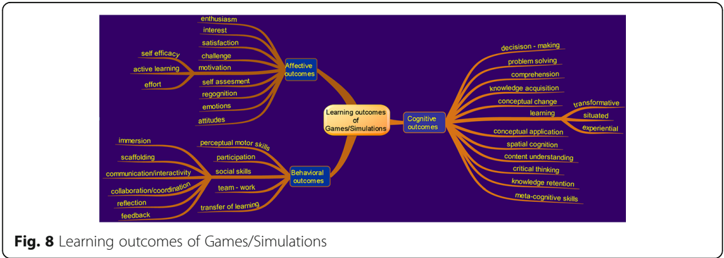
The focus of higher education institutions is the preparation of future professionals. To achieve this aim, innovative teaching methods are often deployed, including games and simulations, which form the subject of this paper. As the field of digital games and simulations is ever maturing, this paper attempts to systematically review the literature relevant to games and simulation pedagogy in higher education. Two researchers collaborate to apply a qualitative method, coding and synthesizing the results using multiple criteria. The main objective is to study the impact of games and simulations with regard to achieving specific learning objectives. On balance, results indicate that games and/or simulations have a positive impact on learning goals. The researchers identify three learning outcomes when integrating games into the learning process: cognitive, behavioural, and affective. As a final step, the authors consolidate evidence for the benefit of academics and practitioners in higher education interested in the efficient use of games and simulations for pedagogical purposes. Such evidence also provides potential options and pathways for future research.
Overview
The claims and statistics of this paper haven’t been checked yet.
Run the check — free, no account needed. It reads the open-access text and checks the sources it cites.
Integrity signals
Registry
Cites
Statistics
Figures
Verification
Claims the paper makes
The claims and statistics of this paper haven’t been checked yet.
Run the check — free, no account needed. It reads the open-access text and checks the sources it cites.
Claims other papers make about this one
Each is checked against this paper’s own text: does it say what the citing paper says it does?
In the citing paper
“Beyond the Longevity Games, practical simulations benefit students by preparing students for practical experiences (17–19).”
From Using generative AI for interview simulations to enhance student research skills in biology education (2025) · cites this paper as [18]
Self-check
Percentages, sums and reported differences re-computed from the paper’s own numbers.
The self-check needs the paper’s full text.
Citations
Cites
Rules of Play: Game Design Fundamentals
Salen, K., & Zimmerman, E. (2003) · Medical Entomology and Zoology · Cited by 5,438
A systematic literature review of empirical evidence on computer games and serious games
Connolly, T. M., Boyle, E. A., MacArthur, E., Hainey, T., & Boyle, J. M. (2012) · Computers & Education · doi:10.1016/j.compedu.2012.03.004 · Cited by 2,890
Merchant, Z., Goetz, E. T., Cifuentes, L., Keeney-Kennicutt, W., & Davis, T. J. (2014) · Computers & Education · doi:10.1016/j.compedu.2013.07.033 · Cited by 2,109
From visual simulation to virtual reality to games
Zyda, M. (2005) · Computer · doi:10.1109/mc.2005.297 · Cited by 2,077
A meta-analysis of the cognitive and motivational effects of serious games.
Wouters, P., van Nimwegen, C., van Oostendorp, H., & van der Spek, E. D. (2013) · Journal of Educational Psychology · doi:10.1037/a0031311 · Cited by 1,864
Digital Games, Design, and Learning: A Systematic Review and Meta-Analysis
Clark, D. B., Tanner-Smith, E. E., & Killingsworth, S. S. (2016) · Review of Educational Research · doi:10.3102/0034654315582065 · Cited by 1,274
The learning effects of computer simulations in science education
Rutten, N., van Joolingen, W., & van der Veen, J. T. (2011) · Computers & Education · doi:10.1016/j.compedu.2011.07.017 · Cited by 1,079
A META‐ANALYTIC EXAMINATION OF THE INSTRUCTIONAL EFFECTIVENESS OF COMPUTER‐BASED SIMULATION GAMES
SITZMANN, T. (2011) · Personnel Psychology · doi:10.1111/j.1744-6570.2011.01190.x · Cited by 882
Serious games as new educational tools: how effective are they? A meta‐analysis of recent studies
Girard, C., Écalle, J., & Magnan, A. (2012) · Journal of Computer Assisted Learning · doi:10.1111/j.1365-2729.2012.00489.x · Cited by 738
Our Princess Is in Another Castle
Young, M. F., Slota, S. T., Cutter, A. B., Jalette, G., Mullin, G., Lai, B., Simeoni, Z., Tran, M. T., & Yukhymenko–Lescroart, M. A. (2012) · Review of Educational Research · doi:10.3102/0034654312436980 · Cited by 737
Research works printed but not linked: 11
- Ahmad, S. M. S., Fauzi, N. F. M., Hashim, A. A., & Zainon, W. M. N. W. (2013). A study on the effectiveness of computer games in teaching and learning. International Journal of Advanced Studies in Computers, Science and Engineering, 2(1), 1.
- Andreu Andrés, M. A., & García Casas, M. (2011). Perceptions of gaming as experiential learning by engineering students. International Journal of Engineering Education, 27(4), 795–804.
- Arias Aranda, D., Haro Domiguez, C., & Romerosa Martinez, M. M. (2010). An innovative approach to the learning process in management: The use of simulators in higher education. REVISTA DE EDUCACION, 353, 333–334.
- Bausch, L., Beran, J., Cahanes, S., & Krug, L. (2008). Physiological responses while playing Nintendo Wii sports. Journal of Undergraduate Kinesiology Research, 3, 19–25.
- Chiang, Y. T., Lin, S. S. J., Cheng, C. Y., & Liu, E. Z. F. (2011). Exploring online game players’ flow experiences and positive affect. The Turkish Online Journal of Educational Technology, 10(1), 106–114.
- Cvetić, B., Vasiljević, D., & Danilović, M. (2013). DRP game: New tool to enhance teaching and learning in logistics and supply chain management. In 1st Logistics International Conference (pp. 299-303).
- Hsu, Y.-C., Ho, H. N. J., Tsai, C.-C., Hwang, G.-J., Chu, H.-C., Wang, C.-Y., & Chen, N.-S. (2012). Research trends in technology-based learning from 2000 to 2009: A content analysis of publications in selected journals. Educational Technology & Society, 15(2), 354–370.
- Liao, Y.-W., & Wang, Y.-S. (2011). Investigating the factors affecting students’ continuance intention to use business simulation games in the context of digital learning. In International Conference on Innovation, Management and Service (pp. 119-124).
- Pløhn, T. (2013). Nuclear mayhem-a pervasive game designed to support learning. In European Conference on Games Based Learning (p. 475). Academic Conferences international limited.
- Sawyer, B. (2002). Serious games: Improving public policy through game-based learning and simulation. USA: Woodrow Wilson International Center for Scholars.
- Tao, Y. H., Yeh, C. C. R., & Hung, K. C. (2015). Validating the learning cycle models of business simulation games via student perceived gains in skills and knowledge. Educational Technology & Society, 18(1), 77–90.
Cited by
Sorted by citations
Items 801–853 of 853
Merle, L. R. B., & Marco, D. N. G. O. (2026) · International Journal of Research Publications · doi:10.47119/ijrp1001981620269211
Introducing Concepts Through Games in the Economics Classroom
Delmond, A., Mehlhorn, J., & Nanney, R. S. (2026) · Applied Economics Education and Extension · doi:10.71162/aeee.609150
Plachynda, T., & Dovga, T. (2026) · Education in the 21st Century · doi:10.46991/educ-21st-century.v8.i1.044
Students as Freight Architects: Reverse Mentorship for Experiential Logistics Pedagogy
Sahadevan, M., Rezo, K. A., Ramamoorthy, J., Jenhar, D., & Shi, X. (2026) · Advances in economics, business and management research/Advances in Economics, Business and Management Research · doi:10.2991/978-94-6239-709-5_139
Learning About Artificial Intelligence in Algebra 1 Classes in Virtual School Settings
Li, L., Chao, J., Lord, T., Collins, K., Ellis, R., Xing, W., & Zhang, Y. (2026) · Lecture notes in computer science · doi:10.1007/978-3-032-29763-1_19
Development and Validation of Perioble: A Board Game for Learning the Periodic Table of Elements
Divina, R., Haja, E., & Lasala, N. J. (2026) · Diversitas Journal · doi:10.48017/dj.v11i2.3712
Gameplay as Medium: Investigating the Educational Efficacy of Game Design in HCI Education
Luckner, N., Zheng, S., & Purgathofer, P. (2026) · Interaction design & architecture(s)/ID&A Interaction design & architecture(s) · doi:10.55612/s-5002-068-009
Gamification Strategies in Climate Education
Moreno-Cruz, A., Gallegos, J. C. P., & Padilla-Díaz, A. (2026) · IGI Global eBooks · doi:10.4018/979-8-3373-9048-2.ch015
Garcia, M. B. (2026) · Education and Information Technologies · doi:10.1007/s10639-026-14072-3
Ercan, F., & Özkan, Y. (2026) · Journal of Social and Educational Research · doi:10.66028/jser.51202684
Developing an Educational Game on Protein Degradation
Szulc, N. A., & Pokrzywa, W. (2026) · Methods in molecular biology · doi:10.1007/978-1-0716-5320-3_11
Otto, J. L., Goulet, L., Ware, B. K., Lowry, H., Miller, A.-E., Botello, J. D., Pruett, J. E., & Beatty, A. E. (2026) · bioRxiv (Cold Spring Harbor Laboratory) · doi:10.64898/2026.07.06.736808
Aprendizaje matemático mediado por Minecraft Education: revisión sistemática
Vaca, C. D. T., Benavides, F. L. T., Rojas, J. N. R., Ayala, L. J. R., & Rivera, E. S. V. (2026) · Revista Latinoamericana de Calidad Educativa. · doi:10.70625/rlce/876
Hin, L. T. (2026) · The Asian Conference on the Arts, Humanities and Social Sciences Conference proceedings/Asian Conference on the Social Sciences official conference proceedings/Asian Conference on Arts & Humanities official conference proceedings · doi:10.22492/issn.2186-229x.2026.23
Sumadevi, S. (2026) · Shodh Sari-An International Multidisciplinary Journal · doi:10.59231/sari7966
Aung, M. T. Z., Sureephong, P., Chernbumroong, S., & Duangnamol, T. (2026) · Communications in computer and information science · doi:10.1007/978-981-92-4305-1_19
Teaching Financial Literacy Through the Lens of Career Exploration
Milani, S. (2026) · Sustainable finance · doi:10.1007/978-3-032-29188-2_25
Gobron, S., Jun, K., & Pedrotti, M. (2026) · SeGAH ... IEEE ... International Conference on Serious Games and Applications for Health/IEEE International Conference on Serious Games and Applications for Health · doi:10.1109/segah69272.2026.11653352
Quach, S., & Hsieh, S. (2026) · ASEE Annual Conference & Exposition · doi:10.18260/1-2--60732
Virtual reality: Enhancing chemical engineering students' learning in process safety
Koay, K. H., Tan, J., Hassim, M. H., & Aviso, K. B. (2026) · Education for Chemical Engineers · doi:10.1016/j.ece.2026.100530
Designing Virtual Role-Playing Simulations for Social Sciences Experiments: A Proof-of-Concept StudyPreprint
Kemper, P. C. (2026) · SSRN Electronic Journal · doi:10.2139/ssrn.7404234
Berd-Gómez, R., Candel, E. C., Medina, C. E. G., González, R. R., & González-Martín, A. M. (2026) · Discover Education · doi:10.1007/s44217-026-02121-5
Managing Creative Talent Flow in Graphic Design Education
Aliyev, P. (2026) · Contemporary Issues in Design · doi:10.58225/cid.2026.1.1.4
Experiencias educativas con videojuegos. Una revisión sistemática según PRISMA (2020-2026)
Salazar-Ruiz, M. R., Carmona, R. M., & Sánchez, J. J. T. (2026) · Pulso Revista de educación · doi:10.58265/pulso.8950
Bridging generations: A pilot study of undergraduate students led health education for older adults
Han, J., Smith, Z., Edwards, M., Edwards, M., McKoy, K., Sanderlin, A. H., & Hughes, T. B. (2026) · Educational Gerontology · doi:10.1080/03601277.2026.2727971
Capstone Digital Simulation-based Training: Mobilizing Learning through Exploration and ExploitationPreprint
Coulon, T., Delisle, J., Cheikh‐Ammar, M., & Bourdeau, S. (2026) · SSRN Electronic Journal · doi:10.2139/ssrn.7478775
Cavioni, V., Conte, E., & Ornaghi, V. (2026) · International Online Conference on Education Sciences · doi:10.3390/proceedings2026145013
Development and Preliminary Validation of Cognitive Anatomy Games for Sports Education Students
Wati, K. J., Kesumawati, S. A., Sukmawati, N., Muslimin, & Endrawan, I. B. (2026) · COMPETITOR Jurnal Pendidikan Kepelatihan Olahraga · doi:10.67322/cpjok.v18i3.1209
Human Factors Evaluation of a Robotics-Based STEM Camp for Youth in a Middle Eastern Context
Greene, J., Smith, H., Sears, M., & Khasawneh, A. (2026) · Proceedings of the Human Factors and Ergonomics Society Annual Meeting · doi:10.1177/10711813261475210
Stavropoulou, F., Zervas, K., & Kostopoulos, I. (2026) · The International Journal of Management Education · doi:10.1016/j.ijme.2026.101547
Aruchidi, N. A., Барабаш, Д. А., Misichenko, N., Eleonora, M., & Shcherbakov, S. M. (2026) · De Gruyter eBooks · doi:10.1515/9783112213117-010
Learning beyond the lab: A gamified approach to anatomy education in a museum‐based experience
da Silva, W. N., Cury, D. P., Lacchini, S., & Takano, A. P. C. (2026) · Anatomical Sciences Education · doi:10.1002/ase.70360
Hamzaj, Y. A. (2026) · Buca eğitim fakültesi dergisi (Online)/Buca Eğitim Fakültesi dergisi · doi:10.53444/deubefd.1934591
AI-Supported Feedback, Team Dynamics and Coaching in Hospitality Management Simulation
Calisto, M. D. L., & Afonso, V. A. (2026) · European Conference on Games Based Learning · doi:10.34190/ecgbl.20.1.5505
Жицька, С., Yefimova, O. M., & Бецько, О. (2026) · Innovate Pedagogy · doi:10.32782/ip/99.26
Briciu, V.-A., Istrate, F.-E., Briciu, A., & Meseșan-Schmitz, L. (2026) · Revista Romaneasca pentru Educatie Multidimensionala · doi:10.66388/rrem/18.3/59
Hermawan, S., & Widianto, M. H. (2026) · International Conference on ICT for Smart Society (ICISS) · doi:10.1109/iciss71466.2026.11715419
van Esch, P., & Cui, Y. (. (2026) · Marketing Education Review · doi:10.1080/10528008.2026.2744265
Wulandari, A., Salsabila, S., Maulidiyah, F. K., Ni’mah, L. M., & Fikri, A. M. Z. A. (2026) · Journal of Science Education Literacy · doi:10.30872/jsel.v1i1.6638
Clarke, S. (2026) · AI and Ethics · doi:10.1007/s43681-026-01419-2
Leiton, L. R. D., Peralta, D. A. T., Morales, M. A. A., Narváez, C. J. R., Proaño, E. T. T., & Dominguez, E. (2026) · Communications in computer and information science · doi:10.1007/978-3-032-41327-7_28
Sombria, K. J. (2026) · Science & Technology Journal · doi:10.66133/22jxbk85
Aprillia, R., Peni, N. R. N., & Mahmudah, K. R. (2024) · AKSIOMA Jurnal Matematika dan Pendidikan Matematika · doi:10.26877/1y4mg339
Nicolaidou, I. A., Karanikola, C., Moisa, A., Aristeidis, L., Tourapi, C., & Vasquez, M. I. (2026) · Multimodal Technologies and Interaction · doi:10.3390/mti10100107
Eirini, S., & Anastasia, P. (2026) · Journal of Educational and Developmental Psychology · doi:10.5539/jedp.v16n2p1
MELIYEVA, M. (2025) · Eurasian Journal of Academic Research · doi:10.70413/ejar-v05-i09-ps-068
Chaidi, I., Pergantis, P., Vlotinou, P., Papanastasiou, G., Skianis, C. A., Καραγιαννίδης, Χ., & Drigas, A. S. (2026) · Computers · doi:10.3390/computers15100741
Interactive Stratigraphic Forward Simulation: An Open-Source Toolkit for Marine Geoscience Education
Qiu, S., Dai, Y., Liu, Y., & 李景哲 (2026) · Applied Sciences · doi:10.3390/app162110608
ADVANCED HAPPY FAMILY: AN EDUCATIONAL CARD GAME FOR LEARNING SI PREFIXES, SYMBOLS AND VALUES
Zaine, I. S., Mokhtar, M., Yunus, M. B. M., & Yeh, T. M. T. (2026) · International Journal of Modern Education · doi:10.35631/ijmoe.831110
Aguilar, J. A. H., Espíndola, M. T. E., Castillo, L. A. F., Méndez, A. M., & López, O. C. (2026) · Revista Facultad de Ciencias Contables Económicas y Administrativas -FACCEA · doi:10.47847/faccea.v16n2a3
Quality management approach to industry-education collaboration in engineering education
Sabo, A., Kuljić, B., & Szakáll, T. (2026) · doi:10.5937/iizs26251s
Metadata
- Authors
- Vlachopoulos, D., & Makri, A.
- Affiliations
- European University Cyprus (CY)
- Corresponding author
- Vlachopoulos, Dimitrios
- Venue
- International Journal of Educational Technology in Higher Education
- Published
- 2017-07-10
- Volume
- 14
- Issue
- 1
- ISSN
- 2365-9440 (ISSN-L)
- OpenAlex
- W2626812977
- Cited by
- 776
- References
- 152
- Citations by year
- 2026: 70 · 2025: 107 · 2024: 123 · 2023: 144 · 2022: 99 · 2021: 112 · 2020: 76 · 2019: 35 · 2018: 10
- FWCI
- 6.35
- Type
- journal article
- Language
- en
- Open access
- diamond
- doi.org
- Locations
- International Journal of Educational Technology in Higher Education (publishedVersion, cc-by)
- DOAJ (DOAJ: Directory of Open Access Journals) (submittedVersion, cc-by-sa)
- Redalyc (Universidad Autónoma del Estado de México) (submittedVersion)
- Funders
- Laureate Education Inc. (David Wilson Award of Excellence in Teaching and Learning)
- Topics
- Social Sciences › Psychology › Developmental and Educational Psychology › Educational Games and Gamification
- Social Sciences › Education › Innovative Teaching Methodologies in Social Sciences
- Social Sciences › Education › Management and Marketing Education
- Keywords
- game-based learning, simulation, simulation-based training, university teaching, learning outcomes, cognitive outcomes, behavioural outcomes, affective learning outcomes, professional training
About these checks
Registry, retraction, Cites and statistics results are computed, not judged, with one exception: a printed reference that no index lists is read once by a model before it counts as a citation error. Claims are extracted by a model and kept only when their quote appears verbatim in the text; each cited source is then checked, with a model’s help, for whether it says what the claim relies on. Those verdicts can be wrong — read the claim’s quote and the cited source before relying on one.
Statistics and arithmetic are recomputed, not judged.
Confidence bands are shown only for fields calibrated on our annotated test set. None is calibrated yet, so no band is shown.
What counts as a claim ›How we measure confidence ›How we check this ›
Are you an author, or do you see a problem with this page? Request a review
