

Adaptive e-learning environment based on learning styles and its impact on development students' engagement
Open accessThe DOI matches its Crossref record; 86 of the 87 references it cites were found in a registry or an index; 7 of the 46 sources its claims cite were checked for support.
Abstract
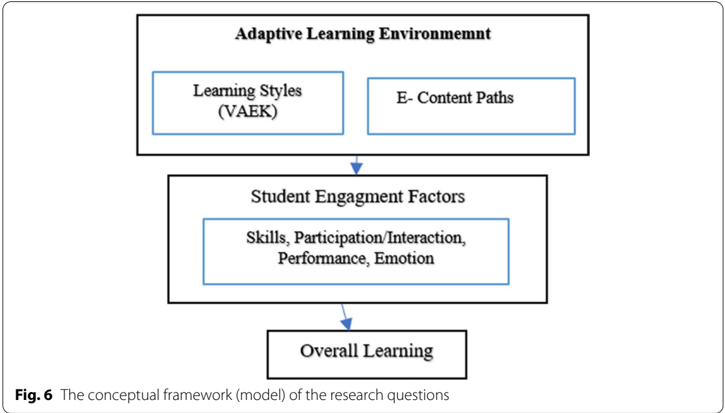
Abstract Adaptive e-learning is viewed as stimulation to support learning and improve student engagement, so designing appropriate adaptive e-learning environments contributes to personalizing instruction to reinforce learning outcomes. The purpose of this paper is to design an adaptive e-learning environment based on students' learning styles and study the impact of the adaptive e-learning environment on students’ engagement. This research attempts as well to outline and compare the proposed adaptive e-learning environment with a conventional e-learning approach. The paper is based on mixed research methods that were used to study the impact as follows: Development method is used in designing the adaptive e-learning environment, a quasi-experimental research design for conducting the research experiment. The student engagement scale is used to measure the following affective and behavioral factors of engagement (skills, participation/interaction, performance, emotional). The results revealed that the experimental group is statistically significantly higher than those in the control group. These experimental results imply the potential of an adaptive e-learning environment to engage students towards learning. Several practical recommendations forward from this paper: how to design a base for adaptive e-learning based on the learning styles and their implementation; how to increase the impact of adaptive e-learning in education; how to raise cost efficiency of education. The proposed adaptive e-learning approach and the results can help e-learning institutes in designing and developing more customized and adaptive e-learning environments to reinforce student engagement.
Overview
CoChat Summary
TL;DR
This paper designed an adaptive e-learning environment based on VARK learning styles and tested its impact on first-year university students’ engagement in a learning skills course. The experimental group showed significantly higher post-test engagement than the conventional e-learning control group across skills, participation/interaction, performance, and emotional factors.
Key findings
- Pre-test equivalence: no significant differences between experimental and control groups on engagement overall or on any factor (t values 0.464, 0.514, 0.321, 0.397, 0.632; p > 0.05).
- Post-test: the experimental group scored significantly higher than the control group on all engagement factors: skills 34.81 vs 23.34 (t = 4.086, p = 0.001); participation/interaction 21.05 vs 13.26 (t = 2.210, p = 0.002); performance 25.86 vs 14.60 (t = 2.071, p = 0.003); emotional 24.93 vs 13.07 (t = 2.909, p = 0.001); average score 38.87 vs 26.13 (t = 4.738, p = 0.003).
- Effect size: Cohen’s d = 0.826 and effect-size r = 0.401; the paper describes this as a large effect, with the treated group’s mean at the 79th percentile of the control group.
- Instrument reliability: VARK questionnaire Cronbach’s alpha = 0.83; engagement scale full alpha = 0.81, with subscale alphas from 0.80 to 0.87.
Methods
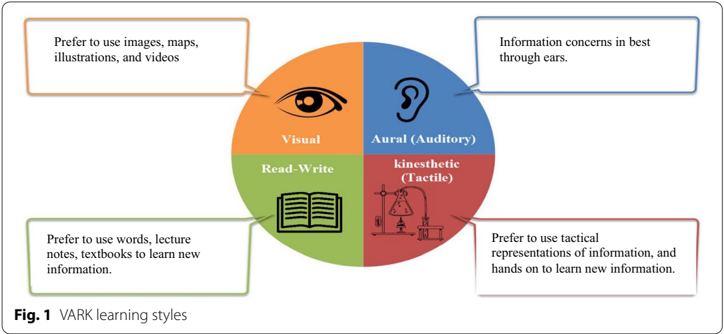
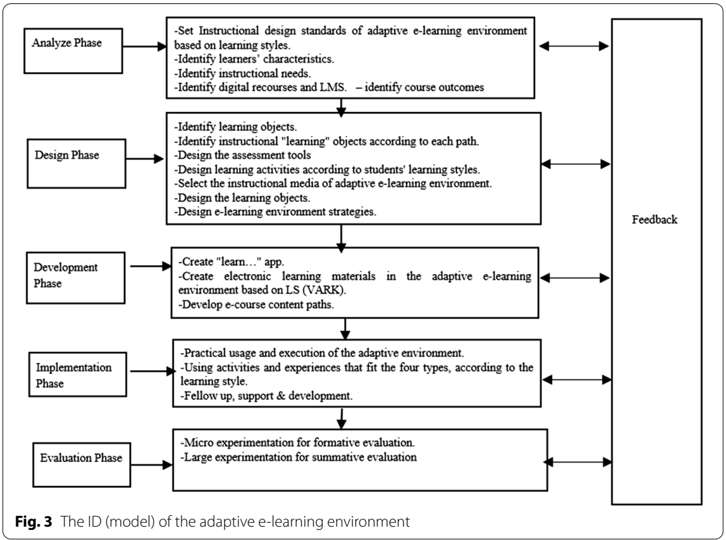
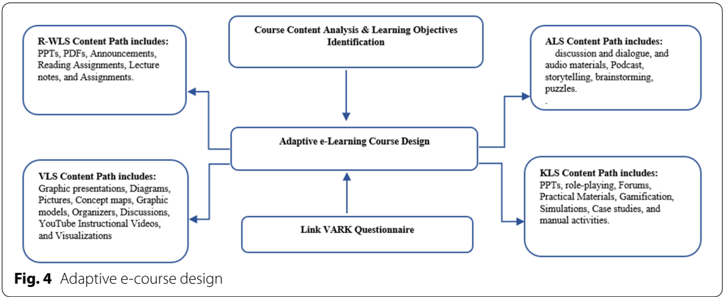
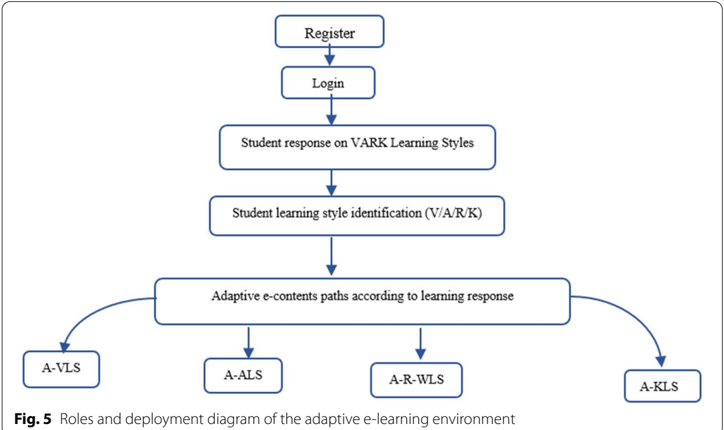
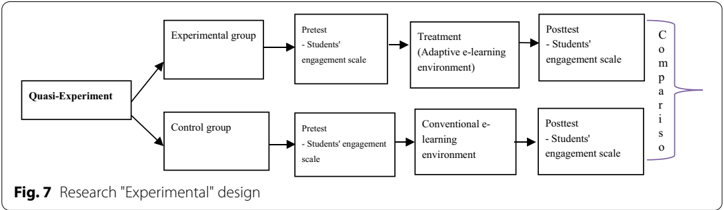
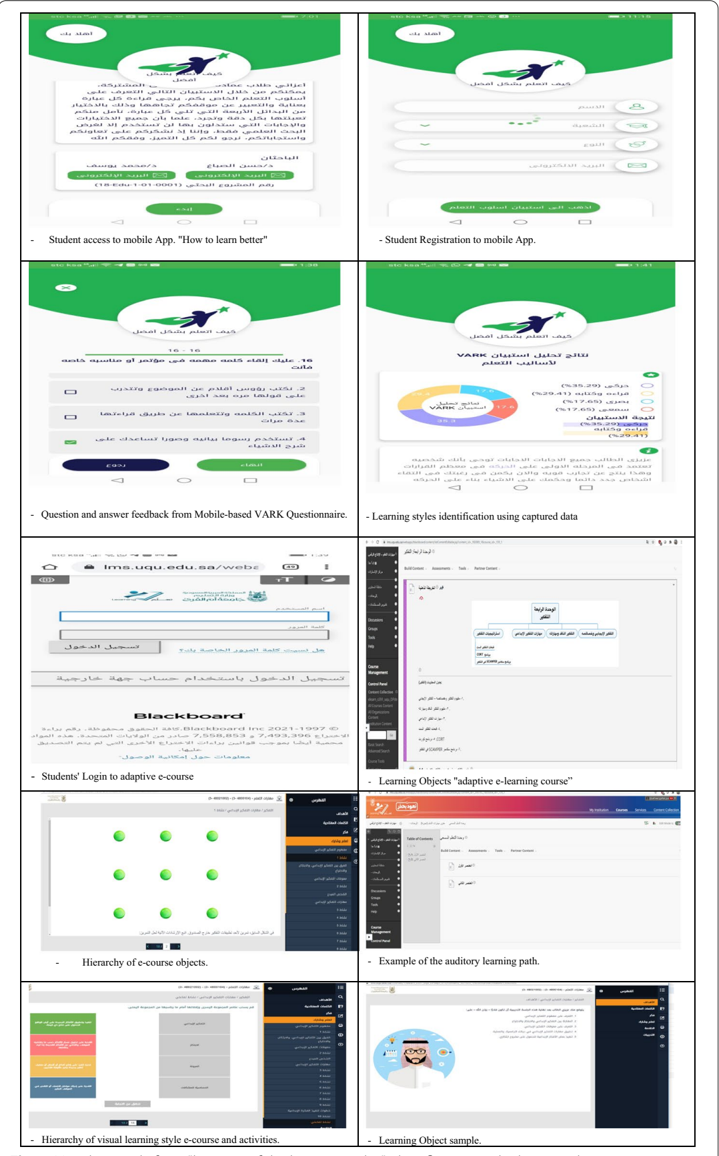
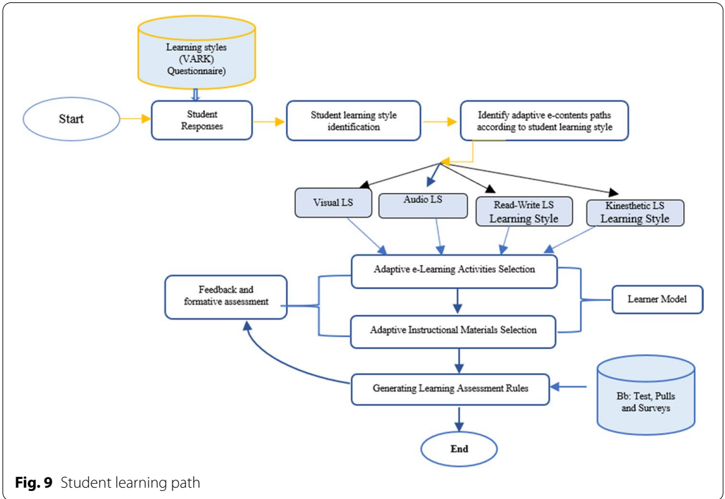
- Quasi-experimental pretest-posttest design; the adaptive e-learning environment was developed using the ADDIE instructional design model, with content paths based on VARK learning styles (visual, auditory, read/write, kinesthetic).
- Participants were 118 first-year “learning skills” students aged 17–18 at Umm Al-Qura University in the 2019/2020 academic year: control group N = 58 (31 males, 27 females) and experimental group N = 60 (36 males, 24 females), taught by the same instructors.
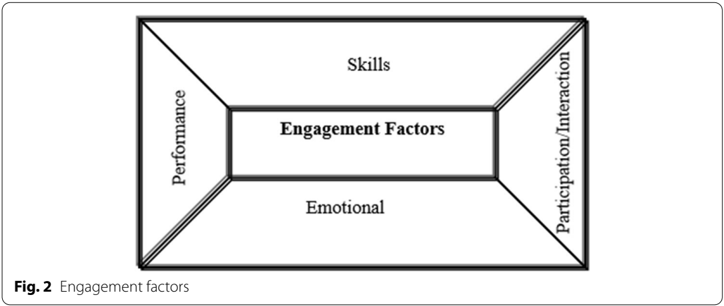
- Instruments and analysis: electronic VARK questionnaire (16 MCQ items); adapted Dixson student engagement scale (27 items, 5-point, four factors: skills, participation/interaction, performance, emotional), piloted on 20 students; independent-sample t-tests and Cohen’s d were used.
Limitations
- Stated in the paper: the study is restricted to one aspect of content adaptation—learning materials adapted based on learning styles—and notes that other considerations include content-dependent adaptation. It also states that empirical findings on adapting instruction to learning style are mixed and that Murray and Pérez found adaptive learning environments have a limited impact on learning outcome.
- Evident from the text: the study is limited to a single institution and a single “learning skills” course with first-year students, uses a short pretest-posttest window, and measures engagement through a self-report scale, which limits broader generalization and long-term conclusions.
Model-written summary. Check it against the paper before relying on it.
Integrity signals
Registry
Cites
Statistics
Figures
Verification
Claims the paper makes
5 Valid · 2 Not valid · 24 Not checked · 46 Own results and interpretations
The cited sources that could be checked couldn’t confirm or dispute this claim.
In the paper
“According to the findings of (Akbulut & Cardak, 2012;Alshammari & Qtaish, 2019;Alzain et al., 2018a, b;Shi et al., 2013;Truong, 2016), adaptation based on a combination of learning style, and information level yields significantly better learning gains.”
§ Adaptive e-learning environment based on learning styles and its impact on development students' engagement > Adaptive e-learning environments based on learning styles
What the sources say
- Not checked — no full text of the sourcecites Akbulut & Cardak, 2012 matched to “Adaptive educational hypermedia accommodating learning styles: A content analysis of publications from 2000 to 2011” (2012) source
- Not matchedcites Shi et al., 2013
An author–year citation the paper’s reference list doesn’t settle. We don’t search these by name.
- Could not verifycites Truong, 2016 matched to “Integrating learning styles and adaptive e-learning system: Current developments, problems and opportunities” (2016) sourceExperimental — accuracy not yet measured
Our copy of Truong (2016) is a systematic review of learning-styles integration into adaptive e-learning systems; its retrievable passages cover the Introduction (learning-styles theories, drawbacks of questionnaire measurement), Section 2 Search methods (51 papers, 2004-2014) and Section 3.1 (the integration-process classification). None of them mentions adapting on a combination of learning style AND information level, nor reports significantly better learning gains; the nearest statement is the generic Introduction claim of 'several positive results in both learning styles detection... and applications'. Searched: 'information level', 'learning gains / achievement test scores / statistically significant difference', 'combining learning styles with other characteristics such as prior knowledge', 'evaluation of adaptive system effect on student performance' — no supporting or contrary passage returned. (LLM, conf=0.68)
plainstates a cause- Asserted: passes — The authors put it forward as true.
- Checkable: passes — It can be checked against evidence.
- Load-bearing: passes — The paper’s conclusions depend on it.
- Based: passes — The paper gives a reason why it holds.
Every source the paper cites for this claim was checked and supports it.
In the paper
“There is also evidence that an adaptive environment positively impacts other aspects of quality such as student engagement (Murray & Pérez, 2015).”
§ Adaptive e-learning environment based on learning styles and its impact on development students' engagement > Discussions and limitations
What the sources say
- Supportedcites Murray & Pérez, 2015 matched to “Informing and Performing: A Study Comparing Adaptive Learning to Traditional Learning” (2015) source
The Conclusion states that there is evidence adaptive systems positively affect aspects of quality including student engagement. The claim closely paraphrases that statement; the paper cites Jarrett (2013) and Zimmer (2014) for the evidence. (LLM, conf=0.94)
plainstates a cause- Asserted: passes — The authors put it forward as true.
- Checkable: passes — It can be checked against evidence.
- Load-bearing: unclear — It is unclear whether the paper’s conclusions depend on it.
- Based: passes — The paper gives a reason why it holds.
- Supported
Every source the paper cites for this claim was checked and supports it.
In the paper
“(Chun-Hui et al., 2017) demonstrated that adaptive eLearning technologies can be beneficial to students' learning and development.”
§ Adaptive e-learning environment based on learning styles and its impact on development students' engagement > Discussions and limitations
What the sources say
- Supportedcites Chun-Hui et al., 2017 matched to “An Adaptive e-Learning System for Enhancing Learning Performance: Based on Dynamic Scaffolding Theory” (2017) source
The Abstract (p. 1) states that 'the developed adaptive e-learning system can effectively support students with personalized learning materials and successfully helps students acquired knowledge and develop cognitive abilities,' which is exactly the benefit to students' learning and development the citing sentence attributes. The hedged wording ('can be beneficial') matches the source's own claim, though the underlying evidence is a single experimental study of 60 undergraduates in an Excel spreadsheet course, with the authors flagging limited generalizability — so the generalization to adaptive e-learning technologies broadly rests on that narrow base. No contrary statement was found in our copy. (LLM, conf=0.85)
boostedstates a cause- Asserted: passes — The authors put it forward as true.
- Checkable: passes — It can be checked against evidence.
- Load-bearing: passes — The paper’s conclusions depend on it.
- Based: passes — The paper gives a reason why it holds.
- Supported
A result the paper reports from its own data — it cites no other source for it, so there is none to check. The quote shows it is in the paper.
In the paper
“Table 4. indicates that students in the experimental group had significantly higher mean of engagement post-test (engagement factors items) scores than students in the control group (p < 0.05).”
§ Adaptive e-learning environment based on learning styles and its impact on development students' engagement > Findings
hedgedstates a cause- Asserted: passes — The authors put it forward as true.
- Checkable: passes — It can be checked against evidence.
- Load-bearing: passes — The paper’s conclusions depend on it.
- Based: passes — The paper gives a reason why it holds.
A result the paper reports from its own data — it cites no other source for it, so there is none to check. The quote shows it is in the paper.
In the paper
“The results revealed that the experimental group is statistically significantly higher than those in the control group.”
§ Adaptive e-learning environment based on learning styles and its impact on development students' engagement > Abstract
plainstates a cause- Asserted: passes — The authors put it forward as true.
- Checkable: passes — It can be checked against evidence.
- Load-bearing: passes — The paper’s conclusions depend on it.
- Based: passes — The paper gives a reason why it holds.
15 more claims
Create a free account to see all 77 claims and to verify the 18 references still open.
- Probably not a substantial claim. 26
- It may state two separate claims as one. 39
- The quote only partly states this claim. 6
Claims other papers make about this one
Each is checked against this paper’s own text: does it say what the citing paper says it does?
In the citing paper
“Additionally, compliance with theoretical learning can be enhanced among trainees with customized sessions, supporting individual learning styles accessible anywhere and anytime17 compared with conventional lectures.”
From Neurosurgery resident training using blended learning concepts: Course development and participant evaluation (2022) · cites this paper as [17]
In the citing paper
“These systems enable trainees to individually study theoretical content based on their respective preferences, needs, and prior knowledge.17”
From Neurosurgery resident training using blended learning concepts: Course development and participant evaluation (2022) · cites this paper as [17]
Self-check
Percentages, sums and reported differences re-computed from the paper’s own numbers.
Each contradiction between two passages listed here was confirmed by an independent check.
Rated major: it would touch a result — a value a result rests on, reported and recomputed p-values on opposite sides of the significance level, two passages that conflict with no sign which is right, or a cited work retracted before this paper was published.
In the paper
“| Whole engagement scale | Experiment | 60 | 26.76 | 1.84 | 0.632 |”
§ Adaptive e-learning environment based on learning styles and its impact on development students' engagement > Research implication
Reported 26.76 · recomputed 58.57
Rated minor: it would not touch a result — a value no result rests on, a p-value that stays on the same side of the significance level, or a conflict that is clerical, resolved elsewhere in the paper, or outside its own findings.
In the paper
§ Adaptive e-learning environment based on learning styles and its impact on development students' engagement > Research implication
“Table: 4 Table 4 Descriptive data and independent sample t-tests of the pre-test results”
§ Adaptive e-learning environment based on learning styles and its impact on development students' engagement > Findings
“Table 4. indicates that students in the experimental group had significantly higher mean of engagement post-test (engagement factors items) scores than students in the control group (p < 0.05).”
Rated minor: it would not touch a result — a value no result rests on, a p-value that stays on the same side of the significance level, or a conflict that is clerical, resolved elsewhere in the paper, or outside its own findings.
In the paper
§ Adaptive e-learning environment based on learning styles and its impact on development students' engagement > Research participants
“All participants were chosen in the academic year 2109-2020 at the first term which was taught by the same instructors.”
§ Adaptive e-learning environment based on learning styles and its impact on development students' engagement > Learner content path in adaptive e-learning environment
“The present study covered the 1st semester during the 2019/2020 academic year.”
Citations
Cites
School Engagement: Potential of the Concept, State of the Evidence
Fredricks, J. A., Blumenfeld, P. C., & Paris, A. H. (2004) · Review of Educational Research · doi:10.3102/00346543074001059 · Cited by 12,581 · cited 1×
“Previous research has emphasized that student participation is a key factor in overcoming academic problems such as poor academic performance, isolation, and high dropout rates (Fredricks et al., 2004).”
BackgroundCohen, J. (1992) · Current Directions in Psychological Science · doi:10.1111/1467-8721.ep10768783 · Cited by 5,870
Research in Education: Evidence Based Inquiry
McMillan, J. H., & Schumacher, S. (2005) · Medical Entomology and Zoology · Cited by 4,006
Pashler, H., McDaniel, M., Rohrer, D., & Bjork, R. (2008) · Psychological Science in the Public Interest · doi:10.1111/j.1539-6053.2009.01038.x · Cited by 2,147
How video production affects student engagement: an empirical study of MOOC videos
Guo, P. J., Kim, J., & Rubin, R. (2014) · Proceedings of the first ACM conference on Learning @ scale conference · doi:10.1145/2556325.2566239 · Cited by 1,850 · cited 1×
“Guo et al. (2014) checked the participation of students when they watched videos.”
BackgroundHinton, P., McMurray, I., & Brownlow, C. (2014) · Routledge eBooks · doi:10.4324/9781315797298 · Cited by 1,022
Handbook of Individual Differences, Learning, and Instruction
Jonassen, D. H., & Grabowski, B. L. (2012) · Routledge eBooks · doi:10.4324/9780203052860 · Cited by 934
Engaging online learners: The impact of Web-based learning technology on college student engagement
Chen, P.-S. D., Lambert, A. D., & Guidry, K. R. (2010) · Computers & Education · doi:10.1016/j.compedu.2009.11.008 · Cited by 785 · cited 1×
“E-learning produces constructive learning outcomes, as it allows students to actively participate in learning at anytime and any-place (Chen et al., 2010; Lee et al., 2019).”
BackgroundStudent Engagement Techniques: A Handbook for College Faculty
Barkley, E. F. (2009) · Cited by 765
Measuring Student Engagement in the Online Course: The Online Student Engagement Scale (OSE)
Dixson, M. D. (2015) · Online Learning · doi:10.24059/olj.v19i4.561 · Cited by 707 · cited 5×
“Hence, previous research has moved beyond comparing online and face-to-face classes to investigating ways to improve online learning (Dixson, 2015; Gaytan & McEwen, 2007; Lévy & Wakabayashi, 2008; Mutahi et al., 2017).”
BackgroundInfluential
Research works printed but not linked: 8
- 4. Ali, N., Eassa, F., & Hamed, E. (2019). Personalized Learning Style for Adaptive E-Learning System, International Journal of Advanced Trends in Computer Science and Engineering. 223-230. Retrieved June 26, 2020 from http:// www. warse. org/ IJATC SE/ static/ pdf/ file/ ijatc se4181. 12019. pdf.
- 13. Behaz, A., & Djoudi, M. (2012). Adaptation of learning resources based on the MBTI theory of psychological types. IJCSI International Journal of Computer Science, 9(2), 135-141.
- 18. Cletus, D., & Eneluwe, D. (2020). The impact of learning style on student performance: mediate by personality. Interna- tional Journal of Education, Learning and Training. https:// doi. org/ 10. 24924/ ijelt/ 2019. 11/ v4. iss2/ 22. 47Des mond. · doi:10.24924/ijelt/2019.11/v4.iss2/22.47desmond
- 37. Jaleel, S., & Thomas, A. (2019). Learning styles theories and implications for teaching learning. Horizon Research Publishing. 978-1-943484-25-6.
- 45. Lévy, P. & Wakabayashi, N. (2008). User's appreciation of engagement in service design: The case of food service design. Proceedings of International Service Innovation Design Conference 2008 -ISIDC08. Busan, Korea. Retrieved October 28, 2019 from https:// www. resea rchga te. net/ publi cation/ 23058 4075.
- 46. Liang, J. S. (2012). The effects of learning styles and perceptions on application of interactive learning guides for web- based. Proceedings of Australasian Association for Engineering Education Conference AAEE. Melbourne, Australia. Retrieved October 22, 2019 from https:// aaee. net. au/ wpcon tent/ uploa ds/ 2018/ 10/ AAEE2 012-Liang.-Learn ing_ styles_ and_ perce ptions_ effec ts_ on_ inter active_ learn ing_ guide_ appli cation. pdf.
- 65. Roy, S., & Roy, D. (2011). Adaptive e-learning system: a review. International Journal of Computer Trends and Technology (IJCTT), 1(1), 78-81. ISSN:2231-2803.
- 75. Velázquez, A., & Assar, S. (2009). Student learning styles adaptation method based on teaching strategies and electronic media. Educational Technology & SocieTy., 12, 15-29.
Cited by
Items 201–300 of 564
Aprendizaje Adaptativo para Moodle desde la IA
Segura, J. A. P., & Gómez, A. B. (2025) · Ciencia Latina Revista Científica Multidisciplinar · doi:10.37811/cl_rcm.v8i5.15241 · Cited by 6
Cruz, R. A. D. (2023) · Cosmos An International Journal of Art & Higher Education · doi:10.46360/cosmos.ahe.520231011 · Cited by 6
Perdana, R., Oktavia, S. W., & Sinaga, F. P. (2024) · Journal Evaluation in Education (JEE) · doi:10.37251/jee.v5i3.815 · Cited by 7
Editorial: Risky behaviors faced by youth in an internet-based learning environment
Huang, C. L., Kang, S., & Yang, S. (2024) · Frontiers in Psychology · doi:10.3389/fpsyg.2024.1420357 · Cited by 2
Comprehensive Survey of Adaptive and Intelligent Education System Using Reinforcement Learning
Roayaei, M. (2024) · Advances in educational technologies and instructional design book series · doi:10.4018/979-8-3693-2728-9.ch008 · Cited by 2
Tsai, W.-J., & Yao, S.-H. (2023) · International Journal of Emerging Technologies in Learning (iJET) · doi:10.3991/ijet.v18i22.43925 · Cited by 3
Impact of Online Learning on Student Engagement and Academic Performance
Anand, R., & Gupta, N. (2023) · Praxis International Journal of Social Science and Literature · doi:10.51879/pijssl/060703 · Cited by 11
Artificial Intelligence and Assessment Generators in Education: A Comprehensive Review
Boutyour, Y., Idrissi, A., & Uden, L. (2024) · Studies in computational intelligence · doi:10.1007/978-3-031-65038-3_21 · Cited by 5
Intelligent Adaptive E-Learning Systems: Current Approaches, Architectures, and Applications
Aljuboori, A. F., & Lawati, H. A. (2023) · European Conference on e-Learning · doi:10.34190/ecel.22.1.1925 · Cited by 3
Exploring Student Involvement in E-Learning
Benabbes, K., Zellou, A., Housni, K., & Mezouary, A. E. (2023) · International Conference on Intelligent Systems: Theories and Applications · doi:10.1109/sita60746.2023.10373724 · Cited by 3
Learning Effectiveness of Semi Practice Course in Online Learning
Sudarwanto, T., Andriansyah, E. H., Sulistyowati, R., Cahya, S. B., & Rafida, V. (2023) · AL-TA LIM · doi:10.15548/jt.v30i1.783 · Cited by 2
An Examination of the Emotional Impact of Technology-Driven E-Learning
George, A., Ravindran, D., Sirothiya, M., Goli, M., & Rajan, N. (2023) · Advances in educational technologies and instructional design book series · doi:10.4018/978-1-6684-7639-0.ch006 · Cited by 2
Immersive Education: Leveraging Extended Reality for Environmental Awareness and Action
Tung, T. M. (2025) · Information systems engineering and management · doi:10.1007/978-3-031-88013-1_18 · Cited by 4
issa, S. A. M., & El-Sabagh, H. A. (2026) · Frontiers in Education · doi:10.3389/feduc.2026.1765181 · Cited by 5
Self-citationAlan, B., & Zengin, F. K. (2025) · İnsan ve Toplum Bilimleri Araştırmaları Dergisi · doi:10.15869/itobiad.1574248 · Cited by 3
Ge, Z.-G., & Liu, Y. (2026) · Journal of Engineering Education · doi:10.1002/jee.70052 · Cited by 3
An Adaptive Learning Path Optimization Model for Advanced English Learners
Xiao, H. (2024) · Applied Mathematics and Nonlinear Sciences · doi:10.2478/amns-2024-2666 · Cited by 2
Germane processes moderate the effectiveness of complex desirable difficulty tasks
Zeitlhofer, I., & Zumbach, J. (2026) · Instructional Science · doi:10.1007/s11251-026-09807-1 · Cited by 3
Best Practices and Challenges in the Assessment of Online Learning among Bsed Freshmen
Ramos, A. R., & Castillo, G. C. (2024) · Journal of Tertiary Education and Learning · doi:10.54536/jtel.v2i1.2390 · Cited by 6
Evaluating Learning Success, Engagement, and Usability of Moalemy: An Arabic Rule-Based Chatbot
Faia, D. A., & Alomar, K. (2025) · Future Internet · doi:10.3390/fi17100449 · Cited by 3
Web-Based Learning Media for Distance Education: A Review
Nababan, D., Wijayanti, A. P., Rico, Nashrallah, M. N., & Sari, W. A. S. (2023) · Jurnal Penelitian Pendidikan IPA · doi:10.29303/jppipa.v9i12.5827 · Cited by 20
Nacheva, R. V. (2025) · Acta Educationis Generalis · doi:10.2478/atd-2025-0009 · Cited by 6
Cultivating Effective Classroom Management: The Implementation of an Adaptive Gamification Platform
Chang, C.-F., Chuang, T., Chen, W.-F., & Su, Y.-N. (2024) · IIAI International Congress on Advanced Applied Informatics (IIAI-AAI) · doi:10.1109/iiai-aai63651.2024.00047 · Cited by 3
Javadzade, H., & Reisi, M. (2024) · Медицинский журнал Западного Казахстана · doi:10.18502/wkmj.v66i3.16179 · Cited by 3
Sun, J., Shagalov, K., & Liao, T. (2026) · Computers in Human Behavior Reports · doi:10.1016/j.chbr.2026.100945 · Cited by 5
Use of ChatGPT as a supplemental learning tool in mathematics
Sosas, M. R. D., Fat, A. F. G., Dangculos, J. M. M., Anoba, H. R. P., Remiscal, C. G., & Aleguen, J. M. (2026) · Contemporary Mathematics and Science Education · doi:10.30935/conmaths/17989 · Cited by 6
Adiyono, A., Rahayu, A. P., Besari, A., Wahib, A., Arianti, S., & Kojin, K. (2025) · doi:10.1109/icaie64856.2025.11158040 · Cited by 12
Artificial Intelligence as a Harbinger of Engagement and Collaboration
Ouariach, S., Ouariach, F. Z., & Khaldi, M. (2025) · Advances in educational technologies and instructional design book series · doi:10.4018/979-8-3373-2262-9.ch006 · Cited by 6
Sağıroğlu, N., Uzunboylu, H., Akçamete, G., & Demirok, M. S. (2025) · Applied Sciences · doi:10.3390/app15105326 · Cited by 14
Younis, J. A., Al-Tulaibawi, F. A., Al-Tameemi, A. A., Massoud, M. F., Hejase, H., & Hejase, A. J. (2023) · International Journal of Professional Business Review · doi:10.26668/businessreview/2023.v8i5.2057 · Cited by 3
Guevara-Reyes, R. J., Vinueza-Morales, M., Ruano-Lara, E. L., & Vidal-Silva, C. L. (2025) · Frontiers in Education · doi:10.3389/feduc.2025.1584040 · Cited by 3
Unleashing the Potential: A Holistic Approach to Adaptive Learning in Virtual Reality
Elghobashy, Y., Sharaf, N., & Abdennadher, S. (2024) · Lecture notes in networks and systems · doi:10.1007/978-3-031-54327-2_4 · Cited by 5
Besonia, B. E. A., Arabia, J. A. S., Babas, R. P., Luena, A. N., Banico-Villaruel, R., Daquin, C. G. D., Decrepito, M. A. L., Jardenil, K. C., Baclagon, C. M. B., Espora, S. M. H., et al. (2025) · International Journal of ADVANCED AND APPLIED SCIENCES · doi:10.21833/ijaas.2025.05.023 · Cited by 5
AlKhaza’leh, M. S., Obeidat, B. F., Hadi, S. A. A., & Al-Qaruty, R. (2023) · Emerging Science Journal · doi:10.28991/esj-2023-sied2-014 · Cited by 7
Dewi, N. P. A., Sintadewi, N. M. D., & Dewi, T. K. (2024) · Jurnal Imiah Pendidikan dan Pembelajaran · doi:10.23887/jipp.v8i3.85834 · Cited by 7
Patil, T., & Hemamalini, V. (2025) · World Skills Conference on Universal Data Analytics and Sciences (WorldSUAS) · doi:10.1109/worldsuas66815.2025.11199106 · Cited by 2
A Functional Framework for E-Learning Content Creation Using Generative AI Tools
Choi, S.-W., Kang, B., & Shin, Y. J. (2026) · Applied Sciences · doi:10.3390/app16021124 · Cited by 3
Utami, C. T., Kawuryan, S. P., Astuti, P. P., & Sugara, U. (2024) · MIMBAR PGSD Undiksha · doi:10.23887/jjpgsd.v12i2.81205 · Cited by 6
Soliman, S. M., Hassan, H. A., & Ata, F. (2023) · Egyptian Journal of Health Care · doi:10.21608/ejhc.2023.335231 · Cited by 2
Jia, L. (2024) · SSRN Electronic Journal · doi:10.2139/ssrn.4770051 · Cited by 1
Isnaniah, I., Marlina, M., & Ningsih, R. P. (2025) · Salud Ciencia y Tecnología · doi:10.56294/saludcyt20252214 · Cited by 9
Storytelling Materials: An Intervention to Improve Reading Comprehension
Perez, R. B. (2025) · International Journal of Latest Technology in Engineering Management & Applied Science · doi:10.51583/ijltemas.2025.1409000043 · Cited by 2
Akefe, I. O., Adegoke, V. A., Akefe, E., Schweitzer, D. R., & Bolaji, S. (2025) · Trends in Higher Education · doi:10.3390/higheredu4030036 · Cited by 3
The Role of Adaptive Learning in the Training of Electronics and Automation Engineers
Ivanchenko, K. (2022) · Futurity Education · doi:10.57125/fed.2022.25.03.8 · Cited by 1
Melzner, L., & Kappes, C. (2024) · Instructional Science · doi:10.1007/s11251-024-09689-1 · Cited by 12
Suryani, N. Y., & Jaya, A. (2025) · Conference on English Language Teaching · doi:10.24090/celti.2025.1318 · Cited by 4
Online learning support to reinforce motivation of university students during homeschool exodus
Toquero, C. M. D. (2023) · Mediterranean Journal of Social & Behavioral Research · doi:10.30935/mjosbr/13039 · Cited by 1
Yuliasari, S., & Amini, R. (2026) · Jurnal Penelitian Pendidikan IPA · doi:10.29303/jppipa.v12i3.14133 · Cited by 1
EduFlex – An Adaptive E learning Platform Using RAG and Integrated APIs
Meena, R. D., Bahauddin, A., Swamy, V. K., Reddy, S. A., Vivek, S. T. S., & Aarya, V. S. N. (2025) · International Conference on Knowledge Engineering and Communication Systems (ICKECS) · doi:10.1109/ickecs65700.2025.11035512 · Cited by 2
Lattice-Based Adaptation Model for Developing Adaptive Learning Games
Аркадьевна, Ш. О., Хайров, А. В., Kataev, A., & Moffat, D. C. (2023) · Communications in computer and information science · doi:10.1007/978-3-031-44615-3_28 · Cited by 1
Motamedi, S., & Marcus, V. (2024) · ASEE Annual Conference & Exposition · doi:10.18260/1-2--47564 · Cited by 2
Faia, D. A., & Alomar, K. (2025) · Applied Sciences · doi:10.3390/app152413266 · Cited by 2
Adaptive Evaluation for Barriers Elimination: The OpenEDR4C Platform
Alvarez-Icaza, I., Espinosa, J. M. M., Suárez-Brito, P., & Alvarado-Reyes, I. (2024) · International Conference on Information and Education Technology (ICIET) · doi:10.1109/iciet60671.2024.10542786 · Cited by 5
Foundations for Complete Exercise Generation
Schmidt, D., Uzulis, M., Kersten, N., Grasse, O., Hinckeldeyn, J., & Kreutzfeldt, J. (2022) · International Conference on Information Technology Based Higher Education and Training (ITHET) · doi:10.1109/ithet56107.2022.10031913 · Cited by 1
Moreno-Mendoza, D. E., Vergara-Mendoza, P. N., Vaca, J. W. T., & Bonilla-Tenesaca, J. (2025) · MQRInvestigar · doi:10.56048/mqr20225.9.1.2025.e65 · Cited by 4
Paz, A. I. L., & Stambuk‐Castellano, M. (2026) · Lecture notes in networks and systems · doi:10.1007/978-3-032-09077-5_18 · Cited by 1
Ethics and Privacy in AI Education: Prospects and Challenges in Higher Education
Dadson, Y. A., Mohammed, Z., Hussein, B., Armah, Y. E., & Yeboah, A. K. (2025) · Future education and learning spaces · doi:10.1007/978-981-96-7937-9_10 · Cited by 5
The Effectiveness of a blog resilience programme for first-year basic organic chemistry students
Cha, J., Kan, S., Ziden, A. B. A., & Chia, P. W. (2025) · Journal of Turkish Science Education · doi:10.36681/tused.2025.011 · Cited by 1
Enhancing Project-Based Learning through Digital E-Modules in Elementary Schools
Haryanti, Y. D., Wulandari, I. G. A. A., Tristiantari, N. K. D., Rosidah, A., Yonanda, D. A., & Maula, M. (2025) · Jurnal Ilmiah Sekolah Dasar · doi:10.23887/jisd.v9i2.93786 · Cited by 22
Humanizing the Digital Classroom: The Educator's Role in Fostering Connection Amidst Technology
Asrifan, A., Wajdi, F., Ishak, S., & Alwi, A. (2025) · IGI Global eBooks · doi:10.4018/979-8-3373-0771-8.ch005 · Cited by 5
A Reinforcement Learning Framework for Personalized Adaptive E-Learning
Dahan, A., Roth, N., Pelosi, A. D., & Reiner, M. (2024) · Lecture notes in networks and systems · doi:10.1007/978-3-031-71530-3_10 · Cited by 3
Learning analytics-informed teaching strategies: enhancing interactive learning in STEM education
Zheng, Y. J., & Li, D. (2025) · Interactive Learning Environments · doi:10.1080/10494820.2025.2553113 · Cited by 4
Penerapan Media Wordwall Gameshow Quiz untuk Meningkatkan Minat dan Hasil Belajar IPAS Kelas IV
Rahma, A. L., & Suratno, S. (2024) · Jurnal Penelitian Pendidikan IPA · doi:10.29303/jppipa.v10i8.8257 · Cited by 5
Evolution of Learning Styles in Surgery Comparing Residents and Teachers: Cross-Sectional Study
Silva, G. G., Costa, C. D. D. S., Gonçalves, B. C., Nunes, L. V. S. C., dos Santos, E. R., Castro, N. A. D. A. S. R., Lima, A. R. D. A., Brienze, V. M. S., Oliani, A. H., & André, J. C. (2025) · JMIR Medical Education · doi:10.2196/64767 · Cited by 1
Teng, M. F., & Yin, F. (. (2026) · Computers & Education X Reality · doi:10.1016/j.cexr.2026.100168 · Cited by 1
Tao, H. (2024) · Journal of Computational Methods in Sciences and Engineering · doi:10.1177/14727978241305756 · Cited by 5
Canonigo, A. M. (2024) · American Journal of Distance Education · doi:10.1080/08923647.2024.2303325 · Cited by 10
Improving educational quality: the role of quality 4.0 in higher education institutions
Kumar, V., Singh, A., Sharma, N. K., Verma, P., & Kaswan, M. S. (2025) · The TQM Journal · doi:10.1108/tqm-12-2024-0527 · Cited by 12
Rong, J., Deng, Y., & Liu, D. (2026) · Language Teaching Research · doi:10.1177/13621688251412525 · Cited by 2
Maqbool, S., Zafeer, H. M. I., Maqbool, S., Tariq, A., Al-Masaeid, M., & Rasool, A. (2025) · Advances in computational intelligence and robotics book series · doi:10.4018/979-8-3373-4217-7.ch005 · Cited by 2
Yang, B., & Sun, Y. (2025) · International Journal of Human-Computer Interaction · doi:10.1080/10447318.2025.2543990 · Cited by 3
A Hybrid Deep Learning Framework for Personalized MOOC Recommendations
Boulmane, E.-S., Mahmoud, H., Badouch, M., et al. (2025) · International Conference on Circuit, Systems and Communication (ICCSC) · doi:10.1109/iccsc66714.2025.11135163 · Cited by 1
Shemeen, A., Sangeetha, P. V., Deepa, S., et al. (2025) · IGI Global eBooks · doi:10.4018/979-8-3693-8593-7.ch012 · Cited by 1
Commognitive and Learning Styles Study of Students' Middle School Understanding of Circles
Syahri, A. A. (2025) · ETDC Indonesian Journal of Research and Educational Review · doi:10.51574/ijrer.v4i2.2929 · Cited by 2
Automatic generation of learning path for teaching informatics at university
Aliyeva, A., & Abbasov, A. M. (2025) · MethodsX · doi:10.1016/j.mex.2025.103634 · Cited by 2
Puspitasari, I., Margaretha, M., Yuliani, S. R., Khamida, N., & Wikantono, V. E. M. (2022) · International Conference on Education Technology and Computer · doi:10.1145/3572549.3572587 · Cited by 1
Green, G. (2024) · SAGE Open Nursing · doi:10.1177/23779608241262670 · Cited by 4
Implementation of the Independent Curriculum to Improve the Quality of Learning English
Purnama, S., & Pawiro, M. A. (2023) · Indonesian Journal Of Educational Research and Review · doi:10.23887/ijerr.v6i3.67645 · Cited by 16
Data-Driven Adaptive Course Framework—Case Study: Impact on Success and Engagement
Ademi, N., & Loshkovska, S. (2025) · Multimodal Technologies and Interaction · doi:10.3390/mti9070074 · Cited by 3
The Effect of Digital Media on Grammar Mastery for TOEFL Preparation
Jasrial, D., Zaim, M., & Yunita, W. (2024) · Journal of English Education and Teaching · doi:10.33369/jeet.8.2.386-399 · Cited by 4
Ability to organize experiential activities of teachers in primary schools
Ngoc, N. T. (2024) · Journal of Education and e-Learning Research · doi:10.20448/jeelr.v11i1.5426 · Cited by 6
Hu, F., & Tahir, S. B. (2024) · South Asian Journal of Social Sciences and Humanities · doi:10.48165/sajssh.2024.5301 · Cited by 1
AI for Personalized Learning Experiences: Adaptive Course Content and Intelligent Tutoring Systems
Khalil, S. A., Mahmood, M., Ali, Z., & Alam, I. (2026) · Advances in computational intelligence and robotics book series · doi:10.4018/979-8-3373-2752-5.ch010 · Cited by 1
Measuring the quality of adaptive environments in instruction based on student perceptions
Thaariq, Z. Z. A., Kuswandi, D., & Degeng, M. D. K. (2024) · Inovasi Kurikulum · doi:10.17509/jik.v21i1.62255 · Cited by 3
Empowering Civics Education: A Design Thinking for Deep Learning in the 21st Century
Junaidi, J., Afrina, B., Suganda, F. A., Safitri, K. D., Abdulkarim, A., & Komalasari, K. (2025) · Edukasi Jurnal Pendidikan dan Pengajaran · doi:10.19109/nbjxvv29 · Cited by 9
Almaqbali, S., Leow, M.-C., Shannaq, B., et al. (2025) · doi:10.1109/isci65687.2025.11167693 · Cited by 1
Wang, W. (2025) · International Conference on Intelligent Computing and Knowledge Extraction (ICICKE) · doi:10.1109/icicke65317.2025.11136655 · Cited by 3
Diao, J., Tang, X., Wang, T., Ding, X., & Chen, L. (2026) · Education and Information Technologies · doi:10.1007/s10639-025-13877-y · Cited by 2
Innovative Media: A Successful Approach to Improve Learning Quality
Universitas Muhammadiyah Parepare. Address Jend.Ahmad Yani KM 6 Parepare, S. S., Mustafa, S., Baharullah, B., Universitas Muhammadiyah Makassar. Address Sultan Alauddin No.259, S. S., Maming, K., Universitas Muhammadiyah Parepare. Address Jend.Ahmad Yani KM 6 Parepare, S. S., Asrinan, A., & Universitas Muhammadiyah Parepare. Address Jend.Ahmad Yani KM 6 Parepare, S. S. (2024) · International Journal of Innovative Research in Multidisciplinary Education · doi:10.58806/ijirme.2024.v3i7n11 · Cited by 1
Design and Implementation of AI-Based Authoring Tools for Learning Systems Development
Aray-Arauz, R., Albiño, A. L., Cuzme, L. M., & López, O. A. G. (2025) · World Skills Conference on Universal Data Analytics and Sciences (WorldSUAS) · doi:10.1109/worldsuas66815.2025.11199247 · Cited by 1
Chen, X. (2026) · Discover Artificial Intelligence · doi:10.1007/s44163-026-01019-3 · Cited by 2
Novela, E., Viyanti, V., & Rohman, F. (2025) · Indonesian Journal of Science and Mathematics Education · doi:10.24042/ijsme.v8i3.29563 · Cited by 1
Metadata
- Authors
- El-Sabagh, H. A.
- Affiliations
- Mansoura University (EG)
- Corresponding author
- El-Sabagh, Hassan A.
- ORCID
- El-Sabagh, Hassan A.
- Venue
- International Journal of Educational Technology in Higher Education
- Published
- 2021-10-01
- Volume
- 18
- Issue
- 1
- ISSN
- 2365-9440 (ISSN-L)
- OpenAlex
- W3203800336
- Cited by
- 566
- References
- 87
- Citations by year
- 2026: 108 · 2025: 190 · 2024: 143 · 2023: 95 · 2022: 28 · 2021: 2
- FWCI
- 23.69
- Type
- journal article
- Language
- en
- Open access
- diamond
- doi.org
- Licence
- cc-by
- creativecommons.org/licenses/by/4.0 (tdm)
- creativecommons.org/licenses/by/4.0 (vor)
- Locations
- International Journal of Educational Technology in Higher Education (publishedVersion, cc-by)
- DOAJ (DOAJ: Directory of Open Access Journals) (submittedVersion, cc-by-sa)
- Funders
- Umm Al-Qura University (18-EDU-1-01-0001)
- Topics
- Physical Sciences › Computer Science › Artificial Intelligence › Intelligent Tutoring Systems and Adaptive Learning
- Social Sciences › Psychology › Developmental and Educational Psychology › Learning Styles and Cognitive Differences
- Social Sciences › Education › Online and Blended Learning
- Keywords
- adaptive e-learning, learning styles, student engagement, personalized instruction, emotional engagement, behavioral engagement, e-learning environment design
About these checks
Registry, retraction, Cites and statistics results are computed, not judged, with one exception: a printed reference that no index lists is read once by a model before it counts as a citation error. Claims are extracted by a model and kept only when their quote appears verbatim in the text; each cited source is then checked, with a model’s help, for whether it says what the claim relies on. Those verdicts can be wrong — read the claim’s quote and the cited source before relying on one.
The claim verdicts this report counts are experimental: their accuracy is not yet measured.
A language model drew the claims from the paper on 2026-10-10, under version 3 of the claim definition (model deepseek-v4.1-flash, prompt extract-v3).
A second model labelled each claim on 2026-10-10 (model jev-1.13-20260917, definition revision gold-guideline-v0.2).
Cited sources are checked with a language model’s help (qwen3.8-omni-flash and gpt-6-sol).
Statistics and arithmetic are recomputed, not judged.
Confidence bands are shown only for fields calibrated on our annotated test set. None is calibrated yet, so no band is shown.
What counts as a claim ›How we measure confidence ›How we check this ›
Are you an author, or do you see a problem with this page? Request a review
Data sources
Bibliographic data: Semantic Scholar, OpenAlex, Crossref.
Contains information from the Semantic Scholar Academic Graph Datasets, made available under the ODC Attribution License (ODC-BY 1.0).
Semantic Scholar’s data is described in: Kinney, R., et al. (2023). The Semantic Scholar Open Data Platform. arXiv:2301.10140.
