

Adaptive e-learning environment based on learning styles and its impact on development students' engagement
Open accessThe DOI matches its Crossref record; 86 of the 87 references it cites were found in a registry or an index; 7 of the 46 sources its claims cite were checked for support.
Abstract
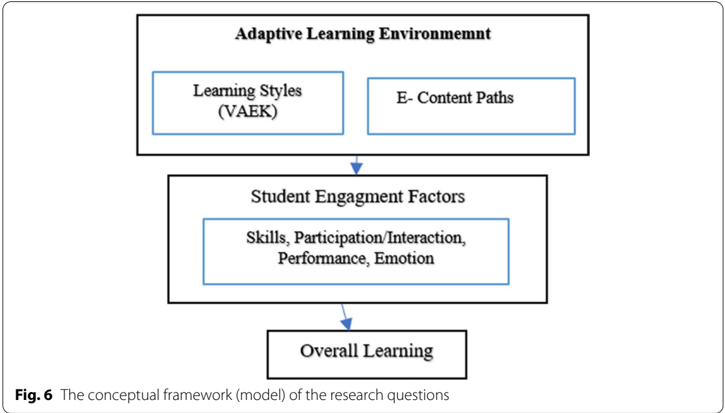
Abstract Adaptive e-learning is viewed as stimulation to support learning and improve student engagement, so designing appropriate adaptive e-learning environments contributes to personalizing instruction to reinforce learning outcomes. The purpose of this paper is to design an adaptive e-learning environment based on students' learning styles and study the impact of the adaptive e-learning environment on students’ engagement. This research attempts as well to outline and compare the proposed adaptive e-learning environment with a conventional e-learning approach. The paper is based on mixed research methods that were used to study the impact as follows: Development method is used in designing the adaptive e-learning environment, a quasi-experimental research design for conducting the research experiment. The student engagement scale is used to measure the following affective and behavioral factors of engagement (skills, participation/interaction, performance, emotional). The results revealed that the experimental group is statistically significantly higher than those in the control group. These experimental results imply the potential of an adaptive e-learning environment to engage students towards learning. Several practical recommendations forward from this paper: how to design a base for adaptive e-learning based on the learning styles and their implementation; how to increase the impact of adaptive e-learning in education; how to raise cost efficiency of education. The proposed adaptive e-learning approach and the results can help e-learning institutes in designing and developing more customized and adaptive e-learning environments to reinforce student engagement.
Overview
CoChat Summary
TL;DR
This paper designed an adaptive e-learning environment based on VARK learning styles and tested its impact on first-year university students’ engagement in a learning skills course. The experimental group showed significantly higher post-test engagement than the conventional e-learning control group across skills, participation/interaction, performance, and emotional factors.
Key findings
- Pre-test equivalence: no significant differences between experimental and control groups on engagement overall or on any factor (t values 0.464, 0.514, 0.321, 0.397, 0.632; p > 0.05).
- Post-test: the experimental group scored significantly higher than the control group on all engagement factors: skills 34.81 vs 23.34 (t = 4.086, p = 0.001); participation/interaction 21.05 vs 13.26 (t = 2.210, p = 0.002); performance 25.86 vs 14.60 (t = 2.071, p = 0.003); emotional 24.93 vs 13.07 (t = 2.909, p = 0.001); average score 38.87 vs 26.13 (t = 4.738, p = 0.003).
- Effect size: Cohen’s d = 0.826 and effect-size r = 0.401; the paper describes this as a large effect, with the treated group’s mean at the 79th percentile of the control group.
- Instrument reliability: VARK questionnaire Cronbach’s alpha = 0.83; engagement scale full alpha = 0.81, with subscale alphas from 0.80 to 0.87.
Methods
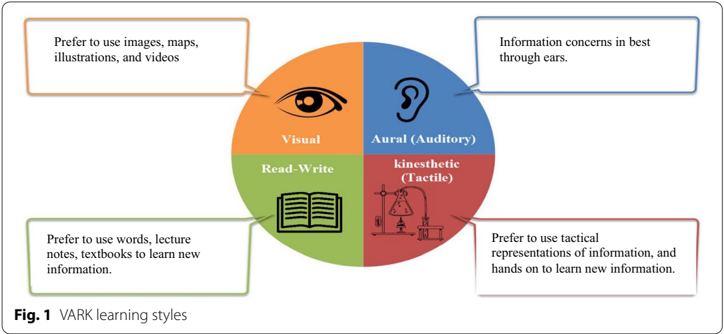
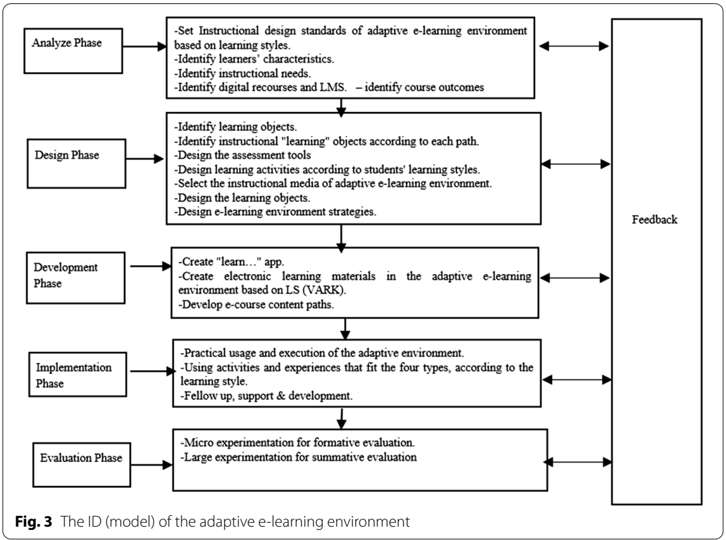
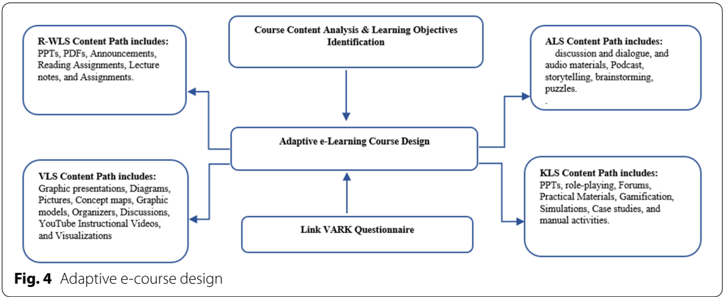
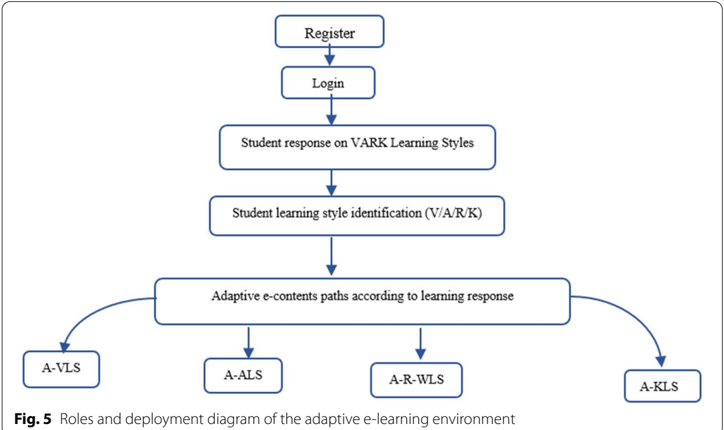
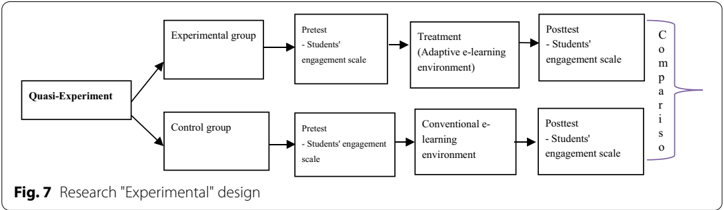
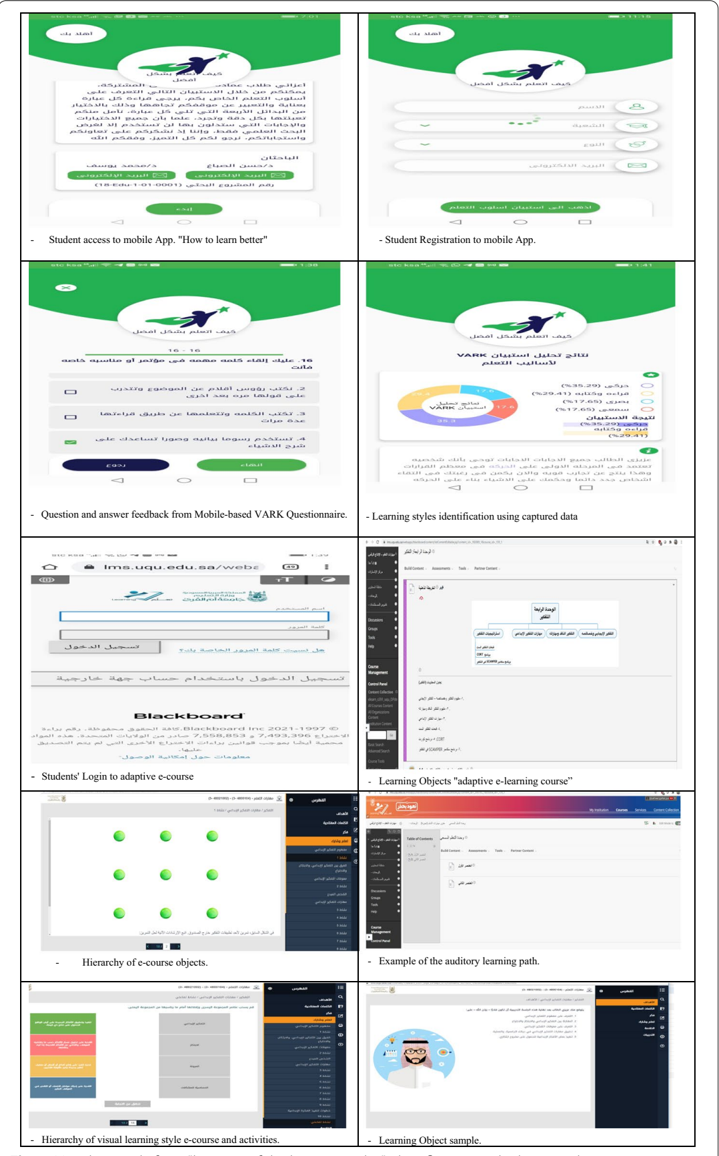
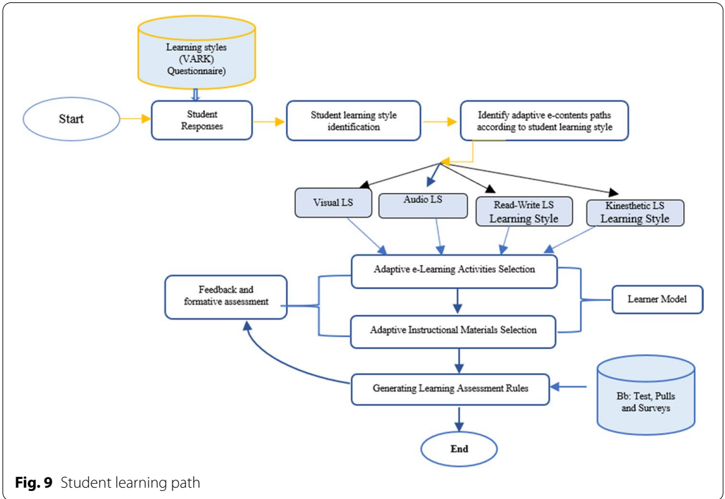
- Quasi-experimental pretest-posttest design; the adaptive e-learning environment was developed using the ADDIE instructional design model, with content paths based on VARK learning styles (visual, auditory, read/write, kinesthetic).
- Participants were 118 first-year “learning skills” students aged 17–18 at Umm Al-Qura University in the 2019/2020 academic year: control group N = 58 (31 males, 27 females) and experimental group N = 60 (36 males, 24 females), taught by the same instructors.
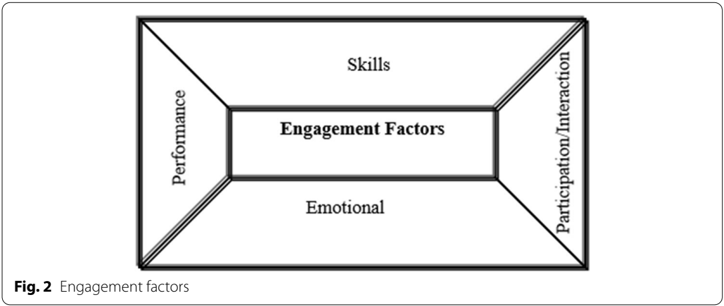
- Instruments and analysis: electronic VARK questionnaire (16 MCQ items); adapted Dixson student engagement scale (27 items, 5-point, four factors: skills, participation/interaction, performance, emotional), piloted on 20 students; independent-sample t-tests and Cohen’s d were used.
Limitations
- Stated in the paper: the study is restricted to one aspect of content adaptation—learning materials adapted based on learning styles—and notes that other considerations include content-dependent adaptation. It also states that empirical findings on adapting instruction to learning style are mixed and that Murray and Pérez found adaptive learning environments have a limited impact on learning outcome.
- Evident from the text: the study is limited to a single institution and a single “learning skills” course with first-year students, uses a short pretest-posttest window, and measures engagement through a self-report scale, which limits broader generalization and long-term conclusions.
Model-written summary. Check it against the paper before relying on it.
Integrity signals
Registry
Cites
Statistics
Figures
Verification
Claims the paper makes
5 Valid · 2 Not valid · 24 Not checked · 46 Own results and interpretations
The cited sources that could be checked couldn’t confirm or dispute this claim.
In the paper
“According to the findings of (Akbulut & Cardak, 2012;Alshammari & Qtaish, 2019;Alzain et al., 2018a, b;Shi et al., 2013;Truong, 2016), adaptation based on a combination of learning style, and information level yields significantly better learning gains.”
§ Adaptive e-learning environment based on learning styles and its impact on development students' engagement > Adaptive e-learning environments based on learning styles
What the sources say
- Not checked — no full text of the sourcecites Akbulut & Cardak, 2012 matched to “Adaptive educational hypermedia accommodating learning styles: A content analysis of publications from 2000 to 2011” (2012) source
- Not matchedcites Shi et al., 2013
An author–year citation the paper’s reference list doesn’t settle. We don’t search these by name.
- Could not verifycites Truong, 2016 matched to “Integrating learning styles and adaptive e-learning system: Current developments, problems and opportunities” (2016) sourceExperimental — accuracy not yet measured
Our copy of Truong (2016) is a systematic review of learning-styles integration into adaptive e-learning systems; its retrievable passages cover the Introduction (learning-styles theories, drawbacks of questionnaire measurement), Section 2 Search methods (51 papers, 2004-2014) and Section 3.1 (the integration-process classification). None of them mentions adapting on a combination of learning style AND information level, nor reports significantly better learning gains; the nearest statement is the generic Introduction claim of 'several positive results in both learning styles detection... and applications'. Searched: 'information level', 'learning gains / achievement test scores / statistically significant difference', 'combining learning styles with other characteristics such as prior knowledge', 'evaluation of adaptive system effect on student performance' — no supporting or contrary passage returned. (LLM, conf=0.68)
plainstates a cause- Asserted: passes — The authors put it forward as true.
- Checkable: passes — It can be checked against evidence.
- Load-bearing: passes — The paper’s conclusions depend on it.
- Based: passes — The paper gives a reason why it holds.
Every source the paper cites for this claim was checked and supports it.
In the paper
“There is also evidence that an adaptive environment positively impacts other aspects of quality such as student engagement (Murray & Pérez, 2015).”
§ Adaptive e-learning environment based on learning styles and its impact on development students' engagement > Discussions and limitations
What the sources say
- Supportedcites Murray & Pérez, 2015 matched to “Informing and Performing: A Study Comparing Adaptive Learning to Traditional Learning” (2015) source
The Conclusion states that there is evidence adaptive systems positively affect aspects of quality including student engagement. The claim closely paraphrases that statement; the paper cites Jarrett (2013) and Zimmer (2014) for the evidence. (LLM, conf=0.94)
plainstates a cause- Asserted: passes — The authors put it forward as true.
- Checkable: passes — It can be checked against evidence.
- Load-bearing: unclear — It is unclear whether the paper’s conclusions depend on it.
- Based: passes — The paper gives a reason why it holds.
- Supported
Every source the paper cites for this claim was checked and supports it.
In the paper
“(Chun-Hui et al., 2017) demonstrated that adaptive eLearning technologies can be beneficial to students' learning and development.”
§ Adaptive e-learning environment based on learning styles and its impact on development students' engagement > Discussions and limitations
What the sources say
- Supportedcites Chun-Hui et al., 2017 matched to “An Adaptive e-Learning System for Enhancing Learning Performance: Based on Dynamic Scaffolding Theory” (2017) source
The Abstract (p. 1) states that 'the developed adaptive e-learning system can effectively support students with personalized learning materials and successfully helps students acquired knowledge and develop cognitive abilities,' which is exactly the benefit to students' learning and development the citing sentence attributes. The hedged wording ('can be beneficial') matches the source's own claim, though the underlying evidence is a single experimental study of 60 undergraduates in an Excel spreadsheet course, with the authors flagging limited generalizability — so the generalization to adaptive e-learning technologies broadly rests on that narrow base. No contrary statement was found in our copy. (LLM, conf=0.85)
boostedstates a cause- Asserted: passes — The authors put it forward as true.
- Checkable: passes — It can be checked against evidence.
- Load-bearing: passes — The paper’s conclusions depend on it.
- Based: passes — The paper gives a reason why it holds.
- Supported
A result the paper reports from its own data — it cites no other source for it, so there is none to check. The quote shows it is in the paper.
In the paper
“Table 4. indicates that students in the experimental group had significantly higher mean of engagement post-test (engagement factors items) scores than students in the control group (p < 0.05).”
§ Adaptive e-learning environment based on learning styles and its impact on development students' engagement > Findings
hedgedstates a cause- Asserted: passes — The authors put it forward as true.
- Checkable: passes — It can be checked against evidence.
- Load-bearing: passes — The paper’s conclusions depend on it.
- Based: passes — The paper gives a reason why it holds.
A result the paper reports from its own data — it cites no other source for it, so there is none to check. The quote shows it is in the paper.
In the paper
“The results revealed that the experimental group is statistically significantly higher than those in the control group.”
§ Adaptive e-learning environment based on learning styles and its impact on development students' engagement > Abstract
plainstates a cause- Asserted: passes — The authors put it forward as true.
- Checkable: passes — It can be checked against evidence.
- Load-bearing: passes — The paper’s conclusions depend on it.
- Based: passes — The paper gives a reason why it holds.
15 more claims
Create a free account to see all 77 claims and to verify the 18 references still open.
- Probably not a substantial claim. 26
- It may state two separate claims as one. 39
- The quote only partly states this claim. 6
Claims other papers make about this one
Each is checked against this paper’s own text: does it say what the citing paper says it does?
In the citing paper
“Additionally, compliance with theoretical learning can be enhanced among trainees with customized sessions, supporting individual learning styles accessible anywhere and anytime17 compared with conventional lectures.”
From Neurosurgery resident training using blended learning concepts: Course development and participant evaluation (2022) · cites this paper as [17]
In the citing paper
“These systems enable trainees to individually study theoretical content based on their respective preferences, needs, and prior knowledge.17”
From Neurosurgery resident training using blended learning concepts: Course development and participant evaluation (2022) · cites this paper as [17]
Self-check
Percentages, sums and reported differences re-computed from the paper’s own numbers.
Each contradiction between two passages listed here was confirmed by an independent check.
Rated major: it would touch a result — a value a result rests on, reported and recomputed p-values on opposite sides of the significance level, two passages that conflict with no sign which is right, or a cited work retracted before this paper was published.
In the paper
“| Whole engagement scale | Experiment | 60 | 26.76 | 1.84 | 0.632 |”
§ Adaptive e-learning environment based on learning styles and its impact on development students' engagement > Research implication
Reported 26.76 · recomputed 58.57
Rated minor: it would not touch a result — a value no result rests on, a p-value that stays on the same side of the significance level, or a conflict that is clerical, resolved elsewhere in the paper, or outside its own findings.
In the paper
§ Adaptive e-learning environment based on learning styles and its impact on development students' engagement > Research implication
“Table: 4 Table 4 Descriptive data and independent sample t-tests of the pre-test results”
§ Adaptive e-learning environment based on learning styles and its impact on development students' engagement > Findings
“Table 4. indicates that students in the experimental group had significantly higher mean of engagement post-test (engagement factors items) scores than students in the control group (p < 0.05).”
Rated minor: it would not touch a result — a value no result rests on, a p-value that stays on the same side of the significance level, or a conflict that is clerical, resolved elsewhere in the paper, or outside its own findings.
In the paper
§ Adaptive e-learning environment based on learning styles and its impact on development students' engagement > Research participants
“All participants were chosen in the academic year 2109-2020 at the first term which was taught by the same instructors.”
§ Adaptive e-learning environment based on learning styles and its impact on development students' engagement > Learner content path in adaptive e-learning environment
“The present study covered the 1st semester during the 2019/2020 academic year.”
Citations
Cites
School Engagement: Potential of the Concept, State of the Evidence
Fredricks, J. A., Blumenfeld, P. C., & Paris, A. H. (2004) · Review of Educational Research · doi:10.3102/00346543074001059 · Cited by 12,581 · cited 1×
“Previous research has emphasized that student participation is a key factor in overcoming academic problems such as poor academic performance, isolation, and high dropout rates (Fredricks et al., 2004).”
BackgroundCohen, J. (1992) · Current Directions in Psychological Science · doi:10.1111/1467-8721.ep10768783 · Cited by 5,870
Research in Education: Evidence Based Inquiry
McMillan, J. H., & Schumacher, S. (2005) · Medical Entomology and Zoology · Cited by 4,006
Pashler, H., McDaniel, M., Rohrer, D., & Bjork, R. (2008) · Psychological Science in the Public Interest · doi:10.1111/j.1539-6053.2009.01038.x · Cited by 2,147
How video production affects student engagement: an empirical study of MOOC videos
Guo, P. J., Kim, J., & Rubin, R. (2014) · Proceedings of the first ACM conference on Learning @ scale conference · doi:10.1145/2556325.2566239 · Cited by 1,850 · cited 1×
“Guo et al. (2014) checked the participation of students when they watched videos.”
BackgroundHinton, P., McMurray, I., & Brownlow, C. (2014) · Routledge eBooks · doi:10.4324/9781315797298 · Cited by 1,022
Handbook of Individual Differences, Learning, and Instruction
Jonassen, D. H., & Grabowski, B. L. (2012) · Routledge eBooks · doi:10.4324/9780203052860 · Cited by 934
Engaging online learners: The impact of Web-based learning technology on college student engagement
Chen, P.-S. D., Lambert, A. D., & Guidry, K. R. (2010) · Computers & Education · doi:10.1016/j.compedu.2009.11.008 · Cited by 785 · cited 1×
“E-learning produces constructive learning outcomes, as it allows students to actively participate in learning at anytime and any-place (Chen et al., 2010; Lee et al., 2019).”
BackgroundStudent Engagement Techniques: A Handbook for College Faculty
Barkley, E. F. (2009) · Cited by 765
Measuring Student Engagement in the Online Course: The Online Student Engagement Scale (OSE)
Dixson, M. D. (2015) · Online Learning · doi:10.24059/olj.v19i4.561 · Cited by 707 · cited 5×
“Hence, previous research has moved beyond comparing online and face-to-face classes to investigating ways to improve online learning (Dixson, 2015; Gaytan & McEwen, 2007; Lévy & Wakabayashi, 2008; Mutahi et al., 2017).”
BackgroundInfluential
Research works printed but not linked: 8
- 4. Ali, N., Eassa, F., & Hamed, E. (2019). Personalized Learning Style for Adaptive E-Learning System, International Journal of Advanced Trends in Computer Science and Engineering. 223-230. Retrieved June 26, 2020 from http:// www. warse. org/ IJATC SE/ static/ pdf/ file/ ijatc se4181. 12019. pdf.
- 13. Behaz, A., & Djoudi, M. (2012). Adaptation of learning resources based on the MBTI theory of psychological types. IJCSI International Journal of Computer Science, 9(2), 135-141.
- 18. Cletus, D., & Eneluwe, D. (2020). The impact of learning style on student performance: mediate by personality. Interna- tional Journal of Education, Learning and Training. https:// doi. org/ 10. 24924/ ijelt/ 2019. 11/ v4. iss2/ 22. 47Des mond. · doi:10.24924/ijelt/2019.11/v4.iss2/22.47desmond
- 37. Jaleel, S., & Thomas, A. (2019). Learning styles theories and implications for teaching learning. Horizon Research Publishing. 978-1-943484-25-6.
- 45. Lévy, P. & Wakabayashi, N. (2008). User's appreciation of engagement in service design: The case of food service design. Proceedings of International Service Innovation Design Conference 2008 -ISIDC08. Busan, Korea. Retrieved October 28, 2019 from https:// www. resea rchga te. net/ publi cation/ 23058 4075.
- 46. Liang, J. S. (2012). The effects of learning styles and perceptions on application of interactive learning guides for web- based. Proceedings of Australasian Association for Engineering Education Conference AAEE. Melbourne, Australia. Retrieved October 22, 2019 from https:// aaee. net. au/ wpcon tent/ uploa ds/ 2018/ 10/ AAEE2 012-Liang.-Learn ing_ styles_ and_ perce ptions_ effec ts_ on_ inter active_ learn ing_ guide_ appli cation. pdf.
- 65. Roy, S., & Roy, D. (2011). Adaptive e-learning system: a review. International Journal of Computer Trends and Technology (IJCTT), 1(1), 78-81. ISSN:2231-2803.
- 75. Velázquez, A., & Assar, S. (2009). Student learning styles adaptation method based on teaching strategies and electronic media. Educational Technology & SocieTy., 12, 15-29.
Cited by
Items 301–400 of 564
Traditional learning and audio-visual-based e-learning post covid-19 in university students
Salazar-Palomino, S., Huamán-Romaní, Y.-L., Szczcpansky-Grobas, D., Aparco, R. H., Moreno-Huamán, M., Alarcón-Sucasaca, A., & Alburqueque, I. L. V. (2023) · VISUAL REVIEW International Visual Culture Review / Revista Internacional de Cultura Visual · doi:10.37467/revvisual.v15.5133 · Cited by 1
Aisyah, N. S., Degeng, I. N., Sumarmi, S., & Toenlioe, T. (2024) · AL-TANZIM JURNAL MANAJEMEN PENDIDIKAN ISLAM · doi:10.33650/al-tanzim.v8i2.8168 · Cited by 1
Kılıçkaya, F. (2025) · Advances in computational intelligence and robotics book series · doi:10.4018/979-8-3373-5092-9.ch009 · Cited by 1
Potential Benefits of Enhance Motivation on English Language Learners’ Performance
Asiri, M. S. F. (2023) · Arab World English Journal · doi:10.24093/awej/th.294 · Cited by 2
WITHDRAWN: Data-driven Adaptive Course Framework - Case study: Impact on Success and Engagement
Ademi, N., & Loshkovska, S. (2025) · Computers and Education Open · doi:10.1016/j.caeo.2025.100273 · Cited by 1
RetractedAdaptative Learning in a Calculus Course for Students of Engineer
Benitez-Medina, R., Gonzalez, C. A. M., & Juárez-Ordóñez, S. (2025) · International Conference of the Portuguese Society for Engineering Education (CISPEE) · doi:10.1109/cispee64787.2025.11124031 · Cited by 1
Policy Frameworks for Personalized STEAM Education: Ensuring Sustainable Learning
Asrifan, A., Syamsuardi, S., Saripuddin, D., Rossydi, A., Sahabuddin, R., & Sulaeman, S. (2025) · IGI Global eBooks · doi:10.4018/979-8-3693-7718-5.ch004 · Cited by 2
Hoppmann, N. A., Manassa, E. H., Kleining, L., & Ehlers, J. P. (2025) · BMC Medical Education · doi:10.1186/s12909-025-07213-8 · Cited by 10
Empowering Special Needs Children: Community Outreach for Inclusive Mathematics Education
Faradiba, S. S., Sunismi, Ilmi, Y. I. N., & Fuat, F. (2024) · International Journal of Community Service Learning · doi:10.23887/ijcsl.v8i3.80816 · Cited by 4
Ni'matussyahara, D., Sugiyanto, S., & Sarwono, S. (2023) · Jurnal kependidikan · doi:10.33394/jk.v9i4.9198 · Cited by 9
Astuti, L. N. W., Sodiq, A., & Yanti, Y. (2025) · ETDC Indonesian Journal of Research and Educational Review · doi:10.51574/ijrer.v4i3.3182 · Cited by 2
ADAPTIVE LEARNING PLATFORMS FOR PERFORMING ARTS
Shinde, J. M., Chaudhary, S., Bhilare, A., Jarad, R., Anitha, K., & Satav, S. S. (2026) · ShodhKosh Journal of Visual and Performing Arts · doi:10.29121/shodhkosh.v7.i1s.2026.7081 · Cited by 2
Nguyen, T. T. H., & Hoang, T. T. H. (2022) · VNU Journal of Foreign Studies · doi:10.63023/2525-2445/jfs.ulis.5082 · Cited by 4
YouTube como herramienta de aprendizaje en docentes y alumnos de Educación Superior
Hernández, P. R. (2023) · Revista de educación y derecho · doi:10.1344/reyd2023.28.40414 · Cited by 3
Aguda, E., & Delute, R. C. S. (2025) · Frontiers in Education · doi:10.3389/feduc.2025.1682242 · Cited by 6
Cong, J. (2025) · Lecture Notes in Education Psychology and Public Media · doi:10.54254/2753-7048/2025.22633 · Cited by 4
Elsamanoudy, A., Alhazimi, A. M., Hassanien, M. A., Almarabheh, A. J., Al-Aqidi, S., Alwalidi, R., & Alrefaie, Z. A. (2026) · BMC Medical Education · doi:10.1186/s12909-026-09088-9 · Cited by 4
Developing Ethno-STEM-based android in topic of dayak musical instruments
Lestari, N., Rahmawati, P., Setiawan, H., & Parno (2026) · Multidisciplinary Science Journal · doi:10.31893/multiscience.2026563 · Cited by 1
Hardey, M., & Pimblett, C. (2026) · Education Innovations Systems and Future Learning · doi:10.1108/eisfl-12-2025-0065 · Cited by 4
Hammami, S., & Alomair, Y. (2026) · PeerJ Computer Science · doi:10.7717/peerj-cs.3508 · Cited by 1
Adaptive Microlearning Using Mixed Reality Technology
(2024) · doi:10.1007/978-981-97-3883-0_5 · Cited by 1
Ariesta, F. W. (2025) · Jurnal Ilmiah Sekolah Dasar · doi:10.23887/jisd.v9i2.94754 · Cited by 10
Collaborative E-Learning Model Development for Increase Quality Learning in Vocational School
Kurnaedi, D., & Widyarto, S. (2024) · bit-Tech · doi:10.32877/bt.v7i2.1846 · Cited by 9
Simanjuntak, L. N., Yantoro, Y., Radmika, H. A., & Basyir, B. (2024) · AlphaMath Journal of Mathematics Education · doi:10.30595/alphamath.v10i1.21697 · Cited by 4
Zhang, J., Li, Z., Wu, Y., & Huang, Y. (2026) · Lecture notes in computer science · doi:10.1007/978-981-95-8420-8_33 · Cited by 1
Peñaranda, C., & Atienzar, E. A. (2023) · doi:10.7176/jep/14-15-08
Essa, S. A. M., Çelik, T., & Human-Hendricks, N. E. (2026) · IEEE Access · doi:10.1109/access.2026.3736231
Li, W. (2026) · International Conference on Machine Intelligence and Digital Applications (MIDA) · doi:10.1145/3801438.3802317
Wu, S., Phopli, W., & Zhang, T. (2026) · Acta Psychologica · doi:10.1016/j.actpsy.2026.107527 · Cited by 1
Alice and the Risky Wonderland: Pedagogical Agents in Dual Roles
Mavrogianni, A., & Vasilaki, E. (2025) · Advances in social networking and online communities book series · doi:10.4018/979-8-3693-4191-9.ch014
Exploring Emerging Trends in Adaptive Learning Environments—A Bibliometrics Study Using CiteSpace
Ye, B., & Yahaya, W. A. J. W. (2024) · Lecture notes in educational technology · doi:10.1007/978-981-97-8752-4_8
Utilizing Machine Learning to Increase Online Learning Instructors' Efficiency
Das, S., & Acharjya, P. P. (2024) · Advances in systems analysis, software engineering, and high performance computing book series · doi:10.4018/979-8-3693-3033-3.ch003
Juliawan, K., Christiawan, P. I., & Citra, I. P. A. (2025) · Indonesian Journal of Instruction · doi:10.23887/iji.v6i2.101634
Perspectives on teaching learning philosophy
Farhana, S. (2025) · i-manager’s Journal on Educational Psychology · doi:10.26634/jpsy.19.1.21280
Method for Adaptive Learning Path Recommendations in Dynamic Learning EnvironmentsPreprint
Fan, Y., Zhuang, Z., Chen, J., & Tong, M. (2024) · SSRN Electronic Journal · doi:10.2139/ssrn.4715283
Uribe-Hernández, K., Buitrago-Mayorquin, L. A., Gil-Amaya, D. P., & Duque-Ortiz, C. (2026) · Investigación en Educación Médica · doi:10.22201/fm.20075057e.2026.58.25731
Smart Learning Environment: An Access to Quality University Education in Nigeria
Ogunbodede, K. F., & Achugbue, E. I. (2023) · Asian Journal of Information Science and Technology · doi:10.51983/ajist-2023.13.2.3649 · Cited by 2
Drahunova, V., Mykhatska, A., Бурлука, О., Gevorkian, N., & Babichev, A. (2025) · RIVISTA DI STUDI SULLA SOSTENIBILITA · doi:10.3280/riss2025oa19773
Dabare, C., Herath, H. M. S. S., & Chandrasiri, S. (2026) · International Research Conference on Smart Computing and Systems Engineering (SCSE) · doi:10.1109/scse70081.2026.11499939
Zhang, J., Zhang, J., Su, X., & Lan, M. (2026) · Education and Information Technologies · doi:10.1007/s10639-026-13907-3 · Cited by 1
Francis, R. S., Anantharajah, S., Mokhtar, T. M. T., Singh, A., & Das, K. D. S. R. (2025) · Emerald Group Publishing Limited eBooks · doi:10.1108/978-1-83662-106-520251011
Peng, S., & Li, X. (2026) · Data & Metadata · doi:10.56294/dm2026782
Salman, A., Adam, S. M. A. A., Yavarian, R., & Bousseliou, N. (2026) · Journal of Language Literature and Educational Research · doi:10.37251/jolle.v2i2.2758
The Effectiveness of Blended Learning on STEM Achievement of Secondary School Students
Almarzuqi, A. A., & Mat, H. B. (2024) · International Journal of Academic Research in Business and Social Sciences · doi:10.6007/ijarbss/v14-i1/20140 · Cited by 13
Lara, M. S., Sreela, B., Sindhu, K., Devi, V. V., Vuyyuru, V. A., & Prema, S. (2024) · International Conference on Innovative Sustainable Computational Technologies (CISCT) · doi:10.1109/cisct62494.2024.11134240
Lotulung, M. S. D., Ole, A. A., & Tumbelaka, E. (2025) · Journal Evaluation in Education (JEE) · doi:10.37251/jee.v6i3.1810 · Cited by 1
Altınsoy, E., & Boyraz, S. (2025) · Frontiers in Psychology · doi:10.3389/fpsyg.2025.1602117 · Cited by 6
Facilitating Gamification for Teachers: An Ontological Approach
Gomaa, Y., Lahoud, C., Abel, M., & Moussa, S. M. (2025) · International Conference on Computer Supported Cooperative Work in Design (CSCWD) · doi:10.1109/cscwd64889.2025.11033576
Communication Technologies and Learning Environments
Προκοπιάδου, Γ. (2025) · Springer eBooks · doi:10.1007/978-3-032-00755-1_2
Advancing Educational Content Classification via Reinforcement Learning-Integrated Bloom’s Taxonomy
Shaik, T., Tao, X., Li, L., Dann, C. E., Sun, Y., & Sun, Y. G. (2023) · International Conference on Digital Society and Intelligent Systems (DSInS) · doi:10.1109/dsins60115.2023.10455310 · Cited by 1
Pang, S., Luo, K., Zhang, J., & Yang, Y. (2026) · International Conference on Computer Science and Technologies in Education (CSTE) · doi:10.1109/cste69562.2026.11649835
Mulla, J., Rathi, S., Khedkar, V. N., Nichat, S., Mule, S., & Neware, S. (2025) · Lecture notes in networks and systems · doi:10.1007/978-981-96-5607-3_12
Nihaya, M., Nurhilaliyah, N., Nihaya, H., & Nurhidayat, N. (2026) · Jurnal Riset dan Inovasi Pembelajaran · doi:10.51574/jrip.v6i2.5403
Nihaya, M., Nurhilaliyah, N., Nihaya, H., & Nurhidayat, N. (2026) · ETDC Indonesian Journal of Research and Educational Review · doi:10.51574/ijrer.v5i4.4959
EmoVision: Real-Time Engagement Detection in MOOCs
Mrayhi, S., Khribi, M. K., & Jemni, M. (2026) · Lecture notes in educational technology · doi:10.1007/978-981-96-7587-6_8
The Impact and Potential of Large Language Models in Personalized Learning Environments
Aderghal, Y., Ghazi, A. E., & Hafidi, H. (2026) · Lecture notes in networks and systems · doi:10.1007/978-3-032-23844-3_30
Adaptive E-Learning System in Corporate using SALM
Tjahyadi, R., Kurniawan, Y., & Cassandra, C. (2023) · 2023 6th International Seminar on Research of Information Technology and Intelligent Systems (ISRITI) · doi:10.1109/isriti60336.2023.10467775
Lee, N. A. A., Halim, M. A. A., Zulkifli, F. A., & Yulian, R. (2023) · International Journal of Academic Research in Progressive Education and Development · doi:10.6007/ijarped/v12-i4/19551
Shatri, K., Bunjaku, F., & Buza, K. A. (2026) · International Journal of Engineering Pedagogy (iJEP) · doi:10.3991/ijep.v16i2.59397 · Cited by 2
An Introduction to Policies and Issues in Namibian Higher Education Institutions
Simataa, G. M., Goosen, L., & Jakovljević, M. (2026) · IGI Global eBooks · doi:10.4018/979-8-3373-4317-4.ch004
Harnessing Technology: The Future of Online Learning Communities
Dhakal, R., Heske, K., & Davis, B. (2025) · IGI Global eBooks · doi:10.4018/979-8-3373-6960-0.ch011
Elementary Teachers’ Experiences with Challenges in Teaching Science
Garcia, H. P., Bacang, A. G., & Calumpang, E. (2025) · Journal of interdisciplinary perspectives · doi:10.69569/jip.2025.247 · Cited by 2
Clarke, P., Fernandez, C., Perez, R., Kornreich‐Leshem, H., Sotomayor, J., & Cickovski, T. (2026) · ASEE Annual Conference & Exposition · doi:10.18260/1-2--58719
Valachis, I., & Tsilogiannis, G. (2025) · IGI Global eBooks · doi:10.4018/979-8-3373-1962-9.ch003
Developing a Gamified Assessment Framework to Enhance Student Engagement
Samsudin, N., Zain, N. H. M., & Diah, N. M. (2026) · International Conference on Cognitive Systems and Computer Interaction (ICoSCI) · doi:10.1109/icosci66700.2026.11447602
Cordero, J., & Morales, G. R. (2025) · Communications in computer and information science · doi:10.1007/978-3-031-98290-3_16 · Cited by 3
Kharakh, Y. N., Yuzhakov, A. A., Байдаров, А. А., Асташина, Н. Б., & Arutyunov, S. D. (2024) · Clinical Dentistry (Russia) · doi:10.37988/1811-153x_2024_4_61 · Cited by 1
Aqil, D. I., Abbas, H., Astra, I. M., & Vhalery, R. (2026) · Asian Journal of Interdisciplinary Research · doi:10.54392/ajir2613
Innovative Ausbildungstechniken für Wirbelsäulenchirurg*innen
Pöser, P., Vajkoczy, P., & Onken, J. (2025) · Die Wirbelsäule · doi:10.1055/a-2290-0536
DESIGNING ENRICHMENT PROGRAM IN SCIENCE UTILIZING BLENDED LEARNING MODELSPreprint
Postrado, F., & Aliazas, J. V. (2024) · SSRN Electronic Journal · doi:10.2139/ssrn.4888999 · Cited by 2
Cultivating curriculum resilience in higher educational institutions: a novel decision tool
Waldeck, R., Gars, J. G. L., Winkens, A.-K., Lemke, C., & Kanyangale, M. (2026) · Studies in Higher Education · doi:10.1080/03075079.2026.2719848
CyberSense AI: Enhancing Cybersecurity Awareness Through Adaptive, Behavior-Driven Education
Adamu, Y. A., & Chaudhry, S. A. (2026) · Lecture notes in computer science · doi:10.1007/978-3-032-19981-2_4 · Cited by 1
Integrating TPACK in online pedagogies: effects on science postgraduate students’ competence
Mavenge, L., Ncanywa, T., Dyantyi, N., & Asaleye, A. J. (2026) · Frontiers in Education · doi:10.3389/feduc.2026.1751227 · Cited by 3
Iqbal, S., Kausar, S., Malik, H., & Masaud, P. (2023) · Qlantic journal of social sciences. · doi:10.55737/qjss.737076082 · Cited by 3
Desty, D. S. N., Putra, F. G., & Hidayah, N. (2025) · Journal of Literacy Education · doi:10.64780/jole.v1i2.73
Metadata
- Authors
- El-Sabagh, H. A.
- Affiliations
- Mansoura University (EG)
- Corresponding author
- El-Sabagh, Hassan A.
- ORCID
- El-Sabagh, Hassan A.
- Venue
- International Journal of Educational Technology in Higher Education
- Published
- 2021-10-01
- Volume
- 18
- Issue
- 1
- ISSN
- 2365-9440 (ISSN-L)
- OpenAlex
- W3203800336
- Cited by
- 566
- References
- 87
- Citations by year
- 2026: 108 · 2025: 190 · 2024: 143 · 2023: 95 · 2022: 28 · 2021: 2
- FWCI
- 23.69
- Type
- journal article
- Language
- en
- Open access
- diamond
- doi.org
- Licence
- cc-by
- creativecommons.org/licenses/by/4.0 (tdm)
- creativecommons.org/licenses/by/4.0 (vor)
- Locations
- International Journal of Educational Technology in Higher Education (publishedVersion, cc-by)
- DOAJ (DOAJ: Directory of Open Access Journals) (submittedVersion, cc-by-sa)
- Funders
- Umm Al-Qura University (18-EDU-1-01-0001)
- Topics
- Physical Sciences › Computer Science › Artificial Intelligence › Intelligent Tutoring Systems and Adaptive Learning
- Social Sciences › Psychology › Developmental and Educational Psychology › Learning Styles and Cognitive Differences
- Social Sciences › Education › Online and Blended Learning
- Keywords
- adaptive e-learning, learning styles, student engagement, personalized instruction, emotional engagement, behavioral engagement, e-learning environment design
About these checks
Registry, retraction, Cites and statistics results are computed, not judged, with one exception: a printed reference that no index lists is read once by a model before it counts as a citation error. Claims are extracted by a model and kept only when their quote appears verbatim in the text; each cited source is then checked, with a model’s help, for whether it says what the claim relies on. Those verdicts can be wrong — read the claim’s quote and the cited source before relying on one.
The claim verdicts this report counts are experimental: their accuracy is not yet measured.
A language model drew the claims from the paper on 2026-10-10, under version 3 of the claim definition (model deepseek-v4.1-flash, prompt extract-v3).
A second model labelled each claim on 2026-10-10 (model jev-1.13-20260917, definition revision gold-guideline-v0.2).
Cited sources are checked with a language model’s help (qwen3.8-omni-flash and gpt-6-sol).
Statistics and arithmetic are recomputed, not judged.
Confidence bands are shown only for fields calibrated on our annotated test set. None is calibrated yet, so no band is shown.
What counts as a claim ›How we measure confidence ›How we check this ›
Are you an author, or do you see a problem with this page? Request a review
Data sources
Bibliographic data: Semantic Scholar, OpenAlex, Crossref.
Contains information from the Semantic Scholar Academic Graph Datasets, made available under the ODC Attribution License (ODC-BY 1.0).
Semantic Scholar’s data is described in: Kinney, R., et al. (2023). The Semantic Scholar Open Data Platform. arXiv:2301.10140.
