

Prompt engineering in higher education: a systematic review to help inform curricula
Open accessThe DOI matches its Crossref record; 51 of the 53 references it cites were found in a registry or an index, and 2 are not checked yet.
Abstract
This paper presents a systematic review of the role of prompt engineering during interactions with Generative Artificial Intelligence (GenAI) in Higher Education (HE) to discover potential methods of improving educational outcomes. Drawing on a comprehensive search of academic databases and relevant literature, key trends, including multiple framework designs, are presented and explored to review the role, relevance, and applicability of prompt engineering to purposefully improve GenAI-generated responses in higher education contexts. Multiple experiments using a variety of prompt engineering frameworks are compared, contrasted and discussed. Analysis reveals that well-designed prompts have the potential to transform interactions with GenAI in higher education teaching and learning. Further findings show it is important to develop and teach pragmatic skills in AI interaction, including meaningful prompt engineering, which is best managed through a well-designed framework for creating and evaluating GenAI applications that are aligned with pre-determined contextual educational goals. The paper outlines some of the key concepts and frameworks that educators should be aware of when incorporating GenAI and prompt engineering into their teaching practices, and when teaching students the necessary skills for successful GenAI interaction.
Overview
The claims and statistics of this paper haven’t been checked yet.
Free: it reads the open-access text and checks the first 5 claims that cite a source we can check. Create a free account to check every claim.
Integrity signals
Registry
Cites
Statistics
Figures
Verification
Claims the paper makes
The claims and statistics of this paper haven’t been checked yet.
Free: it reads the open-access text and checks the first 5 claims that cite a source we can check. Create a free account to check every claim.
Claims other papers make about this one
Each is checked against this paper’s own text: does it say what the citing paper says it does?
In the citing paper
“Although prompting has been widely studied in computer science (Debnath et al. 2025), research in non-expert settings remains limited (Dierickx et al. 2026;Lee and Palmer 2025;Zamfirescu-Pereira et al. 2023).”
From A Taxonomy of LLM-Supported Tasks for Critical AI Literacy in Journalism (2026) · cites this paper as Lee and Palmer 2025
In the citing paper
“In educational settings, task definition presupposes that users already possess some prerequisite knowledge relevant to the task in order to use the system meaningfully (Lee and Palmer 2025).”
From A Taxonomy of LLM-Supported Tasks for Critical AI Literacy in Journalism (2026) · cites this paper as Lee and Palmer 2025
In the citing paper
“In this light, prompting represents an emerging skill set that enables trainees to engage critically with GenAI systems (Lee and Palmer 2025;Walter 2024).”
From A Taxonomy of LLM-Supported Tasks for Critical AI Literacy in Journalism (2026) · cites this paper as Lee and Palmer 2025
Self-check
Percentages, sums and reported differences re-computed from the paper’s own numbers.
The self-check needs the paper’s full text.
Citations
Cites
Guidelines for performing Systematic Literature Reviews in Software Engineering
Kitchenham, B. A., & Charters, S. (n.d.) · Cited by 10,073
Control problems of grey systems
Ju-Long, D. (1982) · Systems & Control Letters · doi:10.1016/s0167-6911(82)80025-x · Cited by 4,487 · cited 4×
“Abdlushahed found by combining Grey Theory with prompt engineering techniques enhances decision makers’ abilities to make informed choices which consider case specific needs and conditions.”
InfluentialGuidance on Conducting a Systematic Literature Review
Xiao, Y., & Watson, M. (2019) · Journal of Planning Education and Research · doi:10.1177/0739456x17723971 · Cited by 3,467 · cited 1×
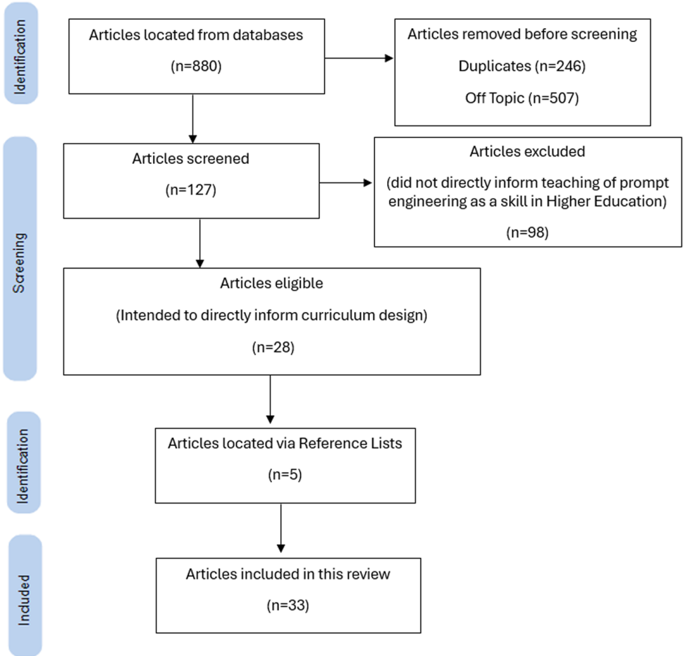
“The research was conducted using the protocols of a systematic literature review, as out-lined by Kitchenham and Charters (2007), Xiao and Watson (2019), and Tawfik et al. (2019), to determine the current state of discourse surrounding the topic of prompt engineering in HE.”
What if the devil is my guardian angel: ChatGPT as a case study of using chatbots in education
Tlili, A., Shehata, B., Adarkwah, M. A., Bozkurt, A., Hickey, D. T., Huang, R., & Agyemang, B. (2023) · Smart Learning Environments · doi:10.1186/s40561-023-00237-x · Cited by 2,003 · cited 2×
“Tlili et al. (2023), observed participants felt their chatbot became their “personal assistant” (p. 9) inducing emotional responses in the user including gratitude.”
Walter, Y. (2024) · International Journal of Educational Technology in Higher Education · doi:10.1186/s41239-024-00448-3 · Cited by 1,113 · cited 6×
“Developing skills in prompt engineering improves students’ abilities to transform AI from a “mere repository of information into an interactive tool that stimulates deeper learning and understanding” (Walter, 2024, p. 14).”
InfluentialA Prompt Pattern Catalog to Enhance Prompt Engineering with ChatGPT
White, J., Fu, Q., Hays, S., Sandborn, M., Olea, C., Gilbert, H., Elnashar, A., Spencer-Smith, J., & Schmidt, D. C. (2023) · arXiv · doi:10.48550/arxiv.2302.11382 · Cited by 838 · cited 1×
“(p. 142) This example shows the personification technique which was prevalent among the literature and found to be a common successful strategy (Fotaris et al., 2023; White et al., 2023).”
A step by step guide for conducting a systematic review and meta-analysis with simulation data
Tawfik, G. M., Dila, K. A. S., Mohamed, M. Y. F., Tam, D. N. H., Kien, N. D., Ahmed, A. M., & Huy, N. T. (2019) · Tropical Medicine and Health · doi:10.1186/s41182-019-0165-6 · Cited by 808 · cited 1×
“The research was conducted using the protocols of a systematic literature review, as out-lined by Kitchenham and Charters (2007), Xiao and Watson (2019), and Tawfik et al. (2019), to determine the current state of discourse surrounding the topic of prompt engineering in HE.”
Prompt Engineering as an Important Emerging Skill for Medical Professionals: Tutorial
Meskó, B. (2023) · Journal of Medical Internet Research · doi:10.2196/50638 · Cited by 709 · cited 1×
“In a discussion about prompt engineering as an important emerging skill, Meskó (2023) provides the following example: “What prompt could I use right now to get a better output from you in this thread/task?””
AI-generated feedback on writing: insights into efficacy and ENL student preference
Escalante, J., Pack, A., & Barrett, A. (2023) · International Journal of Educational Technology in Higher Education · doi:10.1186/s41239-023-00425-2 · Cited by 589 · cited 2×
“An emerging terminology among the literature was the concept of “shots” which was discussed in nine papers (Clavié et al., 2023; Escalante et al., 2023; Henrickson & Meroño-Peñuela, 2023; Heston & Kuhn, 2023; Korzynski et al., 2023; Schäffer & Lieder, 2023; Walter, 2024; Wang et al., 2021; Zheng et…”
ChatGPT Chemistry Assistant for Text Mining and the Prediction of MOF Synthesis
Zheng, Z., Zhang, O., Borgs, C., Chayes, J. T., & Yaghi, O. M. (2023) · Journal of the American Chemical Society · doi:10.1021/jacs.3c05819 · Cited by 536 · cited 3×
“For example, Zheng et al. (2023) used prompt engineering to guide ChatGPT in the automation of text mining of metal − organic framework synthesis conditions from diverse formats and styles of scientific literature.”
Research works printed but not linked: 1
- Hutson, J. (2024). Integrating art and AI: Evaluating the educational impact of AI tools in digital art history learning. Forum for Art Studies, 1(1), 393.
Cited by
Items 301–400 of 452
Prompt-as-Lesson: Authoring AI-Delivered Lessons for Fidelity and Observability
David, L. (2026) · European Conference on e-Learning · doi:10.34190/ecel.25.1.5451
A Generative AI-Integrated Framework for Teaching Operations Management: Case-Based Projects
Ebrahimi, S., & Bridgelall, R. (2026) · INFORMS Transactions on Education · doi:10.1287/ited.2026.0224
Alyahyan, E. A., Ada, M. B., & Lever, J. (2026) · Enlighten: Publications (University of Glasgow)
Jeong, D., & Lee, S. W. (2026) · Computers in Human Behavior · doi:10.1016/j.chb.2026.109227
Adini, M. H., Purba, H. S., Wiranda, N., Ardhabilly, M., & Adawiyah, R. (2026) · Jurnal Teknologi Informasi dan Pendidikan · doi:10.24036/jtip.v19i2.1088
AUGMENTED PEDAGOGY: INTEGRATING GENERATIVE AI IN CREATIVE EDUCATION
(2026) · Education and New Developments 2022 – Volume I · doi:10.36315/2026v1end120
The Role of Prompt Engineering in Vocational Education: A Systematic Review to Help Inform Curricula
Hamidah, I., & Pangestu, F. N. N. (2026) · Jurnal Penelitian dan Pengembangan Pendidikan · doi:10.23887/jppp.v10i2.109489
Dennisson, J., & Ross, G. (2025) · JALT PanSIG Journal · doi:10.37546/jaltpansigj11.1-6
(2025) · JALT PanSIG Journal · doi:10.37546/jaltpansigj11.1
Lasap, R. A., & Jesus, L. C. M. D. (2026) · International Journal of Artificial Intelligence and Machine Learning · doi:10.51483/ijaiml.6.12s.2026.414-425
JeevanYaan - An AI Powered Career and Wellness Companion
Mistry, S., More, V., Pedgulwar, A., & Nerkar, M. (2026) · International Conference on Computing, Communication and Green Engineering (CCGE) · doi:10.1109/ccge67142.2026.11581803
THE IMPLICATIONS OF CRITICAL IMPACT FACTORS (CIFS) ON ENGAGEMENT USING CHATGPT
(2026) · Issues in Information Systems · doi:10.48009/2_iis_2026_139
Mendoza, K. K. R., & González, E. O. (2026) · Revista Iberoamericana de Tecnología en Educación y Educación en Tecnología · doi:10.24215/18509959.44.e4
Els objectius de desenvolupament sostenible i l’educació per la sostenibilitat a la docència
Lahmidi, M. B., Expósito, L. M. C., Sánchez, J. G., Salvi, A. S., & Piferrer, M. R. T. I. (2025) · Documenta Universitaria eBooks · doi:10.33115/c/9788499847276_11
Kobat, M. S. A. S., Ali, A. Z. M., & Ghali, N. M. M. (2026) · Jurnal Pemikir Pendidikan · doi:10.51200/jpp.v14i1.7607
Andrade, M. S., & Chen, W.-T. (2026) · Journal of Higher Education Theory and Practice · doi:10.33423/pg4yt174
Optimizing RAG-Based Academic Chatbot Performance Using Prompt Engineering
Artayasa, A. S., Kusuma, A. S., & Sugiartawan, P. (2026) · IJOEM Indonesian Journal of E-learning and Multimedia · doi:10.58723/ijoem.v5i3.710
Multidisciplinary Research: New Horizons, Emerging Trends and Contemporary Perspectives
Ragini, R. D., Priya, M., Soniya, K., & Sanitha, K. K. (2026) · doi:10.65647/msp/149/2026
Darzhinova, L. (2026) · International Journal of TESOL Studies · doi:10.58304/ijts.261120
Dai, Y. M., Ye, Z., Du, M., & Zhai, X. (2026) · Scientific Reports · doi:10.1038/s41598-026-74561-w
IA generativa para docentes: planificación, enseñanza, evaluación y retroalimentación
Torres, C. E. O., Reinoso, R. D. C., Carrión, Y. M. C., & Girón, G. N. R. (2026) · doi:10.64245/eanean55
Personalized Learning in AI-Driven Smart Environments for Inclusive Education
Anusuya, S., & Prasheetha, V. D. (2026) · International Conference on Data Science, Agents & Artificial Intelligence (ICDSAAI) · doi:10.1109/icdsaai69492.2026.11505082
EFL learners’ epistemic agency in AI-supported digital storytelling: a rhizomatic analysis
Wang, W.-H., & Yu, B. (2026) · Computer Assisted Language Learning · doi:10.1080/09588221.2026.2756909
Rosales, L. L. R., Capuñay, J. E. C., Márquez, G. B., Bardales, Z. E. P., Cedillo, A. R., Lizana, M. A. T., Rivas, J. F. C., Maldonado, H. I., & Lobatón, C. O. H. (2026) · doi:10.48209/978-65-5417-685-9
Kaur, G., Shan, C. C., Ng, N., Hua, A., Pulsifer, O., Sheldon, V., Najjar, A., Holmes, J., & Arnot, M. I. (2026) · American Journal of Pharmaceutical Education · doi:10.1016/j.ajpe.2026.102120
Students’ Perceptions of using Character.AI in Reducing Speaking Anxiety
Kurniawan, R., Norahmi, M., Fauzan, A., & Damayanti, A. (2026) · Journal of Language Development and Linguistics · doi:10.55927/jldl.v5i2.16648
Sava, M. (2026) · Journal of Educational Practice and Technology · doi:10.54093/jept.v2i2.2339
Alcocer, A. A. B., Mejía, L. R. C., Montelongo, L. A. L., & Macías, P. M. (2026) · PUERTO MADERO EDITORIAL eBooks · doi:10.55204/pmea.153
Yudhono, M. S. A., Permana, I. S., & Fitriana, F. V. (2025) · DEWANTECH Jurnal Teknologi Pendidikan · doi:10.61434/dewantech.v3i3.434
Plan-Do-Study-Act (PDSA) prompting
O’Malley, A., & Veenhuizen, M. (2026) · Journal of the Academy of Medical Educators · doi:10.18573/jaome.11
Competencias en inteligencia artificial para docentes universitarios
León, S. L. V. (2026) · Revista de investigación, formación y desarrollo/Revista de investigación, formación y desarrollo (En línea) · doi:10.34070/rif/.v14.i2.2026.536.108-121
A Novel Framework for AI Storytelling to CreateEngaging Educational NarrativesPreprint
Saravi, S., Batmaz, F., Burger, Y., & Harland, R. (2025) · Research Square · doi:10.21203/rs.3.rs-7273408/v1
Sistemas de tutoría inteligente: el cambio y transición a la inteligencia artificial generativa
Bonilla, I. M., Laureano‐Cruces, A. L., & Garduño-Bonilla, I. (2026) · Editorial Transdigital eBooks · doi:10.56162/transdigitalbc13.26
Integración de la inteligencia artificial en el proceso de enseñanza/aprendizaje
Olguín, S. P., Rodriguez, A. G., Ulloa, P. V., Arredondo, C. V., Sánchez-Pincheira, C., Villalobos, R. A., Fernández, R. C., Vivar, M. A., Meneses, P. L. C., Becerra, K. C., et al. (2026) · doi:10.22370/jbp.2026.3
lyu, G., Liu, C., Qian, F., Ju, W., & Wang, S. (2026) · Authorea · doi:10.22541/au.177083901.13202904/v1
Integrating AI Tools into Undergraduate Heat Transfer Curriculum
Manzo, M., & Sakib, N. (2026) · ASEE Conference for Industry and Education Collaboration (CIEC) · doi:10.18260/1-2-1125-58315
Prompt Patterns That Improve Text-To-SQL Accuracy Under Increasing Schema Complexity
Pothukuchi, S. L. (2026) · Iconic Research and Engineering Journals · doi:10.64388/irev8i12-1716727
PROMPT-ENGINEERING AS AN INTELLECTUAL EDUCATIONAL TECHNOLOGY
Onipko, V. (2026) · Ukrainian professional education · doi:10.33989/2519-8254.2026.20.370543
Mendonça, M., Machado, C. W., Milani, V. B., Bovolenta, M. G., Przybysz, A. L., da Silva, E. R. P., Lopes, J. L. D., Kawamura, M. T., Buzzacchero, L. F. S., da Silva, A. P., et al. (2026) · doi:10.22533/at.ed.6501226260610
La inteligencia artificial como herramienta de diseño para la creación de audiovisuales
Chávez, E. C. V., & Villacis, P. D. L. M. M. (2026) · Revista San Gregorio · doi:10.36097/rsan.v1i67.4166
Cano, C. A. G., Polanía, L. R., & Gamboa, A. J. P. (2026) · Revista Conocimiento Global. · doi:10.70165/cglobal.v11is1.673
Torres-Barreto, M. L., Valencia-Ortiz, D., & Zapata, R. E. (2026) · Revista Conocimiento Global. · doi:10.70165/cglobal.v11is1.674
Qualifying Utility-Driven Technology Acceptance of Generative AI in Higher Education
Yuan, L., Guo, W., 雷爱侠, Bu, X., He, Y., Chen, Z., & Yang, H. (2026) · IEEE Access · doi:10.1109/access.2026.3739755
Developing and Evaluating an AI Prompt Blueprint for Inter-active Seventh-Grade Mathematics Media
Burrahman, H. (2026) · Intellect Indonesian Journal of Learning and Technological Innovation · doi:10.57255/intellect.v5i01.1816
Tuveri, M. (2026) · arXiv (Cornell University) · doi:10.48550/arxiv.2607.11680
López‐Pernas, S., Misiejuk, K., de Oliveira, E. A., & Saqr, M. (2026) · Lecture notes in educational technology · doi:10.1007/978-981-92-1792-2_18
Innovación Pedagógica en Educación General: Revisión Sistemática 2022-2025
Macías, A. E. A., Cantos, M. L. M., Gutiérrez, C. D. R. T., Ortega, G. R. P., Bone, Y. I. E., & Vinueza, V. N. M. (2026) · Sinergia Académica · doi:10.51736/sa1121
Evaluating Large Language Models for Automated Assessment and Feedback in Physics Education
Gupta, S. K., & Madhusudan, J. V. (2025) · Journal of Education Technology · doi:10.23887/jet.v9i4.105174
Prompt Engineering for Scale Development in Generative PsychometricsPreprint
Russell-Lasalandra, L. L., & Golino, H. (2026) · arXiv (Cornell University) · doi:10.48550/arxiv.2603.15909
Introduction to the Future of Traditional Prompt Engineering
Geroimenko, V. (2025) · Springer eBooks · doi:10.1007/978-3-032-04569-0_1
On the Concept of Violence: A Comparative Study of Human and AI JudgmentsPreprint
Stellato, M., Lancia, F., Galeazzi, C., & Curti, N. (2026) · arXiv (Cornell University) · doi:10.48550/arxiv.2602.17256
Li, Y. (2026) · UEF eRepo (University of Eastern Finland)
Ananda, M. R., Wahyuni, T. S., Rizal, F., & Darni, R. (2026) · JRTI (Jurnal Riset Tindakan Indonesia) · doi:10.29210/30037008000
Langenau, E. E., & Chen, H. (2026) · BMC Medical Education · doi:10.1186/s12909-026-10790-x
Costa, G. G., Belluci, F. C., & Júnior, G. G. (2026) · Revista da Sociedade Brasileira de Ensino de Química · doi:10.56117/resbenq.2026.v7.e072609
What Do Students Ask ChatGPT? An Analysis of Prompting Practices in a Course Assignment
Rostami, E., Karlsson, F., & Gao, S. (n.d.) · AIS Electronic Library (AISeL)
Barrientos, D. S. (2025) · Communities in DSpace (Pontifical Catholic University of Peru)
MASCHIETTO, L. G., & Maschietto, V. A. D. L. (2026) · Revista Tópicos · doi:10.70773/revistatopicos/788640883
ChatGPT í háskólastarfi, viðhorf og notkun kennara
Elídóttir, J., & Zophoníasdóttir, S. (2025) · Tímarit um uppeldi og menntun · doi:10.24270/tuuom.2025.34.14
Al-Anqoudi, M., Ada, M. B., McQuistin, S., & Sivaprasatham, V. (2026) · IEEE Global Engineering Education Conference (EDUCON) · doi:10.1109/educon67543.2026.11574304
A Collaborative AI-Driven Platform to Foster Social Creativity in Graphic Design Education
Abdullah, Z. B., Idin, A. A., Liang, P., Said, M. N. H. M., Abdullah, N. S., Razak, M. S. H., & Hamidi, N. I. (2025) · International Journal of Academic Research in Progressive Education and Development · doi:10.6007/ijarped/v14-i4/26693
The world of didactic: didactic in the contemporary world
Топузов, О. М., & Malykhin, O. V. (2026) · Institute of Pedagogy of the National Academy of Educational Sciences of Ukraine eBooks · doi:10.32405/978-617-9006-32-6-2026-319
Психологиялық қауіпсіздік және эмпатия: «Зар заман» поэзиясын оқытуда ЖИ – медиациясының рөлі
Ametkhan, Z., & Ussenova, M. (2026) · Habaršy. Psihologiâ seriâsy
Diseño de instrumentos de evaluación curricular asistido por inteligencia artificial generativa
Ñurinda-Montoya, G. A., Varela, M. R., Benavides, K. A. R., & López, G. M. G. (2026) · La Universidad · doi:10.66778/lu.e02v07n02.01
Oerther, D. B., Oerther, S. E., & Gadhamshetty, V. (2026) · Engineering Archive (engrXiv) · doi:10.31224/8002
Rybenská, K., & Sklenářová, S. (2026) · Pedagogika · doi:10.14712/23362189.2025.4918
DEMİRKUŞ, N. (2026) · International Journal of Science and Research Archive · doi:10.30574/ijsra.2026.19.3.1326
Chen, M., Chen, S., Chen, Y., Lü, Y., & Zhang, Y. (2026) · Asian Journal of Education and Social Studies · doi:10.9734/ajess/2026/v52i83274
Bui, T. N., Nguyen, N. T., & Nguyen, L. T. (2026) · doi:10.1109/icaie70080.2026.11751381
Al-Khalifa, H. S., Alnajashi, S. A., Aljhani, A., Taarit, H. B., & BaFadhel, M. (2026) · International Journal of Human-Computer Interaction · doi:10.1080/10447318.2026.2755692
Shi, Y., & Zhan, X. (2026) · Thinking Skills and Creativity · doi:10.1016/j.tsc.2026.102422
Pentesting LLM Models With an Automated Framework
López-Delgado, J. L., & Lopez-Ramos, J. A. (2026) · International Journal of Intelligent Systems · doi:10.1155/int/9698691
Large Language Models and Prompt Engineering: A Comprehensive Guide with Practical Applications
Kuhail, M. A., Tubishat, M., Kohail, S., & Hadid, M. (2026) · Chapman & Hall/CRC eBooks · doi:10.1201/9781003626909
Artificial Intelligence Literacy Workshop for Graduate Teaching Assistants
Amin, M. M., Amackson, E., Santana, S., & Duha, M. S. U. (2026) · Journal of Technology-Integrated Lessons and Teaching · doi:10.13001/jtilt.v5i1.10317
Jannah, M., Prasetiya, B., Suprapto, F., & Khoiriyah (2026) · Immortalis Journal of Interdisciplinary Studies · doi:10.67307/ijis.v2i1.81
Ubaidillah, A. F., Gunawan, I., Wiyono, B. B., Triwiyanto, T., Fauziyah, H., Putri, N. A., & Titin, N. M. (2026) · Communautaire Journal of Community Service · doi:10.61987/communautaire.v5i2.2813
ACCELERATING ACOUSTICS: A LEARNING PARADIGM WITH PYTHON AND PROMPT ENGINEERING
Ueda, M., Kanamori, K., Takahashi, K., & Tanaka, S. K. A. T. (2025) · Cognition and Exploratory Learning in Digital Age · doi:10.33965/celda2025_202509l029
Generative Artificial Intelligence in Healthcare Education: Challenges and Ethical IssuesPreprint
Sánchez, S. L., & Gorina, M. S. (2025) · Preprints.org · doi:10.20944/preprints202503.0327.v1
Inteligencia Artificial Generativa en la educación sanitaria; retos y cuestiones éticas
Lorente, S., & Gorina, M. S. (2026) · Dialnet (Universidad de la Rioja)
Tanguila, F. A. C., Torres, L. S. A., Yandún, C. E. M., Inchiglema, R. C. C., & Izquierdo, K. H. A. (2026) · doi:10.63415/saga.2026.115
Martínez, C. M., Sirvent, F. C., & Roger‐Monzó, V. (2026) · RIED Revista Iberoamericana de Educación a Distancia · doi:10.5944/ried.49280
Developing Digital Teaching Identities? The Role of Initial Teacher Education (Practicum)
Maslin, P. R. (2025) · Tuwhera (Auckland University of Technology)
Nawaz, A. R., Umar, H., & Khan, E. U. (2026) · University of Chitral Journal of Linguistics and Literature
Farklı Yapay Zeka Araçlarıyla Hazırlanan Ders Planlarının Karşılaştırılmalı İncelenmesi
Şendur, A., & UYGUN, T. (2026) · DergiPark
Zhuang, X., Bakharia, A., Gasevic, D., & Khosravi, H. (2026) · arXiv (Cornell University) · doi:10.48550/arxiv.2611.11435
Teran, R. J. T., Mendoza, M. G. P., Guerrero, B. R. C., & Calderón, G. E. B. (2026) · doi:10.63415/saga.2026.148
Large Language Model-Based Academic Writing Support Framework for University English Learners
Jones-Mensah, I. (2025) · International Journal of English and Education · doi:10.67050/ijee/v14i1/ijee251014
Dissemination of AI Utilization to Elementary School Teachers towards the Realization of STEM Class
Mardhia, M. M., Normawati, D., Dhaniaputri, R., Moniaga, F. F. A., Puspita, A. D., Arifin, Y. R., Masyhur, M. M., Nidaulhaq, H., & Ayu, D. A. (2026) · SPEKTA (Jurnal Pengabdian Kepada Masyarakat Teknologi dan Aplikasi) · doi:10.12928/spekta.v7i1.15783
PENGUATAN LITERASI GENERATIVE AI MELALUI PROMPT ENGINEERING BAGI SISWA SMKN 1 TEKUNG
Patmanthara, S., Ningrum, G. D. K., Gunawan, W. S., Rofiq, A., Hatun, D. I., Salsabila, A. A., Alami, M. K., Zubaidah, S., Haryudi, A. I., Agustian, A., et al. (2026) · Pendas Jurnal Ilmiah Pendidikan Dasar · doi:10.23969/jp.v11i04.70284
Freire, E. S. A., & Gordón, D. F. I. (2026) · Estudios y Perspectivas Revista Científica y Académica · doi:10.61384/r.c.a..v6i4.2156
Mapping Prompting in higher education: a systematic mapping and narrative synthesis
Δήμου, Α. Κ., & Λάππας, Γ. Ι. (2026) · University of Thessaly Institutional Repository (University of Thessaly)
Alsharf, R., Aldawli, F., Ahdal, K. A. A., & Shamsan, N. (2026) · International Journal of Linguistics and Translation Studies · doi:10.36892/ijlts.v7i1.666
BACE: Bloom’s Asymmetric Hybrid Cognitive-Level Classification Educational Large Language Model
Yi, W., Huang, S., Grishentsev, A. Y., & Cheng, X. (2026) · Applied Sciences · doi:10.3390/app162211134
Classen, O. (2025) · LUTPub (LUT University)
Käyttävätkö kauppakorkeakoulun opiskelijat tekoälyä huijaamiseen opinnoissaan?
Kopperoinen, A. (2025) · LUTPub (LUT University)
Li, S. (2025) · JALT PanSIG Journal · doi:10.37546/jaltpansigj11.1-10
Alshammarı, S. H., Alrashidi, M. E., & Alkhabra, Y. A. (2026) · International Journal of Technology in Education · doi:10.46328/ijte.8083
Tang, W., & Jamaludin, K. A. (2026) · International Journal of Academic Research in Business and Social Sciences · doi:10.6007/ijarbss/v16-i7/28661
Metadata
- Authors
- Lee, D., & Palmer, E.
- Venue
- International Journal of Educational Technology in Higher Education
- Published
- 2025-02-10
- Volume
- 22
- Issue
- 1
- ISSN
- 2365-9440 (ISSN-L)
- OpenAlex
- W4407284288
- Cited by
- 234
- References
- 49
- FWCI
- 39.71
- Type
- journal article
- Language
- en
- Open access
- diamond
- Licence
- creativecommons.org/licenses/by/4.0 (tdm)
- creativecommons.org/licenses/by/4.0 (vor)
About these checks
Registry, retraction, Cites and statistics results are computed, not judged, with one exception: a printed reference that no index lists is read once by a model before it counts as a citation error. Claims are extracted by a model and kept only when their quote appears verbatim in the text; each cited source is then checked, with a model’s help, for whether it says what the claim relies on. Those verdicts can be wrong — read the claim’s quote and the cited source before relying on one.
Statistics and arithmetic are recomputed, not judged.
Confidence bands are shown only for fields calibrated on our annotated test set. None is calibrated yet, so no band is shown.
What counts as a claim ›How we measure confidence ›How we check this ›
Are you an author, or do you see a problem with this page? Request a review
Data sources
Bibliographic data: Semantic Scholar, OpenAlex, Crossref.
Contains information from the Semantic Scholar Academic Graph Datasets, made available under the ODC Attribution License (ODC-BY 1.0).
Semantic Scholar’s data is described in: Kinney, R., et al. (2023). The Semantic Scholar Open Data Platform. arXiv:2301.10140.
