

Prompt engineering in higher education: a systematic review to help inform curricula
Open accessThe DOI matches its Crossref record; 51 of the 53 references it cites were found in a registry or an index, and 2 are not checked yet.
Abstract
This paper presents a systematic review of the role of prompt engineering during interactions with Generative Artificial Intelligence (GenAI) in Higher Education (HE) to discover potential methods of improving educational outcomes. Drawing on a comprehensive search of academic databases and relevant literature, key trends, including multiple framework designs, are presented and explored to review the role, relevance, and applicability of prompt engineering to purposefully improve GenAI-generated responses in higher education contexts. Multiple experiments using a variety of prompt engineering frameworks are compared, contrasted and discussed. Analysis reveals that well-designed prompts have the potential to transform interactions with GenAI in higher education teaching and learning. Further findings show it is important to develop and teach pragmatic skills in AI interaction, including meaningful prompt engineering, which is best managed through a well-designed framework for creating and evaluating GenAI applications that are aligned with pre-determined contextual educational goals. The paper outlines some of the key concepts and frameworks that educators should be aware of when incorporating GenAI and prompt engineering into their teaching practices, and when teaching students the necessary skills for successful GenAI interaction.
Overview
The claims and statistics of this paper haven’t been checked yet.
Free: it reads the open-access text and checks the first 5 claims that cite a source we can check. Create a free account to check every claim.
Integrity signals
Registry
Cites
Statistics
Figures
Verification
Claims the paper makes
The claims and statistics of this paper haven’t been checked yet.
Free: it reads the open-access text and checks the first 5 claims that cite a source we can check. Create a free account to check every claim.
Claims other papers make about this one
Each is checked against this paper’s own text: does it say what the citing paper says it does?
In the citing paper
“Although prompting has been widely studied in computer science (Debnath et al. 2025), research in non-expert settings remains limited (Dierickx et al. 2026;Lee and Palmer 2025;Zamfirescu-Pereira et al. 2023).”
From A Taxonomy of LLM-Supported Tasks for Critical AI Literacy in Journalism (2026) · cites this paper as Lee and Palmer 2025
In the citing paper
“In educational settings, task definition presupposes that users already possess some prerequisite knowledge relevant to the task in order to use the system meaningfully (Lee and Palmer 2025).”
From A Taxonomy of LLM-Supported Tasks for Critical AI Literacy in Journalism (2026) · cites this paper as Lee and Palmer 2025
In the citing paper
“In this light, prompting represents an emerging skill set that enables trainees to engage critically with GenAI systems (Lee and Palmer 2025;Walter 2024).”
From A Taxonomy of LLM-Supported Tasks for Critical AI Literacy in Journalism (2026) · cites this paper as Lee and Palmer 2025
Self-check
Percentages, sums and reported differences re-computed from the paper’s own numbers.
The self-check needs the paper’s full text.
Citations
Cites
Guidelines for performing Systematic Literature Reviews in Software Engineering
Kitchenham, B. A., & Charters, S. (n.d.) · Cited by 10,073
Control problems of grey systems
Ju-Long, D. (1982) · Systems & Control Letters · doi:10.1016/s0167-6911(82)80025-x · Cited by 4,487 · cited 4×
“Abdlushahed found by combining Grey Theory with prompt engineering techniques enhances decision makers’ abilities to make informed choices which consider case specific needs and conditions.”
InfluentialGuidance on Conducting a Systematic Literature Review
Xiao, Y., & Watson, M. (2019) · Journal of Planning Education and Research · doi:10.1177/0739456x17723971 · Cited by 3,467 · cited 1×
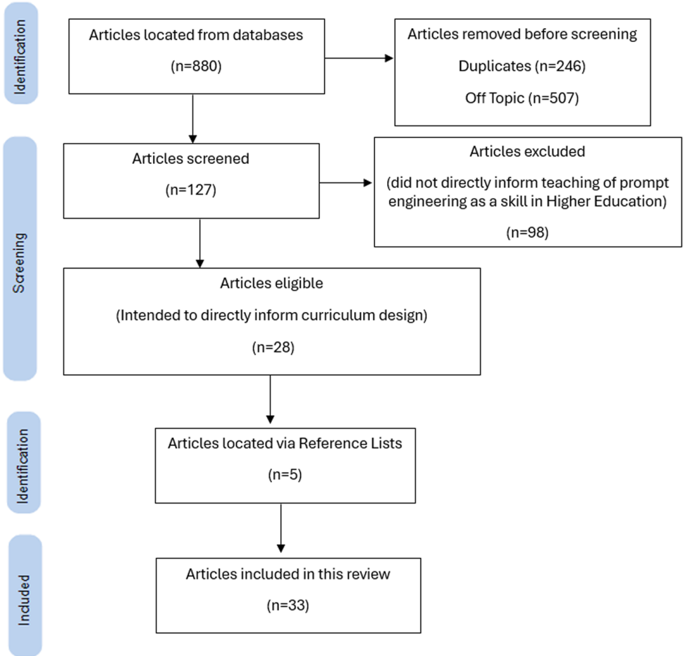
“The research was conducted using the protocols of a systematic literature review, as out-lined by Kitchenham and Charters (2007), Xiao and Watson (2019), and Tawfik et al. (2019), to determine the current state of discourse surrounding the topic of prompt engineering in HE.”
What if the devil is my guardian angel: ChatGPT as a case study of using chatbots in education
Tlili, A., Shehata, B., Adarkwah, M. A., Bozkurt, A., Hickey, D. T., Huang, R., & Agyemang, B. (2023) · Smart Learning Environments · doi:10.1186/s40561-023-00237-x · Cited by 2,003 · cited 2×
“Tlili et al. (2023), observed participants felt their chatbot became their “personal assistant” (p. 9) inducing emotional responses in the user including gratitude.”
Walter, Y. (2024) · International Journal of Educational Technology in Higher Education · doi:10.1186/s41239-024-00448-3 · Cited by 1,113 · cited 6×
“Developing skills in prompt engineering improves students’ abilities to transform AI from a “mere repository of information into an interactive tool that stimulates deeper learning and understanding” (Walter, 2024, p. 14).”
InfluentialA Prompt Pattern Catalog to Enhance Prompt Engineering with ChatGPT
White, J., Fu, Q., Hays, S., Sandborn, M., Olea, C., Gilbert, H., Elnashar, A., Spencer-Smith, J., & Schmidt, D. C. (2023) · arXiv · doi:10.48550/arxiv.2302.11382 · Cited by 838 · cited 1×
“(p. 142) This example shows the personification technique which was prevalent among the literature and found to be a common successful strategy (Fotaris et al., 2023; White et al., 2023).”
A step by step guide for conducting a systematic review and meta-analysis with simulation data
Tawfik, G. M., Dila, K. A. S., Mohamed, M. Y. F., Tam, D. N. H., Kien, N. D., Ahmed, A. M., & Huy, N. T. (2019) · Tropical Medicine and Health · doi:10.1186/s41182-019-0165-6 · Cited by 808 · cited 1×
“The research was conducted using the protocols of a systematic literature review, as out-lined by Kitchenham and Charters (2007), Xiao and Watson (2019), and Tawfik et al. (2019), to determine the current state of discourse surrounding the topic of prompt engineering in HE.”
Prompt Engineering as an Important Emerging Skill for Medical Professionals: Tutorial
Meskó, B. (2023) · Journal of Medical Internet Research · doi:10.2196/50638 · Cited by 709 · cited 1×
“In a discussion about prompt engineering as an important emerging skill, Meskó (2023) provides the following example: “What prompt could I use right now to get a better output from you in this thread/task?””
AI-generated feedback on writing: insights into efficacy and ENL student preference
Escalante, J., Pack, A., & Barrett, A. (2023) · International Journal of Educational Technology in Higher Education · doi:10.1186/s41239-023-00425-2 · Cited by 589 · cited 2×
“An emerging terminology among the literature was the concept of “shots” which was discussed in nine papers (Clavié et al., 2023; Escalante et al., 2023; Henrickson & Meroño-Peñuela, 2023; Heston & Kuhn, 2023; Korzynski et al., 2023; Schäffer & Lieder, 2023; Walter, 2024; Wang et al., 2021; Zheng et…”
ChatGPT Chemistry Assistant for Text Mining and the Prediction of MOF Synthesis
Zheng, Z., Zhang, O., Borgs, C., Chayes, J. T., & Yaghi, O. M. (2023) · Journal of the American Chemical Society · doi:10.1021/jacs.3c05819 · Cited by 536 · cited 3×
“For example, Zheng et al. (2023) used prompt engineering to guide ChatGPT in the automation of text mining of metal − organic framework synthesis conditions from diverse formats and styles of scientific literature.”
Research works printed but not linked: 1
- Hutson, J. (2024). Integrating art and AI: Evaluating the educational impact of AI tools in digital art history learning. Forum for Art Studies, 1(1), 393.
Cited by
Items 201–300 of 452
Afrin, S., Ahmed, T., & Hasan, M. J. (2026) · Computers in Human Behavior Reports · doi:10.1016/j.chbr.2026.101358
Artificial intelligence and the sustainable internationalisation of education in the Global South
Jain, B., Sonwane, V., Hirawat, A., & Banga, V. (2026) · Journal of International Students · doi:10.32674/n6wz5879
Abhishek, N. A., Nayak, K. M., Divyashree, M. S., & Jain, U. (2026) · Frontiers of digital education. · doi:10.1007/s44366-026-0102-2
The Validation Paradox: Cognitive Partnership and the Design of AI Literacy EducationPreprint
McGregor, C., & Wolff, K. E. (2026) · Research Square · doi:10.21203/rs.3.rs-9827982/v1
Fitri, A., Yusuf, H., Razzaq, A., & Anshari, M. (2026) · Education Innovations Systems and Future Learning · doi:10.1108/eisfl-03-2026-0048
Digital Financial Inclusion and Its Impact on Economic Growth
Shaniba Nazneen K, M. G. T. K., K, G. T., & K, A. J. T. (2026) · International Journal of Advanced Research in Science Communication and Technology · doi:10.48175/ijarsct-38216
How do Students Collaborate with GAI during Task Completion? An Exploratory Study
Wu, Y., Liu, J., & Li, H. (2026) · International Conference on Educational and Information Technology · doi:10.1109/iceit68991.2026.11521534
Kim, K., Kwon, K., 권혜성, & Brush, T. A. (2026) · Educational Technology Research and Development · doi:10.1007/s11423-026-10692-1
Meng, K., Zhou, J., & Yang, Y. (2026) · Open Journal of Social Sciences · doi:10.4236/jss.2026.147009
Aryani, L. N., Widiana, I. W., Suharta, I. G. P., Lasmawan, I. W., & Arnyana, I. B. P. (2026) · Discover Education · doi:10.1007/s44217-026-02177-3
Prompt Writing and Program Quality: An Investigation from a Programming Education Perspective
Nakamura, Y., Ito, W., Nishigata, Y., & Kuramitsu, K. (2026) · Journal of Information Processing · doi:10.2197/ipsjjip.34.648
The role of agency in human-GenAI interaction for writing: Theoretical reflections
Khosronejad, M., Mills, K. A., Reimann, P., & Ryan, M. E. (2026) · Educational Philosophy and Theory · doi:10.1080/00131857.2026.2729436
McDermott, B., & Ross, R. (2026) · Advances in computational intelligence and robotics book series · doi:10.4018/979-8-3373-3000-6.ch012
Banga, C., Kincar, A., & Mustafa, H. (2026) · Research Square · doi:10.21203/rs.3.rs-9993353/v1
Non-automatable cognitive skills in higher education in the age of generative AI
Jog, S. (2026) · Frontiers in Education · doi:10.3389/feduc.2026.1827610
Ünsal, G., & Yüksel, N. S. (2026) · KIRŞEHİR EĞİTİM FAKÜLTESİ DERGİSİ · doi:10.29299/kefad.1898498
Amponsah, C., Kyiewu, B., & Bessa-Simons, L. (2026) · Journal of Educational Technology and Online Learning · doi:10.31681/jetol.1991829
How Users Engage With ChatGPT: A Collaborative Autoethnography of Prompting Practices
Bulkia, W. S. M., Alvarado, H. A. L., & Jackaria, P. M. (2026) · Advances in computational intelligence and robotics book series · doi:10.4018/979-8-2600-4664-7.ch011
Kővári, A. (2026) · Discover Artificial Intelligence · doi:10.1007/s44163-026-02312-x
Bridging the gap between vocational AI curricula and industry skill demand: Evidence from China
Xiao, H., Lee, H. L., Zheng, K., Kuang, Z., Oung, Q. W., & Zhang, Q. (2026) · Industry and Higher Education · doi:10.1177/09504222261478197
Generative AI for Writing: Student Interactions with AI Feedback in a High School English ClassroomPreprint
Kwon, K., Park, J., Kale, U., Kim, K., & Yang, S. (2026) · SSRN Electronic Journal · doi:10.2139/ssrn.7471093
Fostering critical thinking skills in students through prompt engineering training
(Lavrovskaia), V. G. K. (2026) · Informatics and Education · doi:10.32517/0234-0453-2026-41-3-49-61
A Framework for Creating Effective Prompts Using Prompt Engineering
Choi, J., Hicks, D., Shakya, S., Woo, S., Chen, Y.-J., & Kim, Y. (2026) · CIN Computers Informatics Nursing · doi:10.1097/cin.0000000000001532
Hạnh, V. T. (2026) · Multidisciplinary Reviews · doi:10.31893/multirev.2027032
Der KI-Prompt – Eine (neue) Textorte für den DAFUnterricht? Eine Analyse aus textlinguisticher Sicht
CLUJ-NAPOCA, U. B.-B., & PARASCA, M. (2026) · Lingua. Language and Culture · doi:10.24193/llc.2025.1.4
Toktarova, V. I., & Rebko, O. V. (2026) · Informatics and Education · doi:10.32517/0234-0453-2026-41-3-37-48
Yan, R., Xiong, L., & Wang, S. (2026) · International Journal of Educational Research · doi:10.1016/j.ijer.2026.103055
Zwischen Mensch und Maschine – Werbefilm im Zeitalter der Künstlichen Intelligenz
Eberwein, T. (2026) · Springer eBooks · doi:10.1007/978-3-658-51264-4_6
Weng, Y. (2026) · International Conference on Learning Analytics and Knowledge (LAK) · doi:10.1145/3785022.3785114
Institutional Policies for AI and Prompt Literacy
Gupta, D. K., Shokhista, K., Sadoqat, S., Almardanovna, S. D., Vakhabov, B., & ABDULLAEVA, N. (2026) · Advances in computational intelligence and robotics book series · doi:10.4018/979-8-2600-4664-7.ch007
Understanding EFL Teachers' Readiness for Generative AI Integration: A GenAI-TPACK Perspective
Jiang, R., An, X., Li, Y., & Edusei‐Mensah, W. (2026) · International Conference on Computer Science and Technologies in Education (CSTE) · doi:10.1109/cste69562.2026.11649823
Students need more than AI skills — they need accountable AI literacy
Chen, S. (2026) · The Conversation · doi:10.64628/aam.xhydjq4gu
Ethical Alignment and Trust Calibration: Managing AI Reliability, Biases, and Ethical Constraints
Geroimenko, V. (2025) · Springer eBooks · doi:10.1007/978-3-032-04569-0_12
Exploring Students’ Prompt Engineering Practices and Competencies in Higher Education
Moguš, A. M., & Barišić, K. D. (2026) · International Convention on Information and Communication Technology, Electronics and Microelectronics · doi:10.1109/mipro70003.2026.11591502
Alam, A. (2026) · Advances in computational intelligence and robotics book series · doi:10.4018/979-8-3373-8332-3.ch004
Designing Prompt Literacy: Teaching and Learning With AI in Higher Education
Ojha, M. (2026) · Advances in computational intelligence and robotics book series · doi:10.4018/979-8-3373-8332-3.ch007
Learning@Edge: Model-based Edge Learning through Prompt Engineering for Personalized Education
Rai, L. (2026) · World Conference on Computing and Communication Technologies (WCCCT) · doi:10.1109/wccct69960.2026.11549677
Surmanov, S. E., Azimova, M., Ravshankhanovna, S. B., Sabirova, G., & Ruzmetova, M. (2026) · SSRN Electronic Journal · doi:10.2139/ssrn.7067747
Xu, X. X., Lu, G., Ba, S., & Li, L. (2026) · Lecture notes in computer science · doi:10.1007/978-981-92-3761-6_5
Halaweh, M. (2026) · Journal of Sustainability · doi:10.55845/q9qraj03
From Prompts to Publications: Rethinking Academic Writing and Research With Generative AI
Tyagi, V. (2026) · Advances in computational intelligence and robotics book series · doi:10.4018/979-8-3373-8332-3.ch013
Kassab, M. (2026) · ACM Joint European Software Engineering Conference and Symposium on the Foundations of Software Engineering (ESEC/FSE) · doi:10.1145/3803437.3805788
Defining Prompt Literacy in Higher Education and Faculty Development for Prompt Literacy
Mahajan, J. (2026) · Advances in computational intelligence and robotics book series · doi:10.4018/979-8-3373-8332-3.ch001
A Systematic Evaluation of Decision Mechanisms in Multi-agent LLMs for Misinformation Detection
Lee, Y., Huang, Y., & Chu, T.-H. (2026) · Lecture notes in computer science · doi:10.1007/978-3-032-30044-7_6
The Future Is Collaborative and Co-creative
Geroimenko, V. (2025) · Springer eBooks · doi:10.1007/978-3-032-04569-0_7
Geroimenko, V. (2025) · Springer eBooks · doi:10.1007/978-3-032-04569-0_5
The Future Is Personal, Social, and Cultural
Geroimenko, V. (2025) · Springer eBooks · doi:10.1007/978-3-032-04569-0_3
The Future Is Ethical and Philosophical
Geroimenko, V. (2025) · Springer eBooks · doi:10.1007/978-3-032-04569-0_8
Geroimenko, V. (2025) · Springer eBooks · doi:10.1007/978-3-032-04569-0_4
The Future Is Intuitive and Emotional
Geroimenko, V. (2025) · Springer eBooks · doi:10.1007/978-3-032-04569-0_6
The Evolution of AI Communication
Geroimenko, V. (2025) · Springer eBooks · doi:10.1007/978-3-032-04569-0_2
Crafting Effective Prompts: Thinking with Machines Not Just Talking to Them
Sinha, E., Chandra, S., & Waghmare, C. D. (2026) · Emerald Group Publishing Limited eBooks · doi:10.1108/978-1-83742-179-420261002
Bhatt, V., Thakar, D., Cervantes-Fernandez, J., Kim, S. D., Kim, M., & Jin, J. (2025) · Conference on AI, Science, Engineering, and Technology (AIxSET) · doi:10.1109/aixset65682.2025.00015
Abubakar, A. (2026) · Journal of Studies in Science and Mathematics Education · doi:10.67203/jossme.2026.blbmyc3j
Designing Teacher-Centered Interfaces to Elicit Pedagogical Context for LLM-Based Content Generation
Faraji, A., Tavakoli, M., Moein, M. M., Molavi, M., & Kismihók, G. (2026) · Lecture notes in computer science · doi:10.1007/978-3-032-37979-5_13
Rethinking AI Ethics in Education: From Restrictive Policies to Learning-Oriented Design
Noor, S. M., & Momani, Z. (2026) · International Conference on Computational Intelligence Approaches and Applications (ICCIAA) · doi:10.1109/icciaa68481.2026.11543766
Alyahyan, E. A., & Ada, M. B. (2026) · ACM Conference on Innovation and Technology in Computer Science Education (ITiCSE) · doi:10.1145/3803400.3809357
Berondo, C. M., & Vasay-Cruz, M. J. (2026) · Psychology and Education A Multidisciplinary Journal · doi:10.70838/pemj.510702
Raimbault, T. (2025) · International Conference on Education Technology and Computer · doi:10.1109/icetc66579.2025.11387679
Kusumaningsih, C. P., Dwikurnaningsih, Y., & Relmasira, S. C. (2026) · Education and Human Development Journal · doi:10.33086/ehdj.v11i1.8618
Cassanelli, A. N. (2026) · Communications in computer and information science · doi:10.1007/978-3-032-35635-2_10
Lee, D., & Liu, T. (2026) · The Journal of Korean Association of Computer Education · doi:10.32431/kace.2026.29.6.010
Self-citationThe More Distant Future Is Symbiotic and Unfamiliar
Geroimenko, V. (2025) · Springer eBooks · doi:10.1007/978-3-032-04569-0_16
Preparing for the Foreseeable Future
Geroimenko, V. (2025) · Springer eBooks · doi:10.1007/978-3-032-04569-0_15
Syahidi, A. A., & Voraputhaporn, K. (2026) · International Conference on Information and Education Technology (ICIET) · doi:10.1109/iciet69664.2026.11561592
Zhong, L., & Ma, X. (2026) · Research Papers in Education · doi:10.1080/02671522.2026.2690538
LADJAL, R., & Messekher, H. (2026) · IAFOR Journal of Education · doi:10.22492/ije.14.2.03
Meilani, M. (2026) · International Conference on ICT for Smart Society (ICISS) · doi:10.1109/iciss71466.2026.11715489
Fenici, M. (2026) · Human Affairs · doi:10.1515/humaff-2026-0011
Amponsah, C. (2026) · Computer Science · doi:10.53070/bbd.2007859
Reimagining academic publications: A meta-model for scholarly writing with large language models
Bodhanya, S. (2026) · Elsevier eBooks · doi:10.1016/b978-0-443-36775-5.00028-x
A preliminary study on the use of generative AI in software engineering education
García, P. H., Mijač, M., Díaz, A. D., & García, D. R. (2025) · e_Buah
Wang, X., Xu, T., & Meng, X. (2026) · Frontiers in Psychology · doi:10.3389/fpsyg.2026.1913577
GenAI in Higher Education: Perceived Benefits and Risks and Their Implications for KM and Trust
Akrong, G. B., Evans, M., & Wensley, A. K. P. (2026) · European Conference on Knowledge Management · doi:10.34190/eckm.27.1.5296
An Experience Report Observing GenAI Use in College Students with Basic Guidance Level
Corral, L., & Fronza, I. (2025) · Conference on Information Technology Education · doi:10.1145/3769694.3771114
Závodná, M., Havlásková, T., Javorčík, T., & Kostolányová, K. (2025) · International Conference on Emerging eLearning Technologies and Applications (ICETA) · doi:10.1109/iceta67772.2025.11280247
Song, J., Wei, Z., He, C., Liao, J., Xu, X., & Yip, D. K. M. (2026) · International Journal of Human-Computer Interaction · doi:10.1080/10447318.2026.2745545
Evaluating Context-Aware Prompting for Generative Ai in Circuit Analysis Problems
Habib, S. A. (2026) · International STEM Education Conference (iSTEM-Ed) · doi:10.1109/istem-ed69857.2026.11734382
Elliott, I., & Figuière, C. (2026) · Médiations et médiatisations · doi:10.52358/mm.vi23.499
Who benefits from LLMs? Prompt engineering competence and equity in higher education
Li, Z., Liu, Y., Jiang, J., Zhang, Z., Li, Z., & Chen, W. (2026) · International Journal of Educational Technology in Higher Education · doi:10.1186/s41239-026-00633-6
ÖZCAN, N. (2026) · Motif Akademi Halk Bilimi Dergisi · doi:10.12981/mahder.1731951
Williams, A. (2025) · Springer eBooks · doi:10.1007/978-3-032-02665-1_5
GAI-Assisted Digital Content Creation: Effects of Prompting Strategies on Learning Behaviors
Zhang, Q., & Zou, J. (2026) · International Conference on Computer Science and Technologies in Education (CSTE) · doi:10.1109/cste69562.2026.11649587
Li, X., & Razak, R. A. (2026) · Journal of Educational Computing Research · doi:10.1177/07356331261498975
Zhang, L. (2026) · International Conference on Artificial Intelligence in Education Technology and Data Science · doi:10.1145/3810158.3810162
Astuti, M. D. (2026) · Journal of Chemical Learning Innovation. · doi:10.37251/jocli.v3i1.3080
A Technical Introduction to Prompting
Vallverdú, J. (2025) · SpringerBriefs in intelligent systems · doi:10.1007/978-3-032-03593-6_1
Influencia del formato y la complejidad de prompts en calidad de respuestas de modelos generativos
Vera, W. F. Z., & Carrillo, J. J. M. (2025) · Revista Científica de Informática ENCRIPTAR · doi:10.56124/encriptar.v8i16.011
AI Tools for Writing and Editing in Academia and Research
Lavania, S., Verma, A. K., & Basuel, R. B. (2026) · Advances in computational intelligence and robotics book series · doi:10.4018/979-8-3373-5601-3.ch014
Designing Prompt-Level Scaffolds for Student Agency in GenAI-Supported Learning
Taş, E., Memmert, L., & Bittner, E. A. C. (n.d.) · AIS Electronic Library (AISeL)
Manzanares, M. C. S., Llamazares, M. D. C. E., González-Díez, I., Perez-Lopez-de-Echazarreta, G., Varela, C., & Saiz, R. V. (2026) · Interactive Learning Environments · doi:10.1080/10494820.2026.2744402
Zhou, H. (2026) · International Journal of Educational Development · doi:10.63313/ijed.9052
HAI-Agency: Workshop on Orchestrating Human and AI Agency for Proactive and Reflective Learning
Dai, Y., Ma, B., Li, H., Ocheja, P., Seo, K., & Flanagan, B. (2026) · Communications in computer and information science · doi:10.1007/978-3-032-29794-5_5
Bayarassou, O. (2026) · Marketing Education Review · doi:10.1080/10528008.2026.2699800
Metadata
- Authors
- Lee, D., & Palmer, E.
- Venue
- International Journal of Educational Technology in Higher Education
- Published
- 2025-02-10
- Volume
- 22
- Issue
- 1
- ISSN
- 2365-9440 (ISSN-L)
- OpenAlex
- W4407284288
- Cited by
- 234
- References
- 49
- FWCI
- 39.71
- Type
- journal article
- Language
- en
- Open access
- diamond
- Licence
- creativecommons.org/licenses/by/4.0 (tdm)
- creativecommons.org/licenses/by/4.0 (vor)
About these checks
Registry, retraction, Cites and statistics results are computed, not judged, with one exception: a printed reference that no index lists is read once by a model before it counts as a citation error. Claims are extracted by a model and kept only when their quote appears verbatim in the text; each cited source is then checked, with a model’s help, for whether it says what the claim relies on. Those verdicts can be wrong — read the claim’s quote and the cited source before relying on one.
Statistics and arithmetic are recomputed, not judged.
Confidence bands are shown only for fields calibrated on our annotated test set. None is calibrated yet, so no band is shown.
What counts as a claim ›How we measure confidence ›How we check this ›
Are you an author, or do you see a problem with this page? Request a review
Data sources
Bibliographic data: Semantic Scholar, OpenAlex, Crossref.
Contains information from the Semantic Scholar Academic Graph Datasets, made available under the ODC Attribution License (ODC-BY 1.0).
Semantic Scholar’s data is described in: Kinney, R., et al. (2023). The Semantic Scholar Open Data Platform. arXiv:2301.10140.
