

Prompt engineering in higher education: a systematic review to help inform curricula
Open accessThe DOI matches its Crossref record; 51 of the 53 references it cites were found in a registry or an index, and 2 are not checked yet.
Abstract
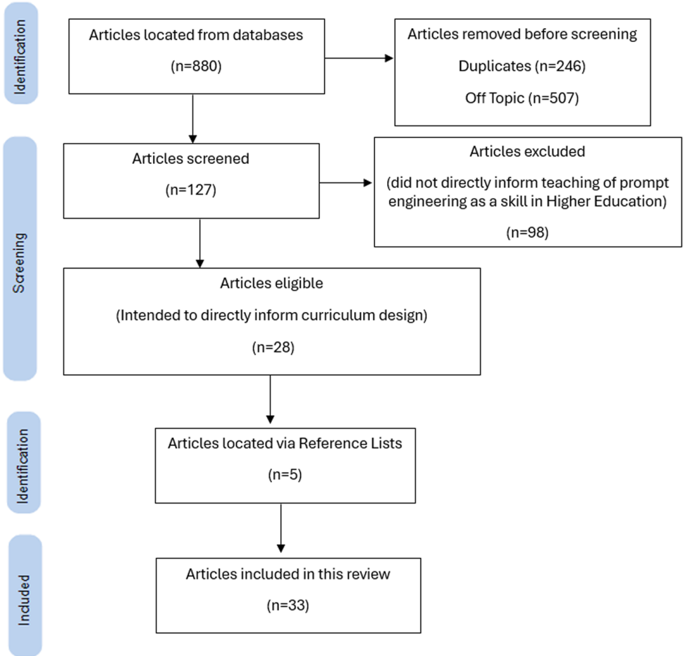
This paper presents a systematic review of the role of prompt engineering during interactions with Generative Artificial Intelligence (GenAI) in Higher Education (HE) to discover potential methods of improving educational outcomes. Drawing on a comprehensive search of academic databases and relevant literature, key trends, including multiple framework designs, are presented and explored to review the role, relevance, and applicability of prompt engineering to purposefully improve GenAI-generated responses in higher education contexts. Multiple experiments using a variety of prompt engineering frameworks are compared, contrasted and discussed. Analysis reveals that well-designed prompts have the potential to transform interactions with GenAI in higher education teaching and learning. Further findings show it is important to develop and teach pragmatic skills in AI interaction, including meaningful prompt engineering, which is best managed through a well-designed framework for creating and evaluating GenAI applications that are aligned with pre-determined contextual educational goals. The paper outlines some of the key concepts and frameworks that educators should be aware of when incorporating GenAI and prompt engineering into their teaching practices, and when teaching students the necessary skills for successful GenAI interaction.
Overview
The claims and statistics of this paper haven’t been checked yet.
Free: it reads the open-access text and checks the first 5 claims that cite a source we can check. Create a free account to check every claim.
Integrity signals
Registry
Cites
Statistics
Figures
Verification
Claims the paper makes
The claims and statistics of this paper haven’t been checked yet.
Free: it reads the open-access text and checks the first 5 claims that cite a source we can check. Create a free account to check every claim.
Claims other papers make about this one
Each is checked against this paper’s own text: does it say what the citing paper says it does?
In the citing paper
“Although prompting has been widely studied in computer science (Debnath et al. 2025), research in non-expert settings remains limited (Dierickx et al. 2026;Lee and Palmer 2025;Zamfirescu-Pereira et al. 2023).”
From A Taxonomy of LLM-Supported Tasks for Critical AI Literacy in Journalism (2026) · cites this paper as Lee and Palmer 2025
In the citing paper
“In educational settings, task definition presupposes that users already possess some prerequisite knowledge relevant to the task in order to use the system meaningfully (Lee and Palmer 2025).”
From A Taxonomy of LLM-Supported Tasks for Critical AI Literacy in Journalism (2026) · cites this paper as Lee and Palmer 2025
In the citing paper
“In this light, prompting represents an emerging skill set that enables trainees to engage critically with GenAI systems (Lee and Palmer 2025;Walter 2024).”
From A Taxonomy of LLM-Supported Tasks for Critical AI Literacy in Journalism (2026) · cites this paper as Lee and Palmer 2025
Self-check
Percentages, sums and reported differences re-computed from the paper’s own numbers.
The self-check needs the paper’s full text.
Citations
Cites
Guidelines for performing Systematic Literature Reviews in Software Engineering
Kitchenham, B. A., & Charters, S. (n.d.) · Cited by 10,073
Control problems of grey systems
Ju-Long, D. (1982) · Systems & Control Letters · doi:10.1016/s0167-6911(82)80025-x · Cited by 4,487 · cited 4×
“Abdlushahed found by combining Grey Theory with prompt engineering techniques enhances decision makers’ abilities to make informed choices which consider case specific needs and conditions.”
InfluentialGuidance on Conducting a Systematic Literature Review
Xiao, Y., & Watson, M. (2019) · Journal of Planning Education and Research · doi:10.1177/0739456x17723971 · Cited by 3,467 · cited 1×
“The research was conducted using the protocols of a systematic literature review, as out-lined by Kitchenham and Charters (2007), Xiao and Watson (2019), and Tawfik et al. (2019), to determine the current state of discourse surrounding the topic of prompt engineering in HE.”
What if the devil is my guardian angel: ChatGPT as a case study of using chatbots in education
Tlili, A., Shehata, B., Adarkwah, M. A., Bozkurt, A., Hickey, D. T., Huang, R., & Agyemang, B. (2023) · Smart Learning Environments · doi:10.1186/s40561-023-00237-x · Cited by 2,003 · cited 2×
“Tlili et al. (2023), observed participants felt their chatbot became their “personal assistant” (p. 9) inducing emotional responses in the user including gratitude.”
Walter, Y. (2024) · International Journal of Educational Technology in Higher Education · doi:10.1186/s41239-024-00448-3 · Cited by 1,113 · cited 6×
“Developing skills in prompt engineering improves students’ abilities to transform AI from a “mere repository of information into an interactive tool that stimulates deeper learning and understanding” (Walter, 2024, p. 14).”
InfluentialA Prompt Pattern Catalog to Enhance Prompt Engineering with ChatGPT
White, J., Fu, Q., Hays, S., Sandborn, M., Olea, C., Gilbert, H., Elnashar, A., Spencer-Smith, J., & Schmidt, D. C. (2023) · arXiv · doi:10.48550/arxiv.2302.11382 · Cited by 838 · cited 1×
“(p. 142) This example shows the personification technique which was prevalent among the literature and found to be a common successful strategy (Fotaris et al., 2023; White et al., 2023).”
A step by step guide for conducting a systematic review and meta-analysis with simulation data
Tawfik, G. M., Dila, K. A. S., Mohamed, M. Y. F., Tam, D. N. H., Kien, N. D., Ahmed, A. M., & Huy, N. T. (2019) · Tropical Medicine and Health · doi:10.1186/s41182-019-0165-6 · Cited by 808 · cited 1×
“The research was conducted using the protocols of a systematic literature review, as out-lined by Kitchenham and Charters (2007), Xiao and Watson (2019), and Tawfik et al. (2019), to determine the current state of discourse surrounding the topic of prompt engineering in HE.”
Prompt Engineering as an Important Emerging Skill for Medical Professionals: Tutorial
Meskó, B. (2023) · Journal of Medical Internet Research · doi:10.2196/50638 · Cited by 709 · cited 1×
“In a discussion about prompt engineering as an important emerging skill, Meskó (2023) provides the following example: “What prompt could I use right now to get a better output from you in this thread/task?””
AI-generated feedback on writing: insights into efficacy and ENL student preference
Escalante, J., Pack, A., & Barrett, A. (2023) · International Journal of Educational Technology in Higher Education · doi:10.1186/s41239-023-00425-2 · Cited by 589 · cited 2×
“An emerging terminology among the literature was the concept of “shots” which was discussed in nine papers (Clavié et al., 2023; Escalante et al., 2023; Henrickson & Meroño-Peñuela, 2023; Heston & Kuhn, 2023; Korzynski et al., 2023; Schäffer & Lieder, 2023; Walter, 2024; Wang et al., 2021; Zheng et…”
ChatGPT Chemistry Assistant for Text Mining and the Prediction of MOF Synthesis
Zheng, Z., Zhang, O., Borgs, C., Chayes, J. T., & Yaghi, O. M. (2023) · Journal of the American Chemical Society · doi:10.1021/jacs.3c05819 · Cited by 536 · cited 3×
“For example, Zheng et al. (2023) used prompt engineering to guide ChatGPT in the automation of text mining of metal − organic framework synthesis conditions from diverse formats and styles of scientific literature.”
Research works printed but not linked: 1
- Hutson, J. (2024). Integrating art and AI: Evaluating the educational impact of AI tools in digital art history learning. Forum for Art Studies, 1(1), 393.
Cited by
Items 101–200 of 452
Harnessing AI in secondary education in Chinese Hong Kong: the role of prompt engineering
Rey, K. T. (2025) · Journal of China Computer-Assisted Language Learning · doi:10.1515/jccall-2025-0016 · Cited by 2
Pan, D., Long, T., Zhu, X., & Li, J. (2026) · Thinking Skills and Creativity · doi:10.1016/j.tsc.2026.102380 · Cited by 2
Zhang, Z. (2026) · PLoS ONE · doi:10.1371/journal.pone.0347428 · Cited by 2
Vallverdú, J. (2025) · SpringerBriefs in intelligent systems · doi:10.1007/978-3-032-03593-6_4 · Cited by 2
Lusi, J., Nikiforova, A., Lorenz, B., & Pappel, I. (2026) · Quality & Quantity · doi:10.1007/s11135-026-02714-0 · Cited by 2
Hernández, P. T., Haines, A. M., Mousseau, V., Elbourne, M., & Hanna, T. (2026) · Forensic Science International Synergy · doi:10.1016/j.fsisyn.2026.100723 · Cited by 2
AI-scaffolded summary writing for pre-class learning in an undergraduate physics course
Kim, M. K., Han, H., Kim, S., & Abdeen, M. S. (2026) · Assessing Writing · doi:10.1016/j.asw.2026.101093 · Cited by 2
Srirahayu, D. P., Ekowati, D., Kusumaningtiyas, T., Anugrah, E. P., Sukma, A., Anwar, M., & Kamarudin, H. D. (2026) · Publications · doi:10.3390/publications14020025 · Cited by 2
Mezzadri, M., & Paita, M. (2025) · Italiano LinguaDue · doi:10.54103/2037-3597/30456 · Cited by 2
Jiang, X. (2026) · Interactive Technology and Smart Education · doi:10.1108/itse-01-2026-0004 · Cited by 2
Cheah, Y. H., Hsu, H.-P., Lu, J., & Alsaka, R. (2026) · Journal of Research on Technology in Education · doi:10.1080/15391523.2026.2704778 · Cited by 2
Liu, S., Li, X., & Hao, J. (2026) · Interactive Learning Environments · doi:10.1080/10494820.2026.2635540 · Cited by 2
Feedback and Iterative Refinement: Improving AI Responses Through Interaction Cycles
Geroimenko, V. (2025) · Springer eBooks · doi:10.1007/978-3-032-04569-0_11 · Cited by 2
Geroimenko, V. (2025) · Springer eBooks · doi:10.1007/978-3-032-04569-0_9 · Cited by 2
Emotional and Relational Aspects: Building Rapport and Human-Like Interaction with AI
Geroimenko, V. (2025) · Springer eBooks · doi:10.1007/978-3-032-04569-0_14 · Cited by 2
Designing an AI assistant to support independent learning in first -and second-year students
Zakharov, A. A., Zakharova, I. G., Шабалин, А. М., & Nguyen, Q. H. (2026) · The Education and science journal · doi:10.17853/1994-5639-2026-6-163-200 · Cited by 2
Liu, Y., Meng, M., & Zhang, Y. (2026) · Frontiers in Psychology · doi:10.3389/fpsyg.2026.1858187 · Cited by 2
Kim, L. (2025) · The Mathematical Education · doi:10.63311/mathedu.25.6439 · Cited by 2
Can ChatGPT graduate as a civil engineer? Exploring the role of prompt design in model behaviour
Genç, O., Durgun, S., & Un, B. (2026) · Engineering Construction & Architectural Management · doi:10.1108/ecam-01-2026-0023 · Cited by 2
Criterion-based assessment of reading literacy with AI
Nábělková, J., Kopecký, K., Plischke, J., & Szotkowski, R. (2026) · Frontiers in Education · doi:10.3389/feduc.2026.1812149 · Cited by 2
A call for an interdisciplinary ethical foundation for GenAI governance in higher education
Uddın, M. M. (2026) · Discover Artificial Intelligence · doi:10.1007/s44163-026-01999-2 · Cited by 2
Pacheco, R. J. P. (2026) · MENTOR revista de investigación educativa y deportiva · doi:10.56200/mentor.v5i13.11557 · Cited by 2
Charette, C., & Ghosh, S. (2025) · Proceedings of the Association for Information Science and Technology · doi:10.1002/pra2.1240 · Cited by 2
The Role of Prompt Writing in AI-Supported Teaching: Views of Prospective Science Teachers
Karakaya, F., Caner, Ş. N., Çakmak, Z., Eser, E., & Bal, B. N. (2026) · International Journal of Education in Mathematics Science and Technology · doi:10.46328/ijemst.5643 · Cited by 2
Inteligencia artificial: experiencias y reflexiones sobre la investigación educativa
Escudero-Nahón, A., & Mercado, E. P. (2026) · Editorial Transdigital eBooks · doi:10.56162/transdigitalbc13 · Cited by 2
The Web Dev Challenge: Designing GenAI-Supported Gamified Learning in a University Classroom
Zolezzi, D., Adorni, G., Torre, I., & Vercelli, G. (2025) · Lecture notes in networks and systems · doi:10.1007/978-3-032-05070-0_17 · Cited by 2
Integrating Generative Artificial Intelligence into University Curricula: Student Insights
Rook, L., & Plumb, M. (2026) · Journal of University Teaching and Learning Practice · doi:10.53761/jjzzd330 · Cited by 2
DEMİRKUŞ, N. (2026) · International Journal of Science and Research Archive · doi:10.30574/ijsra.2026.19.3.1307 · Cited by 2
International journal of education technology
(2024) · International journal of education technology · doi:10.55640/ijet · Cited by 2
Addiucci, L., & Temperini, M. (2026) · Journal of Information Technology Education Research · doi:10.28945/5773 · Cited by 2
Alli, A. O. (2026) · African Research Reports · doi:10.65221/0305 · Cited by 2
Bonilla, I. M., Guarneros-Reyes, E., & Silva-Rodríguez, A. (2026) · Ciencia Latina Revista Científica Multidisciplinar · doi:10.37811/cl_rcm.v10i2.23160 · Cited by 2
Kataoka, H., Li, J., & Matsuno, Y. (2026) · ACM/IEEE International Conference on Software Engineering: Companion Proceedings (ICSE-Companion) · doi:10.1145/3786580.3786960 · Cited by 2
Wiedenmayer, A. (2026) · International Journal of Language Translation and Intercultural Communication · doi:10.12681/ijltic.44846 · Cited by 2
Luci e ombre delle disuguaglianze digitali nei Centri per l’impiego in Italia
Rossotti, L., & Fasano, A. (2018) · DigitCult - Scientific Journal on Digital Cultures · doi:10.54103/2531-5994/31155 · Cited by 2
Azizian, S., Mehrabian, R., & Honary, V. (2026) · Hawaii International Conference on System Sciences (HICSS) · doi:10.24251/hicss.2026.856 · Cited by 2
Bashir, A., & Johnson, P. (2026) · Advances in computational intelligence and robotics book series · doi:10.4018/979-8-3373-6776-7.ch002 · Cited by 2
Navarro-Arcas, A., Llorca-Schenk, J., Gadea, I. S., Campillo-Davó, N., & Velasco, E. (2025) · Education Sciences · doi:10.3390/educsci15121650 · Cited by 2
Fernandes, J., Tham, S. M., Habib, S., & van Loggerenberg, M. J. C. (2026) · Journal of Advertising Education · doi:10.1177/10980482261425125 · Cited by 2
Pelatihan Kreasi Konten Digital dengan Komunikasi melalui Tools Kecerdasan Artifisial
Winiarti, S., Soyusiawaty, D., Umar, R., & Yuliansyah, H. (2025) · Jurnal Pengabdian UntukMu NegeRI · doi:10.37859/jpumri.v9i3.10417 · Cited by 2
PROMPT ENGINEERING AS A TOOL FOR DEVELOPING CRITICAL THINKING AND SYSTEMATIC ANALYSIS IN STUDENTS
Антонович, Б. А. (2026) · Universum Technical sciences · doi:10.32743/unitech.2024.144.3.22168 · Cited by 2
Caruana, I., Corbí, R. G., & Palomar, M. (2026) · Sustainability · doi:10.3390/su18178827 · Cited by 1
Zhang, Q., Li, Q., Li, Z., & Gan, K. (2026) · The International Journal of Management Education · doi:10.1016/j.ijme.2026.101555 · Cited by 1
Prompt Engineering in Higher Education: A Systematic Review of Current Applications and Challenges
Zhang, A., & Tang, W. F. (2026) · Lecture notes on data engineering and communications technologies · doi:10.1007/978-981-95-4423-3_55 · Cited by 1
Optimisation of university instructors’ professional practice through AI agents: a systematic review
Doszhanov, B., Zhumadilla, B., & Zhapparbergenov, R. (2026) · Frontiers in Education · doi:10.3389/feduc.2026.1893124 · Cited by 1
Generative Artificial Intelligence and Human Collaboration in Educational Design
McGregor, C. (2026) · Computer Applications in Engineering Education · doi:10.1002/cae.70238 · Cited by 1
Moganadas, S. R., Marín-González, F., Nun, S. H., & Gan, C. L. (2026) · Frontiers in Education · doi:10.3389/feduc.2026.1856839 · Cited by 1
Carrasco-Aguilar, Á., Shu, Z., Camacho-Ruiz, M., & Arias-Oliva, M. (2026) · Springer eBooks · doi:10.1007/978-3-032-08213-8_11 · Cited by 1
Generative AI in Engineering Education: Equity-Enhancing Tool or Digital Divide Deepener?
Biswas, R. (2026) · IEEE Global Engineering Education Conference (EDUCON) · doi:10.1109/educon67543.2026.11574391 · Cited by 1
Alshammarı, S. H., & Alhamazany, A. (2026) · Education Sciences · doi:10.3390/educsci16091545 · Cited by 1
Rafi, M. S., Ng, D. T. K., Amjad, I., & Yee, W. H. S. (2026) · Artificial Intelligence in Education · doi:10.1108/aiie-12-2026-269 · Cited by 1
Jing, B., Liu, R., Du, T., Wang, Q., & Ma, H. (2026) · Journal of Computers in Education · doi:10.1007/s40692-026-00400-6 · Cited by 1
Liu, W. (2026) · Social Sciences & Humanities Open · doi:10.1016/j.ssaho.2026.103340 · Cited by 1
Yang, X., Zhang, L., & Yuan, Y. (2026) · Creativity Research Journal · doi:10.1080/10400419.2026.2729228 · Cited by 1
Hart, J. L., Makki, A., & Charles, K. (2026) · Medical Teacher · doi:10.1080/0142159x.2026.2743049 · Cited by 1
Research on generative AI within university teaching contexts a methodological analysis
Otavalo, X. M. C., Galarza-Ligña, V. N., Gutierrez, J. M. R., & Romero, A. (2025) · IEEE Ecuador Technical Chapters Meeting (ETCM) · doi:10.1109/etcm67548.2025.11304469 · Cited by 1
Enhancing AI’s Cognitive Abilities: Optimising AI’s Reasoning, Creativity, and Knowledge Application
Geroimenko, V. (2025) · Springer eBooks · doi:10.1007/978-3-032-04569-0_13 · Cited by 1
Context Management and Adaptability: Enhancing AI’s Ability to Understand and Recall Context
Geroimenko, V. (2025) · Springer eBooks · doi:10.1007/978-3-032-04569-0_10 · Cited by 1
Toth, C., Nastal, J., Barney, T. B., Messer, K., & Godfrey, J. (2026) · The Journal of Writing Analytics · doi:10.37514/jwa-j.2026.9.1.01 · Cited by 1
Turós, M., Soltész-Várhelyi, K., & Szűts, Z. (2026) · Education Sciences · doi:10.3390/educsci16060920 · Cited by 1
Conceptualising student-GenAI knowledge co-creation in higher education
Bui, H. T. (2026) · Innovations in Education and Teaching International · doi:10.1080/14703297.2026.2729359 · Cited by 1
Yan, D. “. (2026) · International Journal of Applied Linguistics · doi:10.1111/ijal.70328 · Cited by 2
Dethroning the author figure in GenAI-assisted writing: toward an entangled hybrid authorship
Islam, M. N., & Uddın, M. M. (2026) · AI and Ethics · doi:10.1007/s43681-026-01250-9 · Cited by 1
Adorni, G., & Grosso, D. (2026) · Digital Library Perspectives · doi:10.1108/dlp-01-2026-0026 · Cited by 1
Beyond Answer Engines: LLMs as Reasoning Partners in Data Structures and Algorithms Education
Khan, S. Z., Leal, D., Valença, L., Abdellatif, A., Wang, M., Krishnamurthy, D., & Santos, R. D. S. (2026) · ACM/IEEE International Conference on Software Engineering: Companion Proceedings (ICSE-Companion) · doi:10.1145/3786580.3786972 · Cited by 1
Guan, J., Li, J., Hou, K., & Li, J. (2026) · Complex & Intelligent Systems · doi:10.1007/s40747-026-02342-z · Cited by 1
AI Literacy Through a Project-Based Learning Course
Ho, M., Orr, C., Jeon, R., Lin, M. P.-C., & Ryoo, J. (2025) · IEEE Smart World Congress (SWC) · doi:10.1109/swc65939.2025.00065 · Cited by 1
Ethical Implications of Prompt Injection in AI-mediated Grading: An Adversarial Red-Team Evaluation
Humble, N. (2026) · Journal of Academic Ethics · doi:10.1007/s10805-026-09758-9 · Cited by 1
Kim, B., Kang, J., Kim, M.-Y., & Ahn, J. (2025) · Journal of Educational Evaluation for Health Professions · doi:10.3352/jeehp.2025.22.34 · Cited by 1
AI-Powered English Content Ideathon Through Quest-Based Learning
Choi, J.-H. (2025) · STEM Journal · doi:10.16875/stem.2025.26.3.24 · Cited by 1
Syahputri, I. W., Budiardjo, E. K., Putra, P. O. H., Azhar, S., & Imandeka, E. (2026) · International Conference on Software Engineering and Information Management (ICSIM) · doi:10.1145/3796315.3796329 · Cited by 1
Generative AI in Reflective Learning: Bridging Literacy Gaps
Frendrup, J., Hvarregaard, B., Jensen, C. G., Kristensen, L. F., Christiansen, L., & Thomsen, H. (2025) · Proceedings for the European Conference on Reflective Practice-based Learning 2025 · doi:10.54337/ecrpl25-10934 · Cited by 1
Sari, Y. M., Rahaju, E. B., Indrawatingsih, N., Romadhonia, R. W., & Ariyanto, D. (2026) · Bima Abdi Jurnal Pengabdian Masyarakat · doi:10.53299/ba-jpm.v6i3.5312 · Cited by 1
Evaluating AI-Generated Feedback for Formative Assessment in Higher Education
Li, X., Chen, D., Tuffley, D., Scott, G., Tuxworth, G., Yao, T., & Torrisi‐Steele, G. (2026) · International Journal of AI in Pedagogy Innovation and Learning Futures · doi:10.46787/ijaipil.v2026i1.6962 · Cited by 1
Banquez-Maturana, A.-G. (2026) · Journal of Trends and Challenges in Artificial Intelligence · doi:10.61552/jai.2026.03.002 · Cited by 1
Morán, C. E. (2026) · LATAM Revista Latinoamericana de Ciencias Sociales y Humanidades · doi:10.56712/latam.v7i1.5231 · Cited by 1
Liu, J., & Zhu, H. (2026) · International Conference on Digital Education and Information Technology (DEIT) · doi:10.1145/3802607.3802708 · Cited by 1
USE OF AI TOOLS IN DEVELOPING RESEARCH PROPOSALS AMONG PRE-SERVICE SCIENCE TEACHERS: A CASE STUDY
Hamzah, A. A. (2025) · International Journal of Education Psychology and Counseling · doi:10.35631/ijepc.1059075 · Cited by 1
An Experience Report on a Pedagogically Controlled, Curriculum-Constrained AI Tutor for SE Education
Happe, J., Fuchß, D., Hüttner, L., Marquardt, K., & Koziolek, A. (2026) · ACM/IEEE International Conference on Software Engineering: Companion Proceedings (ICSE-Companion) · doi:10.1145/3786580.3786947 · Cited by 1
Проектирование ИИ-ассистента для сопровождения самостоятельной работы студентов младших курсов
Захаров, А. А., Гелиевна, З. И., Михайлович, Ш. А., & Хай, Н. К. (2026) · The Education and science journal · Cited by 1
Alyahyan, E. A., & Ada, M. B. (2026) · IEEE Global Engineering Education Conference (EDUCON) · doi:10.1109/educon67543.2026.11574436 · Cited by 1
Nykyporets, S. S. (2026) · Repository of Vinnytsia National Technical University (Vinnytsia National Technical University) · Cited by 1
Azis, F. A., Ramadhani, M. W., Akib, A., Dwi Ayu Siti Hartinah, H., & Hastharita, R. (2026) · JURNAL ILMIAH EKONOMI DAN MANAJEMEN · Cited by 1
Teacher Acceptance of AI-Generated Educational Simulations: A Fuzzy DEMATEL Causal Analysis
Gousopoulos, D. (2026) · EIKI Journal of Effective Teaching Methods · doi:10.59652/43y3xd28 · Cited by 1
Abuhan, R. J. (2026) · International Journal of Education Literacies and Curriculum Studies · doi:10.64358/e1tpfg08 · Cited by 1
Evaluating ChatGPT’s Memory and Conversation Continuity: Insights from Academic Prompting
Jha, M., Jha, S., Gabrani, G., Kansal, M., & Mathrani, A. (2026) · Journal of Education, Innovation, and Communication. · doi:10.34097/jeicom-8-2-3 · Cited by 1
Usability of LLM-driven loss function in Automatic Prompt Engineering for e-commerce
Koralewski, M., Dratwiński, F., & Golec, P. (2025) · Procedia Computer Science · doi:10.1016/j.procs.2025.09.283 · Cited by 1
Arık, Z. N., Arık, M. F., Kaan, M. T., & Erol, Ö. F. (2026) · Ibn Haldun University Faculty of Law · doi:10.59831/ihuhfd.2026.31 · Cited by 1
Kecerdasan Buatan dalam Media Digital Interaktif Hikayat Bayan Budiman
Maryaeni, M., & Nugroho, F. H. (2026) · Jurnal Pembelajaran Sastra · doi:10.51543/hiskimalang.v7i2.128 · Cited by 1
Shafi, A. (2026) · International Journal of Advances in Signal and Image Sciences · doi:10.29284/zgeq5y45 · Cited by 1
Gulov, A. P., & Попова, А. В. (2026) · Мир науки, культуры, образования · doi:10.24412/1991-5497-2026-3118-92-96 · Cited by 1
Improving Chatbot Usability Through Structured Prompt-Based Interaction Design
Guacho, G. K. B., Martínez, E. P. A., Martínez, M. A. G., & Vallejo, P. X. M. (2026) · Multimodal Technologies and Interaction · doi:10.3390/mti10060060
Strategic prompting under technostress: A moderation study
Suriano, R., Scozia, M., & Aquino, A. (2026) · Acta Psychologica · doi:10.1016/j.actpsy.2026.107778
Reimagining Art Education: Teaching Drawing and Painting in the Age of Artificial Intelligence
Alhomaidi, M. J. A. (2026) · Art and Design Review · doi:10.4236/adr.2026.143010
Gadot, R., & Tsybulsky, D. (2026) · Education Sciences · doi:10.3390/educsci16091402
Vallverdú, J. (2025) · SpringerBriefs in intelligent systems · doi:10.1007/978-3-032-03593-6_5
Assessing Student Perceptions of LLM-Based Conversational Agents for Foreign Language Learning
Pitarch, R. C. (2026) · Advances in computational intelligence and robotics book series · doi:10.4018/979-8-3373-6420-9.ch002
Generative Artificial Intelligence (GenAI) in Language Education: Current Trends and Perspectives
Trang, B. T. T., & Hoa, C. T. H. (2026) · Studies in computational intelligence · doi:10.1007/978-3-032-18392-7_1
Özyürek, H., & Türen, U. (2026) · SN Computer Science · doi:10.1007/s42979-026-04883-z
From Script to Co-Pilot: Human-AI Framework for Reclaiming Teacher Agency in K-8 Curricula
Wang, L., Wang, Y., Lewis, T. D., & Dueñas, G. (2026) · IGI Global eBooks · doi:10.4018/979-8-3373-5027-1.ch006
Metadata
- Authors
- Lee, D., & Palmer, E.
- Venue
- International Journal of Educational Technology in Higher Education
- Published
- 2025-02-10
- Volume
- 22
- Issue
- 1
- ISSN
- 2365-9440 (ISSN-L)
- OpenAlex
- W4407284288
- Cited by
- 234
- References
- 49
- FWCI
- 39.71
- Type
- journal article
- Language
- en
- Open access
- diamond
- Licence
- creativecommons.org/licenses/by/4.0 (tdm)
- creativecommons.org/licenses/by/4.0 (vor)
About these checks
Registry, retraction, Cites and statistics results are computed, not judged, with one exception: a printed reference that no index lists is read once by a model before it counts as a citation error. Claims are extracted by a model and kept only when their quote appears verbatim in the text; each cited source is then checked, with a model’s help, for whether it says what the claim relies on. Those verdicts can be wrong — read the claim’s quote and the cited source before relying on one.
Statistics and arithmetic are recomputed, not judged.
Confidence bands are shown only for fields calibrated on our annotated test set. None is calibrated yet, so no band is shown.
What counts as a claim ›How we measure confidence ›How we check this ›
Are you an author, or do you see a problem with this page? Request a review
Data sources
Bibliographic data: Semantic Scholar, OpenAlex, Crossref.
Contains information from the Semantic Scholar Academic Graph Datasets, made available under the ODC Attribution License (ODC-BY 1.0).
Semantic Scholar’s data is described in: Kinney, R., et al. (2023). The Semantic Scholar Open Data Platform. arXiv:2301.10140.
