

Prompt engineering in higher education: a systematic review to help inform curricula
Open accessThe DOI matches its Crossref record; 51 of the 53 references it cites were found in a registry or an index, and 2 are not checked yet.
Abstract
This paper presents a systematic review of the role of prompt engineering during interactions with Generative Artificial Intelligence (GenAI) in Higher Education (HE) to discover potential methods of improving educational outcomes. Drawing on a comprehensive search of academic databases and relevant literature, key trends, including multiple framework designs, are presented and explored to review the role, relevance, and applicability of prompt engineering to purposefully improve GenAI-generated responses in higher education contexts. Multiple experiments using a variety of prompt engineering frameworks are compared, contrasted and discussed. Analysis reveals that well-designed prompts have the potential to transform interactions with GenAI in higher education teaching and learning. Further findings show it is important to develop and teach pragmatic skills in AI interaction, including meaningful prompt engineering, which is best managed through a well-designed framework for creating and evaluating GenAI applications that are aligned with pre-determined contextual educational goals. The paper outlines some of the key concepts and frameworks that educators should be aware of when incorporating GenAI and prompt engineering into their teaching practices, and when teaching students the necessary skills for successful GenAI interaction.
Overview
The claims and statistics of this paper haven’t been checked yet.
Free: it reads the open-access text and checks the first 5 claims that cite a source we can check. Create a free account to check every claim.
Integrity signals
Registry
Cites
Statistics
Figures
Verification
Claims the paper makes
The claims and statistics of this paper haven’t been checked yet.
Free: it reads the open-access text and checks the first 5 claims that cite a source we can check. Create a free account to check every claim.
Claims other papers make about this one
Each is checked against this paper’s own text: does it say what the citing paper says it does?
In the citing paper
“Although prompting has been widely studied in computer science (Debnath et al. 2025), research in non-expert settings remains limited (Dierickx et al. 2026;Lee and Palmer 2025;Zamfirescu-Pereira et al. 2023).”
From A Taxonomy of LLM-Supported Tasks for Critical AI Literacy in Journalism (2026) · cites this paper as Lee and Palmer 2025
In the citing paper
“In educational settings, task definition presupposes that users already possess some prerequisite knowledge relevant to the task in order to use the system meaningfully (Lee and Palmer 2025).”
From A Taxonomy of LLM-Supported Tasks for Critical AI Literacy in Journalism (2026) · cites this paper as Lee and Palmer 2025
In the citing paper
“In this light, prompting represents an emerging skill set that enables trainees to engage critically with GenAI systems (Lee and Palmer 2025;Walter 2024).”
From A Taxonomy of LLM-Supported Tasks for Critical AI Literacy in Journalism (2026) · cites this paper as Lee and Palmer 2025
Self-check
Percentages, sums and reported differences re-computed from the paper’s own numbers.
The self-check needs the paper’s full text.
Citations
Cites
Guidelines for performing Systematic Literature Reviews in Software Engineering
Kitchenham, B. A., & Charters, S. (n.d.) · Cited by 10,073
Control problems of grey systems
Ju-Long, D. (1982) · Systems & Control Letters · doi:10.1016/s0167-6911(82)80025-x · Cited by 4,487 · cited 4×
“Abdlushahed found by combining Grey Theory with prompt engineering techniques enhances decision makers’ abilities to make informed choices which consider case specific needs and conditions.”
InfluentialGuidance on Conducting a Systematic Literature Review
Xiao, Y., & Watson, M. (2019) · Journal of Planning Education and Research · doi:10.1177/0739456x17723971 · Cited by 3,467 · cited 1×
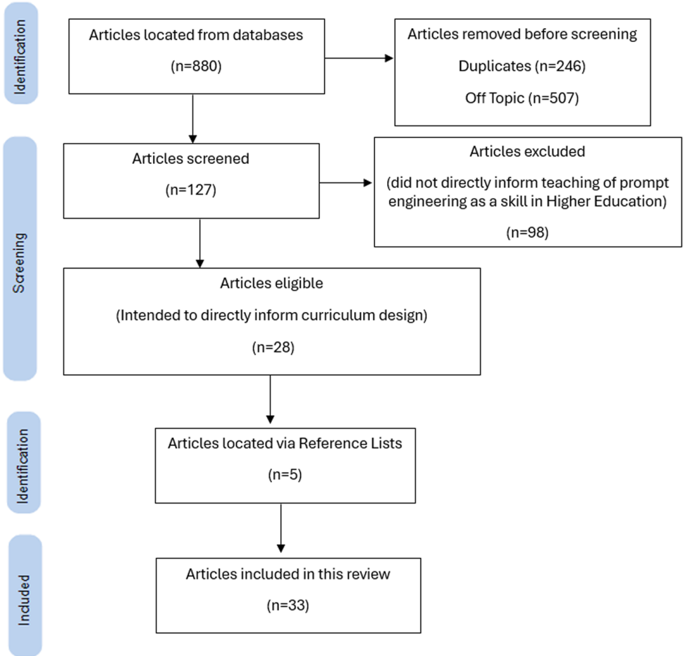
“The research was conducted using the protocols of a systematic literature review, as out-lined by Kitchenham and Charters (2007), Xiao and Watson (2019), and Tawfik et al. (2019), to determine the current state of discourse surrounding the topic of prompt engineering in HE.”
What if the devil is my guardian angel: ChatGPT as a case study of using chatbots in education
Tlili, A., Shehata, B., Adarkwah, M. A., Bozkurt, A., Hickey, D. T., Huang, R., & Agyemang, B. (2023) · Smart Learning Environments · doi:10.1186/s40561-023-00237-x · Cited by 2,003 · cited 2×
“Tlili et al. (2023), observed participants felt their chatbot became their “personal assistant” (p. 9) inducing emotional responses in the user including gratitude.”
Walter, Y. (2024) · International Journal of Educational Technology in Higher Education · doi:10.1186/s41239-024-00448-3 · Cited by 1,113 · cited 6×
“Developing skills in prompt engineering improves students’ abilities to transform AI from a “mere repository of information into an interactive tool that stimulates deeper learning and understanding” (Walter, 2024, p. 14).”
InfluentialA Prompt Pattern Catalog to Enhance Prompt Engineering with ChatGPT
White, J., Fu, Q., Hays, S., Sandborn, M., Olea, C., Gilbert, H., Elnashar, A., Spencer-Smith, J., & Schmidt, D. C. (2023) · arXiv · doi:10.48550/arxiv.2302.11382 · Cited by 838 · cited 1×
“(p. 142) This example shows the personification technique which was prevalent among the literature and found to be a common successful strategy (Fotaris et al., 2023; White et al., 2023).”
A step by step guide for conducting a systematic review and meta-analysis with simulation data
Tawfik, G. M., Dila, K. A. S., Mohamed, M. Y. F., Tam, D. N. H., Kien, N. D., Ahmed, A. M., & Huy, N. T. (2019) · Tropical Medicine and Health · doi:10.1186/s41182-019-0165-6 · Cited by 808 · cited 1×
“The research was conducted using the protocols of a systematic literature review, as out-lined by Kitchenham and Charters (2007), Xiao and Watson (2019), and Tawfik et al. (2019), to determine the current state of discourse surrounding the topic of prompt engineering in HE.”
Prompt Engineering as an Important Emerging Skill for Medical Professionals: Tutorial
Meskó, B. (2023) · Journal of Medical Internet Research · doi:10.2196/50638 · Cited by 709 · cited 1×
“In a discussion about prompt engineering as an important emerging skill, Meskó (2023) provides the following example: “What prompt could I use right now to get a better output from you in this thread/task?””
AI-generated feedback on writing: insights into efficacy and ENL student preference
Escalante, J., Pack, A., & Barrett, A. (2023) · International Journal of Educational Technology in Higher Education · doi:10.1186/s41239-023-00425-2 · Cited by 589 · cited 2×
“An emerging terminology among the literature was the concept of “shots” which was discussed in nine papers (Clavié et al., 2023; Escalante et al., 2023; Henrickson & Meroño-Peñuela, 2023; Heston & Kuhn, 2023; Korzynski et al., 2023; Schäffer & Lieder, 2023; Walter, 2024; Wang et al., 2021; Zheng et…”
ChatGPT Chemistry Assistant for Text Mining and the Prediction of MOF Synthesis
Zheng, Z., Zhang, O., Borgs, C., Chayes, J. T., & Yaghi, O. M. (2023) · Journal of the American Chemical Society · doi:10.1021/jacs.3c05819 · Cited by 536 · cited 3×
“For example, Zheng et al. (2023) used prompt engineering to guide ChatGPT in the automation of text mining of metal − organic framework synthesis conditions from diverse formats and styles of scientific literature.”
Research works printed but not linked: 1
- Hutson, J. (2024). Integrating art and AI: Evaluating the educational impact of AI tools in digital art history learning. Forum for Art Studies, 1(1), 393.
Cited by
Items 401–452 of 452
Xodjimuratova, Z. (2026) · Eurasian Journal of Mathematical Theory and Computer Sciences · doi:10.70413/ejmtcs-v06-i05-s51021
Camus, E. J. A., Palapar, E. M., & Pantao, J. G. (2026) · The New Educational Review · doi:10.15804/tner.2026.85.3.11
Giapoutzi, M., & Stylos, G. (2026) · EIKI Journal of Effective Teaching Methods · doi:10.59652/5bavgg41
McNeill, L., Uddın, M. M., Abu, S., Pei, M., Awoyemi, I. D., & Regalado, L. (2026) · Frontiers in Education · doi:10.3389/feduc.2026.1876200
استكشاف أولويات أعضاء هيئة التدريس بجامعة الملك سعود لدمج ChatGPT في تصميم المقررات الجامعية
الشعلان, أ. ب. م. (2026) · مجلة المناهج وطرق التدريس · doi:10.26389/ajsrp.a260126
IA aplicada a la docencia: herramientas y estrategias para transformar la enseñanza
Hernandez, S. D. E., Fierro, C. S. E., & Escobar, P. R. (2026) · PUERTO MADERO EDITORIAL eBooks · doi:10.55204/pmea.167
Mirzojev, Z. (2025) · DSpace repository (University of Tartu)
Alshammarı, S. H., & Alshammari, M. H. (2026) · The Electronic Journal of e-Learning · doi:10.34190/ejel.24.4.4784
PROMPTING AKADEMIK UNTUK PENGEMBANGAN PERANGKAT PEMBELAJARAN BERBASIS NILAI ISLAM DENGAN CHATGPT
Hamim, H., Hasaniyah, N., & Arifuddin, N. (2026) · SIPISSANGNGI Jurnal Pengabdian Kepada Masyarakat · doi:10.35329/jp.v6i3.7436
Training on the Use of Artificial Intelligence in Academic Writing for Midwifery Students
Nst, M. S., & Kusuma, L. (2026) · International Journal of Humanities Education and Social Sciences · doi:10.58578/ijhess.v4i3.12699
Gómez, B. S. S., & Díaz, E. S. R. (2026) · Universidad Industrial de Santander
Mair, R. (2026) · ASCILITE Publications · doi:10.65106/apubs.2026.3249
Serikov, A., & Biloshchytskyi, A. O. (2025) · Bulletin of D Serikbayev EKTU · doi:10.51885/1561-4212_2025_3_238
Romano, S. (2026) · INTERNATIONAL INTEGRALIZE SCIENTIFIC · doi:10.63391/8vcnee79
SCOPE: A System for Customized and Optimized Project Enhancement for IT Project Management
Samamé, C., Sapaico, D., & Santisteban, J. (2025) · Engineering Technology & Applied Science Research · doi:10.48084/etasr.13853
พิลาบุตร, ศ. (n.d.) · Academic Journal of North Bangkok University · doi:10.14456/ajnbu.2025.30
DA FÁBULA À INTELIGÊNCIA ARTIFICIAL: INOVAÇÃO NA EDUCAÇÃO DE JOVENS E ADULTOS
de Albuquerque, A. M. C., do Nascimento, K. A. S., & Gomes, A. R. (2026) · Revista Amazônida Revista do Programa de Pós-Graduação em Educação da Universidade Federal do Amazonas · doi:10.29280/rappge.v11i1.19090
MEMÓRIA, ESCRITA E INOVAÇÃO: A EDUCAÇÃO DE JOVENS E ADULTOS EM TEMPOS DE INTELIGÊNCIA ARTIFICIAL
de Albuquerque, A. M. C., do Nascimento, K. A. S., & Sales, S. B. (2026) · Revista de Estudos Interdisciplinares · doi:10.56579/rei.v8i2.2760
Belyaeva, U. P., & Базаров, Р. (2026) · Международный научно-исследовательский журнал · doi:10.60797/irj.2026.166.39
Yin, S., Yang, N., & Jia, N. (2026) · Journal of Education and Learning Environments · doi:10.55121/jele.v2i1.1142
Enhancing AI literacy and workforce readiness : policy insights from the AI Workshop Initiative
Tanimale, B. M., Sinniah, S., Cheng, W. L., & Hussain, S. Y. S. (2025) · Institutional Repositories DataBase (IRDB)
Prompt engineering as part of educators’ digital competence in the context of DigComp 2.2
Пригодій, М. А. (2026) · Digital Library NAES of Ukraine (National Academy of Educational Sciences of Ukraine)
Inteligencia artificial y mérito intelectual en la formación académica
García, V. V., & Rodríguez, G. (2026) · Revista Ensayos Pedagógicos · doi:10.15359/19.5.17.21.2.22294
Patel, J., Yadav, R. S., Singh, P., & Prakash, V. (2026) · doi:10.70593/978-93-7185-995-0
李舜瑶, & 熊文浩 (2026) · 教育学刊 · doi:10.62836/jer.v4n8.1337
Uso da Inteligência Artificial com as Melhores Práticas de Prompts Acadêmicos
Murakami, R. G., Costa, B. A., DIÓGENES, A. N., Ribeiro, C. A. S., de Souza, F. G. A., & SILVA, P. L. D. (2026) · Educação & Inovação · doi:10.64326/educao.v2i16.544
Villagómez, E. S. C., & Rivadeneira, P. (2026) · RECIMUNDO · doi:10.26820/recimundo/10.(3).julio.2026.528-552
Sekar, J. J. (2026) · Asian Journal of Education and Social Studies · doi:10.9734/ajess/2026/v52i103357
La ingeniería de prompts como catalizador de la creatividad en el diseño gráfico actual
Gómez, S. M. (2025) · Revista UCES D.G. "Enseñanza y Aprendizaje del Diseño
TECHNOLOGY-INTEGRATED ENGLISH WRITING INSTRUCTION: A TPACK-BASED APPROACH TO COMPETENCE DEVELOPMENT
Omonova, M. S. (2026) · MAKTABGACHA VA MAKTAB TA’LIMI JURNALI · doi:10.5281/zenodo.23189722
Nykyporets, S. S. (2026) · Repository of Vinnytsia National Technical University (Vinnytsia National Technical University)
O que aprendemos ao colocar a IA generativa no centro do Design Sprint: um relato de experiência
Zatti, E., Otemaier, R., Valaski, J., & Tomaschitz, J. (2026) · Anais do Workshop de Informática na Escola · doi:10.5753/wie.2026.26673
Xiong, J., Tang, C., Jiao, H., & 최한나 (2026) · arXiv (Cornell University) · doi:10.48550/arxiv.2610.15231
Coronado, D. M., & Aldazabal, C. G. I. (2026) · IGI Global eBooks · doi:10.4018/979-8-2600-0768-6.ch012
Nurlaelah, E., Purniati, T., Bustaren, B. C. R., Suarsana, I. M., Juniantari, M., & Irianto, I. (2026) · F1000Research · doi:10.12688/f1000research.190994.1
Zero to Hero: AI Prompt Training to Transform Smartphone Profile Photos into Studio-Standard Visuals
Aziz, F., Rijal, M., Usman, S., Syam, R. F., Harvian, H., Arwan, S., Andi, M. J., Jehali, K. F., Berti, M. D., & Handayani, R. (2026) · Jurnal Aktivitas Sosial dan Inovasi · doi:10.68300/jaksi.v2i1.87
Ozguven, M., Ozdemir, M. C., & Isik, V. (2026) · doi:10.1109/icaie70080.2026.11751345
Liu, C., & Cang, P. (2026) · Research Square · doi:10.21203/rs.3.rs-11014752/v1
Nguyen, T. T. H., Thanh, D. T., & Le, H. T. (2026) · Journal of Educational and Social Research · doi:10.36941/jesr-2026-0471
Ge, H., & Shin, J. (2026) · Humanities and Social Sciences Communications · doi:10.1057/s41599-026-09604-8
Промпт-інжиніринг у бібліотеці як складова цифрової освіти та медіа грамотності
Брагінська, В. В., & Щабельник, В. (2026) · Institutional repository eNULAUIR of Yaroslav the Wise National University of Law (Yaroslav Mudryi National Law University)
Tejawati, A., Rajiansyah, Wati, M., Hairah, U., Hatta, H. R., Taruk, M., Wardhana, R., Arifin, Z., Firdaus, M. B., Sa'ad, M. I., et al. (2026) · Inisiatif Jurnal Dedikasi Pengabdian Masyarakat · doi:10.61227/inisiatif.v5i2.882
Let’s plAI: A Case Study on AI-Assisted Game Creation in Software Engineering Education
Parizi, R., Acosta, L., da Fonseca, A., & Kleinpaul, E. (2026) · Anais do Simpósio Brasileiro de Engenharia de Software (SBES) · doi:10.5753/sbes.2026.26666
Prompted: A Puzzle Game on LLM Prompting
van der Heide, G., del Castilho, J., Lago, L., Verigo, P., Stănilă, T., Fan, Z., Hsieh, T.-H., Zaidi, A., Barbero, G., Preuß, M., et al. (2026) · IEEE Conference on Games (CoG) · doi:10.1109/cog67430.2026.11778907
Palsamu, A. P., Fahlefi, E., Nuh, S. M., Rafie, R., & Syahrudin, S. (2026) · JURNAL AKADEMIK PENGABDIAN MASYARAKAT
Relationality and the Human-Machine Imagination: A Sociology of Visual Generative Media
Zuev, D., & Bratchford, G. (2026) · Social visualities · doi:10.1007/978-3-032-20159-1_4
Fortes, M. R., & Diniz, A. C. A. (2026) · Revista Educação Pública · doi:10.18264/repdcec.v5i3.488
Gonçalves, J. P. D. C. A. (2026) · Portuguese National Funding Agency for Science, Research and Technology (RCAAP Project by FCT)
Kahveci, Y. E. (2026) · Writing & Pedagogy · doi:10.3138/wap-2026-0011
Mu, C. (2026) · International Conference on Educational Technology and Artificial Intelligence (ICETAI) · doi:10.1145/3856604.3856662
Metadata
- Authors
- Lee, D., & Palmer, E.
- Venue
- International Journal of Educational Technology in Higher Education
- Published
- 2025-02-10
- Volume
- 22
- Issue
- 1
- ISSN
- 2365-9440 (ISSN-L)
- OpenAlex
- W4407284288
- Cited by
- 234
- References
- 49
- FWCI
- 39.71
- Type
- journal article
- Language
- en
- Open access
- diamond
- Licence
- creativecommons.org/licenses/by/4.0 (tdm)
- creativecommons.org/licenses/by/4.0 (vor)
About these checks
Registry, retraction, Cites and statistics results are computed, not judged, with one exception: a printed reference that no index lists is read once by a model before it counts as a citation error. Claims are extracted by a model and kept only when their quote appears verbatim in the text; each cited source is then checked, with a model’s help, for whether it says what the claim relies on. Those verdicts can be wrong — read the claim’s quote and the cited source before relying on one.
Statistics and arithmetic are recomputed, not judged.
Confidence bands are shown only for fields calibrated on our annotated test set. None is calibrated yet, so no band is shown.
What counts as a claim ›How we measure confidence ›How we check this ›
Are you an author, or do you see a problem with this page? Request a review
Data sources
Bibliographic data: Semantic Scholar, OpenAlex, Crossref.
Contains information from the Semantic Scholar Academic Graph Datasets, made available under the ODC Attribution License (ODC-BY 1.0).
Semantic Scholar’s data is described in: Kinney, R., et al. (2023). The Semantic Scholar Open Data Platform. arXiv:2301.10140.
