

The DOI matches its Crossref record; 30 of the 31 references it cites were found in a registry or an index.
Classroom-Based Science Research at the Introductory Level: Changes in Career Choices and Attitude
Open accessAbstract
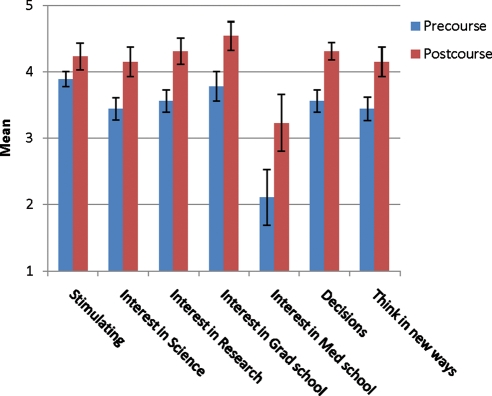
Our study, focused on classroom-based research at the introductory level and using the Phage Genomics course as the model, shows evidence that first-year students doing research learn the process of science as well as how scientists practice science. A preliminary but notable outcome of our work, which is based on a small sample, is the change in student interest in considering different career choices such as graduate education and science in general. This is particularly notable, as previous research has described research internships as clarifying or confirming rather than changing undergraduates’ decisions to pursue graduate education. We hypothesize that our results differ from previous studies of the impact of engaging in research because the students in our study are still in the early stages of their undergraduate careers. Our work builds upon the classroom-based research movement and should be viewed as encouraging to the Vision and Change in Undergraduate Biology Education movement advocated by the American Association for the Advancement of Science, the National Science Foundation, and other undergraduate education stakeholders.
Overview
The claims and statistics of this paper haven’t been checked yet.
Run the check — free, no account needed. It reads the open-access text and checks the sources it cites.
Integrity signals
Registry
Cites
Statistics
Figures
Verification
Claims the paper makes
The claims and statistics of this paper haven’t been checked yet.
Run the check — free, no account needed. It reads the open-access text and checks the sources it cites.
Claims other papers make about this one
Each is checked against this paper’s own text: does it say what the citing paper says it does?
The source backs part of the claim, not all of it — or backs it for a different population, condition or comparison.
In the citing paper
“Changing students’ negative views of researchers/research careers is a likely required first step, if such students are to be inspired to undertake undergraduate research experiences that can lead to research careers (Harrison et al., 2011).”
From CREATE Cornerstone: Introduction to Scientific Thinking, a New Course for STEM-Interested Freshmen, Demystifies Scientific Thinking through Analysis of Scientific Literature (2013) · cites this paper as Harrison et al., 2011
Experimental — accuracy not yet measured
Self-check
Percentages, sums and reported differences re-computed from the paper’s own numbers.
The self-check needs the paper’s full text.
Citations
Cites
Three Approaches to Qualitative Content Analysis
Hsieh, H.-F., & Shannon, S. E. (2005) · Qualitative Health Research · doi:10.1177/1049732305276687 · Cited by 44,601
Rising Above The Gathering Storm: Energizing and Employing America for a Brighter Economic Future
Augustine, N. R. (2006) · Cited by 2,064
Benefits of Undergraduate Research Experiences
Russell, S. H., Hancock, M. P., & McCullough, J. (2007) · Science · doi:10.1126/science.1140384 · Cited by 1,380
Qualitative Analysis on Stage: Making the Research Process More Public
Anfara, V. A., Brown, K. M., & Mangione, T. L. (2002) · Educational Researcher · doi:10.3102/0013189x031007028 · Cited by 1,362
Seymour, E., Hunter, A., Laursen, S. L., & DeAntoni, T. (2004) · Science Education · doi:10.1002/sce.10131 · Cited by 1,332
Hunter, A., Laursen, S. L., & Seymour, E. (2007) · Science Education · doi:10.1002/sce.20173 · Cited by 1,324
Undergraduate research experiences support science career decisions and active learning
Lopatto, D. (2007) · CBE—Life Sciences Education · doi:10.1187/cbe.07-06-0039 · Cited by 1,009
Self-citationSurvey of undergraduate research experiences (SURE): First findings
Lopatto, D. (2004) · Cell Biology Education · doi:10.1187/cbe.04-07-0045 · Cited by 969
Self-citationBIO2010 : Transforming Undergraduate Education for Future Research Biologists
Earth, D. O. (2003) · Cited by 854
Duschl, R. A., & Grandy, R. E. (2008) · BRILL eBooks · doi:10.1163/9789460911453 · Cited by 327
Research works printed but not linked: 6
- Brodl MR, 2005, Bioscene. J Biol College Teach, 31, 13
- Elwess NL, 2004, Bioscene. J College Biol Teach, 30, 25
- Hatfull GF, 2010, Microbe, 5, 243
- Lopatto D, 2003, Council on Undergraduate Research Quarterly, Spring 2003, 139
- Lopatto D, 2006, Peer Rev, 8, 22
- Ronsheim ML, 2009, Bioscene. J Biol College Teach, 35, 12
Cited by
Sorted by citations
Assessment of Course-Based Undergraduate Research Experiences: A Meeting Report
Auchincloss, L. C., Laursen, S. L., Branchaw, J. L., Eagan, K., Graham, M., Hanauer, D. I., Lawrie, G., McLinn, C. M., Pelaez, N., Rowland, S., et al. (2014) · CBE—Life Sciences Education · doi:10.1187/cbe.14-01-0004 · Cited by 1,043
Undergraduate research experiences: Impacts and opportunities
Linn, M. C., Palmer, E., Baranger, A. M., Gerard, E., & Stone, E. M. (2015) · Science · doi:10.1126/science.1261757 · Cited by 829
Jordan, T. C., Burnett, S. H., Carson, S., Caruso, S. M., Clase, K., DeJong, R. J., Dennehy, J. J., Denver, D. R., Dunbar, D., Elgin, S. C. R., et al. (2014) · mBio · doi:10.1128/mbio.01051-13 · Cited by 509
Self-citationCorwin, L. A., Graham, M. J., & Dolan, E. L. (2015) · CBE—Life Sciences Education · doi:10.1187/cbe.14-10-0167 · Cited by 513
Brownell, S. E., & Kloser, M. J. (2015) · Studies in Higher Education · doi:10.1080/03075079.2015.1004234 · Cited by 241
Giving back or giving up: Native American student experiences in science and engineering.
Smith, J. L., Cech, E. A., Metz, A. M., Huntoon, M. I., & Moyer, C. (2014) · Cultural Diversity & Ethnic Minority Psychology · doi:10.1037/a0036945 · Cited by 202
Faculty Perspectives on Developing and Teaching Course-Based Undergraduate Research Experiences
Shortlidge, E. E., Bangera, G., & Brownell, S. E. (2015) · BioScience · doi:10.1093/biosci/biv167 · Cited by 196
Shaffer, C. D., Alvarez, C. J., Bednarski, A. E., Dunbar, D., Goodman, A. L., Reinke, C., Rosenwald, A. G., Wolyniak, M. J., Bailey, C., Barnard, D., et al. (2014) · CBE—Life Sciences Education · doi:10.1187/cbe-13-08-0152 · Cited by 178
Self-citationCorwin, L. A., Runyon, C., Ghanem, E., Sandy, M., Clark, G., Palmer, G. C., Reichler, S. A., Rodenbusch, S. E., & Dolan, E. L. (2018) · CBE—Life Sciences Education · doi:10.1187/cbe.17-07-0141 · Cited by 180
Chemical Exploration with Virtual Reality in Organic Teaching Laboratories
Ferrell, J. B., Campbell, J. P., McCarthy, D. R., McKay, K. T., Hensinger, M. J., Srinivasan, R., Zhao, X., Wurthmann, A., Li, J., & Schneebeli, S. T. (2019) · Journal of Chemical Education · doi:10.1021/acs.jchemed.9b00036 · Cited by 131
Gottesman, A. J., & Hoskins, S. G. (2013) · CBE—Life Sciences Education · doi:10.1187/cbe.12-11-0201 · Cited by 123
“Providing this training early in students’ academic experience might help students gain skills and develop attitudes that would support their persistence in STEM (Harrison et al., 2011).”
BackgroundPromoting Inquiry-Based Teaching in Laboratory Courses: Are We Meeting the Grade?
Beck, C., Butler, A., & Burke da Silva, K. (2014) · CBE—Life Sciences Education · doi:10.1187/cbe.13-12-0245 · Cited by 118
Molecular Genetics of Mycobacteriophages
Hatfull, G. F. (2014) · Microbiology Spectrum · doi:10.1128/microbiolspec.mgm2-0032-2013 · Cited by 100
Buchanan, A. J., & Fisher, G. R. (2022) · CBE—Life Sciences Education · doi:10.1187/cbe.22-04-0069 · Cited by 120
Shortlidge, E. E., & Brownell, S. E. (2016) · Journal of Microbiology and Biology Education · doi:10.1128/jmbe.v17i3.1103 · Cited by 105
Esparza, D., Wagler, A. E., & Olimpo, J. T. (2020) · CBE—Life Sciences Education · doi:10.1187/cbe.19-04-0082 · Cited by 96
Clark, T. M., Ricciardo, R. A., & Weaver, T. (2015) · Journal of Chemical Education · doi:10.1021/acs.jchemed.5b00371 · Cited by 88
Whitley, K. V., Tueller, J. A., & Weber, K. S. (2020) · International Journal of Molecular Sciences · doi:10.3390/ijms21030768 · Cited by 95
Shapiro, C. A., Parker, J. M., Toma, S., Ayon, C., Zimmerman, H. B., Roth-Johnson, E. A., Hancock, S. P., Levis‐Fitzgerald, M., & Sanders, E. R. (2015) · Journal of Microbiology and Biology Education · doi:10.1128/jmbe.v16i2.1045 · Cited by 83
Nostrand, D. F.-V., & Pollenz, R. S. (2017) · CBE—Life Sciences Education · doi:10.1187/cbe.16-10-0294 · Cited by 88
A Review of Course-Based Undergraduate Research Experiences in Chemistry
Watts, F. M., & Rodriguez, J.-M. G. (2023) · Journal of Chemical Education · doi:10.1021/acs.jchemed.3c00570 · Cited by 75
Gasper, B. J., & Gardner, S. M. (2013) · Journal of Microbiology and Biology Education · doi:10.1128/jmbe.v14i1.460 · Cited by 66
Kortz, K. M., & Kraft, K. J. V. D. H. (2016) · Journal of Geoscience Education · doi:10.5408/15-11.1 · Cited by 65
Ward, J. R., Clarke, H. D., & Horton, J. L. (2014) · CBE—Life Sciences Education · doi:10.1187/cbe.13-12-0231 · Cited by 72
Undergraduate Research Experience Models: A systematic review of the literature from 2011 to 2021
Ahmad, Z., & Al-Thani, N. J. (2022) · International Journal of Educational Research · doi:10.1016/j.ijer.2022.101996 · Cited by 78
Premo, J., Cavagnetto, A. R., Davis, W. B., & Brickman, P. (2018) · CBE—Life Sciences Education · doi:10.1187/cbe.17-08-0176 · Cited by 69
Hester, S. D., Nadler, M., Katcher, J., Elfring, L. K., Dykstra, E. A., Rezende, L. F., & Bolger, M. S. (2018) · CBE—Life Sciences Education · doi:10.1187/cbe.18-06-0090 · Cited by 58
A Model for an Introductory Undergraduate Research Experience
Canaria, J. A., Schoffstall, A. M., Weiss, D. J., Henry, R., & Braun‐Sand, S. (2012) · Journal of Chemical Education · doi:10.1021/ed200582v · Cited by 56
Open Science Promotes Diverse, Just, and Sustainable Research and Educational Outcomes
Grahe, J. E., Cuccolo, K., Leighton, D. C., & Alvarez, L. D. C. (2019) · Psychology Learning & Teaching · doi:10.1177/1475725719869164 · Cited by 58
Staub, N. L., Poxleitner, M. K., Braley, A. B., Smith-Flores, H., Pribbenow, C. M., Jaworski, L., Lopatto, D. E., & Anders, K. R. (2016) · CBE—Life Sciences Education · doi:10.1187/cbe.15-10-0211 · Cited by 57
Self-citationWolfe, B. A., & Riggs, E. M. (2017) · Journal of Geoscience Education · doi:10.5408/17-256.1 · Cited by 53
Hillman, S. J., Zeeman, S. I., Tilburg, C. E., & List, H. E. (2016) · Learning Environments Research · doi:10.1007/s10984-016-9205-x · Cited by 50
Malotky, M., Mayes, K. M., Price, K. M., Smith, G., Mann, S. N., Guinyard, M. W., Veale, S., Ksor, V., Siu, L., Mlo, H., et al. (2020) · Journal of Microbiology and Biology Education · doi:10.1128/jmbe.v21i1.1939 · Cited by 56
Heemstra, J. M., Waterman, R., Antos, J. M., Beuning, P. J., Bur, S. K., Columbus, L. M., Feig, A. L., Fuller, A. A., Gillmore, J. G., Leconte, A. M., et al. (2017) · ACS symposium series · doi:10.1021/bk-2017-1248.ch003 · Cited by 48
Innovations in Undergraduate Science Education: Going Viral
Hatfull, G. F. (2015) · Journal of Virology · doi:10.1128/jvi.03003-14 · Cited by 48
Caruso, J. P., Israel, N., Rowland, K., Lovelace, M. J., & Saunders, M. J. (2016) · Journal of Microbiology and Biology Education · doi:10.1128/jmbe.v17i1.1011 · Cited by 48
Frantz, K. J., Demetrikopoulos, M. K., Britner, S. L., Carruth, L. L., Williams, B. A., Pecore, J. L., DeHaan, R. L., & Goode, C. T. (2017) · CBE—Life Sciences Education · doi:10.1187/cbe.16-06-0206 · Cited by 46
Adding Authenticity to Inquiry in a First-Year, Research-Based, Biology Laboratory Course
Indorf, J. L., Weremijewicz, J., Janos, D. P., & Gaines, M. S. (2019) · CBE—Life Sciences Education · doi:10.1187/cbe.18-07-0126 · Cited by 49
Heim, A. B., & Holt, E. A. (2019) · CBE—Life Sciences Education · doi:10.1187/cbe.18-09-0193 · Cited by 50
Wang, J. T. H. (2017) · FEMS Microbiology Letters · doi:10.1093/femsle/fnx157 · Cited by 43
Longitudinal study of teacher acceptance of mobile virtual labs
Kolil, V. K., & Achuthan, K. (2022) · Education and Information Technologies : Official Journal of the IFIP technical committee on Education · doi:10.1007/s10639-022-11499-2 · Cited by 40
Molecular Genetics of Mycobacteriophages
Hatfull, G. F. (2015) · ASM Press eBooks · doi:10.1128/9781555818845.ch5 · Cited by 38
Tomasik, J. H., Lecaptain, D. J., Murphy, S. A., Martin, M., Knight, R. M., Harke, M. A., Burke, R., Beck, K. L., & Acevedo-Polakovich, I. D. (2014) · Journal of Chemical Education · doi:10.1021/ed5000313 · Cited by 37
Storytelling as Pedagogy: The Power of Chemistry Stories as a Tool for Classroom Engagement
Collins, S. N., Steele, T., & Nelson, M. (2023) · Journal of Chemical Education · doi:10.1021/acs.jchemed.3c00008 · Cited by 36
Sarmah, S., Chism, G. W., Vaughan, M. A., Muralidharan, P., Marrs, J. A., & Marrs, K. A. (2016) · Zebrafish · doi:10.1089/zeb.2015.1107 · Cited by 35
Out of the Curricular Shadows: Revolutionizing Undergraduate Immunology Education
Bruns, H. A., Deaver, J., & Justement, L. B. (2019) · Frontiers in Immunology · doi:10.3389/fimmu.2019.02446 · Cited by 35
Wiley, E. A., & Stover, N. A. (2014) · CBE—Life Sciences Education · doi:10.1187/cbe.13-07-0140 · Cited by 34
Science-writing in the blogosphere as a tool to promote autonomous motivation in education
Kramer, I. M., & Kusurkar, R. A. (2017) · The Internet and Higher Education · doi:10.1016/j.iheduc.2017.08.001 · Cited by 38
Dvorak, A. L., & Ruiz, E. H. (2019) · Journal of Music Therapy · doi:10.1093/jmt/thy020 · Cited by 33
Burnette, J. M., & Wessler, S. R. (2012) · Genetics · doi:10.1534/genetics.112.147355 · Cited by 33
Impact of the Surgical Research Methodology Program on Surgical Residents’ Research Profiles
Farrokhyar, F., Amin, N., Dath, D., Bhandari, M., Kelly, S., Kolkin, A. M., Pottruff, C. G., Skot, M., & Reid, S. (2014) · Journal of surgical education · doi:10.1016/j.jsurg.2014.01.012 · Cited by 32
D’Angelo, J. G. (2023) · Journal of Chemical Education · doi:10.1021/acs.jchemed.2c00694 · Cited by 30
Kuchynka, S. L., Nostrand, D. F.-V., & Pollenz, R. S. (2019) · CBE—Life Sciences Education · doi:10.1187/cbe.19-01-0028 · Cited by 34
Díaz-Martínez, L. A., Fisher, G. R., Esparza, D., Bhatt, J. M., D’Arcy, C. E., Apodaca, J., Brownell, S. E., Corwin, L. A., Davis, W. B., Floyd, K. W., et al. (2019) · CBE—Life Sciences Education · doi:10.1187/cbe.18-10-0203 · Cited by 35
Linking teaching and research in an undergraduate course and exploring student learning experiences
Wallin, P., Adawi, T., & Gold, J. (2016) · European Journal of Engineering Education · doi:10.1080/03043797.2016.1193125 · Cited by 29
Genné-Bacon, E. A., Wilks, J. C., & Bascom‐Slack, C. (2020) · CBE—Life Sciences Education · doi:10.1187/cbe.19-10-0208 · Cited by 34
Faber, C. J., Kajfez, R. L., Lee, D. M., Benson, L., Kennedy, M. S., & Creamer, E. G. (2021) · Journal of Research in Science Teaching · doi:10.1002/tea.21736 · Cited by 32
RESEARCH BASED LEARNING IN HIGHER EDUCATION: A REVIEW OF LITERATURE
Camacho, M. H., Valcke, M., & Chiluiza, K. (2017) · INTED proceedings · doi:10.21125/inted.2017.1004 · Cited by 27
Gya, R., & Bjune, A. E. (2021) · Ecology and Evolution · doi:10.1002/ece3.7207 · Cited by 27
pClone: Synthetic Biology Tool Makes Promoter Research Accessible to Beginning Biology Students
Campbell, A. M., Eckdahl, T. T., Cronk, B. C., Andresen, C., Frederick, P., Huckuntod, S., Shinneman, C., Wacker, A., & Yuan, J. X. ‐. (2014) · CBE—Life Sciences Education · doi:10.1187/cbe.13-09-0189 · Cited by 25
Early Research: A Strategy for Inclusion and Student Success
Murray, D. H., Obare, S. O., & Hageman, J. H. (2016) · ACS symposium series · doi:10.1021/bk-2016-1231.ch001 · Cited by 24
Goodwin, E. C., Cary, J. R., & Shortlidge, E. E. (2021) · CBE—Life Sciences Education · doi:10.1187/cbe.21-04-0106 · Cited by 29
Extending Your Research Team: Learning Benefits When a Laboratory Partners with a Classroom
Miller, C. W., Hamel, J. A., Holmes, K. D., Helmey-Hartman, W. L., & Lopatto, D. E. (2013) · BioScience · doi:10.1093/bioscience/63.9.754 · Cited by 24
Self-citationOlimpo, J. T., Díaz-Martínez, L. A., Bhatt, J. M., & D’Arcy, C. E. (2017) · Journal of Microbiology and Biology Education · doi:10.1128/jmbe.v18i2.1344 · Cited by 24
Delventhal, R., & Steinhauer, J. (2020) · PLoS ONE · doi:10.1371/journal.pone.0230912 · Cited by 27
Gormally, C. L. (2017) · CBE—Life Sciences Education · doi:10.1187/cbe.16-06-0194 · Cited by 23
Pathways over Time: Functional Genomics Research in an Introductory Laboratory Course
Reeves, T. D., Warner, D. M., Ludlow, L. H., & O’Connor, C. M. (2018) · CBE—Life Sciences Education · doi:10.1187/cbe.17-01-0012 · Cited by 25
BUILD EXITO: a multi-level intervention to support diversity in health-focused research
Richardson, D. M., Keller, T. E., Wolf, D., Zell, A., Morris, C. D., & Crespo, C. J. (2017) · BMC Proceedings · doi:10.1186/s12919-017-0080-y · Cited by 23
Wu, X. B., Sandoval, C. L., Knight, S. L., Jaime, X. A., Macik, M., & Schielack, J. F. (2021) · International Journal of STEM Education · doi:10.1186/s40594-021-00290-3 · Cited by 31
Smith, K. P. W., Waddell, E. A., Dean, A. N., Anandan, S., Gurney, S. M. R., Kabnick, K., Little, J. L., McDonald, M. B., Mohan, J., Marenda, D. R., et al. (2021) · Journal of Biological Education · doi:10.1080/00219266.2021.1933135 · Cited by 28
Goodwin, E. C., Cary, J. R., Phan, V. D., Therrien, H., & Shortlidge, E. E. (2023) · Journal of Research in Science Teaching · doi:10.1002/tea.21848 · Cited by 28
Beyond the Teaching Assistantship: CURE Leadership as a Training Platform for Future Faculty
Cascella, B., & Jez, J. M. (2017) · Journal of Chemical Education · doi:10.1021/acs.jchemed.7b00705 · Cited by 22
McLaughlin, J., Patel, M., Johnson, D. K., & de la Rosa, C. L. (2018) · Frontiers The Interdisciplinary Journal of Study Abroad · doi:10.36366/frontiers.v30i3.424 · Cited by 21
CRISPR-Cas Technology In and Out of the Classroom
Dahlberg, L., & Groat-Carmona, A. M. (2018) · The CRISPR Journal · doi:10.1089/crispr.2018.0007 · Cited by 20
Undergraduate Research or Research-Based Courses: Which Is Most Beneficial for Science Students?
Olivares-Donoso, R., & González, C. (2017) · Research in Science Education · doi:10.1007/s11165-017-9616-4 · Cited by 25
Hanson, P. K., & Stultz, L. K. (2021) · Journal of Chemical Education · doi:10.1021/acs.jchemed.1c00575 · Cited by 20
DeChenne-Peters, S. E., & Scheuermann, N. L. (2022) · CBE—Life Sciences Education · doi:10.1187/cbe.21-06-0154 · Cited by 20
Impacting resilience and persistence in underrepresented populations through service-learning
Daniels, K. N., Billingsley, K. Y., Billingsley, J. T., Long, Y., & Young, D. L. (2015) · Journal for Multicultural Education · doi:10.1108/jme-02-2015-0005 · Cited by 25
Peteroy-Kelly, M. A., Marcello, M. R., Crispo, E., Buraei, Z., Strahs, D., Isaacson, M. K., Jaworski, L., Lopatto, D. E., & Zuzga, D. S. (2017) · Journal of Microbiology and Biology Education · doi:10.1128/jmbe.v18i1.1226 · Cited by 20
Self-citationStimulating Students’ Learning in Analytical Chemistry through an Environmental-Based CURE Project
Muna, G. W. (2021) · Journal of Chemical Education · doi:10.1021/acs.jchemed.0c01326 · Cited by 19
McDonald, K., Martin, A. R., Watters, C. P., & Landerholm, T. E. (2019) · The journal of college science teaching · doi:10.2505/4/jcst19_048_03_14 · Cited by 18
Alaee, D. Z., Campbell, M. K., & Zwickl, B. M. (2022) · Physical Review Physics Education Research · doi:10.1103/physrevphyseducres.18.010101 · Cited by 23
Alaimo, P. J., Langenhan, J. M., & Suydam, I. T. (2014) · Journal of Chemical Education · doi:10.1021/ed400510b · Cited by 18
Hekmat‐Scafe, D. S., Brownell, S. E., Seawell, P. C., Malladi, S., Conklin, J. F., Singla, V., Bradon, N., Cyert, M., & Stearns, T. (2016) · Biochemistry and Molecular Biology Education · doi:10.1002/bmb.21024 · Cited by 18
Mediating Students’ Fixation with Grades in an Inquiry-Based Undergraduate Biology Course
DeFeo, D. J., Tran, T. C., & Gerken, S. (2020) · Science & Education · doi:10.1007/s11191-020-00161-3 · Cited by 18
Cooper, A. C., Southard, K. M., Osness, J. B., & Bolger, M. S. (2022) · CBE—Life Sciences Education · doi:10.1187/cbe.21-07-0177 · Cited by 17
A Pharmacology-Based Enrichment Program for Undergraduates Promotes Interest in Science
Godin, E. A., Wormington, S. V., Perez, T., Barger, M. M., Snyder, K. E., Richman, L. S., Schwartz‐Bloom, R. D., & Linnenbrink‐Garcia, L. (2015) · CBE—Life Sciences Education · doi:10.1187/cbe.15-02-0043 · Cited by 17
PUMAA: A Platform for Accessible Microbiome Analysis in the Undergraduate Classroom
Mitchell, K., Ronas, J. R., Dao, C., Freise, A. C., Mangul, S., Shapiro, C. A., & Parker, J. M. (2020) · Frontiers in Microbiology · doi:10.3389/fmicb.2020.584699 · Cited by 19
Miller, C. W., Hamel, J. A., Holmes, K. D., Helmey-Hartman, W. L., & Lopatto, D. E. (2013) · BioScience · doi:10.1525/bio.2013.63.9.11 · Cited by 17
Self-citationIntegrating Large Language Models into the Chemistry and Materials Science Laboratory Curricula
Maughan, A. E., Toberer, E. S., & Zevalkink, A. (2025) · Chemistry of Materials · doi:10.1021/acs.chemmater.5c00111 · Cited by 18
Smythers, A. L., Ford, M. M., Hawkins, D. G., Connor, M. C., Lawrence, K. C., Stanton, C. R., Gayton, A. C., & Hicks, L. M. (2021) · Journal of Chemical Education · doi:10.1021/acs.jchemed.0c01269 · Cited by 16
Goodwin, E. C., Cary, J. R., & Shortlidge, E. E. (2022) · PLOS ONE · doi:10.1371/journal.pone.0275313 · Cited by 16
An Experimental Ethics Approach to Robot Ethics Education
Williams, T., Zhu, Q., & Grollman, D. H. (2020) · Proceedings of the AAAI Conference on Artificial Intelligence · doi:10.1609/aaai.v34i09.7067 · Cited by 16
Cartwright, N. M., Liddle, D. M., Arceneaux, B. G., Newton, G. S., & Monk, J. M. (2020) · International Journal of Higher Education · doi:10.5430/ijhe.v9n6p64 · Cited by 16
Student Attitudes Contribute to the Effectiveness of a Genomics CURE
Lopatto, D. E., Rosenwald, A., Burgess, R. C., Key, C. S., Stry, M. V., Wawersik, M. J., DiAngelo, J. R., Hark, A. T., Skerritt, M. P., Allen, A. K., et al. (2022) · Journal of Microbiology and Biology Education · doi:10.1128/jmbe.00208-21 · Cited by 17
Self-citationMiller, D. M., Natale, A., McAnulty, T. K., Swope, R. D., McNaughton, E. A., Beckett, A., Snoke, H. E., Schmidt, A. M., Alumasa, J. N., & Xiong, S. (2022) · Journal of Chemical Education · doi:10.1021/acs.jchemed.1c01179 · Cited by 19
Role of Research Educator in sequential course-based undergraduate research experience program
Light, C. J., Fegley, M., & Stamp, N. E. (2019) · FEMS Microbiology Letters · doi:10.1093/femsle/fnz140 · Cited by 15
Dorn, S. K., Newman, J. D., van Kessel, J. C., & Brown, L. C. W. (2021) · Journal of Chemical Education · doi:10.1021/acs.jchemed.1c00596 · Cited by 14
Messager, M., Comte, L., Couto, T. B. A., Koontz, E. D., Kuehne, L. M., Rogosch, J. S., Stiling, R. R., & Olden, J. D. (2022) · Frontiers in Ecology and the Environment · doi:10.1002/fee.2507 · Cited by 14
There's an app for that: Teaching entomology in the online age
Mech, A. M., Rosenberger, D. W., Fanning, P. D., Riggins, J. J., Aukema, B. H., & Hartshorn, J. A. (2022) · Natural sciences education · doi:10.1002/nse2.20081 · Cited by 14
Metadata
- Authors
- Harrison, M., Dunbar, D., Ratmansky, L., Boyd, K., & Lopatto, D.
- Affiliations
- Cabrini University (US)
- Grinnell College (US)
- Corresponding author
- Dunbar, David
- Venue
- CBE—Life Sciences Education
- Published
- 2011-09
- Volume
- 10
- Issue
- 3
- Pages
- 279-286
- ISSN
- 1931-7913 (ISSN-L)
- PMC
- PMC3164567
- OpenAlex
- W2169289905
- Cited by
- 283
- References
- 31
- Citations by year
- 2026: 6 · 2025: 14 · 2024: 12 · 2023: 25 · 2022: 36 · 2021: 38 · 2020: 26 · 2019: 30 · 2018: 13 · 2017: 24 · 2016: 18 · 2015: 16 · 2014: 15 · 2013: 7 · 2012: 3
- FWCI
- 38.48
- Type
- journal article
- Language
- en
- Open access
- hybrid
- doi.org
- Licence
- cc-by-nc-sa
- Locations
- CBE—Life Sciences Education (publishedVersion, cc-by-nc-sa)
- PubMed Central (publishedVersion, cc-by-nc-sa)
- PubMed (publishedVersion)
- Funders
- National Science Foundation (0715777)
- Howard Hughes Medical Institute
- American Association for the Advancement of Science
- Topics
- Social Sciences › Education › Science Education and Pedagogy
- Social Sciences › Psychology › Applied Psychology › Career Development and Diversity
- Social Sciences › Education › Undergraduate Neuroscience Education and Research
- Keywords
- classroom research, undergraduate research, introductory science courses, career choice, graduate education, student attitudes toward science, scientific method, first-year students
- MeSH terms
- Attitude, Bacteriophages, Career Choice, Curriculum, Data Collection, Education, Graduate, Research, Science, Students, Genomics, Comprehension
About these checks
Registry, retraction, Cites and statistics results are computed, not judged, with one exception: a printed reference that no index lists is read once by a model before it counts as a citation error. Claims are extracted by a model and kept only when their quote appears verbatim in the text; each cited source is then checked, with a model’s help, for whether it says what the claim relies on. Those verdicts can be wrong — read the claim’s quote and the cited source before relying on one.
Statistics and arithmetic are recomputed, not judged.
Confidence bands are shown only for fields calibrated on our annotated test set. None is calibrated yet, so no band is shown.
What counts as a claim ›How we measure confidence ›How we check this ›
Are you an author, or do you see a problem with this page? Request a review
