

The DOI matches its Crossref record; 71 of the 72 references it cites were found in a registry or an index.
Getting Under the Hood: How and for Whom Does Increasing Course Structure Work?
Open accessAbstract
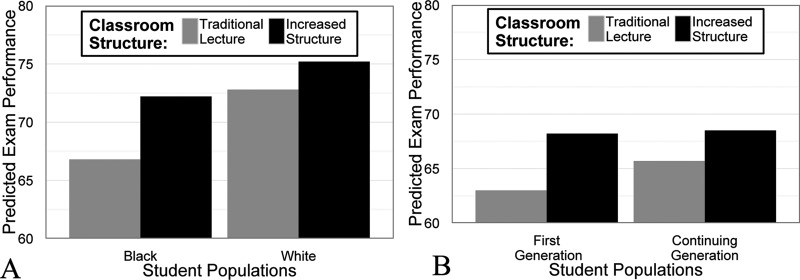
At the college level, the effectiveness of active-learning interventions is typically measured at the broadest scales: the achievement or retention of all students in a course. Coarse-grained measures like these cannot inform instructors about an intervention's relative effectiveness for the different student populations in their classrooms or about the proximate factors responsible for the observed changes in student achievement. In this study, we disaggregate student data by racial/ethnic groups and first-generation status to identify whether a particular intervention-increased course structure-works better for particular populations of students. We also explore possible factors that may mediate the observed changes in student achievement. We found that a "moderate-structure" intervention increased course performance for all student populations, but worked disproportionately well for black students-halving the black-white achievement gap-and first-generation students-closing the achievement gap with continuing-generation students. We also found that students consistently reported completing the assigned readings more frequently, spending more time studying for class, and feeling an increased sense of community in the moderate-structure course. These changes imply that increased course structure improves student achievement at least partially through increasing student use of distributed learning and creating a more interdependent classroom community.
Overview
The claims and statistics of this paper haven’t been checked yet.
Run the check — free, no account needed. It reads the open-access text and checks the sources it cites.
Integrity signals
Registry
Cites
Statistics
Figures
Verification
Claims the paper makes
The claims and statistics of this paper haven’t been checked yet.
Run the check — free, no account needed. It reads the open-access text and checks the sources it cites.
Claims other papers make about this one
Each is checked against this paper’s own text: does it say what the citing paper says it does?
The source backs part of the claim, not all of it — or backs it for a different population, condition or comparison.
In the citing paper
“students in active-learning course designs that reduced or eliminated achievement gaps have reported an increased sense of community and self-efficacy compared to their peers in the lecture-intensive version of the same course (22, 23).”
From Active learning narrows achievement gaps for underrepresented students in undergraduate science, technology, engineering, and math (2020) · cites this paper as [22]
Experimental — accuracy not yet measuredThe source backs part of the claim, not all of it — or backs it for a different population, condition or comparison.
In the citing paper
“Disturbingly, data demonstrate that retention rates for first-generation college students in STEM are lower than those of continuing generation college students (Chen, 2013; Doerschuk et al., 2016) especially in key gatekeeping courses like General Biology and General Chemistry (Eddy & Hogan, 2014; Gregg-Jolly et al., 2016; Harackiewicz et al., 2014).”
From Exploring Organic Chemistry I students’ responses to an exam wrapper intervention. (2020) · cites this paper as Eddy & Hogan, 2014
Experimental — accuracy not yet measuredThe cited source says what the claim attributes to it.
In the citing paper
“Auspiciously however, interventions involving student centered pedagogies have shown excellent promise in combating these trends (Crimmins, 2017; Eddy & Hogan, 2014; Haak, HilleRisLambers, Pitre, & Freeman, 2011).”
From Exploring Organic Chemistry I students’ responses to an exam wrapper intervention. (2020) · cites this paper as Eddy & Hogan, 2014
Self-check
Percentages, sums and reported differences re-computed from the paper’s own numbers.
The self-check needs the paper’s full text.
Citations
Cites
Modern Applied Statistics with S
Venables, W. N., & Ripley, B. D. (2002) · Statisctics and computing/Statistics and computing · doi:10.1007/978-0-387-21706-2 · Cited by 25,941
Active learning increases student performance in science, engineering, and mathematics
Freeman, S., Eddy, S. L., McDonough, M., Smith, M. K., Okoroafor, N., Jordt, H., & Wenderoth, M. P. (2014) · Proceedings of the National Academy of Sciences · doi:10.1073/pnas.1319030111 · Cited by 9,787 · cited 2×
“This type of research is being referred to as second-generation education research (Eddy et al., 2013; Freeman et al., 2014) and will help refine and optimize active-learning interventions by identifying the critical elements that make an intervention effective.”
BackgroundSelf-citationOther people's children: cultural conflict in the classroom
(1995) · Choice Reviews Online · doi:10.5860/choice.32-6344 · Cited by 3,898
Dunlosky, J., Rawson, K. A., Marsh, E. J., Nathan, M. J., & Willingham, D. T. (2013) · Psychological Science in the Public Interest · doi:10.1177/1529100612453266 · Cited by 3,138
Other people’s children: Cultural conflict in the classroom
Delpit, L. (1995) · College Composition and Communication · doi:10.2307/358724 · Cited by 2,502 · cited 1×
“Yet the different racial and ethnic groups that are included in the URM designation have very different cultures, histories, and exposure to college culture that could impact whether a particular classroom strategy is effective for them (Delpit, 2006).”
BackgroundA question of belonging: Race, social fit, and achievement.
Walton, G. M., & Cohen, G. L. (2007) · Journal of Personality and Social Psychology · doi:10.1037/0022-3514.92.1.82 · Cited by 2,163 · cited 1×
“Finally, feeling like they are part of a community increases both performance and motivation, especially for historically underrepresented groups (Walton and Cohen, 2007; Walton et al., 2012).”
BackgroundHurtado, S., & Carter, D. F. (1997) · Sociology of Education · doi:10.2307/2673270 · Cited by 1,938 · cited 1×
“…of our study, arguably as important as increased performance, because a sense of being part of a community (belonging) is crucial for retention (Hurtado and Carter, 1997; Hoffman et al., 2002) and has been 464 CBE—Life Sciences Education correlated with increased performance for…”
BackgroundStudent Engagement and Student Learning: Testing the Linkages*
Carini, R. M., Kuh, G. D., & Klein, S. P. (2006) · Research in Higher Education · doi:10.1007/s11162-005-8150-9 · Cited by 1,799 · cited 1×
“Thus, through increased engagement with the material (because of increased interest in it) student performance will increase (Carini et al., 2006).”
BackgroundAmbient belonging: how stereotypical cues impact gender participation in computer science
Cheryan, S., Plaut, V. C., Davies, P. G., & Steele, C. M. (2009) · Journal of Personality and Social Psychology · doi:10.1037/a0016239 · Cited by 1,372 · cited 1×
“When discussing reasons for leaving STEM, many students, particularly students of color and women, describe feelings of isolation and lack of belonging (Hewlett et al., 2008; Cheryan et al., 2009; Strayhorn, 2011).”
BackgroundStephens, N. M., Fryberg, S. A., Markus, H. R., Johnson, C. S., & Covarrubias, R. (2012) · Journal of Personality and Social Psychology · doi:10.1037/a0027143 · Cited by 1,312
Research works printed but not linked: 17
- Bodenhofer U, 2008, Mathware Soft Comput, 15, 5
- Borrego M, 2013, J Eng Educ, 102, 294
- Burchfield CM, 2000, Teach Psychol, 17, 58
- Dirks C, 2006, Cell Biol Educ, 5, 218
- Fassinger PA, 2000, J Class Inter, 35, 38
- Fox J, 2010, An R Companion to Applied Regression
- Handelsman J, 2007, Scientific Teaching
- Hewlett SA, 2008, The Athena Factor: Reversing the Brain Drain in Science. Engineering, and Technology
- Keeler CM, 1995, J Stats Educ, 3, 1
- Lee P, 2011, Harvard Kennedy School's Asian American Policy Review, 21, 19
- Minchella DJ, 2002, Am Biol Teach, 64, 352, 10.2307/4451310 · DOI
- National Science Foundation, 2013, Division of Undergraduate Education NSF, 13
- Poelzer GH, 2008, J Coll Sci Teach, 38, 59
- Sharma MD, 2005, Austral J Educ Tech, 21, 137
- Tsui L, 2002, J High Educ, 73, 740
- Tsui L, 2007, J Negro Educ, 76, 555
- van Wyk MM, 2012, J Soc Sci, 33, 261
Cited by
Sorted by citations
Items 201–300 of 553
Mnguni, L. E. (2023) · Journal of Pedagogical Sociology and Psychology · doi:10.33902/jpsp.202322298 · Cited by 17
Using Active Learning to Teach Concepts and Methods in Quantitative Biology
Waldrop, L., Adolph, S. C., Behn, C. D., Braley, E., Drew, J., Full, R. J., Gross, L. J., Jungck, J. R., Kohler, B., Prairie, J. C., et al. (2015) · Integrative and Comparative Biology · doi:10.1093/icb/icv097 · Cited by 17
“Freeman et al. (2011) described how to increase course structure from low (lecture-based) to high (active learning), and a follow up study by Eddy and Hogan (2014) included some specific examples of how course structure was improved for an introductory biology class.”
BackgroundVirtual and Augmented Reality in Medical Education and Training
Papadopoulou, P., Chui, K. T., Daniela, L., & Lytras, M. D. (2019) · Advances in educational technologies and instructional design book series · doi:10.4018/978-1-5225-9031-6.ch006 · Cited by 16
Evidence-Inspired Choices for Teachers: Team-Based Learning and Interactive Lecture
Jakobsen, K. V., & Daniel, D. B. (2019) · Teaching of Psychology · doi:10.1177/0098628319872411 · Cited by 17
Reese, A. J. (2020) · Journal of Microbiology and Biology Education · doi:10.1128/jmbe.v21i1.1947 · Cited by 17
Integrative STEM education for undergraduate neuroscience: Design and implementation
Basu, A. C., Hill, A. S., Isaacs, A. K., Mondoux, M. A., Mruczek, R. E. B., & Narita, T. (2021) · Neuroscience Letters · doi:10.1016/j.neulet.2021.135660 · Cited by 17
Case, S. J., Collins, S. L., & Wood, E. A. (2022) · Frontiers in Public Health · doi:10.3389/fpubh.2022.1044487 · Cited by 19
“The initial VE was purposefully structured to be somewhat fluid in its communication requirements and the number of interactions, as it has been demonstrated that, generally, moderately-structured instruction performs better than extremely lax or strict instruction (30).”
BackgroundPreparing future STEM faculty through flexible teaching professional development
Goldberg, B. B., Bruff, D., Greenler, R., Barnicle, K., Green, N. H., Campbell, L., Laursen, S. L., Ford, M., Serafini, A., Mack, C. E., et al. (2023) · PLoS ONE · doi:10.1371/journal.pone.0276349 · Cited by 16
“…in science, technology, engineering, and mathematics (STEM) generally increases undergraduate student learning and success in STEM [1, 2] and reduces the disparities in outcomes between marginalized students who are historically underrepresented in STEM and majority students in STEM [3–6].”
BackgroundBuchenroth-Martin, C., DiMartino, T., & Martin, A. J. (2017) · The journal of college science teaching · doi:10.2505/4/jcst17_046_03_90 · Cited by 16
Kolpikova, E. P., Chen, D. C., & Doherty, J. H. (2019) · CBE—Life Sciences Education · doi:10.1187/cbe.19-05-0098 · Cited by 16
“…effective active-learning course design is “high structure,” in which students obtain basic course content before coming to class to prepare them for the more cognitively demanding in-class active-learning exercises (Freeman et al., 2011; Eddy and Hogan, 2014; O’Flaherty and Phillips, 2015).”
BackgroundIntegrating learning interpersonal skills through team-based learning (TBL) in a management course
Choi, S., Slaubaugh, M. D., & Tian, X. (2021) · Journal of Education for Business · doi:10.1080/08832323.2020.1868962 · Cited by 16
“Socially, it promotes greater awareness of other students and, academically, it decreases achievement gaps among students, especially among minority students (Cooper & Brownell, 2016; Eddy & Hogan, 2014).”
BackgroundOrganic Chemistry Core Competencies: Helping Students Engage Using Specifications
Randall, L. A. A. (2021) · ACS symposium series · doi:10.1021/bk-2021-1378.ch003 · Cited by 16
Krishnan, S., Gehrtz, J., Lemons, P. P., Dolan, E. L., Brickman, P., & Andrews, T. C. (2022) · CBE—Life Sciences Education · doi:10.1187/cbe.21-08-0198 · Cited by 15
“…help to minimize bias, create more consistency, and thereby result in more equitable evaluation experiences across faculty, much like structure fosters equity in other contexts in higher education (e.g., Haak et al., 2011; Eddy and Hogan, 2014; O’Meara et al., 2019; Laursen and Austin, 2020).”
BackgroundStavnezer, A. J., & Lom, B. (2019) · PubMed Central · Cited by 15
Archie, T., Hayward, C. N., Yoshinobu, S., & Laursen, S. L. (2022) · PLoS ONE · doi:10.1371/journal.pone.0267097 · Cited by 20
A Program Aimed toward Inclusive Excellence for Underrepresented Undergraduate Women in the Sciences
Katz, L. A., Aloisio, K. M., Horton, N. J., Ly, M., Pruss, S. B., Queeney, K. T., Rowen, C., & DiBartolo, P. M. (2017) · CBE—Life Sciences Education · doi:10.1187/cbe.16-01-0029 · Cited by 15
“, 2014), working particularly well for underrepresented students (Eddy and Hogan, 2014).”
BackgroundRoden, J. A., Jakob, S., Roehrig, C., & Brenner, T. J. (2018) · Biochemistry and Molecular Biology Education · doi:10.1002/bmb.21120 · Cited by 18
Facilitating Course Assessment with a Competitive Programming Platform
Coore, D., & Fokum, D. T. (2019) · ACM Technical Symposium on Computer Science Education (SIGCSE) · doi:10.1145/3287324.3287511 · Cited by 15
“Such an intervention improved course performance for all students, but it worked especially well for black students [3].”
BackgroundInfluentialBrown, T. L., Brazeal, K. R., & Couch, B. A. (2017) · Journal of Microbiology and Biology Education · doi:10.1128/jmbe.v18i1.1241 · Cited by 14
Deemer, E. D., & Smith, J. L. (2017) · Learning Environments Research · doi:10.1007/s10984-017-9252-y · Cited by 15
Peer vs. Self-Grading of Practice Exams: Which Is Better?
Jackson, M. A., Tran, A., Wenderoth, M. P., & Doherty, J. H. (2018) · CBE—Life Sciences Education · doi:10.1187/cbe.18-04-0052 · Cited by 14
“A possible explanation for why EOP students are less accurate when grading a peer rests in the value that EOP students place on maintaining social networks and community (Stephens et al., 2012; Eddy and Hogan, 2014).”
BackgroundResultInfluentialBrewing for Students: An Inquiry-Based Microbiology Lab
Sato, B. K., Alam, U., Dacanay, S. J., Lee, A. K., & Shaffer, J. F. (2015) · Journal of Microbiology and Biology Education · doi:10.1128/jmbe.v16i2.914 · Cited by 15
“Education research has identified a number of interventions to address the problems presented in these reports, such as active learning (1, 5), increased course structure (6, 8), and the introduction of primary literature into the classroom (9, 17), to name a few.”
BackgroundBeane, R. J., McNeal, K. S., & Macdonald, R. H. (2019) · Journal of Geoscience Education · doi:10.1080/10899995.2019.1621714 · Cited by 14
“…2007; Serpa, White, & Pavlis, 2007), using multicontextual and culturally responsive approaches (Bang & Medin, 2010; Ch avez & Longerbeam, 2016; Ibarra, 1999; Semken & Morgan, 1997), and increasing course structure (Eddy & Hogan, 2014; Haak, HilleRisLambers, Pitre, & Freeman, 2011).”
BackgroundComparing Active Learning to Team-Based Learning in Undergraduate Neuroscience.
Ng, M., & Newpher, T. M. (2020) · PubMed Central · Cited by 14
Lozano, G. I., Franco, M. A., & Subbian, V. (2018) · SSRN Electronic Journal · doi:10.2139/ssrn.3238702 · Cited by 14
“…of literature has shown Evidence Based Pedagogies (EBPs) have a significant positive effect on STEM learning and may be particularly well suited for improving engagement, self-efficacy, performance, and degree attainment among ethnic minorities (Eddy & Hogan, 2014; Mulnix, Vandegrift & Raj, 2016).”
BackgroundWischusen, E. W., Patrick, L., & Howell, L. A. (2021) · Science Progress · doi:10.1177/00368504211033500 · Cited by 18
“Refs.(3,4,24)) and that positive perceptions, positive experiences, and buy-in are important to and predictive of AL implementation by instructors and TAs (e.”
BackgroundUndergraduate R Programming Anxiety in Ecology: Persistent Gender Gaps and Coping Strategies
Forrester, C. C., Schwikert, S. R., Foster, J., & Corwin, L. A. (2022) · CBE—Life Sciences Education · doi:10.1187/cbe.21-05-0133 · Cited by 13
“Toward increasing engagement and decreasing achievement gaps, more structured courses and greater employment of active-learning techniques may be particularly effective (Tanner, 2013; Eddy and Hogan, 2014; Gavassa et al., 2019).”
BackgroundGroup dynamics in inquiry-based labs: Gender inequities and the efficacy of partner agreements
Dew, M., Hunt, E., Perera, V., Perry, J., Ponti, G., & Loveridge, A. J. (2024) · Physical Review Physics Education Research · doi:10.1103/physrevphyseducres.20.010121 · Cited by 15
Frey, R. F., McDaniel, M. A., Bunce, D. M., Cahill, M. J., & Perry, M. D. (2020) · CBE—Life Sciences Education · doi:10.1187/cbe.19-11-0240 · Cited by 19
“…interventions and examined the effects on the performance of an entire class, and more recently the focus has included subgroups of students within a class (e.g., Shields et al. , 2012; Hall et al. , 2013; Eddy and Hogan, 2014; Batz et al. , 2015; Connell et al. , 2016; Barral et al. , 2018).”
Macaluso, R. T., Amaro‐Jiménez, C., Patterson, O. K., Martinez‐Cosio, M., Veerabathina, N., Clark, K., & Luken-Sutton, J. (2020) · College Teaching · doi:10.1080/87567555.2020.1837063 · Cited by 13
Riedl, A. E., Yeung, F., & Burke, T. (2021) · CBE—Life Sciences Education · doi:10.1187/cbe.20-07-0156 · Cited by 16
“Findings from several studies suggest that active-learning methods may have an even greater benefit for students with disadvantaged educational backgrounds (Haak et al., 2011; Eddy and Hogan, 2014; Gavassa et al., 2019), which are common in community college students (AACC, 2020).”
BackgroundAsgari, M., Miles, A. M., Lisboa, M. S., & Sarvary, M. A. (2021) · Frontiers in Education · doi:10.3389/feduc.2021.740344 · Cited by 13
“, 2019) and to reduce the achievement gap among student populations (Haak et al., 2011; Eddy and Hogan 2014).”
BackgroundSebesta, A. J., & Speth, E. B. (2023) · PLoS ONE · doi:10.1371/journal.pone.0287313 · Cited by 16
Plumley, R. D., Bernacki, M. L., Greene, J. A., Kuhlmann, S. L., Raković, M., Urban, C. J., Hogan, K. A., Lee, C., Panter, A. T., & Gates, K. M. (2024) · British Journal of Educational Technology · doi:10.1111/bjet.13472 · Cited by 12
Self-citationThe effect of the math emporium instructional method on students’ performance in college algebra
Cousins-Cooper, K., Staley, K., Kim, S., & Luke, N. S. (2017) · European Journal of Science and Mathematics Education · doi:10.30935/scimath/9493 · Cited by 12
Active Learning: Developing Self-Directed Learners Through Strong Intellectual Engagement
Choi, Y., Jakob, S., & Anderson, W. J. (2017) · CourseSource · doi:10.24918/cs.2017.20 · Cited by 12
“After the addition of active learning into an introductory STEM course, students reported that they spent more time studying for the course and were more likely to complete and appreciate the pre-lecture assignments (72).”
BackgroundSung, H., Bernacki, M. L., Greene, J. A., Yu, L., & Plumley, R. D. (2024) · Journal of Science Education and Technology · doi:10.1007/s10956-024-10164-2 · Cited by 12
“The introductory biology course employed a high-structure active learning (Eddy & Hogan, 2014) course design across pre-class, in-class, and after-class phases, incorporating various learning activities.”
Faculty and Student Perceptions of Active Learning
Patrick, L. E. (2020) · Springer eBooks · doi:10.1007/978-3-030-33600-4_55 · Cited by 11
Characteristics of interactive classrooms that first year students find helpful
Vroom, K., Gehrtz, J., Apkarian, N., Elizondo, T. A., Ellis, B. M., & Hagman, J. E. (2022) · International Journal of STEM Education · doi:10.1186/s40594-022-00354-y · Cited by 14
“…to have opportunities to work individually or in groups can increase students’ conceptual learning and reduce achievement gaps based on gender, race and ethnicity, and income (e.g., Eddy & Hogan, 2014; Freeman et al., 2014; Kogan & Laursen, 2014; Laursen et al., 2014; Theobald et al., 2020).”
BackgroundTorre, N. O., Martínez, M. M., & Peña, M. (2020) · Computer Applications in Engineering Education · doi:10.1002/cae.22338 · Cited by 16
“The benefits of active learning are well‐documented and proven, both in overall student learning and in reducing gaps in marks, achievement, and failure rates between underrepresented groups and majority students [7,11,25].”
BackgroundTracing Undergraduate Science Learners’ Digital Cognitive Strategy Use and Relation to Performance
Mefferd, K., & Bernacki, M. L. (2023) · Journal of Science Education and Technology · doi:10.1007/s10956-022-10018-9 · Cited by 14
“…self-regulated as the enactment of these strategies likely requires external regulation in the form of high-structure designs that require their use (Eddy & Hogan, 2014), or the explicit instruction of skills that empower students to self-regulate their own learning in such complex environments.”
BackgroundMethodInfluentialLu, J., Si, H., Xu, J., & Xu, T.-G. (2025) · Educational Research Review · doi:10.1016/j.edurev.2025.100712 · Cited by 10
Catalyzing Institutional Transformation: Insights from the AAU STEM Initiative
Miller, E. R., Fairweather, J. S., Slakey, L. L., Smith, T. L., & King, T. M. (2017) · Change The Magazine of Higher Learning · doi:10.1080/00091383.2017.1366810 · Cited by 10
“Also, a growing body of evidence demonstrates that learning gains from using these teaching approaches in highly structured classrooms are particularly good for students from disadvantaged and diverse backgrounds (Eddy & Hogan, 2014; Haak, 2011; Trenshaw, 2016).”
BackgroundMcFadden, R. R., Viskupic, K. M., & Egger, A. E. (2019) · Journal of Geoscience Education · doi:10.1080/10899995.2019.1700595 · Cited by 11
“Importantly, engaged teaching practices can not only improve student learning, but can narrow the achievement gap between student groups (Hake, 1998; Eddy & Hogan, 2014; Freeman et al., 2014; Haak, HilleRisLambers, Pitre, & Freeman, 2011; McConnell, Steer, & Owens, 2003; McConnell, Steer, Owens, &…”
BackgroundMarbach‐Ad, G., Rietschel, C. H., & Thompson, K. V. (2016) · CBE—Life Sciences Education · doi:10.1187/cbe.16-05-0164 · Cited by 10
“Students’ demographic characteristics have been shown to influence their perspectives about learning (Eddy and Hogan, 2014; Martinho et al., 2015), so we also examined values in the context of demographics (e.g., gender, underrepresented minority group status) and academic factors (e.g., grade…”
BackgroundInfluentialFollmer, D. J., Hut, M., Spitznogle, R., & Baker, A. C. (2024) · Learning and Individual Differences · doi:10.1016/j.lindif.2024.102471 · Cited by 11
Metzger, K. J., & Via, Z. (2022) · The American Biology Teacher · doi:10.1525/abt.2022.84.6.342 · Cited by 9
“…pedagogies increases overall student performance (Freeman et al., 2014) and significantly improves equity in outcomes through a disproportionate positive effect on performance for students with historically minoritized or marginalized identities in STEM (Eddy & Hogan, 2014; Theobald et al., 2020).”
BackgroundThe Development of the Protocol for Advancing Inclusive Teaching Efforts (PAITE)
Addy, T. M., Younas, H., Cetin, P., Cham, F., Rizk, M., Nwankpa, C., & Borzone, M. (2023) · Journal of Educational Research and Practice · doi:10.5590/jerap.2022.12.0.05 · Cited by 9
A Quantitative Framework for the Analysis of Two-Stage Exams
Martin, A. J. (2018) · International Journal of Higher Education · doi:10.5430/ijhe.v7n4p33 · Cited by 9
“…of questions and groups coupled with published work on social identity effects on student interactions in small groups (Eddy et al. 2014, 2015; Eddy and Hogan 2014; Buchenroth-Martin et al. 2016; Grunspan et al. 2016) underscores instructors need to pay particular attention to what students…”
BackgroundMind the gap: how a large-scale course re-design in economics reduced performance gaps
Miller-Cotto, D., & Schunn, C. D. (2020) · Journal of Experimental Education · doi:10.1080/00220973.2020.1805717 · Cited by 7
“The historical and socio-political experiences of the two groups in the U.S. have many important differences, and others have found differential performance in some settings (Eddy & Hogan, 2014).”
BackgroundAssessment from an Educational Development Perspective
Wright, M. C., Goldwasser, M., Jacobson, W., & Dakes, C. (2017) · To improve the academy · doi:10.1002/tia2.20051 · Cited by 9
Bennett, A. B. (2021) · International Journal of Mathematical Education in Science and Technology · doi:10.1080/0020739x.2021.1961033 · Cited by 9
“While some have suggested student-centered practices for large lecture halls (e.g. Eddy & Hogan, 2014; Reinholz, 2018; Smith & Cardaciotto, 2011), the physical distance between instructor and students can itself be a barrier to equitable power dynamics.”
BackgroundFreeman, S., Pape-Lindstrom, P., Casper, A. M., & Eddy, S. L. (2020) · The journal of college science teaching · doi:10.1080/0047231x.2020.12290645 · Cited by 9
Self-citationHilpert, J. C., & Husman, J. E. (2016) · Educational Psychology · doi:10.1080/01443410.2016.1241379 · Cited by 9
Supriya, K., Bang, C., Ebie, J. D., Pagliarulo, C., Tucker, D. B., Villegas, K., Wright, C. D., & Brownell, S. E. (2024) · CBE—Life Sciences Education · doi:10.1187/cbe.21-11-0320 · Cited by 10
“A reduction in the contribution of high-stakes exams toward total grade (Cotner and Ballen, 2017) or using more frequent low-stakes assessments (Eddy and Hogan, 2014) have been shown to reduce disparities in student course grades by social identities.”
BackgroundGamified Active Learning and Its Potential for Social Change
Marin, S., Lee, V., & Landers, R. N. (2021) · Springer eBooks · doi:10.1007/978-3-030-68207-1_11 · Cited by 9
Distinct factors predict use of active learning techniques by pre-tenure and tenured STEM faculty
Indorf, J. L., Benabentos, R., Daubenmire, P. L., Murasko, D. M., Hazari, Z., Potvin, G., Kramer, L., Marsteller, P., Thompson, K. V., Cassone, V. M., et al. (2021) · Journal of Geoscience Education · doi:10.1080/10899995.2021.1927461 · Cited by 8
“…pedagogical approaches that promote undergraduate STEM student learning more effectively than traditional, instructorcentered, lecture-based approaches (Bonwell & Eison, 1991; Dunkle & Yantz, 2021; Eddy & Hogan, 2014; Freeman et al., 2014; Haak et al., 2011; Trigwell & Prosser, 2004).”
BackgroundDwyer, H., & Smith, J. (2020) · To improve the academy · doi:10.3998/tia.17063888.0039.208 · Cited by 8
Latulipe, C., Tadimalla, S. Y., Maher, M. L., Frevert, T. K., Mejias, M., Payton, J., Rorrer, A. S., Fiore, J., Kwatny, G., Rosen, A. L., et al. (2022) · IEEE Frontiers in Education Conference (FIE) · doi:10.1109/fie56618.2022.9962586 · Cited by 8
“Eddy and Hogan first noted that it was possibly this increase in structure and forcing functions, as much as the nature of the active learning activities themselves, that led to increased student success, especially for first generation college students [28].”
BackgroundHow do digital textbook platforms promote active learning in undergraduate biology courses?
Metcalf, L. E., Bernacki, M. L., & Bernacki, L. E. (2022) · Journal of Research in Science Teaching · doi:10.1002/tea.21845 · Cited by 11
Students Need More than Content Knowledge To Counter Vaccine Hesitancy
Lee, S. W., & Tran, S. (2023) · Journal of Microbiology and Biology Education · doi:10.1128/jmbe.00047-23 · Cited by 8
Serrano, A., Liebner, J. P., & Hines, J. K. (2016) · PLoS Biology · doi:10.1371/journal.pbio.1002351 · Cited by 8
Evolving a Data Structures Class Toward Inclusive Success
Latulipe, C., MacNeil, S., & Thompson, B. (2018) · IEEE Frontiers in Education Conference (FIE) · doi:10.1109/fie.2018.8659334 · Cited by 8
“This adds to the evidence found by Eddy and Hogan, who have shown that high levels of course structure help students who are under-represented and/or first generation college students [7].”
BackgroundResultMuñiz, M. N., Kiraz, C. I. A., & Emenike, M. E. (2021) · Journal of Chemical Education · doi:10.1021/acs.jchemed.1c00387 · Cited by 8
Foster-Hartnett, D., Mwakalundwa, G., Bofenkamp, L., Patton, L., Nguyen, R., & Goodman-Mamula, P. (2022) · CBE - Life Sciences Education · doi:10.1187/cbe.21-01-0007 · Cited by 7
“…practices including back-ward design (Wiggins and McTighe, 2005) and universal design for learning (www. cast.org), and entailed a highly structured format (Supplemental Table 1), which is associated with better student outcomes (Haak et al. , 2011; Eddy and Hogan, 2014; Gavassa et al, 2019).”
Class Size and Student Performance in a Team-Based Learning Course.
Ng, M., & Newpher, T. M. (2021) · PubMed Central · Cited by 8
Bastyr, C., Johnson, C., Lakhan, R., & Wainman, J. W. (2022) · Journal of Chemical Education · doi:10.1021/acs.jchemed.1c01279 · Cited by 8
Shultz, M. (2022) · Journal for Research in Mathematics Education · doi:10.5951/jresematheduc-2020-0306 · Cited by 8
Wijeratne, D., Dennehy, D., Quinlivan, S., Buckley, L.-A., Keighron, C., & Flynn, S. (2022) · Journal of Information Systems Education · doi:10.62273/zzed5705 · Cited by 8
“Likewise, Eddy and Hogan (2014) found that a “moderate-structure” intervention significantly enhanced engagement and improved course performance for all students, but disproportionately increased the performance of Black students (halving the Black-White achievement gap) and first-generation…”
Characterizing the Pedagogical Beliefs of Future Geoscience Faculty Members: a Mixed Methods Study
Chapman, L. Y., & McCONNELL, D. A. (2017) · Innovative Higher Education · doi:10.1007/s10755-017-9416-9 · Cited by 8
Roop, J. P., Edoh, K. D., & Kurepa, A. (2018) · Journal of Education and Learning · doi:10.5539/jel.v7n5p11 · Cited by 8
“(Eddy and Hogan, 2014, Graham, 2013, Ross, 2014, Edoh et. al., 2017) In Section 2, we review the educational theory behind various instructional strategies in mathematics and science courses.”
BackgroundThe Need for Student Engagement
Hamilton, A. L. (2018) · New Directions for Teaching and Learning · doi:10.1002/tl.20288 · Cited by 8
“More encouraging still, these studies show that while all students benefit from highly structured courses, students from under-represented minority groups benefit disproportionately (Freeman et al. 2014; Haak et al. 2012; Eddy and Hogan 2014).”
BackgroundParticipation and Presence: Interrogating Active Learning
Hicks, A., & Sinkinson, C. (2021) · portal Libraries and the Academy · doi:10.1353/pla.2021.0040 · Cited by 8
“Findings will interest teaching librarians who engage in IL instruction as well as LIS educators and professional associations involved with librarian education and training initiatives.”
Perceived Inequities in STEM Classes Make Them Feel Competitive
Tatapudy, S., Boukouzis, K., Kayal, I. S., Socko, R., Rajesh, M., & Theobald, E. J. (2025) · CBE—Life Sciences Education · doi:10.1187/cbe.24-02-0084 · Cited by 9
“Although frequent, lower-stakes assignments are often viewed as inclusive because they reduce reliance on high-stakes exams (Eddy and Hogan, 2014), they also assume students have time outside of class to complete them.”
Cormas, P. C., Gould, G., Nicholson, L., Fredrick, K. C., & Doan, S. (2021) · BioScience · doi:10.1093/biosci/biab050 · Cited by 10
Prunuske, A. J., Evans‐Anderson, H. J., Furniss, K. L., Goller, C., Mirowsky, J. E., Moore, M. E., Raut, S. A., Swamy, U., Wick, S., & Wolyniak, M. J. (2022) · Discover Education · doi:10.1007/s44217-022-00023-w · Cited by 7
Paul, C., & Webb, D. J. (2025) · Physical Review Physics Education Research · doi:10.1103/physrevphyseducres.21.010107 · Cited by 7
Priming productive study strategies with preparatory quizzes in an engineering course
Gyllen, J. G., Stahovich, T. F., Mayer, R. E., Entezari, N., & Darvishzadeh, A. (2020) · Applied Cognitive Psychology · doi:10.1002/acp.3750 · Cited by 8
Handlos, Z., Davenport, C. E., & Kopacz, D. (2021) · Bulletin of the American Meteorological Society · doi:10.1175/bams-d-20-0239.1 · Cited by 7
Kelly, A. E., & Cuccolo, K. (2022) · College Teaching · doi:10.1080/87567555.2022.2071825 · Cited by 7
“Further, adding more structure to courses (Eddy and Hogan 2014), using active learning strategies (Freeman et al. 2014), and providing frequent opportunities for retrieval practice (O’Day and Karpicke 2020; Shobe 2021) are additional ways to support students’ learning.”
BackgroundIntegrating evidence-based teaching practices into the Mammalogy classroom
Patrick, L. E., Duggan, J., & Dizney, L. J. (2023) · Journal of Mammalogy · doi:10.1093/jmammal/gyad011 · Cited by 7
How LT principles can improve diversity, inclusiveness, and student interest
Hoover, G. A., & Washington, E. (2024) · The Journal of Economic Education · doi:10.1080/00220485.2024.2309369 · Cited by 7
Wiesner, E., Weinberg, A., Fulmer, E. F., & Barr, J. (2020) · Journal for Research in Mathematics Education · doi:10.5951/jresematheduc-2020-0020 · Cited by 7
Wojdak, K., Smith, M. K., Orndorf, H. C., & Ramirez, M. L. (2024) · Teaching & Learning Inquiry The ISSOTL Journal · doi:10.20343/teachlearninqu.12.20 · Cited by 6
“…those who are first in their families to attend college and students who identify with persons historically excluded because of their ethnicity and race (Ballen et al. 2017; Bauer et al. 2020; Beichner et al. 2007; Eddy and Hogan 2014; Haak et al. 2011; Theobald et al. 2020; Wilton et al. 2019).”
BackgroundYork, A. M., Miller, K. G., Cahill, M. J., Bernstein, M. A., Barber, A. M., Blomgren, H. E., & Frey, R. F. (2024) · CBE—Life Sciences Education · doi:10.1187/cbe.23-04-0055 · Cited by 7
“…immediacy (Liu, 2021), developing a sense of community and making the large classroom seem less intimidating (Tanner, 2013; White et al. , 2021), and incorporating teaching practices such as active learning (Eddy and Hogan, 2014) and group work (Clements et al. , 2022; Frey and Lewis, 2023).”
BackgroundEwell, S. N., Harvey, A., Clark, A. D., Maloney, M. E., Stevison, L. S., & Ballen, C. J. (2024) · Journal of Research in Science Teaching · doi:10.1002/tea.21996 · Cited by 7
Diversity, Equity, and Inclusion in Course Design and Instructional Material Development
Stephen, J. S., Barnett, N. G., & Ramadan, A. A. B. (2023) · Knowledge studies in higher education · doi:10.1007/978-3-031-31646-3_11 · Cited by 6
Change as a Scientific Enterprise: Practical Suggestions about Using Change Theory
Reinholz, D. L., & Andrews, T. C. (2024) · CBE—Life Sciences Education · doi:10.1187/cbe.23-06-0103 · Cited by 6
“…(STEM) education research has made impressive strides over the past few decades in demonstrating empirically that changes to teaching and learning environments can improve student outcomes (e.g., Chi and Wylie, 2014; Eddy and Hogan, 2014; Deslauriers et al., 2019; Dewsbury et al. , 2022).”
BackgroundQablan, A. M. (2024) · Advances in educational technologies and instructional design book series · doi:10.4018/979-8-3693-0880-6.ch003 · Cited by 6
Fink, A. D. D., Allen, T. S., Arriola, P. E., Barea-Rodrı́guez, E. J., Jacob, N. P., Kelrick, M. I., Otto, J., Reiness, C. G., & Washington, J. M. (2024) · Journal of Microbiology and Biology Education · doi:10.1128/jmbe.00052-24 · Cited by 9
“(PEERs) remain intractable (10) despite evidence that these gaps can be reduced by utilizing appropriate pedagogies (6, 8).”
Demographic isolation and attitudes toward group work in student-selected lab groups
Asgari, M., Cardace, A., & Sarvary, M. A. (2024) · PLoS ONE · doi:10.1371/journal.pone.0310918 · Cited by 6
“As discussed by previous studies [cf. 9, 58–60], student populations from these backgrounds share historical marginalization and present underrepresentation in American post-secondary STEM environments [61].”
ResultRivera, A. M., Chong, S., Kim, J., & Owens, M. T. (2024) · CBE—Life Sciences Education · doi:10.1187/cbe.24-02-0079 · Cited by 6
“Our findings align with the findings of many other studies of “high-structure” classrooms that suggest that an intervention can be low-stakes and graded only for completion but still be meaningful for students (Eddy and Hogan, 2014; Schinske and Tanner, 2014).”
What Type of Debrief is Best for Learning during Think-Pair-Shares?
Hershock, C., Barrett, M. L., McCarthy, M., Melville, M. C., & Mertz, J. (2021) · Teaching & Learning Inquiry The ISSOTL Journal · doi:10.20343/teachlearninqu.9.1.5 · Cited by 6
Gerhart, L. M., & Anderton, B. N. (2021) · Ecology and Evolution · doi:10.1002/ece3.7547 · Cited by 6
“The homework assignments also serve to restructure point values for the course to include more low- stakes formative assessments, which has been shown to reduce or remove achievement gaps in introductory biology courses (Eddy & Hogan, 2014; Haak et al., 2011).”
BackgroundLeveling the Playing Field Inside the Classroom
Frankel, R., & Smith, K. F. (2022) · Journal of First-generation Student Success · doi:10.1080/26906015.2022.2070443 · Cited by 6
“These groupings encourage a sense of collaboration and belonging (Eddy & Hogan 2014).”
BackgroundUpchurch, A. M., Kirkwood-Watts, D. L., Brazeal, K. R., Wheeler, L. A., Couch, B. A., Johnson, G. B., & Spier, S. K. (2022) · CBE—Life Sciences Education · doi:10.1187/cbe.22-05-0098 · Cited by 7
“…and course performance (Sadler, 1989; Boston, 2002; Black and Wiliam, 2009; Freeman et al. , 2011; Eddy and Hogan, 2014), and courses that include regular FA activities have particular benefits for students from underrepresented demographic groups (Freeman et al. , 2011; Eddy and Hogan, 2014).”
Runnerstrom, M. G., Denaro, K., & DiVincenzo, J. (2024) · Sustainability · doi:10.3390/su16114484 · Cited by 6
“Although online courses may offer time flexibility for first-generation learners, an online learning modality may not always provide the extent or variety of communal learning opportunities that first-generation students prefer [27,28].”
Investigating Divergent Outcomes in Organic Chemistry I
Elbulok-Charcape, M. M., McCallen, L. N., Horowitz, G., & Rabin, L. A. (2019) · Research in Science Education · doi:10.1007/s11165-018-9803-y · Cited by 6
Barman, L., Naimi-Akbar, I., McGrath, C., & Weurlander, M. (2018) · IEEE Frontiers in Education Conference (FIE) · doi:10.1109/fie.2018.8658810 · Cited by 6
Designing High Structure Courses to Promote Student Engagement
Beck, E., & Roosa, K. A. (2020) · HAPS Educator · doi:10.21692/haps.2020.019 · Cited by 6
“Structured courses can be characterized by those with clear and accessible learning goals and expectations, inclusive, in-class opportunities to work with course material (Eddy and Hogan 2014), and frequent activities to practice working with material outside of class (Eddy and Hogan 2014).”
BackgroundInfluential
Metadata
- Authors
- Eddy, S. L., & Hogan, K. A.
- Affiliations
- University of Washington (US)
- University of North Carolina at Chapel Hill (US)
- Corresponding author
- Hogan, Kelly A.
- Venue
- CBE—Life Sciences Education
- Published
- 2014-09
- Volume
- 13
- Issue
- 3
- Pages
- 453-468
- ISSN
- 1931-7913 (ISSN-L)
- PMC
- PMC4152207
- OpenAlex
- W2096648490
- Cited by
- 553
- References
- 72
- Citations by year
- 2026: 30 · 2025: 49 · 2024: 71 · 2023: 38 · 2022: 54 · 2021: 67 · 2020: 67 · 2019: 53 · 2018: 40 · 2017: 35 · 2016: 31 · 2015: 14 · 2014: 3
- FWCI
- 142.29
- Type
- journal article
- Language
- en
- Open access
- hybrid
- doi.org
- Licence
- cc-by-nc-sa
- Locations
- CBE—Life Sciences Education (publishedVersion, cc-by-nc-sa)
- PubMed Central (publishedVersion, cc-by-nc-sa)
- PubMed (publishedVersion)
- Carolina Digital Repository (University of North Carolina at Chapel Hill) (submittedVersion)
- UNC Libraries
- Funders
- National Science Foundation (1118890, 0942215)
- Topics
- Social Sciences › Education › Innovative Teaching Methods
- Social Sciences › Education › Higher Education Research Studies
- Social Sciences › Education › Evaluation of Teaching Practices
- Keywords
- course structure, active learning, academic performance, racial and ethnic disparities, first-generation college students, Black-White achievement gap, distributed learning, classroom community, student study time, higher education
- MeSH terms
- Behavior, Curriculum, Educational Measurement, Ethnicity, Female, Humans, Male, Perception, Regression Analysis, Students, Time Factors, Universities, Problem-Based Learning, Racial Groups
About these checks
Registry, retraction, Cites and statistics results are computed, not judged, with one exception: a printed reference that no index lists is read once by a model before it counts as a citation error. Claims are extracted by a model and kept only when their quote appears verbatim in the text; each cited source is then checked, with a model’s help, for whether it says what the claim relies on. Those verdicts can be wrong — read the claim’s quote and the cited source before relying on one.
Statistics and arithmetic are recomputed, not judged.
Confidence bands are shown only for fields calibrated on our annotated test set. None is calibrated yet, so no band is shown.
What counts as a claim ›How we measure confidence ›How we check this ›
Are you an author, or do you see a problem with this page? Request a review
