

The DOI matches its Crossref record; 71 of the 72 references it cites were found in a registry or an index.
Getting Under the Hood: How and for Whom Does Increasing Course Structure Work?
Open accessAbstract
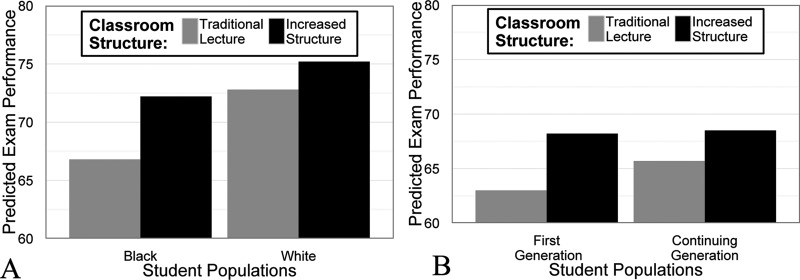
At the college level, the effectiveness of active-learning interventions is typically measured at the broadest scales: the achievement or retention of all students in a course. Coarse-grained measures like these cannot inform instructors about an intervention's relative effectiveness for the different student populations in their classrooms or about the proximate factors responsible for the observed changes in student achievement. In this study, we disaggregate student data by racial/ethnic groups and first-generation status to identify whether a particular intervention-increased course structure-works better for particular populations of students. We also explore possible factors that may mediate the observed changes in student achievement. We found that a "moderate-structure" intervention increased course performance for all student populations, but worked disproportionately well for black students-halving the black-white achievement gap-and first-generation students-closing the achievement gap with continuing-generation students. We also found that students consistently reported completing the assigned readings more frequently, spending more time studying for class, and feeling an increased sense of community in the moderate-structure course. These changes imply that increased course structure improves student achievement at least partially through increasing student use of distributed learning and creating a more interdependent classroom community.
Overview
The claims and statistics of this paper haven’t been checked yet.
Run the check — free, no account needed. It reads the open-access text and checks the sources it cites.
Integrity signals
Registry
Cites
Statistics
Figures
Verification
Claims the paper makes
The claims and statistics of this paper haven’t been checked yet.
Run the check — free, no account needed. It reads the open-access text and checks the sources it cites.
Claims other papers make about this one
Each is checked against this paper’s own text: does it say what the citing paper says it does?
The source backs part of the claim, not all of it — or backs it for a different population, condition or comparison.
In the citing paper
“students in active-learning course designs that reduced or eliminated achievement gaps have reported an increased sense of community and self-efficacy compared to their peers in the lecture-intensive version of the same course (22, 23).”
From Active learning narrows achievement gaps for underrepresented students in undergraduate science, technology, engineering, and math (2020) · cites this paper as [22]
Experimental — accuracy not yet measuredThe source backs part of the claim, not all of it — or backs it for a different population, condition or comparison.
In the citing paper
“Disturbingly, data demonstrate that retention rates for first-generation college students in STEM are lower than those of continuing generation college students (Chen, 2013; Doerschuk et al., 2016) especially in key gatekeeping courses like General Biology and General Chemistry (Eddy & Hogan, 2014; Gregg-Jolly et al., 2016; Harackiewicz et al., 2014).”
From Exploring Organic Chemistry I students’ responses to an exam wrapper intervention. (2020) · cites this paper as Eddy & Hogan, 2014
Experimental — accuracy not yet measuredThe cited source says what the claim attributes to it.
In the citing paper
“Auspiciously however, interventions involving student centered pedagogies have shown excellent promise in combating these trends (Crimmins, 2017; Eddy & Hogan, 2014; Haak, HilleRisLambers, Pitre, & Freeman, 2011).”
From Exploring Organic Chemistry I students’ responses to an exam wrapper intervention. (2020) · cites this paper as Eddy & Hogan, 2014
Self-check
Percentages, sums and reported differences re-computed from the paper’s own numbers.
The self-check needs the paper’s full text.
Citations
Cites
Modern Applied Statistics with S
Venables, W. N., & Ripley, B. D. (2002) · Statisctics and computing/Statistics and computing · doi:10.1007/978-0-387-21706-2 · Cited by 25,941
Active learning increases student performance in science, engineering, and mathematics
Freeman, S., Eddy, S. L., McDonough, M., Smith, M. K., Okoroafor, N., Jordt, H., & Wenderoth, M. P. (2014) · Proceedings of the National Academy of Sciences · doi:10.1073/pnas.1319030111 · Cited by 9,787 · cited 2×
“This type of research is being referred to as second-generation education research (Eddy et al., 2013; Freeman et al., 2014) and will help refine and optimize active-learning interventions by identifying the critical elements that make an intervention effective.”
BackgroundSelf-citationOther people's children: cultural conflict in the classroom
(1995) · Choice Reviews Online · doi:10.5860/choice.32-6344 · Cited by 3,898
Dunlosky, J., Rawson, K. A., Marsh, E. J., Nathan, M. J., & Willingham, D. T. (2013) · Psychological Science in the Public Interest · doi:10.1177/1529100612453266 · Cited by 3,138
Other people’s children: Cultural conflict in the classroom
Delpit, L. (1995) · College Composition and Communication · doi:10.2307/358724 · Cited by 2,502 · cited 1×
“Yet the different racial and ethnic groups that are included in the URM designation have very different cultures, histories, and exposure to college culture that could impact whether a particular classroom strategy is effective for them (Delpit, 2006).”
BackgroundA question of belonging: Race, social fit, and achievement.
Walton, G. M., & Cohen, G. L. (2007) · Journal of Personality and Social Psychology · doi:10.1037/0022-3514.92.1.82 · Cited by 2,163 · cited 1×
“Finally, feeling like they are part of a community increases both performance and motivation, especially for historically underrepresented groups (Walton and Cohen, 2007; Walton et al., 2012).”
BackgroundHurtado, S., & Carter, D. F. (1997) · Sociology of Education · doi:10.2307/2673270 · Cited by 1,938 · cited 1×
“…of our study, arguably as important as increased performance, because a sense of being part of a community (belonging) is crucial for retention (Hurtado and Carter, 1997; Hoffman et al., 2002) and has been 464 CBE—Life Sciences Education correlated with increased performance for…”
BackgroundStudent Engagement and Student Learning: Testing the Linkages*
Carini, R. M., Kuh, G. D., & Klein, S. P. (2006) · Research in Higher Education · doi:10.1007/s11162-005-8150-9 · Cited by 1,799 · cited 1×
“Thus, through increased engagement with the material (because of increased interest in it) student performance will increase (Carini et al., 2006).”
BackgroundAmbient belonging: how stereotypical cues impact gender participation in computer science
Cheryan, S., Plaut, V. C., Davies, P. G., & Steele, C. M. (2009) · Journal of Personality and Social Psychology · doi:10.1037/a0016239 · Cited by 1,372 · cited 1×
“When discussing reasons for leaving STEM, many students, particularly students of color and women, describe feelings of isolation and lack of belonging (Hewlett et al., 2008; Cheryan et al., 2009; Strayhorn, 2011).”
BackgroundStephens, N. M., Fryberg, S. A., Markus, H. R., Johnson, C. S., & Covarrubias, R. (2012) · Journal of Personality and Social Psychology · doi:10.1037/a0027143 · Cited by 1,312
Research works printed but not linked: 17
- Bodenhofer U, 2008, Mathware Soft Comput, 15, 5
- Borrego M, 2013, J Eng Educ, 102, 294
- Burchfield CM, 2000, Teach Psychol, 17, 58
- Dirks C, 2006, Cell Biol Educ, 5, 218
- Fassinger PA, 2000, J Class Inter, 35, 38
- Fox J, 2010, An R Companion to Applied Regression
- Handelsman J, 2007, Scientific Teaching
- Hewlett SA, 2008, The Athena Factor: Reversing the Brain Drain in Science. Engineering, and Technology
- Keeler CM, 1995, J Stats Educ, 3, 1
- Lee P, 2011, Harvard Kennedy School's Asian American Policy Review, 21, 19
- Minchella DJ, 2002, Am Biol Teach, 64, 352, 10.2307/4451310 · DOI
- National Science Foundation, 2013, Division of Undergraduate Education NSF, 13
- Poelzer GH, 2008, J Coll Sci Teach, 38, 59
- Sharma MD, 2005, Austral J Educ Tech, 21, 137
- Tsui L, 2002, J High Educ, 73, 740
- Tsui L, 2007, J Negro Educ, 76, 555
- van Wyk MM, 2012, J Soc Sci, 33, 261
Cited by
Sorted by citations
Items 301–400 of 553
Lee, S. W., & Ing, M. M. (2020) · CBE—Life Sciences Education · doi:10.1187/cbe.20-07-0137 · Cited by 6
Inclusion in neuroscience through high impact courses
Penner, M. R., Sathy, V., & Hogan, K. A. (2021) · Neuroscience Letters · doi:10.1016/j.neulet.2021.135740 · Cited by 6
Self-citationChan, C. W. M., Bhattacharyya, P., & Meisel, S. (2018) · Council on Undergraduate Research Quarterly · doi:10.18833/spur/1/3/13 · Cited by 6
Exploring Organic Chemistry I students’ responses to an exam wrapper intervention.
Grandoit, E., Bergdoll, R., Rosales, E., Turbeville, D., Mayer, S., & Horowitz, G. (2020) · Journal of the Scholarship of Teaching and Learning · doi:10.14434/josotl.v20i1.24825 · Cited by 5
Kreps, A., Brown, I., Wenzel, T. J., & Cole, R. S. (2024) · Journal of Chemical Education · doi:10.1021/acs.jchemed.4c00783 · Cited by 7
Nissen, J., Dusen, B. V., & Kukday, S. S. (2024) · Journal of Research in Science Teaching · doi:10.1002/tea.22000 · Cited by 8
Changing Students’ Perception of Mathematics Through Active Learning
Kurepa, A., Roop, J. P., & Edoh, K. D. (2019) · International Journal of Education · doi:10.5296/ije.v11i1.13983 · Cited by 5
Thriving Online: A Guide for Busy Educators
Kay, R. H., Hunter, W. J., Lauricella, S., Craig, C. D., Mann, A., Dwyer-Kuntz, T., Hughes, J. M., Petrarca, D., Power, R., Bahula, T., et al. (2022) · University of Ontario Insitute of Technology eBooks · doi:10.51357/tmsm9420 · Cited by 8
Ralph, M. C., Schneider, B. B., Benson, D. R., & Ward, D. (2022) · Active Learning in Higher Education · doi:10.1177/14697874221118866 · Cited by 5
“This would be consistent with findings that have shown women participated less in response to instructor prompting, but equitable participation between men and women was observed in smaller instructional settings (Ballen et al., 2019; Eddy and Hogan, 2014; Eddy et al., 2014).”
ResultThe Promise of Labor-Based Grading Contracts for the Teaching of Psychology and Neuroscience
Mena, J. A., & Stevenson, J. R. (2022) · Teaching of Psychology · doi:10.1177/00986283221119783 · Cited by 7
“Students will bene fi t from knowing the purpose of the assignment, steps involved, amount of time needed, number of words or culminating project, and when and how the assignment should be submitted (Eddy & Hogan, 2014).”
Understanding how professional development opportunities affect open educational resource sharing
Flowers, S., Hazlett, Z. S., Ramirez, M. L., Treibergs, K. A., Vinson, E. L., Smith, M. K., & Knight, J. (2024) · Frontiers in Education · doi:10.3389/feduc.2024.1422383 · Cited by 5
The Impact of Instructor Exam Feedback on Student Understanding in a Large-Enrollment Biology Course
Sato, B. K., Dinh-Dang, D., Cruz-Hinojoza, E., Denaro, K., Hill, C. F. C., & Williams, A. E. (2018) · BioScience · doi:10.1093/biosci/biy058 · Cited by 5
Kovtun, O. A., & Krykun, V. (2019) · OPEN EDUCATIONAL E-ENVIRONMENT OF MODERN UNIVERSITY · doi:10.28925/2414-0325.2019s14 · Cited by 5
Gute, B. D., & Wainman, J. W. (2019) · ACS symposium series · doi:10.1021/bk-2019-1341.ch012 · Cited by 7
An Experiment in Active Learning: The Effects of Teams
Ludwig, J. (2021) · International Journal of Educational Methodology · doi:10.12973/ijem.7.2.353 · Cited by 5
“As shown in prior studies, active learning in undergraduate STEM courses decreases the achievement gaps (Haak et al., 2011) for underrepresented minorities (Urton, 2020) and also for first-generation college students (Eddy & Hogan, 2014).”
Staab, K. L. (2021) · Integrative and Comparative Biology · doi:10.1093/icb/icab147 · Cited by 5
Michaud, P., & Lessard, D. R. (2001) · The MIT Press eBooks · doi:10.7551/mitpress/6478.003.0015 · Cited by 5
Moreira, P., & Talanquer, V. (2023) · Chemistry Education Research and Practice · doi:10.1039/d3rp00198a · Cited by 7
Oberlies, M., Buxton, K., & Zeidman-Karpinski, A. (2019) · New Review of Academic Librarianship · doi:10.1080/13614533.2019.1628078 · Cited by 5
“…from the literature that all students learn more and retain more from classes that are not only lecture, there are many ways to teach using EBP (Arnold-Garza, 2014; Dabbour, 1997; Eddy & Hogan, 2014; Freeman et al., 2014; Freeman, Haak, & Wenderoth, 2011; Gross et al., 2015; Knight & Wood, 2005).”
BackgroundWallace, C. S. (2020) · American Journal of Physics · doi:10.1119/10.0000504 · Cited by 5
Patrick, L. E., Barron, H. A., Brown, J. C., & Cotner, S. H. (2021) · Journal of Microbiology and Biology Education · doi:10.1128/jmbe.v22i1.2473 · Cited by 5
Complexity of Faculty Pedagogical Development Within the Changing Higher Education Environment
Lester, J., Rosenberg, J. L., Nelson, J. K., & Shin, C. (2025) · Higher education · doi:10.1007/978-3-031-58698-9_12 · Cited by 5
Tadimalla, S. Y., Latulipe, C., Maher, M. L., Mejias, M., Payton, J., Rorrer, A. S., Fiore, J., Kwatny, G., & Rosen, A. L. (2023) · IEEE Frontiers in Education Conference (FIE) · doi:10.1109/fie58773.2023.10343317 · Cited by 7
“Eddy and Hogan found that course structure, such as schedules, grading, attendance, and participation, is the critical component in flipped classrooms that closes the achievement gap for underrepresented students [18].”
BackgroundResultAre Traditional Chemistry Courses Male-Gendered?
Talanquer, V. (2024) · Journal of Chemical Education · doi:10.1021/acs.jchemed.4c00780 · Cited by 5
Conceptualization and Enactment of Equity in Active Learning: STEM Instructors’ Perspectives
Choi, Y. H., Theobald, E. J., & Eddy, S. L. (2025) · Journal for STEM Education Research · doi:10.1007/s41979-025-00153-4 · Cited by 5
Self-citationRecommendations for an inclusive undergraduate plant science classroom
Butler, K. J., Collins, C. A., & Robison, J. D. (2021) · The Plant Cell · doi:10.1093/plcell/koab167 · Cited by 5
Nelson, L. P. (2021) · Journal of Higher Education Theory and Practice · doi:10.33423/jhetp.v21i9.4600 · Cited by 4
Möller, J., Thürmer, J. L., Tulis, M., Reiß, S., & Jonas, E. (2022) · Frontiers in Psychology · doi:10.3389/fpsyg.2021.768334 · Cited by 6
Equitable Teaching Practices in Higher Education
Argus, S., Vaccaro, A., Coiro, J., Hoş, R., & Deeney, T. A. (2022) · Advances in educational marketing, administration, and leadership book series · doi:10.4018/978-1-7998-9567-1.ch005 · Cited by 4
Jaeger, D. M., Bilinski, T. M., Dunbar‐Wallis, A. K., Alam, I., & Corwin, L. A. (2024) · CourseSource · doi:10.24918/cs.2024.2 · Cited by 4
“Active learning increases student performance in STEM (32) and can decrease the achievement gap for first-generation and other underrepresented students (33, 34).”
BackgroundInvestigating assessment types in an online climate change class: moderating and mediating effects
Millet, A. L., Dinç, E., & Bralower, T. J. (2024) · Educational Technology Research and Development · doi:10.1007/s11423-024-10392-8 · Cited by 4
“As seen, the non-graded knowledge check questions as additional practices supporting student learning enable actively participating in the learning process (Andrade, 2019; Bhebhe & Maphosa, 2020; Eddy & Hogan, 2014; Freeman et al., 2011; Kearns, 2012).”
Teaching and Student Success: ACUE Makes the Link
Mangum, E. (2017) · Change The Magazine of Higher Learning · doi:10.1080/00091383.2017.1366806 · Cited by 4
“24 Change • September/October 2017 by 50%, and decreased course failure rates by 41% (Eddy & Hogan, 2014).”
BackgroundFostering Inclusion and Teaching Equity in a Modern Physics for Engineers Course
Hoehn, J. R., & Finkelstein, N. D. (2020) · ASEE Annual Conference & Exposition · doi:10.18260/1-2--34684 · Cited by 4
Brief Training and Intensive Mentoring Guide Postdoctoral Scholars to Student-Centered Instruction
Price, R., Self, C. J., Young, W. C., Klein, E. R., Al‐Noori, S., Ma, E. Y., & DeMarais, A. A. (2021) · CBE—Life Sciences Education · doi:10.1187/cbe.21-03-0083 · Cited by 4
Teasdale, R., & Aird, H. M. (2022) · Journal of Geoscience Education · doi:10.1080/10899995.2022.2081462 · Cited by 5
“…that students from TMG perform better on non-summative assessments than on summative assessments, specifically for first generation students (Eddy & Hogan, 2014) and students from traditionally underrepresented races/ethnicities (Eddy & Hogan, 2014; Hobbs et al., 2021; Shortlidge et al., 2019).”
BackgroundInfluentialFulton, K. A., Archibald, A., Hudson, C., Rogers, J., Peecksen, S., & Heap, T. (2023) · Journal of Adult and Continuing Education · doi:10.1177/14779714231153815 · Cited by 4
“The research presented here helps to improve and address educational excellence, equal access to education resources, and the speci fi c needs of diverse and non-traditional students in HE (e.g., Eddy & Hogan, 2014; Hurtado & Alvarado, 2013; Villalpando, 2002; Winkelmes et al., 2016).”
BackgroundEsparza, D., Hernandez, A., & Olimpo, J. T. (2023) · CBE—Life Sciences Education · doi:10.1187/cbe.22-03-0054 · Cited by 4
Hiwatig, B. M., Roehrig, G., & Rouleau, M. D. (2024) · Disciplinary and Interdisciplinary Science Education Research · doi:10.1186/s43031-024-00108-6 · Cited by 14
“This aligns with research advocating for active learning environments that have been shown to reduce gender gaps in science and engineering education (Eddy & Hogan, 2014).”
BackgroundDiscovering Prokaryotic Gene Regulation with Simulations of the trp Operon
Crowther, A., Bergan‐Roller, H. E., Galt, N. J., Booth, C. S., Dauer, J. T., & Helikar, T. (2018) · CourseSource · doi:10.24918/cs.2018.9 · Cited by 4
Supporting Faculty in Culturally Responsive Online Teaching
Artze‐Vega, I., & Delgado, P. E. (2019) · Advances in educational technologies and instructional design book series · doi:10.4018/978-1-5225-7802-4.ch002 · Cited by 4
Wischusen, E. W., Patrick, L. E., & Howell, L. A. (2018) · bioRxiv (Cold Spring Harbor Laboratory) · doi:10.1101/502518 · Cited by 4
Celebrating Diverse Voices in Neuroscience: Introducing Project DiViNe
Frenzel, K. E., & Harrington, I. A. (2022) · Journal of Undergraduate Neuroscience Education · doi:10.59390/axfd9450 · Cited by 4
DeCaro, M. S., Golway, K., Bego, C. R., Derkson, S. N., & Hieb, J. (2025) · Journal for STEM Education Research · doi:10.1007/s41979-025-00159-y · Cited by 3
Hou, C., Kuhlmann, S. L., Greene, J. A., Bernacki, M. L., & Hogan, K. A. (2025) · Metacognition and Learning · doi:10.1007/s11409-025-09442-0 · Cited by 3
“The biology course is open to all majors and uses a blended learning format that follows a high-structure design (Eddy & Hogan, 2014; Freeman et al., 2007, 2014 ), in which students read the textbook and complete assign - ments before an in-person lecture, then take a quiz following the lecture,…”
Self-citationKowalski, E. M., Koleci, C., & McDonald, K. J. (2024) · Education Sciences · doi:10.3390/educsci14090943 · Cited by 4
Visualizing Inequities: A Step Toward Equitable Student Outcomes
Tatapudy, S., Potter, R., Bostrom, L., Colgan, A., Self, C. J., Smith, J. L., Xu, S., & Theobald, E. J. (2024) · CBE—Life Sciences Education · doi:10.1187/cbe.24-02-0086 · Cited by 4
Zeedan, R. (2024) · Frontiers in Education · doi:10.3389/feduc.2024.1497045 · Cited by 3
“Courses with moderate or high-level structures have been positively correlated with students’ achievements across different student bodies (Eddy and Hogan, 2014).”
North, G., & Rose, C. D. (2025) · International Journal of Science Education · doi:10.1080/09500693.2025.2527374 · Cited by 3
“Substantial research shows high-quality, engaging, active learning improves learning outcomes, skills, and motivation compared to lecture-based courses, especially with underrepresented students (Dzaiy & Abdullah, 2024; Eddy & Hogan, 2014).”
Deri, M. A., McGregor, D., & Mills, P. A. (2017) · ACS symposium series · doi:10.1021/bk-2017-1270.ch005 · Cited by 3
Social Media May Empower Fisheries Students via Learning Networks
Orth, D. J. (2018) · Fisheries · doi:10.1002/fsh.10034 · Cited by 3
Sweeder, R. D., & Herrington, D. G. (2019) · Canadian Journal of Chemistry · doi:10.1139/cjc-2019-0291 · Cited by 3
McQueen, H. A., & Colegrave, N. (2022) · International Journal of STEM Education · doi:10.1186/s40594-022-00360-0 · Cited by 3
“Studies show that active learning, with its increased support and improved student engagement, has a marked positive effect on learning for specific disadvantaged student sub-groups, thus helping to close this gap (Cottone & Yoon, 2020; Eddy & Hogan, 2014; Gavassa et al., 2019; Haak et al., 2011).”
Use of a Role-Playing Activity To Increase Student Understanding of Bacterial Gene Regulation
Sampath, V. (2023) · Journal of Microbiology and Biology Education · doi:10.1128/jmbe.00006-23 · Cited by 3
“Active learning exercises have been shown to reduce achievement gaps and promote a more equitable learning environment (1, 2).”
BackgroundThe Ideal versus the Real Deal in Assessment of Physics Lab Report Writing
Passonneau, R. J., Koenig, K. M., Li, Z., & Soddano, J. (2023) · European journal of applied sciences · doi:10.14738/aivp.112.14406 · Cited by 3
Sommers, A. S., White, H. C., Dauer, J. M., & Forbes, C. T. (2022) · The journal of college science teaching · doi:10.1080/0047231x.2022.12315651 · Cited by 3
Effectiveness of project-based learning in a reinforced concrete course of civil engineering
Oller, E., Peña, M., & Torre, N. O. (2024) · Journal of Technology and Science Education · doi:10.3926/jotse.2067 · Cited by 9
“…documented, both in terms of overall student learning (Freeman, Eddy, McDonough, Smith, Okoroafor, Jordt et al., 2014), and in terms of narrowing gaps in course grades (Beichner, Saul, Abbott, Morse, Deardroff, Allain et al., 2007; Eddy & Hogan, 2014; Haak, HilleRisLambers, Pitre & Freeman, 2011).”
BackgroundStudent-Generated Analogies for Learning about Information Flow
Newman, D. L., Uminski, C., & Wright, L. K. (2024) · CourseSource · doi:10.24918/cs.2024.14 · Cited by 3
Distributed Active Learning (DAL): An Approach to Reduce Class Size in Large Enrollment Courses
Clark, T. M., Ricciardo, R. A., & Turner, D. A. (2024) · Journal of Chemical Education · doi:10.1021/acs.jchemed.4c00108 · Cited by 3
Prebel, J., & Li, J. (2024) · Journal of writing assessment · doi:10.5070/w4.jwa.1555 · Cited by 3
Can adding discussion-only active learning increase student learning in materials science class?
Saeidi, A., Williams, A. E., Buswell, N. T., Mumm, D. R., & Denaro, K. (2018) · IEEE Frontiers in Education Conference (FIE) · doi:10.1109/fie.2018.8659146 · Cited by 3
“Some works show AL reduces the learning gap for first-generation students [12], female students [13] and URM students [14].”
BackgroundAustin, R. C., & Murray, T. A. (2019) · ACS symposium series · doi:10.1021/bk-2019-1337.ch011 · Cited by 3
Using share‐out grids in the online classroom: From icebreakers to amplifiers
Kirby, C. S. (2020) · Biochemistry and Molecular Biology Education · doi:10.1002/bmb.21451 · Cited by 3
For Your Enrichment: Jay Gatsby Goes to College
Barrett, L., Ghezzi, R. W., & Satterfield, J. (2015) · Reference & User Services Quarterly · doi:10.5860/rusq.55n1.11 · Cited by 3
Cotter, R. L., Kiser, S., Rasmussen, J. A., & Vemu, S. (2022) · New Directions for Community Colleges · doi:10.1002/cc.20534 · Cited by 3
Gross, M. M., Marquardt, K., Hasson, R. E., Vesia, M., King, A. R., & Bodary, P. F. (2022) · Kinesiology Review · doi:10.1123/kr.2022-0021 · Cited by 3
The Rationality of College Mathematics Instructors: The Choice to Use Inquiry-Oriented Instruction
Shultz, M. (2020) · Deep Blue (University of Michigan) · Cited by 3
Supporting Faculty in Culturally Responsive Online Teaching
Artze‐Vega, I., & Delgado, P. E. (2021) · IGI Global eBooks · doi:10.4018/978-1-7998-9026-3.ch052 · Cited by 2
Student perceptions of alternative grading strategies in the biology classroom
Adler, J. J., & Stoczynski, L. E. (2025) · Journal of Microbiology and Biology Education · doi:10.1128/jmbe.00140-24 · Cited by 2
Examining Digital Curricular Enhancements to First-Year Seminars and Effects on College Success
Bernacki, M. L., Gianoutsos, D., & Cogliano, M. (2025) · Innovative Higher Education · doi:10.1007/s10755-025-09783-3 · Cited by 3
“Instructors in face-to-face courses have begun to make extensive use of digital platform like learning management systems to transform face-to-face lectures from passive instructional contexts into active learning environments (Eddy & Hogan, 2014; Olson & Riordan, 2012).”
Do course syllabi reflect observed teaching practices in undergraduate geoscience courses?
Czajka, C. D., Teasdale, R., Ryker, K. D., & Viskupic, K. M. (2025) · Journal of Geoscience Education · doi:10.1080/10899995.2025.2489922 · Cited by 2
“Faculty may also be influenced by a desire to lower student stress levels (Domain of Consequence), which could inform their grading strategies (Eddy & Hogan, 2014; Harris et al., 2019).”
The Future of Virology Education
Maginnis, M. S. (2025) · Annual Review of Virology · doi:10.1146/annurev-virology-092623-110921 · Cited by 2
Latulipe, C., Rosen, A. L., Rorrer, A. S., Tadimalla, S. Y., Nowrin, S., Fiore, J., Mejias, M., Kwatny, G., Payton, J., & Maher, M. L. (2025) · ACM Conference on Innovation and Technology in Computer Science Education (ITiCSE) · doi:10.1145/3724363.3729082 · Cited by 2
Salazar, L. R., & Meador, A. (2025) · Humanities and Social Sciences Communications · doi:10.1057/s41599-025-05314-9 · Cited by 2
“As a form of instruction, active learning has been shown to be effective at closing achievement gaps with fi rst-generation college students (Eddy & Hogan, 2014).”
Challenges in teaching silviculture in Canada: the path forward
Wotherspoon, A. R., Moreau, G., Morin-Bernard, A., Achim, A., Coops, N. C., Villemaire‐Côté, O., Irwin, L., Hagerman, S., Thiffault, N., Colton, C., et al. (2025) · Canadian Journal of Forest Research · doi:10.1139/cjfr-2025-0081 · Cited by 2
Designing Research to Capture and Understand Variations in Higher Education in Prison
Russ, R. S., & Wong, P. (2025) · The Prison Journal · doi:10.1177/00328855251374895 · Cited by 2
“…hidden curriculum (O ’ Shea, 2015); creating a sense of belonging (Walton & Cohen, 2011; Stayhorn & Saddler, 2008); engaging in culturally responsive teaching (e.g., Ladson-Billings, 1995; Larke, 2013); and structuring classroom activities, assignments, and procedures (e.g., Eddy & Hogan, 2014).”
Брюховецька, І., Zakharova, H., & Силенко, Ю. В. (2025) · Problemi osvìti · doi:10.52256/2710-3986.2-103.2025.21 · Cited by 2
Interest, Self-efficacy, and Belonging in Classroom Learning
Renninger, K. A., Barton, L. K., Bautista, G., Garcia-Barrios, M., Ogunyinka, I., & Riley, K. (2026) · Educational Psychology Review · doi:10.1007/s10648-025-10102-7 · Cited by 7
“These lines of inquiry have detailed the benefits of (a) active learning that is structured to be inclusive and engaging of all levels of learners (Eddy & Hogan, 2017), as well as (b) pedagogy and/or interventions (e.g., use of real-world examples and hands-on activi - ties) in which, given…”
CBE—Life Sciences Education: the story of a “great journal scientists might be caught reading”
Dolan, E. L. (2018) · Molecular Biology of the Cell · doi:10.1091/mbc.e18-06-0410 · Cited by 2
Chapman, L. Y., & McCONNELL, D. A. (2021) · Journal of Geoscience Education · doi:10.1080/10899995.2021.1940467 · Cited by 2
“…methods have the potential to improve learning and student performance (Handelsman et al., 2007; Pollock & Finkelstein, 2008; Singer et al., 2012), reduce the achievement gap (Eddy & Hogan, 2014; Haak et al., 2011; Theobald et al., 2020), and decrease attrition rates (Freeman et al., 2014).”
MethodKarodeh, Y. R., Wingate, L. T., Drame, I., Talbert, P. Y., Dike, A., & Sin, S. (2021) · American Journal of Pharmaceutical Education · doi:10.5688/ajpe8600 · Cited by 2
НАВЧАННЯ АНГЛІЙСЬКОЇ МОВИ У КОНТЕКСТІ FLIPPED LEARNING
Litkovych, Y., Shevchuk, A., & Yanovets, A. (2022) · АКАДЕМІЧНІ СТУДІЇ СЕРІЯ «ПЕДАГОГІКА» · doi:10.52726/as.pedagogy/2021.4.2.3 · Cited by 2
Using Design-Based Research to Layer Career-Like Experiences onto Software Development Courses
Bakke, C., & Sakai, R. (2022) · Journal of Information Technology Education Innovations in Practice · doi:10.28945/4988 · Cited by 4
EQUIDADE NA EDUCAÇÃO STEM PARA TODOS OS GÊNEROS
Moreira, R. (2022) · TICs & EaD em Foco · doi:10.18817/ticseademfoco.v8i2.631 · Cited by 3
McWilliams, A., Glide, C., & Henderson, F. (2023) · Journal of Block and Intensive Learning and Teaching · doi:10.15209/jbilt.1303 · Cited by 2
“Their findings included greater frequency of reading set texts and “an increased sense of community” (Eddy & Hogan, 2014, p.453).”
BackgroundUniversity learners’ educational experience survey: a gender dimensional analysis
Asamoah, M. K., Kwablah, E., & Amoah, A. (2024) · Cogent Social Sciences · doi:10.1080/23311886.2024.2312654 · Cited by 5
“…student learning (Freeman et al., 2011, 2014), as well as retention rates (Graham et al., 2013) and the achievement gap between student populations (eddy & hogan, 2014). in a meta-analysis of 55 studies that looked at concept mapping’s effects across a range of disciplines and student age groups,…”
Student Advice for Success in High Structure Science and Engineering Courses
Shaffer, J. F., & Ringsby, A. (2024) · The journal of college science teaching · doi:10.1080/0047231x.2024.2316380 · Cited by 2
Woodbury, J., & Offerdahl, E. G. (2024) · CBE—Life Sciences Education · doi:10.1187/cbe.24-02-0090 · Cited by 2
“The disaggregation of student data is an important practice in evaluating educational interventions, including active learning (Bensimon, 2005; Eddy and Hogan, 2014; Theobald et al. , 2020).”
Archie, T., Wise, S. B., Robalino, J., Chmiel, M., & Laursen, S. L. (2024) · CBE—Life Sciences Education · doi:10.1187/cbe.24-02-0095 · Cited by 3
Lofton, M. E., Moore, T. N., Woelmer, W. M., Thomas, R. Q., & Carey, C. C. (2024) · BioScience · doi:10.1093/biosci/biae089 · Cited by 2
Arıcı, F., Salar, R., & Yılmaz, R. M. (2025) · Technology Knowledge and Learning · doi:10.1007/s10758-025-09834-w · Cited by 2
“Students’ engagement in the lesson improves due to these features (Carini et al., 2006; Eddy & Hogan, 2014; Freeman et al., 2014).”
After School Matters: Expanding the Time to Engage Minority Middle School Girls in STEM
Luster‐Teasley, S., Minor, R. C., & Alford, V. (2016) · ASEE Annual Conference & Exposition · doi:10.18260/p.26543 · Cited by 2
Cook, & Bishop, D. B. (2018) · Cited by 2
A New Lecture-Tutorial for Teaching Interferometry to Astro 101 Students
Wallace, C. S., Hatcher, C., Chambers, T. G., Hornstein, S. D., Kamenetzky, J., & Prather, E. E. (2021) · The Physics Teacher · doi:10.1119/10.0006124 · Cited by 2
Motivated Reasoning and Persuading Faculty Change in Teaching
Smith, G. A. (2020) · To improve the academy · doi:10.3998/tia.17063888.0039.105 · Cited by 3
“…of RBIS would likely benefit from efforts to enhance individuals’ priority for these more broadly perceived values, which would prioritize egalitarian learner outcomes (e.g., Eddy & Hogan, 2014; Haak et al., 2011) through self- directed exploration and incorporation of new teaching practices.”
BackgroundPromoting Inclusive Excellence in the Inorganic Chemistry Curriculum through Faculty Culture Shift
Ekanger, L. A., Chan, B. C., Gazley, J. L., & O’Connor, A. R. (2020) · ACS symposium series · doi:10.1021/bk-2020-1370.ch009 · Cited by 2
Replicating or franchising a STEM afterschool program model: core elements of programmatic integrity
Stevenson, N., Sommers, A. S., Grandgenett, N. F., Tapprich, W. E., McQuillan, J., Phillips, M., Jensen, R., & Cutucache, C. E. (2022) · International Journal of STEM Education · doi:10.1186/s40594-021-00320-0 · Cited by 2
“…not an easy institutional task; despite an emphasis on retention in higher education, many post-secondary students struggle to complete a degree in STEM fields (American Association for the Advancement of Science, 2011; Dolan, 2017; Eddy & Hogan, 2014; Egenrieder, 2010; Gottesman & Hoskins, 2013).”
BackgroundA gut microbiome tactile teaching tool and guided-inquiry activity promotes student learning
Shoaf, P. T., French, K. S., Clifford, N. J., McKenney, E. A., & Ott, L. E. (2022) · Frontiers in Microbiology · doi:10.3389/fmicb.2022.966289 · Cited by 5
“The course was taught in a high-structure format that has been previously shown to benefit biology majors, particularly in large-enrollment courses (Haak et al., 2011; Eddy and Hogan, 2014).”
BackgroundTsehelnyk, T. M., & Силенко, Ю. В. (2024) · ГРААЛЬ НАУКИ · doi:10.36074/grail-of-science.15.03.2024.064 · Cited by 2
Pechenkina, E. (2017) · ASCILITE Publications · doi:10.14742/apubs.2017.777 · Cited by 2
“While there are some examples of international students approaching learning differently when compared to their non-international peers (Eddy & Hogan, 2014; Savani, Alvarez, Mesquita, & Markus, 2013), when it comes to FTL, some studies suggest FTL may be better for international students than…”
BackgroundTan, T. M., & Leininger, E. C. (2024) · Journal of Undergraduate Neuroscience Education · doi:10.59390/fzwh1820 · Cited by 2
Metadata
- Authors
- Eddy, S. L., & Hogan, K. A.
- Affiliations
- University of Washington (US)
- University of North Carolina at Chapel Hill (US)
- Corresponding author
- Hogan, Kelly A.
- Venue
- CBE—Life Sciences Education
- Published
- 2014-09
- Volume
- 13
- Issue
- 3
- Pages
- 453-468
- ISSN
- 1931-7913 (ISSN-L)
- PMC
- PMC4152207
- OpenAlex
- W2096648490
- Cited by
- 553
- References
- 72
- Citations by year
- 2026: 30 · 2025: 49 · 2024: 71 · 2023: 38 · 2022: 54 · 2021: 67 · 2020: 67 · 2019: 53 · 2018: 40 · 2017: 35 · 2016: 31 · 2015: 14 · 2014: 3
- FWCI
- 142.29
- Type
- journal article
- Language
- en
- Open access
- hybrid
- doi.org
- Licence
- cc-by-nc-sa
- Locations
- CBE—Life Sciences Education (publishedVersion, cc-by-nc-sa)
- PubMed Central (publishedVersion, cc-by-nc-sa)
- PubMed (publishedVersion)
- Carolina Digital Repository (University of North Carolina at Chapel Hill) (submittedVersion)
- UNC Libraries
- Funders
- National Science Foundation (1118890, 0942215)
- Topics
- Social Sciences › Education › Innovative Teaching Methods
- Social Sciences › Education › Higher Education Research Studies
- Social Sciences › Education › Evaluation of Teaching Practices
- Keywords
- course structure, active learning, academic performance, racial and ethnic disparities, first-generation college students, Black-White achievement gap, distributed learning, classroom community, student study time, higher education
- MeSH terms
- Behavior, Curriculum, Educational Measurement, Ethnicity, Female, Humans, Male, Perception, Regression Analysis, Students, Time Factors, Universities, Problem-Based Learning, Racial Groups
About these checks
Registry, retraction, Cites and statistics results are computed, not judged, with one exception: a printed reference that no index lists is read once by a model before it counts as a citation error. Claims are extracted by a model and kept only when their quote appears verbatim in the text; each cited source is then checked, with a model’s help, for whether it says what the claim relies on. Those verdicts can be wrong — read the claim’s quote and the cited source before relying on one.
Statistics and arithmetic are recomputed, not judged.
Confidence bands are shown only for fields calibrated on our annotated test set. None is calibrated yet, so no band is shown.
What counts as a claim ›How we measure confidence ›How we check this ›
Are you an author, or do you see a problem with this page? Request a review
