

The DOI matches its Crossref record; 15 of the 15 references it cites were found in a registry or an index.
Personal, social and relational predictors of UK postgraduate researcher mental health problems
Abstract
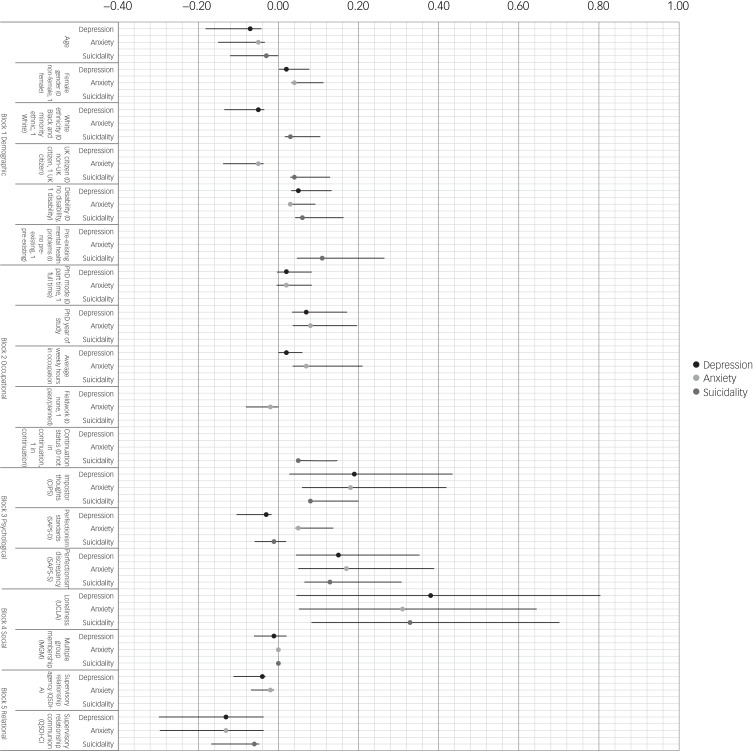
Background: Emerging evidence demonstrates that postgraduate researchers have high rates of mental health problems. These problems are distressing, affect PhD studies, and have longer-term potential effects beyond the duration of the PhD. Yet large-scale studies of multiple risk and protective factors are rare. Aims: We aimed to test the predictive validity of a comprehensive set of potential determinants of mental health symptoms (depression, anxiety and suicidality) among postgraduate researchers in the UK, including personal, study-related, and supervision characteristics. Method: We used regression models applied to data obtained from a national online survey of UK postgraduate researchers (Understanding DOCtoral researcher mental health; U-DOC, 2018–2019) to test predictors of mental health symptoms. Results: These models show that postgraduate researchers' mental health symptoms are predicted by demographic, occupational, psychological, social and supervisory relationship factors. Greater perfectionism, more impostor thoughts and reduced supervisory communion most strongly and consistently predict mental health symptoms. Conclusions: Institutions training postgraduate researchers should focus interventions intended to improve depression, anxiety, suicidality, on self-beliefs and social connectedness. Moreover, supervisors should be provided with training that improves the degree of agency, and especially communion, in the relationships they form with postgraduate researchers.
Overview
The claims and statistics of this paper haven’t been checked yet.
Run the check — free, no account needed. It reads the open-access text and checks the sources it cites.
Integrity signals
Registry
Cites
Statistics
Figures
Verification
Claims the paper makes
The claims and statistics of this paper haven’t been checked yet.
Run the check — free, no account needed. It reads the open-access text and checks the sources it cites.
Claims other papers make about this one
Each is checked against this paper’s own text: does it say what the citing paper says it does?
In the citing paper
“Using hierarchical regression, they found that low communion was associated with symptoms of depression and anxiety, whereas agency only predicted depression.”
From The supervisory relationship as a predictor of mental health outcomes in doctoral students in the United Kingdom (2024) · cites this paper as Berry et al. (2021)
In the citing paper
“This is in line with previous literature demonstrating that supervisory relationship is a significant predictor, but not the only important factor influencing doctoral students’ mental health (e.g., Berry et al., 2021, 2023).”
From The supervisory relationship as a predictor of mental health outcomes in doctoral students in the United Kingdom (2024) · cites this paper as Berry et al., 2021
Self-check
Percentages, sums and reported differences re-computed from the paper’s own numbers.
The self-check needs the paper’s full text.
Citations
Cites
The PHQ-9: Validity of a brief depression severity measure
Kroenke, K., Spitzer, R. L., & Williams, J. B. W. (2001) · Journal of General Internal Medicine · doi:10.1046/j.1525-1497.2001.016009606.x · Cited by 44,910
Kroenke, K., Spitzer, R. L., Williams, J. B. W., & Löwe, B. (2010) · General Hospital Psychiatry · doi:10.1016/j.genhosppsych.2010.03.006 · Cited by 4,057
Auerbach, R. P., Collaborators, W. W.-I., Mortier, P., Bruffaerts, R., Alonso, J., Benjet, C., Cuijpers, P., Demyttenaere, K., Ebert, D. D., Green, J. G., et al. (2018) · Journal of Abnormal Psychology · doi:10.1037/abn0000362 · Cited by 2,522
The imposter phenomenon in high achieving women: Dynamics and therapeutic intervention.
Clance, P. R., & Imes, S. A. (1978) · Psychotherapy: Theory, Research & Practice · doi:10.1037/h0086006 · Cited by 2,212
Developing a measure of loneliness
Russell, D., Peplau, L. A., & Ferguson, M. L. (1978) · Journal of Personality Assessment · doi:10.1207/s15327752jpa4203_11 · Cited by 2,089 · cited 1×
“Loneliness was captured using the 20-item UCLA Loneliness Scale (35).”
MethodA Meta-Analysis of Interventions to Reduce Loneliness
Masi, C. M., Chen, H.-Y., Hawkley, L. C., & Cacioppo, J. T. (2011) · Personality and Social Psychology Review · doi:10.1177/1088868310377394 · Cited by 1,995
Positive Conceptions of Perfectionism: Approaches, Evidence, Challenges
Stoeber, J., & Otto, K. (2006) · Personality and Social Psychology Review · doi:10.1207/s15327957pspr1004_2 · Cited by 1,779
Evidence for a mental health crisis in graduate education
Evans, T. M., Bira, L., Gastelum, J. B., Weiss, L. T., & Vanderford, N. L. (2018) · Nature Biotechnology · doi:10.1038/nbt.4089 · Cited by 1,441
Work organization and mental health problems in PhD students
Levecque, K., Anseel, F., De Beuckelaer, A., Van der Heyden, J., & Gisle, L. (2017) · Research Policy · doi:10.1016/j.respol.2017.02.008 · Cited by 1,182 · cited 4×
“Previous research has focused mainly on PGR 99 demographic characteristics and aspects of the PhD and institutional environment (1,4), and often have 100 small sample sizes and fail to disaggregate doctoral from other postgraduate students (1).”
BackgroundMethodResultInfluentialThe growing problem of loneliness
Cacioppo, J. T., & Cacioppo, S. (2018) · The Lancet · doi:10.1016/s0140-6736(18)30142-9 · Cited by 897 · cited 1×
“Loneliness 382 on mental health problems is not unique to PGRs, but is a huge global public health issue (51,52) further 383 exacerbated by the COVID-19 pandemic, felt by other student groups (24) and the general public (40).”
Background
Research works printed but not linked: 40
- 10.1080/1360080X.2018.1478613 · DOI · Paper page
- Chakraverty, 2020, PhD student experiences with the impostor phenomenon in STEM, Int J Dr Stud, 15, 159
- 10.1080/09602010701643449 · DOI
- Kessler, 2007, Lifetime prevalence and age-of-onset distributions of mental disorders in the World Health Organization's World Mental Health Survey Initiative, World Psychiatry, 6, 168
- 10.1080/07448481.2020.1841207 · DOI · Paper page
- Clance, 1985, The Impostor Phenomenon: When Success Makes You Feel Like A Fake
- 10.1007/s11606-019-05364-1 · DOI · Paper page
- Russell, 1982, Loneliness: A Sourcebook of Current Theory, Research and Therapy, 81
- 10.1080/13562517.2015.1045859 · DOI
- 10.1080/j.1440-1614.2000.00801.x · DOI
- 10.1002/j.1556-6678.2011.tb00070.x · DOI
- 10.1037/a0033764 · DOI
- 10.1080/00223891.2013.838172 · DOI
- 10.1016/j.aprim.2017.12.004 · DOI
- Hazell, 2021, Nationwide assessment of the mental health of UK doctoral researchers, PsyArXiv
- 10.1080/07481756.2018.1547619 · DOI
- 10.1007/s10212-016-0290-0 · DOI
- 10.1080/07294360.2019.1676198 · DOI · Paper page
- 2019, Who's Studying in HE?
- 10.1186/s13643-020-01443-1 · DOI · Paper page
- 10.2224/sbp.2008.36.1.43 · DOI
- 10.1080/07294360.2018.1556620 · DOI · Paper page
- 10.1080/13562517.2019.1632825 · DOI
- 10.3389/fnins.2021.593562 · DOI
- Mann, 2021, Loneliness and the onset of new mental health problems in the general population: a systematic review, MedRxiv
- 2021, Who Does Doctoral Research in the UK?
- Milicev, 2020, Evaluating mental health and wellbeing of postgraduate researchers: prevalence and contributing factors, PsyArXiv
- 10.1016/j.ijer.2020.101575 · DOI · Paper page
- 10.1016/j.jad.2013.01.004 · DOI · Paper page
- 10.1007/s10903-020-01043-0 · DOI
- 10.1007/s10734-009-9199-8 · DOI · Paper page
- 10.1111/eip.12798 · DOI
- 10.1177/1745691615570616 · DOI · Paper page
- Alageel, 2021, The prevalence of depression and anxiety disorders among postgraduate students in an Arabic sample: a cross-sectional study, Res Sq
- 10.1111/joms.12344 · DOI
- 10.1080/09638237.2018.1437608 · DOI
- 10.1108/SGPE-06-2020-0034 · DOI
- 10.1002/wps.20821 · DOI
- 10.1037/0022-006X.49.5.773 · DOI
- 10.1001/archinte.166.10.1092 · DOI · Paper page
Cited by
Sorted by citations
Mavrogalou-Foti, A. P., Kambouri, M. A., & Çili, S. (2024) · Frontiers in Psychology · doi:10.3389/fpsyg.2024.1437819 · Cited by 34
Metadata
- Authors
- Berry, C., Niven, J. E., & Hazell, C. M.
- ORCID
- Berry, Clio
- Venue
- BJPsych Open
- Publisher
- Royal College of Psychiatrists
- Published
- 2021-11
- Volume
- 7
- Issue
- 6
- ISSN
- 2056-4724
- PMC
- PMC8612019
- Cited by
- 32
- References
- 15
- Language
- en
- Funders
- Office for Students and Research England (Supporting postgraduate researcher mental health a)
About these checks
Registry, retraction, Cites and statistics results are computed, not judged, with one exception: a printed reference that no index lists is read once by a model before it counts as a citation error. Claims are extracted by a model and kept only when their quote appears verbatim in the text; each cited source is then checked, with a model’s help, for whether it says what the claim relies on. Those verdicts can be wrong — read the claim’s quote and the cited source before relying on one.
Statistics and arithmetic are recomputed, not judged.
Confidence bands are shown only for fields calibrated on our annotated test set. None is calibrated yet, so no band is shown.
What counts as a claim ›How we measure confidence ›How we check this ›
Are you an author, or do you see a problem with this page? Request a review
How to cite
Cite CoChat for the checks on this page, and the paper for its own findings.
- This page
- CoChat. (2026). Citation check: Personal, social and relational predictors of UK postgraduate researcher mental health problems. https://app.cochat.ai/papers/10.1192/bjo.2021.1041
- The paper
- Berry, C., Niven, J. E., & Hazell, C. M. (2021). Personal, social and relational predictors of UK postgraduate researcher mental health problems. BJPsych Open. https://doi.org/10.1192/bjo.2021.1041
