

Metformin and Combined Oral Contraceptive Pills in the Management of Polycystic Ovary Syndrome: A Systematic Review and Meta-analysis
Open accessThe DOI matches its Crossref record; 89 of the 95 references it cites were found in a registry or an index; 36 of the 76 sources its claims cite were checked for support.
Abstract
Context: Polycystic ovary syndrome (PCOS) affects more than 1 in 10 women. Objective: As part of the 2023 International PCOS Guidelines update, comparisons between combined oral contraceptive pills (COCP), metformin, and combination treatment were evaluated. Data Sources: Ovid Medline, Embase, PsycINFO, All EBM, and CINAHL were searched. Study Selection: Women with PCOS included in randomized controlled trials (RCTs). Data Extraction: We calculated mean differences and 95% CIs regarding anthropometrics, metabolic, and hyperandrogenic outcomes. Meta-analyses and quality assessment using GRADE were performed. Data Synthesis: The search identified 1660 publications; 36 RCTs were included. For hirsutism, no differences were seen when comparing metformin vs COCP, nor when comparing COCP vs combination treatment with metformin and COCP. Metformin was inferior on free androgen index (FAI) (7.08; 95% CI 4.81, 9.36), sex hormone binding globulin (SHBG) (−118.61 nmol/L; 95% CI −174.46, −62.75) and testosterone (0.48 nmol/L; 95% CI 0.32, 0.64) compared with COCP. COCP was inferior for FAI (0.58; 95% CI 0.36, 0.80) and SHBG (−16.61 nmol/L; 95% CI −28.51, −4.71) compared with combination treatment, whereas testosterone did not differ. Metformin lowered insulin (−27.12 pmol/L; 95% CI −40.65, −13.59) and triglycerides (−0.15 mmol/L; 95% CI −0.29, −0.01) compared with COCP. COCP was inferior for insulin (17.03 pmol/L; 95% CI 7.79, 26.26) and insulin resistance (0.44; 95% CI 0.17, 0.70) compared with combination treatment. Conclusions: The choice of metformin or COCP treatment should be based on symptoms, noting some biochemical benefits from combination treatment targeting both major endocrine disturbances seen in PCOS (hyperinsulinemia and hyperandrogenism).
Overview
CoChat Summary
TL;DR
This systematic review and meta-analysis of 36 RCTs compared metformin, combined oral contraceptive pills (COCP), and combination treatment in women with PCOS. COCP was superior for cycle regularity and some androgen outcomes, metformin was superior for metabolic outcomes, and combination treatment improved biochemical hyperandrogenism and insulin measures over COCP alone.
Key findings
- Among 36 RCTs, metformin was inferior to COCP for free androgen index (MD 7.08; 95% CI 4.81–9.36), SHBG (MD −118.61 nmol/L; 95% CI −174.46 to −62.75), and total testosterone (MD 0.48 nmol/L; 95% CI 0.32–0.64), with no overall hirsutism difference; metformin was superior for fasting insulin (MD −27.12 pmol/L; 95% CI −40.65 to −13.59), triglycerides (MD −0.15 mmol/L; 95% CI −0.29 to −0.01), total cholesterol (MD −0.40 mmol/L; 95% CI −0.66 to −0.14), and CRP (MD −11.31 nmol/L; 95% CI −19.78 to −2.85).
- Metformin was inferior to COCP for restoring regular menses (OR 0.17; 95% CI 0.05–0.57).
- COCP alone was inferior to COCP plus metformin for FAI (MD 0.58; 95% CI 0.36–0.80), SHBG (MD −16.61 nmol/L; 95% CI −28.51 to −4.71), DHEAS (MD 0.93 μmol/L; 95% CI 0.54–1.31), androstenedione (MD 1.37 nmol/L; 95% CI 0.14–2.60), fasting insulin (MD 17.03 pmol/L; 95% CI 7.79–26.26), HOMA-IR (MD 0.44; 95% CI 0.17–0.70), and CRP (MD 1.94 nmol/L; 95% CI 0.05–3.84), with no difference in hirsutism or total/free testosterone.
- Metformin alone was inferior to combination treatment for DHEAS (MD 82.38 μmol/L; 95% CI 15.43–149.36) and total testosterone (MD 0.64 nmol/L; 95% CI 0.26–1.02), but had marginally lower fasting glucose (MD −0.33 mmol/L; 95% CI −0.64 to −0.01) and CRP (MD −4.08 nmol/L; 95% CI −6.01 to −2.16).
Methods
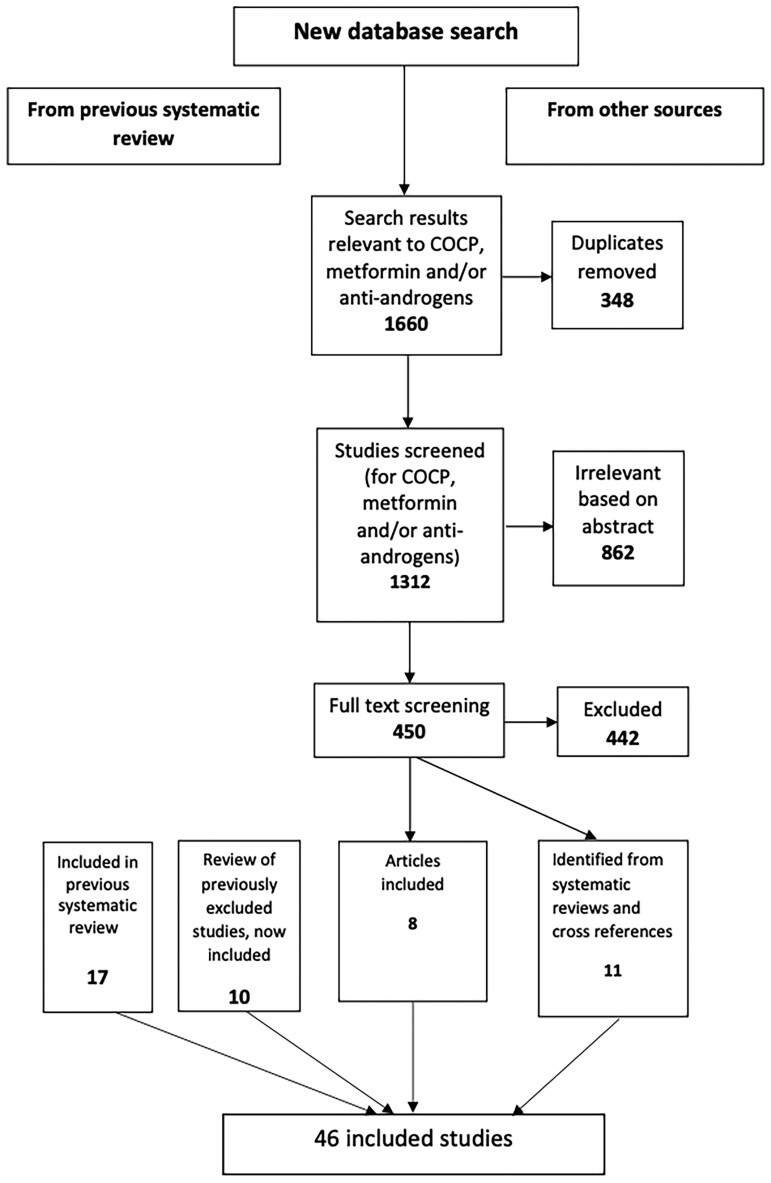
- Systematic review and meta-analysis conducted for the 2023 International PCOS Guidelines update, following PRISMA and registered in PROSPERO (CRD42022345640). Searches of Ovid Medline, Embase, PsycINFO, All EBM, and CINAHL covered 2017 to July 7, 2022, plus re-evaluation of the previous 1946–2017 search; 1660 publications were identified, 450 full texts reviewed, plus 176 from the previous search, yielding 36 RCTs in 46 publications.
- Included RCTs of women with PCOS (Rotterdam, NIH, or AES criteria) comparing metformin, COCP, or COCP plus metformin; outcomes included anthropometric, metabolic, androgenicity, psychological, and adverse-event measures.
- Random-effects meta-analyses used Review Manager 5.4.1, calculating mean differences and 95% CIs for continuous outcomes and odds ratios and 95% CIs for dichotomous outcomes; risk of bias was assessed with RoB2 and certainty with GRADE, with subgroup analyses by BMI, age, and COCP type.
Limitations
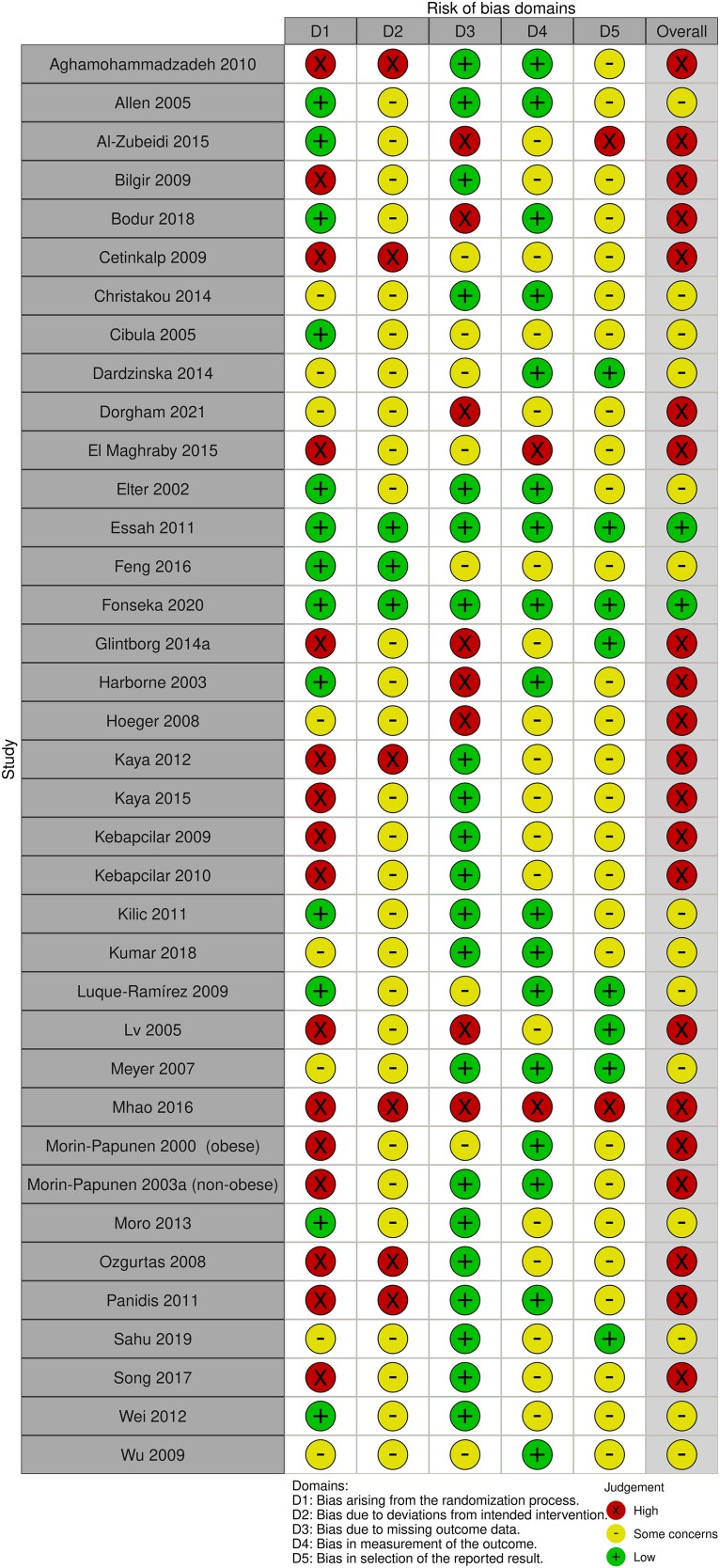
- Paper-stated limitations: many included studies had high risk of bias (20 high, 14 some concerns, 2 low), often due to poorly described randomization or lack of blinding; certainty of evidence was affected by inconsistency of effect sizes and small sample sizes; several studies did not provide BMI data; adverse effects could not be meta-analyzed due to lack of systematic reporting; health-related quality of life could not be meta-analyzed; research gaps include lack of larger studies in adolescents and of metformin versus combination treatment.
- Evident from the text: most GRADE certainty ratings were low or very low, and several comparisons relied on few studies or participants, limiting precision and generalizability.
Model-written summary. Check it against the paper before relying on it.
Integrity signals
Registry
Cites
Statistics
Figures
Verification
Claims the paper makes
24 Valid · 3 Not valid · 30 Not checked · 105 Own results and interpretations
Some cited sources support this claim and some don’t — read each source’s verdict below.
In the paper
“Two systematic reviews found that adding metformin to COCP and anti-androgens improved BMI and glucose tolerance (11, 88).”
§ Metformin and Combined Oral Contraceptive Pills in the Management of Polycystic Ovary Syndrome: A Systematic Review and Meta-analysis > Discussion > Interpretation
What the sources say
- Disputedcites [11] Luque-Ramírez M, Nattero-Chávez L, Ortiz Flores AE, Escobar-Morreale HF. Combined oral contraceptives and/or antiandrogens versus insulin sensitizers for polycystic ovary syndrome: a systematic review and meta-analysis. Hum Reprod Update. 2018; 24(2): 225‐ 241. 29293982 sourceExperimental — accuracy not yet measured
In “Meta-analyses of primary outcomes” (page not provided), the paper says adding metformin to antiandrogenic therapy yielded no advantage in glucose measured after an oral glucose tolerance test. It reports a reduction in fasting glucose with combined therapy, but that is a different outcome from the claimed improvement in glucose tolerance. (LLM, conf=0.89)
Checked by a reasoning model — may be wrong.
- Partly supportedcites [88] Wu L, Liu Y, Huang X, et al Oral contraceptives (OCs) in combination with metformin versus OCs alone on metabolism in nonobese polycystic ovary syndrome: a meta-analysis and systematic review of randomized controlled trials. Clin Endocrinol. 2023; 99(1): 3‐ 16. 36799083 sourceExperimental — accuracy not yet measured
The Overall results (§3.5.1) report lower fasting glucose with metformin plus oral contraceptives than with oral contraceptives alone in nonobese women with PCOS. The review does not report a glucose-tolerance outcome or evaluate adding metformin to a separate anti-androgen treatment, so those parts of the attributed claim are not established. (LLM, conf=0.86)
plainstates a cause- Asserted: passes — The authors put it forward as true.
- Checkable: passes — It can be checked against evidence.
- Load-bearing: unclear — It is unclear whether the paper’s conclusions depend on it.
- Based: passes — The paper gives a reason why it holds.
- Disputed
Some cited sources support this claim and some don’t — read each source’s verdict below.
In the paper
“COCP does not have any major effects on carbohydrate metabolism in healthy women, whereas the effect on lipid metabolism depends on the level of estrogen and type of progestin, with potential negative effects (78, 79, 80, 81).”
§ Metformin and Combined Oral Contraceptive Pills in the Management of Polycystic Ovary Syndrome: A Systematic Review and Meta-analysis > Discussion > Interpretation
What the sources say
- Not checked — no full text of the sourcecites [78] Korytkowski MT, Mokan M, Horwitz MJ, Berga SL. Metabolic effects of oral contraceptives in women with polycystic ovary syndrome. J Clin Endocrinol Metab. 1995; 80(11): 3327‐ 3334. 7593446 source
- Disputedcites [79] Piltonen T, Puurunen J, Hedberg P, et al Oral, transdermal and vaginal combined contraceptives induce an increase in markers of chronic inflammation and impair insulin sesitivity in young healthy normal-weight women: a randomized study. Hum Reprod. 2012; 27(10): 3046‐ 3056. 22811306 sourceExperimental — accuracy not yet measured
The Discussion (page not supplied) reports that insulin sensitivity decreased in the oral contraceptive group, with increased insulin levels and worsened measures of glucose tolerance. Although fasting glucose remained unchanged, the paper concludes that the contraceptives studied had unfavourable effects on glucose metabolism—contrary to the attributed claim. (LLM, conf=0.91)
Checked by a reasoning model — may be wrong.
- Supportedcites [80] Lopez L, Grimes D, Schulz K. Steroidal contraceptives: effect on carbohydrate metabolism in women without diabetes mellitus. Cochrane Database Syst Rev. 2019; 2019(11). doi: 10.1002/14651858.CD006133.pub5 31711271 source
The Discussion (Summary of main results) states that combined hormonal contraceptives do not cause clinically important changes in carbohydrate metabolism in women without diabetes. This supports the claim about COCPs and carbohydrate metabolism; the review notes that no trial was placebo-controlled. (LLM, conf=0.91)
plain- Asserted: passes — The authors put it forward as true.
- Checkable: passes — It can be checked against evidence.
- Load-bearing: unclear — It is unclear whether the paper’s conclusions depend on it.
- Based: passes — The paper gives a reason why it holds.
The cited sources support only part of this claim — read each source’s verdict below.
In the paper
“Several studies have shown that metformin may improve biochemical hyperandrogenism and anovulation (9, 10).”
§ Metformin and Combined Oral Contraceptive Pills in the Management of Polycystic Ovary Syndrome: A Systematic Review and Meta-analysis > Abstract > Conclusions
What the sources say
- Supportedcites [9] Naderpoor N, Shorakae S, de Courten B, Misso ML, Moran LJ, Teede HJ. Metformin and lifestyle modification in polycystic ovary syndrome: systematic review and meta-analysis. Hum Reprod Update. 2015; 21(5): 560‐ 574. 26060208 source
The metformin-alone results (p. 10) report lower total testosterone than lifestyle treatment, supporting a possible improvement in biochemical hyperandrogenism. The Discussion (p. 13) reports improved menstrual cyclicity with metformin added to lifestyle treatment and cites evidence of improved ovulation in women with PCOS. It also notes that adding metformin did not improve biochemical hyperandrogenism relative to lifestyle plus placebo, so the effects depend on the comparison. (LLM, conf=0.88)
- Not matchedcites [10] RCOG. Metformin therapy for the management of infertility in women with polycystic ovary syndrome: scientific impact paper No. 13. BJOG. 2017; 124(12): e306‐ e313. 28834093
We searched by its title and found no matching paper.
hedgedstates a possible cause- Asserted: passes — The authors put it forward as true.
- Checkable: passes — It can be checked against evidence.
- Load-bearing: passes — The paper’s conclusions depend on it.
- Based: passes — The paper gives a reason why it holds.
- Supported
The cited sources support only part of this claim — read each source’s verdict below.
In the paper
“Generally combined oral contraceptive pills (COCP) are regarded as more effective than metformin for the management of hyperandrogenism and menstrual regulation in PCOS (11, 12).”
§ Metformin and Combined Oral Contraceptive Pills in the Management of Polycystic Ovary Syndrome: A Systematic Review and Meta-analysis > Abstract > Conclusions
What the sources say
- Supportedcites [11] Luque-Ramírez M, Nattero-Chávez L, Ortiz Flores AE, Escobar-Morreale HF. Combined oral contraceptives and/or antiandrogens versus insulin sensitizers for polycystic ovary syndrome: a systematic review and meta-analysis. Hum Reprod Update. 2018; 24(2): 225‐ 241. 29293982 source
The Principal findings section says COC and antiandrogen therapy was superior to insulin sensitizers for low-to-moderate hyperandrogenic symptoms in women with PCOS not pursuing pregnancy. The Meta-analyses of primary outcomes section reports that regular menses favoured COC over metformin. Page numbers are unavailable in our copy. (LLM, conf=0.91)
- Partly supportedcites [12] Teede H, Tassone EC, Piltonen T, et al Effect of the combined oral contraceptive pill and/or metformin in the management of polycystic ovary syndrome: a systematic review with meta-analyses. Clin Endocrinol (Oxf). 2019; 91(4): 479‐ 489. 31087796 sourceExperimental — accuracy not yet measured
The COCP-versus-metformin results for adults (section 3.6, p. 6) favor COCP for androgen measures and irregular cycles. In adolescents (section 3.5, p. 6), COCP improved menstrual regulation more, but the review found no significant difference in the reported androgen measures. The claim is therefore supported for adults, but its broad hyperandrogenism comparison across PCOS is not fully supported. (LLM, conf=0.84)
plainstates a cause- Asserted: passes — The authors put it forward as true.
- Checkable: passes — It can be checked against evidence.
- Load-bearing: passes — The paper’s conclusions depend on it.
- Based: passes — The paper gives a reason why it holds.
- Supported
The cited sources support only part of this claim — read each source’s verdict below.
In the paper
“COCPs containing cyproterone acetate (CPA) might be more effective in reducing hirsutism compared to conventional COCPs (14, 15);”
§ Metformin and Combined Oral Contraceptive Pills in the Management of Polycystic Ovary Syndrome: A Systematic Review and Meta-analysis > Abstract > Conclusions
What the sources say
- Partly supportedcites [14] De Leo V, Musacchio MC, Cappelli V, Piomboni P, Morgante G. Hormonal contraceptives: pharmacology tailored to women's health. Hum Reprod Update. 2016; 22(5): 634‐ 646. 27307386 sourceExperimental — accuracy not yet measured
The PCOS section reports that CPA improved hirsutism compared with placebo. The Acne and hirsutism section describes CPA as an anti-androgen that can be used in a contraceptive pill when COCs alone do not work. Neither passage establishes that CPA-containing COCs reduce hirsutism more effectively than conventional COCs; page numbers are unavailable in our copy. (LLM, conf=0.84)
- Not checked — no full text of the sourcecites [15] Amiri M, Kabir A, Nahidi F, Shekofteh M, Ramezani Tehrani F. Effects of combined oral contraceptives on the clinical and biochemical parameters of hyperandrogenism in patients with polycystic ovary syndrome: a systematic review and meta-analysis. Eur J Contracept Reprod Health Care. 2018; 23(1): 64‐ 77. 29457756 source
hedgedstates a possible cause- Asserted: passes — The authors put it forward as true.
- Checkable: passes — It can be checked against evidence.
- Load-bearing: passes — The paper’s conclusions depend on it.
- Based: passes — The paper gives a reason why it holds.
- Partly supported
111 more claims · 8 with their cited sources checked
Create a free account to see all 162 claims and to verify the 2 references still open.
- Probably not a substantial claim. 37
- It may state two separate claims as one. 13
- The quote only partly states this claim. 2
Self-check
Percentages, sums and reported differences re-computed from the paper’s own numbers.
Each contradiction between two passages listed here was confirmed by an independent check.
Rated major: it would touch a result — a value a result rests on, reported and recomputed p-values on opposite sides of the significance level, two passages that conflict with no sign which is right, or a cited work retracted before this paper was published.
In the paper
“adolescents (MD −30.03 pmol/L; 95% CI, −78.63 to −18.56)”
§ Metformin and Combined Oral Contraceptive Pills in the Management of Polycystic Ovary Syndrome: A Systematic Review and Meta-analysis > Results > Metabolic Outcomes
Reported -30.03 · recomputed -48.595
Rated minor: it would not touch a result — a value no result rests on, a p-value that stays on the same side of the significance level, or a conflict that is clerical, resolved elsewhere in the paper, or outside its own findings.
In the paper
§ Metformin and Combined Oral Contraceptive Pills in the Management of Polycystic Ovary Syndrome: A Systematic Review and Meta-analysis > Results > Anthropometric Outcomes
“Metformin was superior in lowering WHR (MD −0.03; 95% CI, −0.06 to −0.01) compared with metformin, with no difference in BMI (Table 5).”
§ Metformin and Combined Oral Contraceptive Pills in the Management of Polycystic Ovary Syndrome: A Systematic Review and Meta-analysis > Results > Meta-analyses
“Table: Table 5. Grade assessments and evidence profile of outcomes in PCOS comparing metformin with metformin and combined oral contraceptive pills”
Rated minor: it would not touch a result — a value no result rests on, a p-value that stays on the same side of the significance level, or a conflict that is clerical, resolved elsewhere in the paper, or outside its own findings.
In the paper
§ Metformin and Combined Oral Contraceptive Pills in the Management of Polycystic Ovary Syndrome: A Systematic Review and Meta-analysis > Results > Study Selection
“all studies used 30 to 35 µg ethinylestradiol (EE)”
§ Metformin and Combined Oral Contraceptive Pills in the Management of Polycystic Ovary Syndrome: A Systematic Review and Meta-analysis > Results > Study Selection
“C2: 20μg EE + 100μg LVG + 50 mg SPL (low dose)***”
Rated minor: it would not touch a result — a value no result rests on, a p-value that stays on the same side of the significance level, or a conflict that is clerical, resolved elsewhere in the paper, or outside its own findings.
In the paper
§ Metformin and Combined Oral Contraceptive Pills in the Management of Polycystic Ovary Syndrome: A Systematic Review and Meta-analysis > Discussion > Interpretation
“In our meta-analysis, there were no differences in weight, WHR, and BMI”
§ Metformin and Combined Oral Contraceptive Pills in the Management of Polycystic Ovary Syndrome: A Systematic Review and Meta-analysis > Results > Meta-analyses
“| Overall | 2 | Seriousa | No serious | No serious | Very seriouse | 18 | 16 | −0.03 (−0.06 to −0.01) | Metformin | ⨁◯◯◯VERY LOW |”
Citations
Cites
The PRISMA 2020 statement: An updated guideline for reporting systematic reviews
Page, M. J., McKenzie, J. E., Bossuyt, P. M., Boutron, I., Hoffmann, T. C., Mulrow, C. D., Shamseer, L., Tetzlaff, J. M., Akl, E. A., Brennan, S. E., et al. (2021) · BMJ · doi:10.1136/bmj.n71 · Cited by 108,283
RoB 2: a revised tool for assessing risk of bias in randomised trials
Sterne, J. A. C., Savović, J., Page, M. J., Elbers, R. G., Blencowe, N. S., Boutron, I., Cates, C. J., Cheng, H.-Y., Corbett, M. S., Eldridge, S. M., et al. (2019) · BMJ · doi:10.1136/bmj.l4898 · Cited by 34,787
Alberti, K. G. M. M., Eckel, R. H., Grundy, S. M., Zimmet, P. Z., Cleeman, J. I., Donato, K. A., Fruchart, J.-C., James, W. P. T., Loria, C. M., & Smith, S. C. (2009) · Circulation · doi:10.1161/circulationaha.109.192644 · Cited by 14,860
Preferred reporting items for systematic reviews and meta-analyses: The PRISMA statement
Moher, D., Liberati, A., Tetzlaff, J., & Altman, D. G. (2010) · International Journal of Surgery · doi:10.1016/j.ijsu.2010.02.007 · Cited by 12,156
Profound Peripheral Insulin Resistance, Independent of Obesity, in Polycystic Ovary Syndrome
Dunaif, A., Segal, K. R., Futterweit, W., & Dobrjansky, A. (1989) · Diabetes · doi:10.2337/diab.38.9.1165 · Cited by 1,967
Diamanti-Kandarakis, E., & Dunaif, A. (2012) · Endocrine Reviews · doi:10.1210/er.2011-1034 · Cited by 1,947
Teede, H. J., Misso, M. L., Costello, M. F., Dokras, A., Laven, J., Moran, L., Piltonen, T., Norman, R. J., & the International PCOS Network (2018) · Clinical Endocrinology · doi:10.1111/cen.13795 · Cited by 1,823
Self-citationBozdag, G., Mumusoglu, S., Zengin, D., Karabulut, E., & Yildiz, B. O. (2016) · Human Reproduction · doi:10.1093/humrep/dew218 · Cited by 1,526
Teede, H. J., Misso, M. L., Costello, M. F., Dokras, A., Laven, J., Moran, L., Piltonen, T., Norman, R. J., Andersen, M., Azziz, R., et al. (2018) · Fertility and Sterility · doi:10.1016/j.fertnstert.2018.05.004 · Cited by 1,325
Self-citationJoham, A. E., Norman, R. J., Stener-Victorin, E., Legro, R. S., Franks, S., Moran, L. J., Boyle, J., & Teede, H. J. (2022) · The Lancet Diabetes & Endocrinology · doi:10.1016/s2213-8587(22)00163-2 · Cited by 838
Self-citation
Research works printed but not linked: 2
- Schünemann HBJ, Guyatt G, Oxman A, eds. GRADE Handbook for Grading Quality of Evidence and Strength of Recommendations. The GRADE Working Group; 2022.
- Aghamohammadzadeh N, Aliasgarzadeh A, Baglar L, et al Comparison of metformin and cyproterone-estrodiol compound effect on HS C-reactive protein and serum androgen levels in patients with polycystic ovary syndrome. Pak J Med Sci. 2010; 2(26): 347‐ 351.
Cited by
Stener-Victorin, E., Teede, H., Norman, R. J., Legro, R., Goodarzi, M. O., Dokras, A., Laven, J., Hoeger, K., & Piltonen, T. T. (2024) · Nature Reviews Disease Primers · doi:10.1038/s41572-024-00511-3 · Cited by 495
“…a meta-analysis showed that COCP treatment results in lower free androgen index, total and free testosterone, androstenedione, and dehydroepiandrosterone sulfate levels along with higher SHBG levels than metformin treatment; however, hirsutism did not differ between the treatments 251 .”
Self-citationInternational evidence-based recommendations for polycystic ovary syndrome in adolescents
Peña, A. S., Witchel, S. F., Boivin, J., Burgert, T. S., Ee, C., Hoeger, K. M., Lujan, M. E., Mousa, A., Oberfield, S. E., Tay, C. T., et al. (2025) · BMC Medicine · doi:10.1186/s12916-025-03901-w · Cited by 125
“Metformin could be used over COCP for metabolic features and COCP could be used over metformin for hirsutism and/or menstrual irregularities based on four studies (142 adolescents) [1, 43].”
Self-citationFroldi, G. (2024) · Pharmaceuticals · doi:10.3390/ph17040478 · Cited by 83
“…of 46 RCTs has been performed as a 2023 update of the “International Evidence-based Guidelines for the Assessment and Management of PCOS”, highlighting that metformin is superior to hormonal treatment in controlling the blood sugar, overweight, and lipid profile of PCSO subjects [207,208].”
MethodPrevalence, Phenotypes, and Comorbidities of Polycystic Ovary Syndrome Among Indian Women
Ganie, M. A., Chowdhury, S., Malhotra, N., Sahay, R. K., Bhattacharya, P. K., Agrawal, S., Jabbar, P. K., Suri, V., Rozati, R., Sreenivas, V., et al. (2024) · JAMA Network Open · doi:10.1001/jamanetworkopen.2024.40583 · Cited by 105
Saadati, S., Mason, T., Godini, R., Vanky, E., Teede, H. J., & Mousa, A. (2025) · Diabetes Obesity and Metabolism · doi:10.1111/dom.16422 · Cited by 118
“141 Earlier meta-analyses – one in non-obese women (14 RCTs) 142 and another in the broader PCOS population (33 RCTs) 143 – found that adding metformin to COCPs or anti-androgens improved BMI and glucose tolerance compared with hormonal therapy alone.”
Self-citationPolycystic ovary syndrome: A metabolic disorder with therapeutic opportunities
Zhang, Y., Chen, Z., & Zhao, H. (2025) · Cell Metabolism · doi:10.1016/j.cmet.2025.08.002 · Cited by 67
Meng, Y., Zhao, T., Zhang, R., Zhu, X., Ma, C., & Shi, Q. (2025) · Frontiers in Public Health · doi:10.3389/fpubh.2025.1514250 · Cited by 43
Metformin beyond type 2 diabetes: Emerging and potential new indications
Petrie, J. R. (2024) · Diabetes Obesity and Metabolism · doi:10.1111/dom.15756 · Cited by 61
“16 Another review focusing on lowering weight and testosterone levels with insulin sensitizers (metformin vs. PPAR γ agonists) based on 13 randomized controlled trials (RCTs) involving 787 women concluded that metformin was superior to rosi-glitazone and non-inferior to pioglitazone.”
Pililis, S., Lampsas, S., Kountouri, A., Pliouta, L., Korakas, E., Livadas, S., Thymis, J., Peppa, Μ., Kalantaridou, S., Oikonomou, E. K., et al. (2024) · Medicina · doi:10.3390/medicina60101656 · Cited by 65
“However, metformin was inferior in the free androgen index, insulin secretion, plasma triglyceride levels, sex hormone-binding globulin (SHBG) levels, and testosterone levels compared with COCPs according to a meta-analysis of 36 RCTs [142].”
MethodInternational evidence‐based guideline on assessment and management of PCOS —A Nordic perspective
Forslund, M., Melin, J. M., Stener‐Victorin, E., Hirschberg, A. L., Teede, H. J., Vanky, E., & Piltonen, T. (2023) · Acta Obstetricia Et Gynecologica Scandinavica · doi:10.1111/aogs.14725 · Cited by 69
Self-citationMetformin: From diabetes to cancer to prolongation of life
Sirtori, C. R., Castiglione, S., & Pavanello, C. (2024) · Pharmacological Research · doi:10.1016/j.phrs.2024.107367 · Cited by 41
Teede, H. J., Mousa, A., Tay, C. T., Costello, M., Brennan, L., Norman, R. J., Peña, A. S., Boyle, J. A., Joham, A. E., Berry, L., et al. (2024) · The Medical Journal of Australia · doi:10.5694/mja2.52432 · Cited by 32
Self-citationPeña, A. S., Witchel, S. F., Boivin, J., Burgert, T. S., Ee, C., Hoeger, K. M., Lujan, M. E., Mousa, A., Oberfield, S. E., Tay, C. T., et al. (2024) · SSRN Electronic Journal · doi:10.2139/ssrn.4689131 · Cited by 17
Self-citationAzam, S. S., Vasudevan, S., Bukhari, W. S., Thadhani, J., Tasneem, H., Singh, S., Chijioke, I., de Freitas, B. M., Thammitage, M. B. W., & Motwani, J. (2025) · Cureus · doi:10.7759/cureus.78222 · Cited by 24
“…of mature oocytes (6.6 ± 1.3 vs. 6 ± 1.8, p = 0.71), number of transferable embryos (4.5 ± 1.8 vs. 5.1 ± 2.0, p = 0.63), pregnancy rates (22.39% vs. 25.37%, p = 0.69), and clinical pregnancy rates (17.91% vs. 25.37%, p = 0.29) without any significant difference among the groups [52].”
InfluentialGeraci, G., Riccio, C., Oliva, F. G., Gabrielli, D., Colivicchi, F., Grimaldi, M., Facchinetti, F., & Unfer, V. (2025) · Frontiers in Cardiovascular Medicine · doi:10.3389/fcvm.2025.1520490 · Cited by 24
Approach to the Patient: Hirsutism
Azziz, R., Amiri, M., Bril, F., Joham, A. E., Keleştimur, F., Ottey, S., Сутурина, Л. В., Tay, C. T., Teede, H. J., Yıldız, B. O., et al. (2025) · The Journal of Clinical Endocrinology & Metabolism · doi:10.1210/clinem/dgaf226 · Cited by 24
Self-citationDiagnosis and Treatment of Adolescent Polycystic Ovary syndrome:A Review
Zhang, Y., Yang, K., Fan, T., Zheng, D., & Liu, H. (2025) · International Journal of Women s Health · doi:10.2147/ijwh.s506498 · Cited by 12
“94 Therefore, metformin is not recommended as monotherapy for alleviating hirsutism in adolescent PCOS patients.”
de Medeiros, S. F., Soares, J. M., de Medeiros, M. A. S., Yamamoto, A. K. L. W., de Medeiros, C. L. W., Carvalho, A. B. D. S., Yamamoto, M. M. W., & Baracat, E. C. (2024) · Archives of Gynecology and Obstetrics · doi:10.1007/s00404-024-07637-5 · Cited by 11
Dokras, A., Coutifaris, C., Remaley, A. T., Mehta, N. N., Playford, M. P., Kunselman, A. R., Stetter, C. C., Dodson, W. C., & Legro, R. S. (2025) · PLoS Medicine · doi:10.1371/journal.pmed.1004662 · Cited by 8
“Of note, as most prior studies included women with both normoandrogenic and hyperandrogenic PCOS, they may not have observed the benefits attributed to androgen suppression explaining differences in some outcomes when compared to our study [13].”
InfluentialUnraveling PCOS therapies: Pharmacotherapeutic strategies and emerging therapeutic targets
Shirasath, K. R., Ahmed, N. Z., Kumar, P., Alam, S., Karwasra, R., Goyal, S. N., & Agrawal, Y. O. (2025) · Pathology - Research and Practice · doi:10.1016/j.prp.2025.156245 · Cited by 7
Biomaterials for Reproductive Restoration: Translating Engineering Innovations
Yang, C., & Yoo, H. S. (2026) · Biomaterials Research · doi:10.34133/bmr.0307 · Cited by 6
“The 2 primary pharmacological treatments for PCOS target distinct aspects of the disease (hyperandrogenism and insulin resistance) and may adversely affect one another, generating clinical challenges [ 137 ].”
Peng, H., Ren, J., Zhao, Y., Fang, X., Wang, X., Liu, C., & Wan, Z. (2025) · Diabetes Research and Clinical Practice · doi:10.1016/j.diabres.2025.112235 · Cited by 7
Nizamani, M., Uddin, M. Z., Nagdev, C., Ahmed, N., & Raza, A. (2024) · European Journal of Obstetrics & Gynecology and Reproductive Biology · doi:10.1016/j.ejogrb.2024.06.037 · Cited by 6
Polycystic Ovarian Syndrome: Exploring Hypertension and Cardiometabolic Implications
Silva, G. D. B., Garcia, K. D. T., Ajamyan, H., Shekhawat, P., Rodriguez, L., Hammoud, A. O., Zapata, M. D. J. A., Hernandez, N. F., & Rayon, H. M. R. (2024) · Cureus · doi:10.7759/cureus.70958 · Cited by 10
“Obesity, IR, and HA are the most frequent presentations of PCOS [61]; therefore, among the most common treatments are antiandrogenic drugs such as combined oral contraceptives (COCP) and insulin sensitizers like metformin [62].”
BackgroundZhang, Y., Hu, Z., Cai, Z., Lai, J., & Zeng, H. (2025) · Reproductive Sciences · doi:10.1007/s43032-025-01917-4 · Cited by 4
“Imbalances in T helper 17 cells / Regulatory T cells (Th17/Treg) ratios and increased auto-antibodies contribute to ovarian dysfunction, insulin resistance, and infertility [4].”
Effects of melatonin and metformin on the ovaries of rats with polycystic ovary syndrome
Lombardi, L. A., Mattos, L. S., Espíndula, A. P., Simões, R. S., Sasso, G. R. D. S., Simões, M. D. J., Soares, J. M., & Florencio‐Silva, R. (2024) · F&S Science · doi:10.1016/j.xfss.2024.03.001 · Cited by 5
Jin, Y., Hu, H., Zhang, J.-C., Zhu, Y., Zhang, H., Xin, X., Fan, R., Yang, Y., Li, Y., & Li, D. (2025) · Chinese Medicine · doi:10.1186/s13020-025-01165-3 · Cited by 4
“Despite advances in pharmacological treatments– including GLP-1 receptor agonists [20, 21], metformin [22], rosiglitazone, pioglitazone [23], and inositol [24]– current therapies typically address either metabolic or reproductive symptoms, without achieving a comprehensive resolution.”
Exosomes for Polycystic Ovary Syndrome Treatment: Mechanisms and Therapeutic Potential
Liu, P., Sha, Y., Yang, H., & Liu, T. (2026) · International Journal of Nanomedicine · doi:10.2147/ijn.s574044 · Cited by 5
“41 Ovulation-inducing drugs, particularly clomiphene citrate, act on the hypothalamus to inhibit the negative feedback of estrogen, thereby stimulating the release of follicle-stimulating hormone (FSH).”
Emanuel, R. H. K., Docherty, P. D., Lunt, H., & Campbell, R. E. (2025) · Physical and Engineering Sciences in Medicine · doi:10.1007/s13246-025-01539-9 · Cited by 3
Xuesong, D., Tao, T., Weilu, W., Xiong, W. G., Wei, X., Yan, D., Wang, Y., Ma, R., Yingying, G., Wang, Y., et al. (2025) · Therapeutic Advances in Endocrinology and Metabolism · doi:10.1177/20420188251355411 · Cited by 3
Kondamudi, S., Sadu, S., Deva, S., Yalamanchi, A., & Yalamanchi, A. (2025) · Food & Nutrition Research · doi:10.29219/fnr.v69.13244 · Cited by 4
“Common approaches include oral contraceptives for menstrual regulation, insulin sensitizers (e.g. metformin, pioglitazone, glucagon-like peptide-1 agonists) for metabolic homeostasis, and antiandrogens (e.g. spironolactone, statins) for hirsutism and acne (16, 17).”
Xu, H., Liu, X., Sun, W. Y., Dong, X., Liu, X., Xie, Y., He, J., Ali, A. M. M., Chen, M., Wu, L., et al. (2026) · Frontiers in Nutrition · doi:10.3389/fnut.2025.1709581 · Cited by 6
Mechanistic insights into aging and longevity: Implications for ovarian function and health
Harrath, A. H. (2026) · Tissue and Cell · doi:10.1016/j.tice.2026.103473 · Cited by 2
Xu, J., & He, B. (2026) · Journal of Ovarian Research · doi:10.1186/s13048-026-02124-8 · Cited by 2
Metabolic disorders and infertility
Дикке, Г. Б. (2025) · FOCUS Endocrinology · doi:10.62751/2713-0177-2025-6-1-06 · Cited by 12
Jiang, S., Li, Y., Lin, X., Zou, K., Du, J., & Li, Q. (2025) · Computers in Biology and Medicine · doi:10.1016/j.compbiomed.2025.111187 · Cited by 2
Moon, S., Oh, Y., Noh, H., Kim, S., & Cho, J. Y. (2025) · Integrative Medicine Research · doi:10.1016/j.imr.2025.101264 · Cited by 1
A multidisciplinary approach to polycystic ovary syndrome: synergy of methods
Andreeva, E. N., Mel'nichenko, G. A., Yarmolinskaya, M. I., Khamoshina, M. B., Сутурина, Л. В., Фархадовна, Б. Ф., Grigoryan, O. R., Sukhareva, O. Y., Tiselko, A. V., Vorotnikova, S. Y., et al. (2025) · Bulletin of Reproductive Health · doi:10.14341/brh12779 · Cited by 1
Skin deep: dermatologic challenges in PCOS through the female lifespan
Oğuz, S. H., Armağan, B. Y., & Yildiz, B. O. (2026) · Expert Review of Endocrinology & Metabolism · doi:10.1080/17446651.2026.2632020 · Cited by 3
“Nevertheless, supplementary treatments may be required for hirsutism [104].”
Zheng, L., Wu, B., Zhang, J., Zhang, Y., Yang, Z., Deng, C., Huang, C., & Lu, L. (2026) · Frontiers in Endocrinology · doi:10.3389/fendo.2026.1675883 · Cited by 2
Flavonoids and polycystic ovary syndrome
Shen, H., & Liu, Y. (2026) · Food & Function · doi:10.1039/d5fo04823k · Cited by 4
Lu, Y., Li, L., Fang, J., Ju, W., Yan, Y., & Wu, F. (2026) · Frontiers in Immunology · doi:10.3389/fimmu.2026.1739230 · Cited by 3
Qin, Y., Hu, S., Xu, Y., Lin, Z.-X., Liang, X., Liu, Y., Li, Y., Geng, C., Chen, X., Feng, X. H., et al. (2026) · Science China Life Sciences · doi:10.1007/s11427-025-3220-8 · Cited by 1
“Although metformin confers beneficial metabolic effects and COCPs effectively decrease serum testosterone levels (Fonseka et al., 2020; Melin et al., 2023; Wu et al., 2026), they also face significant challenges.”
Nandagopal, P. B., Jayakrishnan, G., Kaithamattathil, A. V., & Manickam, V. (2026) · Frontiers in Reproductive Health · doi:10.3389/frph.2026.1821411 · Cited by 5
Debnath, B., Nath, R., Das, J., Chaudhary, P., Dewan, D., Paul, D., Patel, A., Islam, A., Sridhar, S. B., Panigrahy, U. P., et al. (2026) · Health Nanotechnology · doi:10.1186/s44301-026-00030-y · Cited by 2
Topiramate Added to Metformin for Obesity Control in Women With Polycystic Ovary Syndrome
Marchesan, L. B., Silva, T. R., & Spritzer, P. M. (2024) · The Journal of Clinical Endocrinology & Metabolism · doi:10.1210/clinem/dgae637 · Cited by 4
Self-citationde Zegher, F., & Ibáñez, L. (2024) · Clinical Endocrinology · doi:10.1111/cen.15021
Melin, J. M., Forslund, M., Alesi, S., Piltonen, T., Romualdi, D., Spritzer, P. M., Tay, C. T., Peña, A. S., Witchel, S. F., Teede, H. J., et al. (2024) · The Journal of Clinical Endocrinology & Metabolism · doi:10.1210/clinem/dgae331
Self-citationDiabetes Update 2024 – wertvolle neue Erkenntnisse
Scherbaum, W. A. (2024) · Die Diabetologie · doi:10.1007/s11428-024-01205-w
do Vale, I. S., Santiago, E. P. R., & Caputo, S. R. S. (2024) · Cuadernos de Educación y Desarrollo · doi:10.55905/cuadv16n12-217
Jovens com SOP e DM2: Estudo de Casos Sobre Atendimento Público em Saúde
Ferreira, G., Ferreira, A. P. V. D., Marschall, C., Bianchin, G. S., Daroit, L., Fernandes, K. A., Balbinot, E. N., & Pinto, L. H. (2025) · Saúde Coletiva (Barueri) · doi:10.36489/saudecoletiva.2024v14i92p13976-13991
Yadav, S. K., Rai, A., Gupta, A., & Kumari, R. (2025) · Indian Journal of Obstetrics and Gynecology Research · doi:10.18231/j.ijogr.2025.014 · Cited by 2
Dokras, A., Coutifaris, C., Remaley, A. T., Mehta, N. N., Playford, M. P., Kunselman, A. R., Stetter, C. M., William, D., & Legro, R. S. (2025) · SSRN Electronic Journal · doi:10.2139/ssrn.5236696
Mechanism of Zuogui pill in the treatment of polycystic ovary syndrome based on LC-MS and proteomics
Ke, Y., Tang, Y., He, J., Xiao, M., & Zhao, M. (2025) · Journal of Ovarian Research · doi:10.1186/s13048-025-01802-3
“Among them, oral contra-ceptives are one of the most commonly used treatments, with mechanisms that include reducing free testosterone levels in the blood and inhibiting FSH secretion, thereby exerting therapeutic effects [23].”
Bukowiec, M., Szałata, K., Sikorska, L. M., Pudło, P., Koman, A. M., Czekalska, M., Worosz, W., Łabuzińska, L., Ćwil, A., & Asztabski, M. (2025) · International Journal of Innovative Technologies in Social Science · doi:10.31435/ijitss.3(47).2025.3839
Fernandes, T. S. D., Buchmann, H., Augustin, B. M., Liebl, L. C., de Castro, T. A. T., Uber, B. D. A., Fernandes, K. A., Balbinot, E. N., Alzahrani, Q. E., Franczak, P. F., et al. (2025) · Saúde Coletiva (Barueri) · doi:10.36489/saudecoletiva.2025v16i101p17314-17333
Contraception for adolescent and young women. A consensus conference results
Fruzzetti, F., Cagnacci, A., Farris, M., Dei, M., Caruso, S., Fidecicchi, T., Paolo, G. D., Londero, A. P., & for the Italian Society of Contraception (S.I.C.) (2025) · The European Journal of Contraception & Reproductive Health Care · doi:10.1080/13625187.2025.2586091 · Cited by 2
“…broadly [150]. the therapeutic versatility of hormonal methods is well established. cOcs are the first-line treatment for hyperandrogenism and cycle regulation in PcOS [151–153], are recommended in hirsutism guidelines [75,76], and are included in integrated acne management strategies [70,154,155].”
Antiandrogens and insulin sensitizers in PCOS management
Lello, S., Fagotti, A., Colonna, L., Lella, G. D., Vignali, M., & Capozzi, A. (2025) · Minerva Obstetrics and Gynecology · doi:10.23736/s2724-606x.25.05822-1 · Cited by 3
Lim, C. Y. S., Loke, K. Y., Varughese, S. M., Lee, Y. S., & Ng, N. B. H. (2025) · Obesity Reviews · doi:10.1111/obr.70072 · Cited by 3
Селюкова, Н. Ю., Lurin, I. A., Tyzhnenko, T., & Misiura, K. V. (2025) · INTERNATIONAL JOURNAL OF ENDOCRINOLOGY (Ukraine) · doi:10.22141/2224-0721.21.8.2025.1661
The stromal microenvironment of ovary: a novel area in polycystic ovary syndrome
Wang, H., Zhou, H., Liu, Z., Zhao, T., & Zhang, C. (2026) · Journal of Ovarian Research · doi:10.1186/s13048-026-02117-7 · Cited by 2
Liu, X., Zhang, L. L., Han, S., Liu, J., Wu, Z., & Gong, L. (2026) · Research Square · doi:10.21203/rs.3.rs-9227802/v1
CURRENT THERAPEUTIC APPROACHES IN THE MANAGEMENT OF POLYCYSTIC OVARY SYNDROME
Wojtala, A., Rafałowska, Z., Rutz, S., Kret, J., Wyrostkiewicz, A., Pałubska, J., Muller, O., Sadkowski, A., Bigda, P., Gdula, J., et al. (2026) · International Journal of Innovative Technologies in Social Science · doi:10.31435/ijitss.2(50).2026.5328
Yin, Y., Wu, J., Shen, Y., et al. (2026) · In Silico Pharmacology · doi:10.1007/s40203-026-00638-z
Where are we in the diagnosis and treatment of hirsutism? A narrative review
Yeşiladalı, M., Ünlühızarcı, K., Attar, E., & Keleştimur, F. (2026) · Reviews in Endocrine and Metabolic Disorders · doi:10.1007/s11154-026-10057-2 · Cited by 1
“…COC, nor between COC alone versus the com - bined treatment; however biochemical androgen markers (e.g. free androgen index, SHBG, total testosterone) and metabolic parameters (insulin, triglycerides) showed greater improvement in COC + metformin compared to COC alone or metformin alone [ 105].”
Li, J., Wei, J., Liu, C., He, P., Zhou, L., Chen, S., & Feng, Z. (2026) · Journal of Translational Medicine · doi:10.1186/s12967-026-08429-y
Sabra, H., El-Zeiny, N., Atwa, S., Rady, M., Maksoud, S. A., & Handoussa, H. (2026) · Future Journal of Pharmaceutical Sciences · doi:10.1186/s43094-026-00995-8
Su, K., Zhao, Y., Chai, H., Cai, M., Dilimulati, D., Zhang, Y., Shao, X., Qu, S., Liu, C., & Zhang, M. (2026) · Frontiers in Endocrinology · doi:10.3389/fendo.2026.1877873
Morawska, M., Siwiec, A., Jakubik, M., Kiżewska, M., Szymczyk, K., Dargacz, A., Szczepańska, D., Ożga, A., Kozikowska, J., Owczarzak, M., et al. (2026) · Humanities & Social Sciences Reviews · doi:10.18510/hssr.2026.1424
Sitanggang, A. E. G., Hardia, L., & Irwandi, I. (2026) · Journal of Pharmaceutical And Sciences · doi:10.36490/journal-jps.com.v9i3.1794
Zhang, Y., Xu, F., Zhang, X., Yang, X., Feng, Y., Zhu, X., Xu, W., & Zhou, K. (2026) · Ecotoxicology and Environmental Safety · doi:10.1016/j.ecoenv.2026.120714
Yang, Y., Dai, F., He, X., Zhao, P., & Chen, Q. (2026) · Frontiers in Nutrition · doi:10.3389/fnut.2026.1945464
“Metformin, an insulin-sensitizing agent, improves insulin sensitivity and glucose tolerance; however, gastrointestinal side effects lead to poor tolerability and reduced adherence in some patients, and its efficacy in improving reproductive function remains inconsistent (7).”
Patil, A., Barathe, R., Tate, D. M., Kate, K., Pande, S. P., Gawande, N., More, A., Mahadik, S., Singhvi, R., & Berde, K. (2026) · medRxiv · doi:10.64898/2026.08.20.26360875
Lu, Y., Qu, J., Yang, Y., Sun, J., Geng, L., Hong, L., Moran, L., Teede, H. J., Zhang, M., Wang, L., et al. (2026) · Frontiers in Public Health · doi:10.3389/fpubh.2026.1881719
Self-citationJiao, H., Hua, G. U. O., & Liu, J. (2026) · Frontiers in Endocrinology · doi:10.3389/fendo.2026.1909495
李红涛, Yin, T., Wang, Y., Wang, Y., Xu, N., Yi, W., & Yang, H. (2026) · Frontiers in Endocrinology · doi:10.3389/fendo.2026.1978249
Metadata
- Authors
- Melin, J., Forslund, M., Alesi, S., Piltonen, T., Romualdi, D., Spritzer, P. M., Tay, C. T., Pena, A., Witchel, S. F., Mousa, A., & Teede, H.
- Affiliations
- University of Helsinki (FI)
- Monash University (AU)
- Oulu University Hospital (FI)
- Agostino Gemelli University Polyclinic (IT)
- Universidade Federal do Rio Grande do Sul (BR)
- Discipline of Paediatrics, The University of Adelaide and Robinson Research Institute , Adelaide, South Australia 5005 , Australia
- Children's Hospital of Pittsburgh (US)
- Monash Medical Centre (AU)
- Corresponding author
- Melin, Johanna
- ORCID
- Venue
- The Journal of Clinical Endocrinology & Metabolism
- Publisher
- The Endocrine Society
- Published
- 2023-08-09
- Volume
- 109
- Issue
- 2
- Pages
- e817-e836
- ISSN
- 0021-972X (ISSN-L)
- 1945-7197
- PMC
- PMC10795934
- OpenAlex
- W4385679942
- Cited by
- 78
- References
- 95
- Citations by year
- 2026: 29 · 2025: 31 · 2024: 17 · 2023: 1
- FWCI
- 3.13
- Type
- journal article
- Language
- en
- Open access
- hybrid
- doi.org
- Licence
- Locations
- The Journal of Clinical Endocrinology & Metabolism (publishedVersion, cc-by-nc-nd)
- PubMed Central (publishedVersion, cc-by-nc-nd)
- PubMed (publishedVersion)
- LA Referencia (Red Federada de Repositorios Institucionales de Publicaciones Científicas) (submittedVersion, cc-by-nc-sa)
- Adelaide Research & Scholarship (AR&S) (University of Adelaide) (submittedVersion, cc-by-nc-nd)
- Työväentutkimus Vuosikirja (submittedVersion)
- Funders
- The Medical Society of Finland
- Orion Research foundation
- Iris foundation
- Hjalmar Svensson Foundation
- National Health and Medical Research Council
- Topics
- Health Sciences › Medicine › Reproductive Medicine › Ovarian function and disorders
- Health Sciences › Medicine › Endocrinology, Diabetes and Metabolism › Diabetes, Cardiovascular Risks, and Lipoproteins
- Health Sciences › Medicine › Reproductive Medicine › Endometriosis Research and Treatment
- Keywords
- polycystic ovary syndrome, metformin, combined oral contraceptives, combination therapy, hirsutism, free androgen index, sex hormone-binding globulin, testosterone, insulin, insulin resistance, triglycerides, hyperandrogenism, ovulation induction, pregnancy outcomes, cardiovascular risk, quality of life
- MeSH terms
- Contraceptives, Oral, Combined, Female, Humans, Hypoglycemic Agents, Metformin, Polycystic Ovary Syndrome, Testosterone, Insulins
About these checks
Registry, retraction, Cites and statistics results are computed, not judged, with one exception: a printed reference that no index lists is read once by a model before it counts as a citation error. Claims are extracted by a model and kept only when their quote appears verbatim in the text; each cited source is then checked, with a model’s help, for whether it says what the claim relies on. Those verdicts can be wrong — read the claim’s quote and the cited source before relying on one.
The claim verdicts this report counts are experimental: their accuracy is not yet measured.
A language model drew the claims from the paper on 2026-10-10, under version 3 of the claim definition (model deepseek-v4.1-flash, prompt extract-v3).
A second model labelled each claim on 2026-10-10 (model jev-1.13-20260917, definition revision gold-guideline-v0.2).
Cited sources are checked with a language model’s help (gpt-6-sol).
Statistics and arithmetic are recomputed, not judged.
Confidence bands are shown only for fields calibrated on our annotated test set. None is calibrated yet, so no band is shown.
What counts as a claim ›How we measure confidence ›How we check this ›
Are you an author, or do you see a problem with this page? Request a review
Data sources
Bibliographic data: Semantic Scholar, OpenAlex, Crossref.
Contains information from the Semantic Scholar Academic Graph Datasets, made available under the ODC Attribution License (ODC-BY 1.0).
Semantic Scholar’s data is described in: Kinney, R., et al. (2023). The Semantic Scholar Open Data Platform. arXiv:2301.10140.
