

Age-Related Anabolic Resistance of Myofibrillar Protein Synthesis Is Exacerbated in Obese Inactive Individuals
Open accessThe DOI matches its Crossref record; 46 of the 46 references it cites were found in a registry or an index.
Abstract
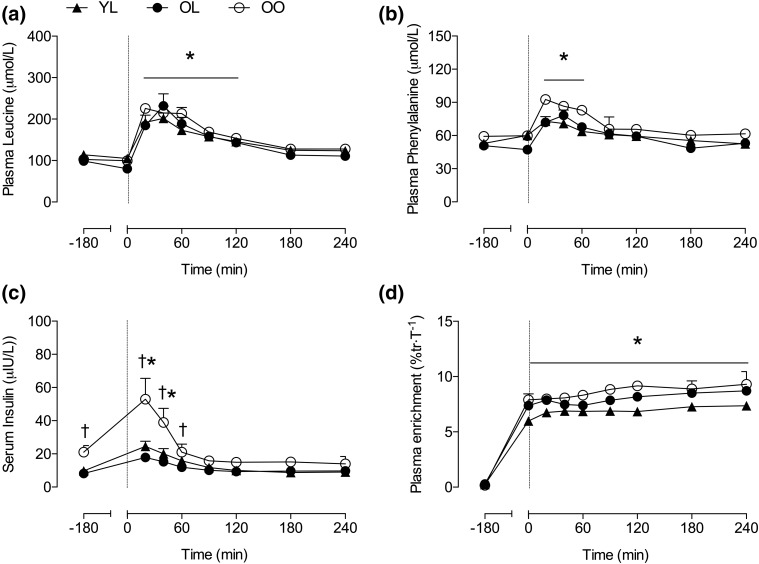
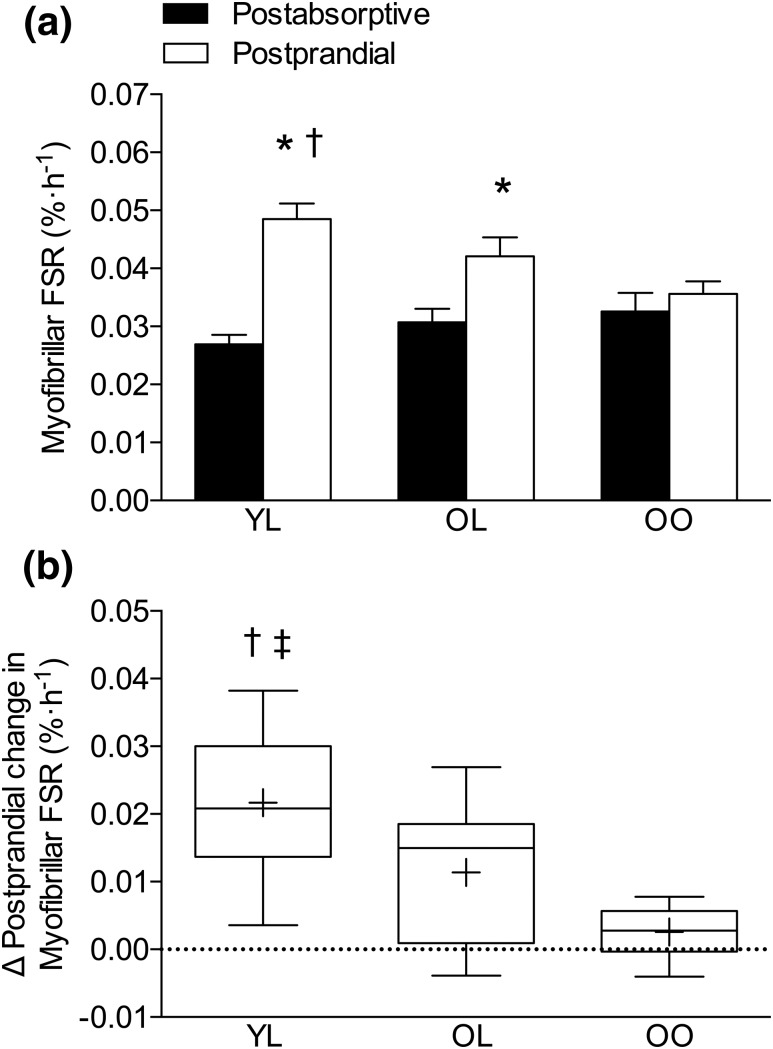
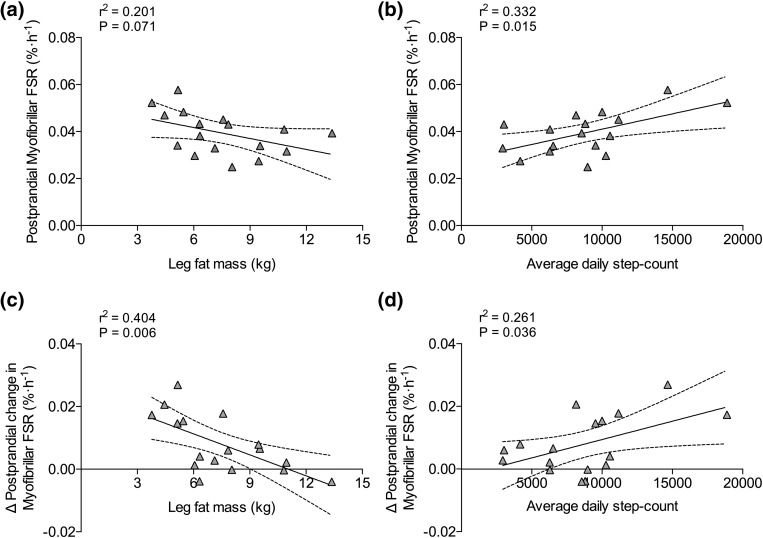
Context: A diminished muscle anabolic response to protein nutrition may underpin age-associated muscle loss. Objective: To determine how chronological and biological aging influence myofibrillar protein synthesis (MyoPS). Design: Cross-sectional comparison. Setting: Clinical research facility. Participants: Ten older lean [OL: 71.7 ± 6 years; body mass index (BMI) ≤25 kg ⋅ m-2], 7 older obese (OO: 69.1 ± 2 years; BMI ≥30 kg ⋅ m-2), and 18 young lean (YL) individuals (25.5 ± 4 years; BMI ≤25 kg ⋅ m-2). Intervention: Skeletal muscle biopsies obtained during a primed-continuous infusion of l-[ring-13C6]-phenylalanine. Main Outcome Measures: Anthropometrics, insulin resistance, inflammatory markers, habitual diet, physical activity, MyoPS rates, and fiber-type characteristics. Results: Fat mass, insulin resistance, inflammation, and type II fiber intramyocellular lipid were greater, and daily step count lower, in OO compared with YL and OL. Postprandial MyoPS rates rose above postabsorptive values by ∼81% in YL (P < 0.001), ∼38% in OL (P = 0.002, not different from YL), and ∼9% in OO (P = 0.11). Delta change in postprandial MyoPS from postabsorptive values was greater in YL compared with OL (P = 0.032) and OO (P < 0.001). Absolute postprandial MyoPS rates and delta postprandial MyoPS change were associated with step count (r2 = 0.33; P = 0.015) and leg fat mass (r2 = 0.4; P = 0.006), respectively, in older individuals. Paradoxically, lean mass was similar between groups, and muscle fiber area was greater in OO vs OL (P = 0.002). Conclusion: Age-related muscle anabolic resistance is exacerbated in obese inactive individuals, with no apparent detriment to muscle mass.
Overview
The claims and statistics of this paper haven’t been checked yet.
Free: it reads the open-access text and checks the first 5 claims that cite a source we can check. Create a free account to check every claim.
Integrity signals
Registry
Cites
Statistics
Figures
Verification
Claims the paper makes
The claims and statistics of this paper haven’t been checked yet.
Free: it reads the open-access text and checks the first 5 claims that cite a source we can check. Create a free account to check every claim.
Claims other papers make about this one
Each is checked against this paper’s own text: does it say what the citing paper says it does?
The cited source says what the claim attributes to it.
In the citing paper
“cross-sectional data suggest that inactivity in conjunction with obesity can exacerbate the anabolic resistance of ageing.63”
From Reduced physical activity in young and older adults: Metabolic and musculoskeletal implications (2019) · cites this paper as [63]
Self-check
Percentages, sums and reported differences re-computed from the paper’s own numbers.
The self-check needs the paper’s full text.
Citations
Cites
Frailty in Older Adults: Evidence for a Phenotype
Fried, L. P., Tangen, C. M., Walston, J., Newman, A. B., Hirsch, C., Gottdiener, J., Seeman, T., Tracy, R., Kop, W. J., Burke, G., et al. (2001) · The Journals of Gerontology Series A: Biological Sciences and Medical Sciences · doi:10.1093/gerona/56.3.m146 · Cited by 24,907
Janssen, I., Heymsfield, S. B., & Ross, R. (2002) · Journal of the American Geriatrics Society · doi:10.1046/j.1532-5415.2002.50216.x · Cited by 3,139 · cited 1×
“Therefore, the aim of the current study was to comprehensively assess the physical activity, whole-body/ muscle metabolic health, and inflammatory characteristics of (1) young lean (YL), (2) older lean (OL), and (3) older obese (OO) individuals to establish whether, and to what extent, these parameters were associated…”
The healthcare costs of sarcopenia in the United States
Janssen, I., Shepard, D. S., Katzmarzyk, P. T., & Roubenoff, R. (2004) · Journal of the American Geriatrics Society · doi:10.1111/j.1532-5415.2004.52014.x · Cited by 1,546
Anabolic signaling deficits underlie amino acid resistance of wasting, aging muscle
Cuthbertson, D., Smith, K., Babraj, J., Leese, G., Waddell, T., Atherton, P., Wackerhage, H., Taylor, P. M., & Rennie, M. J. (2005) · The FASEB Journal · doi:10.1096/fj.04-2640fje · Cited by 1,211 · cited 6×
“2017-00869 J Clin Endocrinol Metab, September 2017, 102(9):3535–3545 https://academic.”
InfluentialGoodpaster, B. H. (2001) · Journal of Clinical Endocrinology & Metabolism · doi:10.1210/jc.86.12.5755 · Cited by 1,194 · cited 1×
“However, type I fiber IMCL content was negatively associatedwith insulin sensitivity forOL andOO, but not YL, reinforcing the notion that the capacity for IMCL oxidation would likely have been greater in YL (39).”
Body Composition in Healthy Aging
BAUMGARTNER, R. N. (2000) · Annals of the New York Academy of Sciences · doi:10.1111/j.1749-6632.2000.tb06498.x · Cited by 1,078 · cited 2×
“increase in adiposity and intramuscular fat infiltration (myosteatosis) (20, 21), the confluence of which has been”
Inflammatory markers and loss of muscle mass (sarcopenia) and strength
Schaap, L. A., Pluijm, S. M. F., Deeg, D. J. H., & Visser, M. (2006) · The American Journal of Medicine · doi:10.1016/j.amjmed.2005.10.049 · Cited by 1,047
Sarcopenia: characteristics, mechanisms and functional significance
Narici, M. V., & Maffulli, N. (2010) · British Medical Bulletin · doi:10.1093/bmb/ldq008 · Cited by 827 · cited 1×
“Although the etiology of sarcopenia is undoubtedly multifactorial, there is contention as to the role of chronological and biological aging in this process (13).”
Moore, D. R., Churchward-Venne, T. A., Witard, O., Breen, L., Burd, N. A., Tipton, K. D., & Phillips, S. M. (2015) · The Journals of Gerontology: Series A · doi:10.1093/gerona/glu103 · Cited by 770 · cited 1×
“This age-related muscle anabolic resistance is apparent in response to low- to moderate-dose protein intake (10, 11), common in the diet of older individuals (12).”
Self-citationValidation of the GENEA Accelerometer
ESLIGER, D. W., ROWLANDS, A. V., HURST, T. L., CATT, M., MURRAY, P., & ESTON, R. G. (2011) · Medicine & Science in Sports & Exercise · doi:10.1249/mss.0b013e31820513be · Cited by 625
Research works printed but not linked: 1
- Scholes S, Mindell J Physical Activity in Adults. Health Survey for England—2012. London, England: National Health Service; 2013.
Cited by
Items 101–117 of 117
Multifactorial nature of anabolic resistance in ageing skeletal muscle: A systems modelling study
McColl, T. J., Moore, D. R., Emberly, E. G., Church, D. D., & Clarke, D. C. (2026) · The Journal of Physiology · doi:10.1113/jp290799 · Cited by 3
“Although our simulations focused solely on the feeding response, reduced levels of physical activity in older adults may contribute to the diminished mTORC1 signalling sensitivity seen in anabolic resistance (English & Paddon-Jones, 2010; Smeuninx et al., 2017; Sun et al., 2013).”
Safonicheva, O. G., Zaborova, V., Lazareva, I., Kryuchkova, K. Y., Bolotskaya, A. A., Ovchinnikova, M., Popova, C. Y., Putilo, V., Rybakov, V., Kotovskiy, S., et al. (2023) · Clinical Interventions in Aging · doi:10.2147/cia.s433944 · Cited by 1
Obésité sarcopénique : des étapes décisives et des perspectives prometteuses
Boirie, Y., Guillet, C., Pouget, M., Walrand, S., & Pinel, A. (2023) · Nutrition Clinique et Métabolisme · doi:10.1016/s0985-0562(24)00009-8 · Cited by 1
Pratt, J., Acheson, J., Lazaratou, A., Greenhalgh, E. K., Witard, O. C., Sale, C., Hannaian, S. J., Gritsas, A., Churchward‐Venne, T. A., Hearris, M. A., et al. (2025) · The Journal of Nutritional Physiology · doi:10.1016/j.jnphys.2025.100001 · Cited by 4
Carbohydrate, Protein, and Fat Metabolism in Obesity
Galgani, J. E., Cortés, V., & Carrasco, F. (2023) · Springer eBooks · doi:10.1007/978-3-031-40116-9_21 · Cited by 1
Bellafronte, N. T. (2021) · Digital Library of Theses and Dissertations (Universidade de São Paulo) · doi:10.11606/t.17.2021.tde-04082021-143309 · Cited by 1
Davies, T., Watson, N., Pilkington, J., McClelland, T., Azzopardi, G., Pearse, R. M., Prowle, J. R., & Puthucheary, Z. (2023) · medRxiv · doi:10.1101/2023.07.03.23292166 · Cited by 1
“Anabolic resistance limits the effectiveness of interventions such as resistance training and amino acid supplementation [88,89].”
BackgroundMcColl, T. J., Moore, D. R., Emberly, E. G., Church, D. D., & Clarke, D. C. (2025) · bioRxiv (Cold Spring Harbor Laboratory) · doi:10.1101/2025.09.12.675977 · Cited by 1
“While our simulations focused solely on the feeding response, reduced levels of physical activity in older adults may contribute to the diminished mTORC1 signaling sensitivity seen in anabolic resistance [46–48].”
Comment lutter contre le vieillissement musculaire ?
Lahaye, C., Soubrier, M., & Tournadre, A. (2019) · Revue du Rhumatisme Monographies · doi:10.1016/j.monrhu.2019.01.003 · Cited by 1
Qian, C. (2021) · Undergraduate Research in Natural and Clinical Science and Technology (URNCST) Journal · doi:10.26685/urncst.226
“Low doses of whey, soy, and beef protein (0-10g) elicited blunted MPS responses in both rested and exercised older muscles [6, 41, 48-50].”
BackgroundGonçalves, N. E. X. M. (2021) · Digital Library of Theses and Dissertations (Universidade de São Paulo) · doi:10.11606/t.17.2021.tde-11042022-141924
Boirie, Y. (2021) · Elsevier eBooks · doi:10.1016/b978-2-294-76753-1.00067-9
Carbohydrate, Protein, and Fat Metabolism in Obesity
Galgani, J. E., Cortés, V., & Carrasco, F. (2023) · Springer eBooks · doi:10.1007/978-3-319-12125-3_21-2
Matchekhina, L. V., Ткачева, О. Н., Shelley, E. M., Мамчур, А. А., Erema, V. V., Bruttan, M., Ivanov, M. V., Kashtanova, D. A., Rumyantseva, A. M., Yudin, V. S., et al. (2024) · Russian Journal of Geriatric Medicine · doi:10.37586/2686-8636-3-2024-174-184
Ding, T., Zhang, Z., Li, W., Zhu, Y., Shi, Y., Li, W., & Chen, X. (2025) · Nutrition · doi:10.1016/j.nut.2025.113052
Nutrition's role in extending healthspan: CRN-international symposium report
Huber, L. G., Bischoff-Ferrari, H. A., Folta, S. C., Marsman, D. S., Moore, D. R., Shao, A. E., Stout, M., Williamson, G., & Griffiths, J. C. (2026) · European Journal of Nutrition · doi:10.1007/s00394-025-03860-1
“However, indiscrimi - nately increasing meal size (i.e., both protein and energy) may not be advisable for all adults given the growing inci - dence of sarcopenic obesity [63 ], which itself can be coun - terproductive via its association with anabolic resistance to protein and exercise [ 64 , 65 ].”
Does protein source influence ageing muscle? A contemporary physiological perspective
Apicella, M. C. A., Korzepa, M., & Breen, L. (2026) · The Journal of Nutritional Physiology · doi:10.1016/j.jnphys.2026.100043
Self-citation
Metadata
- Authors
- Smeuninx, B., Mckendry, J., Wilson, D., Martin, U., & Breen, L.
- Affiliations
- Arthritis Research UK (GB)
- University Hospitals Birmingham NHS Foundation Trust (GB)
- University of Birmingham (GB)
- Corresponding author
- Breen, Leigh
- Venue
- The Journal of Clinical Endocrinology & Metabolism
- Publisher
- The Endocrine Society
- Published
- 2017-07-14
- Volume
- 102
- Issue
- 9
- Pages
- 3535-3545
- ISSN
- 0021-972X (ISSN-L)
- 1945-7197
- PMC
- PMC5587073
- OpenAlex
- W2734380231
- Cited by
- 118
- References
- 45
- Citations by year
- 2026: 10 · 2025: 12 · 2024: 11 · 2023: 14 · 2022: 15 · 2021: 17 · 2020: 14 · 2019: 12 · 2018: 13
- FWCI
- 5.69
- Type
- journal article
- Language
- en
- Open access
- hybrid
- doi.org
- Licence
- cc-by
- Locations
- The Journal of Clinical Endocrinology & Metabolism (publishedVersion, cc-by)
- PubMed Central (publishedVersion, cc-by)
- PubMed (publishedVersion)
- University of Birmingham Research Portal (University of Birmingham) (submittedVersion, cc-by)
- Funders
- Wellcome Trust
- National Institute for Health and Care Research
- Versus Arthritis
- Directorate for Biological Sciences
- Medical Research Council
- Biotechnology and Biological Sciences Research Council (BB/N018214/1)
- Topics
- Health Sciences › Nursing › Nutrition and Dietetics › Muscle metabolism and nutrition
- Health Sciences › Medicine › Physiology (medical) › Nutrition and Health in Aging
- Life Sciences › Biochemistry, Genetics and Molecular Biology › Molecular Biology › Muscle Physiology and Disorders
- Keywords
- myofibrillar protein synthesis, anabolic resistance, aging, obesity, physical inactivity, skeletal muscle, insulin resistance, inflammation, fat mass, step count, muscle fiber area, sarcopenia, lean body mass
- MeSH terms
- Adult, Age Factors, Aging, Biopsy, Needle, Blood Glucose, Body Composition, Cross-Sectional Studies, Energy Metabolism, Female, Humans, Immunohistochemistry, Insulin Resistance, Male, Middle Aged, Myofibrils, Obesity, Prognosis, Protein Biosynthesis, Exercise, Body Mass Index, Muscle, Skeletal, Risk Assessment, Young Adult, Sedentary Behavior
About these checks
Registry, retraction, Cites and statistics results are computed, not judged, with one exception: a printed reference that no index lists is read once by a model before it counts as a citation error. Claims are extracted by a model and kept only when their quote appears verbatim in the text; each cited source is then checked, with a model’s help, for whether it says what the claim relies on. Those verdicts can be wrong — read the claim’s quote and the cited source before relying on one.
Statistics and arithmetic are recomputed, not judged.
Confidence bands are shown only for fields calibrated on our annotated test set. None is calibrated yet, so no band is shown.
What counts as a claim ›How we measure confidence ›How we check this ›
Are you an author, or do you see a problem with this page? Request a review
Data sources
Bibliographic data: Semantic Scholar, OpenAlex, Crossref.
Contains information from the Semantic Scholar Academic Graph Datasets, made available under the ODC Attribution License (ODC-BY 1.0).
Semantic Scholar’s data is described in: Kinney, R., et al. (2023). The Semantic Scholar Open Data Platform. arXiv:2301.10140.
