

Age-Related Anabolic Resistance of Myofibrillar Protein Synthesis Is Exacerbated in Obese Inactive Individuals
Open accessThe DOI matches its Crossref record; 46 of the 46 references it cites were found in a registry or an index.
Abstract
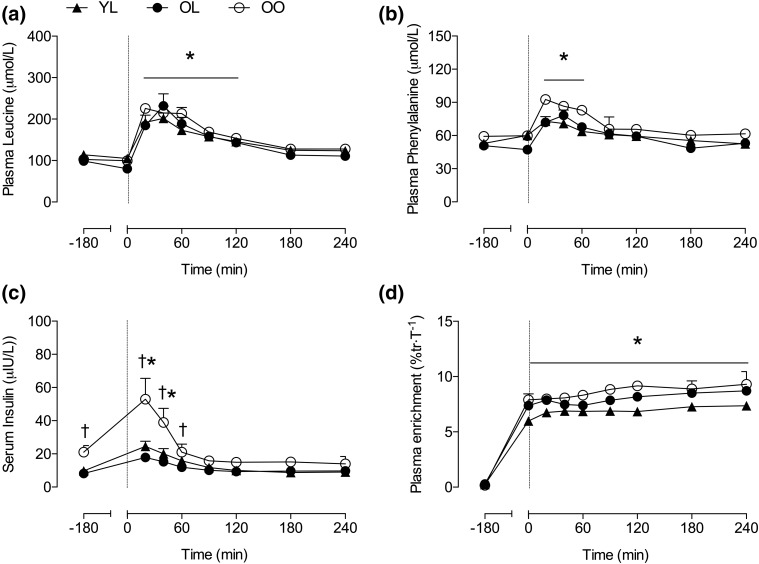
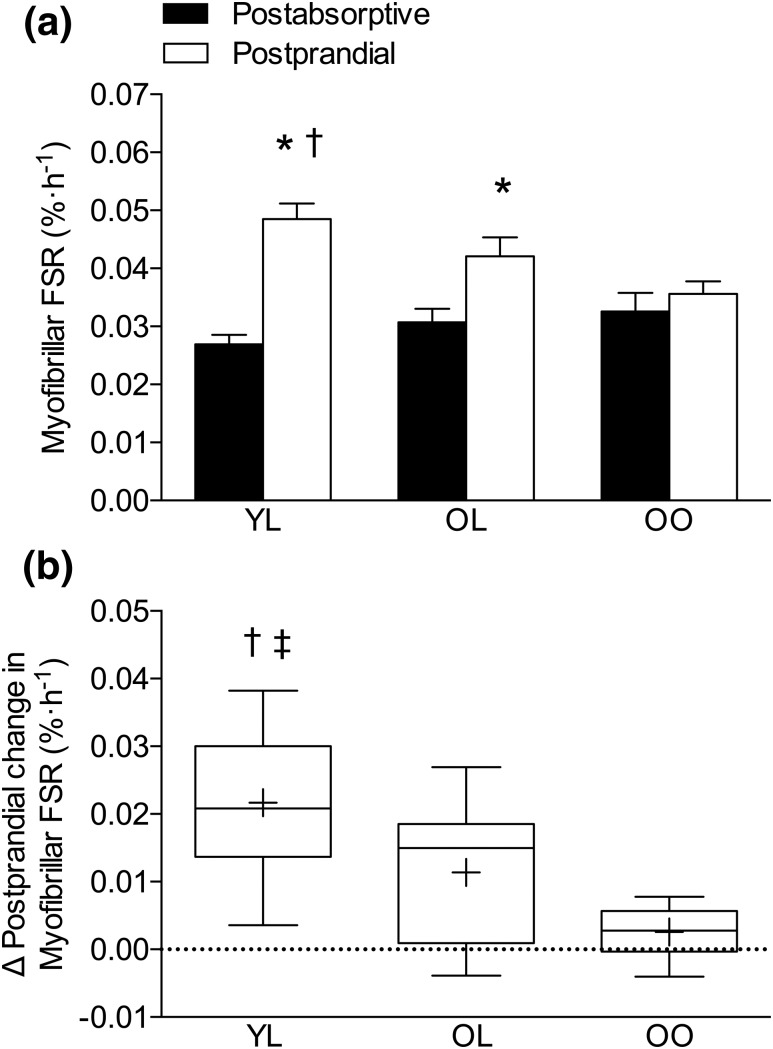
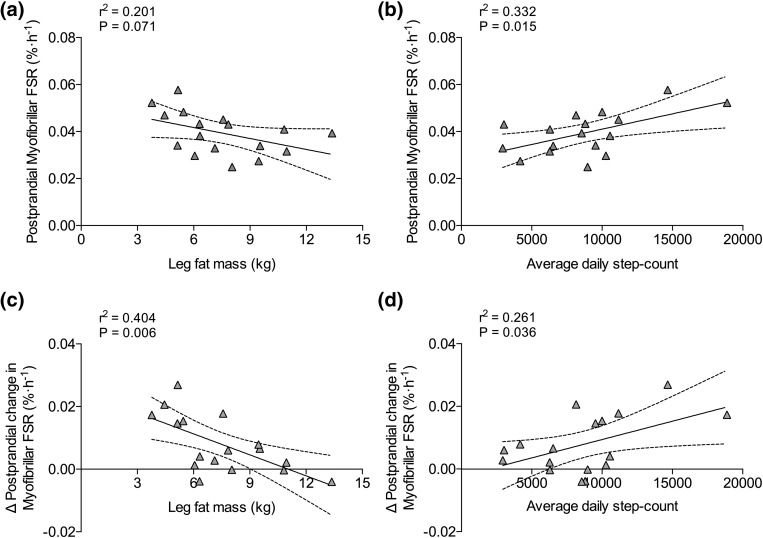
Context: A diminished muscle anabolic response to protein nutrition may underpin age-associated muscle loss. Objective: To determine how chronological and biological aging influence myofibrillar protein synthesis (MyoPS). Design: Cross-sectional comparison. Setting: Clinical research facility. Participants: Ten older lean [OL: 71.7 ± 6 years; body mass index (BMI) ≤25 kg ⋅ m-2], 7 older obese (OO: 69.1 ± 2 years; BMI ≥30 kg ⋅ m-2), and 18 young lean (YL) individuals (25.5 ± 4 years; BMI ≤25 kg ⋅ m-2). Intervention: Skeletal muscle biopsies obtained during a primed-continuous infusion of l-[ring-13C6]-phenylalanine. Main Outcome Measures: Anthropometrics, insulin resistance, inflammatory markers, habitual diet, physical activity, MyoPS rates, and fiber-type characteristics. Results: Fat mass, insulin resistance, inflammation, and type II fiber intramyocellular lipid were greater, and daily step count lower, in OO compared with YL and OL. Postprandial MyoPS rates rose above postabsorptive values by ∼81% in YL (P < 0.001), ∼38% in OL (P = 0.002, not different from YL), and ∼9% in OO (P = 0.11). Delta change in postprandial MyoPS from postabsorptive values was greater in YL compared with OL (P = 0.032) and OO (P < 0.001). Absolute postprandial MyoPS rates and delta postprandial MyoPS change were associated with step count (r2 = 0.33; P = 0.015) and leg fat mass (r2 = 0.4; P = 0.006), respectively, in older individuals. Paradoxically, lean mass was similar between groups, and muscle fiber area was greater in OO vs OL (P = 0.002). Conclusion: Age-related muscle anabolic resistance is exacerbated in obese inactive individuals, with no apparent detriment to muscle mass.
Overview
The claims and statistics of this paper haven’t been checked yet.
Free: it reads the open-access text and checks the first 5 claims that cite a source we can check. Create a free account to check every claim.
Integrity signals
Registry
Cites
Statistics
Figures
Verification
Claims the paper makes
The claims and statistics of this paper haven’t been checked yet.
Free: it reads the open-access text and checks the first 5 claims that cite a source we can check. Create a free account to check every claim.
Claims other papers make about this one
Each is checked against this paper’s own text: does it say what the citing paper says it does?
The cited source says what the claim attributes to it.
In the citing paper
“cross-sectional data suggest that inactivity in conjunction with obesity can exacerbate the anabolic resistance of ageing.63”
From Reduced physical activity in young and older adults: Metabolic and musculoskeletal implications (2019) · cites this paper as [63]
Self-check
Percentages, sums and reported differences re-computed from the paper’s own numbers.
The self-check needs the paper’s full text.
Citations
Cites
Frailty in Older Adults: Evidence for a Phenotype
Fried, L. P., Tangen, C. M., Walston, J., Newman, A. B., Hirsch, C., Gottdiener, J., Seeman, T., Tracy, R., Kop, W. J., Burke, G., et al. (2001) · The Journals of Gerontology Series A: Biological Sciences and Medical Sciences · doi:10.1093/gerona/56.3.m146 · Cited by 24,907
Janssen, I., Heymsfield, S. B., & Ross, R. (2002) · Journal of the American Geriatrics Society · doi:10.1046/j.1532-5415.2002.50216.x · Cited by 3,139 · cited 1×
“Therefore, the aim of the current study was to comprehensively assess the physical activity, whole-body/ muscle metabolic health, and inflammatory characteristics of (1) young lean (YL), (2) older lean (OL), and (3) older obese (OO) individuals to establish whether, and to what extent, these parameters were associated…”
The healthcare costs of sarcopenia in the United States
Janssen, I., Shepard, D. S., Katzmarzyk, P. T., & Roubenoff, R. (2004) · Journal of the American Geriatrics Society · doi:10.1111/j.1532-5415.2004.52014.x · Cited by 1,546
Anabolic signaling deficits underlie amino acid resistance of wasting, aging muscle
Cuthbertson, D., Smith, K., Babraj, J., Leese, G., Waddell, T., Atherton, P., Wackerhage, H., Taylor, P. M., & Rennie, M. J. (2005) · The FASEB Journal · doi:10.1096/fj.04-2640fje · Cited by 1,211 · cited 6×
“2017-00869 J Clin Endocrinol Metab, September 2017, 102(9):3535–3545 https://academic.”
InfluentialGoodpaster, B. H. (2001) · Journal of Clinical Endocrinology & Metabolism · doi:10.1210/jc.86.12.5755 · Cited by 1,194 · cited 1×
“However, type I fiber IMCL content was negatively associatedwith insulin sensitivity forOL andOO, but not YL, reinforcing the notion that the capacity for IMCL oxidation would likely have been greater in YL (39).”
Body Composition in Healthy Aging
BAUMGARTNER, R. N. (2000) · Annals of the New York Academy of Sciences · doi:10.1111/j.1749-6632.2000.tb06498.x · Cited by 1,078 · cited 2×
“increase in adiposity and intramuscular fat infiltration (myosteatosis) (20, 21), the confluence of which has been”
Inflammatory markers and loss of muscle mass (sarcopenia) and strength
Schaap, L. A., Pluijm, S. M. F., Deeg, D. J. H., & Visser, M. (2006) · The American Journal of Medicine · doi:10.1016/j.amjmed.2005.10.049 · Cited by 1,047
Sarcopenia: characteristics, mechanisms and functional significance
Narici, M. V., & Maffulli, N. (2010) · British Medical Bulletin · doi:10.1093/bmb/ldq008 · Cited by 827 · cited 1×
“Although the etiology of sarcopenia is undoubtedly multifactorial, there is contention as to the role of chronological and biological aging in this process (13).”
Moore, D. R., Churchward-Venne, T. A., Witard, O., Breen, L., Burd, N. A., Tipton, K. D., & Phillips, S. M. (2015) · The Journals of Gerontology: Series A · doi:10.1093/gerona/glu103 · Cited by 770 · cited 1×
“This age-related muscle anabolic resistance is apparent in response to low- to moderate-dose protein intake (10, 11), common in the diet of older individuals (12).”
Self-citationValidation of the GENEA Accelerometer
ESLIGER, D. W., ROWLANDS, A. V., HURST, T. L., CATT, M., MURRAY, P., & ESTON, R. G. (2011) · Medicine & Science in Sports & Exercise · doi:10.1249/mss.0b013e31820513be · Cited by 625
Research works printed but not linked: 1
- Scholes S, Mindell J Physical Activity in Adults. Health Survey for England—2012. London, England: National Health Service; 2013.
Cited by
D’Hulst, G., Soro-Arnaiz, I., Masschelein, E., Veys, K., Fitzgerald, G., Smeuninx, B., Kim, S., Deldicque, L., Blaauw, B., Carmeliet, P., et al. (2020) · Nature Communications · doi:10.1038/s41467-019-13889-6 · Cited by 2,310
Self-citationReduced physical activity in young and older adults: Metabolic and musculoskeletal implications
Bowden Davies, K. A., Pickles, S., Sprung, V. S., Kemp, G. J., Alam, U., Moore, D. R., Tahrani, A. A., & Cuthbertson, D. J. (2019) · Therapeutic Advances in Endocrinology and Metabolism · doi:10.1177/2042018819888824 · Cited by 278
Sarcopenic obesity: time to meet the challenge
Barazzoni, R., Bischoff, S. C., Boirie, Y., Busetto, L., Cederholm, T., Dicker, D., Toplak, H., Van Gossum, A., Yumuk, V., & Vettor, R. (2018) · Clinical Nutrition · doi:10.1016/j.clnu.2018.04.018 · Cited by 260
Liu, C., Wong, P. Y., Chung, Y. L., Chow, S. K., Cheung, W. H., Law, S. W., Chan, J. C. N., & Wong, R. M. Y. (2023) · Obesity Reviews · doi:10.1111/obr.13534 · Cited by 247
“Muscle anabolic resistance was more evident in people with obesity.(77) In 17 studies, the accumulation of adipose tissue in different regions correlated with poor muscle function and physical F IGURE 3 Random-effects meta-analysis showing the hazard ratio for all-cause mortality in patients with sarcopenic obesity (S…”
BackgroundSarcopenic obesity: time to meet the challenge
Barazzoni, R., Bischoff, S., Boirie, Y., Busetto, L., Cederholm, T., Dicker, D., Toplak, H., Van Gossum, A., Yumuk, V., & Vettor, R. (2018) · Obesity Facts · doi:10.1159/000490361 · Cited by 244
“…BMI and lean body mass has been reported in general population studies [23] and moderate increments in skeletal muscle mass may occur in obesity as a consequence of higher postural and ambulatory muscle work as well as potential direct anabolic effects of higher dietary intake of calorie-proteins.”
Molecular Mechanisms of Inflammation in Sarcopenia: Diagnosis and Therapeutic Update
Jimenez-Gutierrez, G. E., Martínez-Gómez, L. E., Martínez-Armenta, C., Pineda, C., Martínez-Nava, G. A., & Lopez-Reyes, A. (2022) · Cells · doi:10.3390/cells11152359 · Cited by 231
Age-related changes in skeletal muscle: changes to life-style as a therapy
McCormick, R., & Vasilaki, A. (2018) · Biogerontology · doi:10.1007/s10522-018-9775-3 · Cited by 205
Strategies to Prevent Sarcopenia in the Aging Process: Role of Protein Intake and Exercise
Rogeri, P. S., Zanella, R., Martins, G. L., Garcia, M. D. A., Leite, G., Lugaresi, R., Gasparini, S. O., Sperandio, G. A., Ferreira, L. H. B., Souza-Junior, T. P., et al. (2021) · Nutrients · doi:10.3390/nu14010052 · Cited by 181
“Moreover, some clinical and lifestyle conditions such as DM2 [143], obesity [55], physical inactivity, and bed rest [133] seem to decrease the sensitivity of the skeletal muscle to stimulatory effects of EAA on MPS even more.”
BackgroundSarcopenic Obesity: Epidemiologic Evidence, Pathophysiology, and Therapeutic Perspectives
Koliaki, C., Liatis, S., Dalamaga, M., & Kokkinos, A. (2019) · Current Obesity Reports · doi:10.1007/s13679-019-00359-9 · Cited by 176
Bear, D. E., Langan, A., Dimidi, E., Wandrag, L., Harridge, S. D. R., Hart, N., Connolly, B., & Whelan, K. (2019) · The American Journal of Clinical Nutrition · doi:10.1093/ajcn/nqy373 · Cited by 166
“Older patients also display anabolic resistance whereby muscle protein synthesis is resistant to stimuli such as resistance training and amino acid loading (17, 18), a serious clinical consideration with an increasingly aging population.”
BackgroundSarcopenia: Etiology, Nutritional Approaches, and miRNAs
Cannataro, R., Carbone, L., Petro, J. L., Cione, E., Vargas, S., Angulo, H., Forero, D. A., Odriozola-Martínez, A., Kreider, R. B., & Bonilla, D. A. (2021) · International Journal of Molecular Sciences · doi:10.3390/ijms22189724 · Cited by 157
“This age-related muscle ‘anabolic resistance’ is more evident in response to low or moderate protein intake which is common in the diet of older individuals [101].”
BackgroundMuscle Protein Synthesis after Protein Administration in Critical Illness
Chapple, L. S., Kouw, I. W. K., Summers, M. J., Weinel, L. M., Gluck, S., Raith, E. P., Slobodian, P., Soenen, S., Deane, A. M., van Loon, L. J. C., et al. (2022) · American Journal of Respiratory and Critical Care Medicine · doi:10.1164/rccm.202112-2780oc · Cited by 165
Defining anabolic resistance: Implications for delivery of clinical care nutrition
Morton, R. W., Traylor, D. A., Weijs, P. J. M., & Phillips, S. M. (2018) · Current Opinion in Critical Care · doi:10.1097/mcc.0000000000000488 · Cited by 106
Double burden of malnutrition in persons with obesity
Barazzoni, R., & Gortan Cappellari, G. (2020) · Reviews in Endocrine and Metabolic Disorders · doi:10.1007/s11154-020-09578-1 · Cited by 120
Nutritional Supplements to Support Resistance Exercise in Countering the Sarcopenia of Aging
McKendry, J., Currier, B. S., Lim, C., Mcleod, J. C., Thomas, A. C. Q., & Phillips, S. M. (2020) · Nutrients · doi:10.3390/nu12072057 · Cited by 118
“Additionally, the obese phenotype of the participants may have exacerbated anabolic resistance [88].”
BackgroundSelf-citationMuscle morphology and performance in master athletes: A systematic review and meta-analyses
Mckendry, J., Breen, L., Shad, B. J., & Greig, C. A. (2018) · Ageing Research Reviews · doi:10.1016/j.arr.2018.04.007 · Cited by 111
“quantity per se, plays a more important role in the maintenance of whole-body metabolic health (Smeuninx et al., 2017).”
BackgroundSelf-citationAnabolic Resistance of Muscle Protein Turnover Comes in Various Shapes and Sizes
Paulussen, K. J. M., McKenna, C. F., Beals, J. W., Wilund, K. R., Salvador, A. F., & Burd, N. A. (2021) · Frontiers in Nutrition · doi:10.3389/fnut.2021.615849 · Cited by 107
“Assessments of MPS to ingestion of protein-dense foods have shown that people with obesity have reduced stimulation of myofibrillar (3, 74), but not mitochondrial protein synthesis rates (76), compared with healthy-weight individuals.”
BackgroundInfluentialThe Muscle Protein Synthetic Response to Meal Ingestion Following Resistance-Type Exercise
Trommelen, J., Betz, M. W., & van Loon, L. J. C. (2019) · Sports Medicine · doi:10.1007/s40279-019-01053-5 · Cited by 106
Exploring the Impact of Obesity on Skeletal Muscle Function in Older Age
Morgan, P. T., Smeuninx, B., & Breen, L. (2020) · Frontiers in Nutrition · doi:10.3389/fnut.2020.569904 · Cited by 98
“It is plausible that a physically active older obese individual might possess greater intramuscular lipid oxidation capabilities compared with a inactivity older obese individual (85).”
BackgroundResultInfluentialSelf-citationAge-related muscle anabolic resistance: inevitable or preventable?
Aragon, A. A., Tipton, K. D., & Schoenfeld, B. J. (2023) · Nutrition Reviews · doi:10.1093/nutrit/nuac062 · Cited by 93
Maximizing Post-exercise Anabolism: The Case for Relative Protein Intakes
Moore, D. R. (2019) · Frontiers in Nutrition · doi:10.3389/fnut.2019.00147 · Cited by 86
“, ∼7,400 steps/day) (111), may be exacerbated by inactivity (112), which suggests this anabolic resistance of obesity, similar to older adults (85, 86), has a strong lifestyle component to its manifestation and severity.”
BackgroundObesity Alters the Muscle Protein Synthetic Response to Nutrition and Exercise
Beals, J. W., Burd, N. A., Moore, D. R., & van Vliet, S. (2019) · Frontiers in Nutrition · doi:10.3389/fnut.2019.00087 · Cited by 88
“This receptor is involved in innate immunity and is primarily known for responding to endotoxin (113), but is also responsive to NEFA (114) and CRP (115) in circulation.”
BackgroundResultInfluentialHodson, N., West, D. W. D., Philp, A., Burd, N. A., & Moore, D. R. (2019) · American Journal of Physiology-Cell Physiology · doi:10.1152/ajpcell.00209.2019 · Cited by 72
“However, several investigations have failed to find congruence between these signaling events and MPS responses (115, 160, 189) or report that only select posttranslational modifications are affected (47).”
BackgroundAging Fits the Disease Criteria of the International Classification of Diseases
Khaltourina, D. A., Matveyev, Y., Alekseev, A., Cortese, F., & Ioviţă, A. (2020) · Mechanisms of Ageing and Development · doi:10.1016/j.mad.2020.111230 · Cited by 86
Smeuninx, B., Greig, C. A., & Breen, L. (2020) · Frontiers in Nutrition · doi:10.3389/fnut.2020.00025 · Cited by 69
“This is important to highlight as physical activity status may be an important determinant of muscle anabolic responsiveness, particularly in older individuals (28).”
BackgroundSelf-citationEmerging Targets and Treatments for Sarcopenia: A Narrative Review
Cacciatore, S., Calvani, R., Esposito, I., Massaro, C., Gava, G., Picca, A., Tosato, M., Marzetti, E., & Landi, F. (2024) · Nutrients · doi:10.3390/nu16193271 · Cited by 89
“Insulin resistance, prevalent among older adults, impairs the muscle’s ability to respond to anabolic signals, thereby decreasing MPS [151,152].”
BackgroundPaez, H. G., Pitzer, C. R., & Alway, S. E. (2023) · Cells · doi:10.3390/cells12020249 · Cited by 79
“However, old obese subjects fail to enhance post prandial myofibrillar fractional synthetic rate, indicating that obesity further dampens aging associated anabolic resistance to feeding [74].”
Marshall, R. N., Smeuninx, B., Morgan, P. T., & Breen, L. (2020) · Nutrients · doi:10.3390/nu12051533 · Cited by 63
Self-citationSchoufour, J. D., Tieland, M., Barazzoni, R., Ben Allouch, S., Bie, J. V. D., Boirie, Y., Cruz-Jentoft, A. J., Eglseer, D., Topinková, E., Visser, B., et al. (2021) · Frontiers in Nutrition · doi:10.3389/fnut.2021.661449 · Cited by 62
Castillo, Í. M. P., Argilés, J. M. A., Rueda, R., Ramírez, M., & Pedrosa, J. M. L. (2025) · Reviews in Endocrine and Metabolic Disorders · doi:10.1007/s11154-025-09954-9 · Cited by 83
“Unlike diabetes, obesity per se is not typically associated with lower absolute skeletal muscle mass [22, 23].”
Silveira, É. A., Filho, R. R. D. S., Spexoto, M. C. B., Haghighatdoost, F., Sarrafzadegan, N., & de Oliveira, C. M. (2021) · International Journal of Molecular Sciences · doi:10.3390/ijms22094339 · Cited by 63
“There are several endocrine-hormonal, metabolic and lifestyle aspects involved in the occurrence of sarcopenic obesity [15,16] that, consequently, affect pathophysiological aspects that can contribute to developing cardiovascular diseases and neoplasms [5,17].”
BackgroundBeals, J. W., Skinner, S. K., McKenna, C. F., Poozhikunnel, E. G., Farooqi, S. A., van Vliet, S., Martinez, I. G., Ulanov, A. V., Li, Z., Paluska, S. A., et al. (2018) · The Journal of Physiology · doi:10.1113/jp276210 · Cited by 55
“Specifically, several studies have reported a reduced stimulation of the muscle protein synthetic response to amino acid provision in obese adults compared to normal weight controls (Guillet et al. 2009; Chevalier et al. 2015; Murton et al. 2015; Beals et al. 2016; Smeuninx et al. 2017).”
BackgroundResultLiao, C., Wu, Y., Tsauo, J., Chen, P., Tu, Y., Chen, H., & Liou, T. (2020) · Nutrients · doi:10.3390/nu12082422 · Cited by 60
“First, both PS (especially with leucine and whey protein [71,72]) and ET stimulate myoprotein synthesis in older adults [71,73,74]; such stimulation occurs despite delayed and diminished muscle protein anabolic responses to PS + ET in older adults relative to younger controls [75,76].”
BackgroundResistance Exercise, Aging, Disuse, and Muscle Protein Metabolism
McKendry, J., Stokes, T., Mcleod, J. C., & Phillips, S. M. (2021) · Comprehensive Physiology · doi:10.1002/cphy.c200029 · Cited by 54
Self-citationSmeuninx, B., Elhassan, Y., Manolopoulos, K. N., Sapey, E., Rushton, A., Edwards, S. J., Morgan, P. T., Philp, A., Brook, M. S., Gharahdaghi, N., et al. (2020) · Journal of Cachexia Sarcopenia and Muscle · doi:10.1002/jcsm.12661 · Cited by 59
“for [(13)C6] phenylalanine and [ (2)H] alanine, respectively, with the use of the precursor-product equation, as previously described.(6,25) The use of tracer naïve participants allowed”
BackgroundMethodSelf-citationEfficacy of Dietary and Supplementation Interventions for Individuals with Type 2 Diabetes
Lewgood, J., Oliveira, B., Korzepa, M., Forbes, S. C., Little, J. P., Breen, L., Bailie, R., & Candow, D. G. (2021) · Nutrients · doi:10.3390/nu13072378 · Cited by 58
Self-citationMurphy, C. H., Flanagan, E. M., VITO, G. D., Susta, D., Mitchelson, K. A. J., Castro, E. D. M., Senden, J. M., Goessens, J. P. B., Mikłosz, A., Chabowski, A., et al. (2021) · American Journal of Clinical Nutrition · doi:10.1093/ajcn/nqaa449 · Cited by 56
“Furthermore, greater fat mass has been reported to exacerbate anabolic resistance (53) and declines in muscle quality (54) and physical performance (55) with aging.”
BackgroundÖzkök, S., Aydın, Ç. Ö., Sacar, D. E., Çatıkkaş, N. M., Erdoğan, T., Bozkurt, M. E., Kılıç, C., Karan, M. A., & Bahat, G. (2022) · Clinical Nutrition · doi:10.1016/j.clnu.2022.09.005 · Cited by 55
Liao, C.-D., Huang, S.-W., Chen, H.-C., Huang, M.-H., Liou, T.-H., & Lin, C.-L. (2024) · Nutrients · doi:10.3390/nu16070941 · Cited by 45
“The results of this NMA may help the clinicians to prescribe the optimal PS protocol during RT intervention for ensuring optimal treatment outcomes.”
BackgroundShared and distinct mechanisms of skeletal muscle atrophy: A narrative review
Wilburn, D. T., Ismaeel, A., Machek, S. B., Fletcher, E., & Koutakis, P. (2021) · Ageing Research Reviews · doi:10.1016/j.arr.2021.101463 · Cited by 49
McKendry, J., Joanisse, S., Baig, S., Liu, B., Parise, G., Greig, C. A., & Breen, L. (2020) · The Journals of Gerontology: Series A · doi:10.1093/gerona/glz142 · Cited by 44
Self-citationAssociation of muscle fiber type with measures of obesity: A systematic review
Damer, A., El Meniawy, S., McPherson, R., Wells, G., Harper, M., & Dent, R. (2022) · Obesity Reviews · doi:10.1111/obr.13444 · Cited by 43
Inflammation and metabolism: the role of adiposity in sarcopenic obesity
Lynch, G. M., Murphy, C. H., Castro, E. D. M., & Roche, H. M. (2020) · Proceedings of the Nutrition Society · doi:10.1017/s0029665120007119 · Cited by 41
“There is accumulating evidence that obesity, which represents another model of lipid overload, suppresses the stimulation of MPS rates following dietary protein ingestion((144,145)), combined feeding and resistance exercise((148)) in human subjects.”
BackgroundAoyama, T., Maezawa, Y., Yoshikawa, T., Segami, K., Kano, K., Hayashi, T., Yamada, T., Numata, M., GODA, M., Tamagawa, H., et al. (2018) · In Vivo · doi:10.21873/invivo.11463 · Cited by 40
Zhang, Y., Miyai, N., Abe, K., Utsumi, M., Uematsu, Y., Terada, K., Nakatani, T., Takeshita, T., & Arita, M. (2020) · Journal of Human Hypertension · doi:10.1038/s41371-020-0355-z · Cited by 43
Muscle Mass Loss in the Older Critically Ill Population: Potential Therapeutic Strategies
McKendry, J., Thomas, A. C. Q., & Phillips, S. M. (2020) · Nutrition in Clinical Practice · doi:10.1002/ncp.10540 · Cited by 44
Self-citationGortan Cappellari, G., Semolic, A., Zanetti, M., Vinci, P., Ius, M., Guarnieri, G., Busetto, L., Donini, L. M., & Barazzoni, R. (2023) · Metabolism · doi:10.1016/j.metabol.2023.155595 · Cited by 36
Protein Requirements for Master Athletes: Just Older Versions of Their Younger Selves
Moore, D. R. (2021) · Sports Medicine · doi:10.1007/s40279-021-01510-0 · Cited by 33
Tran, L., Kras, K. A., Hoffman, N., Ravichandran, J., Dickinson, J. M., D'Lugos, A., Carroll, C. C., Patel, S. H., Mandarino, L. J., Roust, L., et al. (2018) · Obesity · doi:10.1002/oby.22213 · Cited by 32
“Previous studies utilizing the hyperaminoacidemic/hyperinsulinemic clamp or meal ingestion have reported either comparable stimulation of mixed-muscle (2) or lower stimulation of myofibrillar (5,6,25) or mitochondrial (2) protein synthesis in humans with obesity.”
BackgroundResultWitard, O. C., Combet, E., & Gray, S. R. (2019) · Proceedings of The Nutrition Society · doi:10.1017/s0029665119000922 · Cited by 39
Smeuninx, B., Elhassan, Y., Sapey, E., Rushton, A., Morgan, P. T., Korzepa, M., Belfield, A. E., Philp, A., Brook, M. S., Gharahdaghi, N., et al. (2023) · The Journal of Physiology · doi:10.1113/jp285130 · Cited by 33
“The amino acid composition of the milk protein is described in our previous work (Smeuninx et al., 2017).”
Self-citationNilsson, M. I., Xhuti, D., de Maat, N. M., Hettinga, B. P., & Tarnopolsky, M. A. (2024) · Nutrients · doi:10.3390/nu16244407 · Cited by 43
Kouw, I. W., van Dijk, J. W., Horstman, A. M., Kramer, I. F., Goessens, J. P., van Dielen, F. M., Verdijk, L. B., & van Loon, L. J. (2019) · The Journal of Nutrition · doi:10.1093/jn/nxz104 · Cited by 28
“Our data seem to agree with some (16, 22), but certainly not all (12, 16, 24, 25), studies that have addressed the proposed impairments in postprandial muscle protein synthesis rates in the obese state.”
BackgroundResultInfluentialGenário, R., Gil, S. D. S., Júnior, G. N. D. O., Leitão, A. E., Franco, T. C., Sales, R. C. D. S., Ferriolli, E., Busse, A. L., Filho, W. J., Gualano, B., et al. (2023) · Scientific Reports · doi:10.1038/s41598-023-37921-4 · Cited by 31
McKendry, J., Shad, B. J., Smeuninx, B., Oikawa, S. Y., Wallis, G., Greig, C., Phillips, S. M., & Breen, L. (2019) · Frontiers in Physiology · doi:10.3389/fphys.2019.01084 · Cited by 27
“Previous studies utilizing acute intravenous infusions of stable isotope tracers have demonstrated age-related muscle anabolic resistance in response to exercise (Kumar et al., 2009) and protein feeding (Moore et al., 2015; Wall et al., 2015; Smeuninx et al., 2017).”
BackgroundSelf-citationThe challenges of muscle biopsy in a community based geriatric population
Wilson, D. V., Breen, L., Lord, J. M., & Sapey, E. (2018) · BMC Research Notes · doi:10.1186/s13104-018-3947-8 · Cited by 32
Self-citationResistance exercise stimulates mixed muscle protein synthesis in lean and obese young adults
Hulston, C. J., Woods, R. M., Dewhurst-Trigg, R., Parry, S. A., Gagnon, S., Baker, L. A., James, L. J., Markey, O., Martin, N. R. W., Ferguson, R. A., et al. (2018) · Physiological Reports · doi:10.14814/phy2.13799 · Cited by 26
“Although interesting from a basic science point of view, we do not believe this to be the case in humans, as obese individuals possess similar, if not greater, lean tissue mass than healthy-weight controls (Murton et al. 2015; Beals et al. 2016; Smeuninx et al. 2017).”
BackgroundResultPérez-Castillo, Í. M., Rueda, R., Pereira, S. L., Bouzamondo, H., Chicharro, J. L., Segura-Ortiz, F., & Atherton, P. J. (2025) · Nutrients · doi:10.3390/nu17223503 · Cited by 28
“…FSR in response to 15 g milk protein isolate relative to postabsorptive values in older compared to young adults, and this response was exacerbated in a group of obese older individuals, thus revealing compounding impact of aging together with obesity on impairing muscle anabolism [124].”
Allen, S., Elliott, B., Carson, B. P., & Breen, L. (2022) · American Journal of Physiology-Cell Physiology · doi:10.1152/ajpcell.00473.2022 · Cited by 26
Self-citationDavies, T. W., Watson, N., Pilkington, J. J., McClelland, T. J., Azzopardi, G., Pearse, R. M., Prowle, J., & Puthucheary, Z. (2024) · Journal of Parenteral and Enteral Nutrition · doi:10.1002/jpen.2607 · Cited by 18
Poggiogalle, E., Rossignon, F., Carayon, A., Capel, F., Rigaudière, J., Vincent, S. D. S., Bacquer, O. L., Salles, J., Giraudet, C., Patrac, V., et al. (2022) · Frontiers in Physiology · doi:10.3389/fphys.2021.749049 · Cited by 20
Christinelli, H. C. B., Westphal, G., Nardo, N., Borim, M. L. C., Costa, M. A. R., & Fernandes, C. A. M. (2021) · Research Society and Development · doi:10.33448/rsd-v10i1.11339 · Cited by 19
“In addition, it is increasingly clear that profound changes in skeletal muscle metabolism can occur in obesity and can lead to an altered body composition with greater fat mass and substantial loss of muscle mass (Beals et al., 2016; Guillet et al., 2009; Murton et al., 2015; Smeuninx et al., 2017).”
BackgroundNew Horizons in the Treatment of Age-Associated Obesity, Sarcopenia and Osteoporosis
Kalinkovich, A., Becker, M., & Livshits, G. (2022) · Drugs & Aging · doi:10.1007/s40266-022-00960-z · Cited by 17
Prediction equations to estimate muscle mass using anthropometric data: a systematic review
Duarte, C. K., Silva, L. D. A., Castro, C. F., Ribeiro, M. V., Saldanha, M. F., Machado, A. M., & Jansen, A. K. (2023) · Nutrition Reviews · doi:10.1093/nutrit/nuad022 · Cited by 20
Murphy, C. H., McCarthy, S. N., & Roche, H. M. (2023) · Proceedings of The Nutrition Society · doi:10.1017/s0029665123003555 · Cited by 25
The Impact of Disuse and High-Fat Overfeeding on Forearm Muscle Amino Acid Metabolism in Humans
Wall, B. T., Cruz, A. M., Otten, B., Dunlop, M. V., Fulford, J., Porter, C. C., Abdelrahman, D. R., Stephens, F. B., & Dirks, M. L. (2020) · The Journal of Clinical Endocrinology & Metabolism · doi:10.1210/clinem/dgaa184 · Cited by 17
Nutrition and physical activity countermeasures for sarcopenia: Time to get personal?
Murphy, C. H., & Roche, H. M. (2018) · Nutrition Bulletin · doi:10.1111/nbu.12351 · Cited by 16
“For example, a recent study reported that the MPS response to protein ingestion was lower in obese older men compared to age-matched lean men (Smeuninx et al. 2017).”
ResultIs There a Need to Reassess Protein Intake Recommendations Following Metabolic Bariatric Surgery?
Ben‐Porat, T., Lahav, Y., Cohen, T. R., Bacon, S., Buch, A., Moize, V. L., & Dagan, S. S. (2025) · Current Obesity Reports · doi:10.1007/s13679-025-00607-1 · Cited by 16
“This eventually leads to a decline in muscle protein synthesis and increased muscle protein breakdown [14], implying that PI might need to be modulated during the post-MBS period [21].”
The Plateau in Muscle Growth with Resistance Training: An Exploration of Possible Mechanisms
Kataoka, R., Hammert, W. B., Yamada, Y., Song, J. S., Seffrin, A., Kang, A., Spitz, R. W., Wong, V. H. Y., & Loenneke, J. P. (2023) · Sports Medicine · doi:10.1007/s40279-023-01932-y · Cited by 18
“…epigenetic changes [146], decreases in satellite cell and capillarization [143], reductions in circulating anabolic hormones [147], impairments of amino acid delivery [148], insulin resistance [149], and age-related physical inactivity which may exacerbate these aforementioned factors [150].”
Morehen, S., Smeuninx, B., Perkins, M., Morgan, P. T., & Breen, L. (2019) · Nutrients · doi:10.3390/nu12010090 · Cited by 17
“Plasma insulin concentrations were increased 30 min after breakfast consumption in the present study, irrespective of treatment group, which is supported by previous findings [51,52].”
ResultSelf-citationSummers, M. J., Kouw, I. W. K., Asser, I., Louis, R., Devanand, N. A., Murthy, T. A., Plummer, M. P., Deane, A. M., Raith, E. P., Lange, K. M., et al. (2026) · American Journal of Respiratory and Critical Care Medicine · doi:10.1093/ajrccm/aamag086 · Cited by 14
Smeuninx, B., Nishimura, Y., McKendry, J., Limb, M. C., Smith, K., Atherton, P. J., & Breen, L. (2018) · Clinical Nutrition · doi:10.1016/j.clnu.2018.06.963 · Cited by 14
Self-citationLees, M. J., Wilson, O. J., Webb, E. K., Traylor, D. A., Prior, T., Elia, A., Harlow, P., Black, A. D., Parker, P. J., Harris, N. J., et al. (2020) · Nutrients · doi:10.3390/nu12072067 · Cited by 16
“The same group also found no significant increase or age-related differences in 4E-BP1Thr37/46 240 min after consuming 15 g of milk protein isolate [72].”
Background(Dys)regulation of Protein Metabolism in Skeletal Muscle of Humans With Obesity
Freitas, E. D. S., & Katsanos, C. S. (2022) · Frontiers in Physiology · doi:10.3389/fphys.2022.843087 · Cited by 13
Allen, S., Seabright, A. P., Quinlan, J. I., Dhaliwal, A., Williams, F. R., Fine, N. H. F., Hodson, D. J., Armstrong, M. J., Elsharkaway, A., Greig, C. A., et al. (2022) · Cells · doi:10.3390/cells11071098 · Cited by 13
“Potential underlying factors that may contribute to the observed myotube atrophy and sarcopenia in ESLD include increased inflammation [32,33] and ammonia [15], which are exacerbated with liver disease progression and were markedly greater in ESLD compared with CON and NAFLD in the present study [9].”
BackgroundSelf-citationVijayakumar, M., Kannappan, P., Janani, B., & Kim, C. Y. (2024) · Ageing Research Reviews · doi:10.1016/j.arr.2024.102543 · Cited by 12
“Additionally, inflammaging has been found to exacerbate the production of inflammatory cytokines, as evidenced by previous studies (Rubio-Ruiz et al. 2019, Lim et al., 2018, Smeuninx et al., 2017).”
Larsen, M. S., Witard, O. C., Holm, L., Scaife, P. J., Hansen, R., Smith, K., Tipton, K. D., Mose, M., Bengtsen, M. B., Lauritsen, K. M., et al. (2023) · Journal of Nutrition · doi:10.1016/j.tjnut.2023.08.011 · Cited by 14
Optimizing Body Composition During Weight Loss: The Role of Amino Acid Supplementation
Cannavaro, D., Leva, F., Caturano, A., Berra, C., Bonfrate, L., & Conte, C. (2025) · Nutrients · doi:10.3390/nu17122000 · Cited by 15
kis, O., Buch, A., Eldor, R., Rubin, A., Dunsky, A., Stern, N., & Moran, D. S. (2022) · European Review of Aging and Physical Activity · doi:10.1186/s11556-021-00280-y · Cited by 11
“That said, the term obesity paradox has also been related to the added muscle mass [11, 56] and muscle strength [57], Caused by the anabolic effect that occurs through continuously carrying the added body mass associated with obesity.”
BackgroundFaria, I. M. D. F., Samreen, S., McTaggart, L. S., Arentson‐Lantz, E. J., & Murton, A. J. (2024) · Nutrients · doi:10.3390/nu17010132 · Cited by 17
“While other groups have also reported the existence of muscle anabolic resistance to exogenous amino acids in the obese [28–30], it has not been universally observed [31–33], and the mechanisms underlying this phenomenon remain largely unresolved.”
Nogami, E., Miyai, N., Zhang, Y., Onishi, S., Sakaguchi, M., Yokoi, K., Utusmi, M., & Arita, M. (2022) · European Geriatric Medicine · doi:10.1007/s41999-022-00662-0 · Cited by 8
“A previous report has shown that sedentary behavior increases inflammatory markers, but their effects are weakened after statistical adjustment for adiposity indices [35].”
BackgroundBellafronte, N. T., Govêia, T. R., & Chiarello, P. G. (2022) · Applied Physiology, Nutrition, and Metabolism · doi:10.1139/apnm-2021-0521 · Cited by 7
Shaikh, S., Ahmad, K., Lim, J. H., Ahmad, S. S., Lee, E. J., & Choi, I. (2025) · Pharmaceuticals · doi:10.3390/ph18091407 · Cited by 8
“Although anabolic resistance contributes to sarcopenia onset, it does not significantly affect continuous muscle mass loss in sarcopenia [31].”
Sun, C., Yang, X., & Feng, X. (2025) · Acta Diabetologica · doi:10.1007/s00592-025-02527-x · Cited by 7
“Additionally, obese older adults often exhibit larger muscle fiber cross-sectional areas compared to those with normal weight, likely due to the mechanical load of higher body weight stimulating muscle hypertrophy [ 37 ].”
Acute responsiveness to single leg cycling in adults with obesity
Gries, K. J., Hart, C. R., Kunz, H., Ryan, Z., Zhang, X., Parvizi, M., Liu, Y., Dasari, S., & Lanza, I. R. (2022) · Physiological Reports · doi:10.14814/phy2.15539 · Cited by 5
“While controversy remains, data generally suggest that individuals with obesity exhibit attenuated anabolic responses to nutritional stimuli (Beals et al., 2016, 2019; Guillet et al., 2009; Kouw et al., 2019; Paulussen et al., 2021; Smeuninx et al., 2017).”
BackgroundProsser, S., Fava, M., Rogers, L. M., Liaset, B., & Breen, L. (2024) · British Journal Of Nutrition · doi:10.1017/s0007114524000540 · Cited by 6
Self-citationAyadi, A. E., Tapking, C., Prasai, A., Rontoyanni, V. G., Abdelrahman, D. R., Cui, W., Fang, G., Bhattarai, N., & Murton, A. J. (2021) · Frontiers in Nutrition · doi:10.3389/fnut.2021.719612 · Cited by 7
Dirks, M. L., Jameson, T. S. O., Andrews, R. C., Dunlop, M. V., Abdelrahman, D. R., Murton, A. J., Wall, B. T., & Stephens, F. B. (2024) · American Journal of Physiology-Endocrinology and Metabolism · doi:10.1152/ajpendo.00345.2023 · Cited by 4
Morgan, P. T., Smeuninx, B., Marshall, R. N., Korzepa, M., Quinlan, J. I., McPhee, J. S., & Breen, L. (2023) · GeroScience · doi:10.1007/s11357-023-00833-2 · Cited by 3
“Thereafter, an initial skeletal muscle biopsy from the vastus lateralis and venous blood samples were obtained, as previously described [61].”
BackgroundMethodResultInfluentialSelf-citationBellafronte, N. T., Barril-Cuadrado, G., & Carli, F. (2026) · Ageing Research Reviews · doi:10.1016/j.arr.2026.103021 · Cited by 2
Aragón-Espinosa, P., Pérez, C., Bompart, C., Gueugneau, M., Capel, F., Arbonés-Mainar, J. M., Gómez-Zorita, S., Mas‐Capdevila, A., Escoté, X., Pinent, M., et al. (2026) · Journal of Physiology and Biochemistry · doi:10.1007/s13105-026-01154-6 · Cited by 4
“The anabolic effect of protein is also impaired with ageing during exercise [63] and obesity was found to further aggravate the effect of ageing in humans [64]Older individuals are often exposed to periods of inactivity due to hospitalisation or chronic diseases.”
Lin, C.-L., Huang, S.-W., Chen, H., Huang, M.-H., Liou, T., & Liao, C. (2026) · Nutrients · doi:10.3390/nu18091409 · Cited by 4
“…findings as follows: (1) the elder adults who suffered frailty, sarcopenia, or other chronic comorbidities have experienced a minor habitual intake of protein and lower physical activity level [113–116], which impacts myofibrillar protein synthetic rates after PS and exercise training [38,39,116].”
Kristiansen, J. B., Vissing, K., & Nielsen, J. L. (2026) · Frontiers in Physiology · doi:10.3389/fphys.2026.1740284 · Cited by 2
Stouge, A., Nielsen-Kudsk, A. H., Væggemose, M., Tankişi, H., Bruun, J. M., & Andersen, H. H. (2026) · Journal of Diabetes & Metabolic Disorders · doi:10.1007/s40200-026-01995-4 · Cited by 2
Traylor, D. A., Nunes, E. A., Lees, M. J., Plucinski, M. J., Vondrasek, M., & Phillips, S. M. (2024) · Archives of Gerontology and Geriatrics Plus · doi:10.1016/j.aggp.2024.100058 · Cited by 2
Arora, S., Sahadevan, P., & Sundarakumar, J. S. (2024) · Sleep Medicine X · doi:10.1016/j.sleepx.2024.100112 · Cited by 6
“Poor sleep quality can further exacerbate metabolic disturbances, cause adverse changes in body composition (such as decreased muscle mass) and thereby, result in muscle weakness and decreased physical functioning [34,35].”
BackgroundVendruscolo, L. D. S., Brendon, H., Hevia-Larraín, V., Aihara, A. Y., & Painelli, V. D. S. (2025) · Clinical Nutrition ESPEN · doi:10.1016/j.clnesp.2025.03.018 · Cited by 3
Gagnon, S. D., Qian, J., Belhac, V., & Martin, N. R. W. (2025) · In Vitro Cellular & Developmental Biology - Animal · doi:10.1007/s11626-025-01041-2 · Cited by 2
Trinh, B., Rasmussen, S. J., Brøgger-Jensen, M. E., Tavanez, A. R., Lund, A., Vassilieva, A., Janum, S., Iepsen, U. W., Møller, K., Pedersen, B. K., et al. (2025) · The Journal of Clinical Endocrinology & Metabolism · doi:10.1210/clinem/dgaf547 · Cited by 3
Martínez-Damas, M. G., Reyes‐Castro, L. A., Fernández‐Valverde, F., Coral-Vázquez, R. M., Cano-Martínez, L. J., Vélez-Caballero, S. H., Prieto-Ibañez, V., García-Mata, D., Zambrano, E., & Canto, P. (2026) · Tissue and Cell · doi:10.1016/j.tice.2026.103455 · Cited by 1
Metadata
- Authors
- Smeuninx, B., Mckendry, J., Wilson, D., Martin, U., & Breen, L.
- Affiliations
- Arthritis Research UK (GB)
- University Hospitals Birmingham NHS Foundation Trust (GB)
- University of Birmingham (GB)
- Corresponding author
- Breen, Leigh
- Venue
- The Journal of Clinical Endocrinology & Metabolism
- Publisher
- The Endocrine Society
- Published
- 2017-07-14
- Volume
- 102
- Issue
- 9
- Pages
- 3535-3545
- ISSN
- 0021-972X (ISSN-L)
- 1945-7197
- PMC
- PMC5587073
- OpenAlex
- W2734380231
- Cited by
- 118
- References
- 45
- Citations by year
- 2026: 10 · 2025: 12 · 2024: 11 · 2023: 14 · 2022: 15 · 2021: 17 · 2020: 14 · 2019: 12 · 2018: 13
- FWCI
- 5.69
- Type
- journal article
- Language
- en
- Open access
- hybrid
- doi.org
- Licence
- cc-by
- Locations
- The Journal of Clinical Endocrinology & Metabolism (publishedVersion, cc-by)
- PubMed Central (publishedVersion, cc-by)
- PubMed (publishedVersion)
- University of Birmingham Research Portal (University of Birmingham) (submittedVersion, cc-by)
- Funders
- Wellcome Trust
- National Institute for Health and Care Research
- Versus Arthritis
- Directorate for Biological Sciences
- Medical Research Council
- Biotechnology and Biological Sciences Research Council (BB/N018214/1)
- Topics
- Health Sciences › Nursing › Nutrition and Dietetics › Muscle metabolism and nutrition
- Health Sciences › Medicine › Physiology (medical) › Nutrition and Health in Aging
- Life Sciences › Biochemistry, Genetics and Molecular Biology › Molecular Biology › Muscle Physiology and Disorders
- Keywords
- myofibrillar protein synthesis, anabolic resistance, aging, obesity, physical inactivity, skeletal muscle, insulin resistance, inflammation, fat mass, step count, muscle fiber area, sarcopenia, lean body mass
- MeSH terms
- Adult, Age Factors, Aging, Biopsy, Needle, Blood Glucose, Body Composition, Cross-Sectional Studies, Energy Metabolism, Female, Humans, Immunohistochemistry, Insulin Resistance, Male, Middle Aged, Myofibrils, Obesity, Prognosis, Protein Biosynthesis, Exercise, Body Mass Index, Muscle, Skeletal, Risk Assessment, Young Adult, Sedentary Behavior
About these checks
Registry, retraction, Cites and statistics results are computed, not judged, with one exception: a printed reference that no index lists is read once by a model before it counts as a citation error. Claims are extracted by a model and kept only when their quote appears verbatim in the text; each cited source is then checked, with a model’s help, for whether it says what the claim relies on. Those verdicts can be wrong — read the claim’s quote and the cited source before relying on one.
Statistics and arithmetic are recomputed, not judged.
Confidence bands are shown only for fields calibrated on our annotated test set. None is calibrated yet, so no band is shown.
What counts as a claim ›How we measure confidence ›How we check this ›
Are you an author, or do you see a problem with this page? Request a review
Data sources
Bibliographic data: Semantic Scholar, OpenAlex, Crossref.
Contains information from the Semantic Scholar Academic Graph Datasets, made available under the ODC Attribution License (ODC-BY 1.0).
Semantic Scholar’s data is described in: Kinney, R., et al. (2023). The Semantic Scholar Open Data Platform. arXiv:2301.10140.
