

The DOI matches its Crossref record; 42 of the 42 references it cites were found in a registry or an index.
Double-blind, randomized, placebo-controlled study of trofinetide in pediatric Rett syndrome
Open accessAbstract
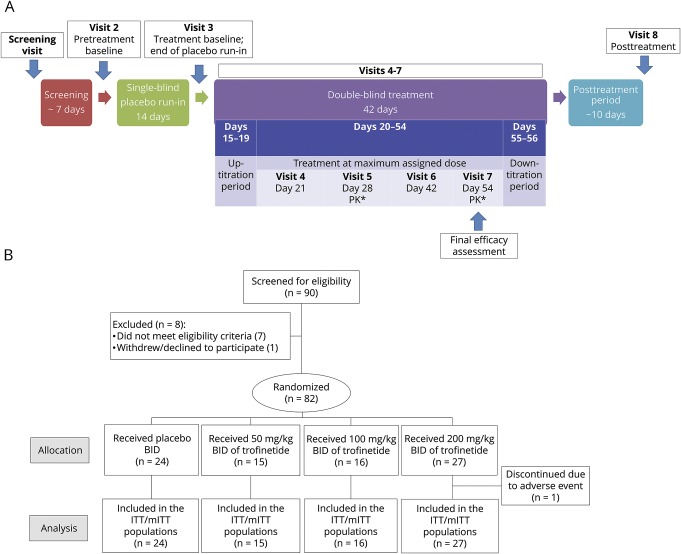
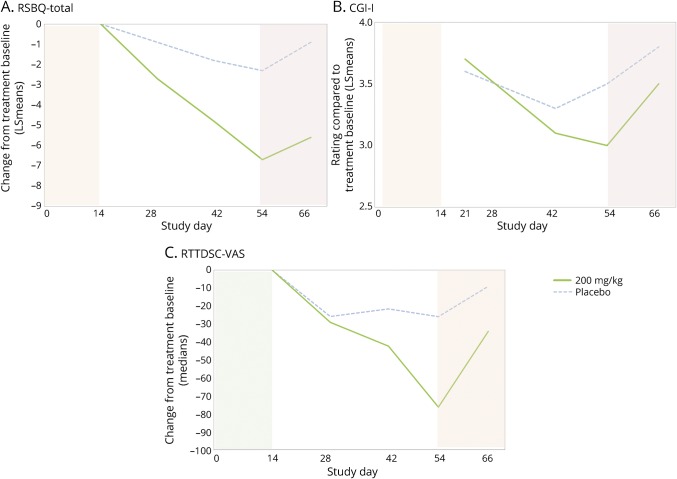
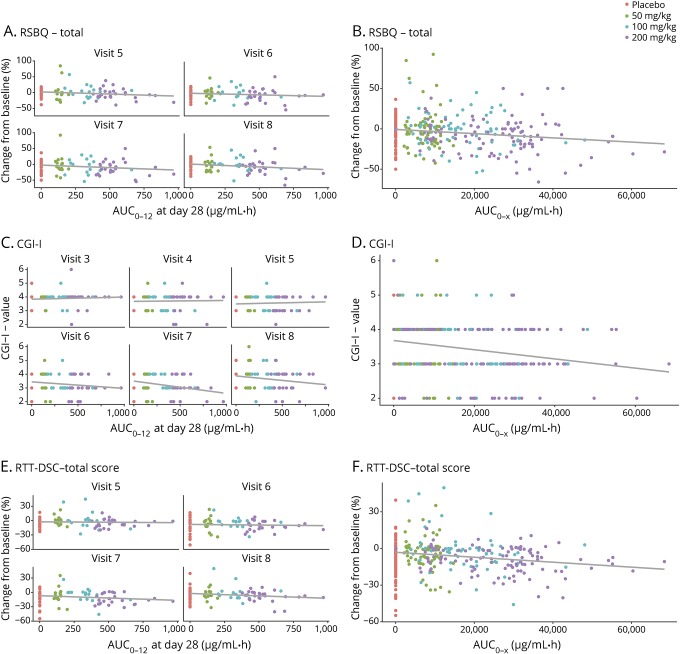
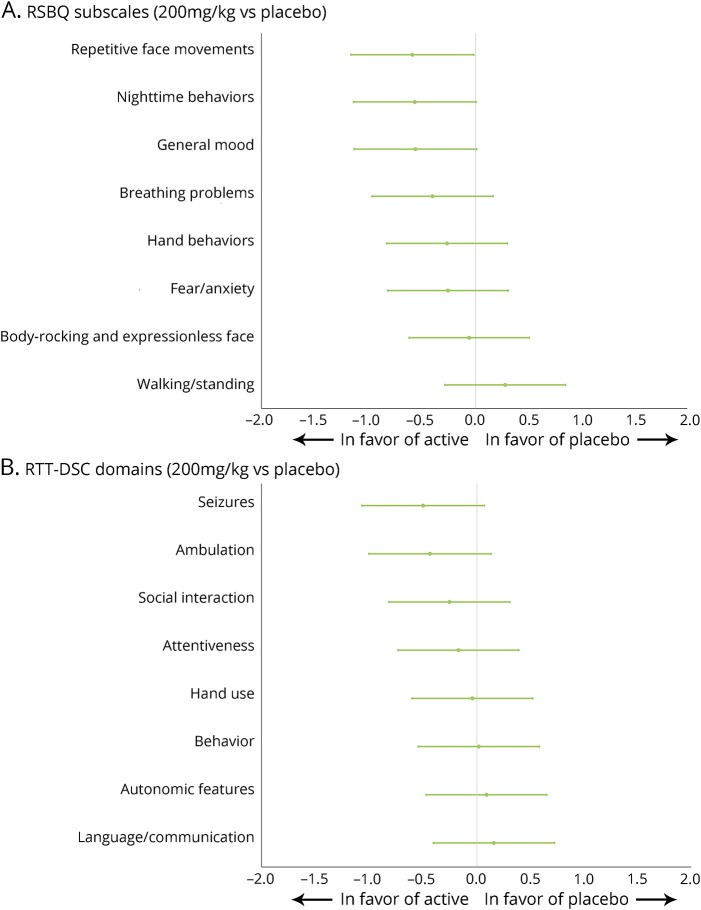
OBJECTIVE: To determine safety, tolerability, and pharmacokinetics of trofinetide and evaluate its efficacy in female children/adolescents with Rett syndrome (RTT), a debilitating neurodevelopmental condition for which no pharmacotherapies directed at core features are available. METHODS: This was a phase 2, multicenter, double-blind, placebo-controlled, parallel-group study, in which safety/tolerability, pharmacokinetics, and clinical response to trofinetide were characterized in 82 children/adolescents with RTT, aged 5 to 15 years. Sixty-two participants were randomized 1:1:1:1 to receive placebo twice a day (bid) for 14 days, followed by placebo, 50, 100, or 200 mg/kg bid of trofinetide for 42 days. Following blinded safety data review, 20 additional participants were randomized 1:1 to the 200 mg/kg or placebo bid groups. Safety assessments included adverse events, clinical laboratory tests, physical examinations, and concomitant medications. Clinician- and caregiver-based efficacy measurements assessed clinically relevant, phenotypic dimensions of impairment of RTT. RESULTS: All dose levels were well tolerated and generally safe. Trofinetide at 200 mg/kg bid showed statistically significant and clinically relevant improvements relative to placebo on the Rett Syndrome Behaviour Questionnaire, RTT-Clinician Domain Specific Concerns-Visual Analog Scale, and Clinical Global Impression Scale-Improvement. Exploratory analyses suggested that observed changes correlated with trofinetide exposure. CONCLUSION: These results, together with those from a previous adolescent/adult trial, indicate trofinetide's potential for treating core RTT symptoms and support further trials. CLASSIFICATION OF EVIDENCE: This study provides Class I evidence that for children/adolescents with RTT, trofinetide was safe, well-tolerated, and demonstrated improvement over placebo at 200 mg/kg bid in functionally important dimensions of RTT.
Overview
The claims and statistics of this paper haven’t been checked yet.
Run the check — free, no account needed. It reads the open-access text and checks the sources it cites.
Integrity signals
Registry
Cites
Statistics
Figures
Verification
Claims the paper makes
The claims and statistics of this paper haven’t been checked yet.
Run the check — free, no account needed. It reads the open-access text and checks the sources it cites.
Claims other papers make about this one
Each is checked against this paper’s own text: does it say what the citing paper says it does?
In the citing paper
“Significant benefits were seen in several measures including the Rett Syndrome Behavior Scale, the Rett Syndrome Clinician Rating Scale, and a visual analogue scale.”
From An Update on Psychopharmacological Treatment of Autism Spectrum Disorder (2022) · cites this paper as [137]
In the citing paper
“Trofinetide is glycyl-L-2-methylprolyl-L-glutamic acid, and it was studied in a controlled phase 2 trial in 82 children with Rett syndrome ages 5 to 15 years, and significant benefit was found in the high-dose group (200 mg/kg/day) compared to placebo [137].”
From An Update on Psychopharmacological Treatment of Autism Spectrum Disorder (2022) · cites this paper as [137]
Self-check
Percentages, sums and reported differences re-computed from the paper’s own numbers.
The self-check needs the paper’s full text.
Citations
Cites
Selective publication of antidepressant trials and its influence on apparent efficacy
Turner, E. H., Matthews, A. M., Linardatos, E., Tell, R. A., & Rosenthal, R. (2008) · New England Journal of Medicine · doi:10.1056/nejmsa065779 · Cited by 2,435
Hagberg, B. A., Aicardi, J. F., Dias, K., & Ramos, O. (1983) · Annals of Neurology · doi:10.1002/ana.410140412 · Cited by 1,515
Rett syndrome: Revised diagnostic criteria and nomenclature
Neul, J. L., Kaufmann, W. E., Glaze, D. G., Christodoulou, J., Clarke, A. J., Bahi‐Buisson, N., Leonard, H., Bailey, M. E. S., Schanen, N. C., Zappella, M., et al. (2010) · Annals of Neurology · doi:10.1002/ana.22124 · Cited by 1,437
Wild-type microglia arrest pathology in a mouse model of Rett syndrome
Derecki, N. C., Cronk, J. C., Lu, Z., Xu, E., Abbott, S. B. G., Guyenet, P. G., & Kipnis, J. (2012) · Nature · doi:10.1038/nature10907 · Cited by 607
Partial reversal of Rett Syndrome-like symptoms in MeCP2 mutant mice
Tropea, D., Giacometti, E., Wilson, N. R., Beard, C., McCurry, C., Fu, D. D., Flannery, R., Jaenisch, R., & Sur, M. (2009) · Proceedings of the National Academy of Sciences · doi:10.1073/pnas.0812394106 · Cited by 593
Specific mutations in Methyl-CpG-Binding Protein 2 confer different severity in Rett syndrome
Neul, J. L., Fang, P., Barrish, J., Lane, J., Caeg, E. B., Smith, E. O., Zoghbi, H., Percy, A., & Glaze, D. G. (2008) · Neurology · doi:10.1212/01.wnl.0000291011.54508.aa · Cited by 498
Self-citationRett syndrome in Australia: A review of the epidemiology
Laurvick, C. L., de Klerk, N. H., Bower, C. I., Christodoulou, J., Ravine, D., Ellaway, C., Williamson, S. L., & Leonard, H. (2006) · The Journal of Pediatrics · doi:10.1016/j.jpeds.2005.10.037 · Cited by 345
Cuddapah, V. A., Pillai, R. B., Shekar, K. V., Lane, J. B., Motil, K. J., Skinner, S. A., Tarquinio, D. C., Glaze, D. G., McGwin, G., Kaufmann, W. E., et al. (2014) · Journal of Medical Genetics · doi:10.1136/jmedgenet-2013-102113 · Cited by 311
ARNOLD, L. E., VITIELLO, B., MCDOUGLE, C., SCAHILL, L., SHAH, B., GONZALEZ, N. M., CHUANG, S., DAVIES, M., HOLLWAY, J., AMAN, M. G., et al. (2003) · Journal of the American Academy of Child & Adolescent Psychiatry · doi:10.1097/00004583-200312000-00011 · Cited by 218
Khwaja, O., Ho, E., Barnes, K. V., O’Leary, H. M., Pereira, L. M., Finkelstein, Y., Nelson, C. A., Vogel‐Farley, V. K., DeGregorio, G., Holm, I. A., et al. (2014) · Proceedings of the National Academy of Sciences · doi:10.1073/pnas.1311141111 · Cited by 212
Cited by
Sorted by citations
Items 101–163 of 163
Sheth, F. J., Shah, J., Jain, D. K., Shah, S. N., Patel, H., Patel, K., Solanki, D., Iyer, A. S., Menghani, B., Mhatre, P., et al. (2023) · Research Square · doi:10.21203/rs.3.rs-2888202/v1 · Cited by 4
Deo, A. D., Oosterholt, S., Horrigan, J. P., Evans, S., McMorn, A., & Pasqua, O. D. (2025) · Pharmaceutics · doi:10.3390/pharmaceutics17081065 · Cited by 4
IRSF 2023 - Rett Syndrome Scientific Meeting Report
Garg, N., Zhou, Z., Marsh, E. D., Niswender, C. M., & Pichard, D. C. (2023) · Translational Science of Rare Diseases · doi:10.3233/trd-230063 · Cited by 3
“Phase 2 trials with trofinetide were conducted in 2 parts, and enrolled a total of 138 participants, including both pediatric and adult female RTT patients [62, 63].”
Rett syndrome diagnostic odyssey: Limitations of NextGen sequencing
Abbott, M., Angione, K., Forbes, E. K., Stoecker, M., Saenz, M. S., Neul, J. L., Marsh, E. D., Skinner, S. A., Percy, A. K., & Benke, T. A. (2024) · American Journal of Medical Genetics Part A · doi:10.1002/ajmg.a.63725 · Cited by 3
“Given the clinical diagnosis of typical RTT and specific, newly FDA-approved treatments (Glaze et al., 2019; Harris, 2023; Neul et al., 2023) as well as the potential for gene-replacement approaches (NCT05898620, NCT05606614), the pursuit of a precise genetic diagnosis can have a tangible impact on…”
Mohammed, H. E., Bady, Z. A. M., Haseeb, M. E., Aboeldahab, H. A., Sharaf‐Eldin, W. E., & Zaki, M. S. (2024) · BMC Medicine · doi:10.1186/s12916-024-03506-9 · Cited by 5
“Furthermore, the CGI-I, which is also a widely used clinical scale in RTT trials, adds clinical context to a care-giver outcome like RSBQ [18, 19, 37–41].”
BackgroundMethodInfluentialRett syndrome and MECP2-related disorders
Neul, J. L., & Chang, Q. (2020) · Elsevier eBooks · doi:10.1016/b978-0-12-814409-1.00011-2 · Cited by 3
Turning the tide on targeted treatments for neurodevelopmental disorders
Hagerman, R. J., & Tuchman, R. F. (2019) · Neurology · doi:10.1212/wnl.0000000000007301 · Cited by 3
“The study by Glaze et al. may well be the first wave that turns the tide on the development of targeted treatments for neurodevelopmental disorders.”
InfluentialAcosta, M. T., Domingo, S. Z., Arango, C., Bishop, K. I., Busner, J., Dorffner, G., del Cerro, I., Diaz, J. C., Grünblatt, E., Hölter, S. M., et al. (2025) · Orphanet Journal of Rare Diseases · doi:10.1186/s13023-025-03814-0 · Cited by 2
“For example, several clinical trials have started to treat youth with Fragile X, Angelman syndrome and Rett syndrome for targeted interventions [1, 3, 6, 10, 18, 19], yet only some positive results for Rett syndrome have been reported.”
Population Pharmacokinetic Modeling to Support Trofinetide Dosing for the Treatment of Rett Syndrome
Darwish, M., Passarell, J. A., Maxwell, K., Youakim, J. M., Bradley, H., & Bishop, K. M. (2024) · Advances in Therapy · doi:10.1007/s12325-024-03056-9 · Cited by 2
“In the Neu-2566-Rett-002 study, trofinetide demonstrated linear pharmacokinetics across the 50 ‒ 200 mg/kg dose range [6].”
InfluentialPercy, A. K., Neul, J. L., Peters, S. U., Brockmann, K., Marsh, E. D., & Benke, T. A. (2023) · Translational Science of Rare Diseases · doi:10.3233/trd-220055 · Cited by 2
“The first substantive effort utilized the amino-terminal tripeptide of the insulin growth factor-1 (IGF-1) in a mouse model, showing partial reversal of specific features including prolongation of survival [19].”
Aspectos neurobiológicos del Síndrome de Rett
Liberona, A., & Albornoz-Miranda, M. (2023) · Revista chilena de neuro-psiquiatría · doi:10.4067/s0717-92272023000100107 · Cited by 3
Darwish, M., Obianom, O. N., Youakim, J. M., Darling, I. M., Lukáčová, V., & Bradley, H. (2024) · Advances in Therapy · doi:10.1007/s12325-024-02926-6 · Cited by 2
“There is minimal to no accumulation of trofinetide following multiple-dose administration in healthy subjects and individuals with RTT [14, 15], and, as such, the single-dose PK profile is considered representative of the steady-state profile.”
BackgroundMethodDarwish, M., Youakim, J. M., Mason, J. W., Stanworth, S. H., & Sanabria, C. R. (2025) · Future Rare Diseases · doi:10.1080/23995270.2024.2449346 · Cited by 1
Keating, B. A., Ogru, Y., Duthy, T. G., Douglas, L., Lichkus, K. S., Isikgel, E., Fahey, M. C., & Ellaway, C. (2025) · Journal of Paediatrics and Child Health · doi:10.1111/jpc.70122 · Cited by 1
Living With Rett Syndrome: From Discovery to Clinical Advancements and Emerging Therapies
Taluri, S., Percy, A. K., & Ananth, A. (2025) · Pediatric Neurology · doi:10.1016/j.pediatrneurol.2025.10.021 · Cited by 2
Design, synthesis and evaluation of trofinetide prodrug based on diketopiperazine strategy
Feng, X., Dong, Y., Guo, C., Lu, J., Xu, Z., Bian, J., Peng, W., Luo, T., & Feng, J. (2026) · Bioorganic & Medicinal Chemistry · doi:10.1016/j.bmc.2026.118633 · Cited by 1
Sato, M., Yamaki, H., Kawano, G., Tanaka, Y., Isooka, A., Yamashita, D., Akita, Y., Eshima, N., Takahashi, T., & Matsuishi, T. (2026) · Brain and Development · doi:10.1016/j.braindev.2026.104531 · Cited by 1
Research on the treatment of Rett syndrome
Gorgoń-Dezor, O. (2024) · Child Neurology · doi:10.5603/cn.98939 · Cited by 1
Abolished clustering of MeCP2T158M can be partially reverted with small molecules
Lata, R., Steegmans, L., Kellens, R., Nijs, M., Klaassen, H., Versele, M., Christ, F., & Debyser, Z. (2024) · Translational Medicine Communications · doi:10.1186/s41231-024-00176-w · Cited by 2
“Recently the first drug specifically developed for RTT was approved by the FDA [26].”
BackgroundSingh, J., Wilkins, G. C., Goodman-Vincent, E., Chishti, S., Guerrero, R. B., Fiori, F., Ameenpur, S., McFadden, L., Zahavi, Z., & Santosh, P. (2024) · Current Issues in Molecular Biology · doi:10.3390/cimb46080497 · Cited by 1
“The RTT-CGI has been used in studies of RTT [48–50], although some have suggested that the RTT-CGI could be difficult to implement when used more widely, especially when knowledge of RTT is limited [51].”
MethodDarwish, M., Passarell, J. A., Maxwell, K., Bradley, H., Bishop, K. M., & Youakim, J. M. (2024) · Advances in Therapy · doi:10.1007/s12325-024-03058-7 · Cited by 1
“Pharmacokinetic findings from the Rett-002 study indicated that body weight was an important moderator of systemic trofinetide exposure [13].”
InfluentialBricker, K., & Vaughn, B. V. (2024) · Sleep Medicine Research · doi:10.17241/smr.2024.02509 · Cited by 1
Rett Syndrome Behaviour Questionnaire: Variability of Scores and Related Factors
Kaufmann, W. E., Oberman, L. M., Downs, J. A., Leonard, H., & Barnes, K. V. (2025) · Journal of Child and Adolescent Psychopharmacology · doi:10.1089/cap.2024.0128 · Cited by 1
Breathing Disturbances as Comorbidity of Rett Syndrome
Куликова, С. Л., Кузнецова, А. В., Савченко, М. А., Sa, L., Плешко, И. В., & Miasnikov, S. O. (2020) · Неврология и нейрохирургия Восточная Европа · doi:10.34883/pi.2020.10.1.043 · Cited by 1
HDAC inhibitors rescue MeCP2 T158M speckles in a high content screenPreprint
Lata, R., Steegmans, L., Kellens, R., Nijs, M., Klaassen, H., Versele, M., Christ, F., & Debyser, Z. (2023) · bioRxiv (Cold Spring Harbor Laboratory) · doi:10.1101/2023.11.02.565272 · Cited by 1
“Recently the first drug specifically developed for Rett syndrome was approved by the FDA 26 .”
BackgroundWITHDRAWN: Commentary: What matters most? Outcome measures in Rett syndrome
Mann, B. (2020) · Pediatric Neurology · doi:10.1016/j.pediatrneurol.2020.06.007
RetractedIn Vivo RNA Editing Repairs Rett Mutation in Mouse Hippocampus
Hurley, D. (2020) · Neurology Today · doi:10.1097/01.nt.0000697008.96099.62
Morphology and Connectivity Impairments in Rett Syndrome Human Stem Cell-Derived Neurons
Mok, R. S. F. (2020) · TSpace (University of Toronto)
La subcontratación en los contratos del sector público
García, I. I. (2007) · Actualidad administrativa
Human induced pluripotent stem cell–derived astrocytes progenitors as discovery platforms
Taga, A., & Maragakis, N. J. (2021) · Elsevier eBooks · doi:10.1016/b978-0-323-85545-7.00005-3
Sa'diyah, C. (2014) · SKRIPSI Jurusan Kependidikan Sekolah Dasar & Prasekolah - Fakultas Ilmu Pendidikan UM
Stefanie, A. (2022) · eDiss (Georg-August-Universität Göttingen) · doi:10.53846/goediss-9106
Renthal, W. R., Szabla, K. L., & Monteggia, L. M. (2020) · Elsevier eBooks · doi:10.1016/b978-0-12-813955-4.00021-0
Debut drug for Rett syndrome at edge of approval
Montanari, S. (2023) · The Transmitter · doi:10.53053/zakf7190
Look at DAYBUE™ (Trofinetide) as first ever drug for treatment of Rett Syndrome
Tareen, M. K., & Mohiyuddin, Z. (2024) · Asian Journal of Psychiatry · doi:10.1016/j.ajp.2024.104011
The novel first-line therapy for rett syndrome
Sultan, W., Irfan, H., & Shariq, K. (2023) · International Journal of Medicine · doi:10.14419/zpn3s949
Trofinetide providing a promising avenue for the treatment of Rett syndrome
Devendar, R., Shigri, A. F., & Khan, M. (2024) · International Journal of Scientific Reports · doi:10.18203/issn.2454-2156.intjscirep20240718
Sheth, F. J., Shah, J., Jain, D. K., Shah, S. N., Patel, H., Patel, K., Solanki, D., Iyer, A. S., Menghani, B., Mhatre, P., et al. (2023) · Figshare · doi:10.6084/m9.figshare.23896141
Sheth, F. J., Shah, J., Jain, D. K., Shah, S. N., Patel, H., Patel, K., Solanki, D., Iyer, A. S., Menghani, B., Mhatre, P., et al. (2023) · Figshare · doi:10.6084/m9.figshare.23896150
Sheth, F. J., Shah, J., Jain, D. K., Shah, S. N., Patel, H., Patel, K., Solanki, D., Iyer, A. S., Menghani, B., Mhatre, P., et al. (2023) · Figshare · doi:10.6084/m9.figshare.23896153
Chapter 65. Treatment of Individuals With Intellectual Developmental Disorder
Stratigos, K. A., Katz, J., & Hong, D. S. (2024) · American Psychiatric Association Publishing eBooks · doi:10.1176/appi.books.9781615375523.as65
Rett syndrome: A coming of age
Percy, A. K. (2024) · Translational Science of Rare Diseases · doi:10.3233/trd-240069
“The FDA granted approval for trofinetide in March 2023 [33, 34, 82, 83].”
Piazza, M. K., Renthal, W. R., & Monteggia, L. M. (2024) · Elsevier eBooks · doi:10.1016/b978-0-443-19041-4.00005-4
Neurological evaluation and management of autism spectrum disorder
Goodspeed, K., Haffner, D. N., Golla, S., Morris, M. A., & Evans, P. (2024) · Elsevier eBooks · doi:10.1016/b978-0-443-19041-4.00042-x
Novel Approaches for Treating Pediatric Psychiatric Disorders
Sabetfakhri, N. P., & Cook, E. H. (2025) · Oxford University Press eBooks · doi:10.1093/med/9780197640654.003.0068
Treatment of Neurodevelopmental Disorders
van Karnebeek, C., Berry‐Kravis, E., & Gropman, A. L. (2024) · Elsevier eBooks · doi:10.1016/b978-0-443-10944-7.00079-2
Li, J., Zhang, Z., & Yan, T. (2025) · Clinical Therapeutics · doi:10.1016/j.clinthera.2025.07.022
Wright, R., Li, J., Blankenship, J. M., Richards, J. C., Coenraads, M., von Hehn, J., Clay, I., Lyden, K. A., & Leonard-Corzo, K. S. (2025) · Digital Biomarkers · doi:10.1159/000548358
“The RSBQ was initially developed as a diagnostic tool and has been used in various studies given the inclusion of a variety of symptomology specific to Rett syndrome [12, 13, 17, 18].”
Neul, J. L., Benke, T. A., Marsh, E. D., Suter, B., Silveira, L., Fu, C., Peters, S. U., & Percy, A. K. (2024) · Figshare · doi:10.6084/m9.figshare.24310000
Sheth, F., Shah, J., Jain, D. K., Shah, S., Patel, H., Patel, K. S., Solanki, D. I., Iyer, A. S., Menghani, B., Mhatre, P., et al. (2023) · Figshare · doi:10.6084/m9.figshare.23896156
Lata, R., Steegmans, L., Kellens, R., Nijs, M., Klaassen, H., Versele, M., Christ, F., & Debyser, Z. (2024) · Figshare · doi:10.6084/m9.figshare.26729956
Additional file 2 of Global prevalence of Rett syndrome: systematic review and meta-analysis
Petriti, U., Dudman, D. C., Scosyrev, E., & Lopez-Leon, S. (2023) · Figshare · doi:10.6084/m9.figshare.22610869
Lata, R., Steegmans, L., Kellens, R., Nijs, M., Klaassen, H., Versele, M., Christ, F., & Debyser, Z. (2024) · Figshare · doi:10.6084/m9.figshare.26729953
Abbas, A., Fayoud, A. M., El Din Moawad, M. H., Hamad, A. A., Hamouda, H., & Fouad, E. A. (2024) · Figshare · doi:10.6084/m9.figshare.25466586
Neul, J. L., Benke, T. A., Marsh, E. D., Suter, B., Silveira, L., Fu, C., Peters, S. U., & Percy, A. K. (2023) · Figshare · doi:10.6084/m9.figshare.24309896
Mohammed, H. E., Bady, Z. A. M., Haseeb, M. E., Aboeldahab, H. A., Sharaf-Eldin, W. E., & Zaki, M. S. (2024) · Figshare · doi:10.6084/m9.figshare.26322596
Sheth, F., Shah, J., Jain, D., Shah, S., Patel, H., Patel, K., Solanki, D. I., Iyer, A. S., Menghani, B., Mhatre, P., et al. (2023) · Figshare · doi:10.6084/m9.figshare.23896144
Development and Validation of the Korean Version of the Rett Syndrome Behavioral Questionnaire
Yi, Y. G., Yang, S., Kim, G. H., HAN, Y., & Jang, D. (2026) · Children · doi:10.3390/children13010093
“Most RTT cases are caused by de novo mutations in the MECP2 gene [11], encoding the transcriptional regulator methyl CpG-binding protein 2 (MECP2).”
Simonnet, C. (2019) · theses.fr (ABES) · doi:10.70675/dcc67be7z8c6dz47b5z92e8z4d75367bfd48
Chen, M., Sun, J., Liu, Y., Tang, Y., Zhao, X., Deng, D., & Ye, S. (2026) · Research Square · doi:10.21203/rs.3.rs-5336506/v1
Mapping Trofinetide Polypharmacology in Rett Syndrome: A Multi‐Stage Computational Analysis
Hernández‐Ayala, L. F., Guzmán‐López, E. G., & Galano, A. (2026) · Journal of Computational Chemistry · doi:10.1002/jcc.70468
Choi, L., McNeer, E. A., Beck, C., & Neul, J. L. (2026) · medRxiv · doi:10.64898/2026.08.26.26360843
Metadata
- Authors
- Glaze, D. G., Neul, J. L., Kaufmann, W. E., Berry-Kravis, E., Condon, S., Stoms, G., Oosterholt, S., Della Pasqua, O., Glass, L., Jones, N. E., Percy, A. K., Rett 002 Study Group, Glaze, D. G., Neul, J. L., Kaufmann, W. E., Berry-Kravis, E., Condon, S., Stoms, G., Oosterholt, S., Pasqua, O. D., Glass, L., Jones, N. E., & Percy, A.
- Affiliations
- From the Department of Pediatrics and Neurology (D.G.G.), Baylor College of Medicine, Houston, TX; Department of Neurosciences (J.L.N.), University of California, San Diego; Greenwood Genetic Center (W.E.K.), Center for Translational Research, Greenwood, SC; Pediatrics, Neurological Sciences, and Biochemistry (E.B.K.), Rush University Medical Center, Chicago, IL;Vital Systems, Inc. (S.C., G.S.), Rolling Meadows, IL; Clinical Pharmacology & Therapeutics Group (S.O., O.D.P.), University College...
- Rush University Medical Center (US)
- ORCID
- Della Pasqua, Oscar
- Venue
- Neurology
- Published
- 2019-04-16
- Volume
- 92
- Issue
- 16
- Pages
- e1912-e1925
- ISSN
- 0028-3878 (ISSN-L)
- 1526-632X
- PMC
- PMC6550498
- OpenAlex
- W2922881551
- Cited by
- 160
- References
- 42
- Citations by year
- 2026: 8 · 2025: 14 · 2024: 46 · 2023: 33 · 2022: 14 · 2021: 15 · 2020: 22 · 2019: 6
- FWCI
- 8.59
- Type
- journal article
- Language
- en
- Open access
- hybrid
- doi.org
- Licence
- cc-by-nc-nd
- Locations
- Neurology (publishedVersion, cc-by-nc-nd)
- Europe PMC (PubMed Central) (publishedVersion, cc-by-nc-nd)
- PubMed Central (publishedVersion, cc-by-nc-nd)
- PubMed (publishedVersion)
- UCL Discovery (University College London) (submittedVersion)
- Funders
- Eunice Kennedy Shriver National Institute of Child Health and Human Development (U54HD083211)
- Topics
- Life Sciences › Biochemistry, Genetics and Molecular Biology › Genetics › Genetics and Neurodevelopmental Disorders
- Health Sciences › Medicine › Pediatrics, Perinatology and Child Health › Pharmacological Effects and Toxicity Studies
- Life Sciences › Neuroscience › Cellular and Molecular Neuroscience › Alzheimer's disease research and treatments
- Keywords
- trofinetide, Rett syndrome, pediatric patients, safety and tolerability, pharmacokinetics, neurodevelopmental disorders, symptom improvement, Clinical Global Impression Scale, dose-response relationship
- MeSH terms
- Adolescent, Anti-Inflammatory Agents, Non-Steroidal, Child, Child, Preschool, Double-Blind Method, Female, Glutamates, Humans, Rett Syndrome, Treatment Outcome, Glutamic Acid
About these checks
Registry, retraction, Cites and statistics results are computed, not judged, with one exception: a printed reference that no index lists is read once by a model before it counts as a citation error. Claims are extracted by a model and kept only when their quote appears verbatim in the text; each cited source is then checked, with a model’s help, for whether it says what the claim relies on. Those verdicts can be wrong — read the claim’s quote and the cited source before relying on one.
Statistics and arithmetic are recomputed, not judged.
Confidence bands are shown only for fields calibrated on our annotated test set. None is calibrated yet, so no band is shown.
What counts as a claim ›How we measure confidence ›How we check this ›
Are you an author, or do you see a problem with this page? Request a review
