

Association of Loneliness With 10-Year Dementia Risk and Early Markers of Vulnerability for Neurocognitive Decline
Open accessThe DOI matches its Crossref record; 47 of the 47 references it cites were found in a registry or an index.
Abstract
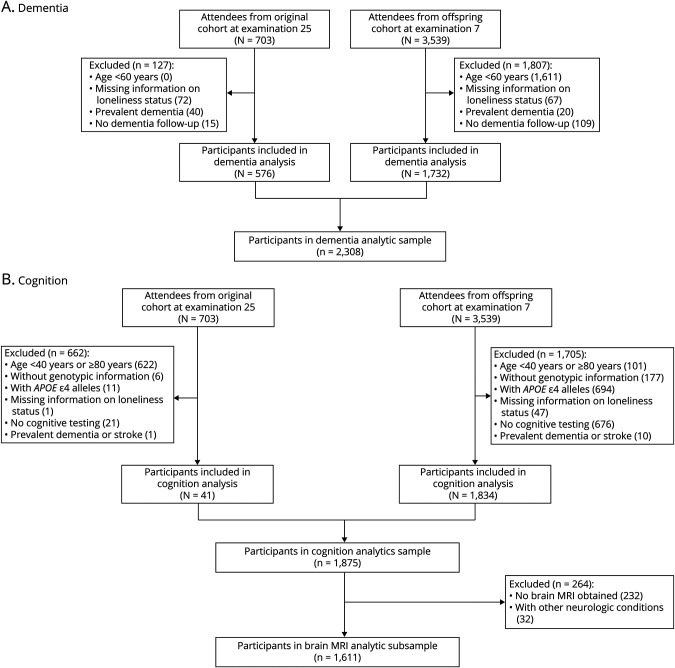
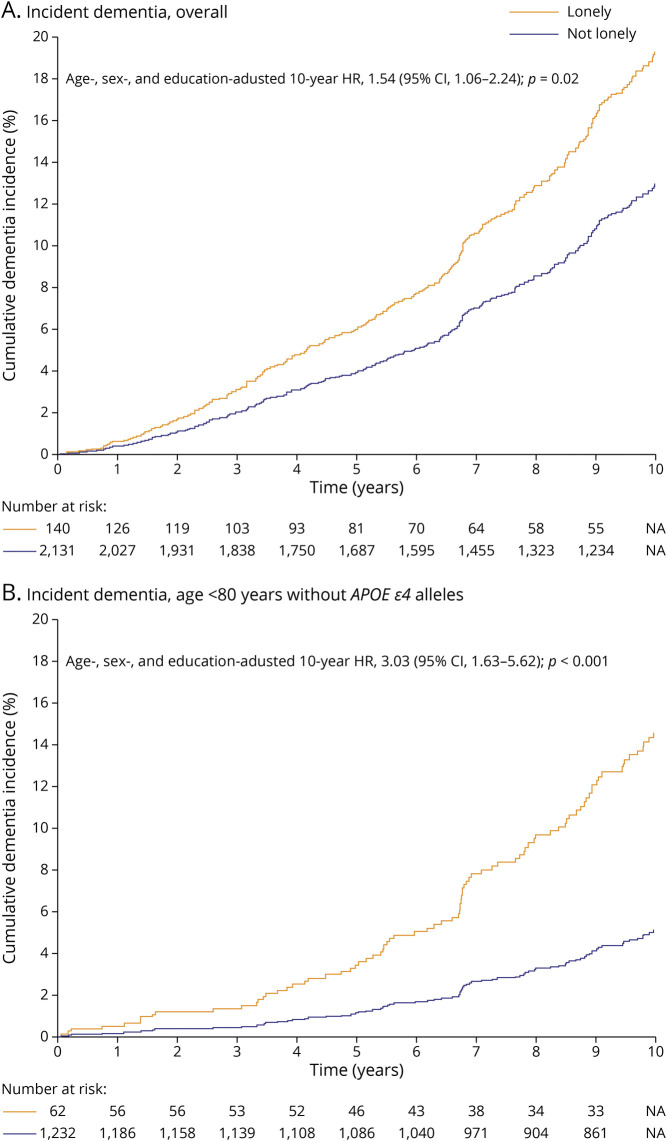
BACKGROUND AND OBJECTIVES: Loneliness is common, and its prevalence is rising. The relationship of loneliness with subsequent dementia and the early preclinical course of Alzheimer disease and related dementia (ADRD) remains unclear. Thus, the primary objective of this study was to determine the association of loneliness with 10-year all-cause dementia risk and early cognitive and neuroanatomic imaging markers of ADRD vulnerability. METHODS: This was a retrospective analysis of prospectively collected data from the population-based Framingham Study cohorts (September 9, 1948-December 31, 2018). Eligible participants had loneliness assessed and were dementia-free at baseline. Loneliness was recorded with the Center for Epidemiologic Studies Depression Scale, defined conservatively as feeling lonely ≥3 days in the past week. The main outcomes were incident dementia over a 10-year period, cognition, and MRI brain volumes and white matter injury. RESULTS: ε4 alleles had a 3-fold greater risk (adjusted hazard ratio 3.03, 95% CI, 1.63-5.62). Among 1,875 persons without dementia who met eligibility in the cognition sample (mean age 62 [SD 9] years, 54% women), loneliness associated with poorer executive function, lower total cerebral volume, and greater white matter injury. DISCUSSION: Over 10 years of close clinical dementia surveillance in this cohort study, loneliness was associated with increased dementia risk; this tripled in adults whose baseline risk would otherwise be relatively low on the basis of age and genetic risk, representing a majority of the US population. Loneliness was also associated with worse neurocognitive markers of ADRD vulnerability, suggesting an early pathogenic role. These findings may have important clinical and public health implications given observed loneliness trends. CLASSIFICATION OF EVIDENCE: This study provides Class I evidence that loneliness increases the 10-year risk of developing dementia.
Overview
The claims and statistics of this paper haven’t been checked yet.
Free: it reads the open-access text and checks the first 5 claims that cite a source we can check. Create a free account to check every claim.
Integrity signals
Registry
Cites
Statistics
Figures
Verification
Claims the paper makes
The claims and statistics of this paper haven’t been checked yet.
Free: it reads the open-access text and checks the first 5 claims that cite a source we can check. Create a free account to check every claim.
Claims other papers make about this one
Each is checked against this paper’s own text: does it say what the citing paper says it does?
The source backs part of the claim, not all of it — or backs it for a different population, condition or comparison.
In the citing paper
“In cross-sectional studies, social isolation or perceived isolation is associated with brain structure abnormalities (volumes and thickness), including lower total brain volumes, gray matter volumes, and greater white matter lesion volumes (Lewis et al., 2011; Salinas et al., 2022; Shen et al., 2022; van der Velpen et al., 2022; Kanai et al., 2012).”
From Internet-Based Conversational Engagement Randomized Controlled Clinical Trial (I-CONECT) Among Socially Isolated Adults 75+ Years Old With Normal Cognition or Mild Cognitive Impairment: Topline Results (2024) · cites this paper as Salinas et al., 2022
Experimental — accuracy not yet measured
Self-check
Percentages, sums and reported differences re-computed from the paper’s own numbers.
The self-check needs the paper’s full text.
Citations
Cites
Folstein, M. F., Folstein, S. E., & McHugh, P. R. (1975) · Journal of Psychiatric Research · doi:10.1016/0022-3956(75)90026-6 · Cited by 88,282 · cited 3×
“Some college 605 (27) 111 (20) 494 (29) 574 (30)”
The CES-D Scale: A Self-Report Depression Scale for Research in the General Population
Radloff, L. S. (1977) · Applied Psychological Measurement · doi:10.1177/014662167700100306 · Cited by 53,267
A Meta-Analysis of Interventions to Reduce Loneliness
Masi, C. M., Chen, H.-Y., Hawkley, L. C., & Cacioppo, J. T. (2011) · Personality and Social Psychology Review · doi:10.1177/1088868310377394 · Cited by 1,995 · cited 4×
“and decision-making), (2) lower total cerebral volume (a global neuroanatomic measure that is often more sensitive to the broad range of neuropathologies underlying cognitive decline in population-based samples than only cortical subregions),(33) and (3) a greater volume of white matter hyperintensities (indicating gr…”
BackgroundInfluentialValtorta, N. K., Kanaan, M., Gilbody, S., Ronzi, S., & Hanratty, B. (2016) · Heart · doi:10.1136/heartjnl-2015-308790 · Cited by 1,971
Loneliness and Risk of Alzheimer Disease
Wilson, R. S., Krueger, K. R., Arnold, S. E., Schneider, J. A., Kelly, J. F., Barnes, L. L., Tang, Y., & Bennett, D. A. (2007) · Archives of General Psychiatry · doi:10.1001/archpsyc.64.2.234 · Cited by 1,363 · cited 5×
“9,11,12 Regardless of whether loneliness is an early ADRD contributor, symptom, or both, uncertainty about its association with incident dementia risk could underestimate the impact of increasing loneliness and limit understanding of ADRD development and underlying mechanisms.”
BackgroundResultInfluentialLoneliness in Older Persons: A Predictor of Functional Decline and Death
Perissinotto, C. M., Stijacic Cenzer, I., & Covinsky, K. E. (2012) · Archives of Internal Medicine · doi:10.1001/archinternmed.2012.1993 · Cited by 1,269
Incidence of dementia over three decades in the Framingham heart study
Satizabal, C. L., Beiser, A. S., Chouraki, V., Chêne, G., Dufouil, C., & Seshadri, S. (2016) · New England Journal of Medicine · doi:10.1056/nejmoa1504327 · Cited by 1,051
Self-citationVilagut, G., Forero, C. G., Barbaglia, G., & Alonso, J. (2016) · PLOS ONE · doi:10.1371/journal.pone.0155431 · Cited by 982 · cited 1×
“College degree or more 594 (26) 76 (14) 518 (30) 691 (37)”
Psychological distress and loneliness reported by US adults in 2018 and April 2020
McGinty, E. E., Presskreischer, R., Han, H., & Barry, C. L. (2020) · JAMA · doi:10.1001/jama.2020.9740 · Cited by 978
The Alzheimer's Disease Centers' Uniform Data Set (UDS): The Neuropsychologic Test Battery
Weintraub, S., Salmon, D., Mercaldo, N., Ferris, S., Graff-Radford, N. R., Chui, H., Cummings, J., DeCarli, C., Foster, N. L., Galasko, D., et al. (2009) · Alzheimer Disease & Associated Disorders · doi:10.1097/wad.0b013e318191c7dd · Cited by 888 · cited 2×
“Some college 605 (27) 111 (20) 494 (29) 574 (30)”
Self-citation
Research works printed but not linked: 2
- American Psychiatric Association. Diagnostic and Statistical Manual of Mental Disorders: DSM-IV. American Psychiatric Association; 1994.
- Wechsler D. WAIS-R: Wechsler Adult Intelligence Scale-Revised. Psychological Corp; 1981: 1981.
Cited by
Items 101–128 of 128
Successful Maintenance of Brain Sharpness
Demarin, V., & Đerke, F. (2023) · Springer eBooks · doi:10.1007/978-3-031-33013-1_11
Can Loneliness Increase Risk for Dementia?
Gibbs, D. (2024) · Cambridge University Press eBooks · doi:10.1017/9781009430067.016
JANKHARIA, B. (2024) · The National Medical Journal of India · doi:10.25259/nmji_670_2023
Palpatzis, E., Akinci, M., & Arenaza‐Urquijo, E. M. (2024) · Elsevier eBooks · doi:10.1016/b978-0-443-13681-8.00006-0 · Cited by 1
Godbole, G. (2024) · The Senior Care Pharmacist · doi:10.4140/tcp.n.2024.283
Downer, B. G., Castro, J. E. C., & Markides, K. S. (2024) · Springer eBooks · doi:10.1007/978-3-031-40858-8_87-1
Landwehr, A., Pollack, L., Schütt, S. C., & Kals, E. (2025) · Journal of Gerontological Social Work · doi:10.1080/01634372.2025.2450210 · Cited by 1
“Experiencing loneliness is associated with numerous diseases, such as cardio-vascular diseases (Hakulinen et al., 2018) and dementia (Salinas et al., 2022) as well as different mental disorders (Hawkley & Cacioppo, 2010).”
Understanding drivers of loneliness: machine learning insights from the HILDA survey
Li, I., Skinner, A., Varidel, M., Zhao, J., Hickie, I. B., & Occhipinti, J. (2025) · Research Directions Depression · doi:10.1017/dep.2025.2
“…(Wang et al., 2018) and suicidal ideation (McClelland et al., 2020; Stravynski and Boyer, 2001), as well as increased risks of dementia, Alzheimer ’ s disease (Wilson et al., 2007; Salinas et al., 2022), cardiovascular diseases (Hawkley and Cacioppo, 2003) and stroke (Valtorta et al., 2016).”
Opsasnick, L. A., Zhao, W., Schmitz, L., Ratliff, S. M., Faul, J. D., Zhou, X., Needham, B. L., & Smith, J. A. (2025) · Brain Behavior & Immunity - Health · doi:10.1016/j.bbih.2025.100994 · Cited by 1
“…needs are not being met by their relationships (Hawkley, 2022), is associated with an increased risk of cardiovascular disease (Albasheer et al., 2024; Golaszewski et al., 2022), functional disability (Qi et al., 2023), cognitive decline, and dementia (Salinas et al., 2022; Huang et al., 2023).”
Loneliness and Risk of Dementia: Moderators, Mediators, and Future Directions
Luchetti, M., Terracciano, A., & Sutin, A. R. (2025) · Springer eBooks · doi:10.1007/978-3-032-02959-1_29
Cognitive sequala of loneliness in long COVID: Differential associations by loneliness subtypes
Rubin, L. H., Azola, A. M., Yoo‐Jeong, M., Dastgheyb, R. M., Easter, R. E., Ehrenspeck, A., Coughlin, J. M., Vannorsdall, T. D., Veenhuis, R. T., & Wilson, T. E. (2026) · Journal of Affective Disorders · doi:10.1016/j.jad.2025.121101
Loneliness Subtypes and Their Association With Prevalent and Incident Dementia
Chek, C. J. W., Araujo-Menendez, C. E. E., Stickel, A. M., Knauft, K. M., González, H. M., & Tarraf, W. (2026) · Journal of Applied Gerontology · doi:10.1177/07334648251413323
A National Big Data Analysis on Alzheimer’s and Other Dementias in Türkiye
YİĞİT, T., DİNÇER, M., Ata, N., Ülgü, M. M., Birinci, Ş., & Ayvalı, M. O. (2026) · Journal of Aging Research · doi:10.1155/jare/1010110
“In addition, loneliness has been linked to rapid cognitive function loss associated with D diseases [27–29].”
Loneliness as a sex-specific risk factor for cognitive aging
Warren, A. (2026) · Frontiers in Human Neuroscience · doi:10.3389/fnhum.2026.1784613
“These findings, drawn from the same Framingham cohort, align with known early biomarkers of Alzheimer’s disease and suggest loneliness as a preclinical risk factor.”
InfluentialLuchetti, M., Terracciano, A., Karaköse, S., Aschwanden, D., Stéphan, Y., Hajek, A., & Sutin, A. R. (2026) · Journal of the International Neuropsychological Society · doi:10.1017/s1355617726101933
“…a stronger association with risk of cognitive impairment among relatively younger participants (60 – 79 years old), as compared to older groups (80 or older; Salinas et al., 2022), while others found loneliness associated with memory decline primarily in older participants (e.g., Yu et al., 2023).”
Social connectedness and cognitive outcomes in rural middle‐ to older‐age adults
Park, J. A., Besser, L. M., Tourelle, M., Williams, C., Cook, D. J., Mitsova, D., Magzamen, S., & Wiese, L. K. (2026) · Alzheimer s & Dementia · doi:10.1002/alz.71401
“92 Collectively, these findings identify loneliness as a potent, independent risk factor for cognitive impairment, underscoring the need for interventions that address not only social contact but also perceived emotional connection in older adults.”
Overview of subjective cognitive decline in Brazil: a narrative review
Soares, I. S., Studart‐Neto, A., & Brucki, S. M. D. (2026) · Dementia & Neuropsychologia · doi:10.1590/1980-5764-dn-2025-0416
“People with SCD also reported more depressive symptoms, feelings of loneliness, and poorer sleep quality, events already reported in other studies 54-56 .”
Gildengers, A. G., Wang, Y., Hughes, T. F., Jacobsen, E., Karikari, T. K., Snitz, B. E., Zeng, X., Chang, C. H., & Ganguli, M. (2026) · American Journal of Geriatric Psychiatry · doi:10.1016/j.jagp.2026.05.012 · Cited by 2
Rahman, H. A., & Zahari, N. H. (2026) · Scandinavian Journal of Caring Sciences · doi:10.1111/scs.70292
Howe, R. J., Southerland, J. L., Sullivan, J. L., & Couch, E. (2026) · Aging & Mental Health · doi:10.1080/13607863.2026.2706191
Li, J., Wang, Y., Shi, L., Zheng, Z., Wu, Y., & Jiang, N. (2026) · Journal of Applied Gerontology · doi:10.1177/07334648261470866
Kamel, M., Nadeem, T., Park, J., & Chung, J. (2026) · Assessment · doi:10.1177/10731911261479255
Hooper, C., González-Bautista, E., Nogueira, L., Delrieu, J., Coley, N., Soto, M., Vellas, B. J., Guyonnet, S., & for the IHU HealthAge INSPIRE/Open Science study group (2026) · Journal of Alzheimer s Disease · doi:10.1177/13872877261482077
“35 Indeed, loneliness has been associated with lower total brain volume 36 and lower white matter volume in dementia-free older adults 37 and reduced regional brain volume speci fi c-ally in frontal white matter and in the putamen and globus pallidus in a population predominantly comprising of…”
Tahmasebi, Z., McEligot, A. J., Pang, K., Ho’opai, U., Kazner, C., Moran-Gomez, S., Avila, M., & Rodriguez, I. H. (2026) · The International Journal of Aging and Human Development · doi:10.1177/00914150261480665
Yoo‐Jeong, M., Herrschaft, R., Ramirez, C. B., Vance, D. E., Tien, P. C., Sharma, A., Jones, D. L., Weber, K. M., Ofotokun, I., Spence, A., et al. (2026) · AIDS Care · doi:10.1080/09540121.2026.2728461
Guarnera, J., Kenyon, K., Joshi, N., Caeyenberghs, K., Wheeler, M., & Macpherson, H. (2026) · Alzheimer s & Dementia · doi:10.1002/alz.71921
“Lonely and socially isolated middle–older adults also exhibited increasedWMH/lesionvolume, 41,57,71–73 suggestingpoorsocialhealth may be associated with compromised WM structural integrity.”
InfluentialWang, Z. (2026) · Transactions on Materials Biotechnology and Life Sciences · doi:10.62051/zw54f193
Metadata
- Authors
- Salinas, J., Beiser, A. S., Samra, J. K., O'Donnell, A., DeCarli, C. S., Gonzales, M. M., Aparicio, H. J., & Seshadri, S.
- Affiliations
- Boston University (US)
- From the Department of Neurology (J.S.), Center for Cognitive Neurology, New York University Grossman School of Medicine, New York; The Framingham Study (J.S., A.S.B., J.K.S., A.O., H.J.A., S.S.); Department of Biostatistics (A.S.B., J.K.S., A.O.), Boston University School of Public Health; Department of Neurology (A.S.B., H.J.A., S.S.), Boston University School of Medicine, MA; Department of Neurology (C.S.D.), University of California Davis; and Glenn Biggs Institute for Alzheimer's and...
- Corresponding author
- Salinas, Joel
- Beiser, Alexa S.
- Venue
- Neurology
- Published
- 2022-03-29
- Volume
- 98
- Issue
- 13
- Pages
- e1337-e1348
- ISSN
- 0028-3878 (ISSN-L)
- 1526-632X
- PMC
- PMC8967424
- OpenAlex
- W4210859428
- Semantic Scholar
- b440e5ee3ecc72473b54f758fbe7478ef2823364
- Cited by
- 127
- References
- 47
- Citations by year
- 2026: 27 · 2025: 29 · 2024: 31 · 2023: 25 · 2022: 15
- FWCI
- 16.29
- Type
- journal article
- Language
- en
- Open access
- hybrid
- doi.org
- Licence
- cc-by-nc-nd
- Locations
- Neurology (publishedVersion, cc-by-nc-nd)
- PubMed Central (publishedVersion, cc-by-nc-nd)
- PubMed (publishedVersion)
- eScholarship (California Digital Library) (submittedVersion, cc-by-nc-nd)
- Funders
- National Institutes of Health (n01hc25195-41-0-1)
- National Institute on Aging (U01AG049505, U01AG052409, R01AG054076, R01AG049607, K23AG057760, RF1AG059421, P30AG044271, P30AG066546)
- National Heart, Lung, and Blood Institute (N01‐HC25195, HHSN268201500001I, 75N92019D00031)
- National Institute of Neurological Disorders and Stroke (UH2NS100605, L30 NS093525, T32NS048005, R01NS017950)
- Topics
- Health Sciences › Medicine › Psychiatry and Mental health › Dementia and Cognitive Impairment Research
- Social Sciences › Health › Health disparities and outcomes
- Life Sciences › Neuroscience › Cellular and Molecular Neuroscience › Alzheimer's disease research and treatments
- Keywords
- loneliness, dementia risk, Alzheimer's disease and related dementias, neurocognitive decline, executive function, brain volume, white matter injury, APOE ε4, preclinical dementia, Framingham Heart Study
- MeSH terms
- Aged, Aged, 80 and over, Alzheimer Disease, Female, Humans, Loneliness, Longitudinal Studies, Male, Middle Aged, Retrospective Studies, Risk Factors, Cohort Studies
About these checks
Registry, retraction, Cites and statistics results are computed, not judged, with one exception: a printed reference that no index lists is read once by a model before it counts as a citation error. Claims are extracted by a model and kept only when their quote appears verbatim in the text; each cited source is then checked, with a model’s help, for whether it says what the claim relies on. Those verdicts can be wrong — read the claim’s quote and the cited source before relying on one.
Statistics and arithmetic are recomputed, not judged.
Confidence bands are shown only for fields calibrated on our annotated test set. None is calibrated yet, so no band is shown.
What counts as a claim ›How we measure confidence ›How we check this ›
Are you an author, or do you see a problem with this page? Request a review
Data sources
Bibliographic data: Semantic Scholar, OpenAlex, Crossref.
Contains information from the Semantic Scholar Academic Graph Datasets, made available under the ODC Attribution License (ODC-BY 1.0).
Semantic Scholar’s data is described in: Kinney, R., et al. (2023). The Semantic Scholar Open Data Platform. arXiv:2301.10140.
