

Association of Loneliness With 10-Year Dementia Risk and Early Markers of Vulnerability for Neurocognitive Decline
Open accessThe DOI matches its Crossref record; 47 of the 47 references it cites were found in a registry or an index.
Abstract
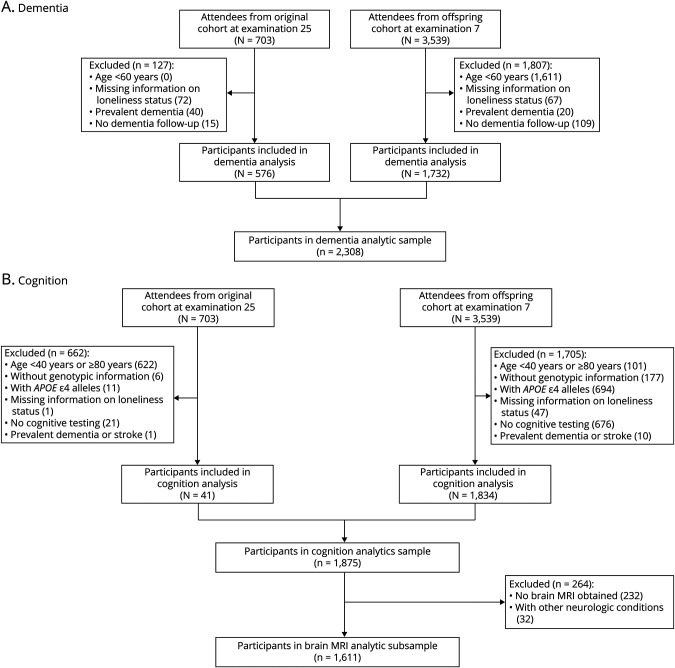
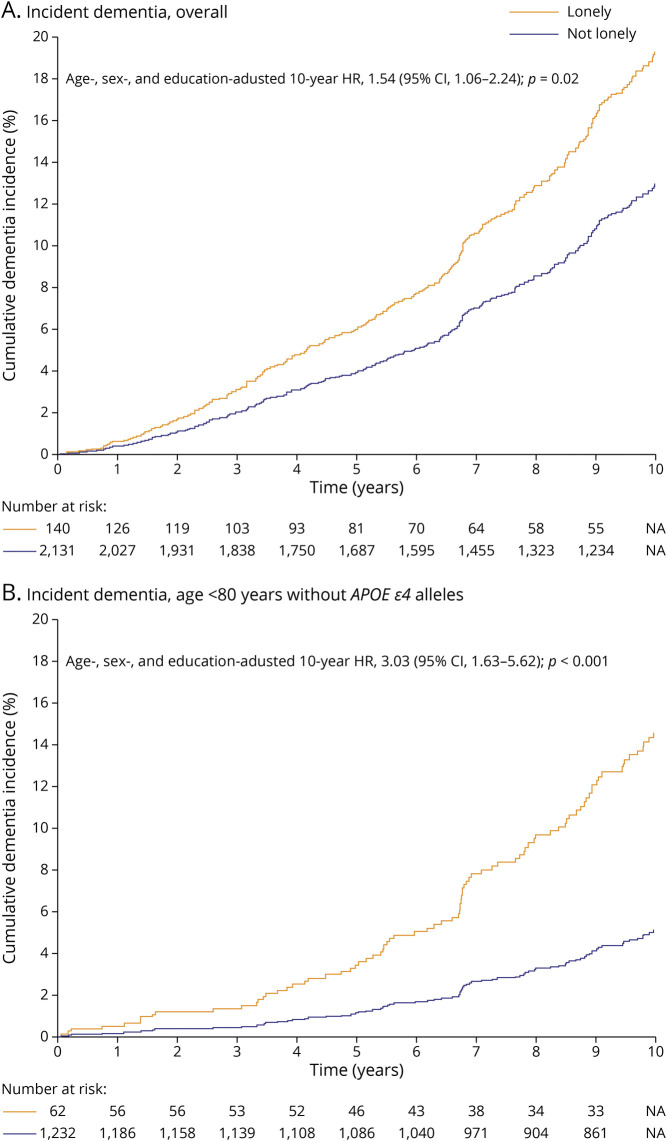
BACKGROUND AND OBJECTIVES: Loneliness is common, and its prevalence is rising. The relationship of loneliness with subsequent dementia and the early preclinical course of Alzheimer disease and related dementia (ADRD) remains unclear. Thus, the primary objective of this study was to determine the association of loneliness with 10-year all-cause dementia risk and early cognitive and neuroanatomic imaging markers of ADRD vulnerability. METHODS: This was a retrospective analysis of prospectively collected data from the population-based Framingham Study cohorts (September 9, 1948-December 31, 2018). Eligible participants had loneliness assessed and were dementia-free at baseline. Loneliness was recorded with the Center for Epidemiologic Studies Depression Scale, defined conservatively as feeling lonely ≥3 days in the past week. The main outcomes were incident dementia over a 10-year period, cognition, and MRI brain volumes and white matter injury. RESULTS: ε4 alleles had a 3-fold greater risk (adjusted hazard ratio 3.03, 95% CI, 1.63-5.62). Among 1,875 persons without dementia who met eligibility in the cognition sample (mean age 62 [SD 9] years, 54% women), loneliness associated with poorer executive function, lower total cerebral volume, and greater white matter injury. DISCUSSION: Over 10 years of close clinical dementia surveillance in this cohort study, loneliness was associated with increased dementia risk; this tripled in adults whose baseline risk would otherwise be relatively low on the basis of age and genetic risk, representing a majority of the US population. Loneliness was also associated with worse neurocognitive markers of ADRD vulnerability, suggesting an early pathogenic role. These findings may have important clinical and public health implications given observed loneliness trends. CLASSIFICATION OF EVIDENCE: This study provides Class I evidence that loneliness increases the 10-year risk of developing dementia.
Overview
The claims and statistics of this paper haven’t been checked yet.
Free: it reads the open-access text and checks the first 5 claims that cite a source we can check. Create a free account to check every claim.
Integrity signals
Registry
Cites
Statistics
Figures
Verification
Claims the paper makes
The claims and statistics of this paper haven’t been checked yet.
Free: it reads the open-access text and checks the first 5 claims that cite a source we can check. Create a free account to check every claim.
Claims other papers make about this one
Each is checked against this paper’s own text: does it say what the citing paper says it does?
The source backs part of the claim, not all of it — or backs it for a different population, condition or comparison.
In the citing paper
“In cross-sectional studies, social isolation or perceived isolation is associated with brain structure abnormalities (volumes and thickness), including lower total brain volumes, gray matter volumes, and greater white matter lesion volumes (Lewis et al., 2011; Salinas et al., 2022; Shen et al., 2022; van der Velpen et al., 2022; Kanai et al., 2012).”
From Internet-Based Conversational Engagement Randomized Controlled Clinical Trial (I-CONECT) Among Socially Isolated Adults 75+ Years Old With Normal Cognition or Mild Cognitive Impairment: Topline Results (2024) · cites this paper as Salinas et al., 2022
Experimental — accuracy not yet measured
Self-check
Percentages, sums and reported differences re-computed from the paper’s own numbers.
The self-check needs the paper’s full text.
Citations
Cites
Folstein, M. F., Folstein, S. E., & McHugh, P. R. (1975) · Journal of Psychiatric Research · doi:10.1016/0022-3956(75)90026-6 · Cited by 88,282 · cited 3×
“Some college 605 (27) 111 (20) 494 (29) 574 (30)”
The CES-D Scale: A Self-Report Depression Scale for Research in the General Population
Radloff, L. S. (1977) · Applied Psychological Measurement · doi:10.1177/014662167700100306 · Cited by 53,267
A Meta-Analysis of Interventions to Reduce Loneliness
Masi, C. M., Chen, H.-Y., Hawkley, L. C., & Cacioppo, J. T. (2011) · Personality and Social Psychology Review · doi:10.1177/1088868310377394 · Cited by 1,995 · cited 4×
“and decision-making), (2) lower total cerebral volume (a global neuroanatomic measure that is often more sensitive to the broad range of neuropathologies underlying cognitive decline in population-based samples than only cortical subregions),(33) and (3) a greater volume of white matter hyperintensities (indicating gr…”
BackgroundInfluentialValtorta, N. K., Kanaan, M., Gilbody, S., Ronzi, S., & Hanratty, B. (2016) · Heart · doi:10.1136/heartjnl-2015-308790 · Cited by 1,971
Loneliness and Risk of Alzheimer Disease
Wilson, R. S., Krueger, K. R., Arnold, S. E., Schneider, J. A., Kelly, J. F., Barnes, L. L., Tang, Y., & Bennett, D. A. (2007) · Archives of General Psychiatry · doi:10.1001/archpsyc.64.2.234 · Cited by 1,363 · cited 5×
“9,11,12 Regardless of whether loneliness is an early ADRD contributor, symptom, or both, uncertainty about its association with incident dementia risk could underestimate the impact of increasing loneliness and limit understanding of ADRD development and underlying mechanisms.”
BackgroundResultInfluentialLoneliness in Older Persons: A Predictor of Functional Decline and Death
Perissinotto, C. M., Stijacic Cenzer, I., & Covinsky, K. E. (2012) · Archives of Internal Medicine · doi:10.1001/archinternmed.2012.1993 · Cited by 1,269
Incidence of dementia over three decades in the Framingham heart study
Satizabal, C. L., Beiser, A. S., Chouraki, V., Chêne, G., Dufouil, C., & Seshadri, S. (2016) · New England Journal of Medicine · doi:10.1056/nejmoa1504327 · Cited by 1,051
Self-citationVilagut, G., Forero, C. G., Barbaglia, G., & Alonso, J. (2016) · PLOS ONE · doi:10.1371/journal.pone.0155431 · Cited by 982 · cited 1×
“College degree or more 594 (26) 76 (14) 518 (30) 691 (37)”
Psychological distress and loneliness reported by US adults in 2018 and April 2020
McGinty, E. E., Presskreischer, R., Han, H., & Barry, C. L. (2020) · JAMA · doi:10.1001/jama.2020.9740 · Cited by 978
The Alzheimer's Disease Centers' Uniform Data Set (UDS): The Neuropsychologic Test Battery
Weintraub, S., Salmon, D., Mercaldo, N., Ferris, S., Graff-Radford, N. R., Chui, H., Cummings, J., DeCarli, C., Foster, N. L., Galasko, D., et al. (2009) · Alzheimer Disease & Associated Disorders · doi:10.1097/wad.0b013e318191c7dd · Cited by 888 · cited 2×
“Some college 605 (27) 111 (20) 494 (29) 574 (30)”
Self-citationThe effect of loneliness on depression: A meta-analysis
Erzen, E., & Çikrikci, Ö. (2018) · International Journal of Social Psychiatry · doi:10.1177/0020764018776349 · Cited by 838 · cited 1×
“Original 576 (25) 503 (90) 73 (4) 41 (2)”
The Prevalence of Loneliness Among Adults: A Case Study of the United Kingdom
Victor, C. R., & Yang, K. (2012) · The Journal of Psychology · doi:10.1080/00223980.2011.613875 · Cited by 746 · cited 1×
“Although loneliness was slightly more prevalent in the older age group (consistent with similar community-based samples of older adults), 6-8 , In this cohort study, loneliness was associated with higher 10-year risk of incident dementia; notably, lonely APOE e 4 – negative younger adults had a…”
ResultThe Epidemiology of Social Isolation: National Health and Aging Trends Study
Cudjoe, T. K. M., Roth, D. L., Szanton, S. L., Wolff, J. L., Boyd, C. M., & Thorpe, R. J. (2020) · The Journals of Gerontology: Series B · doi:10.1093/geronb/gby037 · Cited by 697
Association of loneliness with all-cause mortality: A meta-analysis
Rico-Uribe, L. A., Caballero, F. F., Martín-María, N., Cabello, M., Ayuso-Mateos, J. L., & Miret, M. (2018) · PLOS ONE · doi:10.1371/journal.pone.0190033 · Cited by 648 · cited 3×
“and decision-making), (2) lower total cerebral volume (a global neuroanatomic measure that is often more sensitive to the broad range of neuropathologies underlying cognitive decline in population-based samples than only cortical subregions),(33) and (3) a greater volume of white matter hyperintensities (indicating gr…”
BackgroundOlder adult loneliness: myths and realities
Dykstra, P. A. (2009) · European Journal of Ageing · doi:10.1007/s10433-009-0110-3 · Cited by 632 · cited 1×
“Hypertension, n (%) 1,463 (64) 430 (78) 1,033 (59) 812 (43)”
Toward a neurology of loneliness
Cacioppo, S., Capitanio, J. P., & Cacioppo, J. T. (2014) · Psychological Bulletin · doi:10.1037/a0037618 · Cited by 623
Time for some a priori thinking about post hoc testing
Ruxton, G. D., & Beauchamp, G. (2008) · Behavioral Ecology · doi:10.1093/beheco/arn020 · Cited by 599 · cited 1×
“Male 1,010 (44) 193 (34) 817 (47) 870 (46)”
Carleton, R. N., Thibodeau, M. A., Teale, M. J. N., Welch, P. G., Abrams, M. P., Robinson, T., & Asmundson, G. J. G. (2013) · PLoS ONE · doi:10.1371/journal.pone.0058067 · Cited by 548
Penninkilampi, R., Casey, A.-N., Singh, M. F., & Brodaty, H. (2018) · Journal of Alzheimer's Disease · doi:10.3233/jad-180439 · Cited by 520 · cited 2×
“1–2 d (1 point) 308 (13) 109 (19) 199 (11) 248 (13)”
Gender and incidence of dementia in the Framingham Heart Study from mid‐adult life
Chêne, G., Beiser, A., Au, R., Preis, S. R., Wolf, P. A., Dufouil, C., & Seshadri, S. (2015) · Alzheimer's & Dementia · doi:10.1016/j.jalz.2013.10.005 · Cited by 499
Self-citationThe neuropathology and cerebrovascular mechanisms of dementia
Raz, L., Knoefel, J., & Bhaskar, K. (2016) · Journal of Cerebral Blood Flow & Metabolism · doi:10.1038/jcbfm.2015.164 · Cited by 470
Loneliness, depression and cognitive function in older U.S. adults
Donovan, N. J., Wu, Q., Rentz, D. M., Sperling, R. A., Marshall, G. A., & Glymour, M. M. (2017) · International Journal of Geriatric Psychiatry · doi:10.1002/gps.4495 · Cited by 465 · cited 1×
“Loneliness ≥3 d in the past week (≥2 points), n (%) 144 (6) 55 (10) 89 (5) 77 (4)”
Lara, E., Martín-María, N., De la Torre-Luque, A., Koyanagi, A., Vancampfort, D., Izquierdo, A., & Miret, M. (2019) · Ageing Research Reviews · doi:10.1016/j.arr.2019.03.002 · Cited by 351 · cited 2×
“Prevalent cardiovascular disease, n (%) 593 (26) 254 (45) 339 (19) 219 (12)”
Loneliness and risk of dementia
Sutin, A. R., Stephan, Y., Luchetti, M., & Terracciano, A. (2020) · The Journals of Gerontology: Series B · doi:10.1093/geronb/gby112 · Cited by 331 · cited 1×
“1–2 d (1 point) 308 (13) 109 (19) 199 (11) 248 (13)”
Predictors of Loneliness in U.S. Adults Over Age Sixty-Five
Theeke, L. A. (2009) · Archives of Psychiatric Nursing · doi:10.1016/j.apnu.2008.11.002 · Cited by 297
Association of Higher Cortical Amyloid Burden With Loneliness in Cognitively Normal Older Adults
Donovan, N. J., Okereke, O. I., Vannini, P., Amariglio, R. E., Rentz, D. M., Marshall, G. A., Johnson, K. A., & Sperling, R. A. (2016) · JAMA Psychiatry · doi:10.1001/jamapsychiatry.2016.2657 · Cited by 255 · cited 1×
“College degree or more 594 (26) 76 (14) 518 (30) 691 (37)”
SOCIAL NETWORKS AND INFLAMMATORY MARKERS IN THE FRAMINGHAM HEART STUDY
LOUCKS, E. B., SULLIVAN, L. M., D’AGOSTINO Sr, R. B., LARSON, M. G., BERKMAN, L. F., & BENJAMIN, E. J. (2006) · Journal of Biosocial Science · doi:10.1017/s0021932005001203 · Cited by 247
A Human Depression Circuit Derived From Focal Brain Lesions
Padmanabhan, J. L., Cooke, D., Joutsa, J., Siddiqi, S. H., Ferguson, M., Darby, R. R., Soussand, L., Horn, A., Kim, N. Y., Voss, J. L., et al. (2019) · Biological Psychiatry · doi:10.1016/j.biopsych.2019.07.023 · Cited by 246 · cited 1×
“…conceptually separate constructs that are statistically separable, 6,20 represent distinct clinical phenomena, 21 involve distinct brain circuitry, 22,23 and have associations with ADRD neuropath-ologic changes that are independent from one another 14,15,24 and, in this context, have limited to…”
BackgroundThe default network of the human brain is associated with perceived social isolation
Spreng, R. N., Dimas, E., Mwilambwe-Tshilobo, L., Dagher, A., Koellinger, P., Nave, G., Ong, A., Kernbach, J. M., Wiecki, T. V., Ge, T., et al. (2020) · Nature Communications · doi:10.1038/s41467-020-20039-w · Cited by 236 · cited 3×
“…separate constructs that are statistically separable, 6,20 represent distinct clinical phenomena, 21 involve distinct brain circuitry, 22,23 and have associations with ADRD neuropath-ologic changes that are independent from one another 14,15,24 and, in this context, have limited to at…”
BackgroundInfluentialDepression, dementia and immune dysregulation
Hayley, S., Hakim, A. M., & Albert, P. R. (2021) · Brain · doi:10.1093/brain/awaa405 · Cited by 186
“New Old Pathologies”: AD, PART, and Cerebral Age-Related TDP-43 With Sclerosis (CARTS)
Nelson, P. T., Trojanowski, J. Q., Abner, E. L., Al-Janabi, O. M., Jicha, G. A., Schmitt, F. A., Smith, C. D., Fardo, D. W., Wang, W.-X., Kryscio, R. J., et al. (2016) · Journal of Neuropathology & Experimental Neurology · doi:10.1093/jnen/nlw033 · Cited by 158 · cited 2×
“49 Thus, for younger individuals without inherent genetic risk factors, loneliness and related psychosocial determinants of health may be more in fl uential than traditional ADRD clinical risk factors, acting through pathways independent of or compounding biology.”
BackgroundAssociation of ideal cardiovascular health with vascular brain injury and incident dementia
Pase, M. P., Beiser, A., Enserro, D., Xanthakis, V., Aparicio, H., Satizabal, C. L., Himali, J. J., Kase, C. S., Vasan, R. S., DeCarli, C., et al. (2016) · Stroke · doi:10.1161/strokeaha.115.012608 · Cited by 137 · cited 1×
“32 Its creation is summarized in eTable 1, links.lww.com/WNL/B792.”
BackgroundSelf-citationAssociations of loneliness with risk of Alzheimer's disease dementia in the Framingham Heart Study
Akhter‐Khan, S. C., Tao, Q., Ang, T. F. A., Itchapurapu, I. S., Alosco, M. L., Mez, J., Piers, R. J., Steffens, D. C., Au, R., & Qiu, W. Q. (2021) · Alzheimer's & Dementia · doi:10.1002/alz.12327 · Cited by 126 · cited 2×
“Loneliness ≥3 d in the past week (≥2 points), n (%) 144 (6) 55 (10) 89 (5) 77 (4)”
Adaptive image segmentation for robust measurement of longitudinal brain tissue change
Fletcher, E., Singh, B., Harvey, D., Carmichael, O., & DeCarli, C. (2012) · 2012 Annual International Conference of the IEEE Engineering in Medicine and Biology Society · doi:10.1109/embc.2012.6347195 · Cited by 94 · cited 1×
“High school degree only 795 (35) 217 (39) 578 (34) 536 (29)”
Self-citationSalinas, J., Beiser, A., Himali, J. J., Satizabal, C. L., Aparicio, H. J., Weinstein, G., Mateen, F. J., Berkman, L. F., Rosand, J., & Seshadri, S. (2017) · Alzheimer's & Dementia: Translational Research & Clinical Interventions · doi:10.1016/j.trci.2017.03.001 · Cited by 87 · cited 2×
“…amyloid and regional tau accumulation using PET imaging, 14,15 previous FS investigations suggesting that loneliness-related dementia risk 10,39 and risk of neurocognitive markers of early ADRD vulnerability 42 varied between younger and older adults, and loneliness prevalence estimates…”
MethodSelf-citationRegional tau pathology and loneliness in cognitively normal older adults
d’Oleire Uquillas, F., Jacobs, H. I. L., Biddle, K. D., Properzi, M., Hanseeuw, B., Schultz, A. P., Rentz, D. M., Johnson, K. A., Sperling, R. A., & Donovan, N. J. (2018) · Translational Psychiatry · doi:10.1038/s41398-018-0345-x · Cited by 84 · cited 1×
“…constructs that are statistically separable, 6,20 represent distinct clinical phenomena, 21 involve distinct brain circuitry, 22,23 and have associations with ADRD neuropath-ologic changes that are independent from one another 14,15,24 and, in this context, have limited to at most moderate overlap.”
BackgroundAssociation of Social Support With Brain Volume and Cognition
Salinas, J., O’Donnell, A., Kojis, D. J., Pase, M. P., DeCarli, C. S., Rentz, D. M., Berkman, L. F., Beiser, A., & Seshadri, S. S. (2021) · JAMA Network Open · doi:10.1001/jamanetworkopen.2021.21122 · Cited by 79
Self-citationAtrial fibrillation and cognitive decline in the Framingham Heart Study
Nishtala, A., Piers, R. J., Himali, J. J., Beiser, A. S., Davis-Plourde, K. L., Saczynski, J. S., McManus, D. D., Benjamin, E. J., & Au, R. (2018) · Heart Rhythm · doi:10.1016/j.hrthm.2017.09.036 · Cited by 78 · cited 1×
“Prevalent cardiovascular disease, n (%) 593 (26) 254 (45) 339 (19) 219 (12)”
Self-citationNeuropsychological changes in asymptomatic persons with Alzheimer disease neuropathology
Monsell, S. E., Mock, C., Hassenstab, J., Roe, C. M., Cairns, N. J., Morris, J. C., & Kukull, W. (2014) · Neurology · doi:10.1212/wnl.0000000000000650 · Cited by 71 · cited 1×
“29 For the present study, we selected 3 separate measures to analyze that re fl ect key cognitive processes commonly a ff ected early in ADRD 17 30 The global cognitive score is a weighted sum of standardized scores; higher scores represent better performance.”
MethodWelty, F. K., Lahoz, C., Tucker, K. L., Ordovas, J. M., Wilson, P. W. F., & Schaefer, E. J. (1998) · Arteriosclerosis, Thrombosis, and Vascular Biology · doi:10.1161/01.atv.18.11.1745 · Cited by 71 · cited 1×
“41”
Farias, S. T., Mungas, D., Reed, B., Carmichael, O. T., Beckett, L. A., Harvey, D. J., Olichney, J., Simmons, A. L., & DeCarli, C. S. (2011) · Neurobiology of Aging · doi:10.1016/j.neurobiolaging.2011.03.017 · Cited by 69
Self-citationRajan, K. B., Barnes, L. L., Wilson, R. S., McAninch, E. A., Weuve, J., Sighoko, D., & Evans, D. A. (2017) · Journal of the American Geriatrics Society · doi:10.1111/jgs.15059 · Cited by 59
Ware, E. B., Faul, J. D., Mitchell, C. M., & Bakulski, K. M. (2020) · BMC Medical Genomics · doi:10.1186/s12920-020-00815-9 · Cited by 37 · cited 1×
“40 APOE genotype was determined by isoelectric focusing of collected plasma and con fi rmed by DNA genotype.”
MethodGonzales, M. M., Samra, J., O’Donnell, A., Mackin, R. S., Salinas, J., Jacob, M. E., Satizabal, C. L., Aparicio, H. J., Thibault, E. G., Sanchez, J. S., et al. (2021) · Journal of Alzheimer's Disease · doi:10.3233/jad-210232 · Cited by 37
Self-citationAssociation Between Neuropathology and Brain Volume in The Framingham Heart Study
Kaur, B., Himali, J. J., Seshadri, S., Beiser, A. S., Au, R., McKee, A. C., Auerbach, S., Wolf, P. A., & DeCarli, C. S. (2014) · Alzheimer Disease & Associated Disorders · doi:10.1097/wad.0000000000000032 · Cited by 36
Self-citationThe Long-Term Public Health Impact of Social Distancing on Brain Health: Topical Review
Kumar, A., & Salinas, J. (2021) · International Journal of Environmental Research and Public Health · doi:10.3390/ijerph18147307 · Cited by 25 · cited 1×
“APOE «4 carrier status, positive, n (%) 441 (20) 93 (17) 348 (21) NA”
Self-citationProfiles by Sex of Brain MRI and Cognitive Function in the Framingham Offspring Study
Albert, M. G., Massaro, J. M., DeCarli, C. S., Beiser, A., Seshadri, S. S., Wolf, P. A., & Au, R. (2010) · Alzheimer Disease & Associated Disorders · doi:10.1097/wad.0b013e3181c1ed44 · Cited by 19
Self-citation
Research works printed but not linked: 2
- American Psychiatric Association. Diagnostic and Statistical Manual of Mental Disorders: DSM-IV. American Psychiatric Association; 1994.
- Wechsler D. WAIS-R: Wechsler Adult Intelligence Scale-Revised. Psychological Corp; 1981: 1981.
Cited by
Dementia prevention, intervention, and care: 2024 report of the Lancet standing Commission
Livingston, G., Huntley, J., Liu, K. Y., Costafreda, S. G., Selbæk, G., Alladi, S., Ames, D., Banerjee, S., Burns, A., Brayne, C., et al. (2024) · The Lancet · doi:10.1016/s0140-6736(24)01296-0 · Cited by 3,860
Social participation and risk of developing dementia
Sommerlad, A., Kivimäki, M., Larson, E. B., Röhr, S., Shirai, K., Singh-Manoux, A., & Livingston, G. (2023) · Nature Aging · doi:10.1038/s43587-023-00387-0 · Cited by 207
The Impact of Loneliness and Social Isolation on Cognitive Aging: A Narrative Review
Guarnera, J., Yuen, E., & Macpherson, H. (2023) · Journal of Alzheimer's Disease Reports · doi:10.3233/adr-230011 · Cited by 161
Wang, X., Ma, H., Li, X., Heianza, Y., Fonseca, V. A., & Qi, L. (2023) · European Heart Journal · doi:10.1093/eurheartj/ehad306 · Cited by 165
Ren, Y. L., Savadlou, A., Park, S., Siska, P., Epp, J. R., & Sargin, D. (2023) · Frontiers in Neuroendocrinology · doi:10.1016/j.yfrne.2023.101061 · Cited by 149
Metadata
- Authors
- Salinas, J., Beiser, A. S., Samra, J. K., O'Donnell, A., DeCarli, C. S., Gonzales, M. M., Aparicio, H. J., & Seshadri, S.
- Affiliations
- Boston University (US)
- From the Department of Neurology (J.S.), Center for Cognitive Neurology, New York University Grossman School of Medicine, New York; The Framingham Study (J.S., A.S.B., J.K.S., A.O., H.J.A., S.S.); Department of Biostatistics (A.S.B., J.K.S., A.O.), Boston University School of Public Health; Department of Neurology (A.S.B., H.J.A., S.S.), Boston University School of Medicine, MA; Department of Neurology (C.S.D.), University of California Davis; and Glenn Biggs Institute for Alzheimer's and...
- Corresponding author
- Salinas, Joel
- Beiser, Alexa S.
- Venue
- Neurology
- Published
- 2022-03-29
- Volume
- 98
- Issue
- 13
- Pages
- e1337-e1348
- ISSN
- 0028-3878 (ISSN-L)
- 1526-632X
- PMC
- PMC8967424
- OpenAlex
- W4210859428
- Semantic Scholar
- b440e5ee3ecc72473b54f758fbe7478ef2823364
- Cited by
- 127
- References
- 47
- Citations by year
- 2026: 27 · 2025: 29 · 2024: 31 · 2023: 25 · 2022: 15
- FWCI
- 16.29
- Type
- journal article
- Language
- en
- Open access
- hybrid
- doi.org
- Licence
- cc-by-nc-nd
- Locations
- Neurology (publishedVersion, cc-by-nc-nd)
- PubMed Central (publishedVersion, cc-by-nc-nd)
- PubMed (publishedVersion)
- eScholarship (California Digital Library) (submittedVersion, cc-by-nc-nd)
- Funders
- National Institutes of Health (n01hc25195-41-0-1)
- National Institute on Aging (U01AG049505, U01AG052409, R01AG054076, R01AG049607, K23AG057760, RF1AG059421, P30AG044271, P30AG066546)
- National Heart, Lung, and Blood Institute (N01‐HC25195, HHSN268201500001I, 75N92019D00031)
- National Institute of Neurological Disorders and Stroke (UH2NS100605, L30 NS093525, T32NS048005, R01NS017950)
- Topics
- Health Sciences › Medicine › Psychiatry and Mental health › Dementia and Cognitive Impairment Research
- Social Sciences › Health › Health disparities and outcomes
- Life Sciences › Neuroscience › Cellular and Molecular Neuroscience › Alzheimer's disease research and treatments
- Keywords
- loneliness, dementia risk, Alzheimer's disease and related dementias, neurocognitive decline, executive function, brain volume, white matter injury, APOE ε4, preclinical dementia, Framingham Heart Study
- MeSH terms
- Aged, Aged, 80 and over, Alzheimer Disease, Female, Humans, Loneliness, Longitudinal Studies, Male, Middle Aged, Retrospective Studies, Risk Factors, Cohort Studies
About these checks
Registry, retraction, Cites and statistics results are computed, not judged, with one exception: a printed reference that no index lists is read once by a model before it counts as a citation error. Claims are extracted by a model and kept only when their quote appears verbatim in the text; each cited source is then checked, with a model’s help, for whether it says what the claim relies on. Those verdicts can be wrong — read the claim’s quote and the cited source before relying on one.
Statistics and arithmetic are recomputed, not judged.
Confidence bands are shown only for fields calibrated on our annotated test set. None is calibrated yet, so no band is shown.
What counts as a claim ›How we measure confidence ›How we check this ›
Are you an author, or do you see a problem with this page? Request a review
Data sources
Bibliographic data: Semantic Scholar, OpenAlex, Crossref.
Contains information from the Semantic Scholar Academic Graph Datasets, made available under the ODC Attribution License (ODC-BY 1.0).
Semantic Scholar’s data is described in: Kinney, R., et al. (2023). The Semantic Scholar Open Data Platform. arXiv:2301.10140.
