

The DOI matches its Crossref record; 47 of the 47 references it cites were found in a registry or an index.
Comparison of clustering tools in R for medium-sized 10x Genomics single-cell RNA-sequencing data
Open accessPublished version of a preprint
Abstract
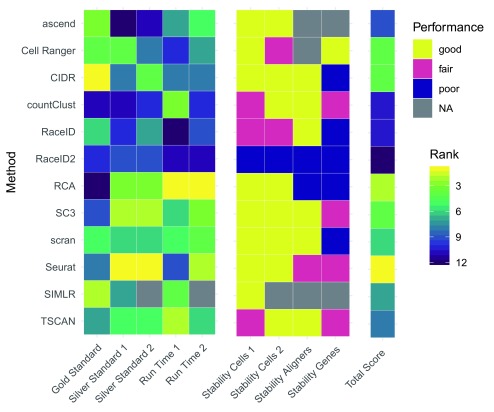
Background: The commercially available 10x Genomics protocol to generate droplet-based single-cell RNA-seq (scRNA-seq) data is enjoying growing popularity among researchers. Fundamental to the analysis of such scRNA-seq data is the ability to cluster similar or same cells into non-overlapping groups. Many competing methods have been proposed for this task, but there is currently little guidance with regards to which method to use. Methods: Here we use one gold standard 10x Genomics dataset, generated from the mixture of three cell lines, as well as three silver standard 10x Genomics datasets generated from peripheral blood mononuclear cells to examine not only the accuracy but also robustness of a dozen methods. Results: We found that some methods, including Seurat and Cell Ranger, outperform other methods, although performance seems to be dependent on the complexity of the studied system. Furthermore, we found that solutions produced by different methods have little in common with each other. Conclusions: In light of this, we conclude that the choice of clustering tool crucially determines interpretation of scRNA-seq data generated by 10x Genomics. Hence practitioners and consumers should remain vigilant about the outcome of 10x Genomics scRNA-seq analysis.
Overview
The claims and statistics of this paper haven’t been checked yet.
Run the check — free, no account needed. It reads the open-access text and checks the sources it cites.
Integrity signals
Registry
Cites
Statistics
Figures
Verification
Claims the paper makes
The claims and statistics of this paper haven’t been checked yet.
Run the check — free, no account needed. It reads the open-access text and checks the sources it cites.
Claims other papers make about this one
Each is checked against this paper’s own text: does it say what the citing paper says it does?
The source backs part of the claim, not all of it — or backs it for a different population, condition or comparison.
In the citing paper
“Cluster co-membership alone, however, is insufficient to conclude that two cell populations from different organs represent the same or similar cell types; at any given resolution, unbiased clustering that groups related cells may also group unrelated cells21.”
From Single-cell transcriptomics of 20 mouse organs creates a Tabula Muris (2018) · cites this paper as [21]
Experimental — accuracy not yet measuredIn the citing paper
“Independent benchmarks5,50,51 showed that community detection based on graph modularity optimization via the Louvain algorithm works best for cluster identification.”
From Best practices for single-cell analysis across modalities (2023) · cites this paper as [51]
In the citing paper
“It has been shown to outperform other clustering methods for single‐cell RNA‐seq data (Duò et al, 2018; Freytag et al, 2018), and flow and mass cytometry data (Weber & Robinson, 2016).”
From Current best practices in single-cell RNA-seq analysis: a tutorial (2019) · cites this paper as Freytag et al, 2018
Self-check
Percentages, sums and reported differences re-computed from the paper’s own numbers.
The self-check needs the paper’s full text.
Citations
Cites
STAR: ultrafast universal RNA-seq aligner
Dobin, A., Davis, C. A., Schlesinger, F., Drenkow, J., Zaleski, C., Jha, S., Batut, P., Chaisson, M., & Gingeras, T. R. (2013) · Bioinformatics · doi:10.1093/bioinformatics/bts635 · Cited by 51,709
Integrating single-cell transcriptomic data across different conditions, technologies, and species
Butler, A., Hoffman, P., Smibert, P., Papalexi, E., & Satija, R. (2018) · Nature Biotechnology · doi:10.1038/nbt.4096 · Cited by 13,174
Hubert, L., & Arabie, P. (1985) · Journal of Classification · doi:10.1007/bf01908075 · Cited by 8,219
Massively parallel digital transcriptional profiling of single cells
Zheng, G. X. Y., Terry, J. M., Belgrader, P., Ryvkin, P., Bent, Z. W., Wilson, R., Ziraldo, S. B., Wheeler, T. D., McDermott, G. P., Zhu, J., et al. (2017) · Nature Communications · doi:10.1038/ncomms14049 · Cited by 7,353
Trapnell, C., Cacchiarelli, D., Grimsby, J., Pokharel, P., Li, S., Morse, M., Lennon, N. J., Livak, K. J., Mikkelsen, T. S., & Rinn, J. L. (2014) · Nature Biotechnology · doi:10.1038/nbt.2859 · Cited by 7,314
Highly parallel genome-wide expression profiling of individual cells using nanoliter droplets.
Macosko, E. Z., Basu, A., Satija, R., Nemesh, J., Shekhar, K., Goldman, M., Tirosh, I., Bialas, A. R., Kamitaki, N., Martersteck, E. M., et al. (2015) · Cell · doi:10.1016/j.cell.2015.05.002 · Cited by 7,110
The Subread aligner: fast, accurate and scalable read mapping by seed-and-vote
Liao, Y., Smyth, G. K., & Shi, W. (2013) · Nucleic Acids Research · doi:10.1093/nar/gkt214 · Cited by 3,064
An overlap invariant entropy measure of 3D medical image alignment
Studholme, C., Hill, D., & Hawkes, D. J. (1999) · Pattern Recognition · doi:10.1016/s0031-3203(98)00091-0 · Cited by 2,167
McCarthy, D. J., Campbell, K. R., Lun, A. T. L., & Wills, Q. F. (2017) · Bioinformatics · doi:10.1093/bioinformatics/btw777 · Cited by 1,852
A step-by-step workflow for low-level analysis of single-cell RNA-seq data
Lun, A. T. L., McCarthy, D. J., & Marioni, J. C. (2016) · F1000Research · doi:10.12688/f1000research.9501.1 · Cited by 1,551
Cited by
Sorted by citations
Items 201–217 of 217
The future of genome studies of complex human and plant disease
Desai, S. A., Patel, V. P., Nagare, S. D., Pagare, N. B., & More, M. J. (2025) · Elsevier eBooks · doi:10.1016/b978-0-443-31554-1.00014-5
Yu, S., Yang, Z., Liu, T., Liang, C., & Wang, H. (2025) · Interdisciplinary Sciences Computational Life Sciences · doi:10.1007/s12539-025-00765-9
Wang, N., Turner, D., Feinberg, H., Caballero, V. E. N., Yuan, D., Scott, N., Cardenas, C., DeBerardine, M., Dan, S., Caceres, L., et al. (2025) · bioRxiv (Cold Spring Harbor Laboratory) · doi:10.1101/2025.11.16.686778
Clustering Single-Cell RNA Sequencing Data Using LEIDEN Algorithm
Rajesh, M., Reddy, S. N., Mamidi, R., Hasanoddin, S., Gudimilla, P., & Sharada, A. (2025) · International Conference on Emerging Techniques in Computational Intelligence (ICETCI) · doi:10.1109/icetci67340.2025.11257976
Additional file 1 of Improving replicability in single-cell RNA-Seq cell type discovery with Dune
de Bézieux, H. R., Street, K., Fischer, S., Van den Berge, K., Chance, R. K., Risso, D., Gillis, J., Ngai, J., Purdom, E. A., & Dudoit, S. (2024) · Figshare · doi:10.6084/m9.figshare.26725487
Additional file 1 of An information-theoretic approach to single cell sequencing analysis
Casey, M. J., Fliege, J., Sánchez-García, R. J., & MacArthur, B. D. (2023) · Figshare · doi:10.6084/m9.figshare.23937296
Jiang, C., Zheng, R., Ji, Y., Cao, S., Fang, Y., Wang, Z., Wang, R., Liang, S., & Tao, S. (2026) · bioRxiv (Cold Spring Harbor Laboratory) · doi:10.64898/2026.02.17.706490
Nasrollahi, F. S. F., Silva, F. N., Liu, S., Chaudhuri, S., Yu, M., Wang, J., Nho, K. T., Saykin, A. J., Bennett, D. A., Sporns, O., et al. (2026) · Scientific Reports · doi:10.1038/s41598-026-49033-w · Cited by 4
Social and Economic Aspects of Single-Cell Analysis
Nguyen, T.-Q., Bui, N. L., Nguyen, M. Q., & Chu, D.-T. (2026) · Springer eBooks · doi:10.1007/978-981-95-9789-5_18
ScEnsemble: weighted hypergraph ensemble clustering for single-cell RNA sequencing
Beste, U. N. C. U., & Yavuz, İ. (2026) · BMC Bioinformatics · doi:10.1186/s12859-026-06525-w
Kohl, C., & Vingron, M. (2026) · PLoS Computational Biology · doi:10.1371/journal.pcbi.1014418
Wang, N., Cardenas, C., Caballero, V. E. N., Turner, D., Feinberg, H., Yuan, D., Scott, N., DeBerardine, M., Dan, S., Caceres, L., et al. (2026) · bioRxiv (Cold Spring Harbor Laboratory) · doi:10.64898/2026.08.06.743394
Drug Discovery from Gene Expression/Gene Regulation
Cong, Y., & Endo, T. (2026) · Methods in molecular biology · doi:10.1007/978-1-0716-5284-8_2
Metadata
- Authors
- Freytag, S., Tian, L., Lönnstedt, I., Ng, M., & Bahlo, M.
- Affiliations
- The University of Melbourne (AU)
- Corresponding author
- Freytag, Saskia
- Venue
- F1000Research
- Publisher
- F1000 Research Ltd
- Published
- 2018-08-15
- Volume
- 7
- Pages
- 1297
- ISSN
- 2046-1402 (ISSN-L)
- PMC
- PMC6124389
- OpenAlex
- W4251287806
- Cited by
- 220
- References
- 46
- Citations by year
- 2026: 11 · 2025: 19 · 2024: 20 · 2023: 29 · 2022: 25 · 2021: 45 · 2020: 30 · 2019: 32 · 2018: 8
- FWCI
- 10.23
- Type
- journal article
- Language
- en
- Update notices
- new_version (2018-12-19)
- Open access
- gold
- doi.org
- Locations
- F1000Research (publishedVersion, cc-by)
- bioRxiv (Cold Spring Harbor Laboratory) (acceptedVersion, cc-by-nd)
- Europe PMC (PubMed Central) (publishedVersion, cc-by)
- PubMed Central (publishedVersion, cc-by)
- PubMed (publishedVersion)
- Minerva Access (University of Melbourne) (submittedVersion, cc-by)
- DOAJ (DOAJ: Directory of Open Access Journals) (submittedVersion, cc-by-sa)
- Funders
- National Health and Medical Research Council (IRIIS, ProgramGrant1054618, SeniorResearchFellowship110297)
- Topics
- Life Sciences › Biochemistry, Genetics and Molecular Biology › Molecular Biology › Single-cell and spatial transcriptomics
- Life Sciences › Biochemistry, Genetics and Molecular Biology › Molecular Biology › Gene expression and cancer classification
- Life Sciences › Biochemistry, Genetics and Molecular Biology › Molecular Biology › Genomics and Phylogenetic Studies
- Keywords
- single-cell RNA sequencing, cell clustering, 10x Genomics, clustering algorithm comparison, Seurat, Cell Ranger, peripheral blood mononuclear cells, method robustness, R package
- MeSH terms
- Leukocytes, Mononuclear, RNA, Software, Gene Expression Profiling, Genomics, Single-Cell Analysis
About these checks
Registry, retraction, Cites and statistics results are computed, not judged, with one exception: a printed reference that no index lists is read once by a model before it counts as a citation error. Claims are extracted by a model and kept only when their quote appears verbatim in the text; each cited source is then checked, with a model’s help, for whether it says what the claim relies on. Those verdicts can be wrong — read the claim’s quote and the cited source before relying on one.
Statistics and arithmetic are recomputed, not judged.
Confidence bands are shown only for fields calibrated on our annotated test set. None is calibrated yet, so no band is shown.
What counts as a claim ›How we measure confidence ›How we check this ›
Are you an author, or do you see a problem with this page? Request a review
