

The DOI matches its Crossref record; 174 of the 177 references it cites were found in a registry or an index, and 3 are not checked yet; 6 of the 111 sources its claims cite were checked for support.
Guidelines for performing Mendelian randomization investigations
Open accessAbstract
This paper provides guidelines for performing Mendelian randomization investigations. It is aimed at practitioners seeking to undertake analyses and write up their findings, and at journal editors and reviewers seeking to assess Mendelian randomization manuscripts. The guidelines are divided into nine sections: motivation and scope, data sources, choice of genetic variants, variant harmonization, primary analysis, supplementary and sensitivity analyses (one section on robust statistical methods and one on other approaches), data presentation, and interpretation. These guidelines will be updated based on feedback from the community and advances in the field. Updates will be made periodically as needed, and at least every 18 months.
Verified 2026-10-10 · 3 references not checked yet
Overview
AI snapshot
Written from the paper’s full text.
TL;DR
This paper provides updated guidelines for performing and appraising Mendelian randomization investigations, organized into ten sections from motivation and data sources through analysis, sensitivity analyses, presentation, and interpretation. It recommends inverse-variance weighted analysis with multiplicative random-effects as the primary summarized-data method and a range of sensitivity analyses, while emphasizing cautious causal interpretation.
Key findings
- The guidelines are divided into ten sections: motivation and scope, data sources, choice of genetic variants, variant harmonization, primary analysis, supplementary and sensitivity analyses (one section on robust statistical methods and one on other approaches), extensions and additional analyses, data presentation, and interpretation; updates are planned at least every 24 months.
- For summarized data, the paper recommends the inverse-variance weighted (IVW) method with multiplicative random-effects as the primary analysis, because it is most efficient with valid instruments and accounts for heterogeneity; if a causal effect is detected, investigators should perform sensitivity analyses.
- Table 1 summarizes robust methods including MR-Egger (InSIDE assumption), weighted median (majority valid), mode-based estimation (plurality valid), MR-PRESSO, MR-RAPS, MR-cML, and others; the paper suggests, for example, performing MR-RAPS, weighted median, and MR-cML because they require different assumptions, and recommends reporting heterogeneity measures such as Cochran’s Q or I².
- Interpretation should be cautious: Mendelian randomization estimates are better interpreted as a test statistic for a causal hypothesis and an indicator of direction rather than the expected impact of a well-defined intervention, and estimates are often larger than those from trials for the same magnitude of exposure difference.
Methods
- Design: a guideline/consensus document aimed at practitioners, journal editors, and reviewers, complementary to the STROBE-MR reporting recommendations; it is not an empirical study or systematic review.
- Data or sample: no primary data or study sample are analyzed; the paper references statistical methods and software in Table 1 and provides flowcharts and a reviewer checklist.
- Main analysis recommendations: two-stage least-squares for individual-level one-sample data; IVW for summarized data; multivariable Mendelian randomization when related exposures share genetic predictors; robust methods for sensitivity analysis.
Limitations
- Stated: the guidelines are deliberately written as suggestions and recommendations rather than prescriptive rules, and the authors state there is no recipe or single “right way” to perform a Mendelian randomization investigation; best practice depends on the aim and the specific exposure and outcome variables.
- Stated: causal inferences from Mendelian randomization rely on untestable assumptions, including gene–environment equivalence; even replicated findings retain intrinsic uncertainty, and robust methods make different assumptions and may be less effective for invalidity affecting all variants systematically, such as population stratification or dynastic effects.
- Evident: as a guideline document, it does not provide new empirical data or a systematic quantitative synthesis; its recommendations are based on cited methodological literature and author consensus.
Model-written summary. Check it against the paper before relying on it.
Integrity signals
Registry
Cites
Statistics
Figures
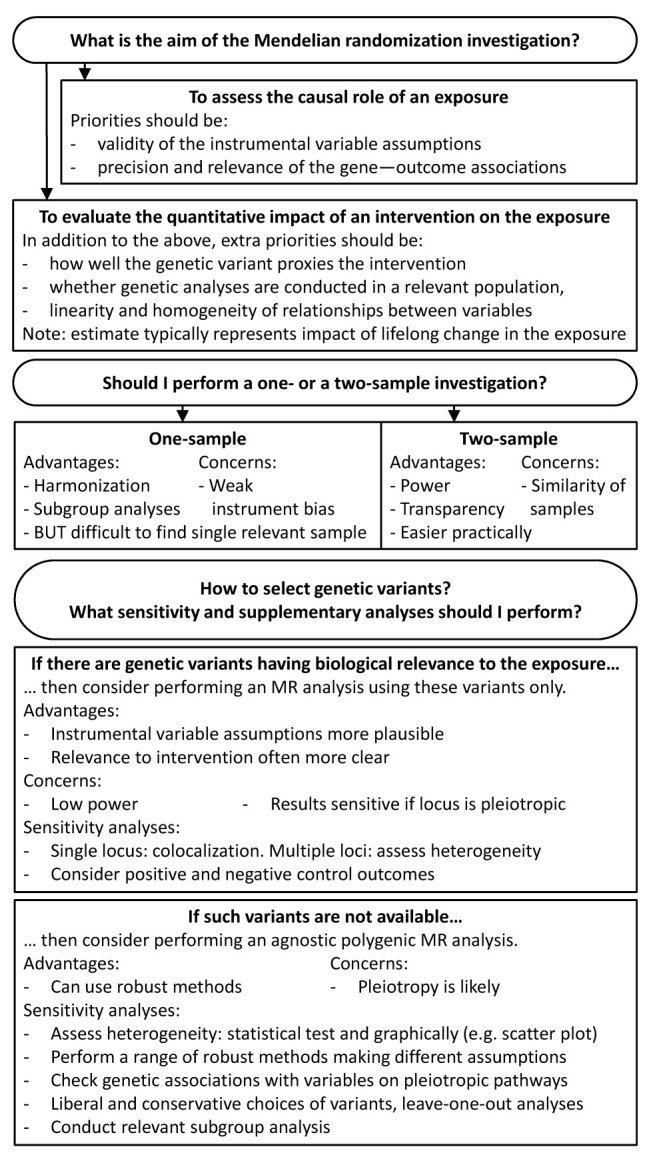
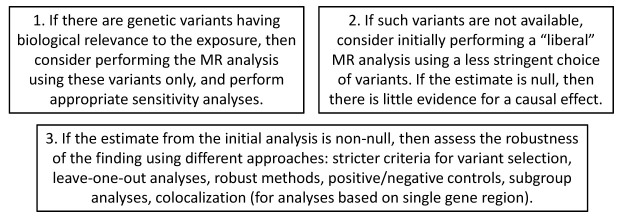
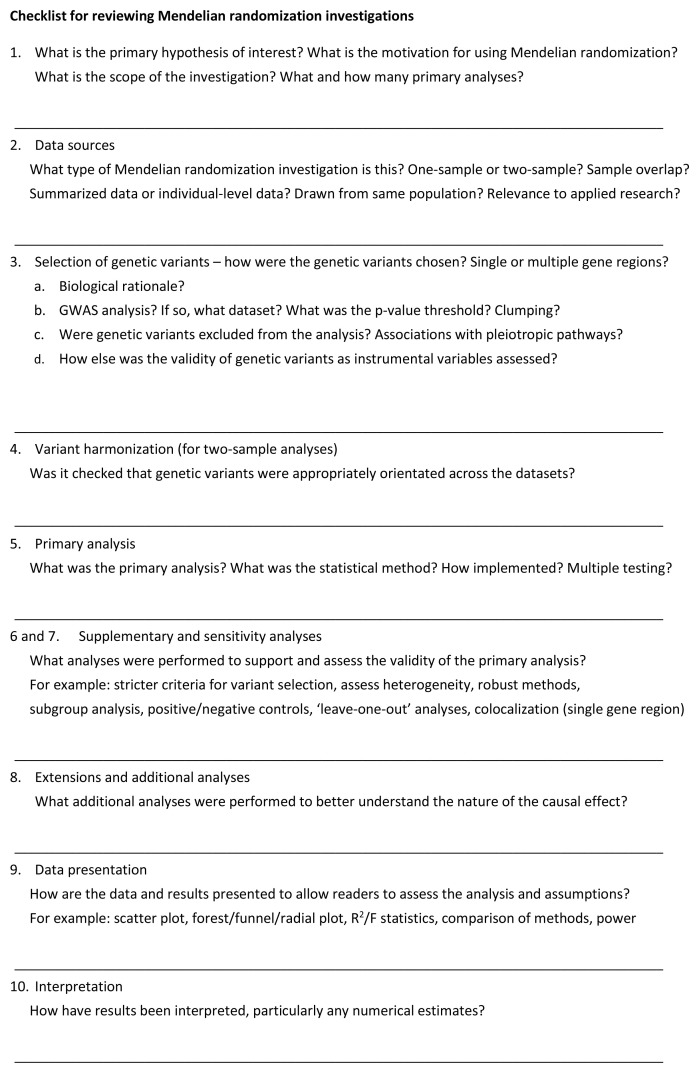
Verification
Claims the paper makes
89 Not checked yet · 80 Own interpretation · 18 No basis given · 1 Partly supported · 1 Couldn’t confirm · accuracy not yet measured
The cited sources support only part of this claim — read each source’s verdict below.
In the paper
“Specifically, the median-based method assumes that less than half of the variants are invalid instruments (majority valid assumption)”
§ Guidelines for performing Mendelian randomization investigations: update for summer 2023 > 6. Robust methods for sensitivity analysis
What the sources say
- Supportedcites [19] J Bowden, 2015, Mendelian randomization with invalid instruments: effect estimation and bias detection through Egger regression., Int J Epidemiol. source
The Discussion (‘Relation to existing literature’) says that taking the median of the individual variant estimates gives a consistent causal estimate if at least half of the genetic variants are valid instruments. The claim’s majority-valid condition is a slightly stricter statement of that requirement. (LLM, conf=0.91)
- Partly supportedcites [20] J Bowden, 2016, Consistent Estimation in Mendelian Randomization with Some Invalid Instruments Using a Weighted Median Estimator., Genet Epidemiol. sourceExperimental — accuracy not yet measured
The Methods section (Simple Median Estimator) says the simple median remains consistent when fewer than 50% of genetic variants are invalid. But the Methods section (Weighted Median Estimator) specifies a different condition for the weighted median: at least 50% of the total weight must come from valid variants. The claim applies the variant-count condition to median-based methods generally. (LLM, conf=0.88)
- Partly supportedcites [92] E Porcu, 2019, Mendelian randomization integrating GWAS and eQTL data reveals genetic determinants of complex and clinical traits., Nat Commun. sourceExperimental — accuracy not yet measured
The Introduction says a majority of valid instruments makes exclusion of variants contributing to heterogeneity a good solution, and separately lists the weighted-median method as an option when some instruments are invalid. It does not state that the majority-valid condition is an assumption of the median-based method or specify a less-than-half threshold for invalid variants. (LLM, conf=0.78)
plain- Asserted: passes — The authors put it forward as true.
- Checkable: passes — It can be checked against evidence.
- Load-bearing: passes — The paper’s conclusions depend on it.
- Based: passes — The paper gives a reason why it holds.
- Supported
A conclusion the paper draws from its own results — it cites no other source for it, so there is none to check. The quote shows it is in the paper.
In the paper
“However, access to only summarized data limits the range of analyses that can be performed.”
§ Guidelines for performing Mendelian randomization investigations: update for summer 2023 > 2. Data sources
plaindirect- Asserted: passes — The authors put it forward as true.
- Checkable: passes — It can be checked against evidence.
- Load-bearing: passes — The paper’s conclusions depend on it.
- Based: passes — The paper gives a reason why it holds.
In the paper
“If published summarized association estimates have already been adjusted for a variable causally downstream of the exposure or outcome, collider bias (see Section 7) can occur 38 .”
§ Guidelines for performing Mendelian randomization investigations: update for summer 2023 > 2. Data sources
What the sources say
- Not checked yetcites [38] S Burgess, 2016, Bias due to participant overlap in two-sample Mendelian randomization., Genet Epidemiol. source
plaindirect- Asserted: passes — The authors put it forward as true.
- Checkable: passes — It can be checked against evidence.
- Load-bearing: passes — The paper’s conclusions depend on it.
- Based: passes — The paper gives a reason why it holds.
A conclusion the paper draws from its own results — it cites no other source for it, so there is none to check. The quote shows it is in the paper.
In the paper
“A particular concern arises if the two samples represent different ethnic groups, as patterns of linkage disequilibrium can differ between population ancestry groups, meaning that a genetic variant may not be as strongly (or even not at all) associated with the exposure in the outcome dataset.”
§ Guidelines for performing Mendelian randomization investigations: update for summer 2023 > 2. Data sources
hedgedcorrelational- Asserted: passes — The authors put it forward as true.
- Checkable: passes — It can be checked against evidence.
- Load-bearing: passes — The paper’s conclusions depend on it.
- Based: passes — The paper gives a reason why it holds.
A conclusion the paper draws from its own results — it cites no other source for it, so there is none to check. The quote shows it is in the paper.
In the paper
“In a two-sample setting, the populations from which the two samples were extracted may differ. This is problematic if associations of the genetic variant with the exposure or with variables on pleiotropic pathways differ between the two samples, as this could affect the validity of the instrumental variable assumptions.”
§ Guidelines for performing Mendelian randomization investigations: update for summer 2023 > 2. Data sources
hedgedconditional- Asserted: passes — The authors put it forward as true.
- Checkable: passes — It can be checked against evidence.
- Load-bearing: passes — The paper’s conclusions depend on it.
- Based: passes — The paper gives a reason why it holds.
None of the sources cited for this claim have been checked yet.
In the paper
“Several large consortia have made such estimates publicly available for millions of variants 30, 35, 36 .”
§ Guidelines for performing Mendelian randomization investigations: update for summer 2023 > 2. Data sources
What the sources say
- Not checked yetcites [30] S Burgess, 2016, Combining information on multiple instrumental variables in Mendelian randomization: comparison of allele score and summarized data methods., Stat Med. source
- Not checked yetcites [35] J Staley, 2017, Semiparametric methods for estimation of a nonlinear exposure-outcome relationship using instrumental variables with application to Mendelian randomization., Genet Epidemiol. source
- Not checked yetcites [36] B Pierce, 2013, Efficient design for Mendelian randomization studies: subsample and 2-sample instrumental variable estimators., Am J Epidemiol. source
plain- Asserted: passes — The authors put it forward as true.
- Checkable: passes — It can be checked against evidence.
- Load-bearing: unclear — It is unclear whether the paper’s conclusions depend on it.
- Based: passes — The paper gives a reason why it holds.
In the paper
“In a one-sample setting, if the genetic variant–exposure associations are weak, then chance variation means that genetic associations with the exposure and outcome are correlated in the direction of the confounded association between the two.”
§ Guidelines for performing Mendelian randomization investigations: update for summer 2023 > 2. Data sources
What the sources say
- Not checked yetcites [41] M Brion, 2013, Calculating statistical power in Mendelian randomization studies., Int J Epidemiol. source
plaindirect- Asserted: passes — The authors put it forward as true.
- Checkable: passes — It can be checked against evidence.
- Load-bearing: passes — The paper’s conclusions depend on it.
- Based: passes — The paper gives a reason why it holds.
In the paper
“Individual data in a one-sample setting are required to investigate non-linear effects 39 .”
§ Guidelines for performing Mendelian randomization investigations: update for summer 2023 > 2. Data sources
What the sources say
- Not checked yetcites [39] D Swerdlow, 2016, Selecting instruments for Mendelian randomization in the wake of genome-wide association studies., Int J Epidemiol. source
plaindirect- Asserted: passes — The authors put it forward as true.
- Checkable: passes — It can be checked against evidence.
- Load-bearing: unclear — It is unclear whether the paper’s conclusions depend on it.
- Based: passes — The paper gives a reason why it holds.
In the paper
“However, as several large consortia have overlapping studies, participants may overlap between the datasets used to estimate the genetic associations with the exposure and outcome 42 .”
§ Guidelines for performing Mendelian randomization investigations: update for summer 2023 > 2. Data sources
What the sources say
- Not checked yetcites [42] L Mokry, 2015, Vitamin D and Risk of Multiple Sclerosis: A Mendelian Randomization Study., PLoS Med. source
hedgedconditional- Asserted: passes — The authors put it forward as true.
- Checkable: passes — It can be checked against evidence.
- Load-bearing: passes — The paper’s conclusions depend on it.
- Based: passes — The paper gives a reason why it holds.
In the paper
“In this case, the direction and size of the bias varies linearly depending on the degree of overlap (formally, depending on the degree of correlation between the genetic association estimates).”
§ Guidelines for performing Mendelian randomization investigations: update for summer 2023 > 2. Data sources
What the sources say
- Not checked yetcites [42] L Mokry, 2015, Vitamin D and Risk of Multiple Sclerosis: A Mendelian Randomization Study., PLoS Med. source
plaincorrelational- Asserted: passes — The authors put it forward as true.
- Checkable: passes — It can be checked against evidence.
- Load-bearing: passes — The paper’s conclusions depend on it.
- Based: passes — The paper gives a reason why it holds.
- Probably not a substantial claim. 48
- It may state two separate claims as one. 45
- The quote only partly states this claim. 1
The cited sources that could be checked couldn’t confirm or dispute this claim.
In the paper
“and the mode-based method assumes more variants estimate the true causal effect than estimate any other quantity (plurality valid assumption).”
§ Guidelines for performing Mendelian randomization investigations: update for summer 2023 > 6. Robust methods for sensitivity analysis
What the sources say
- Could not verifycites [19] J Bowden, 2015, Mendelian randomization with invalid instruments: effect estimation and bias detection through Egger regression., Int J Epidemiol. sourceExperimental — accuracy not yet measured
The Discussion section (“Relation to existing literature”; page unavailable) describes a median-based method that requires at least half the variants to be valid, but does not describe a mode-based method or its plurality-valid assumption. Searches for the mode-based method and plurality-valid assumption found no passage addressing that claim in our copy. (LLM, conf=0.74)
- Could not verifycites [20] J Bowden, 2016, Consistent Estimation in Mendelian Randomization with Some Invalid Instruments Using a Weighted Median Estimator., Genet Epidemiol. sourceExperimental — accuracy not yet measured
The Methods section describes simple and weighted median estimators, including the requirement that more than half of the variants be valid for the simple median. The passages found for “mode,” “modal,” and “plurality” do not describe a mode-based method or its plurality-valid assumption. Our copy therefore does not verify the claim attributed to this paper. (LLM, conf=0.73)
- Could not verifycites [92] E Porcu, 2019, Mendelian randomization integrating GWAS and eQTL data reveals genetic determinants of complex and clinical traits., Nat Commun. sourceExperimental — accuracy not yet measured
The Introduction mentions mode-based MR as an approach for analyses with invalid instruments, but does not describe its plurality-valid assumption. Searches for that assumption and for modal effect estimates found no passage in our copy stating the claimed requirement. (LLM, conf=0.72)
plain- Asserted: passes — The authors put it forward as true.
- Checkable: passes — It can be checked against evidence.
- Load-bearing: passes — The paper’s conclusions depend on it.
- Based: passes — The paper gives a reason why it holds.
Probably not a substantial claim.
- Could not verify
A conclusion the paper draws from its own results — it cites no other source for it, so there is none to check. The quote shows it is in the paper.
In the paper
“Summarized data are often available for larger sample sizes, meaning that power to detect a causal effect is increased.”
§ Guidelines for performing Mendelian randomization investigations: update for summer 2023 > 2. Data sources
plaindirect- Asserted: passes — The authors put it forward as true.
- Checkable: passes — It can be checked against evidence.
- Load-bearing: fails — The paper’s conclusions may not depend on it.
- Based: passes — The paper gives a reason why it holds.
Probably not a substantial claim. The paper’s conclusions may not depend on it.
None of the sources cited for this claim have been checked yet.
In the paper
“Alternatively, the two samples could differ substantially according to population characteristics such as age, sex, socio-economic background, and so on 32 . Such differences can affect not only the interpretation of causal estimates, but also the validity of causal inferences 33 .”
§ Guidelines for performing Mendelian randomization investigations: update for summer 2023 > 2. Data sources
What the sources say
plaindirect- Asserted: passes — The authors put it forward as true.
- Checkable: passes — It can be checked against evidence.
- Load-bearing: passes — The paper’s conclusions depend on it.
- Based: passes — The paper gives a reason why it holds.
It may state two separate claims as one.
In the paper
“Moreover, two-sample approaches can be used with individual-level data (such as the use of externally-derived weights), and summarized data approaches can be used with one-sample data (if necessary, by creating the summarized data from the individual-level data 37 ).”
§ Guidelines for performing Mendelian randomization investigations: update for summer 2023 > 2. Data sources
What the sources say
- Not checked yetcites [37] S Burgess, 2011, Avoiding bias from weak instruments in Mendelian randomization studies., Int J Epidemiol. source
plain- Asserted: passes — The authors put it forward as true.
- Checkable: passes — It can be checked against evidence.
- Load-bearing: unclear — It is unclear whether the paper’s conclusions depend on it.
- Based: passes — The paper gives a reason why it holds.
It may state two separate claims as one.
A conclusion the paper draws from its own results — it cites no other source for it, so there is none to check. The quote shows it is in the paper.
In the paper
“Individual-level data are required to conduct analyses in specific subgroups or strata of the population, or to choose which variables to adjust for when generating the summarized data.”
§ Guidelines for performing Mendelian randomization investigations: update for summer 2023 > 2. Data sources
plaindirect- Asserted: passes — The authors put it forward as true.
- Checkable: passes — It can be checked against evidence.
- Load-bearing: passes — The paper’s conclusions depend on it.
- Based: passes — The paper gives a reason why it holds.
Probably not a substantial claim. It may state two separate claims as one.
A conclusion the paper draws from its own results — it cites no other source for it, so there is none to check. The quote shows it is in the paper.
In the paper
“One-sample analyses do not suffer from these concerns, nor do they require harmonization of the genetic variants across the datasets (see Section 4).”
§ Guidelines for performing Mendelian randomization investigations: update for summer 2023 > 2. Data sources
plain- Asserted: passes — The authors put it forward as true.
- Checkable: passes — It can be checked against evidence.
- Load-bearing: unclear — It is unclear whether the paper’s conclusions depend on it.
- Based: passes — The paper gives a reason why it holds.
It may state two separate claims as one.
A conclusion the paper draws from its own results — it cites no other source for it, so there is none to check. The quote shows it is in the paper.
In the paper
“A specific advantage of publicly available summarized data is transparency, as the analysis can be reproduced by a third party with access to the same data.”
§ Guidelines for performing Mendelian randomization investigations: update for summer 2023 > 2. Data sources
plaindirect- Asserted: passes — The authors put it forward as true.
- Checkable: passes — It can be checked against evidence.
- Load-bearing: fails — The paper’s conclusions may not depend on it.
- Based: passes — The paper gives a reason why it holds.
Probably not a substantial claim. The paper’s conclusions may not depend on it.
A conclusion the paper draws from its own results — it cites no other source for it, so there is none to check. The quote shows it is in the paper.
In the paper
“Finally, dynastic effects occur when a parent’s genotype affects their child’s outcome by a causal pathway not acting via the child’s phenotype (for example, due to an effect of the parent’s phenotype on the child’s outcome). This can induce associations between the offspring’s genotype and outcomes that do not reflect the effect of the exposure in the offspring.”
§ Guidelines for performing Mendelian randomization investigations: update for summer 2023 > 2. Data sources
plaindirect- Asserted: passes — The authors put it forward as true.
- Checkable: passes — It can be checked against evidence.
- Load-bearing: fails — The paper’s conclusions may not depend on it.
- Based: passes — The paper gives a reason why it holds.
Probably not a substantial claim. The paper’s conclusions may not depend on it. It may state two separate claims as one.
In the paper
“For the special case of a one-sample analysis with a binary disease outcome, if the genetic associations with the exposure are estimated in the controls only, then genetic associations with the exposure and outcome will not be correlated, and bias will follow the pattern of the two-sample setting 42 .”
§ Guidelines for performing Mendelian randomization investigations: update for summer 2023 > 2. Data sources
What the sources say
- Not checked yetcites [42] L Mokry, 2015, Vitamin D and Risk of Multiple Sclerosis: A Mendelian Randomization Study., PLoS Med. source
plaincorrelational- Asserted: passes — The authors put it forward as true.
- Checkable: passes — It can be checked against evidence.
- Load-bearing: passes — The paper’s conclusions depend on it.
- Based: passes — The paper gives a reason why it holds.
It may state two separate claims as one.
A conclusion the paper draws from its own results — it cites no other source for it, so there is none to check. The quote shows it is in the paper.
In the paper
“However, within-family analyses typically have lower power than analyses in unrelated individuals, as families where all individuals have the same genotype (such as where both parents are major homozygotes) would not contribute any information to the analysis.”
§ Guidelines for performing Mendelian randomization investigations: update for summer 2023 > 2. Data sources
plaindirect- Asserted: passes — The authors put it forward as true.
- Checkable: passes — It can be checked against evidence.
- Load-bearing: passes — The paper’s conclusions depend on it.
- Based: passes — The paper gives a reason why it holds.
It may state two separate claims as one.
In the paper
“This results in instrumental variable estimates that are biased in the direction of the confounded association, and inflated false positive (type 1 error) rates, particularly when more than one variant is included in the analysis 41 .”
§ Guidelines for performing Mendelian randomization investigations: update for summer 2023 > 2. Data sources
What the sources say
- Not checked yetcites [41] M Brion, 2013, Calculating statistical power in Mendelian randomization studies., Int J Epidemiol. source
plaindirect- Asserted: passes — The authors put it forward as true.
- Checkable: passes — It can be checked against evidence.
- Load-bearing: passes — The paper’s conclusions depend on it.
- Based: passes — The paper gives a reason why it holds.
It may state two separate claims as one.
A conclusion the paper draws from its own results — it cites no other source for it, so there is none to check. The quote shows it is in the paper.
In the paper
“In a two-sample setting without sample overlap, bias due to weak instruments is in the direction of the null, and does not lead to false positive findings.”
§ Guidelines for performing Mendelian randomization investigations: update for summer 2023 > 2. Data sources
plaindirect- Asserted: passes — The authors put it forward as true.
- Checkable: passes — It can be checked against evidence.
- Load-bearing: passes — The paper’s conclusions depend on it.
- Based: passes — The paper gives a reason why it holds.
It may state two separate claims as one.
A conclusion the paper draws from its own results — it cites no other source for it, so there is none to check. The quote shows it is in the paper.
In the paper
“The key consequence of this randomization is that genetic variants are independently distributed from traits that they do not affect, an implication of Mendel’s laws of segregation and independent assortment.”
§ Guidelines for performing Mendelian randomization investigations: update for summer 2023 > 2. Data sources
plain- Asserted: passes — The authors put it forward as true.
- Checkable: passes — It can be checked against evidence.
- Load-bearing: passes — The paper’s conclusions depend on it.
- Based: passes — The paper gives a reason why it holds.
The quote only partly states this claim.
None of the sources cited for this claim have been checked yet.
In the paper
“Various statistical methods have been proposed to reduce weak instrument bias due to sample overlap and bias due to winner’s curse (see Section 3) 43– 45 .”
§ Guidelines for performing Mendelian randomization investigations: update for summer 2023 > 2. Data sources
What the sources say
- Not checked yetcites [43] D Swerdlow, 2012, The interleukin-6 receptor as a target for prevention of coronary heart disease: a mendelian randomisation analysis., Lancet. source
- Not checked yetcites [44] Q Zhao, 2019, Powerful three-sample genome-wide design and robust statistical inference in summary-data Mendelian randomization., Int J Epidemiol. source
- Not checked yetcites [45] G Davey Smith, 2014, Mendelian randomization: genetic anchors for causal inference in epidemiological studies., Hum Mol Genet. source
plaindirect- Asserted: passes — The authors put it forward as true.
- Checkable: passes — It can be checked against evidence.
- Load-bearing: unclear — It is unclear whether the paper’s conclusions depend on it.
- Based: passes — The paper gives a reason why it holds.
It may state two separate claims as one.
A conclusion the paper draws from its own results — it cites no other source for it, so there is none to check. The quote shows it is in the paper.
In the paper
“In practice, distinguishing between horizontal pleiotropy and vertical pleiotropy requires knowledge of the relationships between the variables in the analysis.”
§ Guidelines for performing Mendelian randomization investigations: update for summer 2023 > 3. Selection of genetic variants
plaincorrelational- Asserted: passes — The authors put it forward as true.
- Checkable: passes — It can be checked against evidence.
- Load-bearing: passes — The paper’s conclusions depend on it.
- Based: passes — The paper gives a reason why it holds.
Probably not a substantial claim.
A conclusion the paper draws from its own results — it cites no other source for it, so there is none to check. The quote shows it is in the paper.
In the paper
“For a polygenic analysis, there are two main strategies for selecting variants: either a biologically driven approach or a statistically driven approach.”
§ Guidelines for performing Mendelian randomization investigations: update for summer 2023 > 3. Selection of genetic variants
plain- Asserted: passes — The authors put it forward as true.
- Checkable: passes — It can be checked against evidence.
- Load-bearing: fails — The paper’s conclusions may not depend on it.
- Based: passes — The paper gives a reason why it holds.
Probably not a substantial claim. The paper’s conclusions may not depend on it.
In the paper
“As an example, although genetic variants in the IL6R gene region are associated with increased circulating levels of interleukin-6, they in fact decrease interleukin-6 signalling, leading to opposite directions of association with disease outcomes to those expected based on serum interleukin-6 measurements 65 .”
§ Guidelines for performing Mendelian randomization investigations: update for summer 2023 > 3. Selection of genetic variants
What the sources say
- Not checked yetcites [65] S Burgess, 2017, Interpreting findings from Mendelian randomization using the MR-Egger method., Eur J Epidemiol. source
plaindirect- Asserted: passes — The authors put it forward as true.
- Checkable: passes — It can be checked against evidence.
- Load-bearing: passes — The paper’s conclusions depend on it.
- Based: passes — The paper gives a reason why it holds.
It may state two separate claims as one.
A conclusion the paper draws from its own results — it cites no other source for it, so there is none to check. The quote shows it is in the paper.
In the paper
“However, for complex multifactorial exposures such as body mass index or blood pressure, there is no single relevant gene, and so a more agnostic polygenic analysis may be necessary.”
§ Guidelines for performing Mendelian randomization investigations: update for summer 2023 > 3. Selection of genetic variants
hedgedconditional- Asserted: passes — The authors put it forward as true.
- Checkable: passes — It can be checked against evidence.
- Load-bearing: passes — The paper’s conclusions depend on it.
- Based: passes — The paper gives a reason why it holds.
Probably not a substantial claim. It may state two separate claims as one.
In the paper
“When genetic variants are all valid instruments, power depends on the proportion of variance in the exposure explained by the variants 56 – hence a polygenic Mendelian randomization investigation will typically have greater power than one including variants only from a single gene region.”
§ Guidelines for performing Mendelian randomization investigations: update for summer 2023 > 3. Selection of genetic variants
What the sources say
- Not checked yetcites [56] M Greco, 2015, Detecting pleiotropy in Mendelian randomisation studies with summary data and a continuous outcome., Stat Med. source
plaindirect- Asserted: passes — The authors put it forward as true.
- Checkable: passes — It can be checked against evidence.
- Load-bearing: passes — The paper’s conclusions depend on it.
- Based: passes — The paper gives a reason why it holds.
It may state two separate claims as one.
A conclusion the paper draws from its own results — it cites no other source for it, so there is none to check. The quote shows it is in the paper.
In the paper
“Variants in the same gene region are likely to either all be valid instruments or all invalid.”
§ Guidelines for performing Mendelian randomization investigations: update for summer 2023 > 3. Selection of genetic variants
hedgedcorrelational- Asserted: passes — The authors put it forward as true.
- Checkable: passes — It can be checked against evidence.
- Load-bearing: passes — The paper’s conclusions depend on it.
- Based: fails — The paper may give no reason why it holds.
Probably not a substantial claim. The paper may give no reason why it holds.
A conclusion the paper draws from its own results — it cites no other source for it, so there is none to check. The quote shows it is in the paper.
In the paper
“The two approaches are not mutually exclusive, and the overall decision of which variants to include may comprise elements from both approaches.”
§ Guidelines for performing Mendelian randomization investigations: update for summer 2023 > 3. Selection of genetic variants
hedged- Asserted: passes — The authors put it forward as true.
- Checkable: passes — It can be checked against evidence.
- Load-bearing: fails — The paper’s conclusions may not depend on it.
- Based: passes — The paper gives a reason why it holds.
Probably not a substantial claim. The paper’s conclusions may not depend on it. It may state two separate claims as one.
In the paper
“Similar two-stage analyses can be performed with binary variables using logistic regression 73”
§ Guidelines for performing Mendelian randomization investigations: update for summer 2023 > 5. Primary analysis
What the sources say
- Not checked yetcites [73] J Smith, 2014, Association of low-density lipoprotein cholesterol-related genetic variants with aortic valve calcium and incident aortic stenosis., JAMA. source
plain- Asserted: passes — The authors put it forward as true.
- Checkable: passes — It can be checked against evidence.
- Load-bearing: fails — The paper’s conclusions may not depend on it.
- Based: passes — The paper gives a reason why it holds.
Probably not a substantial claim. The paper’s conclusions may not depend on it.
A conclusion the paper draws from its own results — it cites no other source for it, so there is none to check. The quote shows it is in the paper.
In the paper
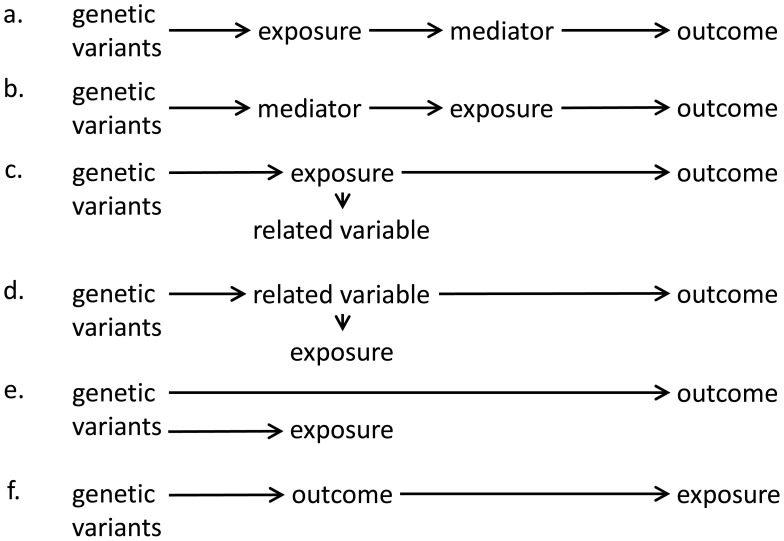
“Scenario e reflects “horizontal pleiotropy” (also called “direct pleiotropy”) that violates the instrumental variable assumptions.”
§ Guidelines for performing Mendelian randomization investigations: update for summer 2023 > 3. Selection of genetic variants
plaindirect- Asserted: passes — The authors put it forward as true.
- Checkable: passes — It can be checked against evidence.
- Load-bearing: fails — The paper’s conclusions may not depend on it.
- Based: passes — The paper gives a reason why it holds.
Probably not a substantial claim. The paper’s conclusions may not depend on it.
A conclusion the paper draws from its own results — it cites no other source for it, so there is none to check. The quote shows it is in the paper.
In the paper
“Hence a null finding in a liberal analysis is more convincing evidence of a true null relationship – there is little evidence for a causal relationship even when potentially pleiotropic genetic variants are included in the analysis.”
§ Guidelines for performing Mendelian randomization investigations: update for summer 2023 > 3. Selection of genetic variants
plain- Asserted: passes — The authors put it forward as true.
- Checkable: passes — It can be checked against evidence.
- Load-bearing: passes — The paper’s conclusions depend on it.
- Based: passes — The paper gives a reason why it holds.
It may state two separate claims as one.
In the paper
“If all genetic variants are valid instruments and the relationships between all variables (genetic variants, exposure and outcome) are linear and homogeneous for all individuals in the population, then we would expect the variant-specific estimates (that is, the ratio estimates based on each variant in turn) to all target the same causal parameter, and for there to be no more heterogeneity between”
§ Guidelines for performing Mendelian randomization investigations: update for summer 2023 > 5. Primary analysis
What the sources say
- Not checked yetcites [13] B Bulik-Sullivan, 2015, LD Score regression distinguishes confounding from polygenicity in genome-wide association studies., Nat Genet. source
hedged- Asserted: passes — The authors put it forward as true.
- Checkable: passes — It can be checked against evidence.
- Load-bearing: passes — The paper’s conclusions depend on it.
- Based: passes — The paper gives a reason why it holds.
It may state two separate claims as one.
A conclusion the paper draws from its own results — it cites no other source for it, so there is none to check. The quote shows it is in the paper.
In the paper
“If there is a reverse causal effect of the outcome on the exposure, then genetic predictors of the outcome could be identified as hits in a genome-wide association study for the exposure. However, such variants would not be valid instrumental variables.”
§ Guidelines for performing Mendelian randomization investigations: update for summer 2023 > 3. Selection of genetic variants
hedgeddirect- Asserted: passes — The authors put it forward as true.
- Checkable: passes — It can be checked against evidence.
- Load-bearing: passes — The paper’s conclusions depend on it.
- Based: passes — The paper gives a reason why it holds.
It may state two separate claims as one.
The paper states this without a source or data behind it here, so there is nothing to check it against. The quote shows it is in the paper.
In the paper
“Allele and strand information can be double-checked by comparing allele frequency information – if the allele frequencies are similar for the A and T alleles, then the researcher can be more confident that this is a strand mismatch.”
§ Guidelines for performing Mendelian randomization investigations: update for summer 2023 > 4. Variant harmonization
plaincorrelational- Asserted: passes — The authors put it forward as true.
- Checkable: passes — It can be checked against evidence.
- Load-bearing: unclear — It is unclear whether the paper’s conclusions depend on it.
- Based: passes — The paper gives a reason why it holds.
It may state two separate claims as one.
A conclusion the paper draws from its own results — it cites no other source for it, so there is none to check. The quote shows it is in the paper.
In the paper
“Causal conclusions will be more reliable when the instrumental variable assumptions are more plausible.”
§ Guidelines for performing Mendelian randomization investigations: update for summer 2023 > 3. Selection of genetic variants
plaindirect- Asserted: passes — The authors put it forward as true.
- Checkable: fails — It may be too vague to check against evidence.
- Load-bearing: passes — The paper’s conclusions depend on it.
- Based: fails — The paper may give no reason why it holds.
Probably not a substantial claim. It may be too vague to check against evidence. The paper may give no reason why it holds.
A conclusion the paper draws from its own results — it cites no other source for it, so there is none to check. The quote shows it is in the paper.
In the paper
“Scenario f reflects a reverse causation situation where the genetic variant has been incorrectly identified as primarily affecting the exposure.”
§ Guidelines for performing Mendelian randomization investigations: update for summer 2023 > 3. Selection of genetic variants
plaindirect- Asserted: passes — The authors put it forward as true.
- Checkable: passes — It can be checked against evidence.
- Load-bearing: fails — The paper’s conclusions may not depend on it.
- Based: passes — The paper gives a reason why it holds.
Probably not a substantial claim. The paper’s conclusions may not depend on it.
In the paper
“Estimates from the MR-Egger method are particularly affected by outlying and influential datapoints 90 , and are prone to be imprecise, particularly when the variant—exposure associations are all similar in magnitude.”
§ Guidelines for performing Mendelian randomization investigations: update for summer 2023 > 6. Robust methods for sensitivity analysis
What the sources say
- Not checked yetcites [90] J White, 2016, Plasma urate concentration and risk of coronary heart disease: a Mendelian randomisation analysis., Lancet Diabetes Endocrinol. source
plaincorrelational- Asserted: passes — The authors put it forward as true.
- Checkable: passes — It can be checked against evidence.
- Load-bearing: unclear — It is unclear whether the paper’s conclusions depend on it.
- Based: passes — The paper gives a reason why it holds.
It may state two separate claims as one.
None of the sources cited for this claim have been checked yet.
In the paper
“Examples of exposure sets where multivariable Mendelian randomization has been used include lipid fractions (such as high-density lipoprotein cholesterol, LDL-cholesterol, and triglycerides) 82 , and body composition measures (such as fat mass and fat-free mass) 83 .”
§ Guidelines for performing Mendelian randomization investigations: update for summer 2023 > 5. Primary analysis
What the sources say
- Not checked yetcites [82] N Solovieff, 2013, Pleiotropy in complex traits: challenges and strategies., Nat Rev Genet. source
- Not checked yetcites [83] M Benn, 2017, Low LDL cholesterol, PCSK9 and HMGCR genetic variation, and risk of Alzheimer's disease and Parkinson's disease: Mendelian randomisation study., BMJ. source
plain- Asserted: passes — The authors put it forward as true.
- Checkable: passes — It can be checked against evidence.
- Load-bearing: fails — The paper’s conclusions may not depend on it.
- Based: passes — The paper gives a reason why it holds.
Probably not a substantial claim. The paper’s conclusions may not depend on it.
The paper states this without a source or data behind it here, so there is nothing to check it against. The quote shows it is in the paper.
In the paper
“If there is no more heterogeneity between the ratio estimates for the individual variants than would be expected by chance alone, then the random-effect analysis is equivalent to the fixed-effect analysis, and there is no loss of precision in making the weaker random-effects assumption.”
§ Guidelines for performing Mendelian randomization investigations: update for summer 2023 > 5. Primary analysis
plain- Asserted: passes — The authors put it forward as true.
- Checkable: passes — It can be checked against evidence.
- Load-bearing: passes — The paper’s conclusions depend on it.
- Based: passes — The paper gives a reason why it holds.
It may state two separate claims as one.
The paper states this without a source or data behind it here, so there is nothing to check it against. The quote shows it is in the paper.
In the paper
“The instrumental variable assumptions in multivariable Mendelian randomization require each variant to be associated with at least one of the exposures, not associated with the outcome via confounding, and not to affect the outcome except potentially via its association with one or more of the exposures included in the analysis model.”
§ Guidelines for performing Mendelian randomization investigations: update for summer 2023 > 5. Primary analysis
plaincorrelational- Asserted: passes — The authors put it forward as true.
- Checkable: passes — It can be checked against evidence.
- Load-bearing: passes — The paper’s conclusions depend on it.
- Based: passes — The paper gives a reason why it holds.
Probably not a substantial claim. It may state two separate claims as one.
The paper states this without a source or data behind it here, so there is nothing to check it against. The quote shows it is in the paper.
In the paper
“The most commonly used robust methods are MR-Egger, median- and mode-based methods, and MR-PRESSO.”
§ Guidelines for performing Mendelian randomization investigations: update for summer 2023 > 6. Robust methods for sensitivity analysis
plain- Asserted: passes — The authors put it forward as true.
- Checkable: passes — It can be checked against evidence.
- Load-bearing: fails — The paper’s conclusions may not depend on it.
- Based: fails — The paper may give no reason why it holds.
Probably not a substantial claim. The paper’s conclusions may not depend on it. The paper may give no reason why it holds.
In the paper
“However, the robust methods are more likely to be effective for addressing instrument invalidity that arises due to issues such as pleiotropy or linkage disequilibrium with a variant influencing a confounder, which affect specific variants in a sporadic way, and less effective for instrument invalidity that arises due to issues such as population stratification or dynastic effects, which affect”
§ Guidelines for performing Mendelian randomization investigations: update for summer 2023 > 6. Robust methods for sensitivity analysis
What the sources say
- Not checked yetcites [48] D Lawlor, 2008, Mendelian randomization: using genes as instruments for making causal inferences in epidemiology., Stat Med. source
hedgedcorrelational- Asserted: passes — The authors put it forward as true.
- Checkable: passes — It can be checked against evidence.
- Load-bearing: passes — The paper’s conclusions depend on it.
- Based: passes — The paper gives a reason why it holds.
It may state two separate claims as one.
The paper states this without a source or data behind it here, so there is nothing to check it against. The quote shows it is in the paper.
In the paper
“A causal model is evidenced if the predominance of variants that associate with the exposure also associate with the outcome in a proportional way.”
§ Guidelines for performing Mendelian randomization investigations: update for summer 2023 > 6. Robust methods for sensitivity analysis
plaindirect- Asserted: passes — The authors put it forward as true.
- Checkable: passes — It can be checked against evidence.
- Load-bearing: passes — The paper’s conclusions depend on it.
- Based: fails — The paper may give no reason why it holds.
Probably not a substantial claim. The paper may give no reason why it holds.
In the paper
“Another method making the InSIDE assumption is the MR-RAPS (robust adjusted profile score) method, which first excludes strongly pleiotropic variants, and then assumes all remaining variants follow the InSIDE assumption 18 .”
§ Guidelines for performing Mendelian randomization investigations: update for summer 2023 > 6. Robust methods for sensitivity analysis
What the sources say
- Not checked yetcites [18] S Burgess, 2013, Mendelian randomization analysis with multiple genetic variants using summarized data., Genet Epidemiol. source
plain- Asserted: passes — The authors put it forward as true.
- Checkable: passes — It can be checked against evidence.
- Load-bearing: unclear — It is unclear whether the paper’s conclusions depend on it.
- Based: passes — The paper gives a reason why it holds.
It may state two separate claims as one.
In the paper
“The MR-PRESSO method is a variation on the IVW method that first sequentially removes genetic variants from the analysis whose variant-specific causal estimate differs substantially from those of other variants 21 .”
§ Guidelines for performing Mendelian randomization investigations: update for summer 2023 > 6. Robust methods for sensitivity analysis
What the sources say
- Not checked yetcites [21] F Hartwig, 2017, Robust inference in summary data Mendelian randomization via the zero modal pleiotropy assumption., Int J Epidemiol. source
plain- Asserted: passes — The authors put it forward as true.
- Checkable: passes — It can be checked against evidence.
- Load-bearing: fails — The paper’s conclusions may not depend on it.
- Based: passes — The paper gives a reason why it holds.
Probably not a substantial claim. The paper’s conclusions may not depend on it.
In the paper
“Leave-one-out analyses (i.e. remove one variant from the analysis and re-estimate the causal effect) can be valuable in assessing the reliance of a Mendelian randomization analysis on a particular variant 100 .”
§ Guidelines for performing Mendelian randomization investigations: update for summer 2023 > 6. Robust methods for sensitivity analysis
What the sources say
- Not checked yetcites [100] M Holmes, 2017, Mendelian randomization in cardiometabolic disease: challenges in evaluating causality., Nat Rev Cardiol. source
plainconditional- Asserted: passes — The authors put it forward as true.
- Checkable: passes — It can be checked against evidence.
- Load-bearing: passes — The paper’s conclusions depend on it.
- Based: passes — The paper gives a reason why it holds.
Probably not a substantial claim.
A conclusion the paper draws from its own results — it cites no other source for it, so there is none to check. The quote shows it is in the paper.
In the paper
“It is unlikely that one approach will perform best in all settings”
§ Guidelines for performing Mendelian randomization investigations: update for summer 2023 > 6. Robust methods for sensitivity analysis
hedged- Asserted: passes — The authors put it forward as true.
- Checkable: fails — It may be too vague to check against evidence.
- Load-bearing: passes — The paper’s conclusions depend on it.
- Based: passes — The paper gives a reason why it holds.
Probably not a substantial claim. It may be too vague to check against evidence.
A conclusion the paper draws from its own results — it cites no other source for it, so there is none to check. The quote shows it is in the paper.
In the paper
“If estimates from all methods are similar, then any causal claim is more credible.”
§ Guidelines for performing Mendelian randomization investigations: update for summer 2023 > 6. Robust methods for sensitivity analysis
plaincorrelational- Asserted: passes — The authors put it forward as true.
- Checkable: passes — It can be checked against evidence.
- Load-bearing: passes — The paper’s conclusions depend on it.
- Based: fails — The paper may give no reason why it holds.
Probably not a substantial claim. The paper may give no reason why it holds.
A conclusion the paper draws from its own results — it cites no other source for it, so there is none to check. The quote shows it is in the paper.
In the paper
“Conclusions are more reliable when multiple genetic variants provide concordant evidence for a causal effect, and particularly when there is no more heterogeneity between the variant-specific causal estimates than expected by chance.”
§ Guidelines for performing Mendelian randomization investigations: update for summer 2023 > 6. Robust methods for sensitivity analysis
plaincorrelational- Asserted: passes — The authors put it forward as true.
- Checkable: passes — It can be checked against evidence.
- Load-bearing: passes — The paper’s conclusions depend on it.
- Based: passes — The paper gives a reason why it holds.
It may state two separate claims as one.
None of the sources cited for this claim have been checked yet.
In the paper
“Combining this with orthogonal validation – such as through the use of positive and negative controls ( Section 7) – is the most powerful way of addressing causal questions, within the triangulation of evidence framework 96, 97 .”
§ Guidelines for performing Mendelian randomization investigations: update for summer 2023 > 6. Robust methods for sensitivity analysis
What the sources say
- Not checked yetcites [96] S Burgess, 2015, Network Mendelian randomization: using genetic variants as instrumental variables to investigate mediation in causal pathways., Int J Epidemiol. source
- Not checked yetcites [97] J Bowden, 2018, Improving the visualization, interpretation and analysis of two-sample summary data Mendelian randomization via the Radial plot and Radial regression., Int J Epidemiol. source
boosteddirect- Asserted: passes — The authors put it forward as true.
- Checkable: fails — It may be too vague to check against evidence.
- Load-bearing: passes — The paper’s conclusions depend on it.
- Based: passes — The paper gives a reason why it holds.
Probably not a substantial claim. It may be too vague to check against evidence.
In the paper
“Removing a variant from the analysis is more justified when a pleiotropic association of the variant has been identified 103 .”
§ Guidelines for performing Mendelian randomization investigations: update for summer 2023 > 6. Robust methods for sensitivity analysis
What the sources say
- Not checked yetcites [103] D Lawlor, 2016, Triangulation in aetiological epidemiology., Int J Epidemiol. source
plainconditional- Asserted: passes — The authors put it forward as true.
- Checkable: passes — It can be checked against evidence.
- Load-bearing: passes — The paper’s conclusions depend on it.
- Based: passes — The paper gives a reason why it holds.
Probably not a substantial claim.
In the paper
“A further approach for identifying variants to remove from the analysis is Steiger filtering, which removes variants from the analysis if their association with the outcome is stronger than that with the exposure 102 .”
§ Guidelines for performing Mendelian randomization investigations: update for summer 2023 > 6. Robust methods for sensitivity analysis
What the sources say
- Not checked yetcites [102] M Munafò, 2018, Robust research needs many lines of evidence., Nature. source
plaindirect- Asserted: passes — The authors put it forward as true.
- Checkable: passes — It can be checked against evidence.
- Load-bearing: fails — The paper’s conclusions may not depend on it.
- Based: passes — The paper gives a reason why it holds.
Probably not a substantial claim. The paper’s conclusions may not depend on it.
In the paper
“For example, childhood levels of vitamin D have been used as a negative control outcome for the effect of adulthood BMI; childhood BMI was shown to affect childhood vitamin D levels in a Mendelian randomization investigation, but adulthood BMI did not 106 .”
§ Guidelines for performing Mendelian randomization investigations: update for summer 2023 > 7. Other approaches for sensitivity analysis
What the sources say
- Not checked yetcites [106] S Burgess, 2019, How humans can contribute to Mendelian randomization analyses., Int J Epidemiol. source
plaindirect- Asserted: passes — The authors put it forward as true.
- Checkable: passes — It can be checked against evidence.
- Load-bearing: unclear — It is unclear whether the paper’s conclusions depend on it.
- Based: passes — The paper gives a reason why it holds.
It may state two separate claims as one.
The paper states this without a source or data behind it here, so there is nothing to check it against. The quote shows it is in the paper.
In the paper
“Other approaches for assessing robustness include varying the dataset and choice of genetic variants in the analysis (including the suggestion of liberal and conservative variant sets in Section 3), the use of positive and negative control outcomes and/or samples, colocalization, subgroup analyses, and examining associations with potentially pleiotropic variables.”
§ Guidelines for performing Mendelian randomization investigations: update for summer 2023 > 7. Other approaches for sensitivity analysis
plain- Asserted: passes — The authors put it forward as true.
- Checkable: passes — It can be checked against evidence.
- Load-bearing: fails — The paper’s conclusions may not depend on it.
- Based: passes — The paper gives a reason why it holds.
Probably not a substantial claim. The paper’s conclusions may not depend on it. It may state two separate claims as one.
In the paper
“If there are many variants in an analysis, leaving one variant out at a time is unlikely to change the estimate substantially, and leaving out subsets of the variants (say, a randomly chosen 30% at a time 101 ) may be more appropriate.”
§ Guidelines for performing Mendelian randomization investigations: update for summer 2023 > 6. Robust methods for sensitivity analysis
What the sources say
- Not checked yetcites [101] T Richardson, 2019, Can the impact of childhood adiposity on disease risk be reversed? A Mendelian randomization study., medRxiv. source
hedged- Asserted: passes — The authors put it forward as true.
- Checkable: passes — It can be checked against evidence.
- Load-bearing: unclear — It is unclear whether the paper’s conclusions depend on it.
- Based: passes — The paper gives a reason why it holds.
It may state two separate claims as one.
The paper states this without a source or data behind it here, so there is nothing to check it against. The quote shows it is in the paper.
In the paper
“This is particularly important for investigations based on a single gene region, as several of the methods discussed above are not applicable in this case.”
§ Guidelines for performing Mendelian randomization investigations: update for summer 2023 > 7. Other approaches for sensitivity analysis
plain- Asserted: passes — The authors put it forward as true.
- Checkable: passes — It can be checked against evidence.
- Load-bearing: fails — The paper’s conclusions may not depend on it.
- Based: fails — The paper may give no reason why it holds.
Probably not a substantial claim. The paper’s conclusions may not depend on it. The paper may give no reason why it holds.
In the paper
“Hence, while in some cases colocalization methods will provide helpful evidence supporting or questioning the Mendelian randomization assumptions, in other cases they may provide no strong evidence for or against colocalization 112 .”
§ Guidelines for performing Mendelian randomization investigations: update for summer 2023 > 7. Other approaches for sensitivity analysis
What the sources say
- Not checked yetcites [112]
hedged- Asserted: passes — The authors put it forward as true.
- Checkable: passes — It can be checked against evidence.
- Load-bearing: unclear — It is unclear whether the paper’s conclusions depend on it.
- Based: passes — The paper gives a reason why it holds.
It may state two separate claims as one.
In the paper
“A colocalization analysis revealed distinct causal variants for LDL-cholesterol and Alzheimer’s disease at the APOE locus, indicating that variants in this gene region are not valid instruments assessing the effect of LDL-cholesterol on Alzheimer’s disease 112 .”
§ Guidelines for performing Mendelian randomization investigations: update for summer 2023 > 7. Other approaches for sensitivity analysis
What the sources say
- Not checked yetcites [112]
hedged- Asserted: passes — The authors put it forward as true.
- Checkable: passes — It can be checked against evidence.
- Load-bearing: passes — The paper’s conclusions depend on it.
- Based: passes — The paper gives a reason why it holds.
It may state two separate claims as one.
A conclusion the paper draws from its own results — it cites no other source for it, so there is none to check. The quote shows it is in the paper.
In the paper
“A further possible sensitivity analysis is to check the genetic associations with other variables associated with the outcome, and which are thought not to lie on the causal pathway through the exposure (i.e. are not mediators).”
§ Guidelines for performing Mendelian randomization investigations: update for summer 2023 > 7. Other approaches for sensitivity analysis
hedgedcorrelational- Asserted: passes — The authors put it forward as true.
- Checkable: passes — It can be checked against evidence.
- Load-bearing: fails — The paper’s conclusions may not depend on it.
- Based: passes — The paper gives a reason why it holds.
Probably not a substantial claim. The paper’s conclusions may not depend on it.
In the paper
“As sex cannot be affected by autosomal genetic variants, sex cannot be a collider, and so stratification on sex will not induce collider bias 119 .”
§ Guidelines for performing Mendelian randomization investigations: update for summer 2023 > 7. Other approaches for sensitivity analysis
What the sources say
- Not checked yetcites [119]
plain- Asserted: passes — The authors put it forward as true.
- Checkable: passes — It can be checked against evidence.
- Load-bearing: passes — The paper’s conclusions depend on it.
- Based: passes — The paper gives a reason why it holds.
It may state two separate claims as one.
In the paper
“A further possibility in this case is to perform a multivariable Mendelian randomization, including the putative pleiotropic variables as additional exposures in the analysis model 120 .”
§ Guidelines for performing Mendelian randomization investigations: update for summer 2023 > 7. Other approaches for sensitivity analysis
What the sources say
- Not checked yetcites [120]
hedged- Asserted: passes — The authors put it forward as true.
- Checkable: passes — It can be checked against evidence.
- Load-bearing: fails — The paper’s conclusions may not depend on it.
- Based: passes — The paper gives a reason why it holds.
Probably not a substantial claim. The paper’s conclusions may not depend on it.
None of the sources cited for this claim have been checked yet.
In the paper
“Simulation studies have shown that selection bias can have a severe impact on Mendelian randomization estimates, but only when the selection effects are quite strong 72, 122 .”
§ Guidelines for performing Mendelian randomization investigations: update for summer 2023 > 7. Other approaches for sensitivity analysis
What the sources say
- Not checked yetcites [72] L Corbin, 2016, BMI as a Modifiable Risk Factor for Type 2 Diabetes: Refining and Understanding Causal Estimates Using Mendelian Randomization., Diabetes. source
- Not checked yetcites [122]
plaindirect- Asserted: passes — The authors put it forward as true.
- Checkable: passes — It can be checked against evidence.
- Load-bearing: unclear — It is unclear whether the paper’s conclusions depend on it.
- Based: passes — The paper gives a reason why it holds.
It may state two separate claims as one.
In the paper
“Collider bias is not unique to Mendelian randomization, but it is particularly relevant as some published genetic association estimates have been adjusted for potential colliders 123 .”
§ Guidelines for performing Mendelian randomization investigations: update for summer 2023 > 7. Other approaches for sensitivity analysis
What the sources say
- Not checked yetcites [123]
plain- Asserted: passes — The authors put it forward as true.
- Checkable: passes — It can be checked against evidence.
- Load-bearing: unclear — It is unclear whether the paper’s conclusions depend on it.
- Based: passes — The paper gives a reason why it holds.
It may state two separate claims as one.
The paper states this without a source or data behind it here, so there is nothing to check it against. The quote shows it is in the paper.
In the paper
“Selection bias is a specific example of collider bias which occurs when selection into a study sample depends on a collider.”
§ Guidelines for performing Mendelian randomization investigations: update for summer 2023 > 7. Other approaches for sensitivity analysis
plaindirect- Asserted: passes — The authors put it forward as true.
- Checkable: passes — It can be checked against evidence.
- Load-bearing: fails — The paper’s conclusions may not depend on it.
- Based: passes — The paper gives a reason why it holds.
Probably not a substantial claim. The paper’s conclusions may not depend on it.
In the paper
“Specific weights to reduce selection bias have been proposed for the UK Biobank study 131 .”
§ Guidelines for performing Mendelian randomization investigations: update for summer 2023 > 7. Other approaches for sensitivity analysis
What the sources say
- Not checked yetcites [131]
plaindirect- Asserted: passes — The authors put it forward as true.
- Checkable: passes — It can be checked against evidence.
- Load-bearing: fails — The paper’s conclusions may not depend on it.
- Based: passes — The paper gives a reason why it holds.
Probably not a substantial claim. The paper’s conclusions may not depend on it.
In the paper
“Selection bias can potentially be addressed using inverse-probability weighting 130 , although this requires estimation of the probability of selection into the study sample for all participants.”
§ Guidelines for performing Mendelian randomization investigations: update for summer 2023 > 7. Other approaches for sensitivity analysis
What the sources say
- Not checked yetcites [130]
hedgedconditional- Asserted: passes — The authors put it forward as true.
- Checkable: passes — It can be checked against evidence.
- Load-bearing: unclear — It is unclear whether the paper’s conclusions depend on it.
- Based: passes — The paper gives a reason why it holds.
It may state two separate claims as one.
A conclusion the paper draws from its own results — it cites no other source for it, so there is none to check. The quote shows it is in the paper.
In the paper
“This analysis will estimate the direct effect of the exposure on the outcome keeping these variables constant.”
§ Guidelines for performing Mendelian randomization investigations: update for summer 2023 > 7. Other approaches for sensitivity analysis
plaindirect- Asserted: passes — The authors put it forward as true.
- Checkable: passes — It can be checked against evidence.
- Load-bearing: fails — The paper’s conclusions may not depend on it.
- Based: passes — The paper gives a reason why it holds.
Probably not a substantial claim. The paper’s conclusions may not depend on it.
A conclusion the paper draws from its own results — it cites no other source for it, so there is none to check. The quote shows it is in the paper.
In the paper
“Each of these steps can be performed using standard Mendelian randomization, although separate instrumental variables are required for the exposure and mediator.”
§ Guidelines for performing Mendelian randomization investigations: update for summer 2023 > 8. Extensions and additional analyses
plain- Asserted: passes — The authors put it forward as true.
- Checkable: passes — It can be checked against evidence.
- Load-bearing: fails — The paper’s conclusions may not depend on it.
- Based: passes — The paper gives a reason why it holds.
Probably not a substantial claim. The paper’s conclusions may not depend on it.
A conclusion the paper draws from its own results — it cites no other source for it, so there is none to check. The quote shows it is in the paper.
In the paper
“A weakness of these investigations is that statistical power to detect an interaction is often low, in which case a null finding should not be interpreted as strong evidence for lack of interaction.”
§ Guidelines for performing Mendelian randomization investigations: update for summer 2023 > 8. Extensions and additional analyses
plain- Asserted: passes — The authors put it forward as true.
- Checkable: passes — It can be checked against evidence.
- Load-bearing: passes — The paper’s conclusions depend on it.
- Based: passes — The paper gives a reason why it holds.
It may state two separate claims as one.
In the paper
“Researchers should be cautious when performing such analyses to ensure that the values of the exposure at different time periods genuinely represent biologically distinct risk factors, and not simply measures taken at different times but capturing the same essential risk factor 144 .”
§ Guidelines for performing Mendelian randomization investigations: update for summer 2023 > 8. Extensions and additional analyses
What the sources say
- Not checked yetcites [144]
plain- Asserted: passes — The authors put it forward as true.
- Checkable: fails — It may be too vague to check against evidence.
- Load-bearing: passes — The paper’s conclusions depend on it.
- Based: passes — The paper gives a reason why it holds.
Probably not a substantial claim. It may be too vague to check against evidence.
In the paper
“The doubly-ranked stratification method has been proposed that may be less sensitive to variability in these genetic effects 139 .”
§ Guidelines for performing Mendelian randomization investigations: update for summer 2023 > 8. Extensions and additional analyses
What the sources say
- Not checked yetcites [139]
hedgedconditional- Asserted: passes — The authors put it forward as true.
- Checkable: passes — It can be checked against evidence.
- Load-bearing: fails — The paper’s conclusions may not depend on it.
- Based: passes — The paper gives a reason why it holds.
Probably not a substantial claim. The paper’s conclusions may not depend on it.
None of the sources cited for this claim have been checked yet.
In the paper
“Indeed, variability in the effect of genetic variants on the exposure is evident for several exposures; this variability can lead to highly misleading estimates 137, 138 .”
§ Guidelines for performing Mendelian randomization investigations: update for summer 2023 > 8. Extensions and additional analyses
What the sources say
- Not checked yetcites [137]
- Not checked yetcites [138]
plaindirect- Asserted: passes — The authors put it forward as true.
- Checkable: passes — It can be checked against evidence.
- Load-bearing: passes — The paper’s conclusions depend on it.
- Based: passes — The paper gives a reason why it holds.
It may state two separate claims as one.
In the paper
“The genetic code is fixed at conception, and so Mendelian randomization investigations typically compare groups of the population having different trajectories in their distribution of the exposure over time 161 .”
§ Guidelines for performing Mendelian randomization investigations: update for summer 2023 > 10. Interpretation
What the sources say
- Not checked yetcites [161]
plaincorrelational- Asserted: passes — The authors put it forward as true.
- Checkable: passes — It can be checked against evidence.
- Load-bearing: passes — The paper’s conclusions depend on it.
- Based: passes — The paper gives a reason why it holds.
It may state two separate claims as one.
In the paper
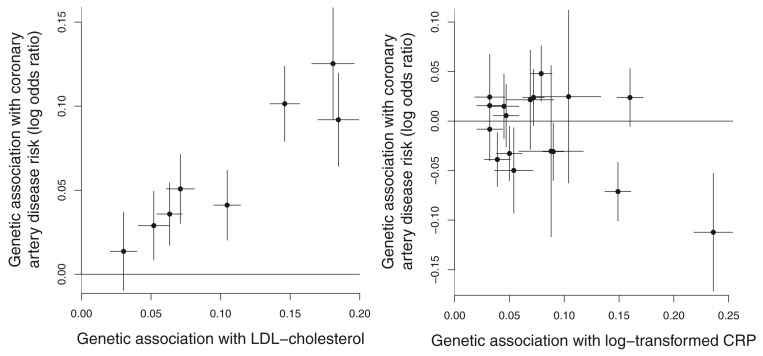
“For example, in a polygenic analysis, a scatter plot of the genetic associations with the outcome against the genetic associations with the exposure reveals much about the analysis – whether different genetic variants provide similar estimates of the causal effect or if there is considerable heterogeneity, and whether the analysis is dominated by a single genetic variant or not 31 .”
§ Guidelines for performing Mendelian randomization investigations: update for summer 2023 > 9. Data presentation
What the sources say
- Not checked yetcites [31] J Labrecque, 2019, Interpretation and Potential Biases of Mendelian Randomization Estimates With Time-Varying Exposures., Am J Epidemiol. source
plaincorrelational- Asserted: passes — The authors put it forward as true.
- Checkable: passes — It can be checked against evidence.
- Load-bearing: unclear — It is unclear whether the paper’s conclusions depend on it.
- Based: passes — The paper gives a reason why it holds.
It may state two separate claims as one.
A conclusion the paper draws from its own results — it cites no other source for it, so there is none to check. The quote shows it is in the paper.
In the paper
“Plots allow the investigators and readers to assess the reliability of the analysis method and its underlying assumptions, and we strongly recommend their inclusion in a manuscript.”
§ Guidelines for performing Mendelian randomization investigations: update for summer 2023 > 9. Data presentation
plaindirect- Asserted: passes — The authors put it forward as true.
- Checkable: fails — It may be too vague to check against evidence.
- Load-bearing: passes — The paper’s conclusions depend on it.
- Based: passes — The paper gives a reason why it holds.
Probably not a substantial claim. It may be too vague to check against evidence.
In the paper
“For multivariable Mendelian randomization, the conditional F statistic is a more relevant measure of instrument strength, and assesses the strength of association of the variants with each exposure in turn after accounting for the other exposures in the model 158 .”
§ Guidelines for performing Mendelian randomization investigations: update for summer 2023 > 9. Data presentation
What the sources say
- Not checked yetcites [158]
plaincorrelational- Asserted: passes — The authors put it forward as true.
- Checkable: passes — It can be checked against evidence.
- Load-bearing: unclear — It is unclear whether the paper’s conclusions depend on it.
- Based: passes — The paper gives a reason why it holds.
It may state two separate claims as one.
A conclusion the paper draws from its own results — it cites no other source for it, so there is none to check. The quote shows it is in the paper.
In the paper
“Even if a Mendelian randomization finding is replicated in a separate dataset, there is still intrinsic uncertainty in the instrumental variable assumptions, meaning that uncertainty in a causal conclusion remains.”
§ Guidelines for performing Mendelian randomization investigations: update for summer 2023 > 10. Interpretation
plain- Asserted: passes — The authors put it forward as true.
- Checkable: passes — It can be checked against evidence.
- Load-bearing: passes — The paper’s conclusions depend on it.
- Based: passes — The paper gives a reason why it holds.
Probably not a substantial claim.
In the paper
“That said, results from Mendelian randomization investigations have often been shown to qualitatively agree with the results from randomized trials, suggesting that a causal interpretation for Mendelian randomization findings is often reasonable 121 .”
§ Guidelines for performing Mendelian randomization investigations: update for summer 2023 > 10. Interpretation
What the sources say
- Not checked yetcites [121]
hedgedconditional- Asserted: passes — The authors put it forward as true.
- Checkable: passes — It can be checked against evidence.
- Load-bearing: passes — The paper’s conclusions depend on it.
- Based: passes — The paper gives a reason why it holds.
It may state two separate claims as one.
A conclusion the paper draws from its own results — it cites no other source for it, so there is none to check. The quote shows it is in the paper.
In the paper
“The appropriate degree of caution will depend on the plausibility of the instrumental variable assumptions, the concordance of estimates from different methods and different analytical approaches, the results from sensitivity and supplementary analyses, and so on.”
§ Guidelines for performing Mendelian randomization investigations: update for summer 2023 > 10. Interpretation
plaincorrelational- Asserted: passes — The authors put it forward as true.
- Checkable: fails — It may be too vague to check against evidence.
- Load-bearing: passes — The paper’s conclusions depend on it.
- Based: passes — The paper gives a reason why it holds.
Probably not a substantial claim. It may be too vague to check against evidence.
The paper states this without a source or data behind it here, so there is nothing to check it against. The quote shows it is in the paper.
In the paper
“Power calculations are often performed post hoc, as sample sizes are rarely determined based on a proposed Mendelian randomization analysis.”
§ Guidelines for performing Mendelian randomization investigations: update for summer 2023 > 9. Data presentation
plain- Asserted: passes — The authors put it forward as true.
- Checkable: passes — It can be checked against evidence.
- Load-bearing: fails — The paper’s conclusions may not depend on it.
- Based: fails — The paper may give no reason why it holds.
Probably not a substantial claim. The paper’s conclusions may not depend on it. The paper may give no reason why it holds. It may state two separate claims as one.
The paper states this without a source or data behind it here, so there is nothing to check it against. The quote shows it is in the paper.
In the paper
“Power to detect a causal effect depends on the proportion of variance in the exposure explained by the genetic variants, proposed size of causal effect, sample size (for the genetic associations with the outcome), and (with a binary outcome) proportion of individuals with an outcome event.”
§ Guidelines for performing Mendelian randomization investigations: update for summer 2023 > 9. Data presentation
plaindirect- Asserted: passes — The authors put it forward as true.
- Checkable: passes — It can be checked against evidence.
- Load-bearing: fails — The paper’s conclusions may not depend on it.
- Based: fails — The paper may give no reason why it holds.
Probably not a substantial claim. The paper’s conclusions may not depend on it. The paper may give no reason why it holds.
In the paper
“Other important information to report include the first-stage R 2 statistic (when the exposure is continuous), which is a measure of the variance in the exposure explained by the genetic variants, and (particularly in a one-sample setting) the related F statistic, which is a measure of instrument strength and can be used to judge the extent of weak instrument bias 157 .”
§ Guidelines for performing Mendelian randomization investigations: update for summer 2023 > 9. Data presentation
What the sources say
- Not checked yetcites [157]
plaincorrelational- Asserted: passes — The authors put it forward as true.
- Checkable: passes — It can be checked against evidence.
- Load-bearing: unclear — It is unclear whether the paper’s conclusions depend on it.
- Based: passes — The paper gives a reason why it holds.
It may state two separate claims as one.
A conclusion the paper draws from its own results — it cites no other source for it, so there is none to check. The quote shows it is in the paper.
In the paper
“Power calculations are more meaningful when performed prior to the analysis, and can guide investigators which exposure/outcome pairs to consider, and so focus on analyses that have a better chance of giving meaningful results.”
§ Guidelines for performing Mendelian randomization investigations: update for summer 2023 > 9. Data presentation
plaindirect- Asserted: passes — The authors put it forward as true.
- Checkable: fails — It may be too vague to check against evidence.
- Load-bearing: fails — The paper’s conclusions may not depend on it.
- Based: passes — The paper gives a reason why it holds.
Probably not a substantial claim. It may be too vague to check against evidence. The paper’s conclusions may not depend on it. It may state two separate claims as one.
In the paper
“Other important information to report include the first-stage R 2 statistic (when the exposure is continuous), which is a measure of the variance in the exposure explained by the genetic variants, and (particularly in a one-sample setting) the related F statistic, which is a measure of instrument strength and can be used to judge the extent of weak instrument bias 157 .”
§ Guidelines for performing Mendelian randomization investigations: update for summer 2023 > 9. Data presentation
What the sources say
- Not checked yetcites [157]
plaincorrelational- Asserted: passes — The authors put it forward as true.
- Checkable: passes — It can be checked against evidence.
- Load-bearing: fails — The paper’s conclusions may not depend on it.
- Based: passes — The paper gives a reason why it holds.
Probably not a substantial claim. The paper’s conclusions may not depend on it.
In the paper
“Alternatives are forest plots, funnel plots, and radial plots – each of these assesses heterogeneity in the variant-specific causal estimates 156 .”
§ Guidelines for performing Mendelian randomization investigations: update for summer 2023 > 9. Data presentation
What the sources say
- Not checked yetcites [156]
plaindirect- Asserted: passes — The authors put it forward as true.
- Checkable: passes — It can be checked against evidence.
- Load-bearing: unclear — It is unclear whether the paper’s conclusions depend on it.
- Based: passes — The paper gives a reason why it holds.
It may state two separate claims as one.
In the paper
“Particularly with the advent of summarized data and the two-sample setting, performing a Mendelian randomization analysis has become more straightforward 30 .”
§ Guidelines for performing Mendelian randomization investigations: update for summer 2023 > Summary
What the sources say
- Not checked yetcites [30] S Burgess, 2016, Combining information on multiple instrumental variables in Mendelian randomization: comparison of allele score and summarized data methods., Stat Med. source
plaindirect- Asserted: passes — The authors put it forward as true.
- Checkable: passes — It can be checked against evidence.
- Load-bearing: fails — The paper’s conclusions may not depend on it.
- Based: passes — The paper gives a reason why it holds.
Probably not a substantial claim. The paper’s conclusions may not depend on it.
None of the sources cited for this claim have been checked yet.
In the paper
“Mendelian randomization investigations are worthwhile in providing an alternative line of aetiological evidence even though the instrumental variable assumptions can never be proved beyond all doubt 96, 97 .”
§ Guidelines for performing Mendelian randomization investigations: update for summer 2023 > 10. Interpretation
What the sources say
- Not checked yetcites [96] S Burgess, 2015, Network Mendelian randomization: using genetic variants as instrumental variables to investigate mediation in causal pathways., Int J Epidemiol. source
- Not checked yetcites [97] J Bowden, 2018, Improving the visualization, interpretation and analysis of two-sample summary data Mendelian randomization via the Radial plot and Radial regression., Int J Epidemiol. source
plain- Asserted: passes — The authors put it forward as true.
- Checkable: fails — It may be too vague to check against evidence.
- Load-bearing: passes — The paper’s conclusions depend on it.
- Based: passes — The paper gives a reason why it holds.
Probably not a substantial claim. It may be too vague to check against evidence.
None of the sources cited for this claim have been checked yet.
In the paper
“The difficulty is not in performing a Mendelian randomization analysis, but rather in performing a credible analysis 167 and providing a reasoned interpretation 164 .”
§ Guidelines for performing Mendelian randomization investigations: update for summer 2023 > Summary
What the sources say
- Not checked yetcites [167]
- Not checked yetcites [164]
plain- Asserted: passes — The authors put it forward as true.
- Checkable: fails — It may be too vague to check against evidence.
- Load-bearing: passes — The paper’s conclusions depend on it.
- Based: passes — The paper gives a reason why it holds.
Probably not a substantial claim. It may be too vague to check against evidence. It may state two separate claims as one.
A conclusion the paper draws from its own results — it cites no other source for it, so there is none to check. The quote shows it is in the paper.
In the paper
“But even when a Mendelian randomization investigation is performed primarily to assess the causal role of an exposure, causal estimates can still be useful, for example to assess heterogeneity in estimates from different variants as a test of instrument validity, or to compare results from different analysis methods as an assessment of robustness.”
§ Guidelines for performing Mendelian randomization investigations: update for summer 2023 > 10. Interpretation
plain- Asserted: passes — The authors put it forward as true.
- Checkable: passes — It can be checked against evidence.
- Load-bearing: fails — The paper’s conclusions may not depend on it.
- Based: passes — The paper gives a reason why it holds.
Probably not a substantial claim. The paper’s conclusions may not depend on it. It may state two separate claims as one.
A conclusion the paper draws from its own results — it cites no other source for it, so there is none to check. The quote shows it is in the paper.
In the paper
“The estimate from a Mendelian randomization investigation is therefore better interpreted as a test statistic for a causal hypothesis and an indicator of the direction of the effect, rather than the estimated impact of a well-defined intervention at a specific point in time.”
§ Guidelines for performing Mendelian randomization investigations: update for summer 2023 > 10. Interpretation
plain- Asserted: passes — The authors put it forward as true.
- Checkable: passes — It can be checked against evidence.
- Load-bearing: passes — The paper’s conclusions depend on it.
- Based: passes — The paper gives a reason why it holds.
Probably not a substantial claim.
A conclusion the paper draws from its own results — it cites no other source for it, so there is none to check. The quote shows it is in the paper.
In the paper
“These elements are necessary for the reader to judge the reliability of a Mendelian randomization investigation.”
§ Guidelines for performing Mendelian randomization investigations: update for summer 2023 > Summary
plain- Asserted: passes — The authors put it forward as true.
- Checkable: fails — It may be too vague to check against evidence.
- Load-bearing: passes — The paper’s conclusions depend on it.
- Based: fails — The paper may give no reason why it holds.
Probably not a substantial claim. It may be too vague to check against evidence. The paper may give no reason why it holds.
The authors state this as an assumption.
A genetic variant is associated with the exposure.
“1) it is associated with the exposure”
The authors state this as an assumption.
A genetic variant is not associated with the outcome due to confounding pathways.
“2) it is not associated with the outcome due to confounding pathways”
The authors state this as an assumption.
A genetic variant does not affect the outcome except potentially via the exposure.
“3) it does not affect the outcome except potentially via the exposure”
The paper relies on this without support.
Genetic associations with exposures and outcomes are typically reported per additional copy of a particular allele.
“Genetic associations with exposures and outcomes are typically reported per additional copy of a particular allele.”
The paper relies on this without support.
Allele alignment problems have led to incorrect results in Mendelian randomization analyses, and retractions and corrections of manuscripts.
“allele alignment problems have led to incorrect results in Mendelian randomization analyses, and retractions and corrections of manuscripts.”
The paper relies on this without support.
Some variants are associated with BMI from early childhood and others from adolescence or later.
“Additionally, some variants are associated with BMI from early childhood and others from adolescence or later.”
The paper relies on this without support.
Different methods will perform better and worse in different scenarios.
“Different methods will perform better and worse in different scenarios, so critical thought and judgement is required.”
The paper relies on this without support.
New methods for Mendelian randomization analysis tend to report simulations and applications suggesting they have advantages over previous methods.
“New methods for Mendelian randomization analysis are appearing regularly, and (unsurprisingly) tend to report simulations and applications suggesting they have advantages over previous methods.”
The paper relies on this without support.
Raised uric acid levels are known to increase risk of gout.
“as raised uric acid levels are known to increase risk of gout.”
The paper relies on this without support.
The APOE gene region contains genetic variants associated with LDL-cholesterol and Alzheimer’s disease.
“An example of this is the APOE gene region, which contains genetic variants associated with LDL-cholesterol and Alzheimer’s disease.”
The authors state this as an assumption.
The genetic predictors are instrumental variables for the exposures.
“Under the assumption that the genetic predictors are instrumental variables for the exposures, the statistical interaction can be interpreted as an interaction between the causal effects of the exposures on the outcome on the same scale 140 .”
The authors state this as an assumption.
Observed differences in the outcome associated with genetically-predicted levels of the exposure would also be seen if the exposure were intervened on.
“In Mendelian randomization, a key assumption is that observed differences in the outcome associated with genetically-predicted levels of the exposure would also be seen if the exposure were intervened on 9, 71 .”
The paper relies on this without support.
The genetic code is fixed at conception and cannot be influenced by reverse causation.
“While the genetic code is fixed at conception and so cannot be influenced by reverse causation, if the outcome influences the risk factor, then variants that primarily affect the outcome would (in a large enough sample size) be associated with the exposure 132 .”
The paper relies on this without support.
Most epidemiological studies do not recruit all individuals from the target population with equal probability.
“Most epidemiological studies do not recruit all individuals from the target population with equal probability, and so suffer from selection bias.”
The paper relies on this without support.
Making causal inferences from observational data always relies on untestable assumptions.
“Making causal inferences from observational data always relies on untestable assumptions.”
The paper relies on this without support.
The 2SLS/IVW method provides the most efficient causal estimate when combining evidence across multiple valid instrumental variables.
“A logical consequence of the 2SLS/IVW method providing the most efficient causal estimate when combining evidence across multiple valid instrumental variables is that, under the same assumptions, the method provides the most powerful test of the presence of a causal effect.”
Claims other papers make about this one
Each is checked against this paper’s own text: does it say what the citing paper says it does?
The source backs part of the claim, not all of it — or backs it for a different population, condition or comparison.
In the citing paper
“in the case of drug-target MR, there is little evidence to support presence of such compensatory mechanisms -e.g. genetic variants with large phenotypic effects appear to have the expected dose-response association with disease as compared to genetic variants of smaller phenotypic effect 57 40 .”
From Integrating genomics with biomarkers and therapeutic targets to invigorate cardiovascular drug development (2021) · cites this paper as [40]
Experimental — accuracy not yet measuredIn the citing paper
“The approach outlined here to obtaining a scaling estimate has generally held true for lipid-lowering therapies and risk of cardiovascular disease 22,23,40,92 but there are several potential reasons why the derivation of such a scaling for other therapeutic target-indication pairs may pose a challenge.”
From Integrating genomics with biomarkers and therapeutic targets to invigorate cardiovascular drug development (2021) · cites this paper as [40]
Citations
Cites
1 retracted
Inoshita, M., Numata, S., Tajima, A., Kinoshita, M., Umehara, H., Nakataki, M., Ikeda, M., Maruyama, S., Yamamori, H., Kanazawa, T., et al. (2018) · Scientific Reports · doi:10.1038/srep46947 · Cited by 10
RetractedBowden, J., Davey Smith, G., & Burgess, S. (2015) · International Journal of Epidemiology · doi:10.1093/ije/dyv080 · Cited by 9,816
Self-citationBowden, J., Davey Smith, G., Haycock, P. C., & Burgess, S. (2016) · Genetic Epidemiology · doi:10.1002/gepi.21965 · Cited by 8,922
Self-citationVerbanck, M., Chen, C.-Y., Neale, B., & Do, R. (2018) · Nature Genetics · doi:10.1038/s41588-018-0099-7 · Cited by 8,591
The MR-Base platform supports systematic causal inference across the human phenome
Hemani, G., Zheng, J., Elsworth, B., Wade, K. H., Haberland, V., Baird, D., Laurin, C., Burgess, S., Bowden, J., Langdon, R., et al. (2018) · eLife · doi:10.7554/elife.34408 · Cited by 7,959
Self-citationMendelian Randomization Analysis With Multiple Genetic Variants Using Summarized Data
Burgess, S., Butterworth, A., & Thompson, S. G. (2013) · Genetic Epidemiology · doi:10.1002/gepi.21758 · Cited by 6,050
Self-citationDavey Smith, G., & Ebrahim, S. (2003) · International Journal of Epidemiology · doi:10.1093/ije/dyg070 · Cited by 5,882
LD Score regression distinguishes confounding from polygenicity in genome-wide association studies
Schizophrenia Working Group of the Psychiatric Genomics Consortium, Bulik-Sullivan, B. K., Loh, P.-R., Finucane, H. K., Ripke, S., Yang, J., Patterson, N., Daly, M. J., Price, A. L., & Neale, B. M. (2015) · Nature Genetics · doi:10.1038/ng.3211 · Cited by 5,559
Mendelian randomization: genetic anchors for causal inference in epidemiological studies
Davey Smith, G., & Hemani, G. (2014) · Human Molecular Genetics · doi:10.1093/hmg/ddu328 · Cited by 4,677
Mendelian randomization: Using genes as instruments for making causal inferences in epidemiology
Lawlor, D. A., Harbord, R. M., Sterne, J. A. C., Timpson, N., & Davey Smith, G. (2008) · Statistics in Medicine · doi:10.1002/sim.3034 · Cited by 4,618
Cited by
Sorted by citations
Items 901–1,000 of 1,002
Shao, Z., Gao, H., Han, Q., Ning, E., Sheng, L., Hao, Y., Che, H., Hu, D., & Wang, C. (2024) · Scientific Reports · doi:10.1038/s41598-024-68718-8 · Cited by 3
Heart failure causally affects the brain cortical structure: a Mendelian randomization study
Meng, T., Fei, Q., Zhu, J., Gu, J., Li, W., Wu, X., Pan, G., Lv, T., & Chen, S. (2024) · Frontiers in Neuroscience · doi:10.3389/fnins.2024.1416431 · Cited by 3
Wang, J., & Yang, G. (2024) · Frontiers in Neurology · doi:10.3389/fneur.2024.1434433 · Cited by 3
Chen, S., Du, Z., Qin, Y., Li, Y., Pan, Y., Qiao, Y., Chen, J., Hou, Z., Jin, S., Tao, H., et al. (2024) · Frontiers in Psychiatry · doi:10.3389/fpsyt.2024.1338481 · Cited by 3
Circulating levels of micronutrients and risk of osteomyelitis: a Mendelian randomization study
Zhang, X., Wang, J., Wu, Z., Xin, B., He, S., He, Z., & Li, Y. (2024) · Frontiers in Nutrition · doi:10.3389/fnut.2024.1443539 · Cited by 3
Educational attainment, brain cortical structure, and sarcopenia: a Mendelian randomization study
Zhang, Y., Wang, R., Chen, Z., Zhou, F., & Su, S. (2024) · Frontiers in Public Health · doi:10.3389/fpubh.2024.1415343 · Cited by 3
Causal relationship between sarcopenia and rotator cuff tears: a Mendelian randomization study
Yang, D., Li, Z., Jiang, Z., Mei, X., Zhang, D., & Wei, Q. (2024) · Frontiers in Endocrinology · doi:10.3389/fendo.2024.1436203 · Cited by 3
Wang, Y., & Li, S. (2024) · Renal Failure · doi:10.1080/0886022x.2024.2420841 · Cited by 3
Wei, X., Yang, H., Yin, X., Fu, Z., & Xiong, W. (2024) · Frontiers in Medicine · doi:10.3389/fmed.2024.1444277 · Cited by 3
Vitamin D, C-Reactive Protein, and Increased Fall Risk: A Genetic Epidemiological Study
Sutherland, J. P., Zhou, A., & Hyppönen, E. (2024) · Nutrients · doi:10.3390/nu17010038 · Cited by 3
Wang, C., & Yuan, C. (2025) · Molecular Neurobiology · doi:10.1007/s12035-025-04691-1 · Cited by 3
Monocyte CCL2 signaling possibly contributes to increased asthma susceptibility in type 2 diabetes
Luo, T., Guo, W., Ji, W., Du, W., Lv, Y., & Feng, Z. (2025) · Scientific Reports · doi:10.1038/s41598-025-95039-1 · Cited by 3
Henry, J., Berrandou, T.-E., Brewster, L. M., & Bouatia‐Naji, N. (2025) · Journal of the American Heart Association · doi:10.1161/jaha.124.036697 · Cited by 3
Dube, L., Mills, N. T., Le, T. D., Hyppönen, E., & Lee, S. (2025) · Human Genetics · doi:10.1007/s00439-025-02739-9 · Cited by 3
Xiang, R., Zhao, X., Sha, L., Tang, M., Wu, X., Zhang, L., Hou, J., Deng, Q., Qu, Y., Zhu, J., et al. (2025) · European Journal of Nutrition · doi:10.1007/s00394-025-03665-2 · Cited by 4
Kamps, A., Runhaar, J., Trajanoska, K., Thompson, W., Zhang, W., Sedaghati-khayat, B., van Meurs, J. B. J., & Bierma‐Zeinstra, S. (2025) · Osteoarthritis and Cartilage Open · doi:10.1016/j.ocarto.2025.100636 · Cited by 3
Liu, D., Shen, H., Greenbaum, J., Yi, Q., Liang, S., Zhang, Y., Liu, J., Qiu, C., Zhao, L., Tian, Q., et al. (2025) · Clinical Pharmacology & Therapeutics · doi:10.1002/cpt.3738 · Cited by 3
Mendelian randomization in cancer research: opportunities and challenges
Tang, M., & Chen, L. (2025) · Infectious Agents and Cancer · doi:10.1186/s13027-025-00672-0 · Cited by 3
Unveiling the genetic association between rheumatoid arthritis and four common hand pathologies
Lv, Z., Yang, Y., Bao, Y., & Deng, C. (2025) · European journal of medical research · doi:10.1186/s40001-025-02695-0 · Cited by 3
Jin, R., Lu, J., Cheng, S., & Shi, S. (2025) · Clinical Cosmetic and Investigational Dermatology · doi:10.2147/ccid.s525937 · Cited by 3
Sun, R., Li, S., Yang, C., Huang, G., Tang, C., Li, W., Xia, Z., Zuo, M., Yang, N., Luo, H., et al. (2025) · MedComm · doi:10.1002/mco2.70302 · Cited by 3
HLA-DOB: A Key “Coordinator” Between Cutaneous Melanoma and Psoriasis
Li, Y., Luo, J., Tian, D., Li, C., Wu, C., Wang, G., Guo, R., He, L., Li, L., Tian, Y., et al. (2025) · Journal of Cancer · doi:10.7150/jca.110306 · Cited by 3
Hong, Y., Wang, Y., Li, J., Shu, W., Chen, H., & Chen, C. (2025) · Journal of Assisted Reproduction and Genetics · doi:10.1007/s10815-025-03664-6 · Cited by 3
Coscia, C., Molina‐Montes, E., Benítez, R., de Maturana, E. L., Muriel, A., Malats, N., & Pérez, T. (2023) · Genetic Epidemiology · doi:10.1002/gepi.22519 · Cited by 3
Tian, M., Hu, T., Ying, J., Cui, H., & Huangfu, N. (2023) · Frontiers in Nutrition · doi:10.3389/fnut.2023.1103330 · Cited by 3
Li, S., Wang, Q., Tan, X., Wang, L., Gong, J., Zhang, J., Wang, W., & Liu, J. (2023) · Frontiers in Endocrinology · doi:10.3389/fendo.2023.1215751 · Cited by 3
Chau, K., Raksadawan, Y., Allison, K., Ice, J. A., Scofield, R. H., Chepelev, I., & Harley, I. T. W. (2023) · International Journal of Molecular Sciences · doi:10.3390/ijms241914449 · Cited by 3
Su, Q., & Yang, Z. (2024) · Frontiers in Endocrinology · doi:10.3389/fendo.2023.1279493 · Cited by 3
Hernáez, Á., Skåra, K. H., Page, C. M., Mitter, V. R., Hernández, M., Magnus, P. M., Njølstad, P. R., Andreassen, O. A., Corfield, E. C., Havdahl, A., et al. (2024) · BMC Medicine · doi:10.1186/s12916-023-03223-9 · Cited by 3
Zhang, Y., Fu, L., Feng, F., Liu, B., Lei, Y., & Kang, Q. (2024) · Frontiers in Genetics · doi:10.3389/fgene.2024.1349860 · Cited by 3
Hirtz, R., Grasemann, C., Hölling, H., von Holt, B.-H., Albers, N., Hinney, A., Hebebrand, J., & Peters, T. (2024) · Psychological Medicine · doi:10.1017/s0033291724000060 · Cited by 3
Abar, L., Zuber, V., Otto, G., Tzoulaki, I., & Dehghan, A. (2024) · NAR Genomics and Bioinformatics · doi:10.1093/nargab/lqae046 · Cited by 3
Liu, Q., Chang, X., Lian, R., Chen, Q., Wang, J., & Fu, S. (2024) · Frontiers in Cardiovascular Medicine · doi:10.3389/fcvm.2024.1340602 · Cited by 3
Zhang, Z., & Song, Y. (2024) · Medicine · doi:10.1097/md.0000000000038234 · Cited by 3
Wang, L., & Lu, Y. W. (2024) · Frontiers in Cardiovascular Medicine · doi:10.3389/fcvm.2024.1393383 · Cited by 4
Fu, X., Wu, H., Shu, Y., Yang, B., & Deng, C. (2024) · Medicine · doi:10.1097/md.0000000000038317 · Cited by 3
Li, F.-J., Zhang, R.-Y., Li, J.-Y., Liu, Y.-N., Zhang, Z.-X., Du, L., Li, Y.-D.-Y., Liu, X., Zhang, W., Cui, G., et al. (2024) · Frontiers in Microbiology · doi:10.3389/fmicb.2024.1413218 · Cited by 3
Li, F., Wang, Z., Tang, T., Zhao, Q., Wang, Z., Han, X., Xu, Z., Chang, Y., Li, H., Hu, S., et al. (2024) · Frontiers in Endocrinology · doi:10.3389/fendo.2024.1375896 · Cited by 3
Yi-fen, L., Liao, L., Wang, S., Zhang, S.-Z., Zhong, X.-B., Zhou, H., Xu, X., Xiong, Z.-Y., Huang, Y., Liu, M., et al. (2024) · International Journal of Medical Sciences · doi:10.7150/ijms.94179 · Cited by 3
Unraveling the genetic association between knee osteoarthritis and hallux deformities
Lv, Z., Lin, M., Zhang, J., Sun, K., Lin, Z., Yin, F., Huang, J., & Ye, Y. (2024) · Journal of Orthopaedic Surgery and Research · doi:10.1186/s13018-024-05107-x · Cited by 3
Kim, B., Yoon, S., Lee, S. Y., Kim, E. G., Kim, J. O., Kim, J. S., & Lee, H. J. (2024) · Journal of Clinical Medicine · doi:10.3390/jcm13206080 · Cited by 3
Mendelian randomisation analysis to explore the association between cathepsins and bipolar disorder
Dong, C., Han, Y., Chen, S., & Wang, G. (2024) · BMC Psychiatry · doi:10.1186/s12888-024-06210-3 · Cited by 3
Chen, S., Zhu, X., Wang, Q., Jiang, F., & Zhang, J. (2024) · American Heart Journal Plus Cardiology Research and Practice · doi:10.1016/j.ahjo.2024.100482 · Cited by 3
Wang, P., Luan, H., Li, S., Han, X., Sun, W., Gong, J., Xu, C., Chen, R., & Wei, C. (2025) · Progress in Neuro-Psychopharmacology and Biological Psychiatry · doi:10.1016/j.pnpbp.2025.111284 · Cited by 3
Chan, R. N. C., Huang, C., Ng, N. Y. H., Tam, H. C. H., Tam, C. H. T., Cheng, F., Wong, K. K., Shi, M., Ng, A. C. W., Tsang, A. Y. T., et al. (2025) · Endocrinology Diabetes & Metabolism · doi:10.1002/edm2.70030 · Cited by 3
Wang, H., Zhang, H., Tang, D., Yao, Y., Qiu, J., & Shu, X. (2025) · Journal of Diabetes · doi:10.1111/1753-0407.70062 · Cited by 3
Evidence for shared genetic risk factors between lymphangioleiomyomatosis and pulmonary function
Farré, X., Espín, R., Baiges, A., Blommaert, E., Kim, W., Giannikou, K., Herranz, C., Román, A., Sáez, B., Casanova, Á., et al. (2021) · ERJ Open Research · doi:10.1183/23120541.00375-2021 · Cited by 6
Twenty-three medication-taking traits and stroke: A comprehensive Mendelian randomization study
Shao, W., Li, T., Wang, Y., Shan, S., Zhang, H., & Yanxing, X. (2023) · Frontiers in Cardiovascular Medicine · doi:10.3389/fcvm.2023.1120721 · Cited by 3
Vasileiadis, G. K., Sayols, S., Zhao, S. S., Fatima, T., & Maglio, C. (2023) · PLoS ONE · doi:10.1371/journal.pone.0286981 · Cited by 3
The causal effect of serum micronutrients on malignant kidney neoplasm in European descent
Qiao, P., & Tian, Z. (2023) · Frontiers in Oncology · doi:10.3389/fonc.2023.1191825 · Cited by 3
Host factor PLAC8 is required for pancreas infection by SARS-CoV-2
Ibargüen-González, L., Heller, S., López-García, D., Dietenberger, H., Barth, T. F., Gallego, P. H., Fernández‐Cadenas, I., Alzate-Piñol, S., Crespı́, C., Mena-Guerrero, J., et al. (2025) · Communications Medicine · doi:10.1038/s43856-025-00745-6 · Cited by 3
Cornish, N., Haycock, P., Brenner, H., Figueiredo, J. C., Galesloot, T. E., Grant, R. C., Johansson, M., Mariosa, D., McKay, J., Pai, R. K., et al. (2023) · International Journal of Epidemiology · doi:10.1093/ije/dyad170 · Cited by 3
Bate, T., Martin, R. M., Yarmolinsky, J., & Haycock, P. (2024) · BMJ Open · doi:10.1136/bmjopen-2023-075981 · Cited by 3
Yi, M., Fei, Q., Liu, K., Zhao, W., Chen, Z., & Zhang, Y. (2022) · European Journal of Clinical Investigation · doi:10.1111/eci.13852 · Cited by 3
The co-occurrence of smoking and suicide
Vermeulen, J. M., & Bolhuis, K. (2020) · The British Journal of Psychiatry · doi:10.1192/bjp.2020.149 · Cited by 3
Juzėnas, S., Ellinghaus, D., Sanna, S., Franke, A., & D’Amato, M. (2023) · Gut · doi:10.1136/gutjnl-2023-330364 · Cited by 3
Epsins oversee smooth muscle cell reprograming by influencing master regulators KLF4 and OCT4Preprint
Wang, B., Cui, K., Zhu, B., Dong, Y., Wang, D., Singh, B., Wu, H., Li, K. S., Eisa-Beygi, S., Sun, Y., et al. (2024) · bioRxiv (Cold Spring Harbor Laboratory) · doi:10.1101/2024.01.08.574714 · Cited by 3
The Uses and Misuses of Mendelian Randomization in Clinical and Translational Science
Lee, P. C., Mann, D. L., & Stitziel, N. O. (2024) · JACC Basic to Translational Science · doi:10.1016/j.jacbts.2024.06.005 · Cited by 3
Shahu, A., Chung, J., Tarraf, W., Ramos, A. R., González, H. M., Redline, S. S., Cai, J., & Sofer, T. (2023) · Scientific Reports · doi:10.1038/s41598-023-36927-2 · Cited by 2
Genetic association between smoking and DLCO in idiopathic pulmonary fibrosis patients
Yuan, Z., Lei, W., Xing, X., He, X., Huang, X., Wei, L., Lv, Y., Qiu, S., Yuan, Z., Wang, J., et al. (2024) · BMC Pulmonary Medicine · doi:10.1186/s12890-024-02974-2 · Cited by 2
Gao, T., Cai, Q.-H., Hu, S., Zhu, R., & Wang, J. (2024) · Frontiers in Medicine · doi:10.3389/fmed.2024.1369695 · Cited by 2
Causal relationship between obesity and anorectal abscess: a Mendelian randomization study
Zeng, X., Wang, H., Deng, Y., Deng, Z., Bi, W., & Fu, H. (2024) · Frontiers in Medicine · doi:10.3389/fmed.2024.1437849 · Cited by 2
Zhu, T., Gao, Z., Shang, Z., & Zhao, Y. (2024) · Heliyon · doi:10.1016/j.heliyon.2024.e35401 · Cited by 2
Zeng, Y., Mo, G., Wang, X., Yang, Y., Dong, Y., Zhong, R., & Tian, N. (2024) · Scientific Reports · doi:10.1038/s41598-024-73337-4 · Cited by 2
Tuesley, K., Webb, P. M., Protani, M. M., Donovan, P. J., Jordan, S. J., & Dixon‐Suen, S. C. (2024) · Cancer Causes & Control · doi:10.1007/s10552-024-01926-9 · Cited by 2
Yang, F., Li, O., Gao, B., Chen, Z., Li, B., He, J., & Yang, X. (2024) · Journal of Cancer Research and Clinical Oncology · doi:10.1007/s00432-024-05960-7 · Cited by 2
The impact of remnant lipids on keloid formation: a causal analysis using mendelian randomization
Zhao, Z., Shen, G., Sun, H., Gong, J., & Hu, B. (2025) · Archives of Dermatological Research · doi:10.1007/s00403-025-03989-3 · Cited by 3
A causal association between osteoporosis and postural instability: a Mendelian randomization study
Zhu, K., An, Z., Li, Y., Zhang, Q., Zhang, F., Zhao, R., Yu, H., & Yao, Q. (2025) · Scientific Reports · doi:10.1038/s41598-025-93793-w · Cited by 2
Sun, J., Li, X., Ma, S., Lin, H., Li, Z., Jia, J., Alizadeh, Y., Wu, Q., Hou, Y. M., Wang, H., et al. (2025) · Scientific Reports · doi:10.1038/s41598-025-96382-z · Cited by 2
Jiang, Z. S., Yao, X., Yang, Y., Tang, F., Ma, W., Yao, X., & Lan, W. (2025) · BMC Musculoskeletal Disorders · doi:10.1186/s12891-025-08626-8 · Cited by 2
Combining GWAS Summary Data and Proteomics Identified Potential Drug Targets in Dementia
Zhao, Y., Lu, F., & Duan, Y. (2025) · Molecular Neurobiology · doi:10.1007/s12035-025-04967-6 · Cited by 2
Glioma raises periodontitis risk via CD8 upregulation on NKT cells: a Mendelian randomization study
Jin, S., Zhao, N., Wang, K., Wang, X., Wang, Y., & Ma, W. (2025) · Discover Oncology · doi:10.1007/s12672-025-02669-y · Cited by 2
Zhang, X., Li, X., Song, S., Miao, C., Yan, L., Xu, X., & Liu, Q. (2025) · International Journal of COPD · doi:10.2147/copd.s507283 · Cited by 2
The relationship between gluten-free diet and IgA nephropathy: A review
Pei, T., & Guo, D. (2025) · Medicine · doi:10.1097/md.0000000000041964 · Cited by 2
Song, X., Ma, J., Zou, T., Lu, R. X., Ji, W., Huang, F., & Yin, M. (2025) · Diabetology & Metabolic Syndrome · doi:10.1186/s13098-025-01829-y · Cited by 3
Zhang, Y., Wu, Y., Su, X., Gan, Q., Ding, Y., Wang, J., Wang, X., Zhang, N., & Wu, K. (2025) · AMB Express · doi:10.1186/s13568-025-01924-3 · Cited by 2
Gong, H., Li, J., Pu, R., & Huang, J. (2025) · Toxicology Research · doi:10.1093/toxres/tfaf113 · Cited by 3
Li, X., Fan, L., Zhao, Y., Li, Y., Wang, J., Xu, S., & Xia, J. (2025) · Translational Psychiatry · doi:10.1038/s41398-025-03633-8 · Cited by 2
Su, Y., He, H., & Hang, L. (2025) · Medicine · doi:10.1097/md.0000000000044860 · Cited by 2
Cronjé, H. T., & Gill, D. (2023) · Arteriosclerosis Thrombosis and Vascular Biology · doi:10.1161/atvbaha.123.319259 · Cited by 2
Self-citationDepression and sarcopenia: a Mendelian randomization analysis
Lu, Y., Zhang, R., & Zheng, Q. (2023) · Psychiatric Genetics · doi:10.1097/ypg.0000000000000346 · Cited by 2
Cho, J. M., Koh, J. H., Kim, S. G., Lee, S., Kim, Y., Cho, S., Kim, K., Kim, Y. C., Han, S. S., Lee, H., et al. (2023) · Journal of Gastroenterology and Hepatology · doi:10.1111/jgh.16355 · Cited by 2
Association between glycemic traits and melanoma: a mendelian randomization analysis
Zhang, Y.-C., Lu, C.-D., Li, Q., Shi, J.-N., Shi, J., & Yang, M. (2023) · Frontiers in Genetics · doi:10.3389/fgene.2023.1260367 · Cited by 2
Causal associations of COVID‐19 on neurosurgical diseases risk: a Mendelian randomization study
Dai, L., Lyu, L., Zhou, P., & Jiang, S. (2024) · Human Genomics · doi:10.1186/s40246-024-00575-y · Cited by 2
Drug classes affecting intracranial aneurysm risk: Genetic correlation and Mendelian randomization
Ruigrok, Y. M., Veldink, J. H., & Bakker, M. K. (2024) · European Stroke Journal · doi:10.1177/23969873241234134 · Cited by 2
Bian, R., Xu, X., & Li, Z. (2024) · BMC Medical Genomics · doi:10.1186/s12920-024-01827-5 · Cited by 2
Ma, X.-B., Liu, Y., Lv, Y.-L., & Lin, Q. (2024) · 老年心脏病学杂志:英文版 · doi:10.26599/1671-5411.2024.01.006 · Cited by 2
Xu, D., & Wu, B. (2024) · BMC Rheumatology · doi:10.1186/s41927-024-00388-5 · Cited by 2
Qiu, Y., Zheng, J., & Zhang, J. (2024) · Medicine · doi:10.1097/md.0000000000038231 · Cited by 2
Ba, Y., Shen, L., Peng, X., Zhang, Y., & Wang, J. (2024) · Medicine · doi:10.1097/md.0000000000038426 · Cited by 2
Mendelian Randomization Unveils Drug Targets for IgA Nephropathy
Khan, A., Lim, T. Y., & Sanna‐Cherchi, S. (2024) · Journal of the American Society of Nephrology · doi:10.1681/asn.0000000000000434 · Cited by 2
Tian, H., Xie, C., Teng, B., Zeng, Q., Zhao, Y., Li, F., Jiang, C., & Chen, Z. (2024) · BMC Cardiovascular Disorders · doi:10.1186/s12872-024-04039-y · Cited by 2
COVID-19 and the risk of acute cardiovascular diseases: a two-sample Mendelian randomization study
Li, Y., Yang, D., Kang, J., Cao, Y., Cui, L., & Liu, F. (2024) · BMC Cardiovascular Disorders · doi:10.1186/s12872-024-04066-9 · Cited by 2
Qi, F., Yang, L.-Z., Chang, G., Wang, X., Tao, G., & Xiao, H. (2024) · Frontiers in Pharmacology · doi:10.3389/fphar.2024.1435545 · Cited by 2
Li, X., Ding, Z., Qi, S., Wang, P., Wang, J., & Zhou, J. (2024) · Brain Sciences · doi:10.3390/brainsci14080833 · Cited by 2
Zhu, X., Li, M., Gan, H., & Guo, Y. (2024) · Frontiers in Endocrinology · doi:10.3389/fendo.2024.1411629 · Cited by 2
Liu, Z., Wang, Y., Wang, S., Wu, J., Cui, J., Tan, X., Liu, X., Huang, X., & Zhang, L. (2024) · Skin Research and Technology · doi:10.1111/srt.13906 · Cited by 2
RetractedKim, H., & Ko, D. S. (2024) · Journal of Clinical Medicine · doi:10.3390/jcm13195908 · Cited by 2
Song, J., Sun, X., Wang, T., Li, C., & Yuan, L. (2024) · BMC Cancer · doi:10.1186/s12885-024-13016-9 · Cited by 2
Ghatan, S., Koromani, F., Trajanoska, K., van Velsen, E. F. S., Kavousi, M., Zillikens, M. C., Medina‐Gómez, C., Oei, L., & Rivadeneira, F. (2024) · JBMR Plus · doi:10.1093/jbmrpl/ziae126 · Cited by 2
Metadata
- Authors
- Burgess, S., Davey Smith, G., Davies, N. M., Dudbridge, F., Gill, D., Glymour, M. M., Hartwig, F. P., Holmes, M. V., Minelli, C., Relton, C. L., & Theodoratou, E.
- Affiliations
- University of Cambridge (GB)
- University of Bristol (GB)
- University of Leicester (GB)
- University of California, San Francisco (US)
- Universidade Federal de Pelotas (BR)
- Imperial College London (GB)
- Corresponding author
- Burgess, Stephen
- ORCID
- Venue
- Wellcome Open Research
- Publisher
- F1000 Research Ltd
- Published
- 2020-04-28
- Volume
- 4
- Pages
- 186
- ISSN
- 2398-502X (ISSN-L)
- PMC
- PMC7384151
- OpenAlex
- W2991007563
- Cited by
- 1,273
- References
- 109
- Citations by year
- 2026: 14 · 2025: 173 · 2024: 448 · 2023: 303 · 2022: 177 · 2021: 121 · 2020: 35
- FWCI
- 93.38
- Type
- journal article
- Language
- en
- Update notices
- new_version (2023-08-04)
- Open access
- gold
- doi.org
- Licence
- Locations
- Wellcome Open Research (publishedVersion, cc-by)
- PubMed Central (publishedVersion, cc-by)
- PubMed (publishedVersion)
- Bristol Research (University of Bristol) (acceptedVersion, cc-by-nc)
- Edinburgh Research Explorer (University of Edinburgh) (submittedVersion, other-oa)
- Apollo (University of Cambridge) (submittedVersion, cc-by)
- DOAJ (DOAJ: Directory of Open Access Journals) (submittedVersion, cc-by-sa)
- UCL Discovery (University College London) (submittedVersion)
- Spiral (Imperial College London) (submittedVersion, cc-by)
- Apollo (cc-by)
- Funders
- Economic and Social Research Council (ES/N000757/1)
- Cancer Research UK (C31250/A22804)
- Wellcome Trust (204623)
- Medical Research Council (MC_UU_12013/9, MC_UU_00011/1, MC_UU_00011/5, MC_UU_12013/1)
- British Heart Foundation (FS/18/23/33512)
- Topics
- Life Sciences › Biochemistry, Genetics and Molecular Biology › Genetics › Genetic Associations and Epidemiology
- Physical Sciences › Mathematics › Statistics and Probability › Advanced Causal Inference Techniques
- Social Sciences › Decision Sciences › Statistics, Probability and Uncertainty › Meta-analysis and systematic reviews
- Keywords
- Mendelian randomization, research guidelines, genetic variants, sensitivity analysis, robust statistical methods, manuscript review, data presentation, causal inference
About these checks
Registry, retraction, Cites and statistics results are computed, not judged, with one exception: a printed reference that no index lists is read once by a model before it counts as a citation error. Claims are extracted by a model and kept only when their quote appears verbatim in the text; each cited source is then checked, with a model’s help, for whether it says what the claim relies on. Those verdicts can be wrong — read the claim’s quote and the cited source before relying on one.
A language model drew the claims from the paper on 2026-10-10, under version 3 of the claim definition (model deepseek-v4.1-flash, prompt extract-v3).
A second model labelled each claim on 2026-10-10 (model jev-1.13-20260917, definition revision gold-guideline-v0.2).
Cited sources are checked with a language model’s help (gpt-6-sol).
Statistics and arithmetic are recomputed, not judged.
Confidence bands are shown only for fields calibrated on our annotated test set. None is calibrated yet, so no band is shown.
What counts as a claim ›How we measure confidence ›How we check this ›
Are you an author, or do you see a problem with this page? Request a review
