

The DOI matches its Crossref record; 53 of the 54 references it cites were found in a registry or an index.
Low-Level Environmental Lead Exposure and Children’s Intellectual Function: An International Pooled Analysis
Open accessAbstract
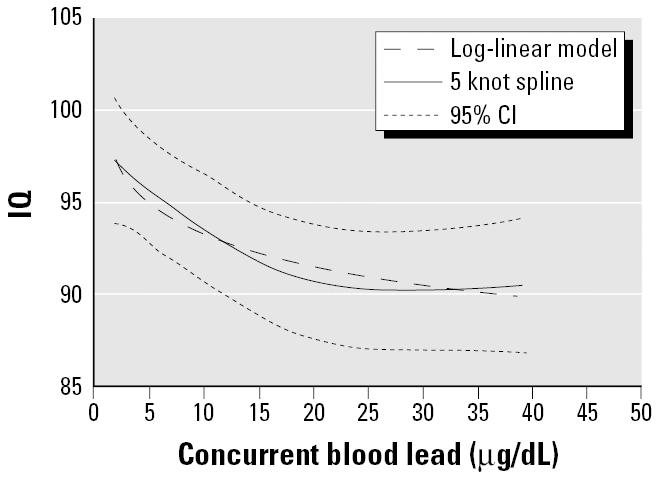
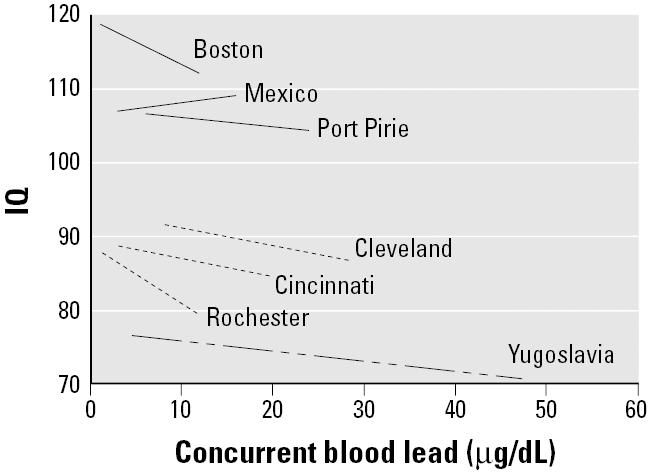
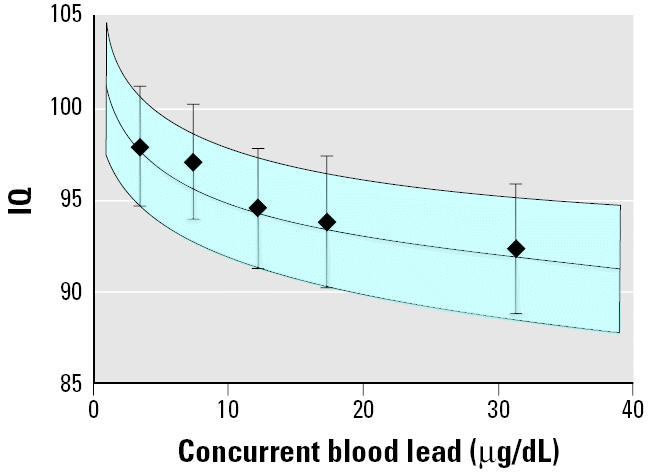
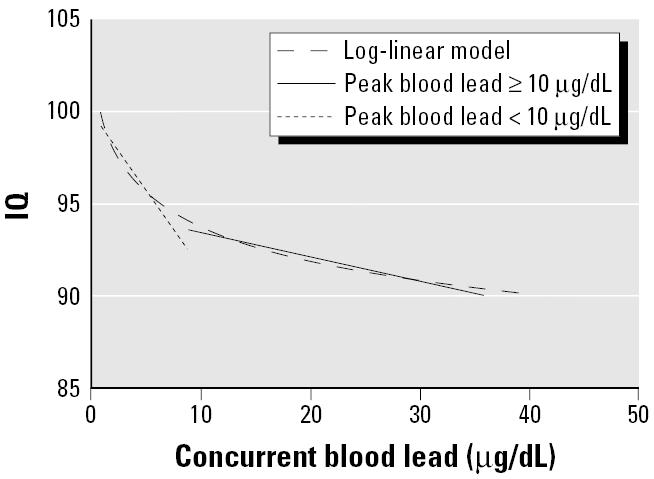
Lead is a confirmed neurotoxin, but questions remain about lead-associated intellectual deficits at blood lead levels < 10 μg/dL and whether lower exposures are, for a given change in exposure, associated with greater deficits. The objective of this study was to examine the association of intelligence test scores and blood lead concentration, especially for children who had maximal measured blood lead levels < 10 μg/dL. We examined data collected from 1,333 children who participated in seven international population-based longitudinal cohort studies, followed from birth or infancy until 5–10 years of age. The full-scale IQ score was the primary outcome measure. The geometric mean blood lead concentration of the children peaked at 17.8 μg/dL and declined to 9.4 μg/dL by 5–7 years of age; 244 (18%) children had a maximal blood lead concentration < 10 μg/dL, and 103 (8%) had a maximal blood lead concentration < 7.5 μg/dL. After adjustment for covariates, we found an inverse relationship between blood lead concentration and IQ score. Using a log-linear model, we found a 6.9 IQ point decrement [95% confidence interval (CI), 4.2–9.4] associated with an increase in concurrent blood lead levels from 2.4 to 30 μg/dL. The estimated IQ point decrements associated with an increase in blood lead from 2.4 to 10 μg/dL, 10 to 20 μg/dL, and 20 to 30 μg/dL were 3.9 (95% CI, 2.4–5.3), 1.9 (95% CI, 1.2–2.6), and 1.1 (95% CI, 0.7–1.5), respectively. For a given increase in blood lead, the lead-associated intellectual decrement for children with a maximal blood lead level < 7.5 μg/dL was significantly greater than that observed for those with a maximal blood lead level ≥7.5 μg/dL (p = 0.015). We conclude that environmental lead exposure in children who have maximal blood lead levels < 7.5 μg/dL is associated with intellectual deficits.
Overview
The claims and statistics of this paper haven’t been checked yet.
Run the check — free, no account needed. It reads the open-access text and checks the sources it cites.
Integrity signals
Registry
Cites
Statistics
Figures
Verification
Claims the paper makes
The claims and statistics of this paper haven’t been checked yet.
Run the check — free, no account needed. It reads the open-access text and checks the sources it cites.
Claims other papers make about this one
Each is checked against this paper’s own text: does it say what the citing paper says it does?
The source backs part of the claim, not all of it — or backs it for a different population, condition or comparison.
In the citing paper
“Chandramouli, Ellis, and Emond (2009); Canfield et al. (2003); Lanphear et al. (2005); Nigg et al. (2010); and Wasserman et al. (1997) all document a significant correlation between lead levels less than 10 milograms per deciliter (ug/ml) during childhood and cognitive and behavioral outcomes including ADHD and hyperactivity.”
From Do Low Levels of Blood Lead Reduce Children's Future Test Scores? (2018) · cites this paper as Lanphear et al. (2005)
Experimental — accuracy not yet measured
Self-check
Percentages, sums and reported differences re-computed from the paper’s own numbers.
The self-check needs the paper’s full text.
Citations
Cites
An Introduction to the Bootstrap
Efron, B., & Tibshirani, R. J. (1994) · doi:10.1201/9780429246593 · Cited by 40,500
An Introduction to the Bootstrap
Efron, B., & Tibshirani, R. J. (1993) · doi:10.1007/978-1-4899-4541-9 · Cited by 21,230
Littell, R. C. (1996) · Medical Entomology and Zoology · Cited by 10,345
Regression Modeling Strategies
Harrell, F. E. (2001) · Springer series in statistics · doi:10.1007/978-1-4757-3462-1 · Cited by 9,270
Regression Diagnostics: Identifying Influential Data and Sources of Collinearity
Belsley, D. A., Kuh, E., & Welsch, R. E. (1980) · Wiley Series in Probability and Statistics · doi:10.1002/0471725153 · Cited by 7,297
Harrell (2015) · Springer Series in Statistics · doi:10.1007/978-3-319-19425-7 · Cited by 6,878
Home Observation for Measurement of the Environment-21
Lansford, J. E., Odgers, C. L., Bradley, R. H., Godwin, J. W., Copeland, W., Rothenberg, W. A., & Dodge, K. A. (2022) · PsycTESTS Dataset · doi:10.1037/t86918-000 · Cited by 2,249
Intellectual Impairment in Children with Blood Lead Concentrations below 10 μg per Deciliter
Canfield, R. L., Henderson, C. R., Cory-Slechta, D. A., Cox, C., Jusko, T. A., & Lanphear, B. P. (2003) · New England Journal of Medicine · doi:10.1056/nejmoa022848 · Cited by 2,081
Self-citationLead neurotoxicity in children: basic mechanisms and clinical correlates
Lidsky, T. I., & Schneider, J. S. (2002) · Brain · doi:10.1093/brain/awg014 · Cited by 1,169
The Long-Term Effects of Exposure to Low Doses of Lead in Childhood
Needleman, H. L., Schell, A., Bellinger, D. C., Leviton, A., & Allred, E. N. (1990) · New England Journal of Medicine · doi:10.1056/nejm199001113220203 · Cited by 1,156
Self-citationLanphear, B. P. (2000) · Public Health Reports · doi:10.1093/phr/115.6.521 · Cited by 877
Self-citationLongitudinal Analyses of Prenatal and Postnatal Lead Exposure and Early Cognitive Development
Bellinger, D. C., Leviton, A., WATERNAUX, C. M., Needleman, H. L., & Rabinowitz, M. B. (1987) · New England Journal of Medicine · doi:10.1056/nejm198704233161701 · Cited by 855
Self-citationLow-Level Lead Exposure and the IQ of Children
Needleman, H. L. (1990) · JAMA · doi:10.1001/jama.263.5.673 · Cited by 677
Self-citationLow-Level Lead Exposure, Intelligence and Academic Achievement: A Long-term Follow-up Study
Bellinger, D. C., Stiles, K. M., & Needleman, H. L. (1992) · Pediatrics · doi:10.1542/peds.90.6.855 · Cited by 676
Self-citationLow-Level Lead Exposure and Children′s IQ: A Metaanalysis and Search for a Threshold
Schwartz, J. D. (1994) · Environmental Research · doi:10.1006/enrs.1994.1020 · Cited by 652
Absorption and Retention of Lead by Infants
Ziegler, E. E., Edwards, B. B., Jensen, R. L., Mahaffey, K. R., & Fomon, S. J. (1978) · Pediatric Research · doi:10.1203/00006450-197801000-00008 · Cited by 563
Environmental Exposure to Lead and Children's Intelligence at the Age of Seven Years
Baghurst, P., McMichael, A. J., Wigg, N. R., Vimpani, G., Robertson, E. F., Roberts, R. J., & Tong, S. (1992) · New England Journal of Medicine · doi:10.1056/nejm199210293271805 · Cited by 511
Self-citationEarly exposure to lead and juvenile delinquency
Dietrich, K. N., Douglas, R. M., Succop, P., Berger, O. G., & Bornschein, R. L. (2001) · Neurotoxicology and Teratology · doi:10.1016/s0892-0362(01)00184-2 · Cited by 461
Self-citationPicomolar concentrations of lead stimulate brain protein kinase C
Markovac, J., & Goldstein, G. W. (1988) · Nature · doi:10.1038/334071a0 · Cited by 440
Roper, W. L., Houk, V. N., Falk, H., & Binder, S. (1991) · OSTI OAI (U.S. Department of Energy Office of Scientific and Technical Information) · Cited by 437
Environmental lead and children's intelligence: a systematic review of the epidemiological evidence
Pocock, S., SMITH, M. A., & Baghurst, P. (1994) · BMJ · doi:10.1136/bmj.309.6963.1189 · Cited by 421
Self-citationBone lead levels in adjudicated delinquents
Needleman, H. L., McFarland, C. E., Ness, R. B., Fienberg, S. E., & Tobin, M. J. (2002) · Neurotoxicology and Teratology · doi:10.1016/s0892-0362(02)00269-6 · Cited by 405
Self-citationMeasuring Lead Exposure in Infants, Children, and Other Sensitive Populations
National Research Council (1993) · National Academies Press eBooks · doi:10.17226/2232 · Cited by 356
Environmental Lead Exposure and Progression of Chronic Renal Diseases in Patients without Diabetes
Lin, J., Lin‐Tan, D., Hsu, K., & Yu, C. (2003) · New England Journal of Medicine · doi:10.1056/nejmoa021672 · Cited by 285
Dietrich, K. N., Berger, O. G., Succop, P., Hammond, P. B., & Bornschein, R. L. (1993) · Neurotoxicology and Teratology · doi:10.1016/0892-0362(93)90043-n · Cited by 279
Self-citationINFLUENCE OF BLOOD LEAD ON THE ABILITY AND ATTAINMENT OF CHILDREN IN EDINBURGH
Fulton, M., Thomson, G. O. B., Hunter, R., RAAB, G. M., LAXEN, D. P. H., & Hepburn, W. (1987) · The Lancet · doi:10.1016/s0140-6736(87)92683-3 · Cited by 272
Environmental lead exposure during early childhood
Lanphear, B. P., Hornung, R., Ho, M. L., Howard, C. R., Eberly, S. W., & Knauf, K. (2002) · The Journal of Pediatrics · doi:10.1067/mpd.2002.120513 · Cited by 252
Self-citationBlood Lead Levels Measured Prospectively and Risk of Spontaneous Abortion
Borja‐Aburto, V. H., Hertz‐Picciotto, I., Lopez, M. R., Farías, P., Rı́os, C., & Blanco, J. (1999) · American Journal of Epidemiology · doi:10.1093/oxfordjournals.aje.a010057 · Cited by 251
Blood Lead, Blood Pressure, and Hypertension in Perimenopausal and Postmenopausal Women
Nash, D., Magder, L. S., Lustberg, M. E., Sherwin, R. W., Rubin, R. J., Kaufmann, R. B., & Silbergeld, E. K. (2003) · JAMA · doi:10.1001/jama.289.12.1523 · Cited by 248
Intellectual Impairment and Blood Lead Levels
Bellinger, D. C., & Needleman, H. L. (2003) · New England Journal of Medicine · doi:10.1056/nejm200307313490515 · Cited by 229
Self-citationYule, W., Lansdown, R., Millar, I. B., & Urbanowicz, M. (1981) · Developmental Medicine & Child Neurology · doi:10.1111/j.1469-8749.1981.tb02038.x · Cited by 225
The Long-Term Effects of Exposure to Low Doses of Lead in Childhood
(1991) · New England Journal of Medicine · doi:10.1056/nejm199102073240612 · Cited by 219
Environmental Health Criteria 165—Inorganic Lead
Coakley, J. C. (1997) · Pathology · doi:10.1016/s0031-3025(16)35080-2 · Cited by 216
Low-level lead exposure and the IQ of children. A meta-analysis of modern studies.
Needleman, H. L., & Gatsonis, C. A. (1990) · PubMed · Cited by 201
Self-citationLead Exposure and Intelligence in 7-Year-Old Children: The Yugoslavia Prospective Study
Wasserman, G. A., Liu, X., Lolacono, N. J., Factor-Litvak, P. R., Kline, J. K., Popovać, D., Morina, N., Musabegovic, A., Vrenezi, N., Capuni-Paracka, S., et al. (1997) · Environmental Health Perspectives · doi:10.1289/ehp.97105956 · Cited by 163
Self-citationLead and Minor Hearing Impairment
Schwartz, J. D., & Otto, D. A. (1991) · Archives of Environmental Health An International Journal · doi:10.1080/00039896.1991.9934391 · Cited by 149
Natural skeletal levels of lead in Homo sapiens sapiens uncontaminated by technological lead
Patterson, C. C., Ericson, J. E., Manea-Krichten, M., & Shirahata, H. (1991) · The Science of The Total Environment · doi:10.1016/0048-9697(91)90260-l · Cited by 136
Association of Dental Caries and Blood Lead Levels
Moss, M. E. (1999) · JAMA · doi:10.1001/jama.281.24.2294 · Cited by 133
Ernhart, C. B., Morrow‐Tlucak, M., Wolf, A. W., Super, D. M., & Drotar, D. (1989) · Neurotoxicology and Teratology · doi:10.1016/0892-0362(89)90055-x · Cited by 122
The Yugoslavia Prospective Study of Environmental Lead Exposure
Factor-Litvak, P. R., Wasserman, G. A., Kline, J. K., & Graziano, J. N. (1999) · Environmental Health Perspectives · doi:10.1289/ehp.991079 · Cited by 122
Self-citationClark, C. S., Bornschein, R. L., Succop, P., Hee, S. S. Q., Hammond, P. B., & Peace, B. E. (1985) · Environmental Research · doi:10.1016/0013-9351(85)90071-4 · Cited by 119
Self-citationExposure to Lead in Children — How Low Is Low Enough?
Rogan, W. J., & Ware, J. H. (2003) · New England Journal of Medicine · doi:10.1056/nejmp030025 · Cited by 118
The Paradox of Lead Poisoning Prevention
Lanphear, B. P. (1998) · Science · doi:10.1126/science.281.5383.1617 · Cited by 103
Self-citationCognitive and Sensorimotor Functions in 6-Year-Old Children in Relation to Lead and Mercury Levels
Walkowiak, J., Altmann, L., Krämer, U., Sveinsson, K., Turfeld, M., Weishoff-Houben, M., & Winneke, G. (1998) · Neurotoxicology and Teratology · doi:10.1016/s0892-0362(98)00010-5 · Cited by 98
Dc, R. (1993) · PubMed · Cited by 95
Low-Level Lead Exposure and Cognitive Function in Children
Bellinger, D. C., & Dietrich, K. N. (1994) · Pediatric Annals · doi:10.3928/0090-4481-19941101-08 · Cited by 95
Self-citationTong, S., & Lu, Y. (2001) · Annals of Epidemiology · doi:10.1016/s1047-2797(00)00176-9 · Cited by 89
Cory-Slechta, D. A. (1997) · PubMed · Cited by 76
Schnaas, L., Rothenberg, S. J., Perroni, E., Martı́nez, S., Hernández, C., & Hernández, R. M. A. (2000) · Neurotoxicology and Teratology · doi:10.1016/s0892-0362(00)00101-x · Cited by 63
Self-citationLOW‐LEVEL EXPOSURES TO LEAD; THE SYDNEY LEAD STUDY
Cooney, G. H., Bell, A., McBride, W. G., & Carter, C. J. (1989) · Developmental Medicine & Child Neurology · doi:10.1111/j.1469-8749.1989.tb04050.x · Cited by 62
Schneider, J. S., Huang, F., & Vemuri, M. C. (2003) · Neurotoxicology and Teratology · doi:10.1016/s0892-0362(03)00018-7 · Cited by 34
Primary Prevention of Childhood Lead Poisoning — The Only Solution
Rosen, J. F., & Mushak, P. (2001) · New England Journal of Medicine · doi:10.1056/nejm200105103441910 · Cited by 34
Invited Commentary: Studies in Mechanism and Prevention: Striking a Proper Balance
Wynder, E. L. (1994) · American Journal of Epidemiology · doi:10.1093/oxfordjournals.aje.a117045 · Cited by 28
Cited by
Sorted by citations
Lim, S. S., Vos, T., Flaxman, A. D., Danaei, G., Shibuya, K., Adair-Rohani, H., AlMazroa, M. A., Amann, M., Anderson, H. R., Andrews, K. G., et al. (2012) · The Lancet · doi:10.1016/s0140-6736(12)61766-8 · Cited by 11,805
The Lancet Commission on pollution and health
Landrigan, P. J., Fuller, R., Acosta, N. J. R., Adeyi, O., Arnold, R., Basu, N. (., Baldé, A. B., Bertollini, R., Bose-O'Reilly, S., Boufford, J. I., et al. (2018) · The Lancet · doi:10.1016/s0140-6736(17)32345-0 · Cited by 4,929
Self-citationChild development: risk factors for adverse outcomes in developing countries
Walker, S. P., Wachs, T. D., Meeks Gardner, J., Lozoff, B., Wasserman, G. A., Pollitt, E., & Carter, J. A. (2007) · The Lancet · doi:10.1016/s0140-6736(07)60076-2 · Cited by 2,133
Self-citationDevelopmental neurotoxicity of industrial chemicals
Grandjean, P., & Landrigan, P. (2006) · The Lancet · doi:10.1016/s0140-6736(06)69665-7 · Cited by 1,984
Neurobehavioural effects of developmental toxicity
Grandjean, P., & Landrigan, P. J. (2014) · The Lancet Neurology · doi:10.1016/s1474-4422(13)70278-3 · Cited by 1,886
Metadata
- Authors
- Lanphear, B. P., Hornung, R., Khoury, J., Yolton, K., Baghurst, P., Bellinger, D. C., Canfield, R. L., Dietrich, K. N., Bornschein, R., Greene, T., Rothenberg, S. J., Needleman, H. L., Schnaas, L., Wasserman, G., Graziano, J., & Roberts, R.
- Affiliations
- Cincinnati Children's Hospital Medical Center (US)
- Women's and Children's Hospital (AU)
- Boston Children's Hospital (US)
- Cornell University (US)
- University of Cincinnati (US)
- Cleveland Clinic (US)
- Instituto Nacional de Salud Pública (MX)
- University of Pittsburgh (US)
- Instituto Nacional de Perinatología (MX)
- Columbia University (US)
- Griffith University (AU)
- ORCID
- Venue
- Environmental Health Perspectives
- Publisher
- American Chemical Society (ACS)
- Published
- 2005-03-18
- Volume
- 113
- Issue
- 7
- Pages
- 894-899
- ISSN
- 0091-6765 (ISSN-L)
- 1552-9924
- PMC
- PMC1257652
- OpenAlex
- W2126489758
- Cited by
- 2,205
- References
- 54
- Citations by year
- 2026: 112 · 2025: 83 · 2024: 95 · 2023: 77 · 2022: 131 · 2021: 112 · 2020: 125 · 2019: 132 · 2018: 114 · 2017: 128 · 2016: 108 · 2015: 110 · 2014: 131 · 2013: 133 · 2012: 111
- FWCI
- 49.30
- Type
- journal article
- Language
- en
- Open access
- gold
- doi.org
- Locations
- Environmental Health Perspectives (publishedVersion, cc-by)
- Europe PMC (PubMed Central) (publishedVersion, public-domain)
- Europe PMC (PubMed Central) (publishedVersion)
- PubMed Central (publishedVersion, public-domain)
- PubMed Central (publishedVersion)
- PubMed (publishedVersion)
- Digital Access to Scholarship at Harvard (DASH) (Harvard University) (submittedVersion, cc-by)
- Adelaide Research & Scholarship (AR&S) (University of Adelaide) (submittedVersion, other-oa)
- Griffith Research Online (submittedVersion)
- Topics
- Physical Sciences › Environmental Science › Health, Toxicology and Mutagenesis › Heavy Metal Exposure and Toxicity
- Physical Sciences › Environmental Science › Pollution › Heavy metals in environment
- Physical Sciences › Environmental Science › Health, Toxicology and Mutagenesis › Mercury impact and mitigation studies
- Keywords
- lead exposure, blood lead levels, child intelligence, IQ, neurotoxicity, low-level lead exposure, dose-response relationship, children, environmental lead
- MeSH terms
- Child, Child, Preschool, Environmental Exposure, Female, Humans, Infant, Infant, Newborn, Intelligence, Intelligence Tests, Lead, Longitudinal Studies, Male, Cohort Studies
About these checks
Registry, retraction, Cites and statistics results are computed, not judged, with one exception: a printed reference that no index lists is read once by a model before it counts as a citation error. Claims are extracted by a model and kept only when their quote appears verbatim in the text; each cited source is then checked, with a model’s help, for whether it says what the claim relies on. Those verdicts can be wrong — read the claim’s quote and the cited source before relying on one.
Statistics and arithmetic are recomputed, not judged.
Confidence bands are shown only for fields calibrated on our annotated test set. None is calibrated yet, so no band is shown.
What counts as a claim ›How we measure confidence ›How we check this ›
Are you an author, or do you see a problem with this page? Request a review
